

These 20 Best Replies to “Grow Up”: That Are Funny and Confident help you answer criticism with humor, calm, and self-respect. When someone tells you to grow up, remember that you don’t have to change your personality just to make others happy. Being yourself is perfectly fine even when someone questions your behavior or opinion.
Sometimes, people use this insult to dismiss your feelings or make you feel there’s something wrong with you. Such comments can be annoying, especially when someone suggests you’re not very mature. However, growing up doesn’t mean giving up everything you enjoy or changing who you are to please others.
True maturity comes from understanding when a harmless joke is appropriate and when a serious argument needs attention. It also means knowing when to laugh, speak up, or walk away. These simple choices can prevent an awkward moment from turning into a bigger problem.
If you’re struggling to find a response or have no response when someone says “Grow up,” a clever comeback can make things easier. These ten ways and other best replies offer plenty of humor and confidence for different situations. A little wit can turn an uncomfortable exchange into a funny moment.
Whether you’re chatting with friends, coworkers, or strangers online, the right words can help you stand your ground without creating unnecessary disagreements. A witty line can keep the conversation light and make everyone laugh. You don’t always need a long explanation to show that you’re comfortable with yourself.
However, some situations require a calm, respectful response, especially during professional conversations. Choose replies that make you feel comfortable, protect your boundaries, and help you express your feelings. You can also remind others that being an adult doesn’t mean taking life too seriously. After all, maturity and enjoying life can go hand in hand.
Quick Answer
The best reply to “Grow up” depends on the tone behind it. For a funny response, try “I tried. It was boring.” For a clever reply, say “Define ‘grown-up’ for me.” If someone genuinely criticizes your behavior, “What exactly do you think I need to change?” keeps the conversation productive. When someone becomes disrespectful, “You can disagree with me without making it personal” sets a clear boundary.
The strongest comeback isn’t always the funniest one. Sometimes the smartest response is short, calm, and impossible to argue with.
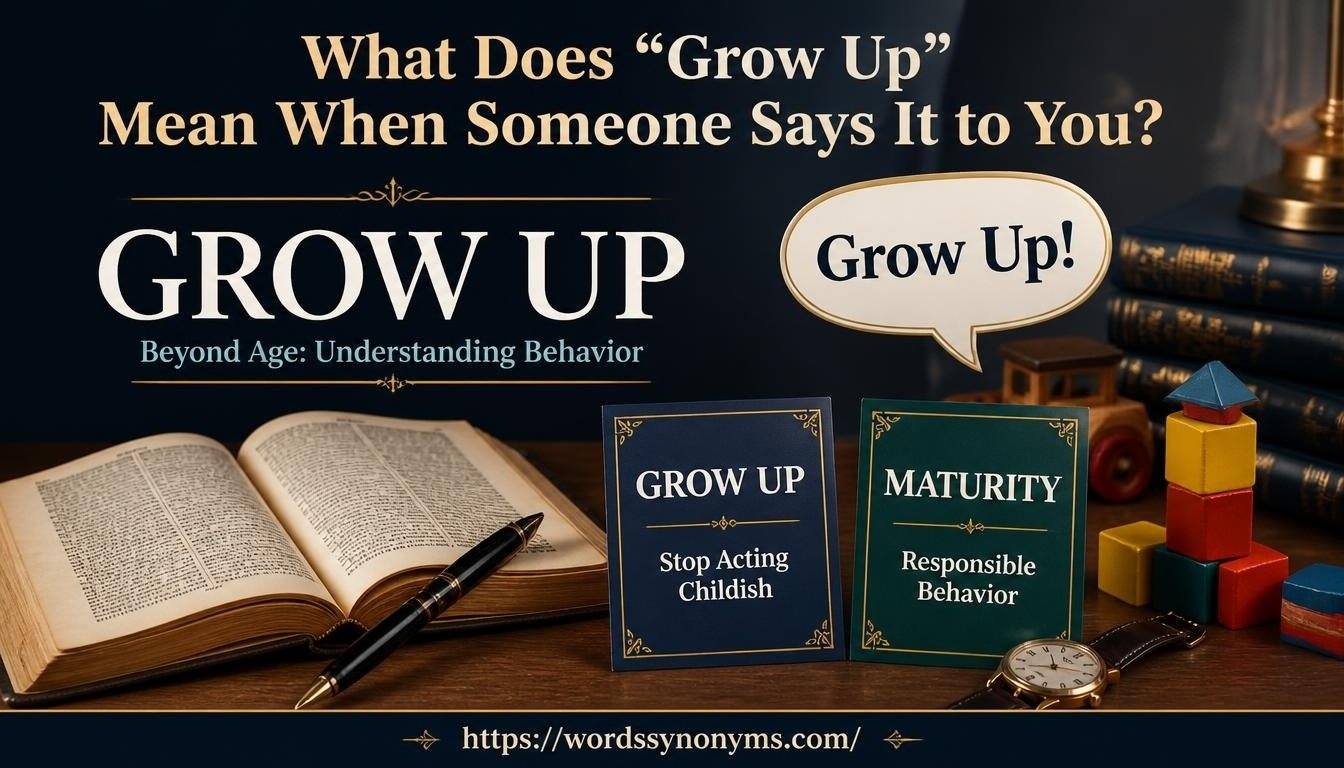
What Does “Grow Up” Mean When Someone Says It to You?
The phrase “grow up” has a straightforward meaning when you talk about age. A child grows up and gradually becomes an adult.
However, conversations often use the expression differently. When someone tells an adult to “grow up,” they usually criticize that person’s behavior. They may believe the person is acting childish, unreasonable, overly emotional, irresponsible, or silly.
That distinction matters because the same two words can carry very different intentions.
For example, imagine two friends joking about an embarrassing childhood story.
“You still laugh about that? Grow up!”
That comment might be playful. The speaker may not genuinely criticize the friend’s maturity.
Now imagine someone dismissing a serious disagreement by saying:
“Oh, just grow up.”
That version sounds more hostile. Instead of explaining their position, the speaker uses “grow up” as a judgment.
The phrase can therefore function as advice, teasing, criticism, dismissal, or an insult.
A useful way to interpret it is to look at what happened immediately before the comment.
| Situation | Likely meaning |
| Friends are joking | Playful teasing |
| Someone dislikes your behavior | Criticism |
| You’re arguing about an issue | Dismissive criticism |
| Someone refuses to explain themselves | Conversation shutdown |
| Someone wants you to take responsibility | Genuine concern |
| Someone wants to provoke you | Insult or bait |
The Oxford Learner’s Dictionary similarly identifies “grow up” as both becoming an adult and telling someone to stop behaving in a silly way.
That second meaning explains why the phrase can feel irritating. It criticizes your maturity without necessarily explaining what you did wrong.
20 Best Replies to “Grow Up”
A good response doesn’t need to sound vicious. In fact, confidence usually lands better than aggression.
Choose your reply based on the relationship, the setting, and the reason behind the comment.
1. “I Grew Up. I Just Kept My Sense of Humor.”
This is one of the best clever replies to “grow up” when someone mistakes playfulness for immaturity.
Growing older doesn’t mean abandoning humor. Adults can joke, laugh, play games, enjoy hobbies, and still handle serious responsibilities.
The comeback works because it challenges the assumption without launching a personal attack.
Best for: Friends, casual conversations, playful criticism.
Example:
“You need to grow up.”
“I grew up. I just kept my sense of humor.”
Short. Confident. No unnecessary drama.
2. “I Tried. It Was Boring.”
Sometimes the simplest comeback wins.
“I tried. It was boring.” turns the criticism into a joke. The response doesn’t attempt to prove anything. Instead, it exaggerates the idea that adulthood requires constant seriousness.
Use this one when the situation feels lighthearted.
If someone is genuinely upset, however, this response could sound dismissive. Context matters.
Best for: Friends, siblings, playful banter, casual teasing.
3. “Define ‘Grown-Up’ for Me.”
This response takes a vague criticism and asks for specifics.
What exactly does the other person mean by “grow up”?
Do they mean you should apologize? Take responsibility? Stop joking? Change a specific behavior?
The question forces the speaker to explain their criticism instead of hiding behind a broad phrase.
Best for: Arguments, disagreements, vague criticism.
It also works because maturity doesn’t have one universal definition. Paying bills and handling responsibilities matter. So do emotional control, accountability, respect, and sound judgment.
4. “I’m Growing at My Own Pace.”
Not every situation needs a sarcastic comeback.
This response works when someone compares your behavior, career, lifestyle, relationships, or personal progress with their expectations.
You don’t have to pretend you’ve figured everything out. Personal growth rarely happens on a neat schedule.
Best for: Personal criticism and comparisons.
It also sounds self-aware without becoming defensive.
5. “Does Being Mature Mean I Can’t Have Fun?”
This question challenges a common assumption: that seriousness automatically equals maturity.
It doesn’t.
A mature person can understand when something requires seriousness. They can also know when a situation doesn’t.
That distinction makes this response especially useful when someone criticizes harmless joking or playful behavior.
Best for: Friends, family, social situations, and harmless teasing.
6. “I’m Mature Enough to Know When to Have Fun.”
This version turns the previous idea into a confident statement.
You aren’t denying responsibility. You’re saying that maturity includes judgment.
Knowing when to work, when to listen, and when to laugh can all reflect good judgment.
Best for: Someone criticizing your personality rather than an actual harmful behavior.
7. “Thanks. I’ll Put That on My To-Do List.”
Dry humor can sometimes work better than a sharp insult.
This response treats the command “grow up” like an ordinary task someone assigned you.
The humor comes from the absurdity of scheduling something as vague as personal maturity.
Best for: Casual conversations where you don’t want a serious argument.
The tone matters. Say it lightly rather than with obvious hostility.
8. “I Grew Up. I Didn’t Become Boring.”
This response separates adulthood from personality.
1. You can become more responsible without becoming humorless.
2. You can learn from mistakes without losing curiosity.
3. You can take life seriously without taking every moment seriously.
That makes this one of the more memorable grow up comebacks.
Best for: Friends who think maturity means abandoning fun.
9. “I’m a Work in Progress.”
Sometimes the other person has a point.
Maybe you overreacted. Perhaps you handled a disagreement poorly. Or maybe you made a mistake and someone called you out.
Instead of becoming defensive, you can acknowledge that personal growth continues throughout life.
Best for: Genuine criticism.
It works especially well when you want to accept responsibility without accepting an unfair insult.
10. “What Exactly Do You Think I Need to Change?”
This is one of the strongest responses when the criticism has no details.
Rather than arguing about the word “mature,” ask for the actual issue.
If the person has a legitimate concern, they can explain it. If they don’t, the vague criticism loses much of its force.
Best for: Serious conversations and disagreements.
This response also moves the discussion toward something useful.
11. “Being Serious All the Time Isn’t Maturity.”
Maturity involves judgment rather than constant seriousness.
A person can behave responsibly while still being funny, enthusiastic, playful, or unconventional.
So if someone equates maturity with a permanently serious personality, this response makes the distinction clear.
Best for: Criticism based on personality or humor.
12. “I’ll Save My Serious Side for When It Matters.”
This reply carries a little more attitude while staying relatively clean.
It suggests that you understand the difference between important moments and harmless ones.
For example, joking with friends during lunch doesn’t require the same tone as discussing an important workplace problem.
Best for: Casual settings and friendly arguments.
13. “I Pay My Bills. Does That Count?”
This is a humorous way to point toward adult responsibility.
The joke works because “grow up” often implies that you haven’t accepted adult responsibilities.
Mentioning bills creates an immediate contrast.
Best for: Friends, relatives, and playful conversations.
It isn’t a serious philosophical argument. That’s exactly why it can work as a light comeback.
14. “You Say That Like Growing Up Is a Competition.”
This response works when someone compares your life with theirs.
Maybe they think you’re behind. Perhaps they believe their choices prove greater maturity.
But adulthood doesn’t come with a scoreboard.
People take different paths. They reach milestones at different times. They also define success differently.
Best for: Comparisons and unsolicited judgments.
15. “We Clearly Have Different Ideas About Maturity.”
This is a calm response when the conversation has reached an impasse.
Instead of saying the other person is immature, you acknowledge the disagreement.
That subtle difference matters.
Calling someone immature usually escalates the argument. Saying you have different ideas about maturity leaves room for disagreement without adding another insult.
Best for: Heated conversations where you still want to remain respectful.
16. “You Can Disagree With Me Without Making It Personal.”
This response draws a clear boundary.
If someone uses “grow up” to dismiss your opinion rather than discuss it, you don’t have to accept that framing.
You can disagree with someone without attacking their character.
Best for: Arguments, workplace disagreements, online discussions, and repeated personal criticism.
It also redirects the conversation toward the actual issue.
17. “I’ll Take That Under Advisement.”
This understated response works beautifully when you don’t want an argument.
It acknowledges what the person said without agreeing with it.
1. There’s no counterattack.
2. There’s no lengthy explanation.
3. There’s simply a polite signal that you’ve heard the comment.
Best for: Workplaces, acquaintances, and situations where sarcasm could create unnecessary tension.
Sometimes a calm response has more bite than a loud one.
18. “Maybe. But I’m Having Fun Along the Way.”
This cheerful response works especially well when someone criticizes harmless enthusiasm.
You aren’t claiming perfection. You’re simply refusing to treat fun as a character flaw.
Best for: Friends, family, hobbies, games, and casual conversations.
It keeps the mood light while protecting your confidence.
19. “If You Have a Point, Just Tell Me.”
This is one of the most practical responses to “grow up.”
It doesn’t attack the speaker. Instead, it asks them to communicate clearly.
If there’s a genuine issue, they now have an opportunity to explain it.
If there isn’t, the conversation may naturally end.
Best for: Arguments and serious disagreements.
Clear communication beats vague criticism almost every time.
20. “Okay. Let’s Move On.”
Not every situation deserves a clever comeback.
Sometimes the smartest response is simply to end the exchange.
This works particularly well when someone clearly wants to provoke you. Arguing over the phrase can turn a minor comment into a full-blown dispute.
Best for: Arguments, online exchanges, and conversations going nowhere.
Walking away from pointless conflict isn’t weakness. Sometimes it’s the most mature option available.
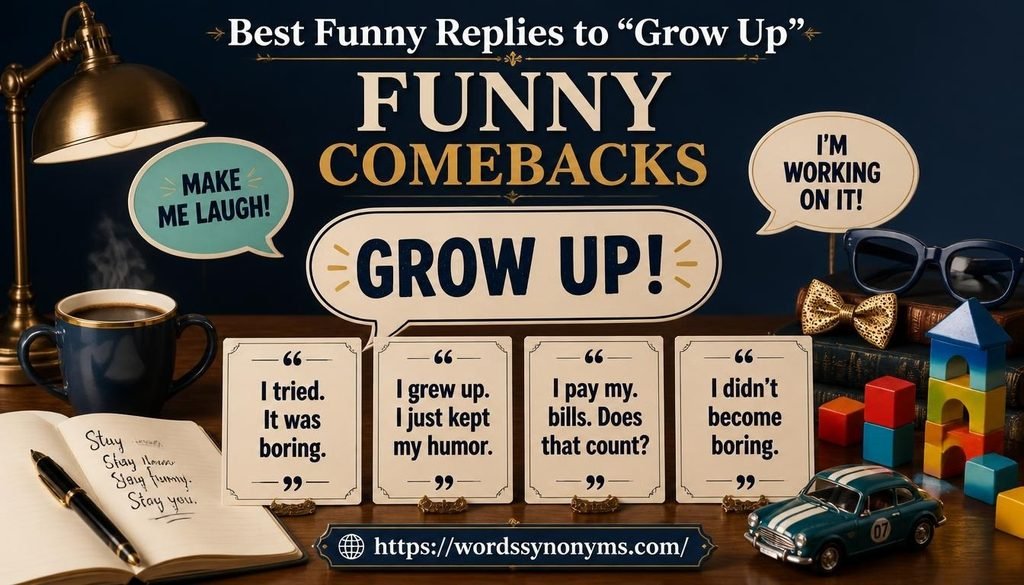
Best Funny Replies to “Grow Up”
If a friend says “grow up” while laughing, a playful comeback can keep the exchange enjoyable.
These responses work because they don’t turn harmless teasing into a personal battle.
Here are some of the better funny replies to “grow up”:
- “I tried. It was boring.”
- “I grew up. I just kept my sense of humor.”
- “I grew up. I didn’t become boring.”
- “Thanks. I’ll put that on my to-do list.”
- “Does being mature mean I can’t have fun?”
- “I pay my bills. Does that count?”
- “Maybe. But I’m having fun along the way.”
- “I’m saving my serious face for later.”
The key is knowing whether the other person is joking.
If they are smiling and teasing, humor can strengthen the interaction. If they’re angry, the same joke may sound dismissive.
Best Clever Replies to “Grow Up”
Clever responses don’t necessarily insult the other person. Instead, they expose a weak argument or ask for greater clarity.
Try these when someone uses “grow up” without explaining their criticism:
- “Define ‘grown-up’ for me.”
- “What exactly do you think I need to change?”
- “Being serious all the time isn’t maturity.”
- “You say that like growing up is a competition.”
- “If you have a point, just tell me.”
- “We clearly have different ideas about maturity.”
Questions can be especially effective here.
A vague criticism becomes much harder to defend once you ask for specifics. Instead of trading insults, you move the discussion toward actual behavior.
That shift often reveals whether the person has a legitimate concern or simply wants to win the exchange.
Read more: 27 Best Replies to “Good Morning”: Funny, Cute and Flirty
Best Mature Responses to “Grow Up”
A mature response doesn’t mean you have to sound stiff.
In fact, the strongest mature replies often sound surprisingly simple:
- “I’m a work in progress.”
- “I’m growing at my own pace.”
- “What exactly do you think I need to change?”
- “You can disagree with me without making it personal.”
- “If you have a point, just tell me.”
- “Okay. Let’s move on.”
These responses work because they separate behavior from identity.
Someone can criticize something you did without deciding what kind of person you are.
That distinction helps keep disagreements productive.
Best Replies When a Friend Says “Grow Up”
Friends often use “grow up” differently from strangers.
Between close friends, it might mean:
“Stop being ridiculous.”
It can also mean:
“You’re taking this joke too far.”
Or simply:
“I’m teasing you.”
Before choosing a comeback, read the room.
If your friend is clearly joking, try:
“I grew up. I just kept my sense of humor.”
If they’re genuinely annoyed, try:
“Okay, what did I do that bothered you?”
If the disagreement has become personal, use:
“You can disagree with me without making it personal.”
The goal isn’t always to deliver the most devastating line. With friends, preserving the relationship usually matters more than winning one exchange.
Best Replies When Someone Is Trying to Insult You
When someone deliberately uses “grow up” as an insult, returning an even harsher insult can create a pointless cycle.
One person attacks. The other responds. The first person escalates. Suddenly, nobody remembers what started the argument.
Instead, use a response that puts the burden back on the speaker.
Good choices include:
- “What exactly do you mean?”
- “If you have a specific point, make it.”
- “You can disagree without making it personal.”
- “That’s your opinion.”
- “Let’s keep this respectful.”
- “Okay. Let’s move on.”
These lines don’t reward provocation with emotional fireworks.
That can make them surprisingly effective.

Best Replies to “Grow Up” at Work
Workplaces require more restraint.
A sarcastic comeback that works with your best friend could sound unprofessional in a meeting. Even when someone speaks rudely, your response should usually focus on the issue.
Consider these alternatives:
“Could you clarify what you mean?”
“If there’s an issue with my work, let’s discuss it.”
“What specifically would you like me to change?”
“Let’s keep the conversation respectful.”
“We clearly have different views on this.”
These responses do something important. They move the discussion away from personality and toward specific behavior or performance.
For example, if a coworker says:
“Grow up. You can’t handle criticism.”
A productive answer might be:
“If you have feedback about my work, please tell me specifically what needs improvement.”
That’s much stronger than responding with another insult.
Best Replies to “Grow Up” in a Text or Online Argument
Text changes how people interpret language.
Without facial expressions, vocal tone, or body language, a short sentence can sound harsher than intended.
Online arguments also tend to spiral because people can respond instantly without much reflection.
For that reason, short replies often work best.
Try:
- “If you have a specific point, make it.”
- “We clearly disagree.”
- “That’s your opinion.”
- “I’m not interested in trading insults.”
- “Let’s move on.”
- “What exactly do you mean?”
Don’t feel pressured to answer every insult.
An online argument isn’t a debate tournament. Nobody awards points for producing the final comeback.
How to Choose the Right Reply to “Grow Up”
The right answer depends more on context than cleverness.
| Situation | Best approach | Example |
| Friend is teasing you | Funny | “I tried. It was boring.” |
| Someone criticizes your personality | Confident | “I grew up. I just kept my sense of humor.” |
| Someone gives vague criticism | Ask for clarity | “What exactly do you mean?” |
| Someone compares your life with theirs | Push back calmly | “Growing up isn’t a competition.” |
| Someone raises a legitimate concern | Self-aware | “I’m a work in progress.” |
| Someone insults you | Set a boundary | “You can disagree without making it personal.” |
| Conversation becomes pointless | Disengage | “Okay. Let’s move on.” |
| Workplace disagreement | Stay professional | “Could you clarify what you mean?” |
| Online argument | Keep it short | “If you have a specific point, make it.” |
Think of your response as a tool.
You wouldn’t use a hammer for every repair. Likewise, you don’t need a sarcastic comeback for every criticism.
When You Shouldn’t Use a Comeback
A clever reply can feel satisfying. It isn’t always useful.
Suppose someone tells you to grow up after you break a promise. A sarcastic response won’t fix the broken promise.
Perhaps someone says it because you interrupted them repeatedly. In that case, the better response might be:
“You’re right. I should’ve let you finish.”
That’s not surrender. It’s accountability.
Maturity often means recognizing when criticism contains useful information.
A useful rule is simple:
If the person has identified a real problem, address the problem instead of attacking the wording.
However, you don’t have to accept unfair criticism either.
If someone uses a legitimate issue as an excuse to insult you, separate the two.
For example:
“I’ll address the issue you’re raising. However, there’s no need to make it personal.”
That response acknowledges the substance while rejecting the disrespect.
What Not to Say When Someone Tells You to “Grow Up”
Some comebacks may feel satisfying for five seconds. They can still make the situation worse.
Avoid responses that attack:
- Intelligence
- Appearance
- Family
- Age
- Personal insecurities
- Mental capacity
- Social status
- Private relationships
Threats are also a poor response.
So are endless rounds of profanity.
A personal insult rarely proves that you’re more mature than the person who criticized you. It simply changes the subject from the original disagreement to another insult.
The same problem applies to:
“Look who’s talking.”
That comeback may be accurate. It still doesn’t address the underlying issue.
If you want a response with more substance, ask:
“What specifically did I do that you think was immature?”
That question has nowhere near the same dramatic flair. It has something better: usefulness.
Funny vs. Mature Replies to “Grow Up”
Different situations call for different levels of attitude.
| Reply style | Best for | Main advantage | Main risk |
| Funny | Friends and teasing | Keeps things light | May seem dismissive |
| Clever | Vague criticism | Forces clarity | May sound sarcastic |
| Confident | Personal criticism | Protects your position | Can sound defensive |
| Mature | Genuine concerns | Encourages discussion | Less punchy |
| Firm | Disrespect | Sets boundaries | May end the conversation |
| Short | Arguments | Avoids escalation | Can sound cold |
The best response isn’t necessarily the one that sounds cleverest.
Instead, choose the response that produces the outcome you want.
Want to make your friend laugh? Use humor.
Want an explanation? Ask a question.
Want to stop an insult? Set a boundary.
Want to end the argument? Keep it short.
That’s far more effective than using the same comeback everywhere.
A Simple Formula for Creating Your Own Reply
You don’t always need a prepared line.
You can build a strong response using three simple steps.
Step 1: Identify the criticism
Ask yourself what “grow up” actually refers to.
1. Is the person criticizing your humor?
2. Your attitude?
3. Your behavior?
4. Your decision?
Step 2: Decide whether the criticism has merit
You don’t have to accept every accusation.
However, don’t reject useful feedback simply because you dislike the delivery.
Step 3: Match your response to the situation
Use this basic formula:
Light criticism → humor
Vague criticism → question
Legitimate concern → accountability
Personal attack → boundary
Pointless argument → disengagement
For example:
“Grow up.”
If it’s playful:
“I tried. It was boring.”
If it’s vague:
“What exactly do you mean?”
If it’s legitimate:
“Fair point. I could’ve handled that better.”
If it’s insulting:
“You can disagree without making it personal.”
If the conversation is pointless:
“Okay. Let’s move on.”
This approach gives you more flexibility than memorizing dozens of comebacks.
Case Study: When a Funny Reply Works
Imagine two longtime friends arguing about which movie to watch.
One friend picks an action movie. The other insists on a comedy.
After several minutes of joking, one says:
“Grow up. Just pick a movie.”
A sharp response could turn the joke into an argument.
Instead:
“I grew up. My movie standards didn’t.”
Both friends understand the playful tone.
The response works because the relationship and context support humor.
Now change the situation.
Suppose a manager tells an employee:
“Grow up and accept criticism.”
The same joke would be inappropriate.
The setting changed. The relationship changed. The consequences changed.
That’s why context matters more than having the perfect one-liner.
Case Study: When a Mature Reply Works Better
Imagine someone repeatedly interrupts during a discussion.
Another person finally says:
“Grow up. Let other people talk.”
The wording sounds rude. Yet the underlying complaint could be legitimate.
A defensive response might create another argument.
A better answer could be:
“Fair enough. I’ll let you finish.”
The person can then address the original disagreement without creating a second one.
That is a useful distinction:
You can reject someone’s delivery without rejecting valid feedback.
Case Study: When a Firm Boundary Works Best
Imagine you’re discussing a personal decision with someone who disagrees.
Instead of explaining their concern, they say:
“Grow up. You’re being ridiculous.”
At this point, the issue isn’t simply disagreement. The conversation has become personal.
A suitable response is:
“You can disagree with me without making it personal.”
That sentence doesn’t insult them.
It identifies the problem and establishes a boundary.
If they continue, ending the conversation may be wiser than producing another comeback.
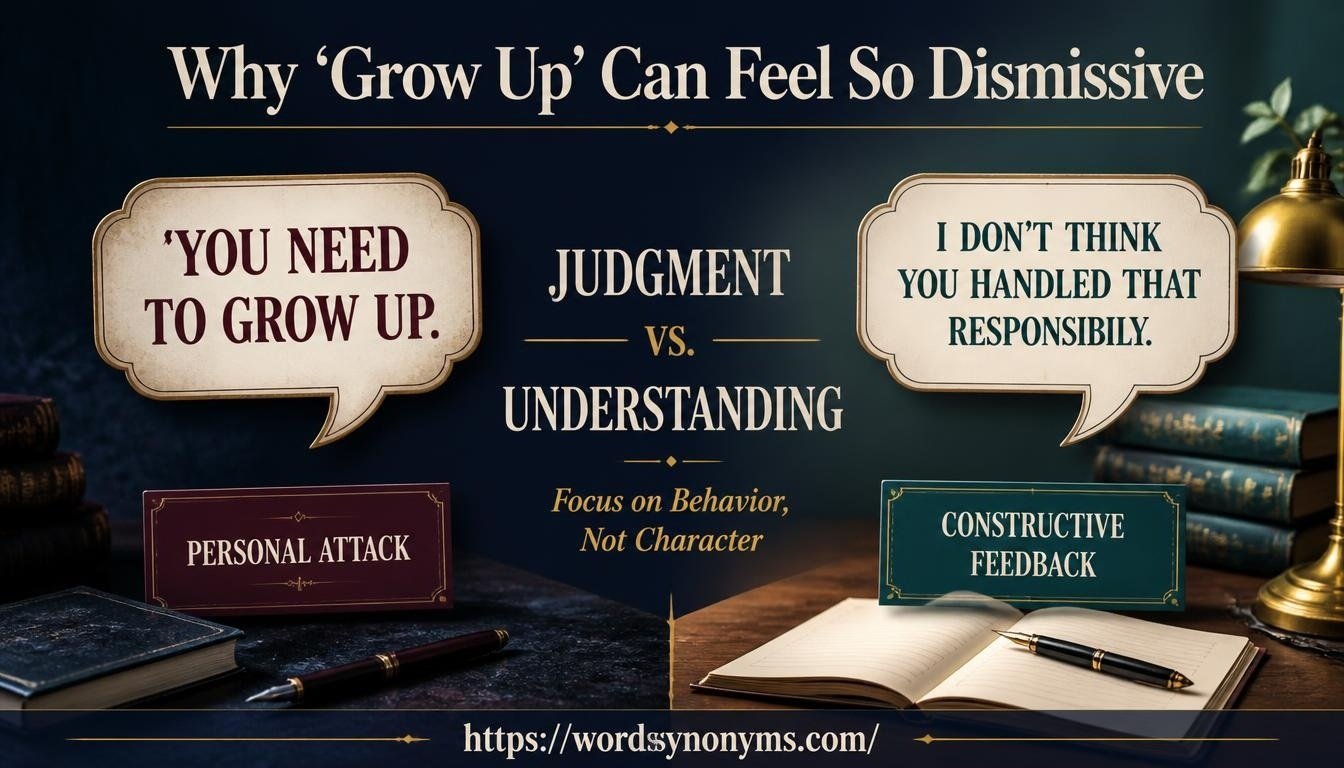
Why “Grow Up” Can Feel So Dismissive
The phrase doesn’t simply challenge a particular action.
It can imply that the entire person lacks maturity.
That’s why “grow up” sometimes feels more personal than:
“I disagree with what you did.”
The second statement targets behavior.
The first can sound like a judgment about character.
This difference matters during disagreements.
When you want to communicate effectively, focus on specific behavior whenever possible.
Compare these:
Personal:
“You need to grow up.”
Specific:
“I don’t think you handled that situation responsibly.”
The second statement gives the other person something concrete to discuss.
The first mainly delivers a verdict.
Read more: 35 Best Replies to “Good Night”: Sweet, Funny and Flirty
Is Saying “Grow Up” Disrespectful?
It can be.
The phrase isn’t automatically disrespectful because tone and context matter. Friends may use it playfully. Someone may also use it as a serious request for more responsible behavior.
However, the expression often carries disapproval when directed at another person.
If someone says “grow up” during an argument without explaining their concern, the phrase can sound dismissive or insulting.
The best way to judge it is to consider the surrounding conversation.
Ask:
- Was the comment playful?
- Did the speaker explain their concern?
- Were they responding to specific behavior?
- Did they use the phrase to end the discussion?
- Did their tone sound mocking or hostile?
Those clues usually reveal the intended meaning.
FAQs
1. What is the best response when someone tells you to grow up?
A good response is, “Growing up doesn’t mean losing my personality.” It sounds confident without being rude. It also reminds the other person that maturity doesn’t require you to stop having fun.
2. How do you respond to “Grow up” in a funny way?
Try saying, “I would, but being this fun is a full-time job!” A little humor can turn an uncomfortable comment into a laugh. Just make sure the joke fits the situation.
3. Is telling someone to grow up an insult?
It can be. People often use this phrase to criticize someone’s behavior or dismiss their feelings. However, the meaning depends on the tone and the situation.
4. How do you respond to “Grow up” without being rude?
Keep your answer short and respectful. You could say, “I understand your point, but I don’t think having fun makes me immature.” This lets you express yourself without starting an argument.
5. What should I say when a friend tells me to grow up?
You can keep things playful by saying, “I’ll grow up when you learn how to have fun!” If your friend genuinely bothers you, explain why the comment doesn’t feel good.
6. How do you respond when a coworker tells you to grow up?
Stay professional and avoid turning the exchange into a personal disagreement. You might say, “Let’s keep this conversation focused on the actual issue.” This response sets a boundary without creating unnecessary tension.
7. Does having fun mean you’re immature?
Not at all. Enjoying jokes, games, hobbies, or silly moments doesn’t make you immature. Real maturity involves responsibility, respect, and knowing when to take things seriously.
8. How do you respond to “Grow up” in a text message?
A short, witty reply works well in text conversations. Try, “I’m grown enough to know that having fun isn’t a crime!” It keeps your response confident without making the conversation unnecessarily serious.
9. Should I ignore someone who keeps telling me to grow up?
If someone repeatedly uses the phrase to provoke or upset you, ignoring them may be the best choice. You don’t have to defend every decision or explain your personality to everyone.
10. What does a mature response to “Grow up” look like?
A mature response shows confidence without insulting the other person. You can disagree politely, explain your feelings, or simply walk away. Sometimes, refusing to argue is the strongest comeback of all.
Conclusion
Being told to “grow up” doesn’t mean you have to change your personality or stop enjoying the little things in life. Sometimes, people use these words to criticize your choices without understanding your situation. The best response depends on who’s saying it and how they’re saying it. A funny comeback can break the tension among friends while a calm answer works better in serious conversations. What matters most is knowing when to laugh, when to speak up, and when someone simply doesn’t deserve your energy.
The 20 best replies to “grow up” give you plenty of ways to handle these comments with humor and confidence. You don’t need to prove your maturity through every conversation or win every disagreement. Be responsible, respect others, and never feel embarrassed about having a playful side. After all, growing older is automatic, but knowing how to enjoy life while respecting yourself and others is what real maturity looks like.

Ethan Parker writes about English grammar, sentence structure, punctuation, and everyday language rules. Through WordsSynonyms.com, he aims to make grammar easier to understand with simple explanations, practical examples, and helpful learning resources.



[…] Read more: 20 Best Replies to “Grow Up”: That Are Funny and Confident […]