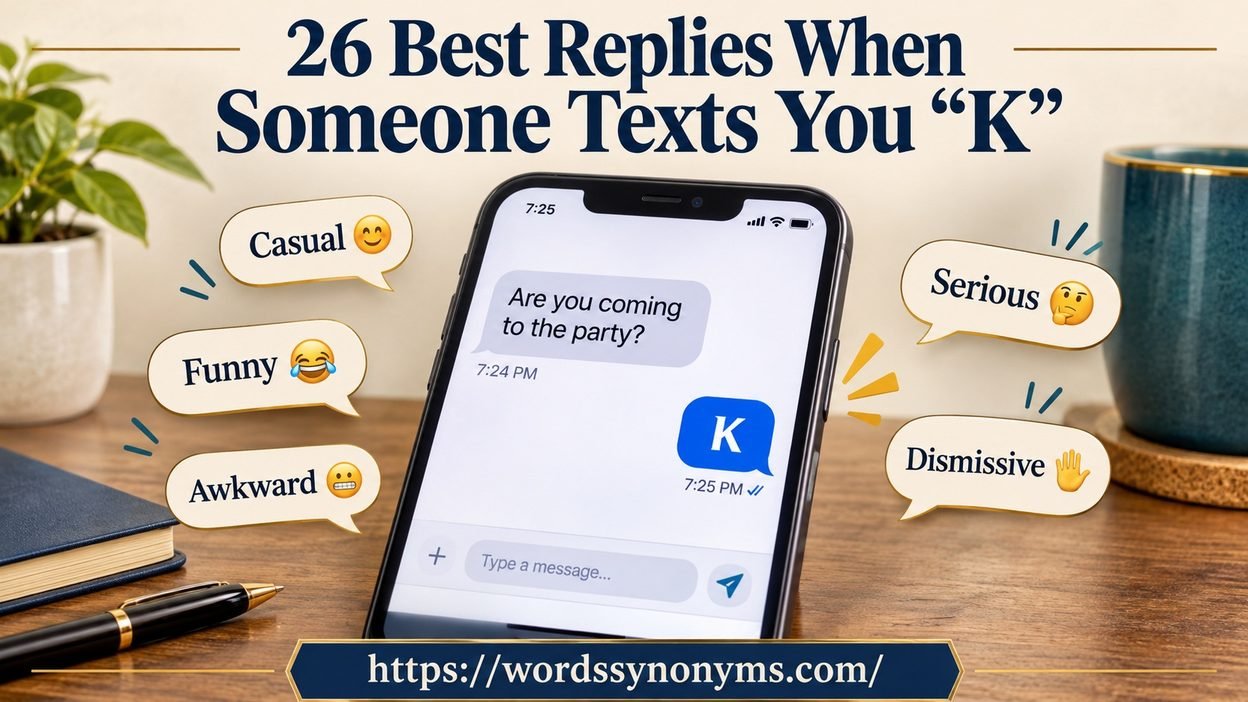
In this guide to 26 Best Replies When Someone Texts You “K”, you’ll learn what “k” means, why its tone matters, and how to choose a suitable reply.
It has happened to all of us at some point. You’re having a conversation with someone, either over text or through chat, when you receive the dreaded, conversation-killing response: “k”. It’s often hard to think of a way to respond or correctly respond. But don’t worry! Understanding its meaning makes communication easier.
The letter “k” is an abbreviation of OK. When a person is texting “k” or “k.”, they’re essentially texting “OK” to confirm something. It’s commonly used to mean OK, show that they agree, or indicate they’re responding to your message. However, the meaning isn’t always the same because context plays an important role.
For example, if you texted someone, “I’ll pick you up around 5,” it’s perfectly fine for them to text back “k” because they’re confirming the plan. There’s nothing left to be said and no reason to continue the conversation. In this situation, a short reply simply keeps things clear without unnecessary messages.
However, replying “k” to a long message or long paragraph containing multiple points you’re trying to make can feel dismissive. This short response may suggest that the person isn’t interested in continuing the discussion, whatever the reason. It can also make you wonder whether they understood everything you said.
In practice, this type of conversation ending can leave you wondering whether they’re clearly contributing anything meaningful. A lack of conversational contribution can make it seem like a rude response, especially when you expect thoughtful responses. That’s why it’s worth considering the situation before judging someone’s intentions.
Below, you’ll find 26 witty responses to help you handle this witty conversation stopper without making things awkward. Whether someone is being brief, uninterested, or simply confirming something, the right reply can keep your conversation going.
Quick Answer
The best response depends on the tone you want to create. If the conversation feels normal, keep your answer simple. If the “K” feels cold, ask what’s wrong instead of jumping to conclusions.
Here are some quick options:
- Casual: “Cool, sounds good.”
- Friendly: “Okay then 😄”
- Funny: “Wow, such a detailed response.”
- Playful: “K? That’s it? 😂”
- Concerned: “You good?”
- Direct: “Everything okay?”
- Confident: “Noted.”
- Mature: “If something’s bothering you, just tell me.”
- Conversation-ending: “No worries. Talk later.”
- Polite: “Alright, have a good one.”
If you aren’t sure what the sender means, don’t invent a story around one letter. Consider what came before it and how that person normally texts.
What Does “K” Mean in a Text?
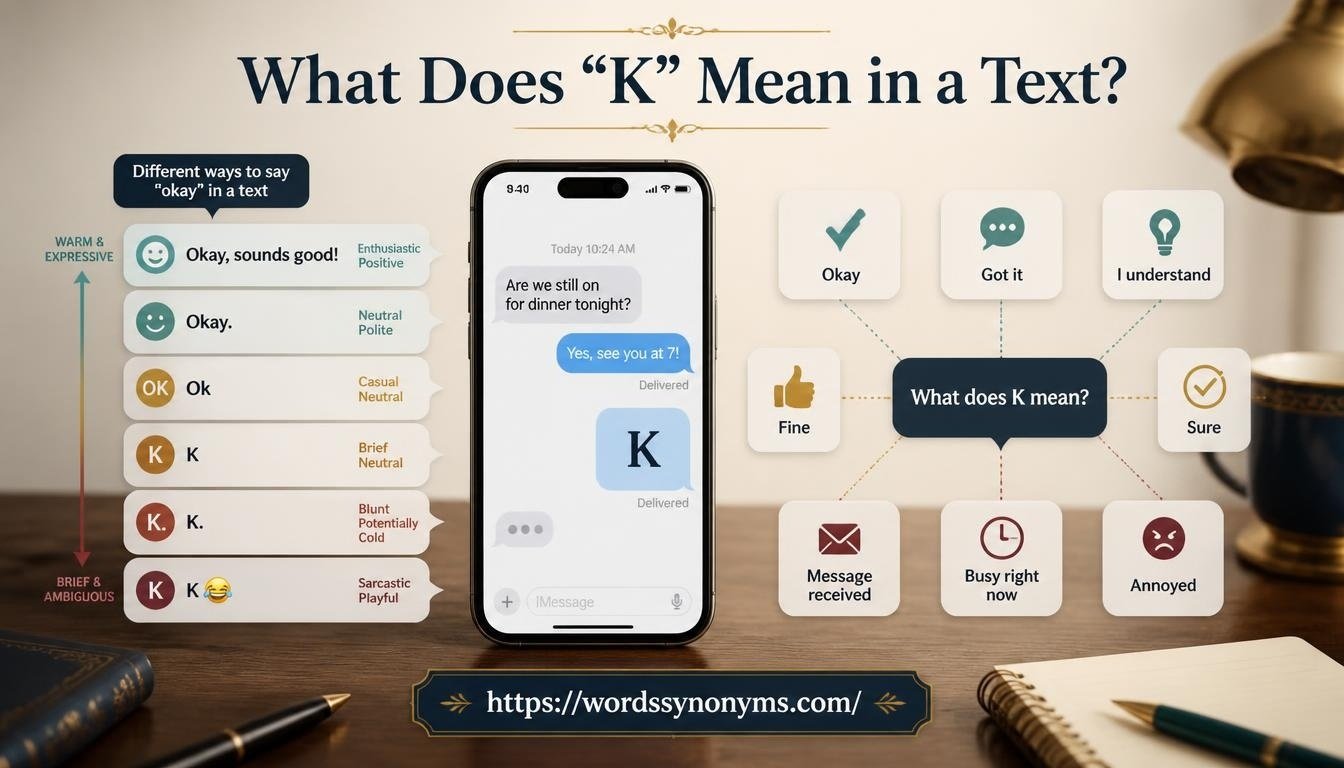
The most basic meaning of “K” in texting is “okay.” It can acknowledge information, confirm a plan, accept a request, or simply show that the person saw your message.
For example:
“I’ll meet you at 7.”
“K.”
In this situation, the sender may simply mean, “Okay, I understand.”
However, texting has one major limitation: you can’t hear the person’s voice. A spoken “okay” can sound warm, irritated, amused, distracted, or completely neutral. Text strips away those vocal clues.
That’s why a single “K” can feel ambiguous.
Consider these different messages:
- “Okay, sounds good!”
- “Okay.”
- “Ok”
- “K”
- “K.”
- “K 😂”
They all relate to the same basic idea. Yet each one can create a different impression.
The difference isn’t necessarily a secret code. Often, it’s simply the result of brevity, punctuation, texting habits, and context.
Common meanings of “K”
Depending on the situation, “K” can mean:
- Okay
- Got it
- I understand
- Fine
- Sure
- Message received
- I don’t have anything else to say
- I don’t want to continue this conversation
- I’m busy right now
- I’m annoyed
The last few possibilities explain why people often react strongly to a one-letter response.
Still, context matters more than the letter itself.
Read more: 23 Best Replies to “It Is What It Is”: Sarcastic Comebacks
Is “K” Rude or Passive-Aggressive?
“K” isn’t automatically rude or passive-aggressive. That’s one of the most important points to remember.
If someone always sends short texts, their “K” probably doesn’t carry much emotional weight. They may simply prefer brief messages.
On the other hand, a sudden “K” from someone who normally sends detailed or friendly replies can feel noticeably different.
For example:
You: “I’m really sorry about what happened earlier. I didn’t mean to upset you.”
Them: “K.”
That response may feel dismissive because the emotional weight of your message doesn’t match the brevity of theirs.
Now consider a different situation:
You: “The movie starts at 8.”
Them: “K.”
Here, there’s probably no reason to assume anger. The person may simply be confirming the time.
When “K” may sound cold
A one-letter response can feel dismissive when:
- You shared something emotional.
- You asked an important question.
- You apologized.
- You tried to resolve an argument.
- The person normally writes much more.
- The conversation already feels tense.
- They suddenly switched from warm messages to extremely short replies.
- They use punctuation that makes the response feel more final.
Even then, one message doesn’t prove someone’s mood.
A pattern tells you much more than a single text.

26 Best Replies When Someone Texts You “K”
The best response isn’t always the funniest one. Sometimes you want to keep things friendly. Other times, you need clarity. In some situations, the smartest move is simply to let the conversation end.
Here are 26 replies to “K” for different situations.
1. “Cool, sounds good.”
This is one of the safest replies when the conversation feels normal.
It doesn’t add unnecessary tension. It also doesn’t force the other person to keep talking.
Use it when you’ve already reached an agreement or confirmed plans.
Example:
“I’ll pick you up around 7.”
“K.”
“Cool, sounds good.”
Simple. Clean. No drama.
2. “Alright, we’re good.”
This response works well when you’ve just settled something.
Maybe you were discussing plans or clearing up a minor misunderstanding. Instead of dissecting the “K,” you can simply acknowledge the agreement.
It gives the conversation a natural sense of closure.
3. “Got it.”
If the person simply acknowledged information, “Got it” is an excellent match.
It doesn’t sound defensive or overly eager. More importantly, it doesn’t turn an ordinary exchange into a psychological investigation.
For example:
“The office moved the meeting to Friday.”
“K.”
“Got it.”
There’s nothing more to decode.
4. “Okay then 😄”
Want to keep things light?
Adding a little warmth can soften an otherwise dry exchange. The emoji makes the message feel more playful without demanding an explanation.
This works especially well with friends or people who already communicate casually.
5. “Perfect.”
Sometimes the conversation doesn’t need another paragraph.
If someone says “K” after confirming a plan, “Perfect” can keep things moving without making the exchange awkward.
For example:
“Dinner at 7?”
“K.”
“Perfect.”
It’s short and confident.
6. “Glad we’re on the same page.”
Use this when you have reached an understanding.
It works particularly well after discussing plans, expectations, or a small disagreement.
The phrase shifts attention away from the strange brevity of “K” and toward the agreement itself.
7. “Wow, such a detailed response.”
Now we’re getting playful.
This sarcastic reply works when you know the person well enough to understand each other’s humor.
The joke is obvious: “K” isn’t exactly a novel.
Still, be careful. Sarcasm can land badly if the person is already upset.
8. “K? That’s it? 😂”
This response directly calls attention to the tiny reply.
It works best when you expect the other person to laugh rather than become defensive.
For example:
“I finally finished that huge project.”
“K.”
“K? That’s it? 😂”
The humor gives them an easy opportunity to respond with something more substantial.
9. “Saving words today, huh?”
This is another lighthearted option.
It gently teases the person without accusing them of being angry.
You can use it when their unusually short response seems more funny than concerning.
The key is tone. A playful sentence can sound completely different depending on the relationship behind it.
10. “I’ll take that as a yes.”
This reply is useful when “K” appears after a question requiring agreement.
For example:
“Want to grab coffee tomorrow?”
“K.”
“I’ll take that as a yes.”
It works best when the intended meaning is reasonably clear.
If the question was emotionally important or complicated, don’t rely on assumptions. Ask directly.
11. “Noted.”
“Noted” has a dry, confident quality.
It works when you don’t need to continue the conversation. It can also add a subtle touch of humor if the situation calls for it.
For example:
“I’m leaving at 6.”
“K.”
“Noted.”
Then move on.
12. “Okay, mysterious.”
This playful response pokes fun at the ambiguity of “K.”
It suggests that the sender has somehow turned a simple conversation into a tiny mystery.
Use it when the mood is already relaxed.
Avoid it during a serious disagreement. That’s when humor can accidentally make things worse.
13. “You good?”
When the “K” feels different from the person’s usual behavior, this may be the best response.
Instead of guessing what they’re thinking, ask.
“You good?”
That’s all you need.
It creates an opening for them to explain themselves without forcing them into a defensive position.
14. “Everything okay?”
This is slightly more serious than “You good?”
Use it when the conversation feels emotionally off or the person suddenly becomes unusually distant.
For example:
“I wanted to talk about what happened yesterday.”
“K.”
“Everything okay?”
This approach focuses on the relationship rather than attacking the person’s texting style.
15. “Did I catch you at a bad time?”
Sometimes the shortest explanation is the simplest one: they’re busy.
Maybe they’re working, driving, studying, dealing with family matters, or simply distracted.
Instead of assuming they’re annoyed, give them another possible explanation.
“Did I catch you at a bad time?”
That question gives them room to say, “Yeah, sorry. I’m in the middle of something.”
16. “That sounded a little cold.”
If the response genuinely bothers you, you can say so without starting a fight.
This sentence identifies the problem without making a sweeping accusation.
Compare:
“Why are you being so rude?”
with:
“That sounded a little cold.”
The second version leaves room for clarification.
17. “If something’s bothering you, just tell me.”
This is a strong response for a serious situation.
Instead of playing the guessing game, you’re inviting direct communication.
It works particularly well when the conversation has already become tense.
The message essentially says: there’s no need to communicate through hints when you can say what’s wrong.
18. “I’d rather know what you mean than guess.”
This response is useful when the meaning of “K” genuinely matters.
Maybe you’re discussing a relationship issue, a disagreement, or an important decision.
Rather than decoding punctuation, ask for clarity.
This also helps prevent a common texting mistake: building an emotional conclusion from incomplete information.
19. “No worries. Talk later.”
Sometimes the best response is to give the person space.
If they seem busy or uninterested in continuing the conversation, don’t chase them with five follow-up messages.
“No worries. Talk later.”
It sounds calm and self-assured.
You aren’t punishing them. You’re simply allowing the conversation to pause.
20. “Alright, I’ll leave you to it.”
This response works when the other person seems occupied.
It also gives you a graceful way to end the exchange.
There’s no accusation. There’s no emotional tug-of-war. You simply recognize that the conversation isn’t going anywhere right now.
21. “Okay, have a good one.”
If the conversation appears finished, this is a polite exit.
It works with friends, acquaintances, coworkers, and casual contacts.
Sometimes a conversation doesn’t need another clever line. A clean ending is better than forced conversation.
22. “Fair enough.”
This is a useful neutral response.
It acknowledges what the other person said without creating another issue.
For example:
“I think I’ll stay home tonight.”
“K.”
“Fair enough.”
The exchange can end naturally from there.
23. “K right back at you.”
This is playful mirroring.
You return the same level of brevity while making it obvious that you’re joking.
It’s best used with people who understand your sense of humor.
If the relationship already feels tense, though, mirroring their coldness could escalate things.
24. “Okay 😂 I’ll assume we’re good.”
This reply combines humor with a small check-in.
It can work when you suspect the other person’s “K” might indicate irritation but don’t want to turn the situation into a serious confrontation.
The emoji keeps the message softer.
25. “If that means okay, we’re good.”
This response handles ambiguity directly.
You’re acknowledging that “K” probably means “okay” while leaving room for clarification.
It’s especially useful when you want to avoid reading too much into the message.
26. “If you’re busy, we can talk later.”
Sometimes a short response isn’t emotional at all.
The person might simply have a full schedule.
This reply gives them an easy way to explain their short message without embarrassment.
It also prevents you from turning a harmless “K” into a bigger problem.
Best Replies to “K” Based on the Situation
Different situations call for different responses. A joke might work beautifully with a close friend yet sound terrible during an argument.
Use this table as a quick guide.
| Situation | Best approach | Example reply |
| Casual conversation | Stay relaxed | “Cool, sounds good.” |
| Confirming plans | Keep it short | “Perfect.” |
| Friend is joking | Tease lightly | “Wow, such a detailed response.” |
| The reply feels unusual | Check in | “You good?” |
| Serious conversation | Ask directly | “Everything okay?” |
| Someone seems busy | Give space | “Talk later.” |
| Conversation is finished | End politely | “Have a good one.” |
| You’re unsure what “K” means | Clarify | “If that means okay, we’re good.” |
| Someone seems annoyed | Stay calm | “If something’s bothering you, just tell me.” |
| You don’t want to chase | Step back | “No worries. Talk later.” |
Funny Replies to “K”
Humor can turn an awkward one-letter response into a funny moment.
The trick is knowing when the joke belongs in the conversation.
If you’re chatting with a close friend, playful sarcasm can work brilliantly. If you’re arguing with your partner, the same joke might pour gasoline on the fire.
Here are some funny responses:
- “Wow, such a detailed response.”
- “Saving words today, huh?”
- “K? That’s it? 😂”
- “That was practically an essay.”
- “K right back at you.”
- “Okay, mysterious.”
- “I’ll cherish those three seconds of typing.”
- “That response had layers.”
- “Truly a speech for the ages.”
The safest humor targets the brevity of the message, not the person.
That’s an important distinction.
“Wow, one whole letter” is playful.
“You’re always so rude” is an accusation.
The first can invite laughter. The second can start an argument.
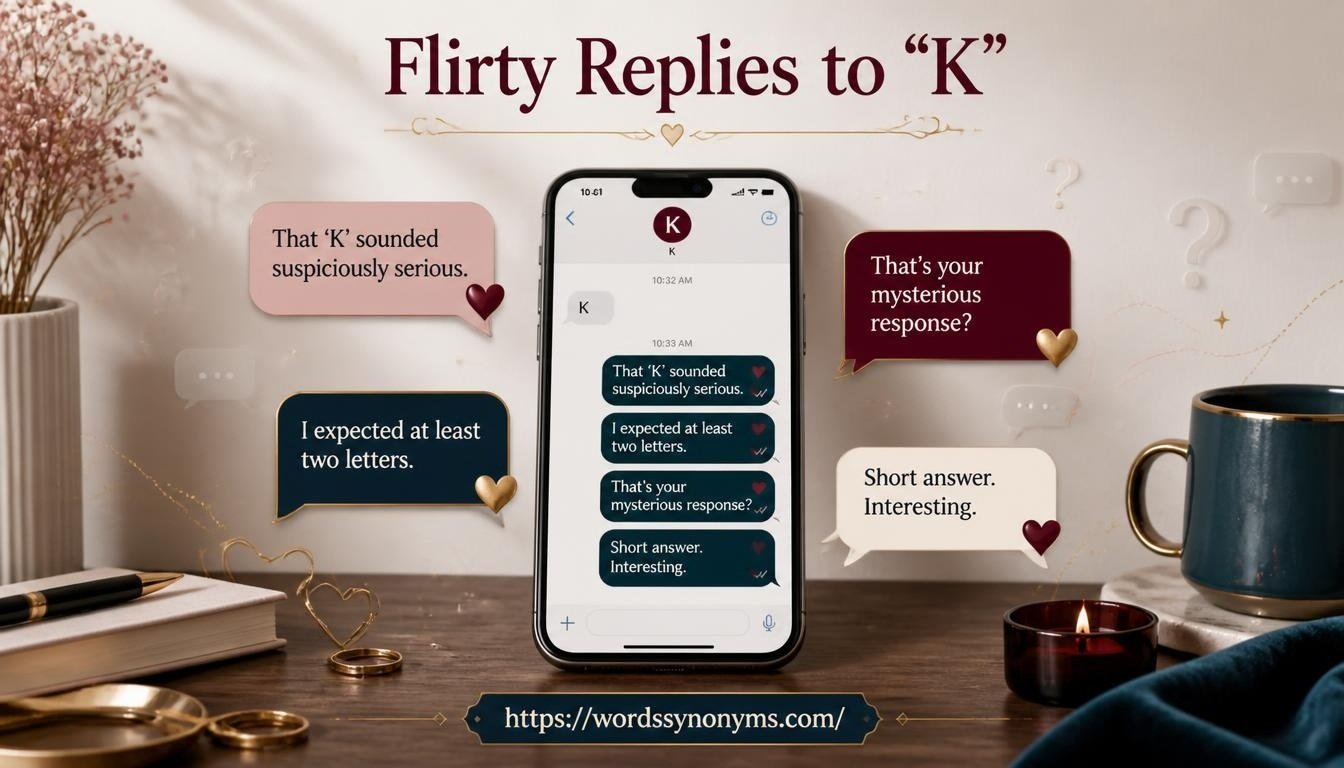
Flirty Replies to “K”
A short “K” from someone you like can trigger a lot of overthinking.
You might wonder whether they’re losing interest or trying to play it cool. But one short message doesn’t provide enough evidence to make that conclusion.
If the conversation already has a flirty tone, you can answer playfully.
Try:
- “That ‘K’ sounded suspiciously serious.”
- “You’re really making me work for this conversation.”
- “I expected at least two letters.”
- “That’s your mysterious response?”
- “Short answer. Interesting.”
- “You’re keeping me guessing now.”
The important part is not assuming romantic meaning from the letter itself.
A person who normally texts briefly may send “K” without thinking twice. Someone who usually sends enthusiastic messages might use it differently.
Look at the pattern rather than one isolated text.
Best Replies When “K” Seems Passive-Aggressive
When “K” feels passive-aggressive, your first instinct might be to respond with an even sharper message.
That’s usually a bad trade.
You may win the exchange while making the actual problem worse.
Instead, try a response that creates clarity:
- “You good?”
- “Everything okay?”
- “Did I say something wrong?”
- “That sounded a little cold.”
- “If something’s bothering you, just tell me.”
- “I’d rather know what you mean than guess.”
These replies work because they address the uncertainty without pretending you know exactly what the other person feels.
A useful rule
Don’t respond to the emotion you imagine. Respond to the information you actually have.
If all you have is “K,” you have very little information.
The conversation surrounding that message gives you the rest.
How to Reply to “K” Without Looking Desperate
A dry reply can make you want to send another message immediately.
Then another.
Then perhaps a third explaining why you asked the original question.
That’s when a tiny text can become a full-blown conversation about texting.
Instead, take a breath and consider whether another response is even necessary.
Avoid these habits
- Sending several follow-up messages.
- Asking repeatedly, “Are you mad?”
- Apologizing without knowing what you did wrong.
- Writing a long explanation after a one-word response.
- Trying to force the person to keep talking.
- Treating punctuation as definitive proof of someone’s feelings.
- Matching their coldness with hostility.
A confident response doesn’t require constant reassurance.
Sometimes “No worries. Talk later.” says more than five anxious messages ever could.
When You Shouldn’t Reply to “K”
Not every “K” needs a response.
If the person has simply acknowledged information, the conversation may already have reached its natural endpoint.
For example:
“The appointment is at 3.”
“K.”
There isn’t much left to discuss.
You also don’t need to respond when you’re tempted to chase the person purely because their message feels unusually short.
Silence isn’t always awkward. Sometimes it’s simply the end of the conversation.
If the person wants to continue, they can reach out.
“K” vs. “OK” vs. “Okay” vs. “KK”
People often assign different emotional meanings to tiny variations in texting.
Some common impressions include:
| Text | Common impression |
| K | Very brief and potentially cold |
| OK | Neutral and direct |
| Okay | More conversational |
| Okay! | Warmer or more enthusiastic |
| KK | Casual and often friendly |
| K. | Can feel especially final |
| Sure | Agreement or willingness |
| Got it | Clear acknowledgment |
| Sounds good | Friendly agreement |
| Alright | Neutral acceptance |
These aren’t universal rules.
Texting styles vary from person to person. One person may use “K” constantly while another uses it only when annoyed.
That’s why individual habits matter more than texting folklore.
How Context Changes the Meaning of “K”
The same message can feel completely different depending on who sends it.
“K” From a Friend
A friend may use “K” because they type quickly.
If they normally communicate with short messages, don’t automatically treat the response as hostility.
Their usual behavior provides important context.
“K” From Someone You Like
When a crush sends “K,” it’s easy to overanalyze.
You may start wondering whether they lost interest or whether you said something wrong.
Resist that temptation.
Look at the broader conversation. One short reply isn’t enough to establish someone’s feelings.
“K” From a Partner
Here, context becomes especially important.
If your partner normally sends warm messages but suddenly responds with “K” after an argument, the change may be meaningful.
Still, the best approach isn’t mind reading.
Ask:
“Everything okay?”
That gives the person an opportunity to explain.
“K” From a Coworker
A coworker’s “K” often has a practical explanation.
Work messages frequently prioritize speed over warmth.
If you’re discussing a meeting time, deadline, or task, there’s little reason to interpret a short acknowledgment emotionally.
“K” During an Argument
This is where the message can feel particularly loaded.
A one-letter response after an emotional disagreement can signal frustration, resignation, or a desire to stop talking.
However, it can also mean the person doesn’t know what else to say.
Instead of escalating, decide whether the issue needs another conversation.
Case Study: When “K” Doesn’t Mean Someone Is Angry
Imagine that you text a coworker:
“The client moved our meeting to Thursday at 2.”
They answer:
“K.”
You might initially think the reply sounds unfriendly.
But there’s no real evidence of conflict.
The message required acknowledgment rather than emotional engagement. The coworker confirmed receipt and moved on.
In this situation, “Got it” or no reply at all would make more sense than asking whether they’re upset.
The lesson is simple: don’t assign emotional meaning to a practical message without evidence.
Case Study: When “K” Probably Needs Attention
Now imagine a different exchange:
“I know yesterday was rough. I really want to work things out.”
“K.”
That response feels different.
The conversation contains emotional content. A one-letter acknowledgment may indicate discomfort, frustration, or unwillingness to engage.
Still, you don’t know which one.
A better reply might be:
“If something’s bothering you, just tell me.”
That creates a path toward an honest conversation.
You aren’t accusing them. You’re asking for clarity.
How to Choose the Right Reply to “K”
Before you respond, ask yourself three quick questions.
1. Is the conversation casual or serious?
A casual conversation gives you more room for humor.
A serious conversation usually needs clarity and restraint.
2. Does this person normally text this way?
If “K” is their normal response, don’t suddenly treat it as an emergency.
If they usually send paragraphs and suddenly switch to one letter, the change deserves more attention.
3. Do you want to continue or end the conversation?
Your goal should shape your response.
Want to continue?
“You good?”
Want to keep it playful?
“Wow, such a detailed response.”
Want to clarify?
“Everything okay?”
Want to end things naturally?
“No worries. Talk later.”
That small decision can save you from unnecessary overthinking.
What to Do If Someone Always Replies “K”
If someone constantly sends “K,” don’t analyze each individual message.
Look at the larger communication pattern.
Ask yourself:
- Do they communicate warmly in person?
- Do they answer important questions?
- Do they initiate conversations?
- Do they usually prefer short texts?
- Do they respond quickly when something matters?
- Do they show care through actions rather than long messages?
Texting isn’t the only measure of communication.
Some people simply aren’t enthusiastic texters.
If their short responses repeatedly cause problems, talk about the communication style itself rather than arguing about individual words.
For example:
“Sometimes your short replies make it hard for me to know what you mean. Can you tell me directly when something’s wrong?”
That’s far more productive than:
“Why do you always say K?”
The first sentence addresses the problem. The second sounds like an accusation.
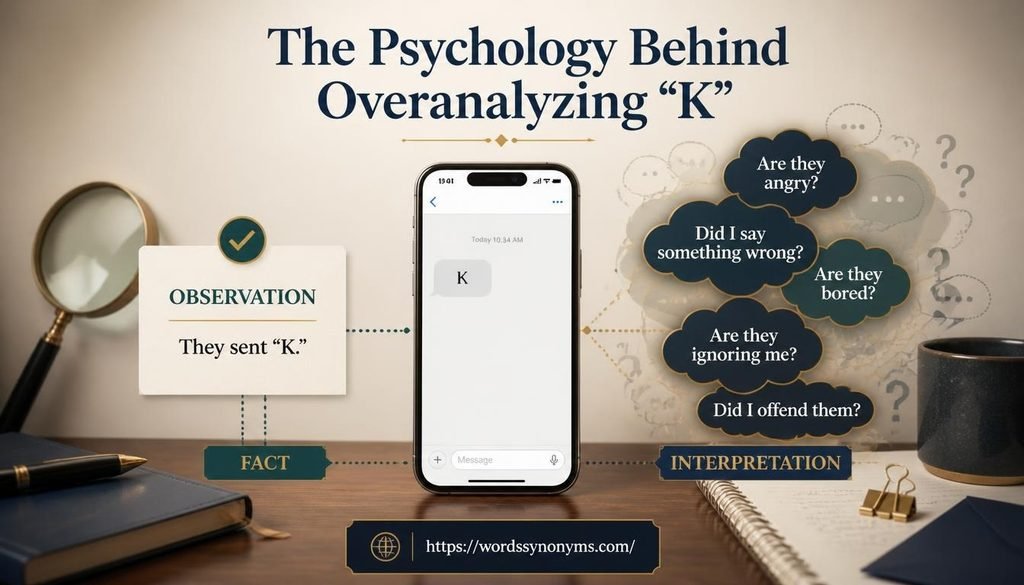
The Psychology Behind Overanalyzing “K”
Short messages create an information gap.
When you don’t know someone’s tone, your brain may try to fill in the missing pieces.
That’s why a single “K” can trigger questions such as:
- Are they angry?
- Did I say something wrong?
- Are they bored?
- Are they ignoring me?
- Do they still want to talk?
- Did I offend them?
The problem is that your brain can create explanations without enough evidence.
A better approach is to separate observation from interpretation.
Observation: They sent “K.”
Interpretation: They’re angry with me.
Those aren’t the same thing.
Once you recognize the difference, you can respond more calmly.
Why “K” Can Feel Colder Than “Okay”
There is a simple reason: brevity changes the perceived tone.
“Okay” contains four letters and feels closer to ordinary speech.
“K” compresses the entire word into one character.
That extreme shortening can make the message feel abrupt.
Punctuation can amplify the effect.
Compare:
“Okay!”
“Okay.”
“K.”
The final version can feel more closed-off because it contains almost no emotional information.
Yet the sender may not intend any of that.
Texting tone is partly created by what isn’t written.
Should You Ask Someone Why They Said “K”?
Sometimes yes.
Sometimes absolutely not.
If the conversation is important and the response genuinely feels unusual, asking can help.
Try:
“Everything okay?”
or:
“Did I catch you at a bad time?”
Avoid making accusations based on assumptions.
Instead of:
“Why are you being rude?”
Try:
“That sounded a little cold. Is everything okay?”
The second version leaves room for the possibility that you misunderstood.
That matters.
Read more: 25 Best Replies to “Just Kidding”: Sarcastic and Firm Comebacks
Key Takeaways About Replying to “K”
When someone texts “K,” you don’t need to crack a secret code.
Keep these points in mind:
- “K” usually means “okay.”
- It isn’t automatically rude.
- Context matters more than the single letter.
- A sudden change in texting style can be more meaningful.
- Don’t assume anger without supporting evidence.
- Humor works best when you already have a playful relationship.
- Don’t chase a dry response with multiple anxious messages.
- Ask directly when the conversation actually matters.
- Give busy people room to respond later.
- Sometimes the best reply is no reply.
- Look for communication patterns rather than isolated texts.
- Your goal should be clarity rather than winning the exchange.
FAQs
1. What does “K” mean in a text message?
“K” is a shortened version of “OK.” People use it to acknowledge a message, agree with something, or confirm a plan. Its meaning often depends on the conversation.
2. Why do people reply with just “K”?
Some people prefer short messages and don’t feel the need to type a full response. Others use “K” when they’re busy, annoyed, or no longer interested in chatting.
3. Is texting “K” considered rude?
Not always. A simple “K” can be perfectly normal when confirming basic information. However, it may sound dismissive when someone shares something important and receives only one letter in return.
4. Does “K” mean someone is angry with me?
Not necessarily. It can sometimes suggest irritation or frustration but you shouldn’t assume someone is angry based on one letter. Consider their usual texting habits and the conversation’s context.
5. How should I respond when someone texts me “K”?
Your response depends on the situation. You can reply with something funny, ask whether everything is okay, or simply leave the conversation there. There’s no need to overthink every short message.
6. Is “K” colder than “OK”?
Yes, it can feel that way. “OK” sounds slightly more complete and friendly while “K” may come across as rushed or uninterested. However, some people use both interchangeably.
7. Should I reply when someone texts “K”?
You don’t always need to respond. If they’re confirming a plan or answering a simple question, the conversation can naturally end there. If you still have something important to discuss, continue with your point.
8. What does “K.” with a period mean?
Some people interpret “K.” as colder or more serious than “K” without punctuation. It may suggest annoyance or a desire to end the conversation. Still, punctuation alone doesn’t reveal someone’s true feelings.
9. How can I tell if someone is being sarcastic with “K”?
Look at the conversation before and after that message. If they usually send longer replies but suddenly switch to “K,” something might be bothering them. Their tone in previous messages can also offer useful clues.
10. Is it better to text “OK” instead of “K”?
If you want to sound friendly and clear, “OK” is usually a safer choice. It feels more complete and leaves less room for misunderstanding. A little extra effort can make your messages sound warmer.
Conclusion
Getting a single “K” in response to your message can feel confusing, especially when you expected a proper conversation. Sometimes it simply means OK or confirms a plan. Other times, it might sound dismissive or suggest that the person isn’t interested in talking. Before jumping to conclusions, consider the situation and how that person usually texts. A short reply doesn’t always carry a negative meaning.
The good news is that you don’t have to let one letter ruin your mood. With these 26 best replies when someone texts you “K”, you can respond with humor, confidence, or a little sarcasm. Choose a reply that matches your relationship and the conversation. Sometimes a clever comeback works perfectly, while other times, saying nothing is the smartest response.

Emily Carter has a strong interest in English grammar, sentence structure, and effective writing. She specializes in explaining complicated grammar concepts in simple language. Her articles help readers understand grammar rules, avoid common mistakes, and develop confidence in everyday and professional communication.