
Explore 23 Best Replies to “It Is What It Is”: Sarcastic Comebacks to keep awkward conversations lively and choose the right tone. When you complain, you want someone to listen rather than brush you off.
This overused phrase can express acceptance, but it may sound dismissive when you share a problem. Its meaning involves accepting what you cannot change. Still, your response depends on the situation, relationship, and speaker’s tone. Sometimes comforting words help; other times, humor or sarcasm eases tension.
The best replies range from funny comebacks to thoughtful and polite responses. In casual conversations, a witty remark can keep things moving without creating conflict. At work, professional communication requires suitable language during meetings, scheduling, or unexpected delays.
Choose words that fit the context and express frustration without sounding harsh. A timely response can encourage problem-solving, protect relationships, and make conversations easier. Strong conversational skills help you answer naturally, maintain confidence, and turn a statement into meaningful discussion.

Quick Answer
Some effective replies include:
- “You’re right. Let’s make the best of it.”
- “True, but we don’t have to like it.”
- “Well, that’s one way to look at it.”
- “Could be worse, right?”
- “Until it isn’t!”
- “Guess we’ll just have to roll with it.”
- “And here I was hoping for a plot twist!”
- “Let’s focus on what we can control.”
- “One day we’ll laugh about this.”
- “What matters is what we do from here.”
Use a funny response when the conversation feels lighthearted. Choose an empathetic or constructive reply when someone faces genuine disappointment.
What Does “It Is What It Is” Mean?
Before choosing a comeback, it helps to understand what someone actually means when they use this expression. Although the words seem straightforward, the message behind them can change considerably.
“It is what it is” is an informal expression people use to acknowledge an existing situation they cannot easily change. It often communicates acceptance, resignation, or a decision to stop worrying about something that has already happened.
For example, imagine you prepared for an important job interview but didn’t get the position. A friend asks how you’re feeling, and you respond, “It is what it is.” You’re acknowledging the disappointment without allowing it to consume your attention.
However, the phrase doesn’t always communicate healthy acceptance. Sometimes people use it to avoid difficult conversations or escape responsibility. Someone might dismiss a preventable mistake by saying, “It is what it is,” instead of discussing what went wrong.
The expression can carry several different meanings:
- Acceptance: Recognizing that something happened and cannot be changed.
- Resignation: Admitting that a situation feels disappointing or frustrating.
- Indifference: Showing that you don’t particularly care about the outcome.
- Practical thinking: Choosing to focus on what happens next.
- Conversation avoidance: Ending a discussion without offering an explanation or solution.
Context makes all the difference. A friend saying it after losing a football match might sound perfectly reasonable. A manager saying it after ignoring an important workplace problem could sound irresponsible.
Understanding that distinction helps you choose a response that actually fits the moment.
23 Best Replies to “It Is What It Is”
The right comeback doesn’t need to sound clever or complicated. Sometimes a short sentence communicates more than an elaborate explanation.
Here are 23 natural replies you can use in everyday conversations, text messages, workplace discussions, and friendly banter.
“You’re Right, Let’s Make the Best of It.”
This response acknowledges reality without allowing disappointment to control the conversation. It communicates acceptance while encouraging a positive attitude toward whatever happens next.
It’s particularly useful when someone faces an unfortunate situation but still has opportunities to improve things.
For example, imagine your friend planned an outdoor birthday party. Unfortunately, heavy rain ruins the original arrangements. Instead of complaining all afternoon, you could offer this response.
Example conversation:
Friend: “The weather ruined everything. It is what it is.”
You: “You’re right. Let’s make the best of it and move the party indoors.”
The beauty of this response lies in its balance. You acknowledge the problem without treating it like the end of the world.
Best used when: Someone feels disappointed but can still take practical steps toward a better outcome.
“Well, What Can We Do About It Now?”
Sometimes, a situation has already happened, and repeatedly discussing it won’t change anything. This response recognizes that reality while gently encouraging everyone to move forward.
It works particularly well when someone keeps revisiting an unfortunate event. Rather than sounding overly optimistic, you’re bringing attention back to the present.
Example conversation:
Friend: “I forgot to submit the application yesterday. It is what it is.”
You: “Well, what can we do about it now? Maybe they’ll accept a late submission.”
Notice that the response doesn’t automatically assume everything will work out. It simply encourages you to explore whatever options remain.
However, your delivery matters. If you sound irritated, the same sentence might feel dismissive. Use a calm tone when someone genuinely feels upset.
Best used when: A mistake has happened and you’re ready to explore possible solutions.
“That’s True, But There’s Always Another Way.”
This comeback introduces optimism without pretending that the original situation wasn’t disappointing. It reminds the other person that one unsuccessful attempt doesn’t eliminate every opportunity.
Imagine someone loses a scholarship, misses a promotion, or fails to secure an important opportunity. They might believe their plans have completely fallen apart.
A thoughtful response can help them see beyond the immediate setback.
Example conversation:
Friend: “I didn’t get accepted into my first-choice university. It is what it is.”
You: “That’s true, but there’s always another way. You still have some excellent options.”
This response works because it acknowledges the disappointment before introducing a different perspective.
Don’t use it to minimize serious problems, though. Sometimes people need understanding before they can appreciate encouragement.
Best used when: Someone needs reassurance that a setback doesn’t necessarily close every door.
“Fair Enough. Life Goes On.”
Few responses sound as natural and uncomplicated as this one. It’s short, relaxed, and suitable for situations where nobody needs a lengthy discussion.
The expression communicates agreement while suggesting that life continues despite unexpected disappointments.
For example, your friend might tell you that their favorite restaurant has closed. You could simply say, “Fair enough. Life goes on.”
Example conversation:
Friend: “They canceled the concert. It is what it is.”
You: “Fair enough. Life goes on. Maybe we’ll catch another show.”
The response feels especially natural among friends who prefer straightforward conversations.
However, avoid using it when someone shares deeply personal or painful news. In those circumstances, it could sound like you’re rushing them through their emotions.
Best used when: The situation is relatively minor and everyone feels ready to move forward.
“At Least We Know Where Things Stand.”
Uncertainty can sometimes feel worse than disappointing news. When you finally understand what’s happening, you can make decisions with a clearer picture.
This response highlights that small advantage.
Imagine waiting several weeks for a client to approve a project. Eventually, they reject your proposal. Although the answer isn’t what you wanted, you can finally stop waiting and consider other opportunities.
Example conversation:
Colleague: “The client rejected our proposal. It is what it is.”
You: “At least we know where things stand. Let’s approach another client.”
The response doesn’t celebrate failure. Instead, it recognizes the value of having definite information.
Best used when: Someone has received an answer after a period of uncertainty.
“Let’s Focus on What We Can Control.”
This is one of the most constructive replies because it separates problems from possibilities.
You cannot control every decision, unexpected event, or external circumstance. However, you can often control your preparation, attitude, communication, and next steps.
Suppose a delivery arrives late because of severe traffic. Spending an hour arguing about something neither person can change won’t make the package arrive sooner.
Example conversation:
Friend: “Our travel plans are ruined because the flight got delayed. It is what it is.”
You: “Let’s focus on what we can control. We can contact the airline and check other flights.”
This response moves the discussion away from helplessness and toward practical action.
It also works in professional settings where teams need to distinguish unavoidable setbacks from manageable responsibilities.
Best used when: A situation feels frustrating but some useful decisions remain within your control.
“I Guess That’s Just How Life Works.”
Life rarely follows a perfectly organized schedule. Plans change, people disappoint us, and unexpected problems appear when we least expect them.
This response acknowledges those everyday uncertainties with a relaxed attitude.
For instance, imagine planning a weekend trip only to discover that your hotel reservation was canceled. You might respond with this expression to show that you’re disappointed but not completely overwhelmed.
Example conversation:
Friend: “The hotel canceled our reservation at the last minute. It is what it is.”
You: “I guess that’s just how life works. Let’s find another place.”
The sentence sounds conversational because it doesn’t try too hard to offer wisdom.
Still, use it carefully when someone faces something serious. A casual observation about life might not provide the emotional support they need.
Best used when: You’re discussing ordinary disappointments and unexpected changes.
“Could Be Worse, Right?”
A little humor can sometimes make an uncomfortable situation easier to handle. This response uses perspective to reduce tension without completely ignoring the problem.
Suppose your friend spills coffee on their shirt shortly before a casual meeting. You could jokingly suggest that things could have gone much worse.
Example conversation:
Friend: “I spilled coffee all over my new shirt. It is what it is.”
You: “Could be worse, right? At least it’s not your laptop!”
The humor works because you’re comparing a minor inconvenience with a more troublesome possibility.
However, this comeback isn’t suitable for every situation. If someone experiences a serious loss, illness, or personal crisis, suggesting that things could be worse may sound insensitive.
Best used when: Something relatively minor happens and both people feel comfortable joking about it.
“Well, That’s One Way to Look at It.”
Not everyone interprets a situation in the same way. Sometimes, someone uses “It is what it is” to express an opinion that you don’t entirely share.
This response lets you acknowledge their perspective without pretending to agree completely.
Imagine a colleague dismisses a failed marketing campaign as something nobody could have prevented. However, you believe the team could have prepared better.
Example conversation:
Colleague: “The campaign didn’t work. It is what it is.”
You: “Well, that’s one way to look at it. I think we could learn something from the results.”
The response creates room for disagreement without immediately turning the discussion into an argument.
Best used when: You want to challenge someone’s perspective politely.
“And Here I Was Hoping for a Plot Twist!”
If you enjoy playful conversations, this comeback adds a little theatrical humor. It treats an ordinary disappointment as though you’re watching an entertaining movie.
The phrase “plot twist” refers to an unexpected development in a story. Using it in everyday conversation makes your disappointment sound deliberately dramatic.
Example conversation:
Friend: “The restaurant is fully booked tonight. It is what it is.”
You: “And here I was hoping for a plot twist! Guess we’re ordering pizza.”
This response works especially well through text messages because it’s expressive without requiring a long explanation.
You can also use it when plans change, tickets sell out, or someone delivers predictable news.
Best used when: You’re chatting with friends who appreciate playful exaggeration.
“Not Exactly the Ending We Wanted.”
Sometimes, the outcome is disappointing even though everyone understands why it happened. This response acknowledges that disappointment without creating unnecessary drama.
It’s particularly suitable for situations involving competitions, projects, group plans, and shared goals.
Imagine your favorite team loses an important match after playing well throughout the season.
Example conversation:
Friend: “We almost won, but they scored in the final minutes. It is what it is.”
You: “Not exactly the ending we wanted. They gave it a good fight, though.”
The response shows disappointment while recognizing the effort involved.
It also avoids blaming people when the outcome simply didn’t go your way.
Best used when: A shared experience ends differently from what everyone hoped.
“Guess We’ll Just Have to Roll With It.”
Life occasionally hands you a different plan without asking for your permission. This response communicates flexibility and a willingness to adapt.
The expression “roll with it” means accepting changing circumstances instead of fighting every unexpected development.
Suppose your friends planned a beach picnic, but strong winds make the location unsuitable. Rather than canceling the entire gathering, you could suggest moving somewhere sheltered.
Example conversation:
Friend: “The beach is too windy for a picnic. It is what it is.”
You: “Guess we’ll just have to roll with it. Let’s find a quieter spot.”
It’s a friendly response that keeps the conversation moving.
Best used when: Plans change unexpectedly and everyone needs to adjust.
“That’s Life. Sometimes It Throws Curveballs.”
A curveball is a baseball pitch that changes direction unexpectedly. In everyday English, the expression describes an unexpected challenge or surprise.
This response uses that familiar comparison to acknowledge life’s unpredictability.
For example, someone might lose an important client just before completing a major project. They didn’t expect the setback, but they still need to decide what happens next.
Example conversation:
Friend: “The client suddenly changed their mind. It is what it is.”
You: “That’s life. Sometimes it throws curveballs. You’ll find another opportunity.”
The response sounds encouraging without pretending that every unexpected problem feels pleasant.
Best used when: Someone experiences an unexpected setback and needs a little reassurance.
“Well, Isn’t That a Little Dramatic?”
This comeback adds playful sarcasm to a conversation. It works when someone makes an ordinary inconvenience sound like a complete disaster.
Imagine your friend discovers that their favorite coffee shop has run out of their preferred drink. They dramatically announce that their entire morning is ruined.
Example conversation:
Friend: “They don’t have my favorite coffee anymore. It is what it is.”
You: “Well, isn’t that a little dramatic? There are other coffees in the world!”
The humor comes from gently exaggerating the difference between the problem and the reaction.
However, relationships matter here. Use this response with people who understand your humor. Otherwise, it could sound like you’re making fun of their feelings.
Best used when: Someone exaggerates a minor inconvenience and enjoys friendly teasing.
“Until It Isn’t!”
This is one of the shortest and most interesting comebacks on the list.
It challenges the assumption that a situation must remain unchanged forever. Although something might be true today, circumstances can shift tomorrow.
For example, someone might believe they’ll never find another suitable job after receiving several rejections.
Example conversation:
Friend: “I’ll probably never find a better opportunity. It is what it is.”
You: “Until it isn’t!”
The response introduces possibility without making unrealistic promises.
It works particularly well when someone feels stuck in a situation that could eventually improve.
Remember that some circumstances genuinely cannot change. The phrase is most useful when the future remains open.
Best used when: You want to offer a brief, optimistic challenge to a pessimistic statement.
“I Suppose Complaining Won’t Change Anything.”
Sometimes, accepting reality means recognizing that frustration alone cannot improve the situation.
This response communicates practical thinking while acknowledging that the outcome might not be ideal.
Imagine missing a train because you arrived five minutes late. Complaining about the schedule won’t bring the train back, so finding another departure makes more sense.
Example conversation:
Friend: “We missed the train. It is what it is.”
You: “I suppose complaining won’t change anything. Let’s check the next departure.”
The sentence works because it connects acceptance with a useful next step.
However, don’t use it to discourage someone from raising a legitimate concern. Complaints can sometimes reveal problems that deserve attention.
Best used when: You’re ready to stop dwelling on an event and start handling its consequences.
“True, But We Don’t Have to Like It.”
Acceptance doesn’t mean you must enjoy everything that happens. You can recognize reality while still feeling disappointed, frustrated, or upset.
That’s exactly what makes this comeback so effective.
Suppose your employer announces an unexpected change to the office schedule. You understand the decision, but the new arrangement creates inconvenience.
Example conversation:
Colleague: “The company changed our working hours. It is what it is.”
You: “True, but we don’t have to like it.”
The response validates both sides of the situation. You acknowledge what happened without pretending the outcome feels wonderful.
It’s also a useful way to disagree without sounding argumentative.
Best used when: You accept a decision but want to express that you’re unhappy with it.
“That’s Not Very Encouraging!”
Sometimes people use “It is what it is” when they’re supposed to provide reassurance. Their response might feel unnecessarily pessimistic, especially when you’re looking for support.
This comeback highlights that lack of encouragement through lighthearted humor.
Example conversation:
Friend: “You probably won’t get the job. It is what it is.”
You: “That’s not very encouraging! I was hoping for a little more confidence.”
The response gently points out the difference between accepting reality and assuming the worst.
It also gives the other person an opportunity to reconsider their wording.
Best used when: Someone responds pessimistically when you expected encouragement.
“Maybe, But There’s Still Room for Improvement.”
This reply is useful when someone treats a disappointing situation as though nothing can be done about it.
Sometimes, the circumstances are real but the outcome isn’t permanent. A poor result can provide valuable information for making better decisions.
Imagine a small business owner whose first advertising campaign attracts very few customers.
Example conversation:
Partner: “The campaign didn’t bring enough sales. It is what it is.”
You: “Maybe, but there’s still room for improvement. Let’s examine the results.”
This response encourages problem-solving instead of accepting every setback as unavoidable.
It also introduces an important distinction: accepting what happened doesn’t mean accepting the same outcome forever.
Best used when: A situation can improve through better planning, effort, or decision-making.
“One Day We’ll Laugh About This.”
Some frustrating experiences become amusing stories once enough time passes. This response offers reassurance by helping someone imagine a less stressful perspective.
For example, picture a group of friends getting lost during a road trip. Everyone feels irritated because their phones have lost reception and nobody recognizes the area.
Example conversation:
Friend: “We’ve been driving in circles for an hour. It is what it is.”
You: “One day we’ll laugh about this. For now, let’s find somewhere with phone reception.”
The response combines encouragement with a practical suggestion.
Of course, not every painful experience eventually becomes funny. Use this phrase when the situation is relatively light and the person seems comfortable with humor.
Best used when: A temporary inconvenience feels frustrating but isn’t especially serious.
“I Hear You. Want to Talk About It?”
Not every conversation needs a clever comeback. Sometimes, the person saying “It is what it is” feels disappointed and doesn’t know how to explain their emotions.
This response offers something more valuable than humor: attention.
Imagine your friend has experienced a difficult breakup. They casually mention that the relationship ended and add, “It is what it is.”
Rather than immediately telling them to move on, give them space to express themselves.
Example conversation:
Friend: “We decided to end things. It is what it is.”
You: “I hear you. Want to talk about it?”
The response doesn’t pressure them to explain anything. It simply lets them know you’re available.
This matters because people sometimes use casual expressions to hide deeper disappointment.
Best used when: Someone sounds emotionally affected and might appreciate a supportive conversation.
“Let’s See What Happens Next.”
Uncertainty doesn’t always require an immediate decision. Sometimes, the most reasonable response is to wait for more information.
This comeback communicates patience without sounding completely indifferent.
For example, a friend might apply for several positions and receive an interview invitation from only one company. They feel unsure about the outcome but don’t want to make assumptions.
Example conversation:
Friend: “I don’t know whether they’ll hire me. It is what it is.”
You: “Let’s see what happens next. You’ve already made it through the interview.”
This response keeps expectations realistic while acknowledging that the situation hasn’t reached its final stage.
Best used when: The outcome remains uncertain and further information could change your perspective.
“What Matters Is What We Do From Here.”
This comeback shifts attention from an unchangeable past toward future decisions. It communicates responsibility, determination, and a willingness to improve.
Imagine a team misses an important deadline because several tasks weren’t completed on time. Simply accepting the situation won’t repair the working relationship or prevent another delay.
Example conversation:
Colleague: “We missed the deadline. It is what it is.”
You: “What matters is what we do from here. Let’s create a better timeline.”
This response doesn’t ignore the mistake. Instead, it encourages everyone to take responsibility and improve their approach.
It’s particularly useful in professional discussions where solutions matter more than excuses.
Best used when: You want to encourage accountability and focus on meaningful next steps.
Read more: 27 Best Replies to “Get Well Soon”: Professional Responses
Funny Replies to “It Is What It Is”
If someone uses this phrase casually, a funny response can keep the conversation entertaining. The trick is choosing humor that matches the situation rather than forcing a joke into an uncomfortable moment.
Here are some additional playful replies:
- “Well, that’s a plot twist nobody ordered!”
- “The universe clearly didn’t check our schedule.”
- “At this point, even the drama needs a vacation.”
- “Guess the situation has made its final decision.”
- “I see we’re letting destiny handle customer service.”
- “Somebody forgot to give life the instructions.”
- “Well, that’s not going according to the brochure.”
- “Should we laugh or start making backup plans?”
- “Apparently, reality doesn’t accept returns.”
- “I’ll add that to today’s collection of surprises.”
Example conversation:
Friend: “I forgot my umbrella and now it’s raining. It is what it is.”
You: “Apparently, reality doesn’t accept returns!”
The joke works because it turns an ordinary inconvenience into an amusing comparison.
When Should You Use Funny Replies?
Funny comebacks work best when:
- You’re speaking with close friends or family members.
- The situation involves a minor inconvenience.
- Everyone feels comfortable joking about the outcome.
- The other person has already shown a playful attitude.
- Humor can reduce tension without dismissing someone’s feelings.
Avoid jokes when someone discusses grief, serious financial trouble, illness, or other painful experiences. A little sensitivity can save an otherwise good conversation.
Sarcastic and Witty Comebacks to “It Is What It Is”
Sometimes, a straightforward agreement doesn’t express what you’re thinking. Perhaps someone keeps avoiding responsibility or uses the phrase to shut down a reasonable discussion.
A witty or sarcastic comeback can highlight that problem without turning the exchange into a personal attack.
Here are some options:
- “What a groundbreaking observation!”
- “Well, that’s certainly an explanation.”
- “And here I thought we were solving problems.”
- “Thanks for clearing up absolutely everything.”
- “I appreciate the detailed analysis!”
- “That’s one way to avoid answering the question.”
- “Should we put that on a motivational poster?”
- “Interesting. Any plans to change it?”
- “Well, the mystery has officially been solved.”
- “I was hoping for a solution, but okay.”
Example conversation:
Colleague: “The same problem happened again. It is what it is.”
You: “Interesting. Any plans to change it?”
This response is pointed without being openly insulting. It questions the idea that repeated problems deserve automatic acceptance.
Sarcasm Versus Genuine Rudeness
There’s a fine line between a clever comeback and an unnecessarily hurtful remark.
| Witty response | Potentially rude response |
| “That’s one way to look at it.” | “That’s a ridiculous way to think.” |
| “Any plans to improve things?” | “You never do anything useful.” |
| “Well, that’s certainly convenient.” | “You’re just making excuses.” |
| “I was hoping for a better answer.” | “You clearly have no idea.” |
A good comeback addresses the statement rather than attacking someone’s intelligence or character.
Supportive Replies to “It Is What It Is”
When someone uses this expression after experiencing disappointment, they might need understanding more than advice.
Perhaps they lost an opportunity, experienced rejection, or received news they weren’t expecting. Their casual response could hide frustration or sadness.
In these situations, supportive replies create room for honest conversation.
Here are some thoughtful alternatives:
- “I know. It’s not easy, though.”
- “I’m sorry things turned out this way.”
- “You don’t have to figure everything out today.”
- “I’m here if you need anything.”
- “It’s okay to feel disappointed.”
- “You’ve handled difficult situations before.”
- “Take your time. There’s no rush.”
- “This doesn’t define your future.”
- “You gave it your best effort.”
- “It’s alright if you’re not ready to move on.”
Example conversation:
Friend: “I didn’t get the promotion. It is what it is.”
You: “I’m sorry things turned out this way. You worked really hard for it.”
Notice that the response doesn’t immediately tell your friend to find another job or forget the disappointment.
It first recognizes what happened and acknowledges their effort.
Why Empathy Matters More Than Advice Sometimes
People don’t always share problems because they want someone to solve them. Sometimes, they simply want another person to understand their experience.
A thoughtful response can help someone feel less isolated.
Consider these three approaches:
| Situation | Supportive response |
| Someone feels disappointed | “I know you were hoping for a different outcome.” |
| Someone feels overwhelmed | “Take things one step at a time.” |
| Someone doesn’t want advice | “I’m here to listen whenever you’re ready.” |
| Someone blames themselves | “One mistake doesn’t define you.” |
| Someone needs encouragement | “You still have opportunities ahead.” |
The important thing is to avoid minimizing their emotions.
Telling someone to “just get over it” rarely makes them feel better. A little patience usually goes much further.
Professional Replies to “It Is What It Is” at Work
Workplace conversations require a different approach. A response that sounds funny among friends might appear disrespectful during a meeting.
When a colleague or manager says “It is what it is,” consider whether the situation requires acceptance, accountability, or a practical solution.
Your response should remain respectful while keeping the discussion productive.
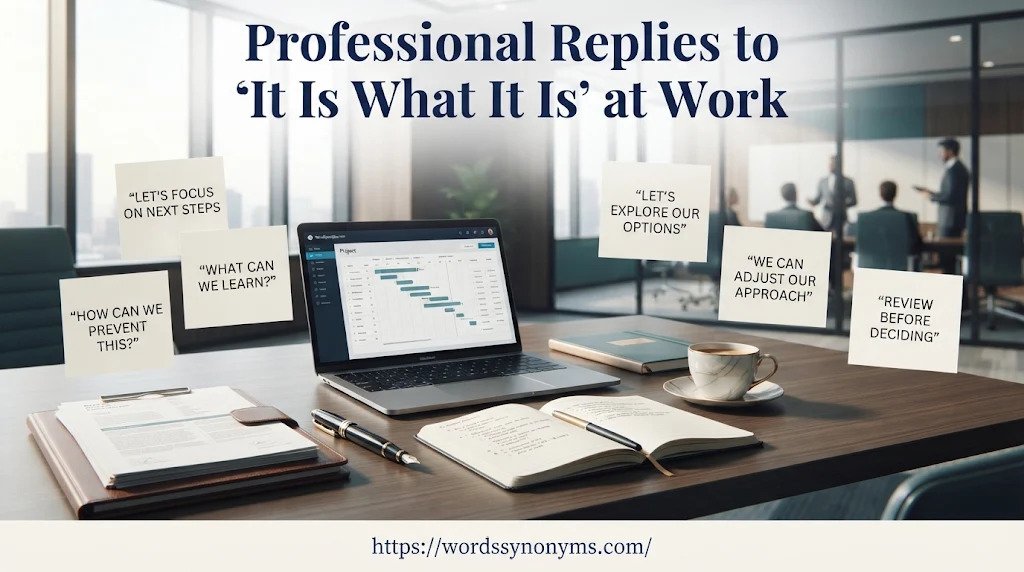
Professional Replies You Can Use
“Let’s focus on the next steps.”
This response moves attention toward action instead of repeatedly discussing what went wrong.
“What can we learn from this?”
Use it when a project, presentation, or business decision produces an unsuccessful outcome. It encourages reflection without automatically blaming anyone.
“How can we prevent this next time?”
This is particularly useful when the same problem has occurred repeatedly. It shifts the discussion toward better planning and prevention.
“Let’s explore the available options.”
Use this when the current situation isn’t ideal but alternative solutions might exist.
“We can adjust our approach moving forward.”
This response acknowledges that the original plan didn’t work while encouraging flexibility.
“Let’s review what happened before making a decision.”
Use it when the team needs more information before deciding what to do next.
Workplace Example: A Missed Project Deadline
Consider a marketing team that misses an important deadline because its original schedule didn’t account for several approval delays.
Manager: “We missed the launch date. It is what it is.”
Team member: “Understood. Let’s review the approval process and identify where we can improve the timeline.”
This response keeps the conversation professional and solution-focused.
It also avoids two common mistakes:
- Blaming individual team members before understanding the problem.
- Accepting repeated delays without examining their causes.
A missed deadline might be unavoidable in some circumstances. However, recurring delays often indicate a process that needs attention.
Workplace Example: An Unsuccessful Presentation
Imagine your team prepares a presentation for a potential client. Unfortunately, the client chooses another company.
Colleague: “They went with a competitor. It is what it is.”
You: “That’s disappointing. What can we learn from their feedback before approaching our next client?”
This response acknowledges the outcome while creating an opportunity to improve future presentations.
Professional communication works best when it combines respect, clarity, and accountability.
How to Choose the Best Reply to “It Is What It Is”
A clever comeback isn’t automatically the right response. Before answering, consider why the other person used the expression.
The same sentence can communicate acceptance in one conversation and frustration in another.
Here are several factors worth considering.
Consider the Person’s Tone
Tone often reveals more than the actual words.
Someone might say “It is what it is” with a relaxed smile. Another person might say exactly the same thing with frustration or disappointment.
Pay attention to:
- Their facial expression.
- Their speaking volume.
- Whether they sound upset or indifferent.
- Whether they’re inviting discussion or ending it.
- The circumstances surrounding the statement.
If someone sounds cheerful, a funny response might work beautifully. If they sound upset, an empathetic reply is usually more appropriate.
Think About Your Relationship
Your relationship determines how comfortable you can be with humor and sarcasm.
For example, a close friend might appreciate a playful comeback that would sound inappropriate coming from a new coworker.
Consider these general guidelines:
- Close friends: Use humor, teasing, and casual expressions.
- Family members: Choose responses that reflect your relationship and their feelings.
- Romantic partners: Prioritize understanding and honest communication.
- Colleagues: Keep your language respectful and constructive.
- Managers or clients: Use clear, professional wording.
The goal isn’t to sound clever at every opportunity. It’s to communicate naturally without creating unnecessary tension.
Understand Whether the Situation Can Change
This is perhaps the most important consideration.
Some events cannot be reversed. Others can still improve through different decisions.
For example, you cannot change yesterday’s weather or recover a missed train. However, you might be able to reschedule a meeting or find another transportation option.
Before agreeing with “It is what it is,” ask yourself:
- Has the situation already become final?
- Are alternative solutions available?
- Could better planning prevent another occurrence?
- Does someone need emotional support?
- Is accepting the situation more useful than arguing about it?
This simple distinction helps you avoid accepting problems that deserve attention.
Decide Whether Humor Will Help
Humor can make ordinary frustrations feel lighter. However, the same joke might hurt someone who’s already struggling.
Use funny replies when the atmosphere feels relaxed.
Choose thoughtful language when someone discusses a serious personal problem.
When you’re unsure, a simple response such as “I understand” gives the other person room to continue.
Match Your Response to the Conversation
Here’s a quick reference table to help you choose the right comeback.
| Conversation type | Suggested reply |
| Casual discussion | “Fair enough. Life goes on.” |
| Funny conversation | “And here I was hoping for a plot twist!” |
| Friendly disagreement | “That’s one way to look at it.” |
| Serious disappointment | “I know. It’s not easy, though.” |
| Workplace problem | “Let’s focus on the next steps.” |
| Repeated mistake | “How can we prevent this next time?” |
| Uncertain outcome | “Let’s see what happens next.” |
| Unexpected change | “Guess we’ll just have to roll with it.” |
| Pessimistic attitude | “Until it isn’t!” |
| Unchangeable situation | “You’re right. Let’s make the best of it.” |

Real-Life Case Studies: Choosing the Right Response
Understanding individual replies becomes easier when you see how they work in realistic situations.
The following examples illustrate how the same phrase can require completely different responses depending on the circumstances.
Case Study: A Friend Loses a Job Opportunity
Situation: Your friend interviews for a position they’ve wanted for months. Unfortunately, the company chooses another candidate.
Friend: “I didn’t get the job. It is what it is.”
Possible response: “I’m sorry. I know how much you wanted that position. You’ll have other opportunities.”
Why it works: Your friend probably feels disappointed after investing time and energy in the application. Acknowledging their feelings shows understanding without making unrealistic promises.
Case Study: A Team Experiences a Project Failure
Situation: A team launches a project that fails to meet its expected targets. Everyone feels disappointed.
Colleague: “The results weren’t good. It is what it is.”
Possible response: “Let’s review the numbers and identify what we can improve.”
Why it works: Accepting the results doesn’t mean ignoring valuable information. Reviewing performance helps the team make better decisions next time.
Case Study: Friends Cancel Weekend Plans
Situation: Your friends planned a weekend picnic, but heavy rain forces everyone to reconsider.
Friend: “Looks like the picnic isn’t happening. It is what it is.”
Possible response: “Guess we’ll just have to roll with it. Movie night instead?”
Why it works: The response keeps the atmosphere positive and immediately introduces an alternative.
Case Study: Someone Avoids Taking Responsibility
Situation: A colleague repeatedly misses deadlines but dismisses the problem whenever someone raises concerns.
Colleague: “Another deadline missed. It is what it is.”
Possible response: “What can we change to prevent this from happening again?”
Why it works: This response challenges the idea that recurring problems deserve automatic acceptance. It encourages accountability without making the discussion personal.
Read more: 27 Best Replies to “Do You Have a Girlfriend?” Funny and Clever
FAQs
1. What does “It Is What It Is” actually mean?
“It is what it is” means accepting a situation you cannot change. People often use it when they feel there’s no point arguing or worrying about something beyond their control.
2. Is “It Is What It Is” a rude thing to say?
Not always. It depends on the speaker’s tone and the situation. However, it can sound rude or dismissive when someone uses it instead of listening to your concerns.
3. What is the best reply to “It Is What It Is”?
A good reply depends on your relationship with the speaker. You could say, “True, but that doesn’t mean we can’t make things better.” It sounds thoughtful without being confrontational.
4. How do you respond to “It Is What It Is” sarcastically?
Try a playful response like, “Well, that’s certainly a groundbreaking observation!” This works when you share a friendly relationship and both enjoy sarcasm.
5. What is a funny response to “It Is What It Is”?
You can say, “And water is wet!” or “Thanks for solving absolutely nothing!” These funny comebacks add humor without making the conversation too serious.
6. How do you respond when someone dismisses your feelings?
Stay calm and explain what you need. For example, say, “I understand, but I’d appreciate it if you heard me out.” This makes your feelings clear without starting an argument.
7. Can I use “It Is What It Is” in professional conversations?
Yes, but use it carefully. In workplace discussions, a more constructive response might be, “Let’s focus on what we can do next.” It encourages teamwork and problem-solving.
8. Is “It Is What It Is” a philosophical expression?
Yes, it reflects the idea of accepting reality rather than fighting things beyond your control. However, acceptance doesn’t mean you must stop trying to improve a difficult situation.
9. What can I say instead of “It Is What It Is”?
You can say, “That’s how things stand,” “We’ll work with what we’ve got,” or “Let’s make the best of it.” These alternatives sound more natural and sometimes more encouraging.
10. How can I avoid sounding rude when replying to this phrase?
Pay attention to your tone and relationship with the other person. Choose a polite or thoughtful response when the conversation is serious. Save sarcastic comebacks for moments when humor feels appropriate.
Conclusion
Knowing how to respond to “It Is What It Is” can make everyday conversations more interesting and meaningful. Sometimes, a funny comeback breaks the tension while a sarcastic reply adds a little personality to the exchange. However, not every situation calls for humor. When someone shares a genuine concern, a thoughtful or polite response can show that you understand their feelings. The trick is to recognize the situation and choose words that match the moment.
Whether you’re chatting with friends, handling workplace discussions, or responding to an unexpected comment, you don’t have to accept every conversation-ending statement without a word. Use these 23 best replies to express yourself with confidence and keep the discussion moving. After all, accepting reality doesn’t mean giving up your sense of humor or your ability to speak your mind.

Emily Carter has a strong interest in English grammar, sentence structure, and effective writing. She specializes in explaining complicated grammar concepts in simple language. Her articles help readers understand grammar rules, avoid common mistakes, and develop confidence in everyday and professional communication.
[…] Read more: 23 Best Replies to “It Is What It Is”: Sarcastic Comebacks […]