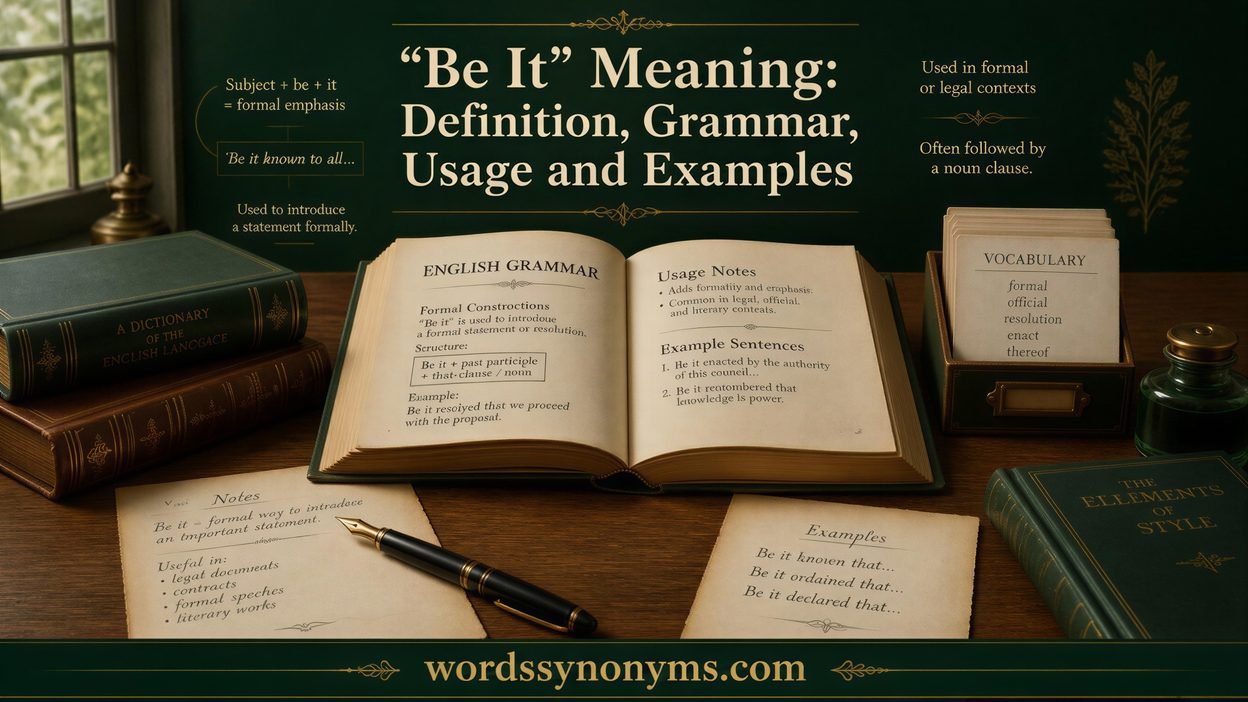
“Be It” Meaning: Definition, Grammar, Usage and Examples explains how this phrase introduces possibilities and fits naturally into English sentences.
Among old-fashioned idioms and sayings, be it remains a widely used English expression, despite sometimes sounding like an outdated phrase. Its meaning involves introducing possibilities or examples, much like saying whether it is. You can use it when creating a list of people or things, including parents, siblings, and other relatives.
For example, “Be it my parents or my siblings, I appreciate their support.” This example sentence demonstrates how the phrase works when listing people or listing alternatives.
From a grammar perspective, be it follows an inverted phrase structure, where the verb be appears before the subject it. This inverted word order differs from the usual word order and creates a distinctive grammatical construction. Its sentence structure makes it a useful conjunction-like expression for introducing alternatives or possibilities.
You may encounter this conditional expression in formal English as well as everyday usage. Understanding its definition, phrase meaning, and grammatical usage helps you improve sentence formation and use the expression naturally in different contexts.

What Does “Be It” Mean?
“Be it” consists of two words: the verb be and the pronoun it. The verb be appears in its base form rather than changing to is, are, or was.
Its meaning depends on the surrounding words and the grammatical construction. In many sentences, it introduces alternatives or possibilities. In other expressions, it communicates a formal declaration or concession.
Consider these examples:
- Be it known that the meeting will begin at nine. (A formal declaration.)
- Be it success or failure, the experience will teach us something. (Introducing alternatives.)
- Be it ever so difficult, the challenge deserves our attention. (Expressing concession.)
- Whether it be true or false, we should examine the evidence. (Presenting possibilities.)
These examples demonstrate that “be it” doesn’t always communicate the same idea. Its surrounding structure determines its function.
The Main Meanings of “Be It”
You can understand the expression more easily by examining its common uses.
| Usage | Meaning | Example |
| Introducing alternatives | Whether something is one option or another | Be it rain or sunshine, the event will continue. |
| Introducing examples | Presenting particular possibilities | Be it music, art, or literature, creativity matters. |
| Expressing concession | Acknowledging a condition despite its circumstances | Be it ever so difficult, the journey continues. |
| Formal declaration | Announcing or establishing something formally | Be it known that the rules have changed. |
| Subjunctive construction | Expressing an uncertain or hypothetical possibility | Whether it be true remains unclear. |
The important point is that “be it” needs context to communicate its intended meaning. You shouldn’t interpret every occurrence as a direct synonym for “whether it is.”
What Is the Grammar Behind “Be It”?
To understand why English speakers write “be it” instead of “is it,” you need to understand the verb be. Its grammatical form changes depending on the subject, tense, and sentence structure.
For example:
- I am ready.
- She is happy.
- They are waiting.
- He was tired.
- We were excited.
- I want to be successful.
Here, am, is, are, was, and were are different forms of the same verb. However, be is its base form.
The construction “be it” often appears in the subjunctive mood. This grammatical mood allows writers to express possibilities, hypothetical situations, wishes, and certain formal statements.
Why Does “Be It” Use the Base Form of “Be”?
The subjunctive mood explains why some sentences use be instead of the ordinary present-tense forms.
In standard English, writers commonly use the subjunctive after certain expressions involving recommendations, requirements, and hypothetical situations.
Consider these examples:
- I suggest that he be present.
- The manager requested that everyone be available.
- Whether it be necessary or not, we must prepare.
- Be it known that the agreement has been approved.
In these sentences, be doesn’t follow the usual subject-verb agreement pattern. Instead, it appears in its base form because the grammatical construction calls for it.
Compare the following examples:
| Ordinary Indicative | Subjunctive Construction |
| She is ready. | I suggest that she be ready. |
| He is available. | The committee requested that he be available. |
| It is necessary. | Whether it be necessary is another question. |
The subjunctive form doesn’t automatically indicate past or future time. It expresses a particular grammatical relationship within the sentence.
How the Subjunctive Mood Works in “Be It”
The subjunctive mood appears in several established English constructions. It frequently communicates something that is desired, required, imagined, or uncertain.
For example:
1. After expressions of recommendation or necessity
- The teacher suggested that he be more careful.
- The doctor recommended that she be examined.
- The committee requested that the proposal be revised.
2. In expressions of uncertainty or possibility
- Whether it be true or false, we need evidence.
- Whatever the reason may be, the decision stands.
3. In formal or literary constructions
- Be it known that the agreement is effective immediately.
- Be it ever so difficult, the task must be completed.
Not every sentence containing be uses the subjunctive mood. However, recognizing these patterns helps you understand why the base form appears in expressions such as “be it” and “whether it be.”
Why “Be It” Doesn’t Always Have One Meaning
The grammatical structure stays similar, but its function changes according to the surrounding words.
For example, consider these sentences:
- Be it known that the decision is final.
- Be it rain or snow, the match will continue.
- Whether it be necessary or optional, the rule applies.
The first sentence makes a formal declaration. The second introduces alternatives. The third presents two possibilities.
Therefore, learning the expression requires understanding its complete sentence pattern rather than memorizing one translation.
Different Meanings and Uses of “Be It”
Although “be it” appears in several contexts, three major uses deserve particular attention. These include introducing alternatives, expressing concession, and appearing in formal declarations.
“Be It” When Introducing Alternatives
One common use of “be it” involves presenting two or more possibilities. The construction often follows this pattern:
Be it A or B, + main clause.
Here, A and B represent different choices, situations, or possibilities. The sentence communicates that the main statement applies regardless of which option occurs.
Consider these examples:
- Be it summer or winter, she enjoys spending time outdoors.
- Be it success or failure, every experience teaches something valuable.
- Be it a small business or a large corporation, customer satisfaction matters.
- Be it Monday or Friday, the office opens at eight.
- Be it love or friendship, trust remains essential.
In each example, the writer presents alternatives without changing the main message.
This construction resembles expressions such as “whether it is A or B” and “regardless of whether it is A or B.”
However, “be it” usually sounds more formal or literary. Everyday speakers often choose simpler wording.
For example:
- Formal: Be it rain or sunshine, the ceremony will proceed.
- Conversational: Whether it rains or shines, the ceremony will go ahead.
Both sentences communicate a similar idea.
“Be It” When Introducing Examples
Writers sometimes use “be it” to introduce examples within a broader statement. This construction helps emphasize that something applies across different categories or situations.
For instance:
- Be it painting, photography, or sculpture, artistic expression requires patience.
- Be it mathematics, science, or history, consistent practice improves understanding.
- Be it a family gathering or a business meeting, good communication matters.
In these examples, the expression introduces particular examples of a larger category.
However, this construction doesn’t always mean exactly the same thing as “for example.” It often carries an additional sense of inclusion or regardless of the particular option.
For a simpler sentence, you could write:
“Whether you enjoy painting, photography, or sculpture, artistic expression requires patience.”
The best choice depends on your intended tone and sentence structure.
“Be It” When Expressing Concession
Another interesting use appears in the expression “be it ever so.”
This construction acknowledges a particular quality or condition while emphasizing that another statement remains true.
For example:
- Be it ever so difficult, the challenge is worth accepting.
- Be it ever so humble, home remains a special place.
- Be it ever so beautiful, the painting cannot replace the original experience.
The phrase often conveys a meaning similar to “however” or “although.”
Consider this sentence:
“Be it ever so difficult, the journey must continue.”
Its meaning is close to:
“However difficult it may be, the journey must continue.”
The construction has a literary or old-fashioned quality. Modern speakers generally prefer the second version because it sounds more natural.
Important: “Be it ever so” is an established expression rather than a pattern that appears frequently in everyday conversation.
“Be It” in Formal Declarations
The expression also appears in formal declarations, traditional documents, and legal-style language.
One familiar construction is:
“Be it known that…”
This phrase introduces an official announcement or declaration. It tells readers that the information following it should be understood as a formal statement.
Examples include:
- Be it known that the agreement takes effect immediately.
- Be it hereby declared that the competition is officially closed.
- Be it known to all members that the meeting has been postponed.
The construction sounds authoritative because it belongs to a traditional style of formal English.
You may encounter similar wording in legal documents, historical records, ceremonial announcements, and formal proclamations.
However, modern professional writing usually favors direct language.
For example:
- Traditional: Be it known that the application period has ended.
- Modern: The application period has officially ended.
Both communicate the announcement, but the modern version is clearer and more direct.
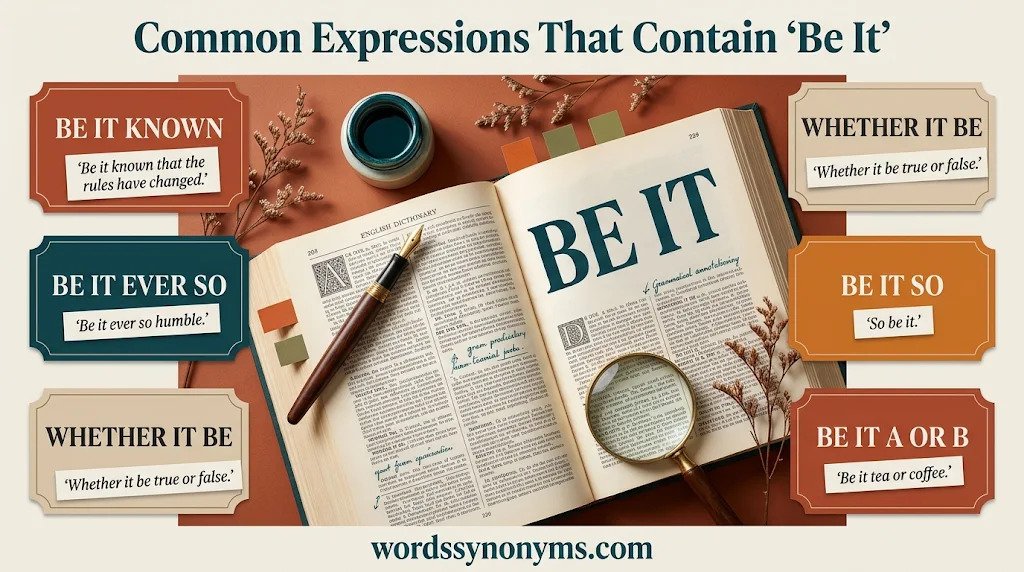
Common Expressions That Contain “Be It”
Several established expressions contain the words “be it.” Understanding their individual meanings will help you recognize them in different contexts.
Be It Known
“Be it known” is a formal expression used to introduce an announcement, declaration, or statement.
It essentially tells readers that something should be officially recognized or understood.
Examples:
- Be it known that the company will introduce new policies next month.
- Be it known to everyone that the final decision has been made.
- Be it known that all participants must follow the competition rules.
The expression has a traditional tone and rarely appears in casual conversation.
Instead of saying “Be it known that the office will remain closed,” you could simply write, “The office will remain closed.”
The second version communicates the information more naturally.
Be It Ever So
“Be it ever so” is a literary construction that expresses concession. It acknowledges a quality or condition without allowing that condition to change the main statement.
For example:
“Be it ever so difficult, the task deserves completion.”
This means that the task deserves completion regardless of how difficult it becomes.
The phrase is also familiar from the traditional song Home! Sweet Home! by John Howard Payne, which includes the famous line:
“Be it ever so humble, there’s no place like home.”
The expression illustrates how writers can acknowledge something while emphasizing a stronger or more important idea.
Although the construction remains recognizable, it sounds old-fashioned in modern everyday English.
Whether It Be
“Whether it be” is another important construction involving the subjunctive form of be.
Writers use it to introduce possibilities, alternatives, or uncertain situations.
Examples:
- Whether it be true or false, the claim needs investigation.
- Whether it be a small problem or a major setback, we should address it.
- Whether it be intentional or accidental, the mistake must be corrected.
- Whether it be summer or winter, the mountains attract visitors.
The construction often appears in formal, literary, and carefully written English.
Compare these examples:
| Formal Construction | More Conversational Alternative |
| Whether it be true or false, we need evidence. | Whether it’s true or false, we need evidence. |
| Whether it be necessary or optional, the rule applies. | Whether it’s necessary or optional, the rule applies. |
| Whether it be intentional or accidental, the error matters. | Whether it was intentional or accidental, the error matters. |
The alternatives may require changes in tense or sentence structure. Choose the version that accurately communicates your intended meaning.
Be It So
“Be it so” is a formal or literary expression that communicates acceptance or acknowledgment.
It can suggest that a situation should be accepted as it stands, even when someone might prefer a different outcome.
For example:
- If the decision cannot be changed, be it so.
- The circumstances are difficult, but be it so.
However, the more familiar modern expression is “so be it.”
For example:
“If that is the only available solution, so be it.”
This means the speaker accepts the situation or outcome.
Although “be it so” and “so be it” contain the same words, their word order differs. The expression “so be it” is considerably more familiar in modern English.
Be It A or B
The construction “be it A or B” introduces alternatives and emphasizes that the following statement applies to either possibility.
Examples:
- Be it tea or coffee, I enjoy a warm drink in the morning.
- Be it a personal decision or a professional responsibility, honesty matters.
- Be it a short journey or a long adventure, preparation makes a difference.
- Be it a simple task or a complicated project, attention to detail is essential.
This construction is useful when you want to present different possibilities without writing separate sentences.
However, don’t force it into every situation. Expressions such as “whether it is” and “whether it’s” often sound more natural.
Read more: As to Why: Meaning, Grammar Usage and Examples
How to Use “Be It” Correctly in Sentences
Using “be it” correctly requires attention to sentence structure, context, and punctuation. The expression can introduce alternatives or appear in established constructions, but it doesn’t work naturally in every sentence.
Sentence Structure and Word Order
The expression commonly appears in several sentence patterns.
Pattern 1: Be it A or B, + main clause
This structure introduces alternatives before presenting the main statement.
Examples:
- Be it rain or sunshine, the farmers must prepare.
- Be it success or failure, the experience matters.
- Be it a weekday or weekend, the store remains open.
Pattern 2: Whether it be A or B, + main clause
This construction introduces possibilities using a more explicit subjunctive structure.
Examples:
- Whether it be a minor issue or a serious problem, report it immediately.
- Whether it be intentional or accidental, the mistake requires attention.
Pattern 3: Main clause + whether it be A or B
The construction can also appear later in a sentence.
Examples:
- We must respect every opinion, whether it be popular or unpopular.
- The organization welcomes everyone, whether it be beginners or experienced professionals.
Pattern 4: Be it known that + declaration
This structure introduces a formal announcement.
Examples:
- Be it known that the agreement is now effective.
- Be it known that the committee has approved the proposal.
Understanding these patterns makes it easier to recognize where “be it” belongs.
Punctuation Rules for “Be It”
Punctuation depends on the sentence structure rather than the expression alone.
Here are some useful guidelines:
1. Use a comma after an introductory construction.
When “be it” introduces alternatives at the beginning of a sentence, place a comma before the main clause.
Example:
“Be it rain or sunshine, the outdoor event will continue.”
2. Use commas around a nonessential interrupting construction when necessary.
Example:
“The decision, whether it be popular or unpopular, must be respected.”
The commas separate the interrupting phrase from the main sentence.
3. Don’t automatically insert commas between alternatives.
Example:
“Be it success or failure, we must keep moving.”
The words “success or failure” form a connected alternative structure. They don’t require an additional comma.
4. Use appropriate punctuation after formal declarations.
Example:
“Be it known that the meeting has been postponed.”
The sentence ends with a period because it makes a statement.
Correct punctuation helps readers understand how the expression connects to the rest of the sentence.
Using “Be It” in Formal Writing
The expression works best in writing that deliberately adopts a formal, literary, or traditional tone.
You might encounter it in:
- Legal-style declarations.
- Historical documents.
- Literary writing.
- Ceremonial announcements.
- Formal speeches.
- Traditional expressions.
For example:
“Be it known that all members must comply with the revised regulations.”
This sentence sounds formal and authoritative.
However, most modern business writing values clarity and directness. A simpler version would be:
“All members must comply with the revised regulations.”
Choose “be it” when its traditional tone serves a clear purpose. Otherwise, straightforward wording usually works better.
Using “Be It” in Everyday Conversation
Although grammatically correct in suitable constructions, “be it” isn’t particularly common in everyday conversation.
Most English speakers prefer simpler expressions because they sound more natural and require less effort to understand.
Compare these examples:
| Formal Expression | Natural Conversational Version |
| Be it rain or sunshine, we will go. | Whether it rains or shines, we’ll go. |
| Be it known that the store is closed. | The store is closed. |
| Whether it be true or false, tell me. | Whether it’s true or false, tell me. |
| Be it ever so difficult, continue. | However difficult it gets, keep going. |
The conversational versions preserve the intended meanings without sounding unnecessarily formal.
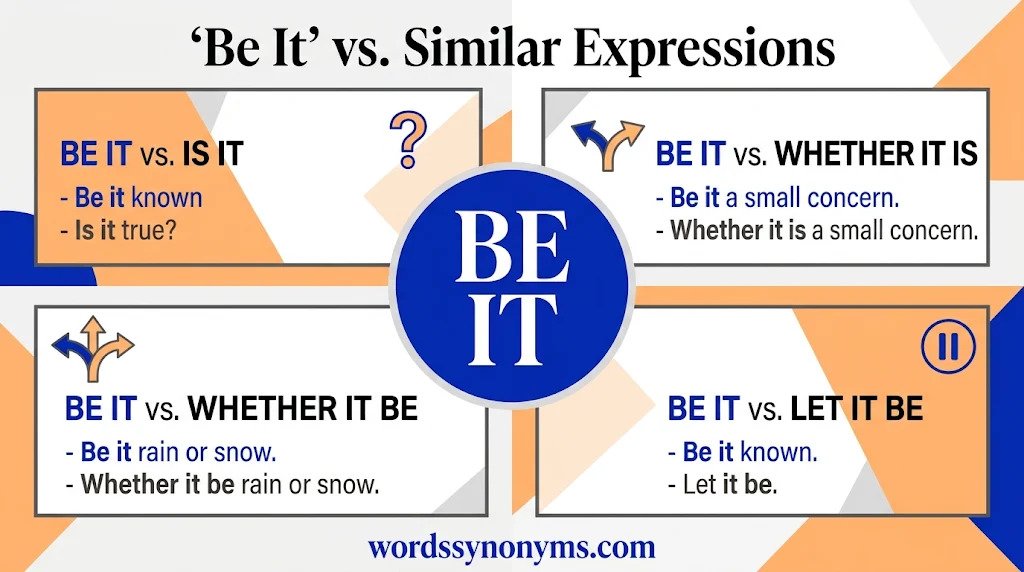
“Be It” vs. Similar Expressions
Several English expressions resemble “be it” in appearance or meaning. However, they perform different grammatical functions.
Understanding these differences will help you avoid awkward sentences.
Be It vs. Is It
The expressions “be it” and “is it” contain different forms of the verb be.
“Be it” uses the base form of the verb. It commonly appears in subjunctive constructions and established expressions.
“Is it” uses the present-tense form is. It commonly appears in questions and ordinary statements.
Compare:
| Be It | Is It |
| Be it known that the rules have changed. | Is it true that the rules have changed? |
| Whether it be necessary remains unclear. | Is it necessary to change the rules? |
| Be it success or failure, we must continue. | Is it success or failure? |
Notice that “is it” commonly forms a direct question. Meanwhile, “be it” usually belongs to a different grammatical construction.
You shouldn’t replace one with the other without considering the sentence’s meaning.
Be It vs. Whether It Is
Both expressions can introduce alternatives or possibilities, but their structures and tones differ.
“Be it” often sounds formal or literary, particularly when introducing alternatives.
“Whether it is” is a more familiar construction in modern English.
Examples:
- Formal: Be it a small concern or a major issue, address it immediately.
- Conversational: Whether it is a small concern or a major issue, address it immediately.
Both sentences communicate that the instruction applies to either situation.
However, the exact construction may depend on tense and context.
For example:
“Whether it is necessary remains unclear.”
This sentence uses the indicative form is.
“Whether it be necessary remains unclear.”
This version uses the subjunctive form be and carries a more formal tone.
Both are grammatical, although the second sounds more traditional.
Be It vs. Whether It Be
These expressions are closely related, but they appear in different sentence patterns.
“Be it A or B” often introduces alternatives directly.
Example:
“Be it rain or snow, the event will continue.”
“Whether it be A or B” explicitly introduces a question of alternatives or possibilities.
Example:
“Whether it be rain or snow, the event will continue.”
The sentences communicate nearly identical ideas. However, the second construction includes the conjunction whether.
Both can sound formal or literary, depending on the surrounding sentence.
Be It vs. Let It Be
These expressions may look similar, but their meanings are entirely different.
“Be it” often appears in subjunctive constructions, formal declarations, or expressions introducing alternatives.
“Let it be” is an imperative construction that expresses permission, acceptance, or a request to leave something alone.
Examples:
- Be it known that the agreement has been approved.
- Let it be known that the agreement has been approved.
- Be it rain or sunshine, we will continue.
- Let it be. There’s no reason to argue.
The final example uses “let it be” to suggest that someone should stop interfering or arguing.
Remember that “be it” and “let it be” aren’t interchangeable.
Common Mistakes to Avoid When Using “Be It”
Even advanced English learners can misunderstand this expression. Most mistakes happen when writers ignore its grammatical function or use it in unsuitable contexts.
Here are some common problems and their corrections.
Confusing “Be It” With “Is It”
The two expressions don’t serve the same grammatical purpose.
Incorrect: Be it necessary to attend the meeting?
Correct: Is it necessary to attend the meeting?
The first sentence attempts to use a subjunctive construction as an ordinary question. The second correctly forms a direct question.
Using “Be It” Instead of an Ordinary Present-Tense Verb
The base form be doesn’t replace is or are in ordinary statements.
Incorrect: She be happy with the results.
Correct: She is happy with the results.
However, a suitable subjunctive construction can use be:
Correct: The manager requested that she be available.
The grammatical structure determines which form you need.
Treating Every “Be It” Construction as Uncertainty
“Be it” doesn’t always express doubt or uncertainty.
For example:
“Be it known that the meeting has been canceled.”
This sentence makes a formal declaration rather than expressing uncertainty.
By contrast:
“Whether it be true remains unclear.”
This sentence presents an uncertain possibility.
The surrounding construction determines the meaning.
Confusing “Be It A or B” With a Question
The construction introduces alternatives. It doesn’t automatically create a question.
Correct: Be it a small problem or a major setback, we must respond.
Question: Is it a small problem or a major setback?
The first sentence makes a statement about both possibilities. The second directly asks someone to identify the situation.
Using Formal Expressions in Casual Conversations
Some constructions containing “be it” sound outdated or overly formal in everyday speech.
Unnatural in casual conversation: Be it rain or sunshine, I shall attend the gathering.
More natural: Whether it rains or shines, I’ll attend the gathering.
Both sentences express a similar idea. However, the second better matches ordinary conversational English.
Confusing “Be It So” With “So Be It”
These expressions have different word orders, and “so be it” is much more familiar.
Example:
“If that’s the final decision, so be it.”
This expresses acceptance of the outcome.
Don’t assume that changing the word order always preserves the same natural usage.
“Be It” Examples in Sentences
The following examples demonstrate how different constructions use “be it” in context. Each sentence includes a short explanation to clarify its intended meaning.
Examples Introducing Alternatives
1. Be it summer or winter, the mountain attracts visitors.
The mountain attracts visitors during either season.
2. Be it success or failure, every attempt teaches something valuable.
Both positive and negative outcomes provide useful lessons.
3. Be it a small business or a large company, customer trust matters.
The importance of customer trust applies to businesses of every size.
4. Be it morning or evening, she enjoys reading.
She enjoys reading regardless of the time.
5. Be it friendship or love, honesty strengthens every relationship.
Honesty matters in both types of relationships.
Examples Using “Whether It Be”
6. Whether it be true or false, the information deserves investigation.
The information should receive attention regardless of its accuracy.
7. Whether it be a minor mistake or a serious error, report it.
Both situations require reporting.
8. Whether it be intentional or accidental, the damage must be addressed.
The cause doesn’t remove the need to address the damage.
9. Whether it be a personal choice or a professional responsibility, handle it carefully.
Both situations require careful consideration.
10. Whether it be easy or difficult, learning requires patience.
The importance of patience remains unchanged.
Examples Expressing Concession
11. Be it ever so difficult, the goal remains worth pursuing.
The goal remains valuable despite the difficulty.
12. Be it ever so beautiful, nothing compares to home.
Home remains special regardless of other beautiful places.
Examples in Formal Declarations
13. Be it known that the application deadline has been extended.
This formally announces a change to the deadline.
14. Be it declared that the competition is officially closed.
This uses a formal declaration to announce the competition’s closure.
15. Be it known to all participants that attendance is mandatory.
This formally informs participants about an important requirement.
These examples demonstrate that “be it” works in different constructions. However, the alternatives and formal declarations should suit the tone of your writing.
A Practical Case Study: Choosing the Right “Be It” Construction
Imagine you’re writing an announcement about an outdoor event. The weather may change, but the organizers intend to continue.
You could express this idea in several ways.
| Sentence | Tone | Meaning |
| Be it rain or sunshine, the event will continue. | Formal or literary | The event continues in either condition. |
| Whether it rains or shines, the event will continue. | Natural and conversational | The event continues regardless of weather. |
| Regardless of the weather, the event will continue. | Direct and professional | Weather won’t affect the event. |
| Even if it rains, the event will continue. | Everyday English | Rain won’t stop the event. |
All four sentences communicate a related idea, but their grammatical structures differ.
The first uses the alternative construction “be it A or B.” The second uses a conditional alternative. The third expresses independence from the circumstances. The fourth emphasizes one particular possibility.
The lesson: Choose your expression according to the meaning and tone you want to communicate. Don’t use formal wording simply because it sounds sophisticated.

What Are Some Alternatives to “Be It”?
The best alternative depends on how “be it” functions in your sentence. Some expressions introduce alternatives, while others communicate concession or acceptance.
Here are several useful options.
| Alternative | Meaning | Example |
| Whether it is | Introduces two possibilities | Whether it is easy or difficult, try your best. |
| Whether it’s | Informal version of whether it is | Whether it’s raining or sunny, we’ll go. |
| Whether or not | Emphasizes that a condition doesn’t change the outcome | Whether or not you agree, the decision stands. |
| Regardless of whether | Shows that the outcome remains unchanged | Regardless of whether it’s difficult, continue. |
| No matter whether | Emphasizes that different possibilities don’t affect the result | No matter whether you win or lose, enjoy the game. |
| Although it may be | Expresses concession | Although it may be difficult, the task is manageable. |
| However difficult | Acknowledges a degree of difficulty | However difficult the challenge becomes, keep going. |
| So be it | Expresses acceptance | If that’s the final decision, so be it. |
When Should You Use These Alternatives?
Each alternative serves a slightly different purpose.
- Use “whether it is” when introducing two possibilities in ordinary writing.
- Use “whether it’s” when you want a more conversational tone.
- Use “whether or not” when emphasizing that a condition doesn’t affect the outcome.
- Use “regardless of whether” in professional or explanatory writing.
- Use “no matter whether” when highlighting that different outcomes lead to the same conclusion.
- Use “although it may be” when acknowledging a difficulty or contrasting condition.
- Use “however difficult” when expressing concession naturally.
- Use “so be it” when accepting an outcome without further objection.
These expressions can overlap in meaning, but they aren’t perfect substitutes in every sentence. Always check the complete sentence before replacing one construction with another.
Read more: Bad Rap or Bad Rep: Which Phrase Is Correct?
FAQs
1. What does “be it” mean in simple English?
“Be it” means “whether it is” and introduces different possibilities or examples. It helps you mention people, things, or situations within a sentence.
2. Is “be it” grammatically correct?
Yes, “be it” is grammatically correct. It uses an inverted structure in which the verb “be” comes before the subject “it.”
3. Is “be it” an old-fashioned expression?
“Be it” can sound formal or old-fashioned in everyday conversation. However, writers still use it in modern English, especially when introducing alternatives.
4. What is an example of “be it” in a sentence?
Here is a simple example: “Be it rain or sunshine, we will continue our journey.” The phrase introduces two possible weather conditions without changing the sentence’s meaning.
5. Can I use “be it” in formal writing?
Yes, “be it” works well in formal writing, academic discussions, and literary expressions. It can make your sentences sound polished when you introduce different possibilities.
6. What is the difference between “be it” and “whether it is”?
Both expressions can introduce alternatives, but their sentence structures differ. “Be it” uses inverted word order, while “whether it is” follows a more familiar grammatical structure.
Conclusion
Understanding the meaning of “be it” helps you recognize and use this expression with confidence. Although it may sound slightly old-fashioned, it still has a place in modern English. You can use it to introduce alternatives, mention different possibilities, or create a more polished sentence. Its meaning is similar to “whether it is,” making it easier to understand once you see it in context.
The most important thing to remember is its unusual word order. In this expression, “be” comes before “it,” creating an inverted grammatical structure. With a little practice, you’ll recognize when this phrase fits naturally into your writing. Whether you’re discussing people, situations, or everyday choices, “be it” can add variety and clarity to your sentences.

Ethan Parker writes about English grammar, sentence structure, punctuation, and everyday language rules. Through WordsSynonyms.com, he aims to make grammar easier to understand with simple explanations, practical examples, and helpful learning resources.


[…] Read more: “Be It” Meaning: Definition, Grammar, Usage and Examples […]