

If you’re unsure about Bad Rap or Bad Rep: Which Phrase Is Correct?, the difference comes down to unfair blame and informal reputation in English. These confusing phrases often create phrase confusion because they sound the same and sound close during fast speech.
However, they express different ideas when you consider their actual meaning. Bad rap is the standard phrase, a traditional expression, and a widely accepted expression. It is also the true idiom when describing unfair criticism, unfair blame, or an undeserved negative reputation. It refers to an unfairly negative reputation or an unfairly negative image that someone receives without deserving it.
For example, a company might get a bad rap because of one mistake, even when its overall service remains excellent. This expression is the safest choice for writers, students, bloggers, and professionals who want a correct expression in formal writing and polished writing. A simple rule makes choosing one easier: use bad rap when discussing unfair criticism or blame. Understanding this distinction helps you avoid common errors and choose the right expression.
On the other hand, bad rep is an informal shortening of bad reputation. It is commonly used in casual speech, spoken language, spoken English, and everyday usage. This casual expression works well in informal usage, although it might not suit every sentence or email. You can use it when discussing someone’s reputation in relaxed conversations.
For instance, a student might say that a difficult subject has a bad rep because many learners find it challenging. Similarly, a restaurant might have a bad rep because of its slow service. Both phrases appear in everyday communication, but their phrase history and traditional usage explain why they aren’t always interchangeable. Context helps you decide which expression sounds appropriate.
A quick answer and real examples make these differences easier to understand. They also help prevent common mistakes when choosing between the two expressions. Following this practical advice can improve your writing and make your sentences clearer. The distinction matters whenever you want to express someone’s reputation accurately.
Quick Answer
Bad rap is the traditional and widely accepted expression when someone receives unfair criticism, blame, or an undeserved negative reputation. Bad rep is an informal abbreviation of bad reputation that describes someone’s unfavorable public image.
For example:
- Bad rap: “Pigeons get a bad rap, but they’re intelligent birds.”
- Bad rep: “That restaurant has a bad rep because of its poor customer service.”
Use bad rap for unfair criticism and bad rep for an informal reference to a negative reputation. In formal writing, bad reputation is usually the clearest choice.

Is It Bad Rap or Bad Rep?
The correct choice depends on what you want to communicate. Although both expressions concern negative opinions, their meanings have slightly different shades.
Bad rap is an established English idiom. It describes unfair criticism, undeserved blame, or a negative judgment that doesn’t accurately reflect someone or something.
For instance:
“Chocolate gets a bad rap because people often blame it for unhealthy eating habits.”
This sentence suggests that chocolate receives more criticism than it deserves. The expression highlights an unfair judgment rather than simply describing a negative reputation.
Bad rep is a shortened form of bad reputation. People use it informally when discussing someone’s unfavorable standing among others.
For example:
“That company has a bad rep because it frequently misses delivery deadlines.”
Here, the company has developed a negative public image because of its behavior. The sentence doesn’t necessarily suggest that the criticism is unfair.
Consider these distinctions:
| Expression | Meaning | Example |
| Bad rap | Unfair criticism or undeserved blame | “Vegetarians get a bad rap from people who misunderstand their diets.” |
| Bad rep | An unfavorable reputation | “The business has a bad rep for ignoring customer complaints.” |
Both expressions appear in everyday English. However, bad rap remains the traditional idiom when discussing unfair criticism.
What Does Bad Rap Mean?
The expression bad rap refers to an unfairly negative judgment, accusation, or reputation. When someone gets a bad rap, people criticize or blame them in ways that may not reflect the truth.
The word rap in this expression doesn’t refer to the musical genre. Instead, it belongs to an older informal use connected with criticism, blame, or punishment.
Imagine a student who receives poor grades because the teacher misunderstands one of their assignments. Other students might start calling that student careless.
If the student usually works hard and completes assignments responsibly, that negative judgment gives them a bad rap.
The expression often appears when people defend someone or something against unfair assumptions.
For example:
- “Cats get a bad rap for being unfriendly.”
- “The new employee received a bad rap after one small mistake.”
- “Fast food gets a bad rap, although some options can fit into a balanced diet.”
Notice how each example suggests that the criticism might be exaggerated or undeserved.
Examples of Bad Rap in Sentences
Understanding an idiom becomes easier when you see how people use it in different situations.
Here are seven examples of bad rap in everyday English:
| Example sentence | Meaning |
| “Math gets a bad rap, but it can be surprisingly enjoyable.” | People unfairly describe math as boring or difficult. |
| “The neighborhood has a bad rap despite recent improvements.” | The neighborhood has an unfavorable reputation that may no longer be deserved. |
| “My brother gets a bad rap for being quiet.” | People judge him negatively because of his quiet personality. |
| “Social media gets a bad rap for distracting students.” | People often criticize social media without considering its useful applications. |
| “The product got a bad rap after one defective batch.” | The product received excessive criticism because of a limited problem. |
| “Dogs sometimes get a bad rap because of irresponsible owners.” | People unfairly blame dogs for problems caused by their owners. |
| “The restaurant gets a bad rap, although its new management has improved everything.” | Its negative reputation doesn’t reflect its current quality. |
Important: A bad rap doesn’t always mean that every criticism is false. Sometimes, a person or organization deserves some criticism but receives more blame than the circumstances justify.
This distinction makes the expression especially useful when discussing fairness, assumptions, and public perception.
Read more: Is “Agreeance” a Proper Word in English? Meaning and Examples
What Does Bad Rep Mean?
Bad rep is an informal expression derived from bad reputation. It describes an unfavorable image that someone or something has developed among other people.
A reputation forms through experiences, behavior, public comments, and repeated observations. When people consistently associate someone with negative qualities, that person may develop a bad rep.
For example, imagine a restaurant that regularly serves cold food and responds poorly to complaints. Customers might warn their friends about the restaurant.
Eventually, the restaurant develops a bad rep for poor service.
Unlike bad rap, this expression doesn’t automatically suggest unfair treatment. The negative reputation might result from genuine problems.
People commonly use bad rep when discussing:
- Individuals with unfavorable public images.
- Businesses known for poor customer service.
- Products associated with disappointing quality.
- Neighborhoods with negative public perceptions.
- Schools or organizations facing repeated complaints.
Because rep shortens reputation, the expression sounds casual and conversational. In formal writing, however, spelling out bad reputation usually provides greater clarity.
Examples of Bad Rep in Sentences
The following examples show how bad rep works in natural conversations.
| Example sentence | Meaning |
| “That company has a bad rep for treating employees poorly.” | Employees associate the company with unfair treatment. |
| “The restaurant has a bad rep because of its slow service.” | Customers have developed an unfavorable opinion of the restaurant. |
| “He has a bad rep among his classmates.” | His classmates hold a negative opinion of him. |
| “The neighborhood has a bad rep for frequent traffic problems.” | People associate the neighborhood with traffic difficulties. |
| “That brand has a bad rep for selling unreliable products.” | Customers don’t trust the brand’s product quality. |
| “The school has a bad rep because of its outdated facilities.” | People have an unfavorable impression of the school. |
| “The company is trying to repair its bad rep.” | The company wants to improve its negative public image. |
These examples focus on an unfavorable reputation rather than necessarily unfair criticism.
For instance, a business might have a bad rep because customers repeatedly experience poor service. In that situation, the reputation reflects actual experiences.
Why Do People Confuse Bad Rap and Bad Rep?
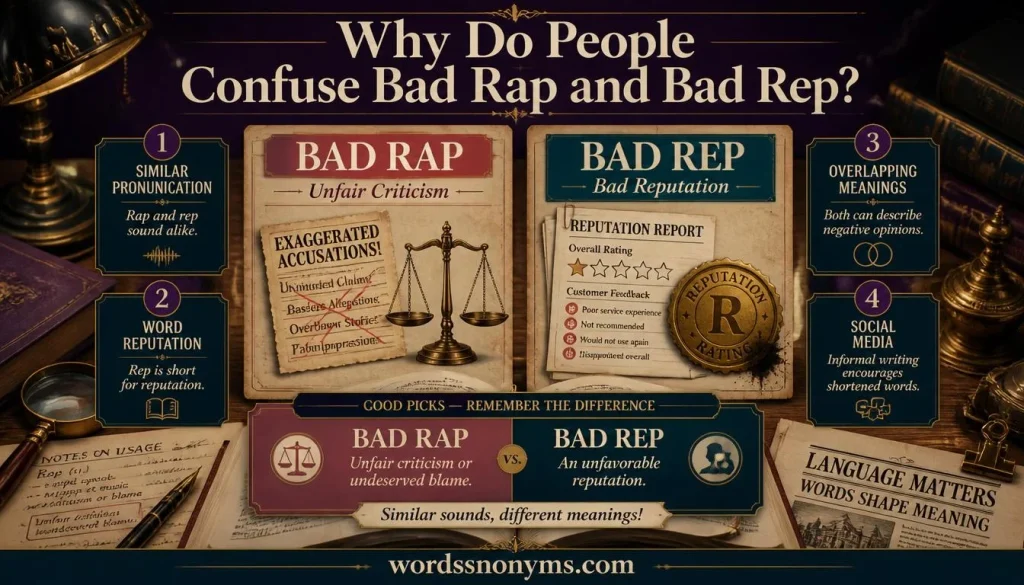
The confusion between bad rap and bad rep comes from their similar pronunciation, overlapping meanings, and connection to reputation.
Although the expressions have different histories and uses, everyday conversations often blur their boundaries.
Here are the main reasons people mix them up.
Similar Pronunciation
The words rap and rep sound quite similar in many accents. When people hear these expressions in conversation, they may struggle to distinguish their spellings.
This becomes especially common when someone learns an expression through speech rather than reading.
For example, a person might hear:
“That movie gets a bad rap.”
Without knowing the traditional spelling, they might write bad rep instead.
The Influence of the Word Reputation
The word reputation naturally encourages people to spell the expression as bad rep.
Since rep serves as an informal shortening of reputation, the spelling seems logical.
For example:
- Reputation becomes rep.
- Bad reputation becomes bad rep.
- Good reputation becomes good rep.
This pattern makes sense, especially in casual conversations.
However, the established idiom bad rap has its own history and meaning. Its spelling doesn’t come from shortening reputation.
Overlapping Meanings
Both expressions can describe a negative public image. That’s another reason people sometimes treat them as interchangeable.
Consider these sentences:
- “That actor gets a bad rap.”
- “That actor has a bad rep.”
The first suggests that people judge the actor unfairly. The second describes the actor’s unfavorable reputation.
In some situations, both expressions might communicate a similar general idea. However, their emphasis differs.
Informal Communication and Social Media
Social media, text messages, and online discussions encourage shortened expressions. People frequently write rep instead of reputation because it saves space.
As a result, bad rep appears naturally in informal communication.
Meanwhile, bad rap remains common as an established idiom. Readers encounter both expressions across different platforms and writing styles.
The easiest way to avoid confusion is to remember their central meanings.
- Bad rap: Unfair criticism or undeserved blame.
- Bad rep: An unfavorable reputation.
Bad Rap vs. Bad Rep: Key Differences
Although these expressions sometimes overlap, their meanings aren’t identical. Understanding their differences helps you choose the right phrase without second-guessing yourself.
The biggest distinction involves fairness versus reputation. Bad rap often suggests that someone receives undeserved criticism. Bad rep simply describes an unfavorable reputation.
Here’s a closer comparison.
| Feature | Bad Rap | Bad Rep |
| Meaning | Unfair criticism, blame, or negative judgment | An unfavorable reputation |
| Origin | Established English idiom | Informal shortening of reputation |
| Main emphasis | Unfair treatment or undeserved criticism | Public image or social standing |
| Tone | Conversational | Casual and informal |
| Formality | Established idiomatic expression | Less suitable for formal writing |
| Common usage | Getting a bad rap | Having a bad rep |
| Example | “That profession gets a bad rap.” | “That company has a bad rep.” |
The Difference Between Getting and Having a Bad Rap or Bad Rep
The verbs surrounding these expressions provide another helpful clue.
People commonly get a bad rap when others criticize or judge them unfairly. The phrase emphasizes receiving negative treatment.
For example:
“Teachers sometimes get a bad rap for assigning too much homework.”
This sentence suggests that people may criticize teachers without considering their reasons for assigning homework.
Meanwhile, people commonly have a bad rep when others associate them with unfavorable qualities.
For example:
“That contractor has a bad rep for missing project deadlines.”
The sentence describes an existing reputation rather than emphasizing unfair treatment.
These patterns aren’t rigid grammatical rules. However, they reflect common usage and make the expressions easier to distinguish.
Can Bad Rap and Bad Rep Be Interchangeable?
Sometimes, yes, especially in casual conversations. However, replacing one with the other can change the intended meaning.
Consider this example:
“That neighborhood gets a bad rap.”
This suggests that people judge the neighborhood unfairly or exaggerate its problems.
Now consider:
“That neighborhood has a bad rep.”
This simply describes its negative reputation.
The second sentence doesn’t tell you whether the reputation is deserved.
Therefore, choose the expression that communicates your intended meaning rather than relying on their similar sounds.
Is Bad Rep Grammatically Correct?
Yes. Bad rep is an understandable informal expression formed by shortening bad reputation. English speakers commonly use rep as a casual alternative to the longer word.
For example:
- “That store has a bad rep.”
- “The company is working to improve its rep.”
- “He doesn’t want a bad rep at work.”
These sentences use rep as a noun referring to reputation.
However, there’s an important distinction between grammatical acceptability and traditional idiomatic usage.
Bad rap remains the established spelling of the expression meaning unfair criticism or undeserved blame. Writing bad rep in its place can create ambiguity.
For example:
- Traditional idiom: “Politicians often get a bad rap.”
- Informal reputation expression: “That politician has a bad rep.”
Both sentences are understandable, but they emphasize different things.
Should You Use Bad Rep in Formal Writing?
Although bad rep works in casual communication, bad reputation generally sounds more polished in professional and academic writing.
Consider these alternatives:
| Informal expression | More formal alternative |
| The company has a bad rep. | The company has a poor reputation. |
| He has a bad rep at work. | He has an unfavorable reputation at work. |
| The product has a bad rep. | The product has developed a negative reputation. |
| That school has a bad rep. | That school has an unfavorable public image. |
The full expression also removes uncertainty for readers who might not recognize the abbreviation.
However, there’s no need to avoid bad rep in every situation. Casual articles, conversations, and informal messages can use it naturally.
Is It Good Rap or Good Rep?
The expressions good rap and good rep follow a similar distinction.
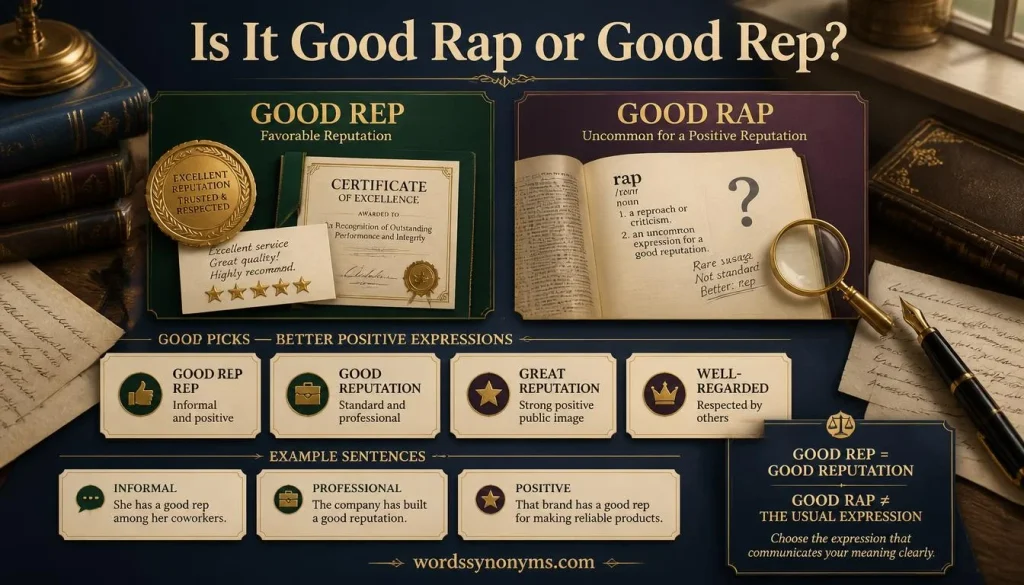
Good rep is an informal shortening of good reputation. It describes someone or something with a favorable public image.
For example:
“That restaurant has a good rep for serving fresh food.”
The sentence means customers generally associate the restaurant with quality food.
Good rap isn’t the usual opposite of bad rap. Although people might occasionally use it creatively, good reputation or good rep communicates a favorable public image more naturally.
Consider these examples:
- “She has a good rep among her coworkers.”
- “The company has built a good reputation.”
- “That brand has a good rep for making reliable products.”
- “He earned a good reputation through years of honest work.”
Good Rap vs. Good Rep: Comparison Table
| Expression | Meaning | Usage |
| Good rap | Not the usual expression for a favorable reputation | Uncommon in this context |
| Good rep | A favorable reputation | Informal |
| Good reputation | A favorable public image | Standard and formal |
| Great reputation | A particularly strong public image | Standard and widely accepted |
If you want to describe someone positively, good reputation is the safest choice in formal writing. Use good rep when the conversation calls for a relaxed tone.
Common Expressions Related to Bad Rap and Bad Rep
English offers several expressions for discussing criticism, reputation, and public perception. Some focus on unfair judgment while others describe how people view someone.
Learning these alternatives helps you communicate more precisely.
Get a Bad Rap
Get a bad rap means receiving unfair criticism or an undeserved negative judgment.
Example:
“Online gaming gets a bad rap because people often overlook its social benefits.”
The sentence suggests that online gaming receives more criticism than it deserves.
Have a Bad Rep
Have a bad rep means having an unfavorable reputation among other people.
Example:
“That repair shop has a bad rep for charging customers too much.”
The expression describes the shop’s negative public image.
Clear Your Name
Clear your name means proving that you didn’t commit an alleged wrongdoing.
Example:
“She presented the missing documents to clear her name.”
This expression focuses on removing suspicion or correcting a false accusation.
Restore Your Reputation
Restore your reputation means rebuilding a positive public image after criticism, controversy, or mistakes.
Example:
“The company introduced better customer policies to restore its reputation.”
This expression often appears in professional and public relations contexts.
Earn a Good Reputation
Earn a good reputation means developing a positive image through consistent behavior, quality work, or trustworthy actions.
Example:
“The business earned a good reputation by treating customers fairly.”
Unlike bad rap, this expression emphasizes positive recognition.
Give Someone a Fair Chance
Give someone a fair chance means judging them without allowing assumptions or past criticism to control your opinion.
Example:
“Before rejecting the new employee, give him a fair chance to demonstrate his skills.”
This expression works particularly well when discussing unfair judgments.
Bad Rap or Bad Rep: Which One Should You Use?
Choosing between these expressions becomes simple once you identify your intended meaning.
Use bad rap when someone receives unfair criticism, undeserved blame, or an exaggerated negative judgment.
Use bad rep when you want to describe someone’s unfavorable reputation in informal conversation.
For professional documents, academic assignments, and formal articles, consider using bad reputation instead.
Here are some practical situations to help you decide.
| Situation | Best expression | Example |
| Someone receives unfair criticism | Bad rap | “Introverts get a bad rap for being antisocial.” |
| A business has poor customer feedback | Bad rep | “That store has a bad rep for late deliveries.” |
| A company faces unfair public criticism | Bad rap | “The company gets a bad rap despite improving its services.” |
| Someone has an unfavorable public image | Bad rep | “He has a bad rep among local business owners.” |
| A formal report discusses public perception | Bad reputation | “The organization has developed a poor reputation.” |
| Someone receives undeserved blame | Bad rap | “The assistant got a bad rap for a mistake she didn’t make.” |
A Simple Trick to Remember Bad Rap vs. Bad Rep
If you frequently confuse these expressions, remember one simple connection:
- Rap = criticism: Think about someone receiving unfair blame or judgment.
- Rep = reputation: Think about someone’s public image or standing.
For example, imagine a hardworking employee who makes one mistake. Everyone starts calling him unreliable.
You could say:
“He got a bad rap after one unfortunate mistake.”
Now imagine another employee who repeatedly misses deadlines and ignores responsibilities.
You could say:
“He has a bad rep because he rarely completes his work on time.”
The first example emphasizes potentially unfair judgment. The second describes an unfavorable reputation based on behavior.
Real-Life Context: Understanding Bad Rap and Bad Rep
Sometimes, the difference becomes clearer through practical situations rather than dictionary-style definitions.
Consider these three scenarios.
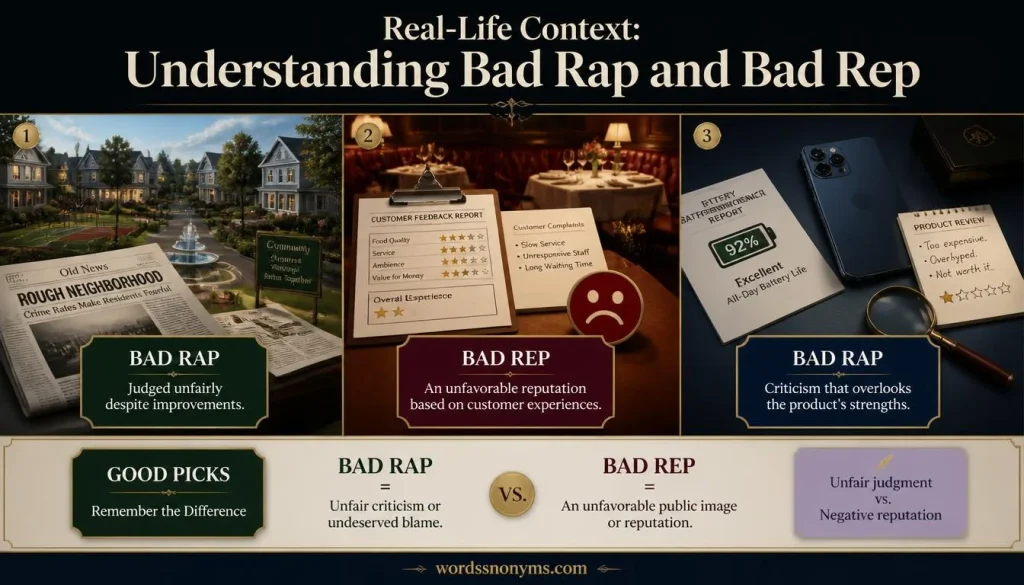
Case Study: A Neighborhood With an Unfair Reputation
Imagine a neighborhood that once experienced frequent petty theft. Over several years, residents and local businesses improve security and community facilities.
Despite these improvements, outsiders continue describing the area as dangerous.
Someone might say:
“The neighborhood gets a bad rap because its reputation hasn’t caught up with recent improvements.”
Here, bad rap works because the negative judgment no longer reflects the neighborhood’s current conditions.
Case Study: A Restaurant With Poor Customer Service
Imagine a restaurant that regularly receives complaints about slow service, incorrect orders, and unhelpful staff.
Customers share their experiences and discourage others from visiting.
Someone might say:
“The restaurant has a bad rep because customers consistently report poor service.”
Here, bad rep describes the restaurant’s unfavorable reputation. The expression doesn’t suggest that customers are criticizing it unfairly.
Case Study: A Product That Receives Excessive Criticism
Imagine a smartphone model that receives criticism because its battery performs poorly during heavy gaming.
However, the device works well for ordinary calls, messaging, and everyday tasks.
Someone might say:
“That smartphone gets a bad rap because people overlook its strengths.”
This sentence uses bad rap because the criticism may exaggerate one weakness while ignoring other qualities.
These scenarios reveal the central distinction: unfair criticism points toward bad rap, while an unfavorable public image points toward bad rep.
Read more: Why Does an Alarm “Go Off” and Not “Go On”? Meaning
FAQs
1. Is Bad Rap or Bad Rep Correct?
Bad rap is the traditional and widely accepted idiom for unfair criticism or blame. Bad rep is also used in everyday English as an informal way to say bad reputation. Both expressions are understandable, but bad rap is generally safer in formal writing.
2. Does Bad Rep Mean Bad Reputation?
Yes, bad rep is an informal shortening of bad reputation. People commonly use it in casual conversations when describing someone or something with a poor public image. For example, a restaurant might have a bad rep for serving cold food.
3. Why Do Bad Rap and Bad Rep Sound the Same?
Both expressions have nearly identical pronunciation in everyday American English. The words rap and rep sound similar, especially during fast speech. This similarity often makes it difficult to identify the correct spelling without considering the meaning.
4. Should You Use Bad Rap in Formal Writing?
Yes, bad rap is generally the better choice in formal writing when you mean unfair criticism or undeserved blame. It is an established idiom that readers readily recognize. Bad rep may sound too casual in professional documents or academic writing.
5. Can You Say Someone Has a Bad Rep?
Yes, you can say someone has a bad rep in informal conversations. It means that person has a poor reputation among others. For example, That salesperson has a bad rep for making false promises.
6. What Is the Difference Between a Bad Rap and a Bad Reputation?
A bad rap usually suggests unfair criticism, blame, or an undeserved negative image. A bad reputation simply describes how others generally view someone or something negatively. The important difference is that a bad rap often suggests the negative judgment isn’t deserved.
Conclusion
Choosing between bad rap and bad rep becomes easier once you understand their meanings. Bad rap is the traditional idiom for unfair criticism, undeserved blame, or an unfairly negative reputation. Meanwhile, bad rep is an informal shortening of bad reputation that works naturally in casual conversations. Although both expressions appear in everyday English, they aren’t always interchangeable. The context and tone of your sentence should guide your choice.
When writing emails, articles, academic papers, or professional documents, bad rap is generally the safer option when you mean unfair criticism. You can still use bad rep when a relaxed, conversational tone feels more appropriate. Remember this simple distinction, and you’ll have fewer doubts whenever these similar-sounding expressions appear in your writing.

Hamza Rehman is passionate about English vocabulary, synonyms, and word meanings. He enjoys exploring how words connect and how the right word can make communication clearer. Through WordsSynonyms, he creates easy-to-understand vocabulary guides, practical examples, and helpful word alternatives for students and writers.



[…] Read more: Bad Rap or Bad Rep: Which Phrase Is Correct? […]