
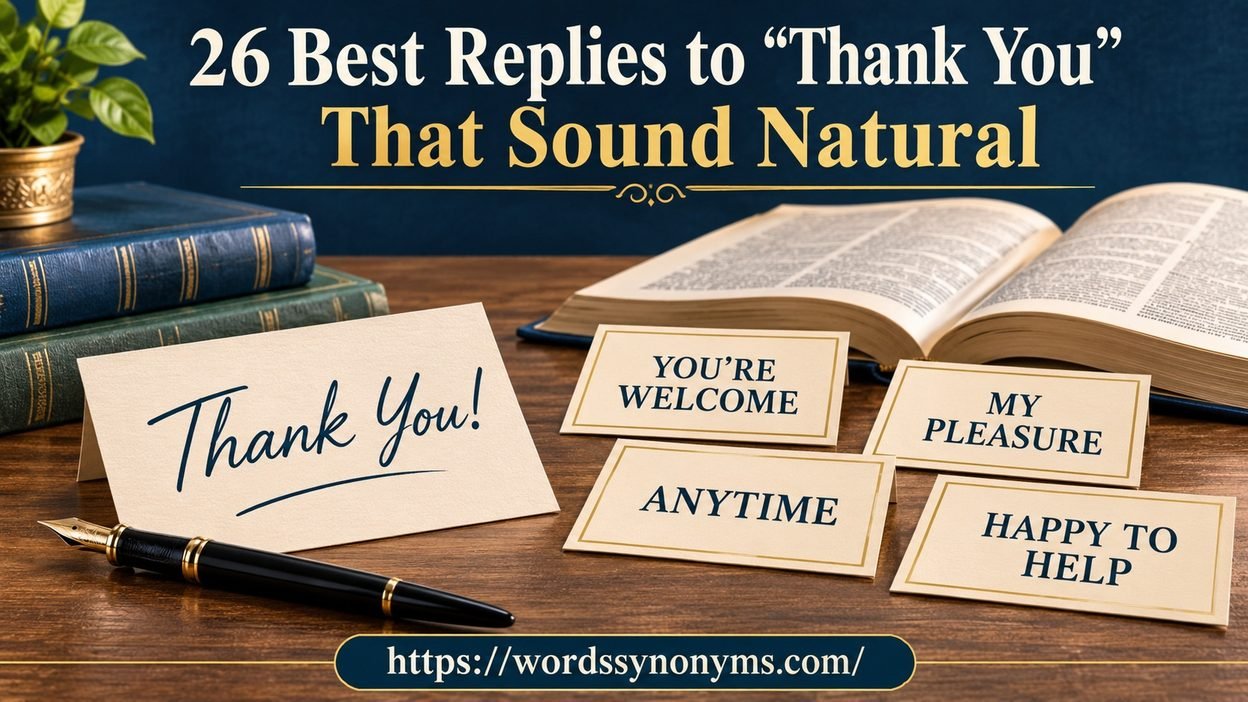
Choosing the right words after someone thanks you can feel surprisingly difficult, but 26 Best Replies to “Thank You” That Sound Natural makes the choice easier and more practical for everyday conversations. A thanks reply can be as simple as You’re welcome, the most common reply, but it’s not your only option.
You can also use My pleasure, No problem, Anytime, Happy to help, or It was my pleasure. Each response can sound natural, but the best choice depends on the situation, who you’re talking to, what they’re thanking you for, and how formal the conversation is.
It’s nice to be thanked because your effort feels appreciated by the people around you. Hearing thank you can feel nice and pleasant, although you may still wonder what you’re supposed to say back or how to respond. In my experience, the right response becomes easier when you focus on the moment instead of overthinking it.
A formal response works especially well during a professional conversation when you want to impress people such as bosses, future bosses, hopeful romantic partners, future in-laws, superiors, or random people on the street. It can make you sound like a kind person who is respectful and polite.
By contrast, informal responses suit casual scenarios, including a conversation with a friend, friends, classmates, co-workers, or immediate family members. An informal response can remain polite without sounding stiff. When you’re thanked, it may be hard to know which response to go with, but you have a choice between formal and informal language.
Reading a room, assessing a situation, and noticing who you’re talking to can help you decide. Ultimately, formal and informal response choices depend on the professional or casual setting, the people involved, and the different tones that suit those moments.
Quick Answer
The best all-purpose response is “You’re welcome.” If you want something more specific, choose your reply based on the situation.
| Situation | Natural Reply |
| General situation | You’re welcome. |
| Professional setting | Happy to help. |
| Customer or client | My pleasure. |
| Friend | Anytime. |
| Family member | Of course. |
| Casual conversation | No problem. |
| Relaxed conversation | No worries. |
| After solving a problem | Glad I could help. |
| Formal situation | Certainly. |
| Meaningful favor | It was the least I could do. |
| Text message | Sure thing! |
| Someone needs help again | Anytime you need me. |
The right response should match the size of the favor and the relationship between you and the other person. A quick “Thanks!” after you hold a door doesn’t need a grand response. A heartfelt thank-you after major support deserves something warmer.

26 Best Replies to “Thank You”
1. You’re Welcome
“You’re welcome” is the safest and most versatile response to “Thank you.”
You can use it with friends, relatives, coworkers, customers, teachers, strangers, and professional contacts. It doesn’t sound excessively formal or overly casual.
For example:
“Thanks for helping me finish this report.”
“You’re welcome.”
The phrase also works when you don’t know exactly what tone to use. When in doubt, this one rarely misses the mark.
Although newer expressions have become common in everyday speech, “You’re welcome” remains a standard response to gratitude. It acknowledges the thanks without adding unnecessary emotion.
2. You’re Very Welcome
“You’re very welcome” adds warmth to the traditional response.
It sounds more gracious than a simple “You’re welcome” without becoming overly formal. You can use it when someone offers especially sincere thanks.
For example:
“Thank you so much for staying late to help me.”
“You’re very welcome.”
The word “very” makes the response feel more deliberate. It suggests that you genuinely appreciated the opportunity to help.
This option works particularly well with customers, older relatives, guests, and people you’ve just met.
3. My Pleasure
“My pleasure” communicates that helping wasn’t a burden.
It often sounds polished and professional. You’ll frequently hear it in customer service, hospitality, business conversations, and other situations where courtesy matters.
For example:
“Thank you for taking care of that so quickly.”
“My pleasure.”
The phrase also works outside professional settings. If a friend thanks you for doing something meaningful, “My pleasure” can sound warm and sincere.
Compared with “No problem,” this response puts more emphasis on your willingness to help.
4. Happy to Help
When you want to sound friendly without becoming too casual, “Happy to help” is an excellent choice.
It works especially well with coworkers, clients, classmates, customers, and acquaintances.
For example:
“Thanks for walking me through the new software.”
“Happy to help.”
The phrase also leaves the door open for future communication. It tells the other person that their request wasn’t an inconvenience.
In professional communication, this can feel more natural than repeatedly using “You’re welcome.”
5. Glad I Could Help
“Glad I could help” focuses on the result of your assistance.
This response fits situations where you’ve solved a problem, answered a question, provided advice, or made something easier.
For example:
“Thanks for helping me fix the printer.”
“Glad I could help.”
The phrase has a reassuring quality. It tells the other person that you’re pleased your effort made a difference.
It also works well after someone thanks you for something practical rather than emotional.
6. Anytime
“Anytime” is short, friendly, and generous.
It essentially means, “I’d be happy to help you again whenever you need me.”
For example:
“Thanks for helping me move those boxes.”
“Anytime.”
This response fits friends, family members, close coworkers, and other familiar people.
You can also use it in text messages:
“Thanks for sending that file!”
“Anytime!”
Because it’s casual, it may feel too relaxed for certain formal situations. A customer or senior executive may receive a more polished response such as “My pleasure” or “Happy to help.”
7. Of Course
“Of course” makes a favor sound natural and uncomplicated.
It often suggests that helping was an obvious or expected thing to do.
For example:
“Thanks for picking me up.”
“Of course!”
This response works particularly well with friends, partners, relatives, and close coworkers.
The tone can change depending on delivery. A warm “Of course!” sounds generous. A flat “Of course” can occasionally sound dismissive.
Context matters.
8. No Problem
“No problem” is one of the most common casual replies to “Thank you.”
It tells the other person that their request didn’t cause difficulty.
For example:
“Thanks for grabbing me a coffee.”
“No problem.”
The phrase works naturally in everyday American English. You can use it with friends, coworkers, classmates, and acquaintances.
However, some people prefer more traditional responses in formal situations. If you’re speaking with an important client or writing a formal business email, “My pleasure” or “Happy to help” may sound more polished.
That doesn’t make “No problem” incorrect. It simply gives you a different tonal option.
9. No Worries
“No worries” feels even more relaxed than “No problem.”
It tells the person not to feel concerned about asking for help or causing inconvenience.
For example:
“Sorry I made you wait.”
“No worries.”
It can respond to both gratitude and apologies depending on the context.
Use it freely in casual conversations. Friends, siblings, classmates, and familiar coworkers can use this phrase naturally.
For a formal business exchange, however, a more polished response may fit better.
10. Don’t Mention It
“Don’t mention it” means the favor was too small to deserve much attention.
For example:
“Thanks for holding the door.”
“Don’t mention it.”
The phrase has a modest and courteous quality. You’re essentially saying that the other person doesn’t need to keep thanking you.
It works best for small favors. If someone thanks you for spending several hours helping them through a difficult situation, “Don’t mention it” may sound like you’re minimizing what you did.
11. It Was Nothing
“It was nothing” downplays your effort.
You might use it after doing something small for another person.
For example:
“Thanks for carrying that box upstairs.”
“It was nothing.”
The expression can sound humble. However, context matters.
If someone expresses deep gratitude for significant help, saying “It was nothing” may accidentally dismiss their feelings. In that situation, “I’m glad I could help” usually sounds more thoughtful.
12. Not at All
“Not at all” offers a polite and somewhat formal response.
You might hear it after a small favor or courteous interaction.
For example:
“Thank you for your assistance.”
“Not at all.”
It has a traditional flavor that can make it sound more formal than “No problem” or “Anytime.”
This makes it useful when you want to maintain a respectful tone without sounding stiff.
13. Sure Thing
“Sure thing” sounds casual, confident, and friendly.
It’s especially useful when someone thanks you for completing a simple request.
For example:
“Thanks for sending me the address.”
“Sure thing.”
You can also use it before completing a request:
“Could you send me that document?”
“Sure thing.”
Afterward, the same phrase can function as a relaxed acknowledgment of thanks.
14. You Got It
“You got it” communicates confidence and willingness.
It works well when someone thanks you for doing something they asked you to do.
For example:
“Thanks for picking up the package.”
“You got it.”
The expression is distinctly conversational. It sounds natural in American English when talking with friends, coworkers, and familiar customers.
It doesn’t usually fit highly formal writing. In a business email, “Happy to help” may sound more appropriate.
15. Absolutely
“Absolutely” adds enthusiasm to your response.
Instead of merely acknowledging the thanks, you signal that helping was something you were completely willing to do.
For example:
“Thank you for helping me prepare for the interview.”
“Absolutely. I’m glad I could help.”
This option works in both professional and casual settings. Tone does most of the work.
If someone thanks you for a major favor, “Absolutely” can feel energetic and supportive.
16. Certainly
“Certainly” has a polished and formal tone.
It’s particularly useful in professional environments where courtesy and precision matter.
For example:
“Thank you for answering my questions.”
“Certainly. I’m happy to assist.”
You’ll often find this type of response in customer service, formal correspondence, business conversations, and service-oriented settings.
If you’re chatting with your best friend, however, “Certainly” may sound unnecessarily formal.
17. Gladly
“Gladly” communicates willingness.
It suggests that you were happy to perform the favor and would willingly do something similar again.
For example:
“Thank you for helping with the event.”
“Gladly.”
The word is concise yet warm. It can sound more polished than “Sure thing.”
Because it carries a slightly formal flavor, use it when that tone feels natural.
18. Anytime You Need Me
“Anytime you need me” takes “Anytime” a step further.
It communicates ongoing support rather than simply acknowledging the current favor.
For example:
“Thank you for being there when I needed someone.”
“Anytime you need me.”
This response works particularly well between close friends and family members.
It can also carry emotional weight. When someone thanks you for support during a difficult period, this phrase tells them that your help wasn’t a one-time gesture.
19. Always Happy to Help
“Always happy to help” sounds warm while remaining professional.
It works well in workplaces where people regularly assist one another.
For example:
“Thank you for helping me prepare the presentation.”
“Always happy to help.”
The word “always” subtly communicates an ongoing willingness to cooperate.
This makes the phrase especially useful for coworkers, clients, customers, and professional relationships.
20. It Was the Least I Could Do
When you’ve done something meaningful for someone, “It was the least I could do” can sound humble and sincere.
For example:
“Thank you for helping me through everything.”
“It was the least I could do.”
The expression suggests that you believe helping was simply the right thing to do.
It’s stronger than a routine “You’re welcome.” Use it when the favor carried genuine importance.
For example, you might say it after helping a close friend during a difficult period or supporting a colleague through a serious work problem.
21. The Pleasure Is Mine
“The pleasure is mine” returns the warmth of the exchange.
You’re essentially saying that helping the other person was enjoyable or rewarding for you too.
For example:
“Thank you for spending the afternoon with us.”
“The pleasure is mine.”
It sounds more formal and elegant than “Anytime.”
Because of that, it works best when the conversation already has a polite or gracious tone.
22. It Was My Pleasure
“It was my pleasure” has a polished and courteous feel.
It’s especially useful in professional situations.
For example:
“Thank you for taking the time to explain everything.”
“It was my pleasure.”
The wording also works after a meaningful personal favor.
Compared with “My pleasure,” the longer version can sound slightly more deliberate. Both express the same basic idea: you were happy to help.
23. Think Nothing of It
“Think nothing of it” means the person shouldn’t worry about repaying you or continuing to thank you.
For example:
“Thank you for helping me carry everything.”
“Think nothing of it.”
This phrase has a somewhat old-fashioned feel. You may encounter it more often in traditional speech or writing than in casual modern conversation.
Still, it remains understandable and useful when you want a courteous, modest response.
24. You’d Do the Same for Me
“You’d do the same for me” emphasizes mutual support.
It works best with people you know well.
For example:
“Thank you for covering my shift.”
“You’d do the same for me.”
The response can make a friendship or close working relationship feel stronger. It frames the favor as part of a reciprocal relationship rather than a transaction.
This isn’t the best response to a stranger or customer. The phrase assumes familiarity.
25. Thanks for Saying That
Sometimes someone’s appreciation means more than the favor itself.
In those moments, “Thanks for saying that” can acknowledge the emotional value of their words.
For example:
“Thank you. You really helped me when things were difficult.”
“Thanks for saying that. It means a lot.”
This response works especially well when someone expresses heartfelt gratitude or recognizes your effort personally.
It’s less appropriate for routine exchanges such as someone thanking you for passing the salt.
26. I’m Glad It Helped
“I’m glad it helped” focuses on the outcome.
It’s particularly useful when you give advice, solve a problem, explain something, or provide support.
For example:
“Thanks for helping me figure out what to do.”
“I’m glad it helped.”
This response feels warm without exaggerating the favor.
It also keeps the attention on the other person’s benefit. That makes it useful in professional communication as well as personal conversations.
Read more: 12 Best Replies to “Nice Meeting You” That Sound Natural
Best Replies to “Thank You” by Situation
The same response won’t fit every conversation. Your relationship with the speaker matters.
Replies to “Thank You” for Friends
With friends, you can relax your language. Natural options include:
- Anytime!
- Of course!
- No problem!
- No worries!
- Sure thing!
- You got it!
- You’d do the same for me.
A friend usually doesn’t need a polished corporate response. “My pleasure” might work in a joking conversation but “Anytime” will often sound more natural.
Replies to “Thank You” for Family
Family conversations often allow warmer responses.
Good choices include:
- Of course.
- Anytime.
- Happy to help.
- It was the least I could do.
- Anytime you need me.
- You’d do the same for me.
The best choice depends on the size of the favor.
Replies to “Thank You” at Work
Professional conversations call for clarity without unnecessary formality.
Try:
- You’re welcome.
- Happy to help.
- Glad I could help.
- My pleasure.
- Always happy to help.
- It was my pleasure.
These phrases work especially well when you’re helping a coworker complete a project or solve a workplace problem.
Replies to “Thank You” From a Customer
Customer-facing conversations benefit from warmth and professionalism.
Useful choices include:
- My pleasure.
- You’re very welcome.
- Happy to help.
- Certainly.
- It was my pleasure.
- Always happy to help.
A short response usually works best. Customers rarely need a long explanation after expressing thanks.
Formal vs. Casual Replies to “Thank You”
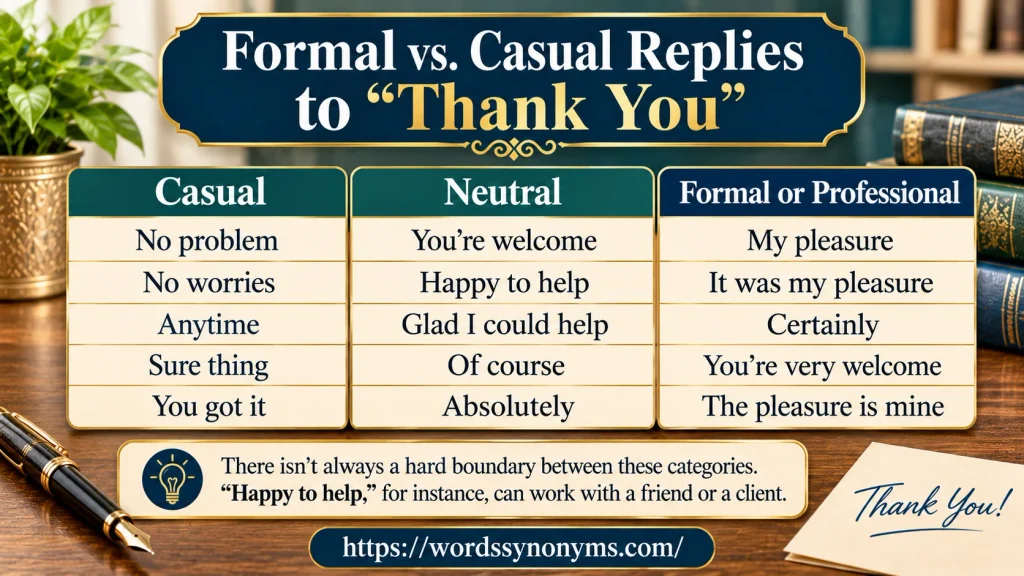
Understanding tone can help you avoid awkward wording.
| Casual | Neutral | Formal or Professional |
| No problem | You’re welcome | My pleasure |
| No worries | Happy to help | It was my pleasure |
| Anytime | Glad I could help | Certainly |
| Sure thing | Of course | You’re very welcome |
| You got it | Absolutely | The pleasure is mine |
There isn’t always a hard boundary between these categories. “Happy to help,” for instance, can work with a friend or a client.
The important point is tone. Casual phrases sound relaxed. Formal phrases create more distance and courtesy.
Replies to “Thanks” in Text Messages
Text conversations usually favor short responses.
You don’t need to type a full sentence every time someone sends “Thanks!”
Natural options include:
- Anytime!
- Of course!
- No problem!
- No worries!
- Sure thing!
- You got it!
- Happy to help!
- Absolutely!
The exclamation point can add warmth in casual texting. However, you don’t need one in every message.
For example:
Friend: Thanks for sending that!
You: Anytime!
That’s enough. No speech required.
Professional Replies to “Thank You” in Emails
Email requires slightly more care because tone can be harder to read.
A short reply often works best:
You’re very welcome. I’m glad I could help.
For a client:
My pleasure. Please let me know if you need anything else.
For a coworker:
Happy to help. Let me know if you have any other questions.
For a formal exchange:
It was my pleasure. Please don’t hesitate to reach out if you need further assistance.
The key is to avoid sounding robotic. A simple and genuine sentence usually beats an elaborate corporate phrase.
Is “No Problem” a Good Reply to “Thank You”?
Yes. “No problem” is a normal and widely used response in casual American English.
Some people dislike the phrase because they feel it implies that helping someone could have been a problem. Others prefer it because it sounds relaxed and reassuring.
Neither interpretation makes the phrase universally right or wrong.
Consider the setting:
Friend: Thanks for picking me up.
You: No problem.
That sounds perfectly natural.
Now consider:
Client: Thank you for resolving the issue.
You: No problem.
It’s still understandable. However, “Happy to help” or “My pleasure” may sound more polished.
The distinction is about register and tone, not basic grammatical correctness.
Should You Always Say “You’re Welcome”?
No. But you can always rely on it.
“You’re welcome” is useful because it doesn’t force you to make a complicated decision. It acknowledges gratitude clearly and politely.
Still, different circumstances invite different responses.
“You’re welcome” sounds neutral.
“My pleasure” sounds gracious.
“Anytime” sounds casual.
“Happy to help” sounds friendly and professional.
“No worries” sounds relaxed.
Think of these responses as different shirts in the same closet. You wouldn’t wear a tuxedo to buy groceries. Likewise, you don’t need a formal phrase for every casual thank-you.
Replies That Can Sound Awkward
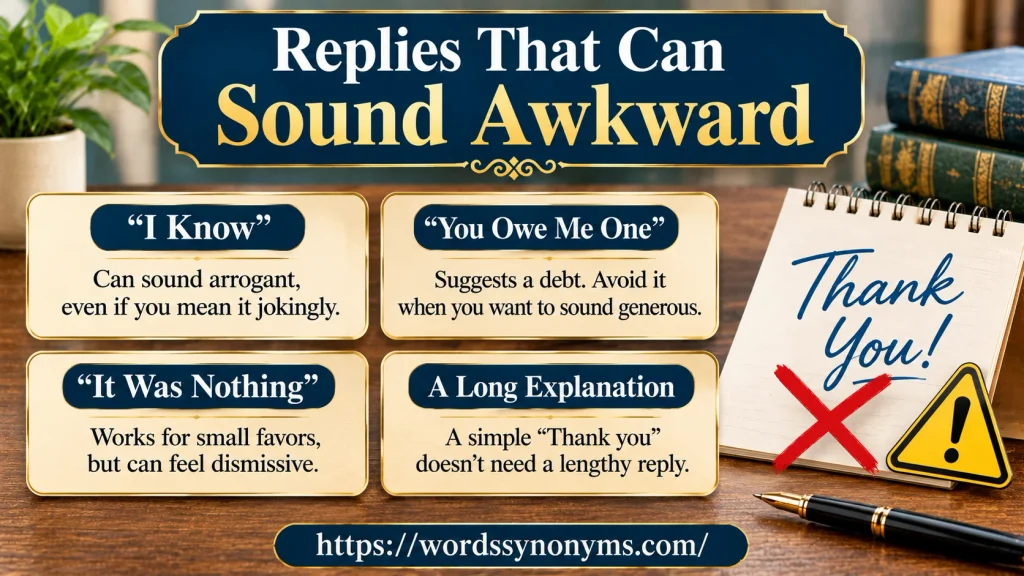
Not every possible response works equally well.
“I Know”
Responding to gratitude with “I know” can sound arrogant.
Even if you mean it jokingly, the phrase can make the exchange uncomfortable.
“You Owe Me One”
This can work as playful banter between close friends.
However, it suggests that the favor created a debt. Avoid it when you want to sound genuinely generous.
“It Was Nothing”
This response works for small favors. It can feel dismissive when someone is expressing deep gratitude.
A Long Explanation
A simple “Thank you” usually doesn’t require a paragraph in response.
If someone says:
“Thanks for helping me!”
You don’t need to explain every reason you decided to help.
A short response keeps the interaction comfortable.
Read more: 23 Best Replies to “Take Care”: Friendly and Funny
How to Choose the Best Reply to “Thank You”
Choosing a natural response becomes easier when you consider four things.
1. Consider Your Relationship
Are you talking to a stranger, friend, coworker, family member, or customer?
Your relationship determines how relaxed you can sound.
2. Consider the Size of the Favor
A tiny favor and a major act of support don’t carry the same emotional weight.
For a small favor:
“No problem.”
For meaningful support:
“I’m glad I could be there for you.”
3. Consider the Setting
A casual coffee shop conversation differs from a formal business meeting.
Match your language to the environment.
4. Consider What You Want to Communicate
Do you want to sound:
- Polite? → You’re welcome.
- Warm? → My pleasure.
- Casual? → Anytime.
- Professional? → Happy to help.
- Supportive? → Anytime you need me.
- Humble? → It was the least I could do.
- Relaxed? → No worries.
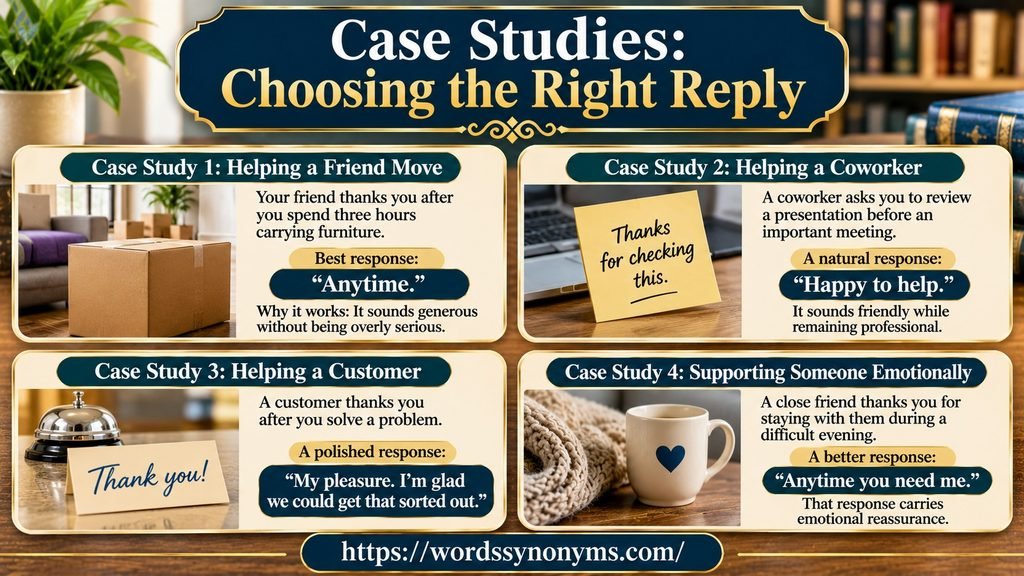
Case Studies: Choosing the Right Reply
Case Study 1: Helping a Friend Move
Your friend thanks you after you spend three hours carrying furniture.
Best response: “Anytime.”
Why does it work? The phrase sounds generous without becoming overly serious.
You could also say:
“Of course. You’d do the same for me.”
That second response works especially well if the friendship has a strong sense of mutual support.
Case Study 2: Helping a Coworker
A coworker asks you to review a presentation before an important meeting.
They later say:
“Thanks for checking this.”
A natural response would be:
“Happy to help.”
It sounds friendly while remaining professional.
Case Study 3: Helping a Customer
A customer thanks you after you solve a problem.
A polished response would be:
“My pleasure. I’m glad we could get that sorted out.”
This response does two things. It acknowledges the gratitude while reinforcing that the problem has been resolved.
Case Study 4: Supporting Someone Emotionally
A close friend thanks you for staying with them during a difficult evening.
A basic “No problem” might sound too casual.
A better response could be:
“Anytime you need me.”
That response carries emotional reassurance without turning the moment into a long speech.
Quick Reference: Which Reply Should You Use?
| If someone thanks you for… | Try saying… |
| A basic favor | You’re welcome. |
| A small favor | Don’t mention it. |
| A ride | Anytime. |
| Helping with work | Happy to help. |
| Solving a problem | Glad I could help. |
| Customer service | My pleasure. |
| Formal assistance | Certainly. |
| Casual help | No problem. |
| A relaxed favor | No worries. |
| Sending something | Sure thing. |
| Completing a request | You got it. |
| Meaningful support | It was the least I could do. |
| Emotional support | Anytime you need me. |
| Ongoing professional help | Always happy to help. |
| Heartfelt appreciation | Thanks for saying that. |
FAQs
1. What is the best reply to “Thank you”?
“You’re welcome” is the safest and most natural choice. However, My pleasure, No problem, Anytime, and Happy to help can sound more relaxed depending on the situation.
2. Is “You’re welcome” too formal?
Not at all. “You’re welcome” works in both casual and professional conversations. Your tone of voice usually makes a bigger difference than the phrase itself.
3. What can I say instead of “You’re welcome”?
You can say My pleasure, No problem, Anytime, Happy to help, or No worries. Choose one that matches your relationship with the other person.
4. What is a casual way to respond to “Thank you”?
For friends, classmates, co-workers, or family, No problem, No worries, and Anytime sound natural. They keep the conversation friendly without making it feel formal.
5. What is a professional response to “Thank you”?
You’re welcome and My pleasure are reliable professional choices. Happy to help also works well when someone appreciates your assistance at work.
6. Can I say “No problem” after someone thanks me?
Yes. No problem is common and friendly. It tells the person that helping them wasn’t a burden, especially in casual conversations.
7. Is “My pleasure” a polite response?
Yes. My pleasure sounds warm, courteous, and slightly more polished than “No problem.” It works particularly well when you want to show genuine appreciation for being able to help.
8. What should I say when my boss thanks me?
Keep your response professional and simple. You’re welcome, My pleasure, or Happy to help can all work well without sounding overly casual.
9. How do I choose the right response to “Thank you”?
Think about who you’re talking to, what they’re thanking you for, and how formal the conversation feels. A quick reading of the room can help you choose a response that sounds natural.
10. Is there one perfect way to respond to “Thank you”?
No. The best response depends on the person, relationship, and setting. Sometimes a simple You’re welcome is perfect, while other moments call for something warmer or more casual.
Conclusion
Knowing how to reply to “Thank you” can make everyday conversations feel smoother and more natural. You don’t always need a polished or clever phrase. You’re welcome, My pleasure, No problem, Anytime, and Happy to help can all work when you choose them at the right moment. The key is to consider the person, the situation, and the tone of the conversation before you answer.
A good response should feel comfortable rather than forced. Use a more professional phrase when you’re speaking with a boss or someone you want to impress. With friends, classmates, co-workers, or family, a casual response may feel more genuine. Once you understand the difference between formal and informal replies, answering “Thank you” becomes much easier.

Emily Carter has a strong interest in English grammar, sentence structure, and effective writing. She specializes in explaining complicated grammar concepts in simple language. Her articles help readers understand grammar rules, avoid common mistakes, and develop confidence in everyday and professional communication.