These 12 Best Replies to “Nice Meeting You” That Sound Natural help you answer warmly, build confidence, and make every new introduction feel easier. Meeting someone new can still feel awkward when you aren’t sure what to say.
I used to overthink simple greetings because I worried about sounding too basic or formal. However, I learned that a friendly, genuine response makes conversations flow naturally. You don’t need complicated words to make someone feel welcome.
A warm reply such as “I’m glad to connect with you” can create a positive first impression without sounding forced. Small expressions of kindness and interest often make introductions more comfortable and memorable.
The best response depends on the setting. With friends or new acquaintances, keep your words relaxed and polite. During networking conversations, virtual meetings, or workplace introductions, choose a professional tone that fits the moment.
You can also use the same approach in an email or follow-up message after a meeting. Clear language, good professional etiquette, and a little confidence help you build personal and professional connections.
Ultimately, you don’t need a clever speech to make a lasting impression. Just be sincere, listen carefully, and let the conversation develop naturally. Showing genuine interest tells the other person that you value their time and attention.
Quick Answer
The simplest and most natural response is:
“Nice meeting you too!”
You can also choose a response based on your situation:
| Situation | Natural reply |
| General conversation | “Nice meeting you too!” |
| Casual conversation | “Same here!” |
| Brief and polite | “Likewise!” |
| Professional setting | “It was great meeting you too.” |
| Formal setting | “It was a pleasure meeting you.” |
| Interesting conversation | “I really enjoyed our conversation.” |
| You want to talk again | “I hope we can talk again soon.” |
| Networking | “I look forward to staying in touch.” |
| Friendly goodbye | “Take care. It was great meeting you.” |
The key is to match your response to the situation. You don’t need to sound overly formal when a simple friendly answer will do.

What Does “Nice Meeting You” Mean?
“Nice meeting you” is a polite expression people use after spending time with someone they have recently met. It communicates that the interaction was pleasant and that the speaker appreciated meeting the other person.
Imagine you attend a conference and speak with someone for fifteen minutes. Before leaving, they smile and say:
“It was nice meeting you.”
They’re not necessarily making a deep statement about your relationship. They’re simply closing the interaction on a positive note.
The expression can carry slightly different shades of meaning depending on context. It might sound warm and personal between two new acquaintances. In a business setting, it can function as a courteous closing after an introduction or discussion.
“Nice to Meet You” vs. “Nice Meeting You”
These expressions look almost identical. However, their usual timing differs.
“Nice to meet you” commonly appears when you first introduce yourself to someone.
“Hi, I’m Daniel. Nice to meet you.”
“Nice meeting you” usually appears after you’ve already spent some time together.
“Thanks for showing me around. Nice meeting you.”
The distinction isn’t absolute. Native speakers use both expressions naturally in different situations. Context does most of the heavy lifting.
A useful way to remember it is:
- Nice to meet you → the introduction
- Nice meeting you → the interaction or goodbye
- It was nice meeting you → a slightly fuller closing
12 Best Replies to “Nice Meeting You”
Not every response needs the same tone. A reply that works with a new friend might sound too casual during a job interview.
Here are twelve natural choices that cover everyday, professional, friendly, and formal situations.
1. “Nice Meeting You Too”
When you aren’t sure what to say, choose this one.
“Nice meeting you too” directly returns the sentiment. It’s friendly, grammatically natural, and appropriate in most everyday situations.
You can use it with:
- New acquaintances
- Coworkers
- Classmates
- Neighbors
- Friends of friends
- Professional contacts
- People you meet socially
For example:
Alex: “Nice meeting you.”
Jordan: “Nice meeting you too!”
Nothing feels forced here. The response simply acknowledges the other person’s kindness.
You can also say “It was nice meeting you too” when you want a slightly fuller version.
2. “It Was Nice Meeting You Too”
This version sounds a little more complete and deliberate.
The addition of “It was” makes the sentence feel like a clear reflection on the conversation you just had. It works particularly well when you’re wrapping up a longer interaction.
For example:
“Thanks for taking the time to chat with me. It was nice meeting you too.”
This reply works in both social and professional environments. You can use it after a coffee meeting, networking conversation, class discussion, or casual introduction.
It’s still simple. That’s part of its strength.
3. “Likewise!”
Sometimes one word does the job.
“Likewise!” means that you feel the same way. It works as a compact response to many positive statements.
For example:
Person A: “It was great meeting you.”
Person B: “Likewise!”
The word has a slightly more polished feel than “Same here!” That’s why it can work particularly well in professional conversations.
However, tone matters. If you’re talking with a close friend at a relaxed gathering, “Likewise!” may sound a touch formal. In that situation, “Same here!” might fit better.
4. “Same Here!”
If you want your reply to sound casual and natural, “Same here!” is an excellent choice.
It means:
“I feel the same way.”
You don’t need to repeat the entire sentence. The phrase already makes the meaning clear from context.
For example:
“Nice meeting you!”
“Same here! I had a great time.”
This response works especially well among:
- Friends of friends
- Classmates
- Young professionals
- Casual acquaintances
- People at social events
It feels relaxed without becoming overly familiar.
5. “It Was a Pleasure Meeting You”
When the situation calls for a more polished response, try this phrase.
“It was a pleasure meeting you” sounds professional and courteous. You might hear it after a business meeting, interview, formal introduction, conference, or important networking conversation.
For example:
“Thank you for sharing your experience with us. It was a pleasure meeting you.”
This expression has more formality than “Nice meeting you too.” That’s useful when you want to show respect.
Still, don’t use formal language simply to sound impressive. If you’re chatting with someone at a backyard barbecue, “Nice meeting you too” will probably sound more natural.
6. “The Pleasure Was Mine”
This response warmly returns the compliment.
“The pleasure was mine.”
It essentially means that you also enjoyed the interaction.
The expression has a distinctly polite and somewhat formal flavor. You’ll often see it in professional or courteous exchanges.
For example:
Client: “It was a pleasure meeting you.”
Consultant: “The pleasure was mine.”
It can sound elegant when the setting supports it. In an everyday conversation with a stranger at a coffee shop, however, it might feel a little dressed up.
Think of it as a formal suit rather than everyday clothing. It’s useful when the occasion calls for it.
7. “I Really Enjoyed Our Conversation”
Sometimes the best response doesn’t simply repeat the other person’s words.
If you genuinely enjoyed talking with someone, tell them.
“I really enjoyed our conversation.”
This response feels more personal because it identifies what you appreciated.
You could make it even more specific:
“I really enjoyed our conversation about photography.”
Or:
“I really enjoyed hearing your ideas about the project.”
Specificity gives the reply more substance. Instead of offering a generic courtesy, you’re showing that you actually remember the interaction.
That can make a meaningful difference during networking.
8. “I’m Glad We Got to Meet”
This response works particularly well when meeting someone felt worthwhile.
“I’m glad we got to meet.”
It sounds warm without being overly intimate. You can use it with a new friend, colleague, professional contact, or someone you’ve wanted to meet.
For example:
“I’ve heard a lot about your work. I’m glad we got to meet.”
The phrase can also create a natural opening for future conversation.
“I’m glad we got to meet. Let’s stay in touch.”
That combination feels friendly without making an exaggerated promise.
9. “It Was Great Talking With You”
If the conversation itself stood out, emphasize that instead of the meeting.
“It was great talking with you.”
This response feels natural after a substantial conversation. It can work at social events, conferences, workplaces, or casual gatherings.
For example:
“Thanks for explaining how you got started in the industry. It was great talking with you.”
The phrase also gives you an easy way to continue the conversation:
“It was great talking with you. I’d love to hear more about that project sometime.”
That’s especially useful when you genuinely want to build a connection.
10. “I Hope We Can Talk Again Soon”
Want to keep the door open? This response does exactly that.
“I hope we can talk again soon.”
Unlike a generic goodbye, this phrase signals genuine interest in another conversation.
It works well when:
- You had an engaging discussion.
- You met someone through mutual friends.
- You connected at an event.
- You discovered a shared interest.
- You’d like to develop a friendship.
For example:
“It was great talking with you about travel. I hope we can talk again soon.”
The wording remains friendly without sounding demanding.
There’s an important distinction here. “I hope we can talk again soon” expresses interest. “We’ll definitely meet again” makes a stronger commitment. Use the latter only when you genuinely mean it.
11. “I Look Forward to Staying in Touch”
For professional relationships, this is one of the most useful replies.
“I look forward to staying in touch.”
It’s especially appropriate after:
- Networking events
- Business meetings
- Conferences
- Interviews
- Industry introductions
- Professional collaborations
Suppose you meet a marketing director at a conference and exchange contact information. You might say:
“It was great meeting you. I enjoyed our discussion about content strategy. I look forward to staying in touch.”
That sounds professional without becoming robotic.
It also makes sense when you have a clear reason to maintain contact.
12. “Take Care. It Was Great Meeting You.”
Sometimes you need both acknowledgment and a goodbye.
This response handles both:
“Take care. It was great meeting you.”
It works especially well when the conversation has naturally reached its end.
For example:
“Thanks for chatting with me. Take care. It was great meeting you.”
The phrase feels warmer than simply saying “You too.” It also gives the conversation a clean landing.
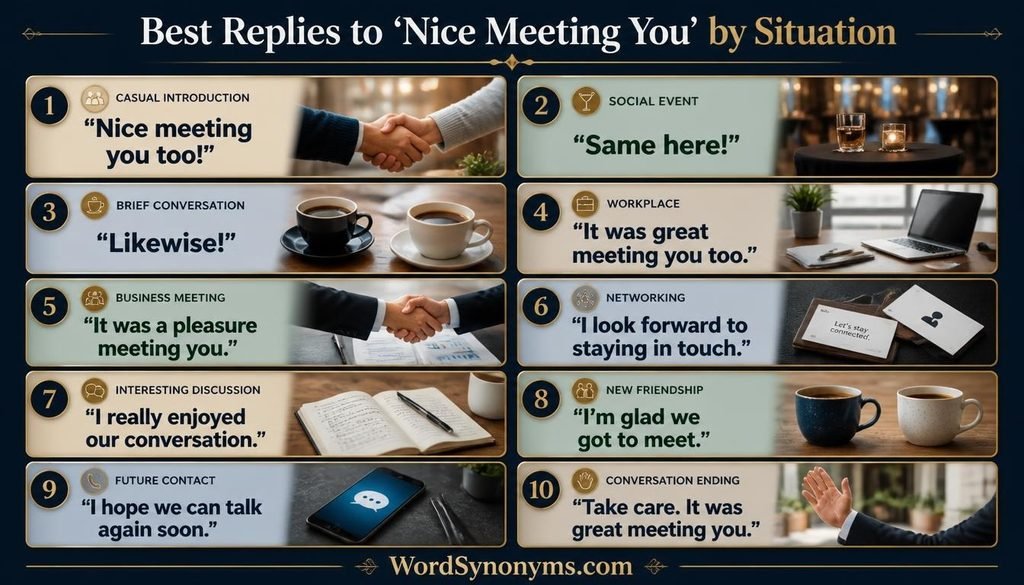
Best Replies to “Nice Meeting You” by Situation
Choosing the right response becomes easier when you consider the setting.
| Situation | Recommended reply | Why it works |
| Casual introduction | “Nice meeting you too!” | Simple and friendly |
| Social event | “Same here!” | Relaxed and natural |
| Brief conversation | “Likewise!” | Short and polite |
| Workplace | “It was great meeting you too.” | Professional without stiffness |
| Business meeting | “It was a pleasure meeting you.” | Polished and respectful |
| Networking | “I look forward to staying in touch.” | Keeps the professional connection open |
| Interesting discussion | “I really enjoyed our conversation.” | Personal and specific |
| New friendship | “I’m glad we got to meet.” | Warm and sincere |
| Future contact | “I hope we can talk again soon.” | Shows genuine interest |
| Conversation ending | “Take care. It was great meeting you.” | Friendly closing |
The best response isn’t necessarily the most impressive one. It’s the one that sounds like something you’d naturally say in that moment.
How to Reply to “Nice Meeting You” Professionally
Professional situations require a little more awareness of tone.
You don’t want to sound cold. At the same time, overly casual language may not fit a client meeting or interview.
A few reliable choices include:
- “It was great meeting you too.”
- “It was a pleasure meeting you.”
- “I really enjoyed our conversation.”
- “Thank you for taking the time to meet with me.”
- “I look forward to staying in touch.”
- “I enjoyed discussing this with you.”
Professional Example
Imagine you meet a potential business partner at an industry event.
A weak response might sound overly generic:
“Yeah, same.”
It isn’t necessarily rude. However, it doesn’t leave much of an impression.
A stronger response could be:
“It was great meeting you too. I really enjoyed our discussion about the project.”
Now you’ve acknowledged the person and reinforced the specific connection.
That’s a small change with a much stronger effect.
Read more: As to Why: Meaning, Grammar Usage and Examples
How to Reply to “Nice Meeting You” in an Email
Email gives you more space to add context.
Instead of replying with only “You too,” you can mention something from the conversation.
For example:
“It was great meeting you as well. I enjoyed learning more about your approach to customer research.”
Or:
“It was a pleasure meeting you yesterday. I appreciated our discussion about the upcoming project.”
A professional email response can follow this simple structure:
- Acknowledge the meeting.
- Mention something specific.
- State your next step if necessary.
- Close naturally.
For example:
“It was great meeting you today. I enjoyed our discussion about the new campaign. I look forward to staying in touch and continuing the conversation.”
The specific detail makes the message feel less like a template.
How to Reply to “Nice Meeting You” Over Text
Text messages usually call for shorter replies.
You don’t need to write a paragraph after someone sends:
“Nice meeting you!”
Try one of these instead:
- “Nice meeting you too!”
- “Same here!”
- “Likewise!”
- “Great meeting you too!”
- “I had a great time talking with you.”
- “Hope we can chat again soon!”
If the relationship feels friendly, a simple emoji can add warmth.
“Nice meeting you too! 😊”
However, professional conversations usually benefit from straightforward wording. You don’t need to decorate every message.
Texting Example
Casual:
“Nice meeting you!”
“Same here! Hope you have a great night.”
Professional:
“Nice meeting you today.”
“It was great meeting you too. I enjoyed our conversation.”
Interested in future contact:
“Nice meeting you!”
“Nice meeting you too! I’d love to continue our conversation sometime.”
How to Reply When You Want to See the Person Again
A simple “Nice meeting you too” ends the exchange politely. If you want another conversation, you can gently make that clear.
Consider these options:
- “I hope we can talk again soon.”
- “It was great meeting you. Let’s stay in touch.”
- “I’d love to continue our conversation sometime.”
- “I’m glad we got to meet. Hopefully we’ll see each other again.”
- “It was great talking with you. Let’s keep in touch.”
The trick is sincerity.
If you met someone for two minutes at an elevator, saying “Let’s definitely meet again next week” could feel forced. A lighter phrase such as “Nice meeting you. Take care!” fits better.
On the other hand, if you spent an hour discussing a shared hobby, suggesting another conversation makes perfect sense.
How to Reply When You Didn’t Enjoy the Conversation
Not every conversation becomes a friendship. Sometimes you need a polite exit rather than an invitation for another meeting.
You can remain courteous without pretending that the interaction changed your life.
Try:
- “Thank you. It was nice meeting you as well.”
- “Likewise. Have a great evening.”
- “It was nice meeting you. Take care.”
- “Thank you. I hope you have a good rest of your day.”
These responses acknowledge the other person without promising future contact.
That’s useful when you want to maintain basic courtesy while keeping your boundaries clear.
You don’t have to say “I’d love to see you again” if you don’t mean it.
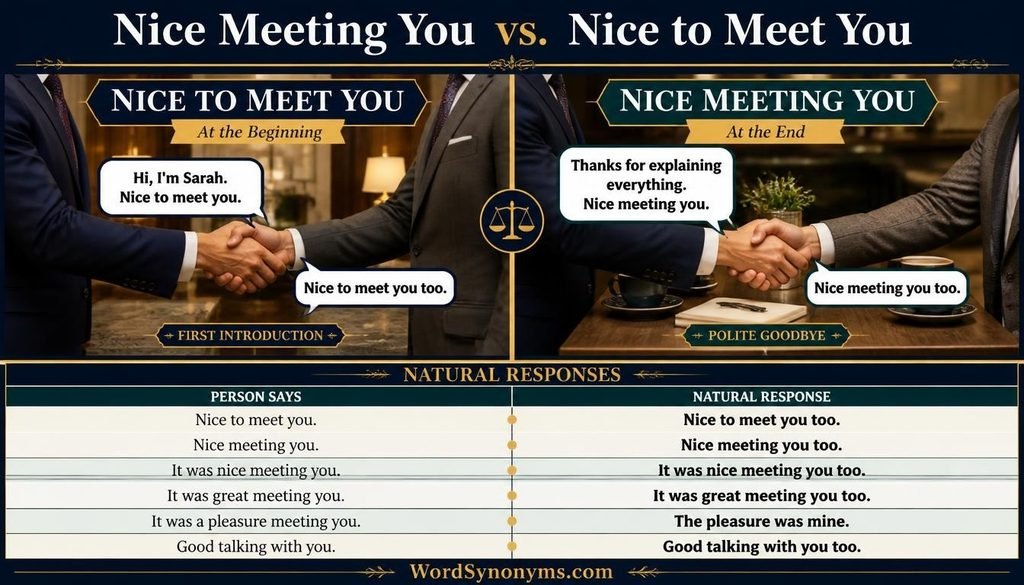
“Nice Meeting You” vs. “Nice to Meet You”
This distinction causes confusion because both expressions are correct.
When to Say “Nice to Meet You”
Use “Nice to meet you” when you’re introducing yourself to someone for the first time.
For example:
“Hi, I’m Sarah. Nice to meet you.”
The other person can respond:
“Nice to meet you too.”
This is one of the most standard first-meeting exchanges in English.
When to Say “Nice Meeting You”
Use “Nice meeting you” naturally toward the end of an interaction.
For example:
“Thanks for explaining everything. Nice meeting you.”
It looks backward at the interaction that has just happened.
What Should You Reply to Each One?
| Person says | Natural response |
| “Nice to meet you.” | “Nice to meet you too.” |
| “Nice meeting you.” | “Nice meeting you too.” |
| “It was nice meeting you.” | “It was nice meeting you too.” |
| “It was great meeting you.” | “It was great meeting you too.” |
| “It was a pleasure meeting you.” | “The pleasure was mine.” |
| “Good talking with you.” | “Good talking with you too.” |
Notice something important: “too” does a lot of work. It lets you return the same positive sentiment without inventing a complicated response.
Common Mistakes When Replying to “Nice Meeting You”
A good response doesn’t need to be clever. In fact, trying too hard can make a simple exchange awkward.
Overthinking a Simple Greeting
You don’t need an unusual phrase when “Nice meeting you too” fits perfectly.
People sometimes search for elaborate alternatives because they worry a basic response sounds boring. It doesn’t.
Simple can be polished.
Using “Nice to Meet You Again”
If you’ve met someone before, “Nice to see you again” usually sounds more natural.
Compare:
“Nice to meet you again.”
with:
“Nice to see you again.”
The second version clearly recognizes the previous meeting.
Sounding Too Formal
Phrases such as “It was a pleasure making your acquaintance” can sound overly formal in ordinary conversation.
There’s nothing inherently wrong with formal language. The problem comes from using it in a setting that doesn’t call for it.
A useful rule is simple:
Match your language to the room.
A job interview isn’t a group chat. A backyard barbecue isn’t a board meeting.
Making an Unwanted Promise
Be careful with statements such as:
“We’ll definitely meet again.”
That phrase can sound stronger than intended.
If you aren’t sure you’ll meet again, try:
“I hope we get to talk again.”
This keeps the tone positive without making a promise.
Giving an Overly Long Response
You don’t need five sentences after someone says “Nice meeting you.”
A short reply often sounds more natural:
“Nice meeting you too. Take care!”
Then let the conversation end.
How to Make Your Reply Sound More Genuine
A generic response works, but a specific response often feels better.
Compare these two:
“Nice meeting you too.”
“Nice meeting you too. I enjoyed hearing about your photography project.”
Both are correct. The second one feels more personal because it refers to something that actually happened.
You can make your response more genuine by mentioning:
- A shared interest
- Something memorable from the conversation
- A useful idea they mentioned
- A future point of contact
- Something you genuinely appreciated
For example:
“It was great meeting you. Your advice about freelance writing was really helpful.”
That’s more memorable than a stock phrase.
A Simple Formula for Better Responses
When you aren’t sure what to say, use this three-part formula:
Acknowledge + Personalize + Close
Acknowledge
Return the positive sentiment.
“Nice meeting you too.”
Personalize
Mention something relevant.
“I enjoyed our conversation about travel.”
Close
End naturally or suggest future contact.
“Hope we can talk again soon.”
Put them together:
“Nice meeting you too. I enjoyed our conversation about travel. Hope we can talk again soon.”
This formula works because it feels conversational rather than scripted.
Quick Guide: Which Reply Should You Choose?
If you’re standing there wondering which phrase to use, this cheat sheet can save you some mental gymnastics.
| You want to sound… | Use this reply |
| Friendly | “Nice meeting you too!” |
| Casual | “Same here!” |
| Brief | “Likewise!” |
| Professional | “It was great meeting you too.” |
| Formal | “It was a pleasure meeting you.” |
| Warm | “I’m glad we got to meet.” |
| Personal | “I really enjoyed our conversation.” |
| Interested | “I hope we can talk again soon.” |
| Networking-focused | “I look forward to staying in touch.” |
| Ready to leave | “Take care. It was great meeting you.” |
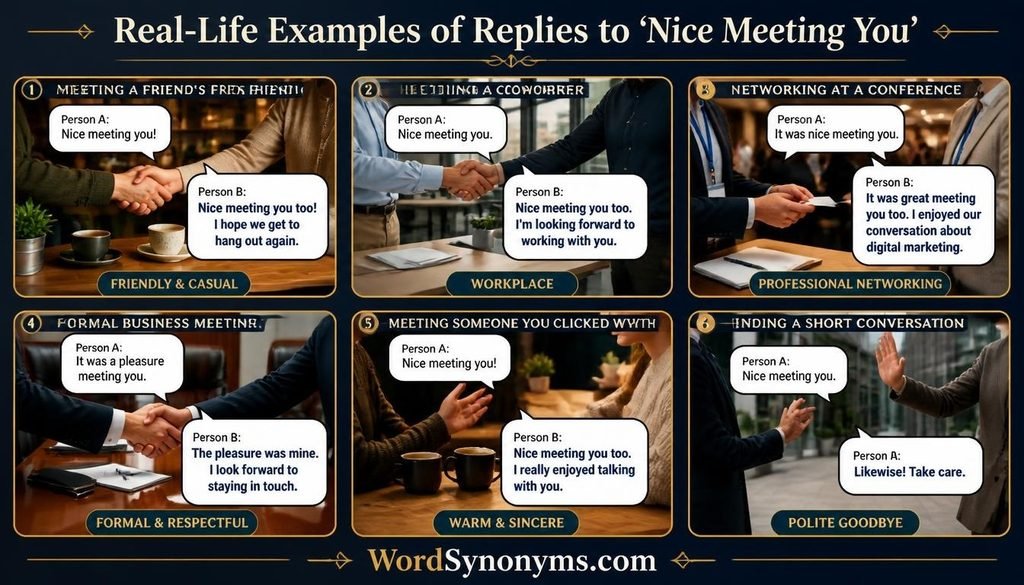
Real-Life Examples of Replies to “Nice Meeting You”
Sometimes seeing the phrase in context makes the choice much easier.
Example 1: Meeting a Friend’s Friend
“Nice meeting you!”
“Nice meeting you too! I hope we get to hang out again.”
The tone is relaxed and friendly.
Example 2: Meeting a Coworker
“Nice meeting you.”
“Nice meeting you too. I’m looking forward to working with you.”
The second sentence gives the exchange a practical purpose.
Example 3: Networking at a Conference
“It was nice meeting you.”
“It was great meeting you too. I enjoyed our conversation about digital marketing.”
This response reinforces the professional connection.
Example 4: A Formal Business Meeting
“It was a pleasure meeting you.”
“The pleasure was mine. I look forward to staying in touch.”
The language matches the formal setting.
Example 5: Meeting Someone You Clicked With
“Nice meeting you!”
“Nice meeting you too. I really enjoyed talking with you.”
This response communicates genuine appreciation without sounding overly intense.
Example 6: Ending a Short Conversation
“Nice meeting you.”
“Likewise! Take care.”
Short, courteous, and complete.
Read more: Bad Rap or Bad Rep: Which Phrase Is Correct?
What Is the Best Reply to “Nice Meeting You”?
For most situations, “Nice meeting you too” is the best answer.
It works because it’s direct, friendly, and difficult to misunderstand. You don’t need to reach for an elaborate phrase simply to sound intelligent.
However, context can make another response better.
Choose “Likewise!” when you want something short. Use “Same here!” for a casual exchange. Try “It was a pleasure meeting you” in a formal professional setting. If you want to build a relationship, “I hope we can talk again soon” adds a clear sense of interest.
The strongest responses usually share one quality: they sound genuine.
FAQs
1. What is the best reply to “Nice meeting you”?
“Nice meeting you too!” is a simple and natural reply. You can also say, “I’m glad we had a chance to connect” to sound warmer.
2. Can I say “Nice to meet you too” after someone says it first?
Yes! It’s a polite and commonly used response. It works well in casual conversations, professional introductions, and networking events.
3. How do I reply to “Nice meeting you” professionally?
You can say, “It was a pleasure meeting you as well.” Another good option is, “I enjoyed our conversation and look forward to staying in touch.”
4. How do I respond to “Nice meeting you” in an email?
Keep your email friendly and professional. Try saying, “It was great meeting you too. I appreciate your time and enjoyed our discussion.”
5. Is “Likewise” a good response to “Nice meeting you”?
Yes! “Likewise” is short, polite, and natural. It means you feel the same way. You can use it in both professional and everyday conversations.
6. How do I reply without sounding too formal?
Use simple and friendly expressions like “You too!” or “I really enjoyed meeting you.” These responses sound relaxed without losing politeness.
7. What should I say after meeting someone at a networking event?
You could say, “It was great connecting with you. I’d love to stay in touch.” This response shows interest and creates an opportunity for future communication.
8. Can I reply with “It was nice meeting you too”?
Absolutely! It’s grammatically correct and sounds natural. You can use it when someone expresses happiness about meeting you.
9. How do I respond when someone says “Nice meeting you” but I want to continue the conversation?
Add a friendly question to your response. For example, “Nice meeting you too! How did you get started in this field?” This keeps the conversation moving.
10. Should I send a follow-up message after someone says “Nice meeting you”?
If you met someone professionally or want to maintain the connection, sending a follow-up message is a good idea. Thank them for their time and mention something interesting you discussed together.
Conclusion
Finding the right response to “Nice meeting you” doesn’t have to be difficult. A simple “Nice to meet you too” works in most situations, but adding a little warmth can make your words more memorable. Whether you’re talking to a new friend, meeting a potential client, or connecting with a colleague, choose a reply that feels natural to you. The goal isn’t to impress someone with fancy language. It’s to make the other person feel comfortable and appreciated.
From my experience, genuine words often leave a stronger first impression than perfectly rehearsed responses. Don’t worry too much about saying the wrong thing or sounding too simple. Pay attention to the situation, keep your tone friendly, and let your personality show. With a little practice, you’ll find it easier to handle introductions, continue conversations, and build meaningful connections without overthinking every word.

Daniel Brooks is interested in English word usage, confusing expressions, and language development. He researches commonly misunderstood words and explains their differences through definitions and practical examples. His work helps readers understand language more accurately and select the right expressions for different situations.