


“Why Does an Alarm “Go Off” and Not “Go On”? Meaning” shows how everyday English follows usage, not strict logic.
The expression “go off” describes an alarm clock, phone alarm, or alarm system that starts ringing and producing a sound. In English usage and grammar, it works as a phrasal verb meaning to activate, ring, or produce a signal. For example, saying “My alarm went off at 7 a.m.” explains when a notification becomes active and sends alerts. Native speakers use this common idiom in everyday communication because its phrase meaning depends on context rather than strict logic.
This curious expression is also connected to scheduling, time management, calendar reminders, meetings, project management, online booking systems, and daily tasks. A reminder might go off before a meeting or when a scheduled task needs attention. You can encounter this common expression in casual settings, professional settings, business communication, formal writing, and everyday speech.
However, “go on” has different meanings in the same context. It usually means continue, happen, or remain active rather than describe an alarm activation. Understanding this difference improves consistency, language use, and communication. The history, usage, and language development of this expression also reveal how language evolution, semantics, idiomatic usage, and linguistic principles shape the English language.
Similar language patterns appear in broadcasting, modern technology, alarm systems, and notification systems. Whether you use spoken English, written English, casual communication, or professional communication, this familiar pattern remains common among native English speakers.
Learning phrasal verbs, idiomatic expressions, common expressions, and everyday expressions helps you understand their contextual meaning and linguistic meaning and use them correctly.
Quick Answer
We say an alarm “goes off” because the phrase means it suddenly starts making a sound or warning signal. The expression is also used for explosions and gunfire, which helps explain its connection with sudden noises. In contrast, “go on” usually means to continue. So, an alarm goes off when it starts ringing and goes on when the ringing continues.

What Does It Mean When an Alarm Goes Off?
When an alarm goes off, it starts producing a sound or warning signal. The expression describes the moment a device activates and alerts people to something.
For example, imagine setting your alarm clock for 7 a.m. You wake up when it begins ringing. You might tell someone, “My alarm went off at seven.”
In this sentence, “went off” means the alarm started sounding. It doesn’t mean the device switched itself off or stopped working.
The same expression applies to several warning devices, including:
- Alarm clocks: My alarm went off before sunrise.
- Smoke detectors: The smoke alarm went off while I was cooking.
- Fire alarms: The building’s fire alarm went off during the afternoon.
- Security systems: The burglar alarm went off when someone opened the back door.
- Car alarms: A parked car alarm went off in the middle of the night.
- Emergency alarms: The warning siren went off during the severe weather alert.
Although these devices serve different purposes, the expression works similarly for all of them.
An alarm going off generally means its warning signal has started. The device may continue making noise until someone silences it or its programmed cycle ends.
Example: “The smoke detector went off because someone burned toast in the kitchen.”
Here, the detector activated and produced an audible warning. The expression doesn’t necessarily mean a dangerous fire existed.
Does an Alarm Going Off Mean It Has Been Turned Off?
No. This is one of the most common misunderstandings surrounding the phrase.
When an alarm goes off, it starts sounding. When someone turns off an alarm, they stop its sound or deactivate the device.
Consider these two sentences:
- “My alarm went off at 6:30 a.m.” This means it started ringing.
- “I turned off my alarm at 6:35 a.m.” This means I stopped the ringing.
The distinction becomes clearer when you think about the sequence of events.
First, the alarm activates. Then it produces a warning sound. Finally, someone may press a button to silence it.
The expressions describe different stages of the same event.
Why Does an Alarm “Go Off” Instead of “Go On”?
The expression “go off” has several established meanings in English. One particularly relevant meaning describes something happening suddenly or producing a sudden sound.
This usage explains why people say an alarm goes off rather than goes on.
Think about a gun firing or an explosive device detonating. English speakers have traditionally used “go off” to describe these sudden events.
An alarm also produces a noticeable sound when it activates. Although a ringing alarm isn’t an explosion, both situations involve an abrupt event that attracts attention.
Over time, the expression became a natural way to describe alarms and warning signals.
However, there’s another important point. The word “off” doesn’t always mean switched off or disconnected.
English uses phrasal verbs in ways that often differ from the literal meanings of their individual parts. For example, “take off” can mean an airplane leaves the ground, while “put off” can mean postponing an event.
The meaning depends on the complete expression rather than one word alone.
The Connection Between “Go Off” and Explosions
One of the clearest connections comes from the expression’s use with firearms and explosives.
Consider these examples:
- The gun went off during the hunting trip.
- A firecracker went off outside the house.
- The bomb went off shortly after midnight.
- The fireworks went off above the stadium.
In each sentence, “went off” describes a sudden event involving a sound, discharge, or explosion.
An alarm clock works differently. It doesn’t explode or release a projectile. Nevertheless, its sudden ringing shares the quality of an abrupt event.
Imagine sitting quietly in a room when a smoke detector suddenly starts screaming. The unexpected sound immediately interrupts the silence.
That’s the kind of situation the expression describes.
The connection isn’t that alarms behave like explosives. Instead, English uses the same phrasal verb for different events that happen suddenly or produce noticeable sounds.
How “Go Off” Became Associated With Alarms
The history of “go off” helps explain why the expression sounds unusual today.
Historical dictionary records document the use of “go off” for firearms and explosions centuries ago. Etymological references commonly trace the firearm-related sense to the late sixteenth century.
That historical usage provides an important clue. The expression already existed as a way to describe a sudden discharge or explosive event before modern household alarm clocks became common.
As mechanical warning devices developed, English speakers used familiar language to describe their sounds.
An alarm’s sudden activation naturally fitted the existing expression.
However, it’s important not to confuse a reasonable historical connection with a proven account of exactly when people first applied “go off” to alarms. The firearm-related history supports the explanation, but it doesn’t establish one specific moment when the alarm meaning originated.
The expression eventually became standard everyday English.
Today, you can use it naturally for an alarm clock, smoke detector, security system, or warning siren.
What Does “Go On” Mean Instead?
To understand why an alarm goes off rather than goes on, you also need to understand the expression “go on.”
Unlike “go off,” the phrasal verb “go on” commonly describes continuation, progression, or something happening.
For example:
- The meeting will go on until noon.
- Please go on with your explanation.
- The show must go on despite the technical problems.
- What’s going on outside?
- The discussion went on for another hour.
In these examples, “go on” describes an activity that continues or an event that takes place.
That’s why it doesn’t normally replace “go off” when you want to describe an alarm beginning to ring.
Imagine saying, “My alarm went on at six.” Most English speakers would find this unusual if you mean the alarm started sounding at that moment.
A more natural sentence would be, “My alarm went off at six.”
However, “go on” can describe an alarm continuing to sound in a suitable context.
For example:
“My alarm went off at six and went on for another ten minutes.”
Here, the first expression describes the alarm’s activation. The second describes the continued ringing.
Go Off vs. Go On: What’s the Difference?
Both expressions contain the verb “go,” but their meanings change depending on the particle that follows.
The following comparison makes their differences easier to understand.
| Expression | Main Meaning | Example |
| Go off | To start sounding or activate suddenly | My alarm went off at seven. |
| Go on | To continue or proceed | The alarm went on for several minutes. |
| Go on | To happen or take place | What’s going on outside? |
| Go off | To explode or fire | The fireworks went off at midnight. |
| Turn off | To stop or deactivate something | I turned off the alarm. |
| Set off | To trigger or activate something | Smoke from the kitchen set off the alarm. |
The most important distinction concerns the action you’re describing.
- Go off: The alarm starts sounding.
- Go on: The alarm continues sounding or an event proceeds.
- Turn off: Someone stops the alarm or deactivates it.
- Set off: Something triggers the alarm.
These expressions aren’t interchangeable, even though they sometimes appear in the same situation.
For example, “The smoke set off the alarm” identifies the trigger. “The alarm went off” describes the resulting warning sound.
Read more: Is “Agreeance” a Proper Word in English? Meaning and Examples
Other Meanings of the Phrasal Verb “Go Off”
Although the alarm-related meaning is common, “go off” has several other uses.
Understanding these meanings helps explain why the expression can seem confusing. The same two words appear in completely different situations.
Here are some important meanings with practical examples.
To Explode or Fire
One established meaning of “go off” describes an explosion or the firing of a weapon.
When a bomb, firework, or gun goes off, it suddenly activates or discharges.
Examples:
- A firework went off above the city.
- The old gun went off accidentally.
- The bomb went off in an abandoned building.
- Several fireworks went off during the celebration.
This meaning is especially relevant to the alarm question because it demonstrates how “go off” describes sudden events.
A warning alarm doesn’t explode. However, its sudden sound fits the broader idea of an abrupt occurrence.
To Make a Sudden Warning Sound
This is the meaning used when discussing alarm clocks and warning systems.
An alarm goes off when it begins producing its warning signal.
Examples:
- My phone alarm goes off at 5:45 every morning.
- The fire alarm went off during the meeting.
- The car alarm went off when someone touched the door.
- The smoke detector keeps going off whenever I cook.
Notice how the expression works with both ordinary and emergency alarms.
It also works in different tenses:
| Tense | Example |
| Present | My alarm goes off every morning. |
| Past | My alarm went off yesterday. |
| Future | The alarm will go off at eight. |
| Present continuous | The alarm is going off right now. |
| Present perfect | My alarm has gone off twice today. |
These examples show how naturally the phrasal verb fits everyday English.
To Stop Working or Being Supplied
“Go off” can also describe an interruption in an electrical supply or another service.
For example, when electricity suddenly becomes unavailable, people often say the power went off.
Examples:
- The electricity went off during the thunderstorm.
- The heating went off in the middle of the night.
- The lights went off without warning.
- Our internet went off during the online meeting.
This meaning differs from an alarm going off.
When the electricity goes off, the supply stops. When an alarm goes off, its warning signal starts.
The surrounding words help you identify the intended meaning.
To Become Spoiled
In British English, “go off” commonly describes food becoming unpleasant or unsafe because it has spoiled.
For example:
- The milk went off because nobody refrigerated it.
- These eggs might have gone off.
- The cheese went off before we could finish it.
- I think the chicken has gone off.
This usage is particularly common in British English. American speakers more often say that food has gone bad or spoiled.
The expression illustrates another important feature of phrasal verbs: their meanings aren’t always predictable from the words themselves.
Food doesn’t literally move away or switch off. The phrase describes a change in its condition.
To Happen in a Particular Way
Another meaning of “go off” describes how an event, performance, or activity happens.
It can suggest that something went smoothly, successfully, or according to expectations.
Examples:
- The wedding went off without any problems.
- The presentation went off better than expected.
- Everything went off according to plan.
- The ceremony went off smoothly despite the rain.
In these sentences, “go off” describes the overall outcome of an event.
For example, when someone says, “The party went off perfectly,” they mean everything happened successfully.
This meaning is different from the sudden-sound meaning used with alarms.
To Become Angry or Criticize Someone
In informal English, “go off on someone” means to suddenly become angry with them or criticize them strongly.
It often describes an emotional reaction during an argument.
Examples:
- My manager went off on me for arriving late.
- She went off on her brother during dinner.
- He went off on his friend after hearing the news.
- The customer went off on the employee over a billing mistake.
You may also hear younger speakers use “go off” as an expression of praise or excitement.
For example, someone might say, “That singer is going off!” to express admiration for an energetic performance.
The meaning depends heavily on the context and the way someone uses the expression.
What Are the Correct Ways to Describe an Alarm?
English offers several expressions for describing an alarm. Each one communicates a slightly different action.
Choosing the right phrase makes your sentences clearer and more natural.
The Alarm Goes Off
Use this expression when an alarm starts ringing, buzzing, beeping, or sounding.
It’s the standard everyday expression for an alarm beginning to produce a warning signal.
Examples:
- My alarm goes off at six every weekday.
- The smoke detector went off during breakfast.
- The security alarm went off when someone opened the window.
- The emergency siren will go off if the system detects danger.
Remember that “go off” describes activation rather than deactivation.
The Alarm Goes On
This expression can describe an alarm continuing to sound, depending on the sentence.
However, it’s not the usual expression for describing the moment an alarm starts ringing.
Examples:
- The alarm went off and went on for several minutes.
- The alarm kept going on even after everyone left.
- The warning signal went on throughout the night.
In these examples, “go on” focuses on continuation rather than initial activation.
For everyday writing, “the alarm continued ringing” or “the alarm kept sounding” may sound clearer.
The Alarm Goes On and On
This expression emphasizes that an alarm continues sounding for a long time.
Repeating “on” adds emphasis and suggests that the noise feels prolonged or annoying.
Examples:
- The alarm went on and on until someone found the control panel.
- My neighbor’s car alarm went on and on throughout the night.
- The fire alarm went on and on while the technicians investigated.
This phrase works particularly well when you want to emphasize an irritating or unusually long warning sound.
The Alarm Turns Off
Use “turn off” when an alarm stops sounding or someone deactivates it.
The phrase describes the opposite stage of the event.
Examples:
- I turned off my alarm before getting out of bed.
- The technician turned off the security alarm.
- The smoke detector turned off after the air cleared.
- Please turn off the alarm before leaving the building.
There’s a small distinction worth remembering.
An alarm can stop making noise without the entire warning system becoming disabled. For example, pressing the snooze button silences an alarm temporarily while keeping the scheduled alarm active.
The Alarm Is Set Off
Use “set off” when something triggers an alarm.
Unlike “go off,” which describes the alarm’s activation, “set off” often identifies the cause.
Examples:
- Burning toast set off the smoke detector.
- Someone accidentally set off the building’s security alarm.
- Opening the emergency exit set off the warning system.
- The movement sensor set off the burglar alarm.
Compare these sentences:
“The smoke detector went off.”
This sentence tells you what happened to the detector.
“The burning food set off the smoke detector.”
This sentence tells you what triggered the warning.
The difference is subtle but important.
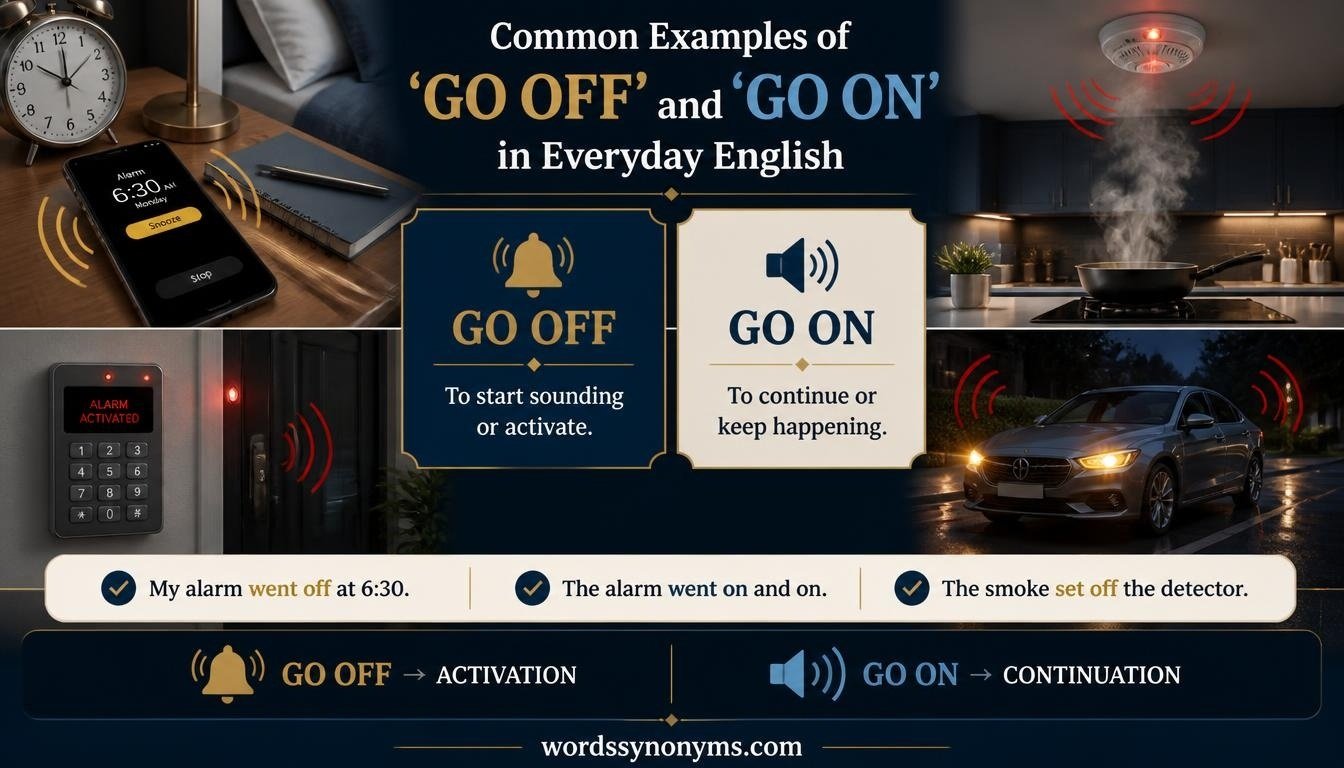
Common Examples of “Go Off” and “Go On” in Everyday English
Real-life examples make phrasal verbs easier to understand than isolated definitions.
Consider these situations involving alarms, household activities, and everyday conversations.
Example: Your Morning Alarm
You set your phone alarm for 6:30 a.m. The phone starts ringing while you’re still asleep.
You could say:
“My alarm went off at 6:30 this morning.”
If you press the snooze button, the alarm temporarily stops. A few minutes later, it rings again.
You might explain:
“My alarm went off twice because I kept pressing snooze.”
Both sentences use “go off” to describe the alarm activating.
Example: A Smoke Detector in the Kitchen
Imagine preparing breakfast when a little smoke rises from your frying pan.
Suddenly, the smoke detector starts beeping.
You could say:
“The smoke alarm went off because I burned the toast.”
If the warning continues for several minutes, you might add:
“The alarm went on and on until I opened the windows.”
The first expression describes activation. The second emphasizes continuation.
Example: A Security Alarm
Suppose someone accidentally opens a protected door without entering the security code.
The system immediately produces a loud warning.
You could describe the situation in two ways:
- “Opening the door set off the security alarm.”
- “The security alarm went off immediately.”
Both sentences are correct. However, they emphasize different parts of the same event.
Example: An Alarm That Won’t Stop
Imagine a car alarm starts ringing outside your apartment.
You wait for someone to silence it, but the noise continues.
You might say:
“The car alarm went off at midnight and went on for twenty minutes.”
This sentence demonstrates why both expressions can appear together without contradiction.
Quick Comparison of Everyday Sentences
| Sentence | Meaning |
| My alarm went off. | My alarm started ringing. |
| My alarm went on. | My alarm continued sounding in context. |
| My alarm went on and on. | My alarm continued for a long time. |
| I turned off my alarm. | I stopped the alarm. |
| The smoke set off my alarm. | Smoke triggered the alarm. |
| The alarm didn’t go off. | The alarm failed to activate. |
| The alarm went off accidentally. | The alarm activated unintentionally. |
These examples demonstrate why choosing the correct phrasal verb matters.
Common Mistakes When Using “Go Off” and “Go On”
Even fluent English speakers occasionally misunderstand phrasal verbs. The unusual meaning of “go off” makes it particularly easy to confuse with other expressions.
Here are some common mistakes and their corrections.
Using “Go On” When You Mean an Alarm Starts Ringing
The most common mistake involves replacing “go off” with “go on.”
Incorrect: “My alarm went on at seven this morning.”
Correct: “My alarm went off at seven this morning.”
The second sentence clearly communicates that the alarm started sounding.
However, remember that “go on” can describe continued ringing in a suitable context.
Assuming “Off” Always Means Stopping
The word “off” frequently appears in expressions involving disconnection or deactivation.
For example:
- Turn off the television.
- Switch off the lights.
- Take off your shoes.
However, “go off” has a separate established meaning when used with alarms.
Incorrect understanding: “My alarm went off, so it must have stopped.”
Correct understanding: “My alarm went off, so it started ringing.”
Never assume that a particle carries exactly the same meaning in every phrasal verb.
Confusing “Go Off” With “Turn Off”
These expressions describe different actions.
Incorrect: “I went off my alarm because it was annoying.”
Correct: “I turned off my alarm because it was annoying.”
The first sentence doesn’t naturally communicate that you silenced the alarm.
Use “turn off” when you mean stopping the device. Use “go off” when you mean its warning signal begins.
Confusing “Go Off” With “Set Off”
Although both expressions involve activation, their grammatical roles differ.
Compare:
- The alarm went off.
- The smoke set off the alarm.
In the first sentence, the alarm is the thing activating.
In the second sentence, smoke is the trigger.
You can remember this distinction by asking a simple question: What happened, or what caused it?
Treating Every Meaning of “Go Off” as Interchangeable
Context determines the meaning of this phrasal verb.
Consider these examples:
- The alarm went off. (It started sounding.)
- The bomb went off. (It exploded.)
- The milk went off. (It spoiled.)
- The lights went off. (They stopped receiving power.)
- The meeting went off well. (It happened successfully.)
The same expression performs different jobs in these sentences.
Understanding the surrounding words helps you interpret the intended meaning accurately.
A Simple Case Study: Why an Alarm Can Go Off and Then Go On
Imagine a family preparing for a weekend trip.
At 5:30 a.m., their alarm clock suddenly starts ringing. Everyone wakes up, but nobody immediately gets out of bed.
The father says, “The alarm went off early this morning.”
This describes the moment the alarm started sounding.
However, nobody presses the stop button. The ringing continues for another five minutes.
The mother complains, “That alarm has been going on forever!”
Here, “going on” emphasizes the continued noise.
Finally, their child reaches over and presses the button.
The father explains, “I finally turned off the alarm.”
This short situation demonstrates three different expressions:
| Event | Correct Expression | Explanation |
| The alarm starts ringing. | Goes off | Describes activation. |
| The alarm continues ringing. | Goes on | Describes continuation. |
| Someone stops the ringing. | Turns off | Describes deactivation. |
Notice how each expression describes a separate stage.
There’s no contradiction. The confusion disappears once you understand what each phrasal verb communicates.

Why English Phrasal Verbs Can Sound So Confusing
The alarm example reveals a broader feature of English: phrasal verbs often have meanings that aren’t obvious from their individual words.
A phrasal verb combines a main verb with a particle such as “off,” “on,” “up,” “out,” or “down.”
Together, these words can create a meaning that differs from their literal parts.
For example:
| Phrasal Verb | Meaning | Example |
| Give up | Stop trying | Don’t give up on your goals. |
| Bring up | Introduce a topic | She brought up an interesting question. |
| Take off | Leave the ground | The airplane took off at noon. |
| Put off | Postpone | We put off the meeting. |
| Find out | Discover information | I found out the truth. |
| Turn down | Reject or reduce | He turned down the invitation. |
| Go off | Start sounding or explode | The alarm went off. |
The particle doesn’t always have one fixed meaning across every expression.
Sometimes, it contributes a familiar idea. In other cases, the complete phrase has developed an established meaning through repeated use.
That’s why memorizing phrasal verbs in context often works better than translating each word separately.
When you encounter an unfamiliar expression, pay attention to the entire sentence. The surrounding words usually provide useful clues.
FAQs
Why does an alarm “go off” instead of “go on”?
We say an alarm goes off because “go off” is the established English expression for an alarm beginning to ring or signal. “Go on” usually means to continue or remain in operation.
Does “go off” always mean an alarm starts ringing?
No. “Go off” has several meanings depending on the context. It can describe an alarm ringing, an explosion occurring, food becoming spoiled, or someone leaving a place.
Can I say “my alarm went on”?
Usually, no. Native speakers generally say, “My alarm went off.” Saying “my alarm went on” can sound unnatural when you mean that the alarm started making a sound.
What does “go off” mean in grammar?
“Go off” is a phrasal verb made from the verb “go” and the particle “off.” Together, they create a meaning that differs from the basic meaning of “go” alone.
Is “go off” formal or informal English?
“Go off” is standard English and works in both casual communication and many professional settings. You can use it naturally in conversations, emails, instructions, and other everyday situations.
Why does English use expressions that seem illogical?
English contains many idiomatic expressions whose meanings developed through long-term usage. As a result, some phrases may not seem logical when you examine each word separately, but their meaning becomes clear through common usage.
Conclusion
The phrase “go off” makes sense once you look at how English actually works in everyday communication. An alarm goes off when it begins ringing, sounding, or sending a signal. Although “go on” may seem more logical at first, it normally carries meanings such as continuing, happening, or staying active. This difference comes from established language usage rather than a simple word-for-word rule.
Understanding expressions like “go off” can make English easier to use with confidence. You’ll hear this phrase in conversations about alarms, reminders, schedules, and notifications, as well as in many other contexts. Like countless phrasal verbs and idiomatic expressions, its meaning becomes natural through repeated exposure. Once you recognize that pattern, “my alarm went off” no longer sounds strange—it simply sounds like normal English.

Daniel Brooks is interested in English word usage, confusing expressions, and language development. He researches commonly misunderstood words and explains their differences through definitions and practical examples. His work helps readers understand language more accurately and select the right expressions for different situations.



[…] Read more: Why Does an Alarm “Go Off” and Not “Go On”? Meaning […]
[…] Read more: Why Does an Alarm “Go Off” and Not “Go On”? Meaning […]