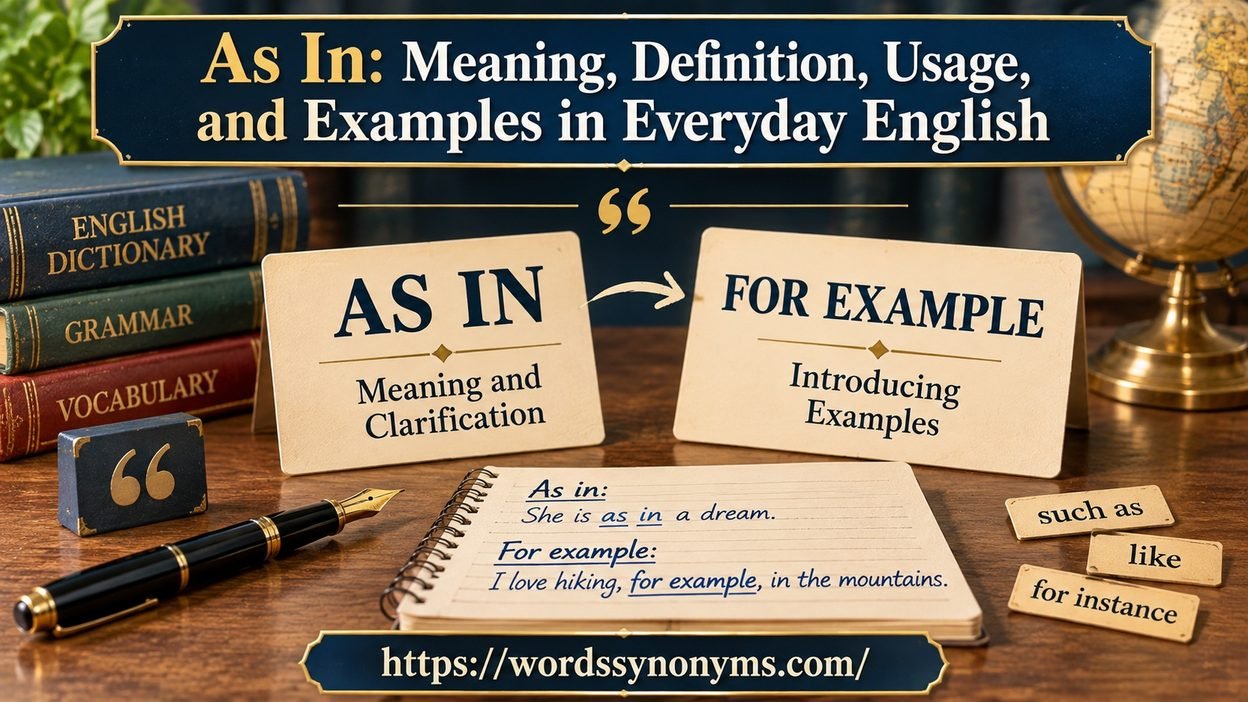
This guide to As In: Meaning and Examples in Everyday English shows how the phrase clarifies ideas and makes everyday communication clearer.
You can use this English expression to specify a specific meaning, explain a word, or make a sentence easier for readers to understand. For example, if someone mentions animals, you might ask, “As in dogs and cats?”
This relevant example provides additional information and helps people gain a further understanding without repeating an idea. Both English learners and native speakers can use this phrase to improve their English usage, grammar skills, and ability to communicate ideas with greater clarity.
It works as a useful tool for natural communication across casual settings, professional settings, and daily conversations. You will also find it in spoken English, written English, and different real-world contexts. For instance, business communication, professional emails, academic writing, and formal writing often require clear explanations and better writing accuracy.
The phrase can also appear in reports, meetings, project management, and a work workflow when someone needs to explain a task or update a calendar. Other examples include scheduling, time management, online booking, and broadcasting.
From my experience, using the phrase naturally makes explanations easier to follow. Learning a few usage tips and avoiding common mistakes can help you use it confidently and naturally.
Its correct use improves accuracy, consistency, and language clarity while strengthening your communication skills and language skills. It also helps explain sentence meaning, phrase usage, and contextual meaning, making reader comprehension easier.
With practical examples and clear definitions, you can understand meaning, improve your English grammar, and apply meaning clarification in everyday and workplace communication.
Quick Answer
“As in” means “for example,” “specifically,” or “meaning” depending on the context. People commonly use it to provide a particular example, clarify a statement, or identify the exact meaning of a word or expression.
For example:
- “I love citrus fruits, as in oranges and lemons.” Here, it introduces specific examples.
- “Do you mean Java, as in the programming language?” Here, it clarifies the intended meaning.
- “He’s a doctor, as in a medical doctor.” Here, it specifies what kind of doctor someone means.
The expression consists of two separate words: as and in. You should write it as two words rather than combining them.

What Does As In Mean?
“As in” is an English expression that introduces an example, provides clarification, or makes a statement more specific. Speakers often use it when a word or phrase could have multiple meanings or when a general description needs further explanation.
For instance, consider this sentence:
“I collect vintage items, as in old coins, stamps, and postcards.”
The first part gives a broad idea about the person’s hobby. The phrase “as in” introduces particular items that explain what the person collects. Instead of leaving the statement open to interpretation, the speaker provides useful details.
The expression becomes especially helpful when people discuss words with several possible meanings. Consider the word bat. It can refer to a flying mammal or a piece of sports equipment.
Someone might ask:
“Are you talking about a bat, as in the animal or the baseball equipment?”
In this example, “as in” helps distinguish between two possible interpretations.
As In Meaning to Give an Example
One common use of “as in” involves introducing one or more specific examples of a general category. It helps readers understand what a broad statement includes.
For example:
- “I enjoy outdoor activities, as in hiking, camping, and fishing.”
- “She collects gemstones, as in rubies, emeralds, and sapphires.”
- “We need office supplies, as in notebooks, pens, and folders.”
Each sentence begins with a general category. The expression then introduces examples that make the category easier to understand.
You can think of “as in” as a conversational bridge between a general idea and its specific details.
However, it doesn’t always work exactly like such as. Its tone and sentence structure often make it more useful for direct clarification or informal explanations.
As In Meaning to Clarify Something
Another important use of “as in” is clarification. People use it when they want to explain what they mean or make sure someone understands a particular reference.
Consider this conversation:
Person A: “I work with Python.”
Person B: “Python, as in the programming language?”
Person B uses the expression to confirm the intended meaning. Python could refer to a programming language or a type of snake. The additional words remove the uncertainty.
Here are more examples:
- “You mean Mercury, as in the planet?”
- “Is that Apple, as in the technology company?”
- “Are you talking about spring, as in the season?”
- “She studies history, as in ancient civilizations.”
This use appears frequently in conversations because people don’t always share the same background knowledge. A quick clarification can prevent an entire discussion from going off track.
As In Meaning to Specify Something
Sometimes, a statement contains a broad word that needs a more precise explanation. In these situations, “as in” identifies the exact meaning the speaker intends.
For example:
“I need a light laptop, as in something I can carry comfortably while traveling.”
The word light could refer to brightness or weight. The additional explanation makes the intended meaning clear.
More examples include:
- “I want a natural look, as in minimal makeup.”
- “We’re planning a short trip, as in a weekend away.”
- “He enjoys classical music, as in Mozart and Beethoven.”
- “I’m looking for a practical solution, as in something affordable and easy to maintain.”
Notice how the expression narrows the meaning of the earlier statement. It gives the listener a clearer picture rather than leaving them to guess.
How to Use As In in a Sentence
Using “as in” correctly becomes easier when you understand the relationship between the words before and after it. The expression usually connects a general statement with a specific example, explanation, or clarification.
In everyday English, you can place it in different parts of a sentence depending on what you want to communicate.
Here are some practical patterns:
| Sentence structure | Example | Purpose |
| General category + as in + examples | I enjoy sports, as in tennis and basketball. | Introduces examples |
| Word + as in + clarification | Do you mean bass, as in the fish? | Clarifies meaning |
| Statement + as in + explanation | I want something simple, as in an easy-to-follow plan. | Adds detail |
| Question + as in + specific meaning | You mean cold, as in the weather? | Checks understanding |
Using As In After a General Statement
When you want to explain a broad statement, you can place “as in” before the specific examples. This construction works particularly well in conversations and informal explanations.
For example:
- “I prefer warm drinks, as in tea and hot chocolate.”
- “They sell handmade products, as in candles, pottery, and jewelry.”
- “We studied European languages, as in French, German, and Italian.”
- “He enjoys water sports, as in swimming and kayaking.”
In each sentence, the expression introduces details that support the original statement.
However, make sure your examples actually belong to the category you’re describing. If someone mentions fruits, listing vegetables afterward creates confusion rather than clarification.
Using As In to Clarify a Word or Phrase
Some English words have several meanings. Using “as in” allows you to identify the intended meaning without rewriting your entire sentence.
Consider the word crane. It can describe a large bird or a machine used for lifting heavy objects.
You could say:
- “I saw a crane, as in the construction machine.”
- “She photographed a crane, as in the tall wading bird.”
- “I’m learning about Java, as in the programming language.”
- “He bought a new mouse, as in a computer accessory.”
This construction proves useful when discussing technical terms, names, places, and words with multiple definitions.
It also makes conversations more efficient. Rather than explaining everything from scratch, you simply add the information needed to identify your meaning.
Using As In in Questions
Questions containing “as in” often ask someone to explain or confirm a particular detail. They’re especially common when a statement sounds vague or has more than one possible interpretation.
For example:
- “You want to move abroad, as in permanently?”
- “Are you talking about jazz, as in traditional New Orleans music?”
- “You said he works remotely, as in from home?”
- “Do you mean a bank, as in a financial institution?”
These questions invite clarification without sounding overly formal.
You can also use the expression when someone introduces an unfamiliar reference. For example:
Person A: “I recently started learning Rust.”
Person B: “Rust, as in the programming language?”
The question checks whether both people are discussing the same subject. That’s a small but useful conversational habit.
Read more: Is “Agreeance” a Proper Word in English? Meaning and Examples
As In Sentence Examples
Examples provide the clearest way to understand how an expression works. The following sentences demonstrate how “as in” appears in different situations.
Everyday Conversation Examples
In casual conversations, people frequently use “as in” to explain preferences, clarify descriptions, and identify specific things.
Here are some natural examples:
- “I love spicy food, as in Mexican and Thai dishes.”
- “She’s interested in astronomy, as in studying stars and planets.”
- “We need comfortable shoes, as in sneakers for walking.”
- “He enjoys adventure movies, as in action-packed stories.”
- “I want a quiet vacation, as in somewhere away from crowded cities.”
- “Do you mean Rose, as in the flower?”
- “I’m learning to cook, as in preparing meals from scratch.”
- “They prefer classic cars, as in older models from the 1960s.”
- “I need a break, as in a few days away from work.”
- “Are you talking about a seal, as in the marine animal?”
These examples show that the expression doesn’t belong to one particular subject. You can use it whenever additional information makes your meaning clearer.
Professional and Workplace Examples
Although “as in” sounds conversational, it can also appear in workplace discussions. Employees may use it to clarify instructions, distinguish technical terms, or explain project requirements.
Consider these examples:
- “We need a scalable solution, as in software that can handle more users.”
- “The client wants a redesign, as in a completely different website layout.”
- “Please prepare a brief report, as in two or three pages.”
- “We’re discussing cloud storage, as in online file hosting.”
- “The company needs a stronger online presence, as in improved website visibility.”
- “Do you mean the annual budget, as in the company’s total operating expenses?”
These sentences help establish expectations and reduce misunderstandings.
However, formal business documents may benefit from more precise expressions. Instead of repeatedly using “as in,” you can choose specifically, including, or namely when the sentence requires a more polished tone.
Academic and Educational Examples
Students and teachers also use “as in” when explaining unfamiliar ideas. It can connect a general concept with a particular subject, example, or definition.
For example:
- “Mammals, as in whales and dolphins, breathe air.”
- “We studied renewable energy, as in solar and wind power.”
- “The experiment examines chemical reactions, as in oxidation.”
- “The assignment focuses on literary devices, as in metaphors and symbolism.”
- “Are you discussing geometry, as in angles and shapes?”
- “The lesson covers ancient civilizations, as in Egypt and Mesopotamia.”
In educational settings, the expression can make complicated explanations easier to follow. A student who doesn’t recognize a broad term may understand it immediately after seeing a familiar example.
As In Examples in Texting and Informal Communication
Digital conversations often rely on short messages. People use “as in” to ask follow-up questions or explain what they mean without writing lengthy descriptions.
Here are some realistic texting examples:
| Message | Meaning |
| “You’re moving, as in to another city?” | Asking for clarification |
| “I need a break, as in a vacation!” | Explaining the type of break |
| “You mean coffee, as in espresso?” | Identifying a specific kind |
| “He’s famous, as in actually famous?” | Confirming the intended meaning |
| “Let’s meet early, as in 8 a.m.” | Specifying a time |
In informal messages, you may see the expression used without a complete sentence. That’s common in conversational English.
For example:
Friend A: “I bought a new bass.”
Friend B: “Bass, as in the instrument?”
The second message is perfectly understandable because the conversation supplies the missing context.
Is As In Formal or Informal?
“As in” works in both formal and informal English, although it appears more frequently in everyday conversation. Its suitability depends on the sentence, audience, and purpose.
In casual speech, people use it naturally to clarify statements or introduce examples. It also appears in workplace discussions and educational explanations.
However, formal writing often benefits from more specific alternatives. Academic papers, business reports, and professional documents usually require precise wording.
Consider these examples:
| Informal or conversational | More formal alternative |
| The study examines renewable energy, as in solar power. | The study examines renewable energy sources, including solar power. |
| We need a simple solution, as in an easy process. | We need a straightforward solution. |
| The company sells natural products, as in organic skincare. | The company sells natural products, particularly organic skincare. |
| The research covers birds, as in eagles and hawks. | The research covers birds such as eagles and hawks. |
You don’t need to avoid “as in” in formal situations. Just make sure it suits the surrounding language.
A useful rule: Use as in when you want a direct clarification. Choose including, specifically, or namely when you need a more formal presentation.
As In vs. Like
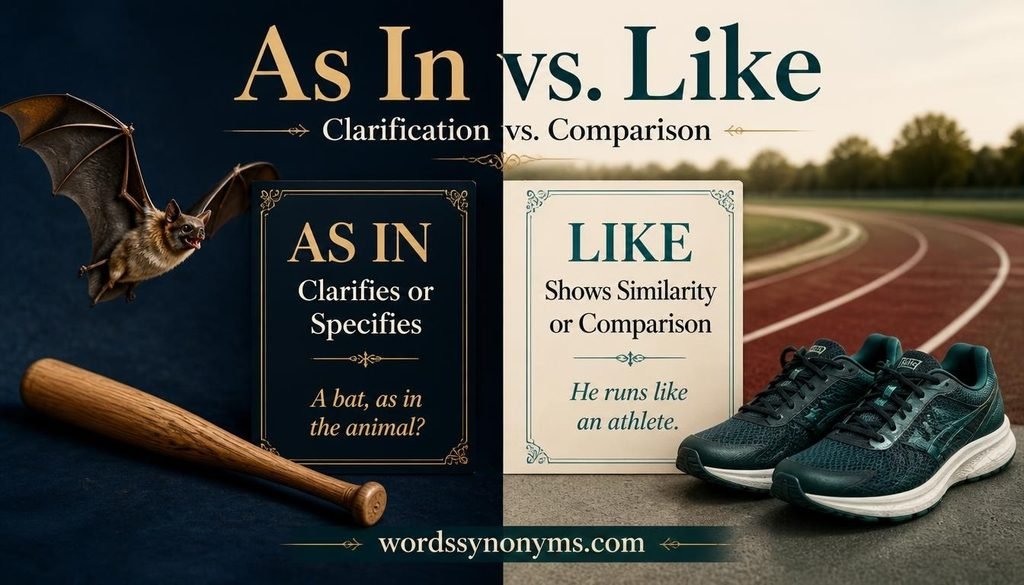
Although “as in” and “like” sometimes introduce examples, they don’t always serve the same purpose. Understanding their differences helps you choose the right expression.
“As in” usually clarifies a particular meaning or introduces examples that explain an earlier statement. “Like” commonly introduces similarities, comparisons, or examples.
Consider these sentences:
- “I enjoy outdoor activities, as in hiking and camping.”
- “I enjoy outdoor activities like hiking and camping.”
Both sentences communicate similar information. However, the first sounds more like a clarification while the second presents hiking and camping as examples.
Here’s another comparison:
| As in | Like |
| Do you mean a bat, as in the animal? | It looks like a bat. |
| I enjoy classical music, as in Mozart. | I enjoy composers like Mozart. |
| We need a warm drink, as in tea. | I prefer drinks like tea. |
| Is that Mercury, as in the planet? | Mercury looks like a bright star in the sky. |
Notice that like can introduce a comparison rather than clarify a word’s identity.
For example, saying “He runs like a professional athlete” compares someone’s running style with an athlete’s performance. It doesn’t necessarily mean the person is a professional athlete.
By contrast, “Professional athlete, as in someone who competes for a living?” asks for a specific explanation.
Remember: Use as in to clarify or specify. Use like when expressing similarity or introducing examples.
As In vs. Such As
The expressions “as in” and “such as” both help introduce examples. However, their sentence patterns and conversational tones differ.
“Such as” introduces examples that belong to a broader category. It’s especially common in informative and descriptive writing.
For example:
- “I enjoy tropical fruits such as mangoes, pineapples, and papayas.”
- “Several countries such as Canada, Japan, and Australia have large developed economies.”
- “Outdoor activities such as hiking and cycling attract many people.”
Meanwhile, “as in” often clarifies what someone means or identifies particular examples.
For instance:
- “I enjoy tropical fruits, as in mangoes and pineapples.”
- “You’re visiting Canada, as in Toronto or Vancouver?”
- “You enjoy cycling, as in mountain biking?”
The difference becomes clearer when you compare their functions.
| Feature | As in | Such as |
| Main purpose | Clarification or examples | Introducing examples |
| Tone | Often conversational | Neutral and descriptive |
| Common setting | Speech and informal writing | Informative and formal writing |
| Typical use | Explaining a specific meaning | Listing members of a category |
| Example | “A light meal, as in soup?” | “Light meals such as soup and salad.” |
When Should You Use As In Instead of Such As?
Choose “as in” when you’re clarifying a word, confirming a reference, or explaining what a statement means.
Choose “such as” when you want to introduce examples in a straightforward list.
For example:
- Better clarification: “You mean a jaguar, as in the wild cat?”
- Better example list: “Wild cats such as jaguars, leopards, and tigers inhabit different regions.”
Both expressions are useful. The best choice depends on your sentence’s purpose.
As In vs. For Example
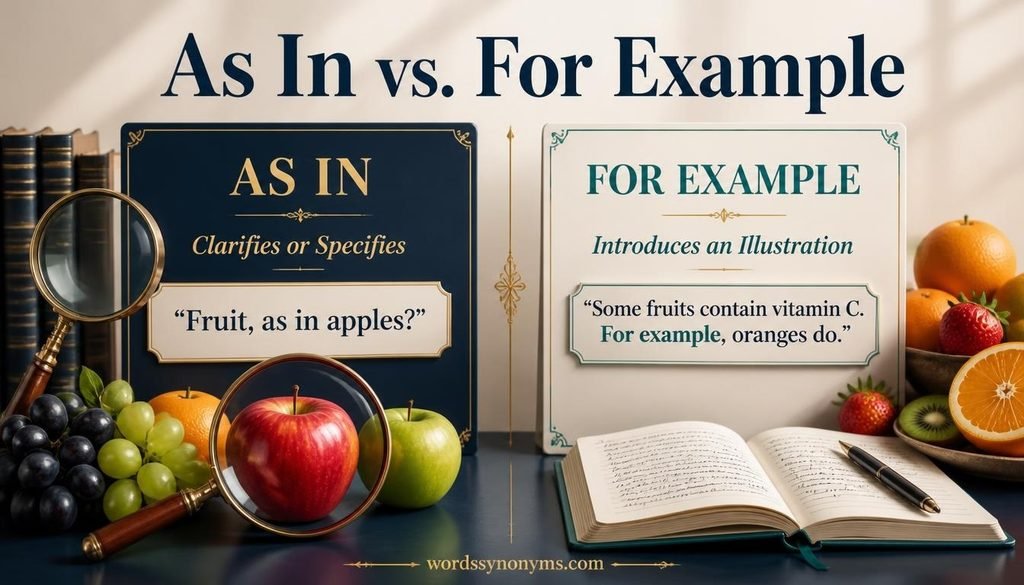
“As in” and “for example” can both introduce specific illustrations. However, for example has a broader role and usually introduces an example that supports an earlier statement.
Consider this sentence:
“Many people enjoy creative hobbies. For example, painting and photography offer different ways to express ideas.”
The phrase for example introduces supporting information. It connects the examples with the broader claim.
Now consider:
“I enjoy creative hobbies, as in painting and photography.”
Here, “as in” identifies the particular activities included in the speaker’s description.
Compare their uses below:
| As in | For example |
| I enjoy creative hobbies, as in painting. | I enjoy creative hobbies. For example, I paint regularly. |
| Do you mean fruit, as in apples? | Some fruits contain vitamin C. For example, oranges do. |
| We need a smaller vehicle, as in a compact car. | Smaller vehicles can be practical. For example, compact cars suit city driving. |
The distinction isn’t always strict because everyday English allows some overlap. Nevertheless, for example usually introduces an illustration while as in often explains the intended meaning of an expression.
Common Mistakes When Using As In
Although “as in” is straightforward, people sometimes use it incorrectly or create sentences that sound confusing. Understanding these mistakes will help you communicate more naturally.
Treating As In as a Replacement for Every Example Phrase
One common mistake involves assuming that “as in” and for example always mean exactly the same thing.
They sometimes overlap, but their functions differ.
Incorrect or awkward:
“I enjoy several activities, as in I go swimming every morning.”
Better:
“I enjoy several activities. For example, I go swimming every morning.”
The second version works better because the following statement describes an activity rather than simply identifying examples of a category.
Using As In Without Providing Clarification
The expression should introduce information that adds meaning to the preceding statement.
Unclear:
“I like music, as in.”
Better:
“I like instrumental music, as in piano and violin compositions.”
The improved sentence completes the thought and gives readers something specific to understand.
Creating Confusing or Incomplete Sentences
Sometimes, people insert “as in” where a different grammatical structure would sound more natural.
Awkward:
“She wants a better job, as in she wants more money.”
Better:
“She wants a better job, meaning she hopes to earn more money.”
The revised sentence communicates the relationship between the two ideas more clearly.
Confusing As In With As and In Separately
The expression “as in” has a combined function that differs from using as and in independently.
Compare these sentences:
- “What do you mean by smart, as in intelligent?”
- “She works as a teacher in Chicago.”
The first uses “as in” to clarify a word. The second uses as to describe someone’s role and in to identify a location.
Although the words are identical, their grammatical functions differ.
Forgetting That Context Matters
The expression doesn’t have one rigid meaning in every sentence. Depending on the context, it may introduce an example, identify a particular reference, or explain a statement.
For instance:
“Do you mean a jaguar, as in the car?”
This sentence identifies a particular meaning of jaguar. Without the surrounding conversation, readers might not know whether the speaker is discussing the vehicle or the animal.
Always consider what information your reader needs before choosing the expression.
Alternative Ways to Say As In
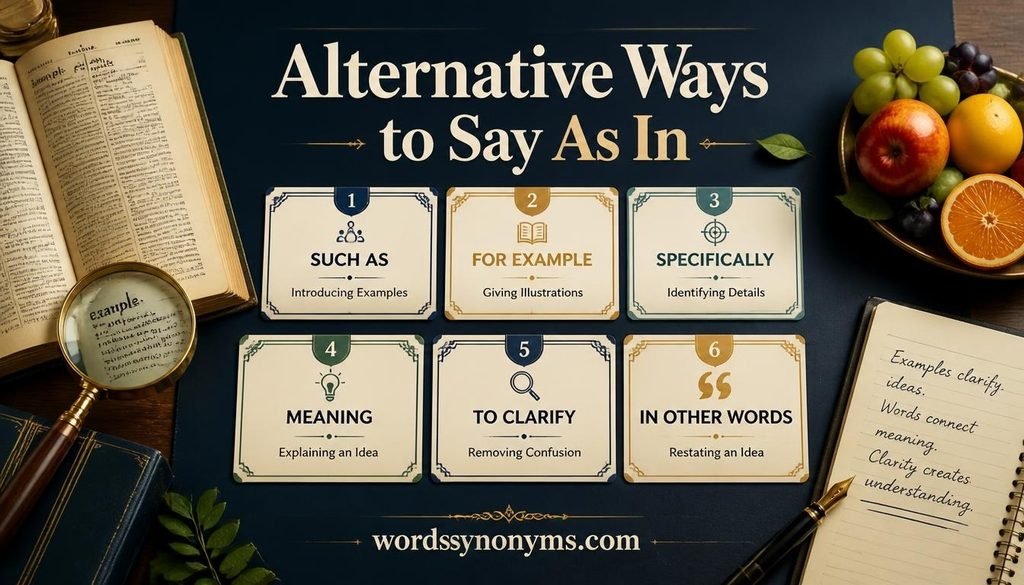
English offers several expressions that can replace “as in” depending on the sentence. However, each alternative has a slightly different purpose.
Choosing the right one makes your writing clearer and prevents repetitive language.
Such As
“Such as” introduces examples belonging to a broader category.
Example:
- Original: “I enjoy outdoor activities, as in hiking and camping.”
- Alternative: “I enjoy outdoor activities such as hiking and camping.”
This alternative works particularly well when listing several examples.
For Example
“For example” introduces a specific illustration that supports a broader statement.
Example:
- Original: “Some fruits contain high amounts of vitamin C, as in oranges.”
- Alternative: “Some fruits contain high amounts of vitamin C. For example, oranges provide vitamin C.”
Use this expression when you want to explain an idea through a practical illustration.
Specifically
“Specifically” identifies an exact detail rather than leaving a statement broad.
Example:
- Original: “I want a healthier breakfast, as in oatmeal.”
- Alternative: “I want a healthier breakfast, specifically oatmeal.”
This word works well in professional writing and direct explanations.
Meaning
“Meaning” explains the intended sense of a word, statement, or situation.
Example:
- Original: “He wants flexible hours, as in working whenever he chooses.”
- Alternative: “He wants flexible hours, meaning he can work whenever he chooses.”
Use meaning when the second part explains or interprets the first.
To Clarify
“To clarify” introduces additional information intended to prevent misunderstanding.
Example:
- Original: “We’re discussing the bank, as in the financial institution.”
- Alternative: “To clarify, we’re discussing the financial institution.”
This expression is especially useful in professional conversations and explanatory writing.
In Other Words
“In other words” restates an idea using different language. It helps make a complicated statement easier to understand.
Example:
- Original: “She needs a more accessible workplace, as in an office that’s easy to reach.”
- Alternative: “She needs a more accessible workplace. In other words, she wants an office that’s easy to reach.”
This phrase works best when you want to explain an idea rather than simply list examples.
Comparison of Alternatives to As In
| Alternative | Best use | Example |
| Such as | Introducing examples | Fruits such as apples and bananas |
| For example | Giving an illustration | Some fruits provide fiber. For example, apples do. |
| Specifically | Identifying exact details | I want specifically the blue version. |
| Meaning | Explaining an intended sense | He wants freedom, meaning more independence. |
| To clarify | Removing confusion | To clarify, the meeting starts Monday. |
| In other words | Restating an idea | In other words, we need more time. |
Choose your alternative based on the relationship between the two parts of your sentence. A natural replacement should preserve the original meaning.
Practical Case Studies: Understanding As In Through Realistic Situations
Sometimes, grammar explanations become easier when you see how people use expressions in everyday situations. These short scenarios demonstrate how “as in” helps clarify meaning.
Case Study: Clarifying a Word With Multiple Meanings
Imagine two friends discussing their weekend plans.
Alex: “I want to visit the coast and see some seals.”
Jordan: “Seals, as in the marine animals?”
Alex: “Yes! I’ve never seen them in the wild.”
Jordan uses “as in” because seal can refer to an animal or an object used to close something securely. The question identifies the intended meaning.
Lesson: Use as in when a word has multiple possible meanings and you need to identify the correct one.
Case Study: Explaining a General Preference
Imagine a customer talking with a travel agent.
Customer: “I’d prefer a relaxing vacation, as in somewhere quiet with beautiful scenery.”
Travel Agent: “Would you prefer a countryside hotel or a coastal resort?”
The customer uses the expression to explain what relaxing vacation means. The additional description helps the travel agent understand the request.
Lesson: Use as in to explain a broad preference through specific details.
Case Study: Clarifying Technical Information
Imagine a workplace discussion about website development.
Manager: “We need a faster website.”
Developer: “Faster, as in shorter loading times?”
Manager: “Exactly. Visitors shouldn’t wait several seconds for each page.”
The developer uses “as in” to identify the exact improvement the manager wants. This prevents confusion between loading speed, navigation, and overall performance.
Lesson: In technical conversations, clarification helps everyone work toward the same goal.
Read more: A Lion Doesn’t Concern Himself With the Opinions of the Sheep
FAQs
1. What does “as in” mean?
“As in” is an expression used to explain or clarify something. It helps you give a specific example so others understand exactly what you mean. For instance, if someone says they enjoy sports, you might ask, “As in soccer or basketball?”
2. Is “as in” grammatically correct?
Yes, “as in” is grammatically correct in English. People use it in everyday conversations, emails, and other forms of writing. It works especially well when you want to explain an idea or make a statement more specific.
3. How do you use “as in” in a sentence?
You can use “as in” before an example or clarification. For example: “I enjoy reading classic books, as in novels written by Jane Austen.” Here, the phrase helps identify the type of books you mean.
4. Is “as in” formal or informal?
“As in” works in both formal and informal communication. You can use it in casual conversations, workplace discussions, and professional emails. However, in academic writing, a phrase such as “for example” or “specifically” may sometimes sound more appropriate.
5. What is the difference between “as in” and “such as”?
Both expressions introduce examples, but they work slightly differently. “As in” often clarifies what someone means or identifies a particular sense of a word. “Such as” usually introduces examples within a broader category. For example, “I like citrus fruits, such as oranges and lemons.”
6. Can you start a sentence with “as in”?
Yes, you can start a sentence with “as in” when you want to ask for clarification or give a quick example. For instance, someone might say, “I collect vintage items.” You could respond, “As in old coins and furniture?” This usage sounds natural in everyday conversation.
Conclusion
Understanding “as in” makes it easier to explain what you mean without adding long or confusing details. This simple expression helps you clarify ideas, give examples, and make conversations more meaningful. Whether you’re chatting with friends, writing professional emails, or explaining something at work, you can use it to make your message clearer. The key is to use it when you want to explain a particular meaning or make an idea more specific.
Like any other English expression, “as in” becomes easier to use with practice. Pay attention to how people use it in everyday conversations and try including it in your own sentences. Remember that clear communication isn’t always about using difficult words. Sometimes, a short phrase like “as in” is all you need to help someone understand exactly what you’re saying.

Sophia Mitchell enjoys researching English words, their meanings, and their different uses in everyday communication. She focuses on synonyms, antonyms, alternative expressions, and vocabulary development. Her goal is to help readers choose appropriate words and make their writing more natural, engaging, and expressive.