
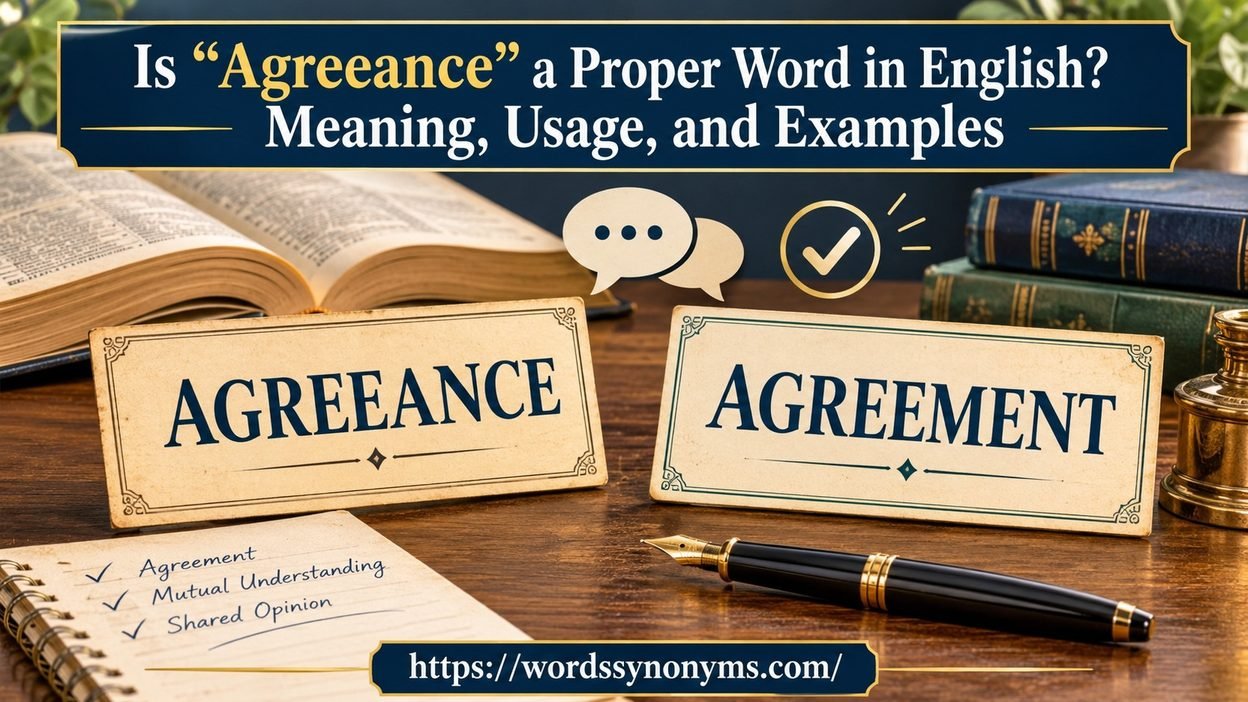
Is “Agreeance” a Proper Word in English? Meaning and Examples explores why this unusual term raises questions about everyday English.
Learning never really stops, especially when you’re exploring the English language. Many native speakers, foreigners, and small children who are new to the language discover unfamiliar expressions while building their vocabulary. You can learn a new word every day and still have less than half of the English vocabulary at your fingertips.
Agreeance is one such word that catches attention because it sounds like a fancy way of saying agreement. People often wonder whether it’s an actual word or a proper word in modern English.
Understanding its meaning, spelling, word usage, and grammatical correctness makes this question easier to answer. It also shows how language learning can introduce unusual English expressions and interesting points about grammar and linguistic usage.
From a grammatical perspective, agreeance functions as a noun, while its word formation connects it to the verb agree. Both terms relate to consent, approval, and acceptance. Depending on the context, they may express mutual understanding, concurrence, a shared opinion, or common ground during communication.
However, these synonyms don’t always have identical meanings or uses. A reliable dictionary, clear definitions, and practical examples help explain the difference between formal expressions and informal expressions. Exploring these details strengthens your vocabulary knowledge, improves your language skills, and supports language development.
Whether you’re using standard English, everyday English, or informal English, understanding accepted English terminology and real usage examples helps you make better word choices in writing and conversation.
Quick Answer
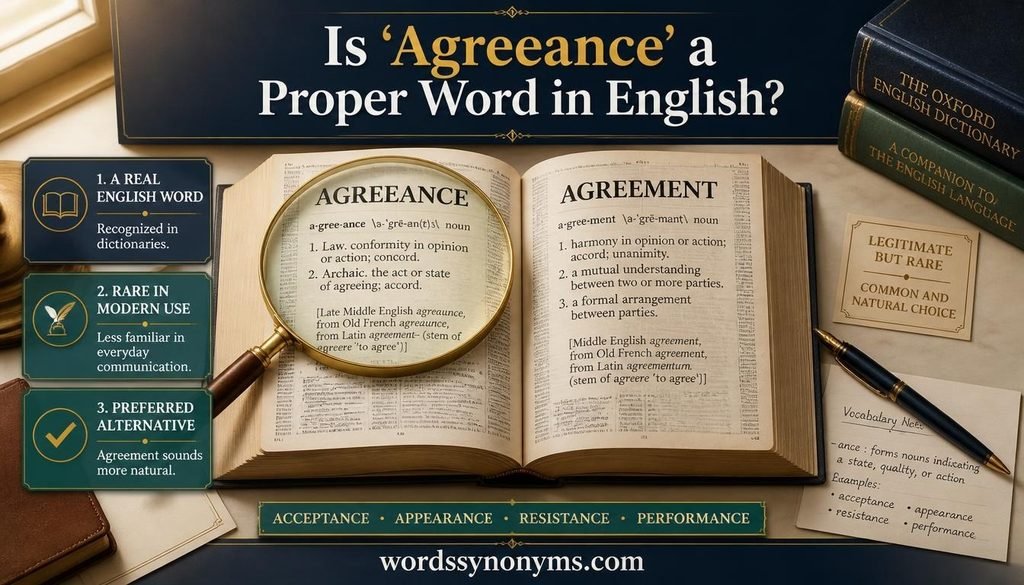
Yes, agreeance is a real English word, but it’s rarely used in modern English. It means the act or state of agreeing with someone or something. Although dictionaries recognize it, agreement is the more common, natural, and widely accepted choice. For example, say “We are in agreement” rather than “We are in agreeance.” Both communicate a similar idea, but agreement sounds clearer and more familiar in everyday and professional writing.
Is “Agreeance” a Proper Word in English?
Yes, agreeance is a proper English word. It appears in established dictionary records and has been used in English for several centuries. However, modern dictionaries generally classify it as rare rather than common.
Dictionary.com defines agreeance as the act or state of agreeing. Its definition is essentially the same as agreement in this particular sense. The dictionary also labels the word as rare which explains why many English speakers rarely encounter it.
This distinction matters because a word can exist without being widely accepted in everyday communication. English contains plenty of uncommon expressions that remain understandable but rarely appear in modern writing.
For example, people generally recognize agreement immediately. However, when someone says, “We are in agreeance,” listeners may pause because the expression sounds unfamiliar.
Is Agreeance Grammatically Correct?
Agreeance follows a recognizable English word-formation pattern. The verb agree combines with the noun-forming suffix -ance to produce a noun.
English uses this suffix in several familiar words:
- Acceptance: The act of accepting something.
- Appearance: The act of appearing or the way something looks.
- Resistance: The act of resisting something.
- Performance: The act of performing.
- Attendance: The act or condition of attending.
Therefore, agreeance isn’t grammatically impossible. Its formation follows a pattern that English already uses.
Nevertheless, grammatical formation doesn’t automatically make a word suitable for every situation. Speakers and writers tend to prefer expressions that sound familiar and communicate ideas clearly.
That’s why agreement remains the more natural choice in most modern contexts.
Is Agreeance an Official Dictionary Word?
Yes, several dictionary resources recognize agreeance. Dictionary.com lists it as a noun and identifies it as rare.
Historical dictionary records also document the word in earlier English and Scottish usage. The Dictionary of the Older Scottish Tongue records related spellings, including agreance, aggreance, and agreeance.
These records demonstrate that the word has genuine historical roots. Its existence doesn’t depend on modern speakers inventing it during workplace conversations.
However, dictionary recognition and everyday popularity are two different things. A word can have a legitimate place in English history while remaining an unusual choice today.
What Does Agreeance Mean?
Agreeance means the act or state of agreeing with someone or something. It describes a situation in which people share an opinion, accept a decision, or reach a common understanding.
The word generally communicates a sense of mutual agreement or harmony between individuals or groups.
For example:
“Both colleagues expressed their agreeance with the proposed changes.”
This sentence means that both colleagues supported the proposed changes. They shared the same opinion and accepted the suggested direction.
Another example:
“The committee reached agreeance after several discussions.”
Here, agreeance describes the shared understanding that developed after the members discussed their differences.
Although readers can understand these sentences the word may sound unusual. Replacing agreeance with agreement would make both examples more natural.
Main Meanings of Agreeance
The word can express several closely related ideas:
- Shared opinion: Two or more people hold the same view about something.
- Mutual understanding: Individuals recognize and accept a common position.
- Common consent: Different parties agree to a particular decision.
- Harmony of views: People share similar thoughts or beliefs.
- Concurrence: Someone supports or accepts another person’s opinion.
These meanings overlap considerably. Agreeance doesn’t normally introduce a separate concept that agreement cannot already express.
Agreeance in Everyday Contexts
Although agreeance is uncommon it can appear in different communication settings.
Consider these examples:
Personal conversations: Two friends discuss their vacation plans and reach agreeance about their destination.
Workplace discussions: Employees express their agreeance with a manager’s proposed schedule.
Group decisions: Committee members reach agreeance after considering several suggestions.
Shared beliefs: Members of a community demonstrate agreeance on an important principle.
In each situation the intended meaning remains understandable. However, agreement or consensus would generally sound more natural.
What Does Agreement Mean?
Agreement is a noun that describes the act of agreeing or a shared understanding between people. It can also refer to an arrangement, decision, or formal contract accepted by two or more parties.
Unlike agreeance, agreement appears regularly in everyday conversations, professional communication, academic writing, and legal documents.
For example:
“We finally reached an agreement about the project budget.”
This sentence describes a mutual decision after discussion or negotiation.
Agreement also has several meanings depending on the context.
Agreement as a Shared Opinion
People use agreement when two or more individuals share the same opinion about a subject.
For example:
- My brother and I are in agreement about the movie.
- The students expressed their agreement with the teacher.
- Everyone seemed to be in agreement about the final decision.
In these examples agreement describes a shared viewpoint rather than a formal arrangement.
Agreement as a Mutual Arrangement
Agreement can also describe an understanding between individuals or organizations about what each party will do.
For example:
“The two companies reached an agreement to share their technology.”
This meaning involves cooperation and mutually accepted terms.
Such agreements may remain informal or become legally binding depending on their nature and circumstances.
Agreement as a Formal Contract
In business and legal settings agreement frequently refers to a documented arrangement between parties.
Examples include:
- Employment agreements
- Rental agreements
- Partnership agreements
- Service agreements
- Confidentiality agreements
- Settlement agreements
For instance:
“Both parties signed an agreement outlining their responsibilities.”
Here, agreement refers to a formal document rather than simply sharing an opinion.
Agreement in Grammar
The word also has an important grammatical meaning.
In English grammar, agreement describes how certain words match in number, person, or grammatical features.
For example:
- She writes every morning.
- They write every morning.
The verb changes depending on whether the subject is singular or plural.
Similarly:
- This book is interesting.
- These books are interesting.
The demonstrative words this and these agree with the number of the nouns they describe.
This grammatical meaning belongs specifically to agreement. Agreeance isn’t the standard term for this linguistic concept.
Agreeance vs. Agreement: What’s the Difference?
Although agreeance and agreement share a similar meaning they differ considerably in modern usage.
Both words can describe the act or condition of agreeing. However, agreement is considerably more established and widely accepted.
Agreeance generally sounds uncommon or old-fashioned to many contemporary English speakers. Agreement feels familiar and works naturally across different situations.
The following comparison highlights their main differences.
| Feature | Agreeance | Agreement |
| Part of speech | Noun | Noun |
| Basic meaning | Act or state of agreeing | Act or state of agreeing |
| Historical use | Recorded in the 16th century and earlier Scottish records | Recorded around the early 15th century |
| Modern frequency | Rare | Common |
| Dictionary status | Recognized as a rare word | Standard English word |
| Formal writing | Generally avoided | Widely accepted |
| Everyday speech | Uncommon | Natural and familiar |
| Legal usage | Not the usual term | Established term |
| Grammatical usage | Not the standard term | Used in grammar |
Similarities Between Agreeance and Agreement
The two nouns share several characteristics.
Both are nouns. They can describe an idea, condition, or relationship rather than an action performed directly by someone.
Both relate to agreement. Each word can communicate shared opinions, mutual understanding, or common consent.
Both connect to the verb agree. Their formation and meanings relate to the idea of accepting or sharing a position.
Both can appear in discussions about shared decisions. Their intended meanings overlap when people describe mutual support or understanding.
Important Differences Between Agreeance and Agreement
The biggest difference involves how English speakers use these words today.
Agreement has a much broader range of established meanings. It can describe shared opinions, legal contracts, business arrangements, and grammatical relationships.
Agreeance has a narrower practical role. It mainly expresses the act or state of agreeing and is much less familiar to contemporary readers.
Consider these sentences:
- Unusual: We are in agreeance about the proposal.
- Standard: We are in agreement about the proposal.
Both sentences communicate the same basic idea. However, the second sounds more natural and follows established modern usage.
Can Agreeance and Agreement Replace Each Other?
Not in every situation.
Although the words overlap in meaning, agreement has additional uses that agreeance doesn’t normally cover.
For example:
“The employee signed an employment agreement.”
Replacing agreement with agreeance would make the sentence sound unnatural and would not communicate the established meaning of a formal contract.
Similarly:
“Subject-verb agreement is an important grammatical rule.”
The standard grammatical term is agreement. Agreeance isn’t an appropriate replacement.
Therefore, the words may overlap when describing shared opinions but aren’t interchangeable in every context.
Is “In Agreeance” Grammatically Correct?
The expression in agreeance is understandable and appears in modern English speech and writing. However, it remains uncommon and often attracts criticism from people who prefer conventional expressions.
The more established phrase is in agreement.
For example:
- Uncommon: We are in agreeance with the decision.
- Preferred: We are in agreement with the decision.
- Simpler: We agree with the decision.
All three sentences aim to communicate support for the same decision. However, the second and third versions sound more natural in contemporary English.
Why Does “In Agreeance” Sound Unusual?
Several factors explain why the expression can sound awkward.
First, most English speakers grow accustomed to hearing in agreement. They encounter it in conversations, books, news reports, and professional documents.
Second, agreeance has a much lower profile in modern vocabulary. People may understand its construction without considering it a familiar expression.
Third, English doesn’t require speakers to create a different noun for every possible variation of a verb. Sometimes an existing word already communicates the intended meaning perfectly.
For these reasons, in agreement remains the conventional expression.
Is “In Agreeance With” Acceptable?
People use in agreeance with to indicate that they support another person’s opinion or decision.
For example:
“I am in agreeance with your suggestion.”
The intended meaning is clear. Nevertheless, most contemporary writing benefits from a more familiar alternative.
You could write:
- I agree with your suggestion.
- I am in agreement with your suggestion.
- I support your suggestion.
- I share your opinion.
The first option is especially direct. It removes unnecessary wording while preserving the original meaning.
Where Does the Word Agreeance Come From?
Agreeance has a much longer history than many people realize. It didn’t suddenly appear because modern speakers wanted an alternative to agreement.
The word has historical connections to French and English. Its development also reflects familiar patterns of English word formation.
The French Origin of Agreeance
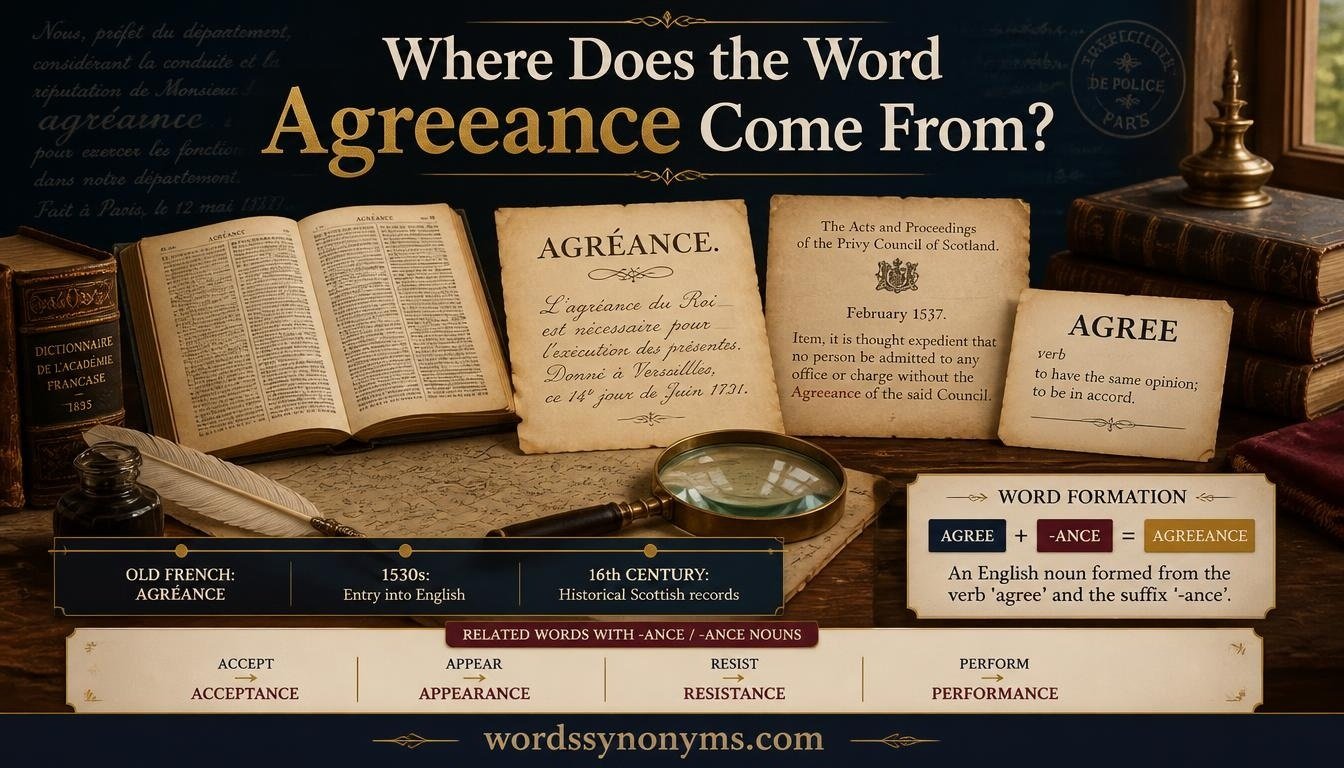
The historical origin of agreeance is connected to the Old French word agréance.
According to the Online Etymology Dictionary, agreeance entered English around the 1530s through French agréance. The French word came from agréer, meaning to please, satisfy, or take pleasure in.
Dictionary.com records its first appearance around 1540–1550.
However, the Dictionary of the Older Scottish Tongue documents related spellings in Scottish records dating back to 1525.
These historical dates help explain why different reference sources sometimes give slightly different first-recorded dates. They may rely on different surviving documents and spelling forms.
How Agreeance Developed From Agree
The modern-looking structure of agreeance comes from combining the verb agree with the suffix -ance.
The verb agree itself has roots in Old French agreer.
Over time, English speakers used agree to describe giving consent, sharing opinions, or reaching a common understanding.
Adding -ance created a noun associated with the act or state of agreeing.
This formation resembles several familiar English words:
| Verb | Noun |
| Accept | Acceptance |
| Appear | Appearance |
| Resist | Resistance |
| Attend | Attendance |
| Perform | Performance |
Agreeance follows a similar pattern. Its formation isn’t random or completely outside the rules of English.
Historical Use of Agreeance
Historical records show that agreeance and its spelling variations appeared in older English and Scottish documents.
The Dictionary of the Older Scottish Tongue includes examples from the 16th and 17th centuries.
These records associate the word with mutual understanding, agreements, covenants, and arrangements between parties.
One particularly interesting feature is its historical connection to formal arrangements. Older records sometimes used related spellings when describing agreements between individuals or political parties.
The word eventually became much less common in general English.
However, its later appearances demonstrate that uncommon vocabulary doesn’t always disappear permanently. Some words return through regional speech, professional settings, or changing language habits.
Read more: Address an Issue: Meaning, Examples and Alternatives
Why Do People Use Agreeance Instead of Agreement?
Despite the popularity of agreement, people continue using agreeance in certain conversations.
Several factors help explain this tendency.
The Influence of English Word Formation
English speakers regularly create nouns by adding suffixes to verbs.
For example, someone familiar with acceptance, resistance, and attendance might naturally assume that agreeance works in the same way.
That assumption isn’t entirely unreasonable. Agreeance follows a recognizable pattern and has historical dictionary support.
However, English word formation doesn’t always produce words with equal popularity. Some forms become established while others remain uncommon.
Workplace Conversations and Professional Speech
Workplace discussions sometimes introduce expressions that spread through repeated use.
For example, an employee might say:
“Are we all in agreeance about the new schedule?”
Other colleagues understand the question and may begin using the same expression.
Eventually, the phrase can become familiar within that particular workplace.
However, familiarity within a group doesn’t necessarily make an expression standard across all professional settings.
Regional Language Differences
English varies across countries and communities.
A word that sounds unusual to one group may seem perfectly understandable to another. Regional habits, local expressions, and differences in speech patterns all influence vocabulary.
Agreeance has received particular attention in Australian English discussions.
Australian lexicographer Sue Butler has described its increased use in Australia since the 1980s. She also discusses how speakers sometimes use agreeance to emphasize a state of shared opinion rather than a formal agreement.
This observation offers an interesting example of how language can develop different patterns within particular communities.
The Desire to Emphasize a State of Agreement
Some speakers feel that agreeance describes a shared state of mind.
They may distinguish between an agreement as a formal arrangement and agreeance as the condition of sharing an opinion.
For example:
“The two companies signed an agreement.”
Compared with:
“The employees expressed their agreeance with the proposal.”
This distinction may explain why certain speakers prefer the second word.
However, the distinction isn’t necessary in standard modern English. Agreement already covers both the act of agreeing and the state of sharing an opinion.
Is Agreeance Acceptable in Formal and Informal Writing?
The suitability of agreeance depends on your audience and purpose.
Although readers can usually understand it, its rarity makes it less suitable for situations where clarity and conventional wording matter.
Let’s examine how it works in different communication settings.
Agreeance in Academic Writing
Academic writing values precise terminology and familiar expressions.
When writing essays, research papers, reports, or scholarly discussions, agreement is generally the better choice.
For example:
Less conventional: “The researchers reached agreeance regarding their findings.”
Preferred: “The researchers reached agreement regarding their findings.”
The second sentence sounds more natural and follows established academic usage.
Academic writers should also consider whether another word communicates their intended meaning more precisely.
For example, consensus may work better when several researchers share a general conclusion.
Agreeance in Business and Professional Communication
Professional communication benefits from familiar and direct language.
When preparing business proposals, reports, emails, or meeting summaries, agreement is the conventional choice.
Consider these examples:
- “We reached an agreement with the supplier.”
- “The management team is in agreement about the new policy.”
- “Both departments agreed to the revised schedule.”
These sentences communicate decisions clearly without introducing uncommon vocabulary.
In professional settings, familiar wording helps prevent unnecessary distractions. Readers can focus on the actual decision rather than wondering about an unusual expression.
Agreeance in Everyday Conversations
Informal conversations allow greater flexibility.
If someone says, “I’m in agreeance with you,” most listeners can understand the intended meaning.
However, some people may find the expression awkward or overly formal.
For everyday conversations, simpler alternatives usually work better:
- I agree with you.
- That’s exactly what I think.
- We share the same opinion.
- I’m on the same page.
- I feel the same way.
These expressions sound natural and communicate agreement without unnecessary complexity.
Agreeance in Creative and Historical Writing
Creative writing offers more freedom than academic or professional writing.
An author might deliberately use agreeance to create an old-fashioned tone, reflect a character’s speech, or reproduce historical language.
For example:
“The council finally reached agreeance after weeks of debate.”
A writer might choose this wording to give a passage a particular voice.
However, unusual vocabulary should serve a purpose. If agreeance doesn’t contribute to the tone, meaning, or characterization, agreement remains the clearer choice.
Historical writing also requires attention to the period being described. When quoting an older document, preserving its original vocabulary may be important.
Agreeance in Sentences: Examples and Explanations
Examples make the difference between these words easier to understand.
Although agreeance is rare, the following sentences demonstrate how someone might use it to express a shared opinion or understanding.
Examples Using Agreeance
Example 1: Both colleagues expressed their agreeance with the proposed changes.
Explanation: The sentence means that both colleagues supported the suggested changes. Agreement would sound more natural.
Example 2: Their agreeance helped resolve the disagreement.
Explanation: The word describes the shared understanding that helped settle the dispute.
Example 3: The committee showed complete agreeance on the matter.
Explanation: This sentence indicates that committee members shared the same position.
Example 4: She expressed her agreeance during the discussion.
Explanation: The speaker accepted or supported an opinion presented during the conversation.
Example 5: The group reached agreeance after several meetings.
Explanation: The group eventually developed a common understanding after discussing the issue.
These examples demonstrate the intended meaning. However, they aren’t recommendations for standard modern writing.
Examples Using Agreement
Agreement works naturally in all five situations.
Example 1: Both colleagues expressed their agreement with the proposed changes.
Explanation: Both colleagues supported the suggestions. Agreement is the conventional noun for this meaning.
Example 2: Their agreement helped resolve the disagreement.
Explanation: A shared understanding helped settle the conflict.
Example 3: The committee showed complete agreement on the matter.
Explanation: The committee members shared the same position.
Example 4: She expressed her agreement during the discussion.
Explanation: She openly supported an idea or opinion.
Example 5: The group reached an agreement after several meetings.
Explanation: The group eventually settled on a shared decision.
Agreeance vs. Agreement: Before-and-After Examples
| Less Common Expression | Preferred Expression |
| We are in agreeance. | We are in agreement. |
| I am in agreeance with you. | I agree with you. |
| They reached agreeance. | They reached an agreement. |
| Her agreeance was obvious. | Her agreement was obvious. |
| Everyone showed agreeance. | Everyone showed agreement. |
| The parties expressed their agreeance. | The parties expressed their agreement. |
The pattern is straightforward. In most situations, replacing agreeance with agreement creates a more familiar sentence.
Better Alternatives to Agreeance
Sometimes agreement isn’t the only suitable replacement.
Your choice should depend on what you actually want to communicate. A group reaching a shared conclusion isn’t necessarily the same as someone giving permission or accepting a proposal.
Here are several useful alternatives.
| Alternative | Meaning | Example |
| Agreement | Shared opinion or mutual decision | We reached an agreement. |
| Consensus | General agreement within a group | The committee reached a consensus. |
| Accord | Harmony or agreement between parties | Both countries reached an accord. |
| Understanding | A shared interpretation or arrangement | We have a clear understanding. |
| Consent | Permission or approval | She gave her consent. |
| Concurrence | Agreement with an opinion or decision | I expressed my concurrence. |
| Harmony | A state of compatibility or agreement | Their opinions were in harmony. |
| Mutual agreement | A decision accepted by everyone involved | They reached a mutual agreement. |
Agreement
Use agreement when people share an opinion or reach a mutual decision.
Example: “We reached an agreement about the project’s direction.”
This is the most versatile alternative to agreeance.
Consensus
Use consensus when a group reaches a general shared position.
Example: “The board reached a consensus after reviewing the proposal.”
Consensus doesn’t always mean every person agrees completely. It often describes broad acceptance within a group.
Accord
Accord works particularly well in formal, diplomatic, and organizational contexts.
Example: “The two organizations reached an accord.”
It can describe harmony or a formal understanding between parties.
Understanding
Use understanding when people share knowledge about an arrangement, expectation, or situation.
Example: “We have an understanding about how responsibilities will be divided.”
This word can describe an informal arrangement without suggesting a signed contract.
Consent
Consent specifically involves permission or approval.
Example: “The manager requested consent before changing the schedule.”
Consent isn’t always interchangeable with agreement. Someone may understand a proposal without giving permission.
Concurrence
Concurrence describes agreement with an opinion, judgment, or decision.
Example: “The director expressed concurrence with the committee’s recommendation.”
It often appears in formal discussions, professional documents, and legal contexts.
Harmony
Harmony emphasizes compatibility and the absence of conflict.
Example: “The team worked in harmony despite their different backgrounds.”
It describes a broader relationship rather than simply accepting one proposal.
Common Mistakes to Avoid When Using Agreeance
Because agreeance resembles agreement, writers sometimes use it without considering its context.
Understanding a few common mistakes can help you avoid awkward sentences.
Assuming Agreeance and Agreement Are Equally Common
Both words exist, but they don’t enjoy the same level of everyday usage.
Agreement is the standard choice. Agreeance remains rare and may sound unfamiliar to many readers.
Don’t assume dictionary recognition automatically means equal acceptance.
Using Agreeance in Formal Documents
Using agreeance in an academic paper or business contract may distract readers.
For example:
“The parties entered into an agreeance concerning payment terms.”
A more conventional version is:
“The parties entered into an agreement concerning payment terms.”
The second sentence communicates the intended meaning clearly.
Replacing Agreement in Legal Terminology
Legal and business documents use established expressions such as purchase agreement, employment agreement, and settlement agreement.
Replacing these terms with agreeance would sound unusual and could create confusion.
Use established terminology when describing formal arrangements.
Confusing Agreement With Consent
Agreement and consent overlap in certain situations but don’t always mean the same thing.
Agreement generally describes shared acceptance or a mutual decision.
Consent specifically involves permission or approval.
For example:
“I agree that the plan is reasonable.”
This sentence expresses an opinion.
“I consent to the proposed changes.”
This sentence communicates permission.
Choosing the correct word helps preserve the intended meaning.
Assuming Rare Words Are Automatically Incorrect
An uncommon word isn’t necessarily grammatically incorrect.
Agreeance has a documented history and appears in dictionary records. Calling it completely invented would ignore its historical evidence.
The better approach is to understand its status and choose vocabulary according to context.

Which Word Should You Use: Agreeance or Agreement?
For almost every modern writing situation, choose agreement.
It is familiar, widely recognized, and suitable for conversations, academic work, business communication, and formal documents.
Agreeance can still appear in certain regional conversations, historical texts, or deliberate stylistic choices. However, it rarely offers an advantage over agreement.
A simple rule can help:
- Use agreement when describing shared opinions, decisions, arrangements, or contracts.
- Use consensus when describing general agreement within a group.
- Use consent when referring to permission or approval.
- Use accord when describing formal harmony or understanding between parties.
- Use agreeance only when you have a specific reason to use this uncommon expression.
A Practical Case Study: Choosing the Right Word at Work
Imagine a company holds a meeting about changing its employee scheduling system.
During the discussion, everyone reviews the proposed changes. Some employees raise concerns while others support the new arrangement.
After considering the suggestions, the team reaches a shared decision.
A writer might describe the meeting in several ways:
A Version: The employees reached agreeance about the new scheduling system.
B Version: The employees reached an agreement about the new scheduling system.
C Version: The employees reached a consensus about the new scheduling system.
All three sentences communicate a similar general idea. However, they carry slightly different implications.
- Version A uses an uncommon expression.
- Version B describes a shared decision.
- Version C emphasizes the group’s general acceptance.
Version B is a straightforward description of the outcome. Version C works particularly well when the group reaches broad agreement without requiring every individual to share identical opinions.
This example shows why choosing the right word involves more than checking whether a dictionary recognizes it. Context and meaning matter just as much.
FAQs
1. Is “Agreeance” a Real Word in English?
Yes, agreeance is a real English word. However, it is uncommon and generally considered less natural than agreement. Most dictionaries recognize it but mark it as rare or dated.
2. Is “Agreeance” Grammatically Correct?
Yes, agreeance can function as a noun. However, its grammatical correctness doesn’t mean it’s the best choice for everyday writing. Agreement is usually clearer and more widely accepted.
3. What Is the Difference Between Agreeance and Agreement?
Both words describe a state of agreeing. However, agreement is the standard choice in modern English. Agreeance is much less common and may sound unusual in everyday conversation.
4. Can I Use Agreeance in Formal Writing?
It’s better to use agreement in formal writing. This word sounds natural in business documents, academic papers, professional emails, and legal discussions. Using agreeance may distract readers.
5. What Are Some Synonyms for Agreeance?
Depending on the context, you can use several alternatives, including:
- Agreement
- Consent
- Approval
- Acceptance
- Concurrence
- Mutual understanding
- Accord
- Consensus
6. Why Do People Confuse Agreeance With Agreement?
The confusion comes from their similar meanings and word formation. Both relate to the verb agree and describe a shared position or understanding. Since agreement appears much more often in modern English, people may question whether agreeance is correct.
Conclusion
Language is full of unusual words that make you stop and think. Agreeance is one of them. Although it’s a real English word, it isn’t commonly used in modern conversations or formal writing. Most people choose agreement because it sounds more natural and clearly expresses the idea of sharing an opinion or reaching a mutual decision.
The next time you come across agreeance, remember that recognizing a word and choosing the right word are two different things. You can understand its meaning without using it in every situation. When you want clear, natural, and widely accepted English, agreement remains the better choice.

Emily Carter has a strong interest in English grammar, sentence structure, and effective writing. She specializes in explaining complicated grammar concepts in simple language. Her articles help readers understand grammar rules, avoid common mistakes, and develop confidence in everyday and professional communication.


[…] Read more: Is “Agreeance” a Proper Word in English? Meaning and Examples […]
[…] Read more: Is “Agreeance” a Proper Word in English? Meaning and Examples […]
[…] Read more: Is “Agreeance” a Proper Word in English? Meaning and Examples […]