
This guide to Aye Yai Yai: Meaning, Origin and How to Use It explains when the phrase expresses surprise, frustration, or disappointment today.
Aye yai yai is an expressive exclamation that people use when something goes wrong. It communicates dismay, disappointment, surprise, or frustration, depending on the situation. For example, someone might say it after hearing bad news or facing an unexpected problem.
It works similarly to oh no and oh my god, making it a natural way to express concern and other negative emotions. When you’re experiencing dismay, this familiar phrase can communicate your feelings without requiring a lengthy explanation.
The word origins of this verbal expression reveal an interesting connection to Mexican Spanish and the wider Spanish language. Despite its foreign backgrounds, the phrase has remained part of American English and American usage for decades. Its cultural background gives it extra character and shows how language develops through contact between different cultures.
As you explore foreign words and phrases, you can see how expressions travel beyond their original communities. Today, this well-known expression remains part of casual language because its meaning, origin, and usage make it easy to recognize and understand.
Unlike ordinary words, aye yai yai carries an immediate emotional reaction. People often use it when trouble catches you off guard or when a situation becomes frustrating. Its expressive quality makes it useful in informal conversations, especially when you want to react naturally without sounding too serious.
Quick Answer
Aye yai yai is an informal exclamation that expresses frustration, surprise, disappointment, pain, or dismay. It is commonly associated with the Spanish expression “Ay, ay, ay!” People use it when something goes wrong, an unexpected situation occurs, or they feel overwhelmed.
For example:
- “Aye yai yai! I forgot my keys again.”
- “Aye yai yai! That’s a terrible situation.”
- “Aye yai yai! Why did you do that?”
The Spanish spelling is “Ay, ay, ay!” English speakers also use spellings such as “ay yi yi” and “aye yai yai” to represent the expression’s pronunciation.
What Does Aye Yai Yai Mean?
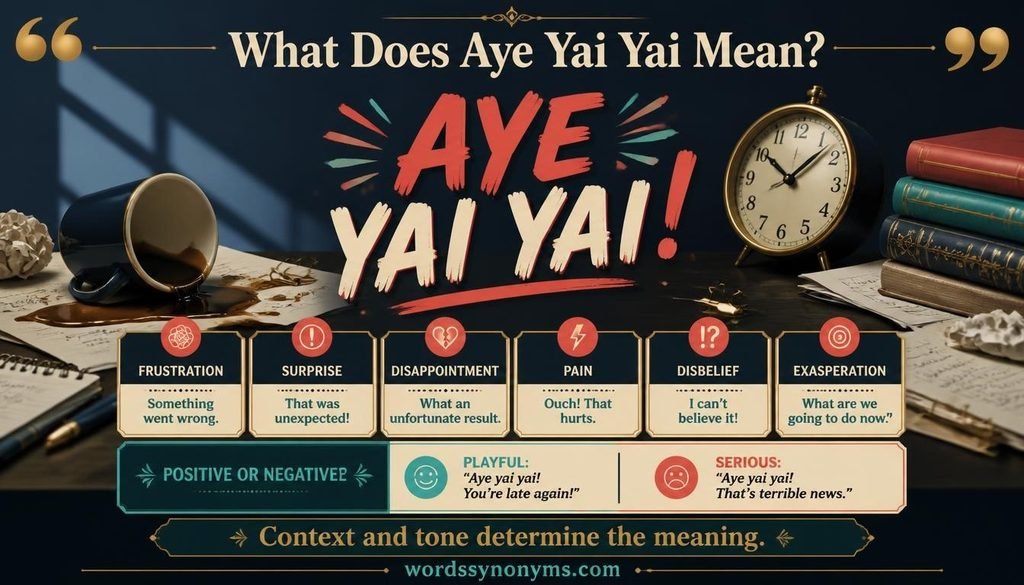
The expression aye yai yai communicates an emotional reaction to something surprising, frustrating, painful, or disappointing. Rather than describing a situation directly, it lets you express how you feel about it.
Think of it as a verbal reaction that can replace phrases such as “Oh no!”, “Good grief!”, or “What a mess!” Its precise meaning changes according to the circumstances.
For example, imagine spilling coffee across your freshly cleaned desk. You might immediately say, “Aye yai yai!” The expression communicates annoyance without requiring further explanation.
Similarly, someone might use it after hearing unexpected news or watching another person make an obvious mistake.
Common Meanings of Aye Yai Yai
Although the expression has several uses, these meanings appear particularly often:
| Meaning | What It Communicates | Example |
| Frustration | Annoyance about something going wrong | “Aye yai yai! The computer froze again.” |
| Surprise | A reaction to unexpected news | “Aye yai yai! You won the competition?” |
| Disappointment | Dissatisfaction with an unfortunate result | “Aye yai yai! That’s disappointing.” |
| Pain | An immediate reaction to physical discomfort | “Aye yai yai! I hit my elbow.” |
| Disbelief | Difficulty accepting something surprising | “Aye yai yai! You actually spent that much?” |
| Exasperation | Feeling overwhelmed by a difficult situation | “Aye yai yai! What are we going to do now?” |
Does Aye Yai Yai Have a Positive or Negative Meaning?
The expression usually communicates a negative or concerned reaction. However, it doesn’t always indicate anger or serious disappointment.
People sometimes use it playfully when something mildly inconvenient happens. For instance, a friend might say, “Aye yai yai! You’re late again!” while laughing.
In another situation, the same expression might communicate genuine concern about an unfortunate event.
Context, facial expressions, and vocal tone determine the emotional meaning. A playful delivery can make it sound humorous, while a serious delivery can communicate frustration or sympathy.
Where Does Aye Yai Yai Come From?
The expression aye yai yai is closely associated with the Spanish interjection “Ay, ay, ay!” The Spanish word ay functions as an exclamation that communicates pain, surprise, sadness, frustration, or other strong emotions.
Spanish speakers have used this interjection in everyday conversation, songs, and expressive speech for generations. Its repeated form adds emphasis and creates a recognizable emotional rhythm.
English speakers commonly encounter the expression through Spanish-language conversations, music, entertainment, and cultural references.
The Spanish Connection: Ay, Ay, Ay
In Spanish, ay is an interjection rather than a regular descriptive word. It communicates an immediate emotional response.
For example:
- Ay, me duele: Oh, it hurts.
- Ay, qué pena: Oh, what a shame.
- Ay, Dios mío: Oh, my goodness.
- Ay, ay, ay: An emphatic reaction to something upsetting, surprising, or difficult.
The exact interpretation depends on the surrounding words and the speaker’s delivery.
When someone repeats ay, the expression can sound more dramatic or emotionally intense. This repetition also gives it a memorable rhythm.
How Did Aye Yai Yai Enter English?
The expression became familiar to many English speakers through cultural contact and popular entertainment. Spanish-speaking communities have long used ay in everyday speech, while English-speaking audiences encountered similar expressions through songs, television, movies, and conversations.
Over time, English speakers began writing the phrase phonetically. They used spellings such as ay yi yi and aye yai yai to represent the sounds they heard.
However, there isn’t one universally established English spelling. Different writers choose different versions depending on pronunciation and personal preference.
It’s also important to distinguish the expression’s Spanish roots from its modern use in English. English speakers can use it as an informal exclamation without speaking Spanish.
Read more: What Does Alpha Mean in Chat? Meaning, Uses and Examples
How Do You Spell Aye Yai Yai?
The spelling of aye yai yai can be confusing because people write it in several different ways. Unlike many standard English expressions, it doesn’t have one universally accepted English spelling.
The original Spanish expression is written “Ay, ay, ay!” English writers often adapt the spelling to represent its familiar pronunciation.
Here are some commonly encountered versions:
| Spelling | Usage |
| Ay, ay, ay! | Spanish spelling |
| Ay yi yi! | Common informal English spelling |
| Aye yi yi! | Phonetic English variation |
| Aye yai yai! | Informal phonetic variation |
| Ai yi yi! | Alternative phonetic rendering |
Which Spelling Is Correct: Aye Yai Yai or Ay Yi Yi?
Both spellings can communicate the same general expression in informal English writing. However, “Ay, ay, ay!” is the appropriate Spanish spelling.
If you’re writing an English article, text message, or casual conversation, ay yi yi and aye yai yai can represent the expression.
Consider these examples:
- Spanish: Ay, ay, ay! ¿Qué pasó?
- Informal English: Ay yi yi! What happened?
- Informal English: Aye yai yai! What a mess!
The important distinction is that phonetic English spellings don’t change the expression’s Spanish origin.
Should You Write Aye Yai Yai as One Word or Three?
The expression is generally written as three repeated elements rather than one combined word.
For example:
- Aye yai yai!
- Ay yi yi!
- Ay, ay, ay!
Commas can help represent the pauses between repeated Spanish interjections. In informal English writing, punctuation often varies.
For a Spanish-language sentence, “Ay, ay, ay!” is the clearest conventional form.
How Do You Pronounce Aye Yai Yai?
The expression is commonly pronounced approximately as eye-yai-yai.
Its pronunciation features three short, connected sounds. The speaker usually gives the repeated syllables a rhythmic delivery, with emphasis depending on the emotion.
Here’s a simple breakdown:
| Part | Approximate Sound | Pronunciation Guide |
| Aye | Eye | Similar to the English word eye |
| Yai | Yai | Similar to yigh |
| Yai | Yai | Repeat the previous sound |
Simple pronunciation: Eye-yai-yai.
The expression can sound playful, dramatic, concerned, or frustrated. A speaker might stretch the final sound to emphasize disappointment or surprise.
For example:
- Mild frustration: “Aye yai yai.”
- Strong disbelief: “Aye yai YAI!”
- Playful disappointment: “Ayeee yai yai!”
The pronunciation doesn’t need to sound exaggerated. A natural conversational delivery works perfectly well.

When Do You Use Aye Yai Yai?
The expression works best when you want to react emotionally without giving a lengthy explanation. You can use it in several everyday situations, depending on the message you want to communicate.
To Express Frustration
When something repeatedly goes wrong, aye yai yai can communicate your annoyance immediately.
Imagine trying to print an important document. The printer jams, runs out of paper, and refuses to cooperate.
You might say:
- “Aye yai yai! This printer never works.”
- “Aye yai yai! I just fixed that problem yesterday.”
- “Aye yai yai! Why does everything happen at once?”
In these examples, the expression emphasizes irritation rather than serious anger.
To Show Surprise or Disbelief
Unexpected situations often leave people searching for the right words. This expression provides a quick and natural reaction.
For example:
- “Aye yai yai! You finished the entire project overnight?”
- “Aye yai yai! I wasn’t expecting that news.”
- “Aye yai yai! That’s quite a surprise.”
The expression can communicate amazement, disbelief, or astonishment. Your tone helps listeners understand which emotion you intend.
To Express Disappointment
Sometimes things don’t turn out as expected. Whether someone misses an opportunity or receives disappointing news, aye yai yai can express dissatisfaction.
Consider these examples:
- “Aye yai yai! We missed the last train.”
- “Aye yai yai! I thought the results would be better.”
- “Aye yai yai! That’s unfortunate.”
It can make your reaction sound conversational rather than overly formal.
To React to a Difficult Situation
Some situations involve several problems at once. The expression can capture that overwhelming feeling without explaining every detail.
For example:
- “Aye yai yai! The meeting starts in ten minutes and the presentation isn’t ready.”
- “Aye yai yai! We have so much work to finish.”
- “Aye yai yai! This situation keeps getting more complicated.”
It works particularly well in informal conversations when you want to acknowledge a problem.
To Express Playful Exasperation
Not every problem deserves a serious reaction. Sometimes a little humor makes an ordinary inconvenience easier to handle.
For example:
- “Aye yai yai! You ate the last slice of pizza?”
- “Aye yai yai! Another shopping trip?”
- “Aye yai yai! You’re making me laugh too much.”
Friends and family members might use the expression playfully when teasing one another.
Aye Yai Yai Examples in Everyday Conversations
Understanding an expression becomes easier when you see how people use it naturally. The following conversations show how aye yai yai fits different situations.
Conversation Between Friends
Situation: One friend accidentally breaks a glass while preparing dinner.
Alex: Oh no! I just dropped the glass.
Mia: Aye yai yai! Are you okay?
Alex: Yes, I’m fine. I just need a broom.
Mia: Good. Watch your step because there are pieces everywhere.
Meaning: Mia uses the expression to show surprise and concern. Her response also acknowledges the unexpected accident.
Conversation Between Family Members
Situation: Someone discovers that a family member forgot an important appointment.
Daniel: I completely forgot about the doctor’s appointment.
Sarah: Aye yai yai! Didn’t you put it on your calendar?
Daniel: I did, but I somehow missed the reminder.
Sarah: Well, let’s call and see if we can reschedule.
Meaning: Sarah expresses mild frustration while responding to an inconvenient mistake.
Conversation Between Coworkers
Situation: A team discovers an error shortly before an important presentation.
James: The presentation has the wrong figures on the final slide.
Emma: Aye yai yai! We need to correct that before the meeting.
James: I’ll update the spreadsheet now.
Emma: Great. I’ll check the remaining slides.
Meaning: Emma uses the expression to communicate concern and frustration. However, she immediately focuses on solving the problem.
Conversation About Unexpected News
Situation: Two friends discuss an unexpectedly expensive repair.
Liam: The mechanic says my car needs a new transmission.
Noah: Aye yai yai! That’s going to cost quite a bit.
Liam: Unfortunately, the repair estimate is much higher than expected.
Noah: Hopefully, you can get another estimate before deciding.
Meaning: Noah expresses sympathy and surprise about the unexpected expense.
Conversation Involving a Small Mistake
Situation: Someone accidentally sends a message to the wrong group chat.
Olivia: I just sent my private message to the entire office group.
Grace: Aye yai yai! What did you send?
Olivia: Just a silly comment about our meeting.
Grace: Hopefully, everyone finds it funny!
Meaning: Grace uses the expression to react humorously to an awkward situation.
Is Aye Yai Yai Spanish?
Yes, aye yai yai is associated with the Spanish expression “Ay, ay, ay!” However, the spelling needs clarification.
In Spanish, ay is an interjection used to express emotions such as pain, surprise, sadness, frustration, and concern. Its meaning depends on the surrounding conversation.
The expression can appear independently or alongside other words.
For example:
- Ay, me duele la cabeza. — Oh, my head hurts.
- Ay, qué bonito. — Oh, how beautiful.
- Ay, no puede ser. — Oh, it can’t be.
- Ay, ay, ay! — An emphatic emotional reaction.
These examples demonstrate how Spanish speakers use ay in different emotional situations.
Is Aye Yai Yai a Mexican Expression?
The expression has strong associations with Mexican Spanish in American popular culture. However, ay is not exclusive to Mexico.
Spanish speakers across different countries and regions use this interjection. Its pronunciation, frequency, and conversational context can vary.
The distinction matters because popular entertainment sometimes presents Spanish expressions as belonging to one country. In reality, many familiar Spanish words and interjections have broader linguistic roots.
Is Aye Yai Yai a Real Spanish Phrase or Just Slang?
The underlying expression, Ay, ay, ay, is genuine Spanish usage. It isn’t simply an invented phrase or meaningless collection of sounds.
However, aye yai yai is an informal English-style phonetic rendering rather than standard Spanish spelling.
It functions as an interjection, meaning it expresses an immediate emotion instead of naming an object, action, or person.

Is Aye Yai Yai Formal or Informal?
Aye yai yai is primarily an informal expression. People generally use it in casual conversations rather than formal writing or professional communication.
Its playful and emotional character makes it suitable for relaxed situations. However, the expression might sound out of place in serious professional documents.
Where Can You Use Aye Yai Yai?
You can use the expression in several everyday communication settings.
| Situation | Is It Appropriate? | Example |
| Casual conversations | Yes | “Aye yai yai! What happened?” |
| Text messages | Yes | “Aye yai yai! That’s a lot of work.” |
| Social media posts | Yes | “Aye yai yai! Monday arrived too quickly.” |
| Conversations with friends | Yes | “Aye yai yai! You’re late again.” |
| Family conversations | Yes | “Aye yai yai! What a busy day.” |
| Professional meetings | Depends | Suitable only in relaxed workplace cultures. |
| Formal reports | Generally no | Use a precise description instead. |
| Academic writing | Generally no | Choose language appropriate to the subject. |
Can You Say Aye Yai Yai at Work?
Yes, but your workplace environment matters.
In a friendly office, you might say, “Aye yai yai! We have another deadline.” This sounds casual and slightly humorous.
However, a formal business presentation requires more precise language. You could say, “This creates an unexpected challenge for the team.”
The expression itself isn’t offensive. Nevertheless, its informal tone might not suit every professional situation.
What Is the Difference Between Aye Yai Yai and Ay, Caramba?
Both aye yai yai and ay, caramba are expressive exclamations associated with Spanish-language speech. People sometimes use them when something surprising, frustrating, or unexpected happens.
However, their wording and emotional associations differ.
Ay, caramba combines the interjection ay with caramba, an exclamatory word used to express surprise, annoyance, or astonishment.
Meanwhile, Ay, ay, ay repeats the interjection to emphasize an emotional reaction.
Aye Yai Yai vs. Ay, Caramba: Key Differences
| Feature | Aye Yai Yai | Ay, Caramba |
| Spanish association | Ay, ay, ay | Ay, caramba |
| Main purpose | Express an emotional reaction | Express surprise or frustration |
| Common emotions | Disappointment, pain, surprise, frustration | Surprise, annoyance, astonishment |
| Tone | Often playful or dramatic | Often expressive or emphatic |
| English spelling | Several informal variations | Usually written as ay, caramba |
| Everyday use | Casual conversations | Casual conversations |
Examples of Aye Yai Yai and Ay, Caramba
Using aye yai yai:
“Aye yai yai! I forgot my wallet at home.”
This expresses frustration about an inconvenient mistake.
Using ay, caramba:
“¡Ay, caramba! That’s an enormous bill!”
This expresses surprise and disbelief about an unexpected expense.
Both expressions can communicate similar emotions. However, they aren’t interchangeable in every Spanish sentence because their wording and conversational nuances differ.
What Are Other Expressions Similar to Aye Yai Yai?
English has plenty of expressions that communicate surprise, frustration, disappointment, and disbelief. Some sound playful, while others express stronger emotions.
If you want to replace aye yai yai, choose an alternative that matches your situation.
Common Alternatives to Aye Yai Yai
| Alternative | Meaning | Example |
| Oh no! | Expresses concern or disappointment | “Oh no! I missed the bus.” |
| Good grief! | Expresses frustration or disbelief | “Good grief! What a mess.” |
| Oh dear! | Shows concern or mild disappointment | “Oh dear! That doesn’t look good.” |
| Here we go again! | Shows frustration about a repeated problem | “Here we go again! Another delay.” |
| What a mess! | Reacts to a disorderly situation | “What a mess! Where should we start?” |
| Oh, boy! | Expresses anticipation, surprise, or concern | “Oh, boy! This won’t be easy.” |
| Yikes! | Shows alarm or nervous surprise | “Yikes! That was close.” |
| For goodness’ sake! | Expresses impatience or annoyance | “For goodness’ sake! Please be careful.” |
| Oh, my goodness! | Shows surprise or concern | “Oh, my goodness! Is everyone okay?” |
| Good heavens! | Expresses surprise or disbelief | “Good heavens! That’s unexpected.” |
Which Alternative Should You Choose?
The best replacement depends on the emotion you want to express.
- For frustration: Good grief! or For goodness’ sake!
- For surprise: Oh, my goodness! or Good heavens!
- For disappointment: Oh dear! or Oh no!
- For repeated problems: Here we go again!
- For sudden alarm: Yikes!
- For playful reactions: Oh, boy!
For example, if your friend forgets an important appointment, you might say, “Oh, dear! How did that happen?”
However, if the same friend repeatedly forgets appointments, “Here we go again!” might communicate your frustration more clearly.
Can You Use Oh No Instead of Aye Yai Yai?
Yes. Both expressions can communicate disappointment, concern, or frustration.
However, oh no is a straightforward English exclamation. It directly communicates a negative reaction.
Aye yai yai often sounds more expressive and playful. It can also carry a stronger sense of exasperation depending on delivery.
Compare these examples:
- Oh no! I lost my phone.
- Aye yai yai! I lost my phone again.
The second example emphasizes the speaker’s frustration about a repeated problem.
Common Mistakes When Using Aye Yai Yai
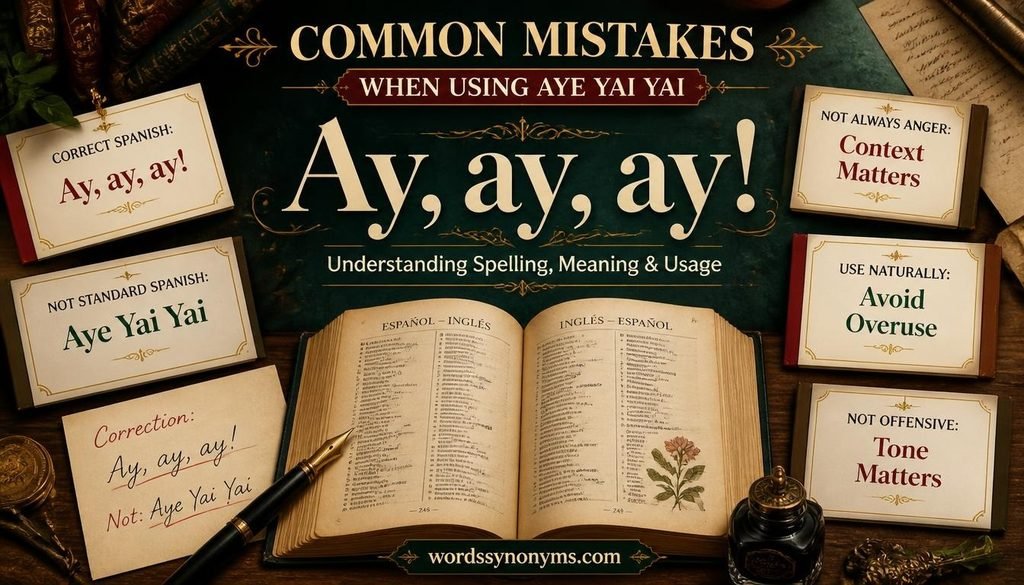
Although the expression is easy to understand, a few mistakes can cause confusion.
Confusing English Phonetic Spelling With Spanish Spelling
One common mistake involves treating aye yai yai as the standard Spanish spelling.
The conventional Spanish form is Ay, ay, ay! English phonetic variations represent the sound rather than the original spelling.
Assuming It Always Expresses Anger
The expression doesn’t automatically mean someone is angry.
It can communicate surprise, concern, disappointment, pain, or playful frustration. Context determines its intended meaning.
Using It in Every Situation
Like other interjections, aye yai yai works best when used naturally.
Repeating it throughout a conversation can make your speech sound exaggerated. Choose it when you genuinely want to emphasize an emotional reaction.
Assuming It Is Offensive
The expression isn’t inherently an insult or profanity. People generally use it as an emotional exclamation.
Nevertheless, tone and context matter. A sarcastic delivery can make an otherwise harmless expression sound critical.
Read more: As In: Meaning and Examples in Everyday English
FAQs
1. What does aye yai yai mean in English?
Aye yai yai expresses disappointment, frustration, surprise, or dismay. People often say it when something goes wrong or an unexpected problem appears.
2. Is aye yai yai a Spanish expression?
Yes, aye yai yai comes from Mexican Spanish. It has also become familiar in American English through decades of cultural and linguistic influence.
3. Is aye yai yai the same as ay ay ay?
Yes, these expressions are closely related variations. Their spelling can differ, but people generally use them to express similar feelings, such as surprise, frustration, or disappointment.
4. When should you say aye yai yai?
You can say aye yai yai when something frustrating, disappointing, or unexpected happens. For example, you might use it after spilling coffee, missing a bus, or hearing unfortunate news.
5. Is aye yai yai considered rude?
No, aye yai yai is generally not considered rude or offensive. It’s an informal expression that communicates an emotional reaction rather than insulting someone.
6. Can you use aye yai yai in everyday conversations?
Absolutely! You can use it in casual conversations with friends, family, or people you know well. However, it may sound too informal for academic writing or professional communication.
Conclusion
Aye yai yai is more than just a playful expression. It gives you a quick, natural way to show disappointment, surprise, frustration, or concern. With roots in Mexican Spanish, this phrase has found a comfortable place in American English. Whether you hear unexpected news, encounter a frustrating situation, or simply don’t know what to say, it can express your reaction in just a few words.
Understanding its meaning and origin also shows how languages influence each other over time. You can use aye yai yai in relaxed conversations when something catches you off guard. Just remember to consider your audience and the situation. Sometimes, a short expression says exactly what a long explanation cannot.

Daniel Brooks is interested in English word usage, confusing expressions, and language development. He researches commonly misunderstood words and explains their differences through definitions and practical examples. His work helps readers understand language more accurately and select the right expressions for different situations.



[…] Read more: Aye Yai Yai: Meaning, Origin and How to Use It […]