

This guide to 13 Best Ways to Respond to an Insult: Witty and Clever helps you answer rude remarks while staying calm and confident. When someone insults you, anger and embarrassment can make it difficult to find the right words. However, you don’t always need a clever speech to handle disrespect. Sometimes, a simple “I don’t care” or “I know you are but what am I?” works perfectly.
In my experience, the best responses are those that protect your self-respect without turning a small disagreement into a bigger confrontation. Whether you’re facing criticism in personal conversations, social settings, or professional environments, use wit, humor, and emotional intelligence to maintain your composure. Your response should match the situation rather than make things worse.
During a roast battle, you can use creative comebacks based on what people think of the other person. Be creative and use playful humor to make your response memorable. You can bend the truth for a joke but don’t break it. Similarly, treating rumors like facts can sometimes work in friendly exchanges when everyone understands the humor.
However, nasty rumors or badly intentioned rumors deserve a different response. You don’t have to answer every negative comment or defend yourself against every accusation. Sometimes, ignoring the person and walking away is the smartest choice. This approach helps you avoid unnecessary confrontation and maintain self-control.
Choosing your words carefully helps you defuse tension, protect your reputation, and avoid escalating the situation. Strong communication skills, including verbal communication, business communication, English usage, grammar, and formal writing, also help you deliver your message clearly. Consistency in your communication makes it easier to express yourself without sounding rude or defensive.
These skills also connect with everyday responsibilities such as time management, project management, meetings, calendar organization, scheduling, online booking, and broadcasting, where professionalism and quick thinking matter. With practice, you can build a collection of witty replies, clever responses, and clever comebacks to answer insults. The goal is to handle challenging interactions with confidence and ease while keeping your self-respect intact.
Quick Answer
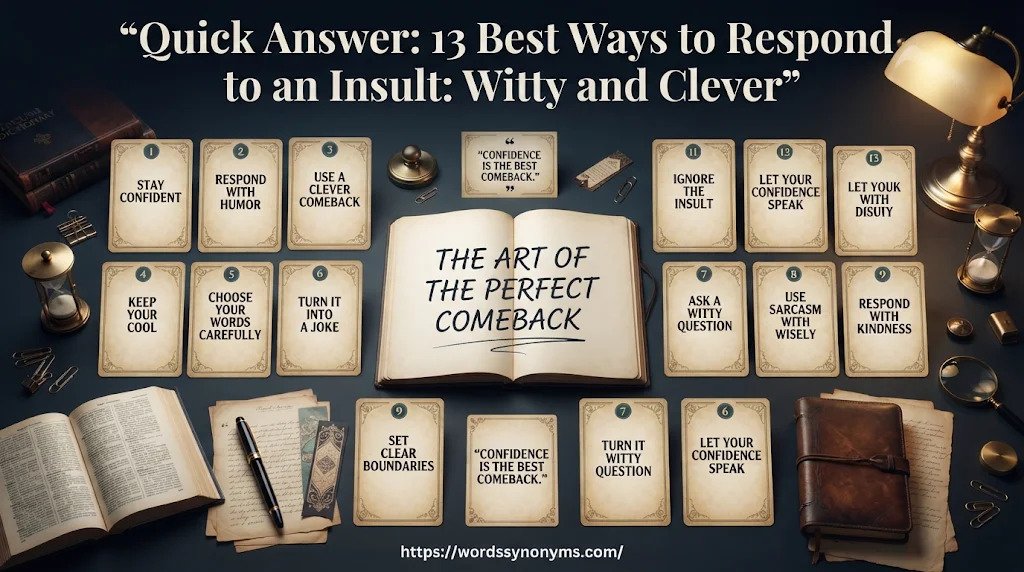
The best ways to respond to an insult include:
- Stay confident and don’t take the comment personally.
- Respond with humor to lighten the situation.
- Use a clever comeback without becoming offensive.
- Ask the person to explain their comment.
- Set clear boundaries against disrespectful behavior.
- Ignore the insult when responding won’t help.
- Respond with kindness and emotional maturity.
- Use sarcasm carefully when the situation allows it.
- Agree with part of the criticism when appropriate.
- Redirect the conversation toward something productive.
- Address the insulting behavior directly.
- Walk away when the conversation becomes unhealthy.
- Give a short and unbothered response.
Your goal isn’t to win every argument. It’s to protect your self-respect while deciding how much attention someone deserves.
13 Best Ways to Respond to an Insult
An insult can catch you off guard, but your response doesn’t have to be impulsive. Some situations call for humor while others require firm boundaries or complete disengagement. Here are 13 practical ways to handle disrespectful comments with confidence.
Stay Confident and Don’t Take It Personally
Confidence is one of the strongest ways to handle an insult. When someone makes a rude comment, you don’t have to accept their judgment as the truth. Their opinion doesn’t determine your intelligence, appearance, personality, or worth.
People sometimes insult others to gain attention, establish superiority, or provoke an emotional reaction. However, you don’t need to participate in that game. Maintaining your composure shows that you understand your value without requiring approval from everyone around you.
For example, imagine a colleague says, “You’re not smart enough to handle this project.” Instead of becoming defensive, respond calmly and confidently. You can acknowledge the comment without allowing it to undermine your abilities.
Try these confident responses:
- “That’s your opinion and you’re entitled to it.”
- “I know what I’m capable of.”
- “Your comment doesn’t change how I see myself.”
- “I’m comfortable with who I am.”
- “You don’t have to agree with me.”
- “I don’t need your approval to feel confident.”
Remember that confidence isn’t about pretending nothing hurts. Even confident people experience embarrassment and disappointment. The difference lies in how they respond to those feelings.
Give yourself a moment before answering. A steady voice, relaxed posture, and direct response can communicate confidence without unnecessary aggression.
Respond With Humor
Humor can turn an uncomfortable moment into something surprisingly manageable. A lighthearted comeback sometimes removes the tension and prevents an insult from becoming a serious confrontation.
The trick is to make your response playful rather than cruel. You want to show that you aren’t easily provoked without humiliating the other person.
Suppose someone says, “You always have something ridiculous to say.” You could smile and respond, “Well, at least I’m keeping the conversation interesting.”
A little humor can make the insult lose its impact. However, read the room before using this approach. A joke that works among friends might sound inappropriate during a serious workplace disagreement.
Funny responses to an insult include:
- “I’ll try to recover from that devastating review.”
- “Was that supposed to hurt my feelings?”
- “Well, that’s certainly one way to start a conversation.”
- “I’ll add your opinion to my collection.”
- “You’re really bringing the drama today.”
- “I didn’t realize we were handing out personal reviews.”
Humor works particularly well when someone makes a minor sarcastic remark or attempts playful teasing. It can also help you avoid unnecessary arguments.
However, don’t use jokes to dismiss serious harassment or repeated mistreatment. Some situations require clear boundaries rather than another punchline.
Use a Clever Comeback
A clever comeback can help you respond quickly without losing your composure. Unlike an aggressive insult, a smart response challenges the remark through wit, timing, or unexpected wording.
The best comebacks are usually short. They don’t require a lengthy explanation or a personal attack. Instead, they communicate that you noticed the disrespect and won’t accept it quietly.
Imagine someone says, “Nobody asked for your opinion.” You could respond, “And yet you seem interested enough to comment on it.”
That response addresses the insult without turning the conversation into a shouting match.
Clever comebacks to insults:
- “Interesting perspective. Did you practice that?”
- “That’s quite a statement coming from you.”
- “I’ll give that comment the consideration it deserves.”
- “You certainly have a creative way of expressing yourself.”
- “I expected a better argument.”
- “That’s an interesting way to make your point.”
A good comeback should match the seriousness of the situation. If someone makes a harmless joke, a playful answer might work. If they deliberately embarrass you, a more direct response may be appropriate.
Avoid attacking someone’s appearance, family, background, or personal struggles. Such remarks can turn a minor disagreement into lasting resentment.
The objective is to demonstrate quick thinking, not to become equally disrespectful.
Ask Them to Explain Their Comment
Sometimes, the most effective response to an insult is a simple question. Asking someone to explain their remark forces them to consider what they actually said.
People often make rude comments because they expect others to laugh nervously, remain silent, or become defensive. A calm question interrupts that pattern.
For example, imagine someone says, “That’s a pretty stupid idea.” Instead of arguing immediately, ask, “What specifically makes you think it’s a bad idea?”
Now the conversation must move beyond the personal attack. The other person has an opportunity to explain their criticism or recognize that their comment wasn’t constructive.
Questions you can use:
- “What exactly do you mean by that?”
- “Could you explain why you think that’s funny?”
- “Why would you say something like that?”
- “What’s the point you’re trying to make?”
- “Are you criticizing my idea or trying to insult me?”
- “Would you mind explaining that comment?”
This approach works particularly well in professional environments and group conversations. It can expose an inappropriate remark without requiring an equally rude response.
However, don’t ask questions aggressively. Your tone matters as much as your words. Speak calmly and give the other person enough space to answer.
If they continue making personal attacks, there’s no need to keep questioning them. Set a boundary and move on.
Set Clear Boundaries
Respectful communication requires boundaries. If someone repeatedly insults you, ignoring every comment may encourage them to continue.
Setting boundaries means communicating what behavior you will and won’t accept. It doesn’t mean controlling another person’s opinions. Instead, you’re explaining how you expect people to treat you.
For instance, a friend might regularly make jokes about your appearance. You may have laughed along before because you didn’t want to seem sensitive. However, if those jokes genuinely bother you, it’s reasonable to address them.
You can say, “I know you’re joking, but I don’t appreciate comments about my appearance.”
This statement identifies the problem without attacking your friend’s personality.
Examples of firm responses:
- “Don’t speak to me that way.”
- “I’m happy to talk when you can be respectful.”
- “Please don’t make personal comments about me.”
- “You can disagree without insulting me.”
- “That kind of joke isn’t acceptable to me.”
- “I won’t continue this conversation if you keep insulting me.”
Clear boundaries work best when you communicate them consistently. If someone crosses the same boundary repeatedly, follow through by ending the conversation or creating distance.
At work, repeated personal insults may require documentation or assistance from a manager or human resources department.
Remember, being polite doesn’t mean allowing people to mistreat you. You can remain respectful while firmly protecting your personal space.
Don’t Give Them a Reaction
Not every insult deserves an answer. Sometimes, refusing to react is the smartest response available.
Certain people deliberately provoke others because they enjoy seeing emotional reactions. They might make sarcastic comments, criticize everything you do, or repeatedly bring up embarrassing subjects.
If you respond emotionally every time, the interaction can become an endless cycle.
Silence interrupts that cycle. A neutral expression, brief pause, or change of subject can communicate that you’re unwilling to participate.
Ways to ignore an insult:
- Maintain a neutral facial expression.
- Avoid arguing over unnecessary comments.
- Continue with whatever you were doing.
- Change the subject when appropriate.
- Stop responding to repeated attempts at provocation.
- Leave the conversation if the person refuses to stop.
For example, imagine someone makes an unnecessary comment during a group gathering. Instead of defending yourself, you can briefly acknowledge the comment and return to the discussion.
Silence doesn’t always mean weakness. Sometimes, it demonstrates that you recognize an argument isn’t worth your energy.
However, ignoring insults isn’t appropriate in every situation. If someone repeatedly bullies you, threatens you, or damages your professional reputation, you may need to address the behavior directly.
Choose silence strategically rather than using it to avoid every uncomfortable conversation.
Read more: 25 Best Replies to “You’re Welcome”: Polite and Clever Responses
Respond With Kindness
Kindness can be an unexpectedly powerful response to disrespect. When someone expects anger and receives a calm, respectful answer, the interaction may lose its momentum.
This doesn’t mean you should accept insults or pretend hurtful comments are harmless. Instead, you can refuse to imitate the behavior you’re criticizing.
Suppose a family member says, “You never make good decisions.” You could respond, “I’m sorry you feel that way, but I’m comfortable making my own choices.”
Your response remains respectful while making your position clear.
Kind responses to insults:
- “I hope you’re having a better day than it sounds.”
- “I’m sorry you feel that way.”
- “I understand that we see things differently.”
- “I wish you could express that more respectfully.”
- “Let’s try to have a better conversation.”
- “I don’t want this discussion to become personal.”
Kindness can help preserve relationships when someone makes an insensitive remark without realizing its impact.
However, there’s an important distinction between kindness and people-pleasing. You don’t have to apologize for having boundaries or tolerate repeated disrespect to maintain peace.
Sometimes, the kindest thing you can do for yourself is end the interaction.
Use Sarcasm Carefully
Sarcasm can make a comeback memorable, especially when someone makes an unnecessary or exaggerated remark. A carefully chosen sarcastic response can highlight how unreasonable the original comment sounds.
For example, if someone says, “You certainly took your time,” after you arrive only a minute late, you might respond, “I appreciate the dramatic entrance review.”
The remark is lighthearted and doesn’t attack the other person’s character.
Sarcastic responses to insults:
- “Thanks for that incredibly helpful observation.”
- “I’ll be sure to give that comment the attention it deserves.”
- “What a wonderfully unnecessary thing to say.”
- “Your honesty is certainly unforgettable.”
- “I didn’t know we were conducting a performance review.”
- “That’s an impressive amount of confidence for such a weak argument.”
Sarcasm works best when both people understand the humor. Among friends, it can keep conversations entertaining. During disagreements, however, sarcasm may sound dismissive or hostile.
Avoid using it with someone who already behaves aggressively. A sarcastic comeback can escalate an argument rather than resolve it.
If your goal is to establish a boundary, direct language usually works better.
Agree With Part of the Insult
Agreeing with part of an insult can sometimes take away its power. This technique works when someone criticizes something harmless or points out a genuine imperfection.
Instead of becoming defensive, you acknowledge the small truth in their statement. That unexpected response can make further criticism difficult.
For example, someone says, “You’re always making mistakes.” You might respond, “You’re right. I made a mistake, and I’ll correct it.”
You’ve acknowledged the mistake without accepting the exaggerated judgment.
Responses that acknowledge harmless criticism:
- “You’re right. I’m not perfect.”
- “Fair enough. I’ve got room to improve.”
- “I can see why you’d think that.”
- “Yes, I could have handled that better.”
- “That’s something I’m still working on.”
- “I make mistakes like everyone else.”
This technique is especially useful when dealing with constructive criticism disguised as an insult.
However, don’t agree with comments designed to undermine your identity or self-worth. If someone says you’re worthless, unintelligent, or incapable, you don’t need to validate their cruelty.
Acknowledge genuine mistakes without accepting unfair labels.
Turn the Conversation Around
Redirecting the conversation can prevent an insult from becoming the main subject. Instead of spending several minutes defending yourself, you guide the discussion toward something useful.
This technique works particularly well during workplace meetings, family discussions, and group conversations.
Imagine presenting an idea at work when someone says, “That’s probably the worst suggestion I’ve heard today.”
You could respond, “Let’s focus on the actual proposal. What specific changes would make it more effective?”
Your answer shifts attention away from the personal remark and toward the issue that needs solving.
Useful conversation-changing responses:
- “Let’s focus on something more productive.”
- “Is there an actual point you’d like to discuss?”
- “We can disagree and still have a useful conversation.”
- “Let’s get back to the subject.”
- “What solution would you suggest instead?”
- “I’d rather discuss the issue than exchange personal comments.”
Redirecting the conversation doesn’t mean pretending the insult never happened. If the person repeatedly makes disrespectful remarks, address the behavior separately.
The goal is to stop an unproductive exchange from distracting everyone involved.
Address the Behavior Directly
When someone crosses a line, addressing their behavior can be more effective than responding with another insult.
People don’t always realize how their words affect others. In other situations, they understand perfectly well what they’re doing. Either way, direct communication helps establish expectations.
For example, suppose a coworker repeatedly interrupts you and makes jokes about your contributions. You could say, “I’ve noticed these comments are becoming personal. I’d appreciate it if we kept our discussions professional.”
This response identifies the problem and requests a specific change.
Direct responses to disrespectful behavior:
- “That was an unnecessary thing to say.”
- “You can disagree without being insulting.”
- “I don’t appreciate personal attacks.”
- “That comment crossed a line.”
- “Please keep the discussion respectful.”
- “There’s no reason to make this personal.”
Try to describe the behavior rather than labeling the person. Saying “That comment was disrespectful” is usually more productive than saying “You’re a terrible person.”
The distinction matters because behavior can change while personal attacks often create defensiveness.
If the insulting behavior continues, consider keeping a record of repeated incidents. This can help when you need to explain the situation to a supervisor, school administrator, or another appropriate authority.
Walk Away With Dignity
Walking away can be the healthiest response when a conversation becomes hostile or pointless. You don’t have to remain in an interaction simply because someone wants to argue.
Some people aren’t interested in understanding your perspective. They want the last word, an emotional reaction, or an opportunity to keep criticizing you.
Continuing such conversations rarely produces anything useful.
Imagine an acquaintance repeatedly mocks your decisions during a social gathering. You’ve already asked them to stop, but they continue. Leaving the conversation protects your peace without requiring another argument.
Responses that help you leave gracefully:
- “I’m not continuing this conversation.”
- “We can talk when things are more respectful.”
- “I think we’re done here.”
- “This conversation isn’t going anywhere.”
- “I’m going to step away now.”
- “I’d rather not spend my time arguing.”
Walking away doesn’t mean you’ve lost. It means you’ve decided that continuing isn’t worth the emotional cost.
If the situation involves threats, intimidation, or potential violence, prioritize your safety. Move toward a safer place and seek appropriate help instead of trying to deliver a clever comeback.
Use a Short and Unbothered Response
Sometimes, a few words communicate more confidence than an entire speech. Short responses help you avoid unnecessary explanations and prevent someone from pulling you into an argument.
This approach is useful when someone makes a minor insult or tries to provoke you repeatedly.
For example, someone might say, “You really think you’re important, don’t you?” Instead of defending yourself, you could respond, “I’m comfortable with myself.”
The conversation doesn’t need to become a debate.
Short and unbothered responses:
- “Noted.”
- “If you say so.”
- “That’s interesting.”
- “Okay, moving on.”
- “I disagree.”
- “That’s your perspective.”
- “Think what you like.”
- “I’m not bothered.”
- “Fair enough.”
- “Let’s leave it there.”
Short answers work because they give the insult very little room to grow.
However, your delivery matters. A calm voice and relaxed expression make these responses sound confident. An eye roll or mocking tone might create unnecessary tension.
Use a short answer when the comment doesn’t deserve a detailed discussion. When someone raises a genuine concern, give them a thoughtful response instead.
How to Choose the Best Response to an Insult
Not every insult requires the same reaction. A sarcastic comment from a close friend differs from deliberate humiliation by a coworker. Choosing the right response requires understanding the person, setting, and intention behind the remark.
Before responding, consider these factors.
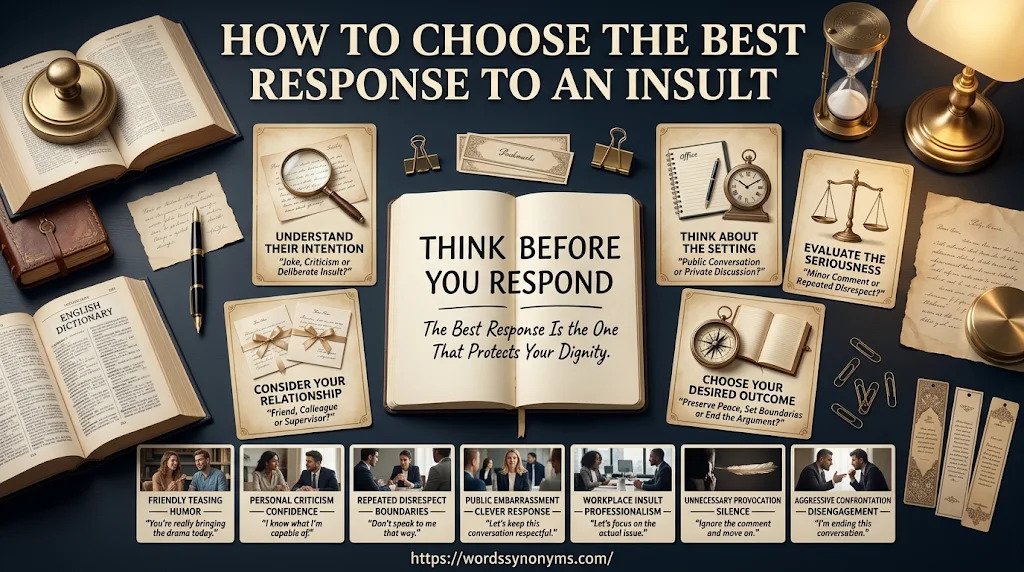
Understand the person’s intention. Did they make an awkward joke, offer badly worded criticism, or deliberately try to embarrass you? Understanding the intention helps you avoid treating every uncomfortable remark as a personal attack.
Consider your relationship. A playful response may work with a close friend. However, a professional boundary might be necessary when dealing with a colleague or supervisor.
Think about the setting. Public arguments can become unnecessarily embarrassing. In a meeting, a short and professional response may be more effective than a sarcastic comeback.
Evaluate the seriousness. A minor comment might deserve silence. Repeated insults or targeted harassment require a stronger response.
Choose your desired outcome. Do you want to preserve a friendship, correct inappropriate behavior, end an argument, or protect yourself? Your answer should support that goal.
Here’s a simple comparison:
| Situation | Suitable response | Example |
| Friendly teasing | Humor | “You’re really bringing the drama today.” |
| Personal criticism | Confidence | “I know what I’m capable of.” |
| Repeated disrespect | Boundaries | “Don’t speak to me that way.” |
| Public embarrassment | Clever response | “Let’s keep this conversation respectful.” |
| Workplace insult | Professionalism | “Let’s focus on the actual issue.” |
| Unnecessary provocation | Silence | Ignore the comment and move on. |
| Aggressive confrontation | Disengagement | “I’m ending this conversation.” |
The best response isn’t necessarily the funniest or sharpest. It’s the one that handles the situation without compromising your dignity.
How to Respond to Insults in Different Situations
The same words can have different meanings depending on who’s speaking. Your relationship with the person and the surrounding circumstances should influence your response.
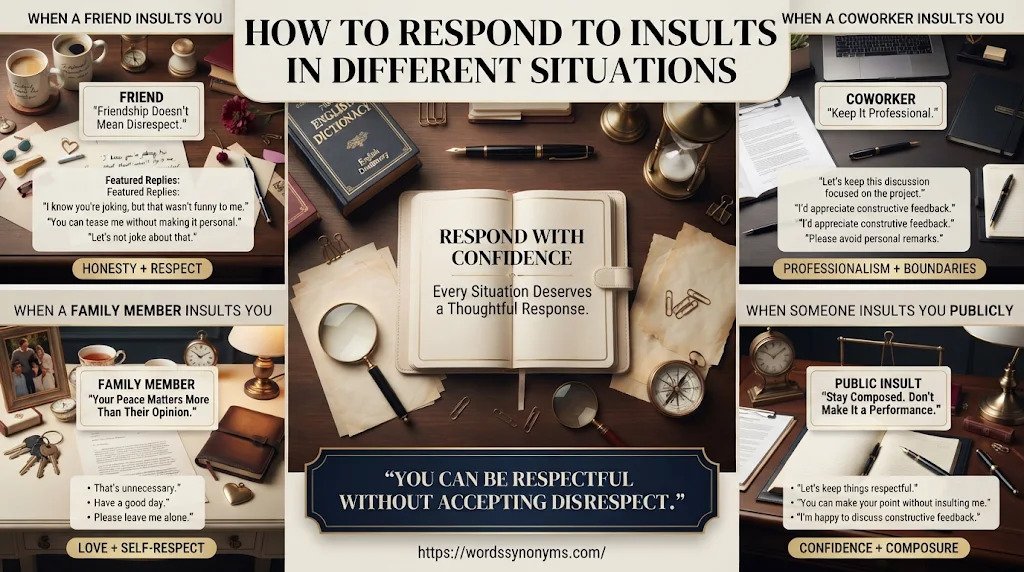
How to Respond to an Insult From a Friend
Friendships often include teasing, sarcasm, and playful arguments. However, there’s a difference between friendly joking and comments that genuinely hurt someone.
If a friend makes an insulting remark, don’t assume you must laugh to keep the friendship comfortable. You can explain how the comment affected you without making the situation unnecessarily dramatic.
For example:
- “I know you’re joking, but that wasn’t funny to me.”
- “We’re friends, so I’d appreciate a little more respect.”
- “You can tease me without making it personal.”
- “Let’s not joke about that.”
If your friend apologizes and changes their behavior, there’s room to move forward. However, repeated insults disguised as jokes deserve a serious conversation.
A healthy friendship should allow both people to express discomfort without fear of ridicule.
How to Respond to an Insult From a Coworker
Workplace insults require a slightly different approach. Your response should protect your reputation while maintaining professionalism.
Avoid reacting emotionally during meetings or exchanging personal attacks through workplace messages. Instead, identify the inappropriate behavior and redirect attention toward the work.
Professional responses include:
- “Let’s keep this discussion focused on the project.”
- “I’d appreciate constructive feedback rather than personal remarks.”
- “Please address the issue without making personal comments.”
- “I’m open to suggestions, but let’s keep things professional.”
If the behavior continues, document relevant incidents. Record dates, specific comments, witnesses, and any related messages.
For repeated harassment or discrimination, consider following your organization’s reporting procedures. You don’t need to handle a serious workplace problem entirely on your own.
How to Respond to an Insult From a Family Member
Family relationships can make insults particularly difficult. A hurtful comment from someone close to you may carry more emotional weight than criticism from a stranger.
Sometimes, relatives make remarks about careers, relationships, appearance, finances, or personal decisions. They may describe these comments as concern or advice even when their delivery feels insulting.
You can acknowledge their concern without accepting disrespect.
Try these responses:
- “I understand your concern, but please respect my decision.”
- “I’d rather not discuss my personal life that way.”
- “That comment hurt me, and I want you to understand why.”
- “We can disagree without making personal remarks.”
- “I’m comfortable with the choices I’m making.”
When possible, discuss repeated problems privately rather than arguing in front of the entire family.
However, family ties don’t give anyone permission to humiliate you. Maintaining healthy boundaries matters in every relationship.
How to Respond to an Insult From a Stranger
When a stranger insults you, you usually have little reason to invest time in the interaction.
A stranger’s rude opinion doesn’t require a detailed explanation or personal defense. Depending on the situation, ignoring the comment or walking away may be the safest choice.
If a brief response feels appropriate, try:
- “That’s unnecessary.”
- “Have a good day.”
- “I don’t appreciate that comment.”
- “Please leave me alone.”
- “I’m not interested in arguing.”
Avoid escalating confrontations with people whose intentions you don’t understand. If someone becomes threatening, move toward a safer location and seek assistance.
Your safety matters much more than delivering the perfect comeback.
How to Respond to an Insult in Front of Other People
Public insults can feel particularly uncomfortable because other people are watching. You might feel pressure to defend yourself immediately or deliver an impressive comeback.
However, you don’t need to turn the moment into a performance.
A short, composed response often works better than an extended argument. It lets others see that you recognize the disrespect without allowing the conversation to become chaotic.
Responses for public situations:
- “That comment was unnecessary.”
- “Let’s keep things respectful.”
- “I’m happy to discuss the issue without personal attacks.”
- “You can make your point without insulting me.”
- “I’d rather keep this conversation constructive.”
For example, imagine someone criticizes your presentation by saying, “That was embarrassing.” You could respond, “If you have specific feedback, I’m happy to hear it.”
This answer shifts attention toward useful criticism and away from public humiliation.
If the person continues, disengage rather than competing for the audience’s attention.
What Not to Do When Someone Insults You
Knowing what to avoid can be just as important as knowing what to say. A poorly chosen response can turn a minor disagreement into a much bigger problem.
Here are common mistakes worth avoiding.
Don’t react immediately out of anger. An unexpected insult can trigger frustration, embarrassment, or defensiveness. Take a breath before responding so you can choose your words carefully.
Avoid returning personal attacks. Insulting someone’s appearance, family, intelligence, or background rarely improves the situation. It usually shifts attention away from the original problem.
Don’t overexplain yourself. You don’t need to provide a detailed defense of every personal decision. Explain yourself when necessary but recognize when someone isn’t interested in listening.
Don’t make threats. Threatening language can escalate an argument and create unnecessary safety concerns. Use direct boundaries instead.
Don’t confuse silence with accepting mistreatment. Ignoring one rude remark may be reasonable. However, repeated bullying or harassment may require direct action.
Avoid trying to win every argument. Some people aren’t looking for a solution. They simply want to keep arguing. Recognizing when to disengage can save considerable time and emotional energy.
Don’t apologize for having reasonable boundaries. You can communicate respectfully without feeling guilty about asking someone to stop making personal remarks.
The goal isn’t to control every conversation. It’s to respond in a way that reflects your values and protects your well-being.
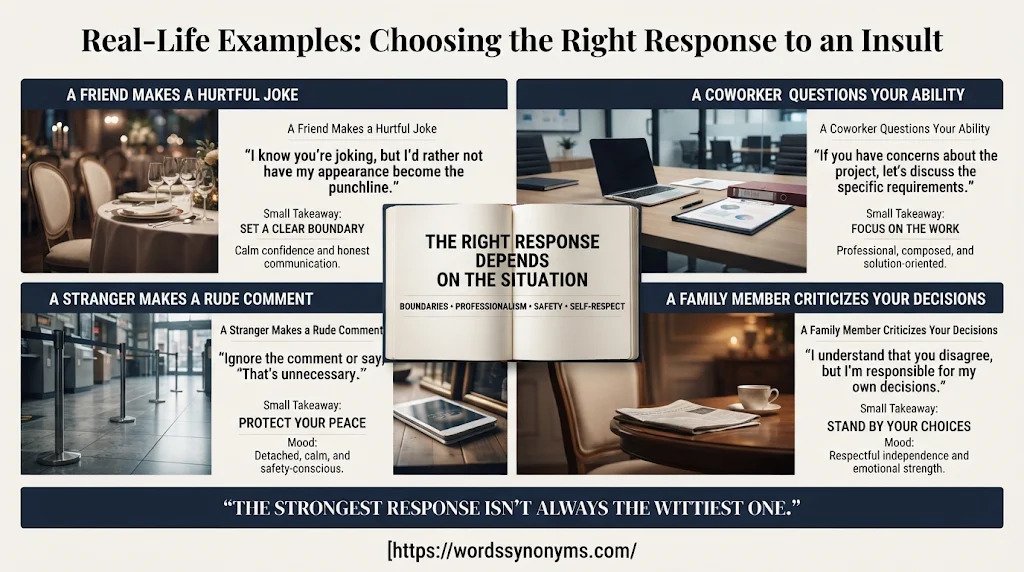
Real-Life Examples: Choosing the Right Response to an Insult
Understanding different responses becomes easier when you see how they work in everyday situations. Consider these practical examples.
Case Study: A Friend Makes a Hurtful Joke
Situation: During a group gathering, your friend says, “You’re probably the least fashionable person here.”
Possible response: “I know you’re joking, but I’d rather not have my appearance become the punchline.”
Why it works: You acknowledge the comment without creating a public argument. Your response also makes your boundary clear.
Case Study: A Coworker Questions Your Ability
Situation: During a meeting, a colleague says, “I don’t think you’re capable of handling this assignment.”
Possible response: “If you have concerns about the project, let’s discuss the specific requirements.”
Why it works: You redirect the conversation toward measurable work issues. This approach avoids a personal disagreement while giving the colleague an opportunity to explain their concerns.
Case Study: A Stranger Makes a Rude Comment
Situation: Someone makes an insulting remark while you’re waiting in line.
Possible response: Ignore the comment or say, “That’s unnecessary.”
Why it works: You avoid investing energy in an interaction that offers little value. If the stranger becomes aggressive, leaving is the safer decision.
Case Study: A Family Member Criticizes Your Decisions
Situation: A relative says, “You’ll never accomplish anything with those choices.”
Possible response: “I understand that you disagree, but I’m responsible for my own decisions.”
Why it works: You acknowledge the disagreement without accepting an unfair judgment. You also establish a boundary around your personal choices.
These examples demonstrate an important principle: the strongest response depends on the situation rather than the cleverness of the words.
Read more: 26 Best Replies to “Mind Your Own Business” That Actually Work
FAQs
1. What is the best way to respond when someone insults you?
The best response is one that protects your dignity without creating unnecessary drama. Stay calm, avoid reacting emotionally, and use a short, confident reply. Sometimes, simply saying, “That’s your opinion” is enough.
2. How do you come up with a clever comeback quickly?
Pay attention to what the other person says and respond naturally. You don’t need a complicated joke or a perfect sentence. A little humor, quick thinking, and confidence can help you deliver a memorable comeback.
3. Should you insult someone back when they insult you?
Not necessarily. Insulting someone back can turn a minor disagreement into a bigger argument. A clever response or a calm statement often works better because you maintain control of the situation.
4. How do you respond to an insult without sounding rude?
Use polite but firm language. For example, you can say, “I don’t appreciate that comment” or “Let’s keep this conversation respectful.” These responses establish boundaries without making you sound aggressive.
5. What should you say when someone makes fun of you?
You can respond with humor if the situation feels friendly. Try saying, “You’ve clearly been practicing that one!” However, if the comment is genuinely hurtful, explain that you don’t find it funny.
6. How do you handle insults at work?
Stay professional and avoid emotional reactions. You can say, “I’d appreciate it if we kept our discussion respectful.” If the behavior continues, document the incidents and consider discussing them with your manager or HR department.
7. Is ignoring an insult better than responding?
Sometimes, yes. Not every comment deserves your attention. Ignoring an insult can prevent unnecessary arguments and show that you won’t let someone else’s negativity control your mood.
8. How can you respond to nasty rumors about yourself?
Avoid spreading the rumor further or responding with another personal attack. Correct false information calmly when necessary. If the rumor is seriously damaging your reputation, keep evidence and seek appropriate support.
9. What makes a comeback clever and classy?
A classy comeback combines confidence, timing, humor, and self-control. It makes your point without humiliating the other person. The goal isn’t to win an argument but to show that you can handle disrespect gracefully.
10. How can you become better at handling insults?
Practice staying calm during uncomfortable conversations. Improve your communication skills, build emotional intelligence, and think before speaking. Reading, observing social interactions, and learning from everyday experiences can also help you respond more confidently.
Conclusion
Knowing how to respond to an insult isn’t about having the sharpest comeback every time. It’s about understanding when to use humor, when to speak firmly, and when to walk away. A clever reply can lighten an awkward moment while a calm response can stop an unnecessary argument. Whether someone makes a rude comment, spreads rumors, or tries to embarrass you in public, your reaction matters more than their words. Stay confident, choose your words carefully, and never feel pressured to prove your worth to someone who shows disrespect.
From my experience, the most memorable comebacks aren’t always the funniest or harshest ones. They’re the responses that show confidence without sacrificing kindness or self-respect. Practice your communication skills, develop emotional intelligence, and learn to recognize situations that deserve your attention. You won’t always find the perfect words immediately and that’s perfectly fine. Sometimes, a simple smile, a thoughtful reply, or walking away says more than a thousand words ever could.

Hamza Rehman is passionate about English vocabulary, synonyms, and word meanings. He enjoys exploring how words connect and how the right word can make communication clearer. Through WordsSynonyms, he creates easy-to-understand vocabulary guides, practical examples, and helpful word alternatives for students and writers.


