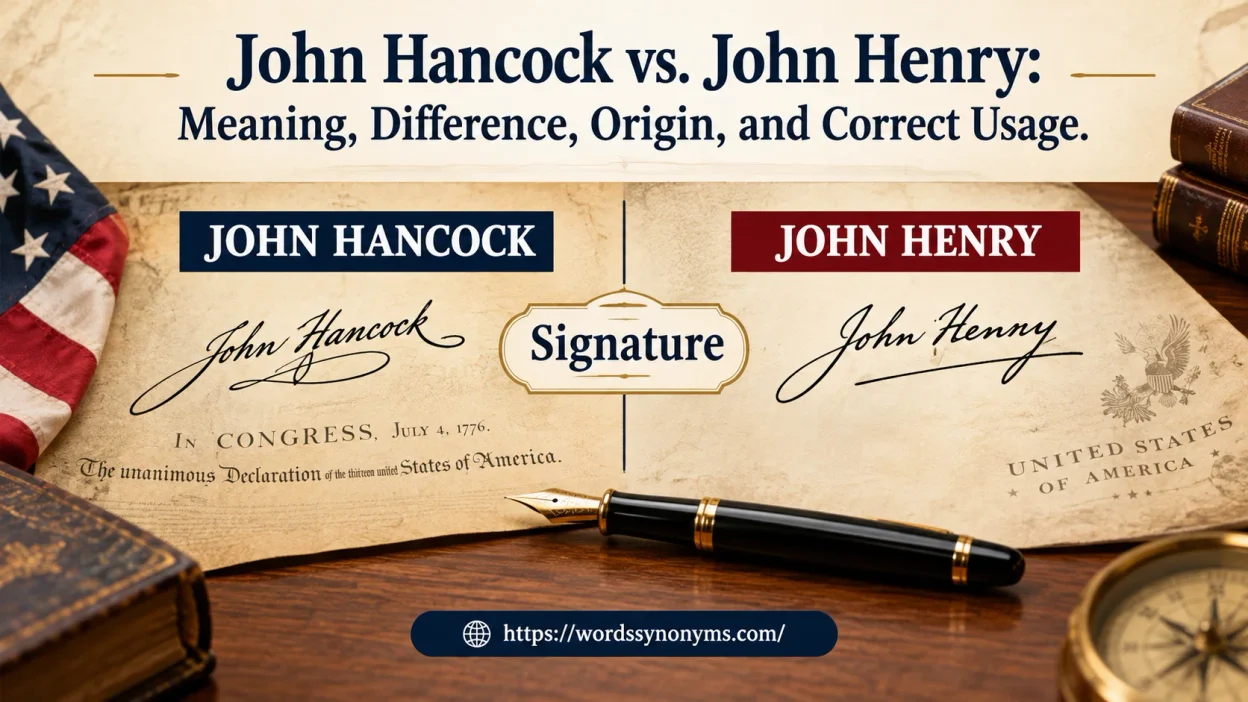
If someone asks for your John Hancock, they aren’t asking you to introduce yourself. They want your signature. Oddly enough, you might also hear someone ask for your John Henry, which can mean exactly the same thing.
That creates an understandable question: What is the difference between John Hancock and John Henry?
Both expressions refer to a person’s signature, but they don’t carry the same history, familiarity, or cultural weight. John Hancock is widely recognized in American English and traces directly to a famous historical figure who signed the Declaration of Independence. John Henry, meanwhile, also appears as slang for a signature, although its linguistic origin is much less certain.
Understanding these phrases helps you recognize an interesting feature of English: sometimes, a person’s name stops being just a name and becomes a cultural shortcut. Let’s unpack what John Hancock vs. John Henry really means, where these expressions came from, and when you should use them.
John Hancock vs. John Henry: Quick Answer
Here’s the simplest answer: both John Hancock and John Henry can mean “signature.”
However, they differ in popularity and historical background.
| Term | Meaning | Commonness | Historical Connection |
| John Hancock | A signature | Very widely recognized | Direct connection to John Hancock |
| John Henry | A signature | Less common | Origin is less certain |
| Signature | A person’s written name or identifying mark | Universal | Standard English term |
In everyday American English, John Hancock is the safer and more recognizable expression.
For example:
- “Put your John Hancock right here.”
- “I need your John Henry before we can finish.”
- “Please provide your signature.”
All three sentences refer to signing something.
Still, they don’t sound identical. The first has a playful American flavor. The second sounds more unusual and regional to many speakers. The third works almost everywhere, especially in professional or formal settings.
What Does John Hancock Mean?
John Hancock is an informal American expression meaning a person’s signature.
When someone says, “I need your John Hancock,” they simply mean:
“I need you to sign this.”
The phrase usually adds personality to an otherwise ordinary request.
John Hancock Meaning in Everyday English
Consider these examples:
- “Put your John Hancock at the bottom of the application.”
- “We just need your John Hancock to complete the sale.”
- “Don’t leave yet. You forgot your John Hancock.”
- “Give me your John Hancock on the dotted line.”
In every example, John Hancock means signature.
You don’t need to write your name in a large or fancy style. That’s another common misunderstanding. The phrase refers to any person’s signature, whether it’s elegant, messy, tiny, or barely readable.
Is John Hancock Formal or Informal?
John Hancock is informal.
You might hear it in:
- Casual conversations
- Friendly business interactions
- Movies and television
- Sales conversations
- Informal instructions
- Humorous requests
However, formal documents usually prefer signature.
For example:
| Informal | More Formal |
| Put your John Hancock here. | Please provide your signature here. |
| We need your John Hancock. | Your signature is required. |
| Add your John Hancock below. | Please sign below. |
The phrase isn’t incorrect in professional conversation. Still, legal documents generally favor plain language.
After all, a contract doesn’t need extra personality when precision matters.
Who Was John Hancock?
To understand why John Hancock means signature, you need to know the man behind the expression.
John Hancock was an American merchant, statesman, and prominent political figure during the American Revolution. He became especially famous because of his role in the movement for American independence.
However, one document permanently tied his name to the English language: the Declaration of Independence.
John Hancock and the Declaration of Independence
John Hancock served as president of the Second Continental Congress when American representatives adopted the Declaration of Independence in 1776.
His signature appeared prominently on the document.
That signature eventually became so culturally famous that Americans began using his name as another way to say signature.
Today, someone can ask:
“Can I get your John Hancock?”
Even though they aren’t referring to the historical figure directly, the expression exists because Hancock’s signature became iconic.
That’s how language evolves. A famous event creates a memorable association, and eventually, everyday speakers turn that association into an expression.
Why Was John Hancock’s Signature So Famous?
Hancock’s signature stood out because of its large and distinctive appearance on the Declaration of Independence.
His name became strongly connected with the act of signing.
Over time, Americans began using John Hancock as shorthand for any signature.
The development follows a familiar linguistic pattern. English often transforms famous names into ordinary words or expressions.
For instance:
- A sandwich takes its name from the Earl of Sandwich.
- A silhouette comes from Étienne de Silhouette.
- A John Hancock became another way to say signature.
Once a name enters common speech, its original owner can become almost secondary. The expression takes on a life of its own.
The Famous Story About King George III
You may have heard the popular story that John Hancock deliberately wrote his name large enough for King George III to read without glasses.
It’s a memorable story. It also appears repeatedly in discussions about Hancock’s famous signature.
However, historical anecdotes often become more polished as generations retell them. The dramatic quotation commonly attached to Hancock shouldn’t automatically be treated as a confirmed historical statement.
The important fact remains clear: his bold signature became one of the most recognizable visual features associated with the Declaration of Independence.
That cultural memory eventually gave English the phrase we still use today.
What Does John Henry Mean?
Like John Hancock, John Henry can mean a signature.
For example:
- “Put your John Henry on the form.”
- “We need your John Henry before moving forward.”
- “Just give us your John Henry, and you’re all set.”
The meaning is straightforward.
John Henry = signature.
Yet there’s an important difference between John Henry and John Hancock.
Many people immediately understand John Hancock. John Henry, on the other hand, is less familiar.
Some speakers use it naturally. Others may never hear it during their entire lives.
Is John Henry Still Used?
Yes, but it isn’t as universally recognized as John Hancock.
The expression has an informal and somewhat old-fashioned flavor. Its use can also vary by region and community.
That’s why context matters.
If you’re writing for a broad audience, John Hancock is usually easier to understand.
If you’re speaking casually with people familiar with the phrase, John Henry can work perfectly well.
Here’s the practical difference:
John Hancock is recognizable slang for a signature. John Henry is an alternative expression that may require more cultural familiarity.
Where Did the Expression John Henry Come From?
This is where the story becomes more complicated.
The origin of John Hancock is fairly easy to explain. The phrase connects directly to a historical figure whose signature became famous.
The origin of John Henry, however, isn’t nearly as straightforward.
Several explanations circulate, and that’s exactly why careful writing matters here. It’s tempting to connect every use of “John Henry” directly to the legendary folk hero of the same name.
The evidence doesn’t support treating that connection as absolute fact.
Did the Legendary John Henry Inspire the Expression?
Possibly—but the connection isn’t firmly established.
The legendary John Henry is a famous American folk hero often described as a steel-driving worker who competed against a machine.
According to the popular ballad, John Henry fought against mechanization with extraordinary physical strength. His story became a symbol of human labor confronting industrial change.
The image is powerful:
A man versus a machine. Muscle versus steel. Human determination versus technology.
Because the folk hero became so famous, many people naturally assume that the phrase John Henry, meaning signature, came from him.
However, language history isn’t always that tidy.
The signature expression has an uncertain etymology, and it shouldn’t automatically be presented as a direct product of the famous folk legend.
Why Do People Connect the Two?
The connection seems natural for several reasons.
First, both involve the same name.
Second, the folk hero became deeply embedded in American culture.
Third, informal expressions often develop through storytelling and regional speech.
Still, similar names don’t automatically prove a shared origin.
This distinction matters because good language research separates documented history from popular assumption.
The Uncertain Origin of John Henry
Unlike John Hancock, John Henry doesn’t have one universally accepted origin story.
Some linguistic discussions suggest that the expression may have developed as a generic personal-name substitute for a signature. Others connect it with earlier slang traditions.
The safest conclusion is simple:
John Henry has been used as an informal term for a signature, but its exact origin remains less certain than the origin of John Hancock.
That uncertainty doesn’t weaken the meaning. People can still use the expression correctly.
It simply means we shouldn’t invent a neat historical explanation where the evidence remains unclear.
John Hancock vs. John Henry: The Main Differences
Although both expressions refer to signatures, they differ in several important ways.
| Feature | John Hancock | John Henry |
| Primary meaning | Signature | Signature |
| Modern recognition | Very high | Lower |
| Typical usage | Informal American English | Informal and less common |
| Origin | Clearly connected to John Hancock | Less certain |
| Historical association | Declaration of Independence | Signature slang and possible folklore associations |
| Best choice for broad audiences | Yes | Usually no |
| Formal suitability | Limited | Limited |
The biggest difference isn’t meaning.
It’s recognition.
Think of the two expressions as different routes to the same destination.
Both point toward the word signature, but one road has a much larger sign.
That larger sign is John Hancock.
Can John Hancock and John Henry Be Used Interchangeably?
In many informal situations, yes.
Consider these sentences:
- “Can I get your John Hancock?”
- “Can I get your John Henry?”
- “Can I get your signature?”
All three requests ask someone to sign something.
However, interchangeability doesn’t mean identical tone.
When John Hancock Works Best
Use John Hancock when:
- You want an informal expression.
- Your audience is likely American.
- You want a phrase most people recognize.
- You want to make a request sound friendlier.
- You’re speaking rather than writing formal documentation.
When John Henry Works Best
Use John Henry when:
- You know your audience understands the expression.
- You’re using casual or regional language.
- You want a less common alternative.
- The conversational setting supports slang.
When Signature Works Best
Use signature when:
- Writing legal documents.
- Preparing official instructions.
- Communicating internationally.
- Writing professional correspondence.
- Avoiding possible confusion.
Clarity beats cleverness when the stakes are high.
A legal agreement shouldn’t leave someone wondering whether “John Henry” refers to a person, a song, or a signature.
How to Use John Hancock and John Henry Correctly
Both expressions function as nouns.
Usually, they follow a possessive pronoun.
Common Sentence Patterns
The most natural pattern looks like this:
possessive pronoun + John Hancock
Examples:
- my John Hancock
- your John Hancock
- his John Hancock
- her John Hancock
- our John Hancock
- their John Hancock
The same structure works with John Henry.
Examples in Sentences
John Hancock:
- “Please put your John Hancock here.”
- “She added her John Hancock to the agreement.”
- “They asked for his John Hancock before processing the request.”
John Henry:
- “Put your John Henry at the bottom.”
- “The clerk asked for my John Henry.”
- “Once they added their John Henry, the paperwork was complete.”
Notice something important: these phrases normally refer to the signature belonging to the person being discussed.
That’s why possessive words such as your, his, and her appear so naturally.
Common Phrases Using John Hancock
Several expressions frequently appear in casual American speech.
Put Your John Hancock Here
This simply means:
Sign here.
Example:
“The delivery driver asked me to put my John Hancock on the electronic screen.”
The phrase works particularly well when someone points to a specific place on a document.
Give Me Your John Hancock
This means:
Provide your signature.
Example:
“Everything looks good. Now give me your John Hancock, and we’re finished.”
The wording sounds conversational and friendly.
Put Your John Hancock on the Dotted Line
This phrase means:
Officially sign an agreement or document.
Example:
“After months of negotiations, the company was finally ready to put its John Hancock on the dotted line.”
Interestingly, this expression can carry a broader meaning. Sometimes, people use it figuratively to describe making an official commitment.
You don’t even need an actual dotted line.
Sign Your John Hancock
This phrase is slightly redundant because John Hancock already means signature.
Still, speakers sometimes say it casually.
For example:
“Just sign your John Hancock here.”
Strictly speaking, “sign here” or “put your John Hancock here” sounds cleaner.
Language isn’t always mathematically efficient, though. Everyday speech often keeps expressions because they sound familiar.
Real-Life Examples of John Hancock and John Henry
Seeing the expressions in context makes their meaning much easier to remember.
Example: Buying a Car
A salesperson places several documents on the desk.
“Everything is ready. I just need your John Hancock on these final pages.”
The salesperson wants your signature.
Example: Receiving a Package
A delivery driver hands you a device.
“Could I get your John Hancock?”
Again, the request means:
Please sign to confirm delivery.
Example: Informal Business Conversation
A manager says:
“The proposal is approved. We just need the CEO’s John Hancock.”
The phrase adds a conversational touch to the discussion.
Example: Using John Henry
A clerk says:
“Put your John Henry right at the bottom of the form.”
The meaning remains the same, although some listeners may find the phrase unfamiliar.
Example: Humorous Usage
A friend jokingly hands you a restaurant bill and says:
“No backing out now. You put your John Hancock on it!”
Here, the phrase adds humor.
That flexibility explains why idiomatic expressions survive. They don’t merely communicate information. They also add personality.
Common Mistakes People Make
The phrases John Hancock and John Henry look simple, but several misunderstandings appear repeatedly.
Mistake: Thinking John Hancock Means a Large Signature
John Hancock’s famous signature was visually prominent.
However, John Hancock doesn’t mean a large signature.
It simply means signature.
Your signature could look like elegant calligraphy or resemble a doctor’s mysterious scribble. Either way, it’s still your John Hancock.
Mistake: Thinking John Hancock Is a Legal Term
It isn’t.
John Hancock is an informal idiom.
Legal documents may require a signature, but they usually don’t use colorful expressions.
Compare:
Casual:
“Put your John Hancock here.”
Formal:
“Please sign in the designated space.”
Both work. The setting determines which one sounds appropriate.
Mistake: Assuming John Henry Only Refers to the Folk Hero
John Henry can refer to the legendary American folk figure.
However, John Henry also has a separate informal meaning: signature.
Context tells you which meaning applies.
For example:
“I need your John Henry.”
This clearly refers to a signature.
But:
“The story of John Henry remains an important American folk legend.”
Here, John Henry refers to the legendary character.
Mistake: Assuming John Henry and the Folk Hero Have a Proven Linguistic Connection
This is where many explanations become overly confident.
The folk hero connection is often repeated, but the exact origin of John Henry as a term for a signature isn’t settled with the same clarity as John Hancock.
A careful explanation should acknowledge that uncertainty.
Mistake: Using Either Phrase When Clarity Is Essential
Idioms can confuse international readers.
Suppose you’re sending instructions to someone unfamiliar with American expressions.
Instead of writing:
“Please provide your John Hancock.”
Write:
“Please provide your signature.”
Simple. Clear. Impossible to misread.
Read More: Adapt vs. Adopt: Easy Ways to Remember
John Hancock, John Henry, and Other Famous Names in English
English has a long history of turning names into useful expressions.
This process happens so naturally that speakers often forget a real person once stood behind the word.
| Name or Expression | Meaning |
| John Hancock | Signature |
| John Henry | Informal term for signature |
| John Doe | Unidentified or hypothetical man |
| Jane Doe | Unidentified or hypothetical woman |
| John Q. Public | An average member of the public |
These names serve different linguistic purposes.
John Doe and Jane Doe
Unlike John Hancock, John Doe and Jane Doe don’t usually refer to famous historical signatures.
They serve as placeholder names.
For example:
“The police identified the victim as John Doe until they confirmed his identity.”
Or:
“Let’s say Jane Doe earns $60,000 per year.”
These names represent an unknown or hypothetical person.
John Q. Public
John Q. Public represents an ordinary member of society.
For example:
“The policy may confuse John Q. Public.”
The expression suggests an average citizen rather than a specific person.
Why Does English Use Names This Way?
Names make abstract ideas easier to picture.
Instead of saying “an unidentified male person,” English speakers can simply say John Doe.
Instead of saying “a person’s signature” in casual conversation, someone might ask for a John Hancock.
Language loves shortcuts.
The best expressions compress a larger idea into a few memorable words.
Is John Hancock Still Used in Modern English?
Yes.
Although signature remains the standard word, John Hancock still appears in modern American conversation.
The phrase survives because it offers something plain language doesn’t: personality.
Imagine two people saying:
“Please sign here.”
and:
“Can I get your John Hancock?”
The first is direct.
The second feels more conversational.
Neither is better in every situation. Tone determines the winner.
John Hancock in the Digital Age
Digital signatures haven’t made the expression obsolete.
In fact, people sometimes use John Hancock humorously even when nobody physically writes with a pen.
For example:
“Add your John Hancock electronically, and we’ll send the final copy.”
Technically, an electronic signature may not resemble traditional handwriting at all.
Still, language doesn’t always follow technology step by step.
We continue to say things like:
- “Hang up the phone.”
- “Roll down the window.”
- “Dial the number.”
Many modern phones don’t hang on hooks. Many car windows don’t roll manually. Smartphones don’t use physical dials.
Yet the expressions remain.
John Hancock works the same way.
The original image belongs to handwriting, but the phrase can survive in a digital environment.
A Practical Case Study: Choosing the Right Expression
Imagine three different situations.
Situation One: A Legal Contract
A company sends a contract to an international client.
Best wording:
Please provide your signature on page six.
Why?
Because clarity matters more than personality.
Situation Two: A Friendly Sales Conversation
A salesperson says:
Everything is ready. Just put your John Hancock here.
This works well because the setting is conversational.
Situation Three: A Regional Conversation
Someone says:
Give me your John Henry, and we’re done.
This may sound perfectly natural to people familiar with the expression.
However, an unfamiliar listener might pause and wonder:
Who is John Henry?
That’s the practical lesson.
The correct phrase isn’t always the most effective phrase. Good communication depends on your audience.
John Hancock vs. John Henry: Which One Should You Use?
For most writers and speakers, the answer is straightforward.
Use John Hancock When You Want an Informal Expression for Signature
Choose it when:
- Your audience understands American English.
- You want a familiar idiom.
- The conversation is casual.
- A little humor fits the moment.
Example:
“Put your John Hancock here, and you’re officially part of the team.”
Use John Henry When Your Audience Recognizes the Expression
Choose it when:
- You’re comfortable using regional slang.
- The context is informal.
- Your audience understands the phrase.
Example:
“I just need your John Henry on this receipt.”
Use Signature When You Want Maximum Clarity
Choose signature when:
- Writing professionally.
- Creating official documents.
- Communicating with international audiences.
- Giving instructions.
- Avoiding ambiguity.
Example:
“Your signature is required before the application can be processed.”
There’s no prize for using the fanciest expression.
The best word is the one your reader understands immediately.
The Cultural Importance of John Hancock
The phrase John Hancock does more than describe a signature.
It preserves a piece of cultural memory.
Every time someone says, “Put your John Hancock here,” they’re indirectly referring to an event from American history.
Most speakers probably don’t stop and think about the Declaration of Independence when they use the phrase.
That’s the fascinating part.
Language quietly carries history forward.
Words and expressions can act like tiny time capsules. They preserve old events, famous people, forgotten technologies, and cultural habits.
John Hancock is one of those linguistic time capsules.
The man lived in the eighteenth century.
The expression built around his name still appears centuries later.
That’s remarkable staying power for a signature.
Why John Hancock Became More Popular Than John Henry
The answer largely comes down to cultural visibility.
John Hancock had a direct connection with one of America’s most important historical documents.
His signature became visually famous.
That gave speakers a clear mental association:
John Hancock → famous signature → signature
The linguistic path is easy to follow.
John Henry doesn’t offer the same universally recognized chain of association.
Even though the expression can mean signature, its history remains less clear. Its cultural meaning also competes with the famous folk hero.
As a result, John Hancock became the dominant expression.
That’s why someone learning American English should generally remember this simple rule:
If you want an idiomatic alternative to “signature,” John Hancock is the phrase you’re most likely to encounter.
How to Remember the Difference Between John Hancock and John Henry
Here’s a simple memory trick.
Think of John Hancock as the Famous Signature
Remember:
Hancock signed the Declaration of Independence.
Therefore:
John Hancock = signature
Think of John Henry as the Less Common Alternative
Remember:
John Henry can also mean signature, but fewer people use or recognize it.
A quick visual formula makes the distinction easier:
John Hancock → Famous historical signature → Common idiom
John Henry → Informal alternative → Less certain origin
That’s all you really need to remember.
Quick Reference Guide
If you need a fast answer, use this table.
| Question | Answer |
| Does John Hancock mean signature? | Yes |
| Does John Henry mean signature? | Yes, in informal usage |
| Are they interchangeable? | Often, but John Hancock is more recognizable |
| Which phrase is more common? | John Hancock |
| Which has a clearer origin? | John Hancock |
| Should you use them in legal writing? | Usually no |
| What’s the safest alternative? | Signature |
| Does John Hancock refer only to a handwritten signature? | No, it can be used informally for signing generally |
| Is John Henry’s origin completely certain? | No |
FAQs
What does “give me your John Hancock” mean?
“Give me your John Hancock” means give me your signature.
Someone might say this when asking you to sign a form, receipt, contract, or other document.
Is John Henry another name for a signature?
Yes. John Henry can be an informal expression for a person’s signature.
However, it isn’t as widely recognized as John Hancock.
Why is a signature called a John Hancock?
The phrase comes from American statesman John Hancock, whose prominent signature on the Declaration of Independence became historically famous.
Over time, his name became an informal synonym for signature.
Are John Hancock and John Henry the same thing?
In the context of informal language, yes.
Both can refer to a signature.
However, John Hancock is much more widely recognized and has a clearer historical origin.
Did the legendary John Henry create the expression?
That connection isn’t firmly established.
The legendary folk hero and the slang term share the same name, but the exact origin of John Henry as a term for signature remains uncertain.
Is John Hancock still commonly used today?
Yes.
It’s still recognized in American English, especially in casual conversation. People often use it humorously when asking someone to sign a document.
Can I use John Hancock in formal writing?
You can, but signature is usually better for formal or legal writing.
For example:
Informal: “Please add your John Hancock.”
Formal: “Please provide your signature.”
What does “put your John Hancock on the dotted line” mean?
It means to officially sign an agreement or document.
The phrase can also imply making a formal commitment.
Final Thoughts: John Hancock vs. John Henry
The difference between John Hancock and John Henry isn’t complicated once you know the background. Both expressions can mean signature, but John Hancock remains far more recognizable in modern American English.
John Hancock has a clear historical story. His famous signature on the Declaration of Independence eventually transformed his name into an everyday idiom. John Henry, meanwhile, also works as slang for a signature, although its origin is less certain and shouldn’t automatically be linked to the legendary folk hero without qualification.
When in doubt, use signature for formal situations. For casual conversation, John Hancock adds a distinctly American touch. And if someone asks for your John Henry, don’t worry they probably aren’t looking for a steel-driving man. They just want you to sign the paper.

Muhammad Taqi is a content writer interested in English vocabulary and language. He writes clear and useful articles on synonyms, antonyms, word meanings, and English usage, helping readers expand their vocabulary and improve their communication skills.