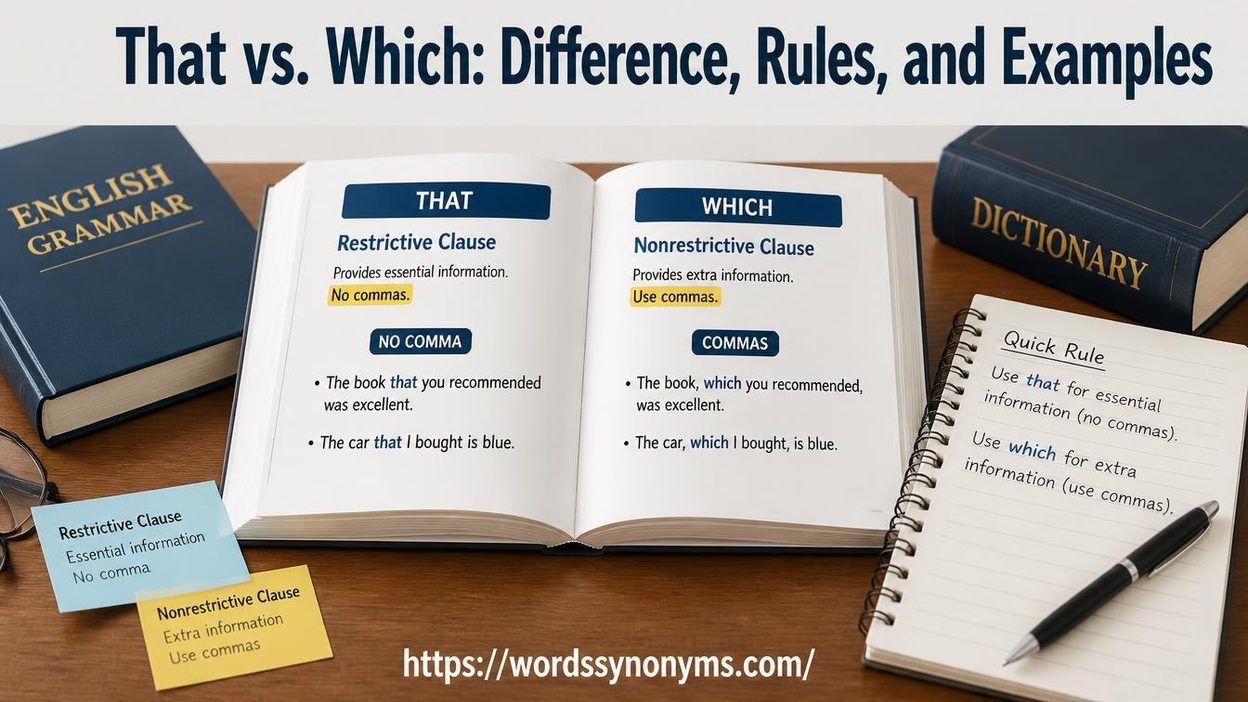
That vs. Which: Difference, Rules and Examples explains why that and which are not always interchangeable words in every context or sentence.
The main difference depends on the meaning of the clause that follows. Use that for a restrictive clause when the information is essential to the point; use which for a nonrestrictive clause when it adds extra information or detail.
A detail clause usually needs commas, while restrictive usage takes no commas. These unwritten rules involve grammar, punctuation, sentence structure, comma usage, and comma placement.
For writing, a simple decision test is to remove the clause and see whether you’re losing the point. This helps writers with recognizing clauses, avoiding common mistakes, and applying writing rules.
In academic writing and professional writing, American usage and British usage may differ. A “which hunt” is a useful proofreading technique: search for which, check the comma, and decide whether the clause is restrictive or nonrestrictive.
Quick Answer
The quickest way to remember that vs. which is this:
That identifies. Which adds information.
Use that when the relative clause tells you which person, thing, animal, or group you mean.
Example:
The shoes that are under the bed are mine.
The phrase that are under the bed identifies the shoes. Without it, The shoes are mine could refer to any shoes.
Use which when the noun has already been identified and the relative clause simply supplies additional information.
Example:
My shoes, which are under the bed, are muddy.
Here, my shoes already tells you what the sentence refers to. The phrase which are under the bed gives you an extra detail.
The basic comparison
| Use | Common choice in American English | Commas | Example |
| Restrictive relative clause | that | No | The book that I bought is expensive. |
| Nonrestrictive relative clause | which | Yes | The book, which I bought yesterday, is expensive. |
| Refers to the whole preceding idea | which | Usually yes | She missed the train, which caused a delay. |
| Relative clause that can be omitted | that/which when functioning as an object | No | The movie that I watched was funny. |
Purdue OWL similarly distinguishes restrictive clauses from nonrestrictive clauses and notes that that is used only in restrictive clauses.
What Is the Difference Between That and Which?
The words that and which can both introduce relative clauses. A relative clause gives more information about a noun or another part of a sentence.
The real difference comes from the job that clause performs.
If the clause helps you identify the noun, it is restrictive. If the noun already has a clear reference and the clause merely adds information, it is nonrestrictive.
That sounds technical. The examples make it much easier.
That Usually Identifies a Specific Noun
Use that when the information following it helps distinguish one noun from another.
Consider:
The employees that completed the training received certificates.
The company may have many employees. The relative clause identifies the particular group that received certificates.
Remove the clause:
The employees received certificates.
Now the sentence makes a broader claim. It no longer tells you which employees received them.
Here’s another example:
The computer that has the cracked screen belongs to Daniel.
The phrase that has the cracked screen helps you locate the correct computer.
Without it:
The computer belongs to Daniel.
The sentence still works grammatically. However, the identifying detail has disappeared.
That is what makes the clause restrictive.
Which Usually Adds Extra Information
Use which to add information that the reader doesn’t need to identify the noun.
For example:
My computer, which has a cracked screen, still works.
The possessive my computer already identifies the machine. The information about the cracked screen is additional.
Take it away:
My computer still works.
The core meaning remains intact.
That’s the practical test. If removing the relative clause leaves the same basic reference, the clause may be nonrestrictive.
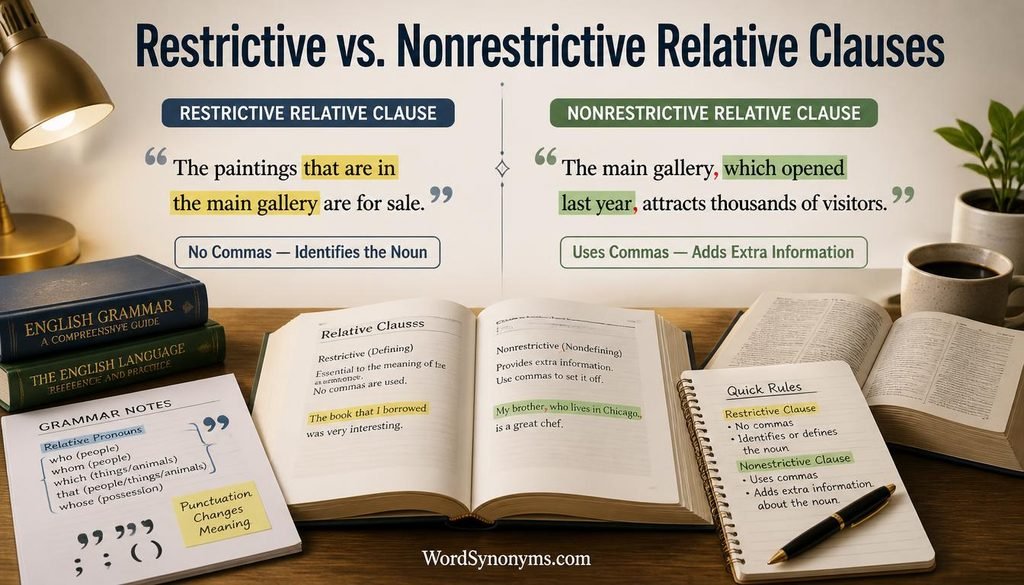
Restrictive vs. Nonrestrictive Relative Clauses
Understanding restrictive and nonrestrictive clauses makes the entire topic much easier.
What Is a Restrictive Relative Clause?
A restrictive relative clause supplies information that helps identify the noun.
It restricts the possible meaning of the noun.
For example:
The paintings that are in the main gallery are for sale.
Suppose a museum contains several groups of paintings. The clause that are in the main gallery tells you which paintings are for sale.
Another example:
Students who submit the form before Friday will receive a confirmation email.
The clause identifies the students who will receive the email.
A restrictive clause normally does not use commas.
What Is a Nonrestrictive Relative Clause?
A nonrestrictive relative clause gives additional information about a noun that is already identifiable.
For example:
The main gallery, which opened last year, attracts thousands of visitors.
The phrase which opened last year doesn’t identify the gallery. The words the main gallery already do that.
Nonrestrictive clauses normally use commas because the writer treats the information as an aside.
Purdue OWL describes this type of clause as information that can be removed without changing the basic meaning of the sentence.
The Comma Can Change the Meaning
This is where that vs. which becomes more than a vocabulary choice.
Compare:
The cars that are parked outside need cleaning.
Now imagine a large parking lot. Only some cars are outside. The clause identifies those cars.
Compare it with:
The cars, which are parked outside, need cleaning.
This version presents the cars as an already identified group. The fact that they are parked outside becomes extra information.
A comma can therefore act like a small traffic signal. It tells the reader how to interpret the information that follows.
A Classic Meaning Comparison
Consider:
They have two sons who are doctors.
This can mean that they have two sons who happen to be doctors. There could be another son who isn’t a doctor.
Now compare:
They have two sons, who are doctors.
The commas suggest that both sons are doctors and that the relative clause merely adds information about the two sons.
Purdue OWL uses this type of example to demonstrate how punctuation can change the meaning of a relative clause.
When to Use That
Use That for Essential Identifying Information
In standard American English, that is a strong choice when the relative clause identifies the noun.
Examples include:
The recipe that uses fresh tomatoes tastes better.
The phone that I ordered arrived today.
The house that has blue shutters belongs to my aunt.
The dog that escaped yesterday has returned home.
In each sentence, the clause helps narrow the reference.
Don’t Put a Comma Before Restrictive That
A common error looks like this:
The book, that I bought yesterday, is excellent.
For the intended restrictive meaning, the comma shouldn’t appear.
A better construction is:
The book that I bought yesterday is excellent.
The same principle applies to other restrictive clauses:
The car that needs repairs is in the garage.
Not:
The car, that needs repairs, is in the garage.
A comma would signal a different grammatical relationship, and that isn’t normally used to introduce a nonrestrictive clause. Cambridge Grammar specifically notes that that introduces defining relative clauses rather than non-defining ones.
That Can Refer to People
Although many learners associate that with things, it can also refer to people in restrictive clauses.
For example:
She’s the person that helped me.
He’s the employee that found the error.
However, who is often preferred when referring to a particular person, especially in formal writing.
For example:
She’s the person who helped me.
Both patterns can occur in English, but who often sounds more natural when the antecedent is clearly a person. Purdue OWL notes that that can substitute for who in informal restrictive constructions.
When to Use Which
Use Which for Nonrestrictive Clauses
Use which when you add information that isn’t needed to identify the noun.
For example:
The library, which opened in 1985, is still popular.
The phrase which opened in 1985 doesn’t tell us which library we mean. It simply tells us more about it.
Another example:
Her new car, which she bought last month, gets excellent gas mileage.
The reader already knows which car we’re discussing: her new car.
Which Can Refer to an Entire Previous Idea
One especially useful feature of which is its ability to refer to an entire preceding clause or situation.
For example:
The flight was canceled, which caused several passengers to miss their connections.
Here, which doesn’t simply refer to the flight. It refers to the preceding situation—the cancellation.
Another example:
He forgot his passport, which meant he couldn’t board the plane.
The phrase which meant he couldn’t board the plane explains the consequence of the entire previous situation.
This construction is different from ordinary noun modification and deserves special attention because that doesn’t perform the same job. Cambridge specifically documents which as a way to refer back to a whole clause or sentence.
Which With Prepositions
You can also use which after a preposition.
For example:
This is the building in which she works.
That is the company for which he writes.
The room in which we met was surprisingly small.
These structures often sound formal. In everyday American English, speakers frequently move the preposition to the end:
This is the building which she works in.
That’s the company which he writes for.
The room which we met in was surprisingly small.
Both patterns are grammatical in appropriate contexts. Cambridge notes that which commonly appears with prepositions and gives both formal and less formal alternatives.
That vs. Which in American English
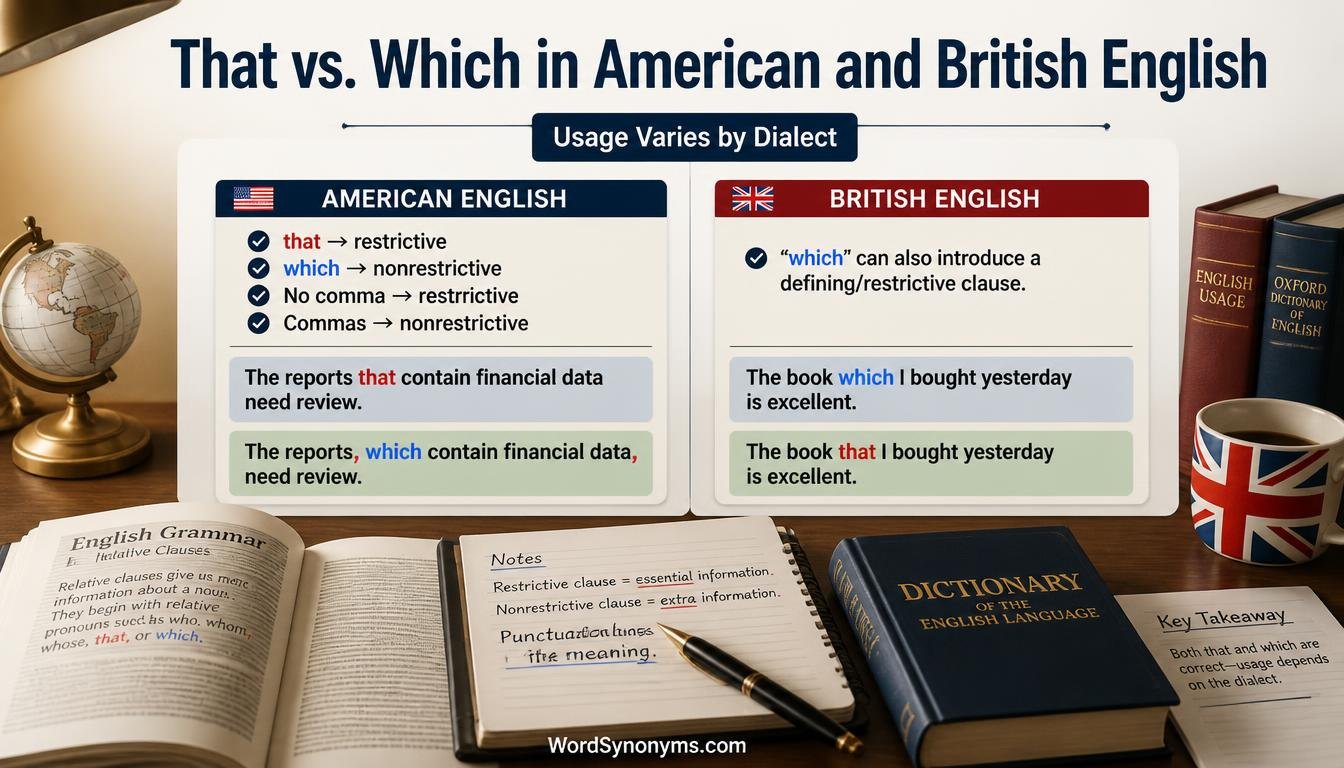
American English style traditionally makes a strong distinction between that and which.
The common pattern is:
- that → restrictive
- which → nonrestrictive
- no comma → restrictive
- commas → nonrestrictive
This approach makes sentences easier to parse because punctuation and word choice work together.
Consider:
The reports that contain financial data need review.
The reports are a larger group. The clause identifies a subset.
Now:
The reports, which contain financial data, need review.
This version presents the reports as an identified group and adds information about them.
The distinction becomes particularly useful in professional, academic, technical, and legal writing where a tiny shift in meaning can matter.
A Practical American English Rule
When writing for an American audience, this shortcut works well:
Use that when the clause is essential to the noun’s identity. Use which when the clause is extra information.
It’s not the only fact about relative clauses, but it’s an excellent working rule.
That vs. Which in British English
Here’s where English refuses to stay inside a neat little box.
British English commonly allows which in defining or restrictive relative clauses.
For example:
The book which I bought yesterday is excellent.
British English can also use:
The book that I bought yesterday is excellent.
Both constructions can be grammatical.
Cambridge Grammar explicitly notes that which can introduce defining as well as non-defining relative clauses, while that is used for defining clauses.
That doesn’t mean the American distinction is wrong. It means English usage varies by dialect and style.
For US-focused writing, the clearest approach remains:
The book that I bought yesterday is excellent.
For British English, which can also work in that restrictive construction.
Why This Difference Matters
Readers sometimes encounter:
The car which I bought is blue.
Then they learn that American English prefers:
The car that I bought is blue.
Neither sentence needs to become a grammar emergency.
The difference largely reflects usage conventions. Good writing should account for the variety of English being used.
Read more: Homeschool vs. Home School vs. Home-School: Which Is Correct?
That vs. Which Comma Rule
Punctuation provides one of the fastest ways to distinguish the two constructions.
No Comma With Restrictive That
The documents that contain confidential information must remain locked.
The clause identifies the documents.
Commas With Nonrestrictive Which
The documents, which contain confidential information, must remain locked.
Here, the writer presents the documents as an identified group and adds information about them.
Use the Removal Test
When you’re unsure, remove the relative clause.
Start with:
The restaurant that opened last month is already busy.
Remove the clause:
The restaurant is already busy.
If the original sentence needs the clause to tell you which restaurant, the information is restrictive.
Now consider:
The restaurant, which opened last month, is already busy.
Remove the clause:
The restaurant is already busy.
The core reference remains clear.
The test isn’t a magical grammar detector. Context still matters. However, it provides a useful editing shortcut.
That vs. Which Examples
Examples make the distinction easier to recognize.
Examples With That
The jacket that you left here is on the chair.
The laptop that has the new software belongs to Mia.
The restaurant that serves homemade pasta fills up quickly.
The documents that require signatures are on my desk.
The dog that barked all night finally fell asleep.
The students that completed the assignment received feedback.
Each that-clause narrows the reference.
Examples With Which
My laptop, which has a new battery, runs much faster now.
The restaurant, which opened in June, is already popular.
Her jacket, which was a birthday gift, still looks new.
The museum, which closes at six, is across the street.
The project was delayed, which frustrated the entire team.
The final example is especially important because which refers to the preceding situation.
Side-by-Side Examples
| Restrictive | Nonrestrictive |
| The files that are marked urgent need attention. | The files, which are marked urgent, need attention. |
| The car that has a flat tire needs repair. | The car, which has a flat tire, needs repair. |
| The students that arrived early entered first. | The students, which is grammatically odd for people, should instead use who. |
| The books that are on the desk belong to Anna. | The books, which are on the desk, belong to Anna. |
| The house that has a red door is ours. | Our house, which has a red door, is easy to recognize. |
The third row highlights an important point: don’t force which into a sentence simply because you’re discussing the comma rule. For people, who is usually the appropriate relative pronoun.
Common Mistakes With That and Which
Adding a Comma Before That
Incorrect for a restrictive clause:
The movie, that we watched last night, was hilarious.
Better:
The movie that we watched last night was hilarious.
Using That in a Nonrestrictive Clause
Incorrect:
My car, that is parked outside, needs gas.
Better:
My car, which is parked outside, needs gas.
The second sentence treats which is parked outside as additional information.
Treating That and Which as Completely Interchangeable
They can overlap in some varieties of English, especially British English. However, they don’t always carry the same grammatical role.
In standard American usage, replacing that with which can change a restrictive clause into a nonrestrictive one if you also add commas.
That’s not a cosmetic edit. It can change the sentence’s meaning.
Assuming Which Always Requires a Comma
This claim is too broad.
American style strongly favors which for nonrestrictive clauses. British English can use which in restrictive clauses as well.
For example:
The house which has the red door belongs to Anna.
That construction can occur in British English as a defining relative clause.
Therefore, the more accurate rule is:
Nonrestrictive which requires commas. Restrictive which can occur in varieties of English that permit it.
Using Which When That Would Make the Meaning Clearer
In American English, this sentence is usually clearer:
The phone that has the cracked screen is mine.
Rather than:
The phone which has the cracked screen is mine.
The second isn’t necessarily impossible in all English varieties. The first simply follows the conventional American pattern more closely.
Read more: Elfs vs. Elves: Which Plural Spelling Is Correct?
Can You Leave Out That or Which?
Sometimes, yes.
Relative pronouns can be omitted when they function as the object of the verb in a restrictive relative clause.
Consider:
The movie that I watched was excellent.
You can remove that:
The movie I watched was excellent.
Why does that work?
Because I is already the subject of watched. The missing relative pronoun functions as the object’s grammatical slot.
The same applies to which:
The book which I bought was expensive.
Can become:
The book I bought was expensive.
Cambridge and Purdue both describe this omission as possible in restrictive relative clauses when the relative pronoun functions as the object.
You Can’t Omit It When It Is the Subject
Consider:
The book that contains the answer is mine.
You can’t write:
The book contains the answer is mine.
The problem is that that functions as the subject of contains.
A simple comparison helps:
| Structure | Can the pronoun be omitted? |
| The book that I bought | Yes |
| The book which I bought | Yes |
| The book that contains the answer | No |
| The book which contains the answer | No |
| My book, which I bought yesterday, is here. | No |
Nonrestrictive relative clauses also retain their relative pronouns.
That vs. Which After Certain Words
Some expressions strongly favor that in restrictive clauses.
These include words and phrases such as:
- all
- anything
- everything
- nothing
- something
- the only
- the first
- the last
- superlatives such as best, largest, and most important
Examples:
Everything that she said was true.
This is the best book that I’ve read this year.
He was the first person that arrived.
That’s the only solution that works.
She took everything that she needed.
Purdue OWL identifies several of these environments as cases where that is especially appropriate in restrictive clauses.
This pattern makes sense because these expressions already narrow the field strongly. The only solution that works, for instance, identifies a particular solution through the combination of only and the relative clause.
That vs. Which in Formal and Informal Writing
Grammar doesn’t exist in a vacuum. Context matters.
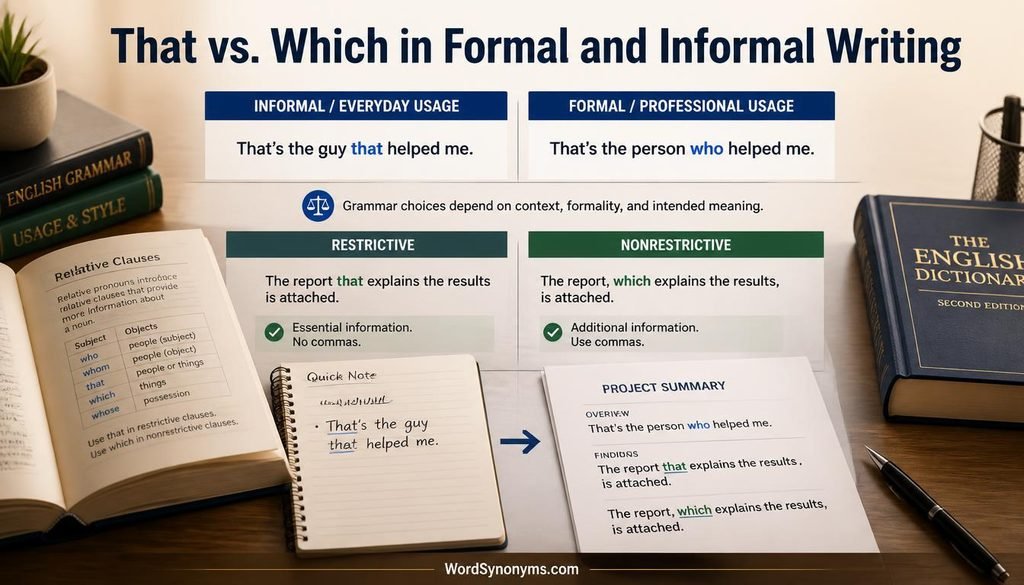
In everyday speech, people often use that broadly in restrictive clauses:
That’s the guy that helped me.
In formal writing, who would often be preferred for a person:
That’s the person who helped me.
Likewise, American professional writing commonly uses that for restrictive clauses involving things:
The report that explains the results is attached.
And which for nonrestrictive information:
The report, which explains the results, is attached.
This distinction creates clean boundaries between essential information and supplementary information.
The goal isn’t to make every sentence sound formal. The goal is to make the intended meaning easy to understand.
Case Study: How One Comma Changes the Message
Imagine a company has five offices.
You write:
The offices that operate on weekends will remain open during the holiday.
The clause identifies a subset. Only the offices operating on weekends are being discussed.
Now change the punctuation:
The offices, which operate on weekends, will remain open during the holiday.
The sentence now presents the offices as an identified group and adds the fact that they operate on weekends.
If the company actually has offices that don’t operate on weekends, the two sentences communicate different information.
This is why that vs. which isn’t merely a style preference. The construction can affect the scope of a statement.
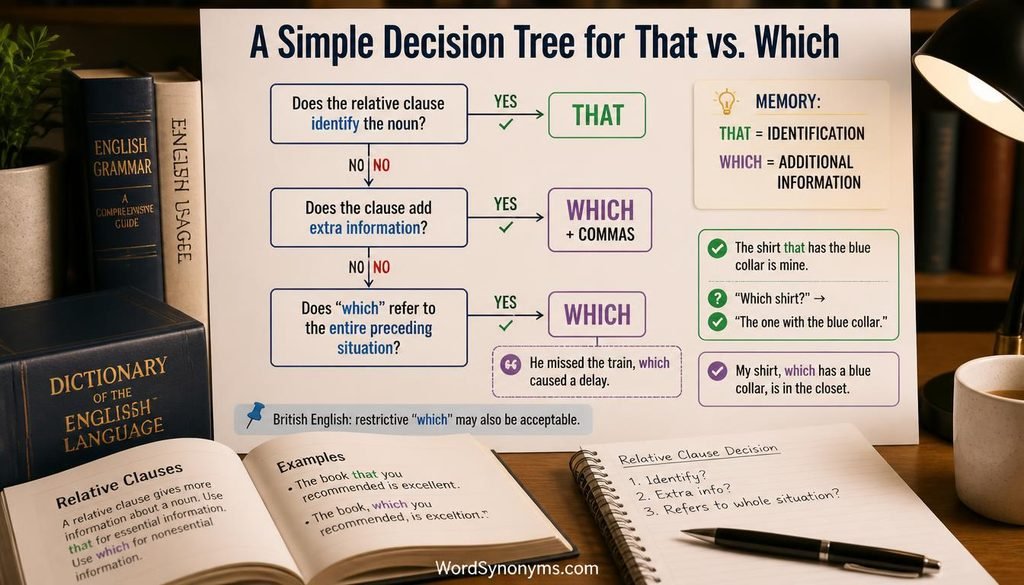
A Simple Decision Tree for That vs. Which
When you’re stuck, ask these questions:
1. Does the relative clause identify the noun?
- Yes → Use that in standard American English.
- No → Continue.
2. Does the clause simply add extra information?
- Yes → Use which with commas.
3. Does which refer to the entire preceding situation?
- Yes → Use which.
- Example: He missed the train, which caused a delay.
Are you writing in British English?
- If yes, restrictive which may also be acceptable.
- If you’re writing standard American English, that is usually the clearer choice for restrictive clauses.
Memory Trick
Think of the two words this way:
That = identification.
Which = additional information.
Then ask:
Which one?
If the relative clause answers that question, that often fits.
The shirt that has the blue collar is mine.
Which shirt?
The one with the blue collar.
If the noun is already clear, which can add the detail:
My shirt, which has a blue collar, is in the closet.
That’s the whole trick in miniature.
Practice: Choose That or Which
Try these sentences before checking the answers.
Questions
1. The computer ___ has the broken keyboard needs repair.
2. My computer, ___ I bought last year, still works perfectly.
3. The files ___ contain confidential information should be locked.
4. She missed the bus, ___ made her late.
5. The book ___ I ordered arrived this morning.
6. The museum, ___ opened in 1998, attracts many visitors.
7. Everything ___ he told us was accurate.
8. The house ___ has the green door belongs to James.
9. The house, ___ has a green door, belongs to James.
10. The project was canceled, ___ surprised everyone.
Answers
1. That
The computer that has the broken keyboard needs repair.
The clause identifies the computer.
2. Which
My computer, which I bought last year, still works perfectly.
The purchase date adds information.
3. That
The files that contain confidential information should be locked.
The clause identifies which files need protection.
4. Which
She missed the bus, which made her late.
Here, which refers to the preceding situation.
5. That or omitted
The book that I ordered arrived this morning.
You can also write:
The book I ordered arrived this morning.
6. Which
The museum, which opened in 1998, attracts many visitors.
The opening date is additional information.
7. That
Everything that he told us was accurate.
The restrictive construction follows everything.
8. That
The house that has the green door belongs to James.
The clause identifies the house.
9. Which
The house, which has a green door, belongs to James.
The house is already identified.
10. Which
The project was canceled, which surprised everyone.
The relative clause comments on the entire preceding event.
Quick Comparison: That vs. Which
| Feature | That | Which |
| Relative pronoun | Yes | Yes |
| Refers to things | Yes | Yes |
| Refers to animals | Yes | Yes |
| Can refer to people | Yes, especially in informal restrictive clauses | Generally no for ordinary people |
| Restrictive clauses | Yes | Yes in some varieties, including British English |
| Nonrestrictive clauses | No | Yes |
| Comma before it in nonrestrictive use | No | Yes |
| Can refer to an entire preceding clause | No | Yes |
| Can follow a preposition directly | No | Yes |
| Can be omitted as an object | Yes | Yes |
| Can be omitted as a subject | No | No |
The table reflects the central distinction documented by major grammar references. Cambridge describes that as a defining relative pronoun and which as usable in defining and non-defining clauses. Purdue emphasizes the restrictive/nonrestrictive distinction and the corresponding punctuation.
FAQs
1. When should I use that instead of which?
Use that when the clause is essential to the sentence’s meaning. It usually appears without commas.
2. Does which always need a comma?
No. Which can appear without a comma in some styles and structures, especially in British English. However, which commonly introduces nonrestrictive information set off by commas.
3. How can I quickly decide between that and which?
Remove the clause as a quick test. If removing it changes the intended meaning, that is often appropriate. If the sentence still makes sense with the same main point, which may introduce extra information.
4. Can that and which be interchangeable?
Sometimes. Their use depends on the clause, sentence structure, punctuation, and the variety of English being used.
5. Is using which after a comma a strict grammar rule?
It is a useful traditional guideline, but it isn’t completely absolute. Actual usage varies by context, writing style, and regional convention.
6. What is the easiest proofreading trick for that and which?
Try a quick “which hunt.” Find every which, check the surrounding commas, and ask whether the following clause provides essential information or simply adds extra detail.
Conclusion
Choosing between that and which becomes much easier once you focus on meaning rather than memorizing a long list of grammar rules. That usually points to information the sentence needs, while which often adds a helpful detail that you could remove.
Pay attention to the clause, check the commas, and read the sentence aloud. With a little practice, you’ll spot the difference naturally and make your writing clearer, smoother, and more precise.

Syeda Naalain Zahra is a content writer with an interest in English vocabulary and language. She creates simple and informative articles about synonyms, antonyms, word meanings, and everyday English usage. Her aim is to help readers build better vocabulary and communicate more confidently.