English has plenty of words that look related but behave very differently. Credible, creditable, and credulous are a perfect example. They share a similar spelling and historical connection to belief and trust. However, using one in place of another can completely change your meaning.
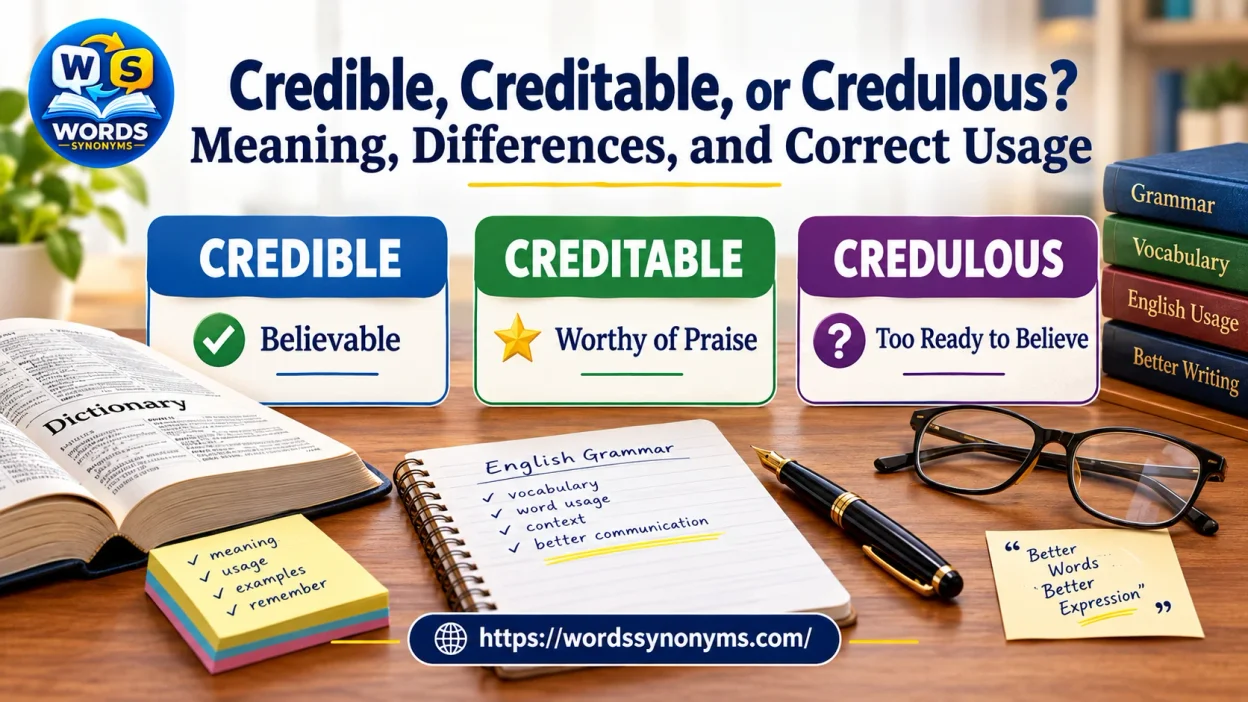
A credible source deserves belief. A creditable effort deserves praise. A credulous person believes things too easily.
That may sound simple at first. Yet these words often cause confusion because they appear in similar contexts and carry related ideas. Someone writing about a trustworthy witness may accidentally call them credulous. A student praising an achievement may choose credible when creditable is the better word.
The difference matters.
Whether you’re improving your writing, preparing for an exam, editing professional content, or simply expanding your vocabulary, understanding these three words will help you communicate with greater precision.
This guide explains the credible vs. creditable vs. credulous difference in plain English. You’ll find definitions, examples, comparisons, common mistakes, memory tricks, word origins, collocations, and practice questions to make the distinction stick.
Credible, Creditable, or Credulous: What’s the Difference?
Before diving into the details, here’s the quickest way to understand these three commonly confused words.
| Word | Core Meaning | Usually Describes | Simple Question |
| Credible | Worthy of belief or trust | Evidence, claims, sources, explanations | Can I believe it? |
| Creditable | Worthy of praise or recognition | Efforts, performances, achievements | Does it deserve credit? |
| Credulous | Too willing to believe | People or groups | Do they believe too easily? |
The easiest summary looks like this:
A credible claim can be believed, a creditable effort deserves recognition, and a credulous person believes almost anything.
Although the words share the beginning cred-, their meanings move in three different directions.
Think of it this way:
- Credible focuses on whether something deserves belief.
- Creditable focuses on whether something deserves praise.
- Credulous focuses on someone who gives belief too freely.
That distinction is the heart of the entire topic.
What Does Credible Mean?
Credible means believable, convincing, trustworthy, or worthy of confidence.
When something is credible, people have a good reason to accept it as true or reliable. The word often appears when discussing evidence, information, witnesses, explanations, institutions, and sources.
For example:
- The journalist presented a credible account of the event.
- Scientists require credible evidence before accepting a major claim.
- Her explanation sounded credible.
- The company needs a credible strategy for future growth.
- The witness appeared calm and credible during the interview.
In each example, credible answers one important question:
Can this be trusted or believed?
Credible Often Means Trustworthy
A credible person has earned trust. A credible source provides information people can reasonably rely on. In a credible explanation makes logical sense and fits the available facts.
However, credible doesn’t mean absolutely proven.
That’s an important distinction.
A theory can sound credible without being confirmed. An explanation may seem credible because it fits the evidence, even if researchers later discover a better explanation.
For example:
The detective considered the witness’s story credible, but investigators still needed physical evidence.
The story seemed believable. That doesn’t automatically make it true.
Common Uses of Credible
The word credible frequently appears with certain nouns.
Some common combinations include:
- credible evidence
- credible source
- credible explanation
- credible witness
- credible claim
- credible threat
- credible alternative
- credible argument
- credible candidate
- credible information
These combinations sound natural because credibility often relates to trust, truth, and reliability.
Credible in Everyday Context
Imagine seeing two headlines online.
The first comes from an established publication and includes named experts, documents, and verifiable facts. The second comes from an anonymous account making dramatic claims without evidence.
Which one seems more credible?
Probably the first.
Credibility doesn’t come from sounding confident. It comes from having reasons to trust the information.
That principle applies everywhere, from journalism and science to business and everyday conversations.
Synonyms for Credible
Depending on the context, you might use:
- believable
- trustworthy
- reliable
- convincing
- plausible
- authentic
- dependable
Be careful, though. These words aren’t always perfect substitutes.
For instance, plausible means something seems possible or reasonable. Credible usually carries a stronger suggestion of trustworthiness.
A plausible story might be possible.
A credible story gives you stronger reasons to believe it.
What Does Creditable Mean?
Creditable means worthy of praise, approval, recognition, or credit.
Unlike credible, which focuses on belief and trust, creditable focuses on merit and achievement.
If someone makes a serious effort or produces respectable results, you may describe their work as creditable.
Consider these examples:
- Her performance was creditable, especially for a beginner.
- Completing the project on time was a creditable achievement.
- The team gave a creditable performance despite losing the match.
- His first attempt at public speaking was creditable.
- The organization made a creditable effort to improve customer service.
In each sentence, the subject deserves some recognition.
Creditable Means “Deserving Credit”
The easiest memory trick comes directly from the word itself.
Creditable = worthy of credit.
If you can reasonably say something deserves acknowledgment, praise, or recognition, creditable may fit.
For example:
Finishing the race after recovering from an injury was a creditable achievement.
The achievement may not have broken a world record. Still, it deserves respect.
That subtle point matters.
Creditable Doesn’t Always Mean Outstanding
One of the most interesting things about creditable is its tone.
Calling something creditable doesn’t necessarily mean it was spectacular. Often, the word suggests that something was respectable, competent, or deserving of praise under the circumstances.
Suppose a new employee gives their first presentation. It isn’t flawless. They make a few mistakes and forget one minor point. Still, they prepared carefully and communicated the main ideas effectively.
You might say:
For a first presentation, it was a creditable effort.
That sounds positive. Yet it doesn’t mean the presentation was perfect.
Creditable often recognizes merit without claiming excellence.
Common Collocations With Creditable
The word frequently appears with:
- creditable effort
- creditable performance
- creditable achievement
- creditable attempt
- creditable result
- creditable showing
- creditable contribution
These combinations often appear in academic, professional, sporting, and formal writing.
Synonyms for Creditable
Depending on the situation, possible alternatives include:
- commendable
- praiseworthy
- admirable
- respectable
- worthy
- meritorious
Each word carries its own shade of meaning.
For example, commendable often expresses stronger direct praise. Respectable can suggest acceptable quality. Creditable specifically emphasizes that the achievement deserves recognition.
What Does Credulous Mean?
Credulous describes someone who is too willing to believe things.
A credulous person doesn’t question information enough. They may accept claims without sufficient evidence or trust people too quickly.
Examples include:
- The scam targeted credulous investors.
- Only a highly credulous person would believe every rumor online.
- The advertisement appealed to credulous consumers.
- Children can sometimes be more credulous than adults.
- A credulous audience accepted the dramatic story without asking questions.
Unlike credible and creditable, credulous usually carries a negative meaning.
It suggests excessive trust.
Credulous Is Similar to Gullible
The closest everyday synonym for credulous is often gullible.
Both words describe someone who believes things too easily.
However, there can be subtle differences in tone.
Gullible often suggests someone can easily be tricked.
Credulous focuses more directly on a willingness to believe.
Consider the difference:
He was gullible enough to send money to the scammer.
This emphasizes how easily he was deceived.
He was credulous enough to believe the scammer’s story.
This emphasizes his readiness to accept the story as true.
The meanings overlap, but the emphasis shifts slightly.
Is Credulous Always Negative?
Usually, yes.
Calling someone credulous often suggests that they lack healthy skepticism.
That doesn’t mean being trusting is always bad. Trust can be a positive quality. Healthy relationships require it.
The problem begins when trust ignores evidence.
There’s a difference between giving someone the benefit of the doubt and believing every claim without question.
A thoughtful person can be open-minded.
A credulous person may be open-minded to the point of being easily misled.
Common Collocations With Credulous
You may encounter phrases such as:
- credulous person
- credulous audience
- credulous public
- credulous consumer
- credulous investor
- credulous reader
- credulous listener
The word almost always describes a person or group capable of believing something.
You generally wouldn’t call a story credulous because stories don’t believe things.
That mistake leads directly to one of the most common usage errors.
Credible vs. Creditable vs. Credulous: A Detailed Comparison
Seeing the three words side by side makes their differences easier to remember.
| Feature | Credible | Creditable | Credulous |
| Main Meaning | Worthy of belief | Worthy of praise | Too willing to believe |
| Main Focus | Trust | Merit | Excessive belief |
| Usually Describes | Evidence, claims, people, sources | Efforts, achievements, performances | People and groups |
| Tone | Neutral or positive | Positive | Usually negative |
| Key Question | Can I believe it? | Does it deserve credit? | Do they believe too easily? |
| Example | A credible source | A creditable effort | A credulous reader |
Here is another simple way to remember the difference:
Credible = believable
Creditable = praiseworthy
Credulous = gullible
Three words. Three directions.
Credible vs. Credulous: Understanding the Biggest Confusion
Among these words, credible and credulous often create the most confusion.
The reason is simple: both relate to belief.
However, they describe opposite sides of the process.
Credible describes something or someone that deserves belief.
Credulous describes someone who gives belief too easily.
Look at this example:
The journalist is credible because readers trust her reporting.
Here, credible describes the journalist’s trustworthiness.
Now compare it with:
The reader was credulous and believed every sensational headline.
Here, credulous describes the reader’s excessive willingness to believe.
One earns belief.
The other gives belief too freely.
A Simple Analogy
Imagine a bridge.
A credible bridge engineer designs a structure people can trust.
A credulous traveler crosses any bridge without checking whether it is safe.
The engineer inspires confidence.
The traveler gives confidence too easily.
That’s the essential difference.
Incorrect and Correct Examples
Incorrect: She is credible because she believes every rumor.
Correct: She is credulous because she believes every rumor.
Incorrect: The witness was credulous because the jury trusted her testimony.
Correct: The witness was credible because the jury trusted her testimony.
The first describes someone who believes too easily.
The second describes someone worthy of belief.
Credible vs. Creditable: Why They Aren’t the Same
At first glance, credible and creditable may seem interchangeable.
They aren’t.
The difference comes down to belief versus praise.
A credible explanation is believable.
A creditable explanation may be well done and deserving of recognition.
Consider these two sentences:
The scientist offered a credible explanation.
This means the explanation seemed believable and logically sound.
The student wrote a creditable explanation.
This means the student’s work was respectable or deserving of praise.
The same noun can sometimes work with either word, but the meaning changes.
That’s why context matters.
Truthworthiness vs. Merit
Think of the words this way:
| If You Are Evaluating… | Use |
| Whether something is believable | Credible |
| Whether something deserves praise | Creditable |
A report can be credible because its facts are reliable.
A report can also be creditable because the writer did a good job.
Those are two separate judgments.
Can Someone Be Both Credible and Credulous?
Interestingly, yes.
A person could theoretically be credible and credulous at the same time.
That sounds contradictory, but the words describe different qualities.
Imagine a respected teacher who always tells the truth. Their students consider them trustworthy.
That makes the teacher credible.
However, suppose the same teacher believes every suspicious email and falls for obvious scams.
That behavior could make them credulous.
One word describes whether others should believe you.
The other describes whether you believe others too easily.
This distinction shows why vocabulary precision matters. A single adjective can point in an entirely different direction.
Common Mistakes With Credible, Creditable, and Credulous
These words often appear in formal writing, academic assignments, and professional communication. Knowing the common mistakes can prevent awkward sentences.
Using Credible When You Mean Credulous
This is probably the most common error.
Incorrect:
He’s credible because he believes everything he reads online.
Correct:
He’s credulous because he believes everything he reads online.
A person who believes everything isn’t necessarily credible. They may simply be too trusting.
Using Creditable When You Mean Credible
Another common mistake happens when writers want to say something seems believable.
Incorrect:
The detective found her explanation creditable.
Better:
The detective found her explanation credible.
Use credible when evaluating truthfulness or believability.
Use creditable when evaluating merit or quality.
Using Credulous to Describe Information
Remember that credulous usually describes the person doing the believing.
Incorrect:
That was a credulous story.
Correct:
That was a credible story.
Or, depending on the intended meaning:
That was an unbelievable story.
A story cannot be too willing to believe something. A person can.
Assuming Similar Spelling Means Similar Meaning
English loves word families, but family resemblance can be misleading.
Consider these three:
- credible
- creditable
- credulous
They look related because they share a historical connection to belief and trust. Still, modern English has assigned each word a distinct job.
Similar spelling isn’t permission to swap words.
The Easiest Way to Remember Credible, Creditable, and Credulous
A good memory trick can save you from second-guessing yourself.
Credible = Can Be Believed
Think about credibility.
If something has credibility, people can trust or believe it.
Credible → credibility → believable
Example:
Is the evidence credible?
Can the evidence be believed?
Creditable = Deserves Credit
This one gives you a helpful clue in its spelling.
Creditable = worthy of credit
Example:
Was her effort creditable?
Does her effort deserve recognition?
Credulous = Believes Too Much
Think of a person who opens the door to every claim without checking who is knocking.
That’s a credulous person.
Example:
Is he credulous?
Does he believe things too easily?
The Three-Question Test
When choosing the correct word, ask:
- Can it be believed? → Credible
- Does it deserve praise? → Creditable
- Does someone believe too easily? → Credulous
This quick test works surprisingly well.
Common Collocations and Natural Word Pairings
Learning definitions helps, but learning how words naturally appear in sentences makes your writing sound more fluent.
Common Collocations With Credible
| Phrase | Meaning |
| Credible evidence | Evidence worthy of belief |
| Credible source | A trustworthy source |
| Credible explanation | A believable explanation |
| Credible witness | A witness considered trustworthy |
| Credible claim | A claim supported by reasonable facts |
| Credible threat | A threat likely to be real |
| Credible alternative | A realistic and trustworthy option |
Example:
The researchers searched for credible evidence rather than relying on speculation.
Common Collocations With Creditable
| Phrase | Meaning |
| Creditable effort | An effort deserving recognition |
| Creditable performance | A respectable performance |
| Creditable achievement | An accomplishment worthy of praise |
| Creditable attempt | A worthwhile attempt |
| Creditable result | A respectable outcome |
| Creditable contribution | A contribution deserving acknowledgment |
Example:
Although the team didn’t win, their performance was creditable.
Common Collocations With Credulous
| Phrase | Meaning |
| Credulous person | Someone who believes too easily |
| Credulous audience | An audience easily persuaded |
| Credulous public | A public inclined to accept claims too readily |
| Credulous consumer | A buyer easily influenced by misleading claims |
| Credulous investor | An investor who may trust unrealistic promises |
| Credulous reader | A reader who accepts information without questioning it |
Example:
Misleading advertisements often depend on credulous consumers who don’t verify the claims.
Word Forms and Related Vocabulary
Understanding related forms helps you recognize how these words work across different sentences.
| Word | Related Form | Meaning |
| Credible | Credibility | The quality of being believable |
| Credible | Credibly | In a believable manner |
| Creditable | Creditably | In a manner worthy of praise |
| Credulous | Credulity | A tendency to believe too easily |
| Credulous | Credulously | In an overly trusting manner |
| Incredulous | Incredulity | Unwillingness or inability to believe |
Credibility
Credibility is the noun form connected with credible.
Example:
The company lost credibility after making several false promises.
Notice the difference between being wrong once and losing credibility. Credibility concerns whether people can continue trusting you.
Credulity
Credulity is the tendency to believe things too easily.
Example:
The scam succeeded because it exploited public credulity.
This word appears more often in formal writing.
Incredulous
Don’t confuse credulous with incredulous.
They point in almost opposite directions.
A credulous person believes too easily.
An incredulous person finds something difficult to believe.
Example:
She looked incredulous when she heard the unbelievable claim.
Here’s the contrast:
The credulous customer believed the advertisement immediately.
The incredulous customer demanded proof.
One believes too quickly.
The other refuses to believe without convincing evidence.
Pronunciation Guide
Pronunciation can also help separate these similar-looking words.
- Credible: CRED-uh-bul
- Creditable: CRED-it-uh-bul
- Credulous: CRED-juh-lus
The emphasis falls near the beginning of each word.
Speaking the words aloud can help lock their differences into memory.
Where Do Credible, Creditable, and Credulous Come From?
These words share an older connection to the idea of belief and trust.
Their roots connect with the concept of credere, a Latin term associated with believing or trusting.
Over time, English developed different branches of meaning.
Credible became associated with something worthy of belief.
Creditable became associated with something worthy of credit or praise.
Credulous developed the sense of being inclined to believe too readily.
The shared history explains their similar appearance.
Their modern meanings explain why they can’t be used interchangeably.
Language often works like a tree. Words can grow from the same root but eventually stretch in different directions.
Case Study: Three Similar Sentences, Three Different Meanings
Consider a fictional company launching a new environmental initiative.
Sentence One: The Company Made a Credible Claim
The company made a credible claim that it had reduced energy consumption by supporting the statement with measurable data.
Here, credible refers to believability.
The claim has evidence behind it.
Sentence Two: The Company Made a Creditable Effort
The company made a creditable effort to reduce waste, even though it didn’t meet every target.
Here, creditable refers to merit.
The company deserves recognition for trying and making progress.
Sentence Three: The Public Was Credulous
The company relied on a credulous audience that accepted exaggerated environmental claims without checking the facts.
Here, credulous describes people who believe too easily.
The three sentences involve the same general situation.
Yet each adjective focuses on something entirely different:
- truthworthiness
- praiseworthiness
- excessive willingness to believe
That’s vocabulary precision in action.
Read More: Adapt vs. Adopt: Easy Ways to Remember
How Context Changes the Correct Word
Choosing the right word often depends on what exactly you’re evaluating.
Suppose someone gives a speech.
You could ask:
Was the speech believable?
Use credible.
She offered a credible explanation.
Did the speaker perform well?
Use creditable.
She gave a creditable performance.
Did the audience believe everything without questioning it?
Use credulous.
The speech persuaded a credulous audience.
Same event. Three different perspectives.
This is why checking the noun you’re describing can help.
Ask yourself: What quality am I actually talking about?
A Quick Decision Tree
When you’re unsure which word to use, follow this simple path.
Are you describing something trustworthy or believable?
→ Use credible
Are you describing an effort, achievement, or performance worthy of praise?
→ Use creditable
Are you describing someone who believes things too easily?
→ Use credulous
You can reduce the entire topic to one simple formula:
Believe it = credible.
Praise it = creditable.
Believes too much = credulous.
Credible, Creditable, and Credulous in Professional Writing
These words appear frequently in professional settings because they help writers make precise judgments.
In Journalism
Journalists often evaluate whether information comes from a credible source.
A credible source usually provides verifiable information and has a reasonable basis for making claims.
Example:
The editor requested confirmation from several credible sources.
In Academia
Researchers look for credible evidence and credible arguments.
Academic writing values claims supported by data, logic, and reliable sources.
Example:
A strong argument requires credible evidence.
In Performance Reviews
Managers may describe an employee’s work as creditable.
Example:
Her handling of the difficult project was creditable.
This recognizes merit without necessarily claiming exceptional results.
In Marketing and Consumer Protection
The word credulous can describe audiences vulnerable to misleading promises.
Example:
Fraudulent schemes often target credulous consumers.
The sentence highlights a lack of skepticism.
Practice Quiz: Choose Credible, Creditable, or Credulous
Test your understanding with these examples.
Question One
The investigators needed ______ evidence before closing the case.
Answer: Credible
Evidence needs to be believable and trustworthy.
Question Two
Despite limited resources, the small team made a ______ effort to finish the project.
Answer: Creditable
The effort deserves recognition.
Question Three
Scammers often search for ______ victims who accept promises without asking questions.
Answer: Credulous
The victims believe too easily.
Question Four
Her explanation sounded completely ______ because it matched the available facts.
Answer: Credible
The explanation appears believable.
Question Five
Finishing the competition after months of difficult training was a ______ achievement.
Answer: Creditable
The achievement deserves praise.
Question Six
A ______ reader may share an article without checking whether the information is accurate.
Answer: Credulous
The reader accepts information too readily.
Question Seven
The lawyer presented a ______ argument supported by documents and testimony.
Answer: Credible
The argument deserves belief.
Question Eight
The rookie’s performance wasn’t perfect, but it was certainly ______.
Answer: Creditable
The performance was respectable and worthy of recognition.
Frequently Asked Questions
Is credible the same as believable?
They are very close.
Credible means worthy of belief, while believable simply means something can reasonably be believed. Credible often carries an additional sense of trustworthiness.
Is creditable the same as credible?
No.
Credible means believable or trustworthy.
Creditable means deserving praise or recognition.
A credible report contains trustworthy information. A creditable report may simply be well written and deserving of approval.
Does credulous mean gullible?
Yes, the meanings overlap.
Both describe someone who believes things too easily. However, credulous often focuses more specifically on a willingness to believe, while gullible can emphasize being easily deceived.
Can a person be credible?
Absolutely.
A credible person is someone others consider trustworthy, believable, or reliable.
Example:
She’s a credible expert because she supports her conclusions with evidence.
Can an achievement be creditable?
Yes.
An achievement can be creditable when it deserves recognition or praise.
Example:
Completing the project under difficult conditions was a creditable achievement.
Can a story be credulous?
Generally, no.
Credulous usually describes someone capable of believing something too easily.
A story can be credible, believable, implausible, or unconvincing, but it doesn’t normally qualify as credulous.
What’s the opposite of credulous?
The closest opposite is often incredulous.
A credulous person believes too easily.
An incredulous person finds something difficult to believe.
What’s the easiest way to remember credible vs. creditable vs. credulous?
Remember this three-part formula:
- Credible = worthy of belief
- Creditable = worthy of credit
- Credulous = too ready to believe
Final Summary: Which Word Should You Use?
The difference between credible, creditable, and credulous becomes easy once you focus on what each word evaluates.
- Use credible when you’re talking about trust, truth, or believability.
2. Use creditable when you’re talking about merit, effort, achievement, or something deserving recognition.
3. Use credulous when you’re describing someone who believes things too easily.
Here’s the final comparison:
| If You Mean… | Correct Word |
| Worth believing | Credible |
| Trustworthy | Credible |
| Worth praising | Creditable |
| Deserving recognition | Creditable |
| Too willing to believe | Credulous |
| Easily persuaded | Credulous |
If you remember only one sentence, make it this:
A credible source deserves belief, a creditable effort deserves praise, and a credulous person gives belief too easily.
Once that distinction clicks, these three confusing words become much easier to use correctly. The spelling may look similar, but the meanings serve very different purposes. Choose the word based on whether you’re judging trustworthiness, merit, or excessive belief.

Samreen Saif is a passionate writer and language enthusiast who contributes informative and engaging content to WordsSynonyms.com. She enjoys exploring English vocabulary, synonyms, antonyms, word meanings, and language usage to help readers understand and use words with confidence.
Samreen focuses on creating clear, accurate, and easy-to-read content for students, writers, professionals, and English learners. Through her articles, she aims to make vocabulary learning simple, practical, and useful for everyday communication.
When she is not writing, Samreen enjoys learning about language, discovering new words, and creating helpful content that makes English learning more accessible to everyone.