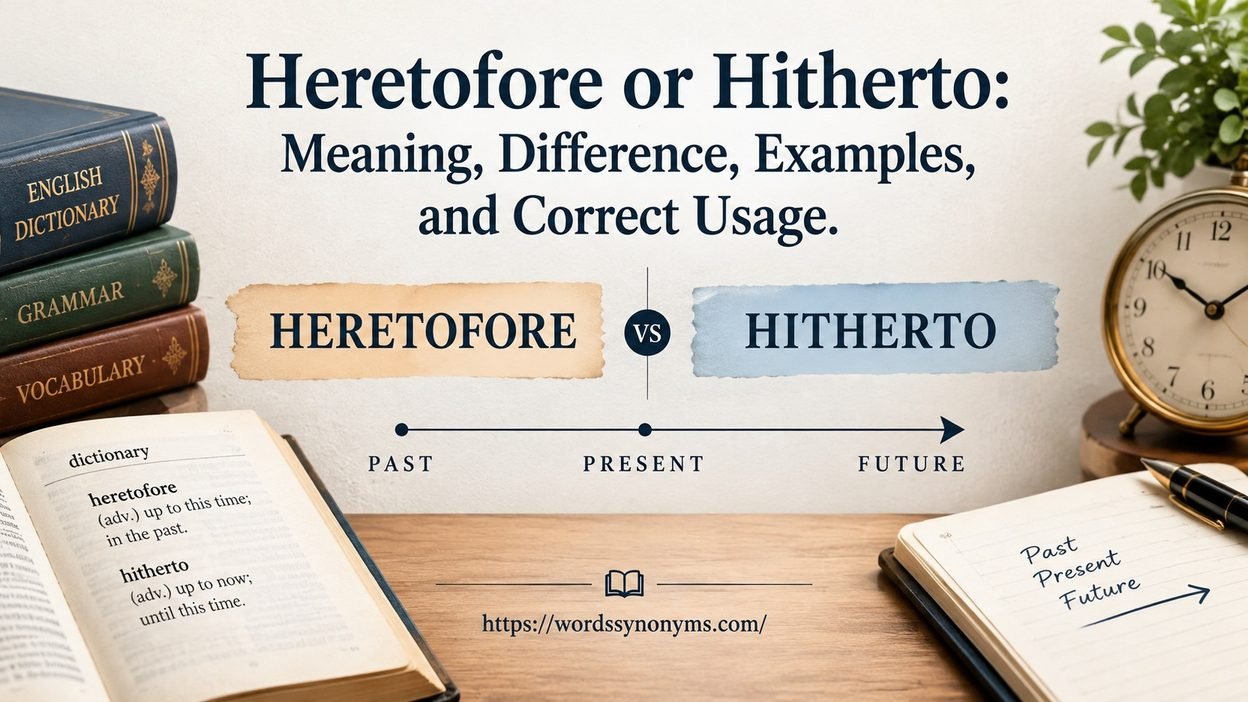
Heretofore or Hitherto: Meaning and Correct Usage explains how these formal adverbs refer to time before now or until now in modern English.
Heretofore and hitherto are forms used for a certain point of time connected to the current time. Heretofore can mean before the current time or until now, while hitherto can mean until the current time or previously.
Both are synonym terms, and their exact use can depend on the action or event being described. In legal and scholarly writing, these terms are severely unpopular and increasingly out of favor.
From my experience, simpler synonyms such as before, previously, and so far often make a sentence clearer.
The same idea appears in several related terms. Hereto is an adverb used for a particular piece of writing or a document, and it is almost always used with the verb attached when something is happening to that document.
Hitherward is an archaic word that describes direction, especially toward somewhere or toward someone, while movement toward somewhere gives it its sense. Another related term, theretofore, refers to a past point of time. These archaic forms are less common in modern English.
Quick Answer
Here’s the short version:
| Word | Basic meaning | Tone | Typical use |
| Heretofore | Before this point in time; until now | Formal, specialized | Legal, academic, official, formal prose |
| Hitherto | Until now or until a particular time | Formal | Academic, literary, historical, formal prose |
| Until now | Up to the present time | Neutral | Everyday and general writing |
| Previously | At an earlier time | Neutral to formal | General writing |
| So far | Up to the present point | Conversational | Everyday speech and writing |
The key point is simple: heretofore and hitherto usually express nearly the same idea.
Cambridge defines heretofore as meaning “before this point in time” and identifies hitherto as a synonym. It defines hitherto as meaning “until now or until a particular time.”
That second part matters.
Hitherto can refer to a particular point in the past, not just the present. That’s one of the most useful distinctions to understand when you’re choosing between these words.
What Does Heretofore Mean?
Heretofore is an adverb meaning before this time or before this point in time.
Oxford classifies it as a law or formal term and defines it as “before this time.” Cambridge similarly labels it as formal or specialized.
In plain English, you can usually translate heretofore as:
- until now
- before now
- previously
- before this point
- up to this time
Consider this sentence:
The company had heretofore focused exclusively on domestic customers.
The sentence means that, before the point being discussed, the company focused only on domestic customers.
A less formal version would be:
The company had previously focused exclusively on domestic customers.
An even more conversational version would be:
Until then, the company had focused exclusively on domestic customers.
All three sentences communicate essentially the same idea. The difference is register, not basic meaning.
Heretofore in a Sentence
Here are several natural examples:
- The method had heretofore remained untested.
- The discovery revealed a heretofore unknown property.
- The issue had heretofore received little attention.
- Researchers examined a problem that had heretofore been overlooked.
- The organization expanded into markets it had heretofore avoided.
- The court considered evidence that had heretofore been unavailable.
Notice a pattern.
Heretofore frequently appears alongside words such as unknown, unused, ignored, overlooked, unavailable, unrecognized, and unexplored. Oxford specifically lists combinations such as heretofore unknown and heretofore unused.
That construction gives the word a useful job. It tells the reader that something had a particular status up to a defined point, then changed.
What Does Hitherto Mean?
Hitherto is also an adverb. It means until now or until the particular time under discussion.
Oxford labels hitherto as formal and gives examples such as “a hitherto unknown species” and “Her life hitherto had been devoid of adventure.”
Cambridge gives essentially the same meaning and explicitly lists heretofore as a synonym.
In simpler language, hitherto can often mean:
- until now
- until then
- up to that point
- previously
- before that time
For example:
The scientist revealed a hitherto unknown mechanism.
That means the mechanism was unknown until the discovery or point being discussed.
You could rewrite it as:
The scientist revealed a previously unknown mechanism.
Or:
The scientist revealed a mechanism that had been unknown until then.
Again, the core meaning stays intact.
Hitherto in a Sentence
Here are useful examples:
- The species was hitherto unknown to researchers.
- Her work had hitherto gone unnoticed.
- The policy had hitherto remained unchanged.
- The evidence challenged a hitherto accepted assumption.
- The region had been hitherto inaccessible to researchers.
- His research uncovered a hitherto neglected problem.
These examples show why hitherto appears frequently in academic and formal prose. It lets writers compress a longer phrase such as “until that point” into a single adverb.
Heretofore vs. Hitherto: What’s the Difference?
The biggest surprise is that there isn’t a large difference in basic meaning.
Both words point backward from a particular reference point.
Think of time as a line:
PAST ────────────────● NOW
When you use heretofore or hitherto, you’re essentially looking backward from that point.
Heretofore: everything before this point.
Hitherto: everything up to this point or up to the particular time being discussed.
That’s why these sentences work:
The theory had heretofore been widely accepted.
The theory had hitherto been widely accepted.
Both say that the theory was widely accepted before the relevant point in time.
The distinction becomes more noticeable when you examine register.
Heretofore Has a Stronger Legal and Specialized Flavor
Heretofore appears particularly often in legal, official, and highly formal writing. Cambridge labels it “law” as well as “formal or specialized,” while Oxford marks it “law or formal.”
That doesn’t mean lawyers own the word.
They don’t.
You can use heretofore in academic, journalistic, scientific, or general formal writing. Modern examples include constructions such as “heretofore ignored,” “heretofore unavailable,” and “heretofore unknown.”
Still, if you encounter heretofore in a contract, legal document, scholarly paper, or formal report, its presence won’t be surprising.
Hitherto Has a Broad Formal Flavor
Hitherto is also formal, but its usage isn’t tied as strongly to legal language.
It appears comfortably in:
- academic writing
- historical writing
- literary prose
- scientific writing
- formal journalism
- scholarly discussion
For example:
The discovery provided evidence for a hitherto overlooked explanation.
That sentence sounds perfectly at home in academic prose.
In casual conversation, however, you’d probably say:
The discovery provided evidence for an explanation we’d overlooked until now.
The second sentence is less ornate and easier to process.
Heretofore or Hitherto: Which Is More Formal?
Both are formal.
However, heretofore often carries a more specialized or legalistic tone, while hitherto can sound formal, literary, academic, or historical. Cambridge specifically marks heretofore as “formal or specialized” and hitherto as “formal.”
Here’s a practical comparison:
| Context | Better choice |
| Legal document | Heretofore often fits well |
| Academic paper | Hitherto or heretofore |
| Scientific paper | Either, depending on sentence |
| Historical writing | Hitherto often sounds natural |
| Literary prose | Hitherto can work well |
| Business report | Either, but simpler wording may be better |
| Everyday email | Until now |
| Casual conversation | Until now or so far |
Don’t treat this table as a rigid grammar rule. English doesn’t work like a traffic light where every context has one permitted word.
Instead, think of these choices as different settings on the same language dial.
Heretofore or Hitherto Examples Side by Side
Seeing the words together makes their relationship much clearer.
| Heretofore | Hitherto | Plain-English version |
| The issue had heretofore been ignored. | The issue had hitherto been ignored. | The issue had been ignored until then. |
| A heretofore unknown species was discovered. | A hitherto unknown species was discovered. | A species that was previously unknown was discovered. |
| The technology had heretofore been unavailable. | The technology had hitherto been unavailable. | The technology hadn’t been available before. |
| The theory had heretofore received little attention. | The theory had hitherto received little attention. | The theory hadn’t received much attention until then. |
| The practice had heretofore remained uncommon. | The practice had hitherto remained uncommon. | The practice had been uncommon until then. |
In most of these examples, swapping the two words doesn’t materially change the meaning.
That’s the central lesson.
Don’t search for a dramatic semantic distinction that isn’t there.
The more useful question is: Which word sounds appropriate for this audience and context?
Heretofore vs. Hitherto vs. Until Now
For most modern readers, this is the comparison that matters most.
Imagine you’re writing three versions of the same sentence:
The technology had heretofore been unavailable.
The technology had hitherto been unavailable.
The technology had been unavailable until now.
The first sounds formal and somewhat specialized.
The second sounds formal and slightly literary or academic.
The third sounds natural and direct.
None is inherently wrong.
The best choice depends on your purpose.
Use “Until Now” for Clarity
If you’re writing for a broad audience, until now will usually win.
It’s short. It’s familiar. Nobody needs to stop and decode it.
For example:
The software was unavailable until now.
That sentence gets straight to the point.
Compare it with:
The software had heretofore been unavailable.
The second sentence isn’t incorrect. It simply wears a much fancier jacket than the occasion requires.
Use “Heretofore” for Formal Prose
Choose heretofore when the surrounding writing already uses a formal register and the word fits naturally.
For example:
The agency had heretofore relied on manual verification procedures.
That works in a formal report.
In a customer email, however, this would probably be unnecessarily stiff:
We have heretofore relied upon manual verification procedures.
A clearer alternative would be:
We previously relied on manual verification.
Same idea. Less friction.
Use “Hitherto” for Formal or Academic Writing
Hitherto can be particularly effective when describing something that remained true until a specific development, discovery, or historical moment.
For example:
The expedition entered a hitherto unexplored region.
The word neatly connects the earlier state of affairs with the event that changed it.
A longer version would be:
The expedition entered a region that had not previously been explored.
Both work. Hitherto simply packs the idea into one word.
Why “Hitherto” Can Refer to a Past Point
This is one of the most important details in the entire comparison.
People often assume that hitherto always means “until today.”
It doesn’t.
It can mean until a particular time being discussed. Oxford explicitly defines it as “until now; until the particular time you are talking about.”
Consider this historical sentence:
Her life hitherto had been peaceful.
The writer doesn’t necessarily mean “her life has been peaceful up to today.”
Instead, the meaning depends on the surrounding context. Perhaps the next sentence describes a major event that changed her life.
For example:
Her life hitherto had been peaceful. The arrival of the new governor changed everything.
Here, hitherto points to the period before that change.
This flexibility makes hitherto especially useful in narratives, historical writing, and academic analysis.
Common Word Combinations With Heretofore
Some constructions sound particularly natural because writers commonly use heretofore with participles and descriptive adjectives.
Common examples include:
- heretofore unknown
- heretofore unused
- heretofore unavailable
- heretofore ignored
- heretofore overlooked
- heretofore unrecognized
- heretofore unexplored
- heretofore unimaginable
- heretofore neglected
- heretofore undisclosed
For example:
Researchers identified a heretofore unknown chemical reaction.
The phrase immediately tells the reader that the reaction was unknown before the discovery being described.
Another example:
The company entered a heretofore untapped market.
Here, the market wasn’t necessarily unknown. Rather, the company hadn’t previously exploited it.
That distinction matters. The word doesn’t automatically mean unknown. It means before the relevant point in time.
Common Word Combinations With Hitherto
Hitherto appears in many of the same constructions.
Common examples include:
- hitherto unknown
- hitherto unsuspected
- hitherto ignored
- hitherto unseen
- hitherto unexplored
- hitherto neglected
- hitherto impossible
- hitherto unheard-of
- hitherto unrecognized
- hitherto inaccessible
Oxford specifically gives examples such as hitherto unknown and notes combinations including hitherto impossible, hitherto neglected, and hitherto unheard-of.
That makes hitherto particularly useful when you want to emphasize a contrast:
What was true before → what became true afterward
For example:
The study uncovered a hitherto neglected factor in the debate.
The factor existed before. What changed was its recognition or attention.
Read more: Resolve vs. Solve: Differences and Usage
Heretofore or Hitherto in Academic Writing
Academic writing often needs to describe how knowledge changes.
A researcher might explain that scholars previously ignored an issue, scientists hadn’t identified a mechanism, or historians hadn’t examined a particular source.
That’s exactly where these words can work well.
Consider:
Previous studies had hitherto overlooked the role of social networks.
The sentence establishes a boundary between the previous state of scholarship and the current study.
Another possibility is:
Previous studies had heretofore overlooked the role of social networks.
Again, the meaning remains nearly identical.
However, academic writers shouldn’t confuse formality with quality.
A sentence isn’t stronger simply because it contains an archaic-looking adverb.
Compare:
Previous studies had hitherto overlooked this factor.
with:
Previous studies had overlooked this factor until now.
The first has a more formal academic texture. The second is plainer.
Both can be effective.
Clarity should decide the matter whenever tone doesn’t require the formal word.
Heretofore or Hitherto in Legal Writing
Legal language provides one of the clearest environments for heretofore.
Because legal documents often distinguish carefully between earlier conditions and later changes, terms that express temporal relationships can become useful.
For example:
The parties shall comply with obligations heretofore established under the agreement.
The intended meaning is that the obligations were established before the relevant point.
However, legal writers should still consider whether simpler wording would improve clarity.
The parties shall comply with obligations previously established under the agreement.
In many contexts, previously communicates the same idea more plainly.
That’s an important writing principle: a formal word isn’t automatically a precise word.
If the simpler alternative says exactly what you mean, it may be the better choice.
Heretofore or Hitherto: Common Mistakes
Mistake: Assuming they have completely different meanings
They don’t.
Their meanings overlap heavily. Cambridge explicitly identifies heretofore and hitherto as synonyms.
Trying to invent a strict grammatical boundary between them will usually create confusion rather than clarity.
Mistake: Thinking “hitherto” means only “until today”
It doesn’t.
It can refer to a particular time in the past.
For example:
The policy had hitherto remained unchanged.
The reference point could be the present or another time established by the surrounding context.
Mistake: Assuming “heretofore” means “forever before”
It doesn’t.
Heretofore simply points backward to an earlier period relative to the relevant reference point.
It doesn’t tell you how long that period lasted.
Mistake: Using these words to sound intelligent
This is perhaps the most common style problem.
If you can say:
The company had not previously offered this service.
there’s rarely a compelling reason to write:
The company had heretofore failed to offer this service.
The second version isn’t necessarily better. It simply sounds more formal.
Good writing isn’t a vocabulary contest.
Mistake: Confusing “heretofore” with “hereafter”
These words look similar, but their meanings point in opposite temporal directions.
Heretofore points backward.
Hereafter can point forward, meaning from this time onward, although it also has other formal uses.
Compare:
Heretofore, the company operated independently.
Hereafter, the company will operate under the new policy.
The first looks backward.
The second looks forward.
Mistake: Confusing “hitherto” with “henceforth”
The distinction becomes even clearer here.
Hitherto means up to now or up to a particular time.
Henceforth means from a particular time forward. Oxford defines henceforth as starting from a particular time and continuing into the future.
Think of them as opposite directions on a timeline:
Hitherto ← PAST | REFERENCE POINT | FUTURE → Henceforth
That visual makes the relationship much easier to remember.
Heretofore, Hitherto, Previously, and Until Now
These words overlap, but they aren’t identical in tone.
| Word or phrase | Meaning | Register | Example |
| Heretofore | Before this point | Formal/specialized | The issue had heretofore been ignored. |
| Hitherto | Until now or until a particular time | Formal | The issue had hitherto been ignored. |
| Previously | At an earlier time | Neutral/formal | The issue had previously been ignored. |
| Until now | Up to the present point | Neutral | The issue had been ignored until now. |
| Until then | Up to a stated past point | Neutral | The issue had been ignored until then. |
| So far | Up to the present point | Conversational | The issue hasn’t caused problems so far. |
The table reveals something important: heretofore and hitherto aren’t usually necessary.
They’re stylistic choices.
They become useful when the surrounding prose benefits from a formal register or when the compact construction makes the sentence cleaner.
How to Choose Between Heretofore and Hitherto
When you’re stuck, ask yourself three questions.
What time point am I referring to?
If you’re describing something that was true before the present moment, either word may work.
If you’re describing a condition that lasted until a particular moment in a past narrative, hitherto can be especially natural.
Who will read this?
For a general audience, until now, until then, or previously will often communicate more effectively.
For academic readers, hitherto or heretofore may fit the established register.
For legal or highly formal writing, heretofore may feel more at home.
Does the word improve the sentence?
This is the final test.
If replacing hitherto with until now makes your sentence clearer without losing meaning, use the simpler phrase.
If the formal word fits the surrounding prose and adds useful precision or rhythm, keep it.
Never choose an ornate word merely because it looks impressive.
Pronunciation of Heretofore and Hitherto
These words can look more intimidating than they sound.
How to pronounce heretofore
In American English, heretofore is pronounced approximately:
HEER-too-FOR
Cambridge gives the American pronunciation as /ˌhɪr.tuˈfɔːr/.
The stress falls toward the final part of the word.
How to pronounce hitherto
Hitherto is pronounced approximately:
HITH-er-TOO
Cambridge gives the American pronunciation as /ˌhɪð.ɚˈtuː/.
The th uses the voiced sound heard in words such as this and rather.
Heretofore or Hitherto: A Practical Case Study
Imagine a research team has spent years studying a rare disease.
Before their latest study, researchers had not identified a particular biological mechanism.
You could write:
The researchers identified a heretofore unknown mechanism.
Or:
The researchers identified a hitherto unknown mechanism.
Or:
The researchers identified a previously unknown mechanism.
Or:
The researchers identified a mechanism that had been unknown until then.
All four versions work.
The choice changes the texture of the sentence.
The first feels formal and specialized.
The second feels formal and academic.
The third feels polished but straightforward.
The fourth explains the relationship in the clearest possible terms.
If the article targets scientists, either of the first two may fit naturally.
If the article targets the general public, previously unknown may be the strongest option.
That’s the larger lesson: good word choice depends on the reader, not just the dictionary.
Heretofore or Hitherto: Synonyms You Can Actually Use
You don’t always need either word.
Depending on the sentence, consider these alternatives:
For everyday writing
- until now
- until then
- so far
- up to now
- up to this point
For neutral professional writing
- previously
- before this
- before then
- up to that point
- until that time
For formal writing
- heretofore
- hitherto
- previously
- prior to this point
Be careful with prior to.
Although grammatically valid in many contexts, it can make ordinary writing sound unnecessarily bureaucratic.
For example:
Prior to the meeting, the team reviewed the report.
is perfectly acceptable.
But:
Before the meeting, the team reviewed the report.
is usually simpler and more natural.
The same principle applies to heretofore and hitherto.
Is Heretofore Still Used Today?
Yes.
Heretofore remains an active English word. Contemporary dictionary entries continue to classify it as a formal or specialized term, and modern corpus examples include uses such as heretofore ignored, heretofore unavailable, and heretofore unknown.
It’s therefore inaccurate to call the word obsolete.
At the same time, rare in everyday conversation doesn’t mean dead.
English has many words that remain productive in specific registers while sounding unusual in casual speech. Heretofore belongs in that category.
Is Hitherto Still Used Today?
Yes.
Hitherto remains a current formal English word. Oxford and Cambridge both list it as formal, while contemporary examples show it appearing in academic, scientific, journalistic, and literary contexts.
It may sound old-fashioned in casual conversation, but that’s different from being obsolete.
You might not tell a friend:
“I’ve hitherto avoided that restaurant.”
You’d probably say:
“I’ve never eaten there before.”
But in formal prose, hitherto can still perform a useful grammatical job.
Which Is Better: Heretofore or Hitherto?
There isn’t a universal winner.
Heretofore is a strong choice when the writing has a formal, legal, official, or specialized tone.
Hitherto is a strong choice when you’re writing formal academic, historical, literary, or analytical prose.
Until now is usually the strongest choice when your priority is plain, modern communication.
Here’s the simplest decision guide:
| If you’re writing… | Choose |
| A casual message | Until now |
| A general-audience article | Until now or previously |
| A business report | Previously or either formal term when appropriate |
| An academic paper | Hitherto or heretofore |
| A scientific paper | Hitherto or heretofore, depending on style |
| A legal document | Heretofore may fit especially well |
| Historical prose | Hitherto often works naturally |
| Literary prose | Hitherto can create the desired formal tone |
FAQs
1. What does “heretofore” mean?
“Heretofore” means before now or until now. It’s a formal word that often appears in legal, academic, or older writing.
2. What does “hitherto” mean?
“Hitherto” means until now or up to the present time. It has nearly the same meaning as “heretofore.”
3. Are heretofore and hitherto synonyms?
Yes. Heretofore and hitherto are synonyms in most contexts because both refer to something that happened or was true before the present time.
4. Which is more common, heretofore or hitherto?
Both are relatively uncommon in everyday English. If you want your writing to sound natural and clear, words such as previously, before, or so far are usually better choices.
5. Is heretofore still used in legal writing?
Yes. Heretofore still appears in legal documents and other highly formal writing. However, many modern writers prefer simpler alternatives when clarity is more important than traditional legal style.
6. Can hitherto and heretofore be used interchangeably?
Often, yes, but the sentence and context matter. Both describe something existing or happening up to a particular time, although hitherto can sometimes sound more natural when referring to a situation that has continued until now.
Conclusion
When choosing between heretofore and hitherto, the key is the time you’re referring to. Both are formal terms for something that happened before now or continued until now, so they can often be replaced with clearer everyday words such as “previously” or “so far.” In practical writing, I’d use the simpler option unless the formal tone serves a specific purpose.
These words can also appear alongside related terms such as hereto and theretofore, especially in older, legal, or formal writing. Hereto usually points to a document or particular piece of writing, while hitherward describes movement or direction toward someone or somewhere. Knowing these distinctions helps you recognize formal English without forcing outdated wording into a modern sentence.

Syeda Naalain Zahra is a content writer with an interest in English vocabulary and language. She creates simple and informative articles about synonyms, antonyms, word meanings, and everyday English usage. Her aim is to help readers build better vocabulary and communicate more confidently.