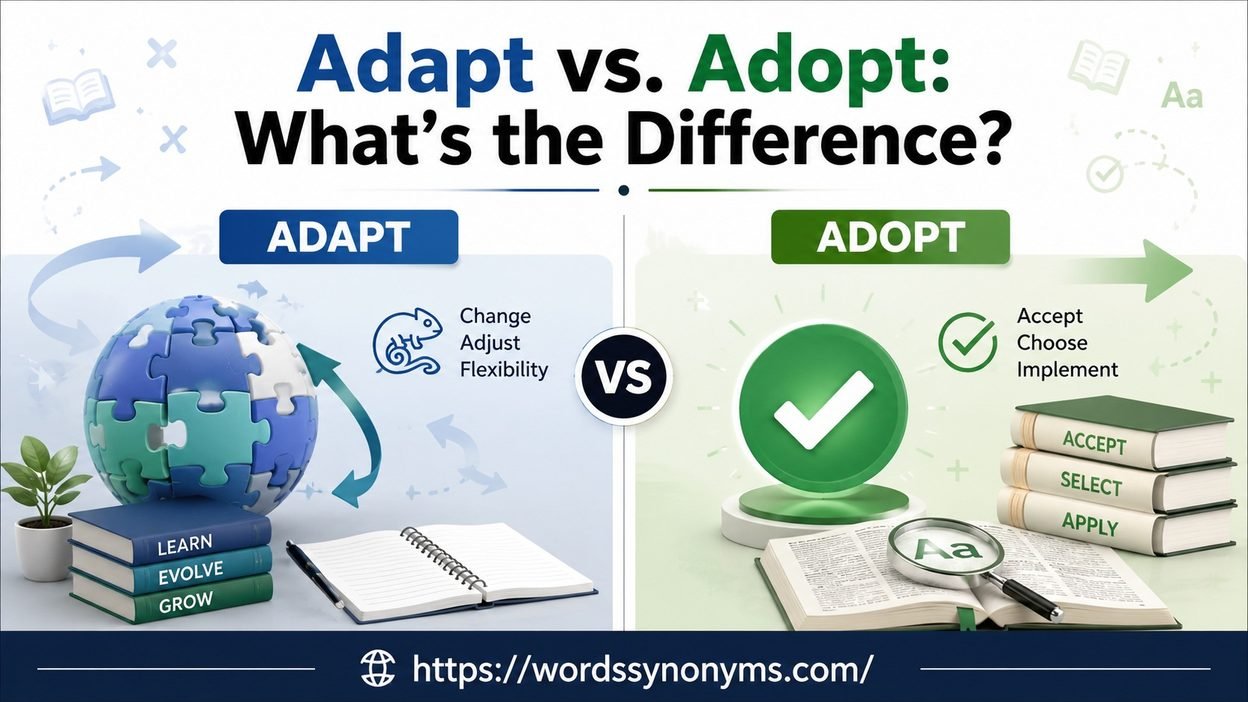
Adapt vs. Adopt can confuse English learners because these similar words look and sound alike, yet their meanings work differently in context.
The simple answer is that adapt means to change, adjust, or modify something so it becomes suitable for a new situation, purpose, or changing conditions. As a transitive verb, you can modify something for a new purpose, while as an intransitive verb, you adjust oneself to a new circumstance.
Someone may have adapted quickly to remote work by changing their habits for a new environment. You can also adapt a source text and render it for film, stage, or television. Its verb forms include adapts, adapted, adapting, with adapted as an adjective form and adaptation as a noun form.
On the other hand, adopt means to accept, choose, take on, or begin using something and make it your own. You might adopt new ideas, methods, policies, a plan, or an attitude, just as a company may adopt a new policy after it is approved. The word can also describe legally taking a child or choosing another country as a residence.
The key meaning difference is change versus acceptance: something is adapted when it is made to fit, while something is adopted when it is taken up by choice.
Despite small differences in spellings and pronunciations, knowing the correct word, word usage, and correct usage helps students build English vocabulary, understand both words, and use each one with greater confidence.
Quick Answer
If you only remember one thing, remember this:
Adapt = Adjust
Adopt = Accept
When you adapt, you change something so it works better in a new situation.
When you adopt, you decide to accept or begin using something.
For example:
- The company adopted a new marketing strategy.
- The company adapted its marketing strategy for international customers.
In the first sentence, the company chose a strategy.
In the second, the company changed an existing strategy.
That difference may seem small. In practice, it matters a lot.
Language references consistently distinguish adapt as changing something to suit new conditions and adopt as accepting or beginning to use something.
What Does Adapt Mean?
Adapt means to change, adjust, or modify something so that it becomes suitable for a different situation, environment, purpose, or condition.
Think of adaptation as reshaping something without necessarily replacing it.
A person can adapt to a new environment. A business can adapt its strategy. A filmmaker can adapt a novel into a movie.
Adapt means adjusting to change
One of the most common uses of adapt involves responding to new circumstances.
For example:
- She quickly adapted to her new job.
- Animals must adapt to environmental changes.
- Small businesses need to adapt to changing customer demands.
- Students often need time to adapt to a new learning environment.
In each example, something changes because the circumstances have changed.
The person, animal, organization, or system adjusts.
Adapt can also mean modifying something
You can also adapt an object, plan, system, story, or method.
Examples include:
- The teacher adapted the lesson for younger students.
- Engineers adapted the design to improve safety.
- The chef adapted the recipe for people with allergies.
- The writer adapted the novel into a screenplay.
Here, adaptation means modification.
The original thing exists, but someone changes it to make it more suitable.
How to Use Adapt Correctly
The word adapt commonly appears in several sentence patterns.
Adapt to something
Use adapt to when someone adjusts to a situation, environment, or condition.
Structure:
Adapt + to + situation or condition
Examples:
- I had to adapt to a different schedule.
- The team adapted to unexpected changes.
- Children usually adapt to new routines over time.
- The species adapted to the colder climate.
This is one of the most important grammar patterns to remember.
You adapt to circumstances.
Adapt something for something
Use this structure when modifying something for a specific purpose or audience.
Examples:
- The company adapted its software for mobile devices.
- The publisher adapted the textbook for younger readers.
- The designer adapted the product for international markets.
The focus remains on change.
Adapt something into something
This structure commonly appears in literature, entertainment, and media.
Examples:
- The director adapted the novel into a film.
- The studio adapted the comic book into a television series.
- The playwright adapted the story into a stage production.
A book doesn’t become a movie by simply being accepted. It must change form.
That’s why adapted, not adopted, is correct.
What Does Adopt Mean?
Adopt means to accept, choose, take up, or begin using something.
The word can also refer to legally taking responsibility for a child and raising that child as part of your family.
Unlike adapt, adopt doesn’t primarily focus on modification.
It focuses on acceptance.
Adopt an idea, policy, or method
Organizations frequently use adopt when formally accepting something.
For example:
- The company adopted a new policy.
- The committee adopted the proposal.
- The school adopted a different teaching method.
- The government adopted new regulations.
In each case, someone made a decision to accept and implement something.
Adopt a habit or lifestyle
Individuals can also adopt behaviors and practices.
Examples:
- She adopted a healthier lifestyle.
- He adopted the habit of reading every evening.
- They adopted a more sustainable approach.
- The athlete adopted a strict training routine.
Again, the idea is acceptance or choice.
Someone decides to take something on.
Adopt a child or pet
Perhaps the most familiar meaning of adopt involves legally accepting a child into a family.
Examples:
- The couple decided to adopt a child.
- She was adopted as a baby.
- They adopted a rescue dog.
In this context, adoption involves taking responsibility and making someone or something part of your family or life.
Read More: Away vs. A Way: What’s the Difference?
Adapt vs. Adopt: The Complete Comparison
The table below makes the distinction easier to understand.
| Feature | Adapt | Adopt |
| Main meaning | Change or adjust | Accept or choose |
| Focus | Modification | Acceptance |
| Common question | How can this fit better? | Should we use this? |
| Used with situations | Yes | Rarely |
| Used with policies | Modify a policy | Accept a policy |
| Used with habits | Adjust behavior | Begin a habit |
| Used with books | Change for another medium | Usually incorrect |
| Used with children | Incorrect | Correct |
| Common phrase | Adapt to change | Adopt a policy |
The central distinction remains simple:
Adaptation changes something. Adoption accepts something.
Adapt vs. Adopt in a Sentence
The best way to understand these confusing words is to compare them directly.
Example: Business strategy
Correct:
The company adopted a new strategy.
The company chose a strategy.
Correct:
The company adapted its strategy after market conditions changed.
The company modified its existing strategy.
Notice what happens when the words change.
The meaning changes too.
Example: Education
Adopt:
The school adopted a new teaching method.
The school chose to use the method.
Adapt:
The teacher adapted the teaching method for students with learning differences.
The teacher modified the method.
Example: Technology
Adopt:
Many businesses adopted cloud-based software.
They started using the technology.
Adapt:
The developers adapted the software for smaller screens.
They changed the software.
Example: Personal change
Adapt:
Moving abroad required him to adapt to a different culture.
He adjusted to new circumstances.
Adopt:
After moving abroad, he adopted several local customs.
He chose to embrace certain practices.
Both words can appear in the same situation. They simply describe different actions.
The Most Important Difference: Change vs. Choice
Here’s a useful way to think about adapt vs. adopt.
Imagine you buy a new jacket.
If you adopt the jacket into your wardrobe, you decide to use it.
If you adapt the jacket, you alter it so it fits differently.
One action involves choosing.
The other involves changing.
The same principle applies to ideas, strategies, technology, policies, and behavior.
Adoption is about selection. Adaptation is about adjustment.
This distinction becomes especially useful in professional and academic writing.
For example:
The organization adopted a new framework and adapted it to local conditions.
This sentence is perfectly logical.
First, the organization selected the framework.
Then, it modified that framework.
Common Uses of Adapt
The word adapt appears in many areas of life.
Adapting to a new environment
People constantly adapt to changing environments.
Examples:
- Adapting to college life
- Adapting to a new workplace
- Adapting to a different climate
- Adapting to technological changes
- Adapting to cultural differences
For example:
Starting a new job can feel overwhelming, but most people gradually adapt to unfamiliar routines.
The person changes their behavior to fit the new environment.
Adapting a plan
Plans rarely survive reality unchanged.
That’s where adaptation becomes necessary.
Examples:
- The team adapted the project timeline.
- The travelers adapted their plans because of bad weather.
- The company adapted its pricing model.
A plan already exists. Someone modifies it.
Adapting literature and media
This is another major use of the word.
Books often become:
- Movies
- Television shows
- Plays
- Podcasts
- Graphic novels
- Video games
When the original work changes form, creators adapt it.
For example:
The filmmaker adapted the historical novel for the screen.
The story may need significant changes because a novel and a movie communicate differently.
A novel can spend pages describing a character’s thoughts. A film usually needs dialogue, visuals, acting, or narration to communicate those same ideas.
That’s adaptation in action.
Common Uses of Adopt
While adapt focuses on adjustment, adopt appears when people accept something new.
Adopting policies
Organizations commonly adopt:
- Policies
- Rules
- Guidelines
- Standards
- Procedures
- Regulations
For example:
The board adopted a new workplace safety policy.
The board officially accepted the policy.
Adopting ideas
People can adopt:
- Ideas
- Beliefs
- Approaches
- Philosophies
- Perspectives
Examples:
The researcher adopted a different theoretical framework.
The company adopted a customer-first approach.
The key idea is deliberate acceptance.
Adopting technology
Businesses often adopt new technologies.
Examples include:
- Artificial intelligence tools
- Cloud computing
- Digital payment systems
- Automation software
- Remote collaboration platforms
For example:
The company adopted new technology to improve efficiency.
However, after adopting the technology, the company may still need to adapt its workflows.
This demonstrates how both words can describe different stages of the same process.
A Real-World Case Study: Adopt First, Adapt Later
Consider a fictional retail company expanding into another country.
The company decides to use a successful marketing strategy from its home market.
Step one: Adoption
The company adopts the marketing strategy.
It chooses the strategy and decides to implement it.
Step two: Adaptation
However, the new market has different cultural expectations and customer preferences.
The company then adapts the strategy.
It changes:
- Advertising language
- Product images
- Pricing
- Promotional timing
- Customer communication
The process looks like this:
Choose a strategy → Adopt it → Encounter new conditions → Adapt it
This pattern explains why the words often appear together in business writing.
You can adopt something without changing it.
You can adapt something that you already use.
Sometimes, you do both.
Adapt vs. Adopt in Academic Writing
Academic writers often confuse these words when discussing research methods, theories, and frameworks.
The distinction can affect precision.
When to use adopt in research
Use adopt when researchers choose a method, theory, or approach.
For example:
The researchers adopted a qualitative research method.
This means they selected that method.
When to use adapt in research
Use adapt when researchers modify an existing method.
For example:
The researchers adapted the questionnaire for younger participants.
The questionnaire already existed. The researchers changed it.
Academic writing sources similarly distinguish adopting a chosen method from adapting a method to fit changing research conditions.
Why this distinction matters
Compare these sentences:
The researchers adopted the survey.
This suggests they selected and began using the survey.
The researchers adapted the survey.
This means they changed the survey.
Perhaps they simplified the language, removed questions, or translated the content.
One letter changes the meaning.
That’s why word choice matters.
Adapt vs. Adopt in Professional Communication
Professional writing depends on precision.
A manager writing a report should understand the difference between these statements:
We adopted a new workflow.
This means the organization introduced a new system.
We adapted our workflow.
This means the organization modified an existing system.
The difference affects how readers understand organizational decisions.
Common professional examples
| Situation | Correct Word | Example |
| Choosing new software | Adopt | The company adopted new software. |
| Changing software settings | Adapt | The team adapted the software for internal use. |
| Accepting a policy | Adopt | The board adopted the policy. |
| Modifying a policy | Adapt | The department adapted the policy. |
| Adjusting to change | Adapt | Employees adapted to remote work. |
| Starting a new practice | Adopt | The team adopted a new practice. |
Clear language prevents confusion.
Common Mistakes When Using Adapt and Adopt
Because the words look similar, writers often swap them accidentally.
Let’s examine the most common mistakes.
Mistake: “The movie was adopted from a novel.”
Incorrect:
The movie was adopted from a novel.
Correct:
The movie was adapted from a novel.
Why?
The story changed from one medium into another.
The filmmaker modified the material.
Therefore, adapt is correct.
Mistake: “She adapted a new habit.”
Incorrect:
She adapted a new habit.
Correct:
She adopted a new habit.
Why?
She chose to begin the habit.
She didn’t modify the habit.
Therefore, use adopt.
Mistake: “They adapted a child.”
Incorrect:
They adapted a child.
Correct:
They adopted a child.
Adoption involves legally accepting a child into a family.
The word adapt doesn’t carry that meaning.
Mistake: “The company adapted a new policy.”
This sentence is usually incorrect when you mean the company accepted a policy.
Correct:
The company adopted a new policy.
However:
The company adapted its existing policy.
That sentence is correct because the company modified the policy.
Read More: Magic Bullet vs. Silver Bullet: Meaning and Correct Usage
How to Remember Adapt vs. Adopt
Grammar rules are useful. Memory tricks can make them easier to recall.
The A-A trick
Think:
- Adapt = Adjust
- Adopt = Accept
Both words begin with A, making the connection simple.
The OPT trick
Look closely at adopt.
It contains opt.
Opt means to choose.
When you adopt something, you choose it.
For example:
- Adopt a method
- Adopt a policy
- Adopt a habit
You’re choosing something to use.
The change test
Ask yourself:
Am I changing something?
If yes, use adapt.
Ask:
Am I accepting or choosing something?
If yes, use adopt.
This simple test solves most situations.
Adapted vs. Adopted
The past tense forms can also cause confusion.
Adapted
Adapted means changed or adjusted.
Examples:
- The recipe was adapted for vegetarians.
- She adapted quickly to her new environment.
- The novel was adapted into a film.
- Engineers adapted the design.
Adopted
Adopted means accepted, chosen, or legally taken into a family.
Examples:
- The company adopted new guidelines.
- He adopted a healthier routine.
- They adopted a child.
- The committee adopted the proposal.
Here’s a quick comparison:
| Word | Meaning | Example |
| Adapted | Changed | The lesson was adapted for beginners. |
| Adopted | Accepted | The school adopted a new curriculum. |
Adaptation vs. Adoption
The nouns also have different meanings.
Adaptation
Adaptation refers to the process of changing or adjusting.
Examples:
- Cultural adaptation
- Climate adaptation
- Workplace adaptation
- Film adaptation
- Behavioral adaptation
For example:
Adaptation to a new environment often takes time.
Adoption
Adoption refers to accepting, choosing, or taking something up.
It can also refer to the legal process of becoming the parent of a child.
Examples:
- Technology adoption
- Policy adoption
- Adoption of new practices
- Child adoption
For example:
The rapid adoption of digital tools changed the workplace.
The same core difference remains:
Adaptation = change.
Adoption = acceptance.
Adaptable vs. Adoptive
These related adjectives have completely different meanings.
Adaptable
Adaptable describes someone or something capable of adjusting easily.
Examples:
- An adaptable employee
- An adaptable system
- An adaptable business model
Sentence:
Highly adaptable people often handle unexpected changes more effectively.
Adoptive
Adoptive relates to adoption.
Examples:
- Adoptive parents
- An adoptive family
Sentence:
The child joined an adoptive family.
Don’t confuse adaptable with adoptive.
They come from different meanings.
Pronunciation of Adapt and Adopt
Although the words look similar, their pronunciation differs.
Adapt
Adapt is generally pronounced:
uh-DAPT
Phonetic form:
/əˈdæpt/
Adopt
Adopt is generally pronounced:
uh-DOPT
Phonetic forms can vary slightly depending on accent.
The important distinction lies in the vowel sound:
- Adapt contains an “a” sound similar to cat.
- Adopt contains an “o” sound.
Pronunciation references also distinguish the two words clearly.
Where Do Adapt and Adopt Come From?
Interestingly, both words entered English through related Latin roots.
Adapt traces back to a root associated with fitting or adjusting something.
Adopt traces back to a root associated with choosing or taking something as one’s own.
Their histories reflect their modern meanings remarkably well:
- Adapt → make something fit
- Adopt → choose or take something
Word origins can sometimes feel like unnecessary trivia. Here, they actually reinforce the meaning.
Can Adapt and Adopt Appear in the Same Sentence?
Absolutely.
In fact, using both correctly in one sentence demonstrates their difference clearly.
Examples:
The company adopted a new strategy and adapted it for local markets.
The school adopted new technology, then adapted its curriculum around it.
She adopted several new habits to adapt to her changing lifestyle.
Businesses must adopt useful innovations and adapt to changing customer expectations.
These examples show that adoption and adaptation often work together.
First, you might choose something.
Then, you modify it.
Adapt vs. Adopt: Everyday Examples
Let’s look at common situations.
Moving to a new city
You adapt to a new city.
You might adopt local customs.
Starting a new job
You adapt to the workplace.
You might adopt a new productivity system.
Running a business
You adopt a new business strategy.
You adapt that strategy when market conditions change.
Reading and entertainment
A filmmaker adapts a book.
A production company may adopt a new filmmaking technique.
Personal development
You adopt healthy habits.
You adapt to lifestyle changes.
Once you understand the relationship between the words, choosing the correct one becomes much easier.
A Simple Decision Tree for Adapt vs. Adopt
Use this quick mental process whenever you’re unsure:
What action is happening?
→ Is someone choosing, accepting, or starting to use something?
Use ADOPT.
→ Is someone changing, modifying, or adjusting something?
Use ADAPT.
→ Is a person responding to a new situation?
Usually use ADAPT TO.
→ Is an organization officially accepting a policy or method?
Usually use ADOPT.
This small decision process handles most everyday situations.
Practice Exercise: Adapt or Adopt?
Choose the correct word for each sentence.
Questions
- The company decided to _____ a new customer service policy.
- Animals must _____ to environmental changes.
- The director will _____ the novel for television.
- She decided to _____ a healthier lifestyle.
- The teacher _____ the lesson for students with different abilities.
- The organization plans to _____ new technology.
- Employees had to _____ to remote working conditions.
- The committee officially _____ the proposal.
- The chef _____ the recipe for people with food allergies.
- The family decided to _____ a child.
Answers
- Adopt
- Adapt
- Adapt
- Adopt
- Adapted
- Adopt
- Adapt
- Adopted
- Adapted
- Adopt
If you got most of them right, you’ve understood the essential difference.
Quick Reference Examples
Here’s a final collection of useful examples.
Use Adapt when talking about:
- Adjusting to change
- Modifying plans
- Changing behavior
- Altering products
- Converting books into movies
- Responding to new environments
- Making something suitable for a new purpose
Examples:
We adapted to the new schedule.
The company adapted its services.
The novel was adapted into a movie.
Use Adopt when talking about:
- Choosing an idea
- Accepting a policy
- Beginning a habit
- Using a new method
- Embracing a lifestyle
- Legally accepting a child
- Taking up a practice
Examples:
We adopted a new schedule.
The company adopted a new policy.
She adopted a healthier lifestyle.
FAQs
What is the main difference between adapt and adopt?
The main difference is simple: adapt means to change or adjust to fit a situation, while adopt means to accept, choose, or begin using something.
Can adapt and adopt be used interchangeably?
No. Although adapt and adopt sound similar, they have different meanings. Using the wrong word can completely change what you want to say.
Is “adapt to” the correct phrase?
Yes. Adapt to is commonly used when someone or something adjusts to new conditions, environments, or situations. For example, people often adapt to changes at work.
What does adopt mean when talking about ideas?
When used with ideas, methods, or policies, adopt means to officially accept or start using something. A company, for example, may adopt a new policy.
How can I easily remember the difference between adapt and adopt?
Think of adapt as “adjust” and adopt as “accept.” If something changes to fit, use adapt. If something is chosen or taken on, use adopt.
Can adapt and adopt be used as different parts of speech?
Both words are mainly used as verbs, but they have related forms. For example, adaptation is a noun connected to adapt, while adoption is a noun connected to adopt.
Conclusion
At first glance, adapt and adopt may seem almost identical, but their meanings take you in two very different directions. Adapt is all about making changes and adjusting to fit a new situation, while adopt means choosing, accepting, or taking something as your own. Once you see this simple distinction, choosing between the two becomes far less confusing.
The easiest way to remember them is to think about the action involved: if something needs to change to fit, use adapt; if something is being chosen or accepted, use adopt. Keep this small trick in mind, pay attention to the context, and you’ll be able to use both words naturally and confidently in everyday English.

Samreen Saif is a passionate writer and language enthusiast who contributes informative and engaging content to WordsSynonyms.com. She enjoys exploring English vocabulary, synonyms, antonyms, word meanings, and language usage to help readers understand and use words with confidence.
Samreen focuses on creating clear, accurate, and easy-to-read content for students, writers, professionals, and English learners. Through her articles, she aims to make vocabulary learning simple, practical, and useful for everyday communication.
When she is not writing, Samreen enjoys learning about language, discovering new words, and creating helpful content that makes English learning more accessible to everyone.