
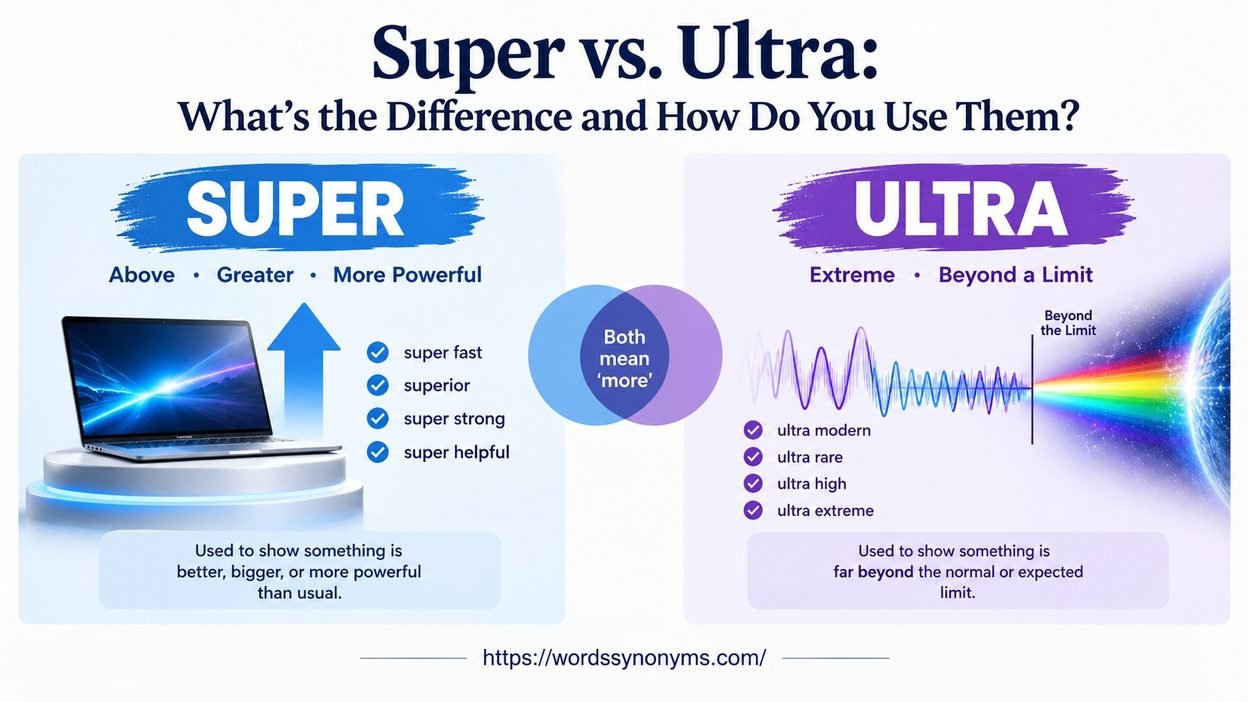
When comparing Super vs. Ultra: How Do You Use Them?, remember that both use a prefix from Latin, but uses can differ in English.
Super- can mean above, beyond, or to a greater degree, while ultra literally means beyond and can sometimes act as a synonym for super-. The choice isn’t always ranked, since a field of study may develop its own terminology.
For example, ultrasonic describes a sound frequency beyond human hearing, while supersonic describes something moving faster than the speed of sound. The distinction becomes clearer when you consider the specific word and what it describes, whether that meaning is figurative or physically beyond something else.
In technical language, power plants may use ultra-supercritical when technology has advanced beyond the supercritical stage. This gives inventors a useful term for a new development.
Usage also changes by location. Outside the United States, ultra-words are generally hyphenated, while inside the United States, fewer forms use a hyphen, including ultra-pasturized. Super-words are generally written without one.
The US and United States can therefore show different patterns, so checking a dictionary and double-checking the accepted spelling is a practical way to handle uncertain forms.
Quick Answer
Super and ultra both express the idea of going beyond the ordinary, but they aren’t interchangeable in every situation.
Super commonly means above, beyond, greater than usual, more powerful, or exceptionally good. It can work as a prefix, adjective, adverb, and noun.
Ultra commonly means extremely, beyond a particular limit, or beyond what is ordinary. It also works as both a prefix and an independent word.
| Word | Core idea | Common sense | Example |
| Super | Above or beyond | Greater, more powerful, better, or more than usual | supercomputer |
| Ultra | Beyond a limit | Extremely high, intense, or far beyond normal | ultramodern |
| Super- | Above, beyond, exceeding | Enhanced or exceptional | superhuman |
| Ultra- | Beyond, extremely | Extreme or outside a defined range | ultraviolet |
The important point is that ultra isn’t automatically a higher level than super. English doesn’t treat these prefixes as steps on a universal ladder.
What Does Super Mean?
The word super has several related meanings. Its central idea comes from the notion of being above, over, or beyond something.
As a prefix, super- can indicate that something exceeds an ordinary standard. It can also describe something larger, more powerful, more effective, or more successful than comparable things.
For example:
- supercomputer — an exceptionally powerful computer
- superhuman — beyond ordinary human ability
- supermodel — a highly successful and prominent fashion model
- superpower — a state with exceptional political, economic, or military influence
- superfast — extremely fast
- superfine — exceptionally fine
- supercritical — exceeding a critical point or condition
Modern dictionaries describe super- as expressing meanings such as “more than usual,” “larger,” “more effective,” “more powerful,” and “more successful.”
That range matters. Super doesn’t always mean simply “very.” Its meaning depends on the word that follows it.
Super as a Prefix
The prefix super- can express several different relationships.
It can mean above or over:
superstructure refers to a structure built above or on top of another structure.
It can indicate greater size or power:
A supercomputer is designed to perform extremely demanding computational tasks.
It can indicate something that exceeds a normal standard:
superhuman abilities go beyond ordinary human capabilities.
It can also express a high degree of a particular quality:
supersensitive means extremely sensitive.
This flexibility explains why super- appears in such a wide range of English vocabulary.
Super as a Standalone Word
You don’t always see super attached to another word.
In everyday American English, super can work as an adjective meaning excellent or very good.
For example:
“The restaurant was super.”
You can also use super informally as an intensifying adverb:
“That test was super easy.”
“She’s super excited about the trip.”
“The new software is super fast.”
This use is especially common in conversational English. It sounds natural in casual speech, messages, reviews, and informal writing.
The prefix super- and the standalone word super are related, but they aren’t grammatically identical.
What Does Ultra Mean?
Ultra comes from Latin ultra, meaning beyond. English uses it to describe things that extend past a normal range, boundary, or expected degree.
As a prefix, ultra- commonly means extremely or beyond a particular limit.
Consider these examples:
- ultramodern — extremely modern
- ultralight — extremely light
- ultrasensitive — extremely sensitive
- ultraviolet — beyond violet in the electromagnetic spectrum
- ultrasound — sound involving frequencies above the normal range of human hearing
- ultramicroscopic — beyond the range of ordinary microscopic observation
The word often carries a stronger sense of extremity than ordinary descriptions such as “very” or “highly.”
Ultra as a Prefix
The prefix ultra- has two especially useful ideas behind it.
The first is beyond a particular boundary.
Ultraviolet is a good example. The term refers to electromagnetic radiation with wavelengths shorter than those of visible violet light. The name literally reflects the idea of going beyond the violet end of the visible spectrum.
The second idea is extremely.
Consider ultramodern. It doesn’t simply mean “modern.” It suggests an unusually advanced, contemporary, or cutting-edge quality.
Likewise, ultralight means exceptionally light.
This gives ultra- a distinctive flavor. It often pushes a description toward an outer edge.
Ultra as a Standalone Word
Ultra can also function independently as an adjective or noun.
As an adjective, it can mean extreme or going beyond ordinary limits.
As a noun, an ultra can refer to someone who holds an extreme position. The noun often appears in political or ideological contexts.
For example:
“The proposal faced opposition from the party’s ultras.”
Here, ultras doesn’t mean people who are merely enthusiastic. It refers to people with particularly extreme views or positions.
Super vs. Ultra: The Main Difference
The easiest way to understand super vs. ultra is to think about what each word emphasizes.
Super often emphasizes enhancement.
Ultra often emphasizes extremity or crossing a boundary.
That distinction isn’t absolute. English has plenty of overlap. Still, it gives you a reliable starting point.
Super Often Means “Above” or “More Than Usual”
When super- appears in a word, it frequently tells you that something exceeds the normal version.
A supercomputer isn’t simply a computer with one extra feature. It’s a machine built for exceptionally demanding computational work.
A superhuman ability goes beyond what ordinary humans can normally accomplish.
A superpower is more powerful than an ordinary state.
In each case, super- establishes a comparison with something ordinary.
Ultra Often Emphasizes an Extreme Degree
Ultra- often takes a quality to an extreme.
An ultramodern building isn’t merely modern. Its design may represent an especially advanced or contemporary style.
An ultrasensitive instrument responds to very small changes or signals.
An ultralight material weighs exceptionally little.
Here, the focus falls heavily on extremity.
The Difference Isn’t a Simple Ranking
This is where many explanations of super vs. ultra become misleading.
It might seem logical to imagine this scale:
normal → super → ultra
English doesn’t work that neatly.
The prefixes don’t function as standardized intensity levels. You can’t automatically assume that something described as ultra must be stronger than something described as super.
Consider these technical terms:
- supersonic
- ultrasonic
A supersonic object travels faster than the speed of sound in the relevant medium.
An ultrasonic wave has a frequency above the range generally audible to humans.
These words don’t represent two versions of the same scale. They describe different physical properties.
That’s a crucial lesson: the meaning of the complete word matters more than the theoretical strength of its prefix.
Super vs. Ultra Comparison Table
| Feature | Super | Ultra |
| Basic origin | Latin super | Latin ultra |
| Basic idea | Above, over, beyond | Beyond |
| Common modern sense | Greater, better, larger, more powerful, more than usual | Extremely high or beyond a limit |
| Common function | Prefix, adjective, adverb, noun | Prefix, adjective, noun |
| Suggests enhancement | Frequently | Sometimes |
| Suggests extremity | Frequently | Very frequently |
| Refers to a boundary | Sometimes | Often |
| Automatically stronger? | No | No |
| Common informal use | Very common | Less common |
| Common technical use | Very common | Very common |
| Example | supercomputer | ultramodern |
Are Super and Ultra Interchangeable?
Sometimes they overlap. Usually, you shouldn’t assume they can replace each other.
English vocabulary contains many established compounds. These combinations have developed through actual usage rather than through a mathematical system of prefixes.
For instance, supercomputer is standard English.
Replacing it with ultracomputer doesn’t automatically create a more powerful meaning. In ordinary English, that substitution simply sounds unfamiliar.
The same principle works in the other direction.
Ultraviolet is a standard scientific term. Replacing it with superviolet would not preserve the scientific meaning.
This is why natural English depends on more than dictionary definitions. Collocation and established usage matter.
A Useful Rule
When you encounter a familiar compound, don’t try to replace its prefix based only on meaning.
Instead, ask:
- Is this an established English word?
- Does the replacement occur naturally in standard usage?
- Does the word have a technical meaning?
- Would a native speaker understand the intended meaning immediately?
That approach prevents many awkward constructions.
Super vs. Ultra in Everyday English
The difference becomes clearer when you compare ordinary conversational expressions.
When Super Sounds Natural
Super works particularly well in casual American English.
You might say:
- super easy
- super important
- super helpful
- super expensive
- super fast
- super interesting
- super excited
- super busy
For example:
“The instructions were super easy to follow.”
Here, super simply intensifies easy. It means something close to very or extremely.
This construction feels relaxed and conversational.
When Ultra Sounds Natural
Ultra tends to sound more deliberate or descriptive.
You might see:
- ultramodern
- ultralight
- ultra-thin
- ultrasensitive
- ultra-high
- ultra-efficient
- ultra-compact
For example:
“The company developed an ultralight material for aerospace applications.”
Here, ultra- sounds more technical and precise than simply saying “very light.”
That difference isn’t a strict grammar rule. It’s a matter of established vocabulary, register, and context.
Super vs. Ultra in Science and Technical Language
Technical vocabulary provides some of the clearest evidence that super and ultra aren’t interchangeable.
Supersonic vs. Ultrasonic
These two words look similar, yet they describe completely different concepts.
Supersonic relates to speed above the speed of sound.
Ultrasonic relates to sound frequencies above the normal human hearing range.
The prefix in each word points toward a different relationship.
| Term | Meaning | Main concept |
| Supersonic | Faster than the speed of sound | Speed |
| Ultrasonic | Above the normal human hearing range | Frequency |
| Ultraviolet | Beyond violet in the electromagnetic spectrum | Wavelength/frequency |
| Supercritical | Above a critical point or condition | Physical state |
| Ultrasensitive | Extremely sensitive | Degree of sensitivity |
This is why translating every prefix as simply “very” can create confusion.
Ultraviolet Is More Than “Very Violet”
The word ultraviolet offers a useful lesson.
Visible light occupies a particular portion of the electromagnetic spectrum. Violet sits at one end of that visible range. Ultraviolet radiation lies beyond that range.
So ultra- doesn’t mean “really violet.”
It expresses the idea of being beyond violet.
That distinction demonstrates how prefixes can preserve a conceptual relationship rather than simply adding intensity.
Super vs. Ultra in Word Formation
Both prefixes have productive histories in English. However, that doesn’t mean you can attach either one freely to every adjective or noun.
Is Super a Prefix?
Yes.
The prefix super- appears in words such as:
- superhuman
- superpower
- supercomputer
- superstructure
- supermarket
- supercritical
- supersensitive
It can express ideas including above, beyond, greater than, exceeding, or extreme.
Some modern informal uses also treat super almost like a standalone intensifier.
Is Ultra a Prefix?
Yes.
The prefix ultra- appears in words such as:
- ultramodern
- ultraviolet
- ultrasound
- ultralight
- ultrasensitive
- ultramicroscopic
Oxford describes ultra- as meaning “extremely” or “beyond a particular limit.”
That definition captures both major patterns: extreme degree and movement beyond a defined boundary.
What About Hyphens?
Don’t assume that every word containing super- or ultra- requires a hyphen.
English spelling varies according to the established word.
For example:
- supercomputer
- superhuman
- supermodel
- ultramodern
- ultraviolet
- ultralight
However, other constructions may use a hyphen depending on the word, style, or context.
The safest rule is simple: check the established spelling of unfamiliar compounds rather than applying one universal hyphen rule.
Read more: Away vs. A Way: What’s the Difference?
Is Ultra Stronger Than Super?
No. Not automatically.
This is perhaps the most important answer in the entire super vs. ultra debate.
If you’re comparing two words in ordinary marketing language, ultra may sound more extreme.
For example:
“super-light”
versus
“ultralight”
The second can feel more emphatic.
However, that doesn’t create a universal linguistic hierarchy.
Consider superhuman. The word already describes something beyond normal human capacity.
Now consider ultraviolet. It doesn’t mean “more extreme than superhuman.” It describes radiation beyond the violet portion of visible light.
The two prefixes work according to the meaning of the complete word.
Why the “Super → Ultra” Scale Fails
Imagine describing three cars:
- regular car
- supercar
- ultracar
The first two are meaningful in established English. The third isn’t a standard general category simply because ultra- sounds more intense.
That example reveals the problem. Prefixes aren’t interchangeable labels that manufacturers or writers can stack on a universal intensity scale.
Usage decides meaning.
Common Mistakes With Super and Ultra
Assuming Ultra Always Means More
This is the biggest mistake.
Ultra often sounds more extreme, but that doesn’t mean it automatically represents a higher degree than super.
Replacing Established Words
Don’t replace supercomputer with ultracomputer simply because you think ultra sounds stronger.
Established vocabulary doesn’t work that way.
Ignoring Technical Definitions
Words such as supersonic, ultrasonic, and ultraviolet have specialized meanings.
You need to understand the full term rather than interpreting the prefix in isolation.
Confusing Super With Super-
In:
“The movie was super.”
super is an adjective.
In:
“She bought a supercomputer.”
super- is a prefix within the noun.
The forms are related, but their grammatical functions differ.
Treating Ultra as Automatically Formal
Ultra can sound technical or polished in compounds. However, it can also appear in everyday descriptive language and independent uses.
Context still determines tone.
Super vs. Ultra: Real Examples
The following examples show how each word works naturally.
Examples With Super
“The new computer is super fast.”
Here, super works as an informal intensifier meaning very or extremely.
“The research team used a supercomputer.”
Here, super- indicates an exceptionally powerful computer.
“The athlete displayed superhuman endurance.”
Here, superhuman means beyond normal human ability.
“That was a super performance.”
Here, super means excellent or very good.
Examples With Ultra
“The hotel has an ultramodern design.”
Here, ultramodern means extremely modern or highly contemporary.
“The camera uses an ultrasensitive sensor.”
Here, ultrasensitive means exceptionally sensitive.
“The material is ultralight.”
Here, ultralight emphasizes unusually low weight.
“The device uses ultrasonic waves.”
Here, ultrasonic has a specific technical meaning connected to sound frequency.
A Closer Look at Their Origins
Understanding the history of these words makes their modern meanings easier to remember.
The Origin of Super
Super comes from Latin super, meaning above, over, or beyond.
That basic spatial idea eventually developed into broader meanings.
Something physically above another object can lead to the idea of superiority. Something beyond a normal level can become something exceptional.
That development explains words such as:
- superstructure
- superhuman
- superpower
- supercomputer
- superstar
The original idea of being “above” remains surprisingly visible.
The Origin of Ultra
Ultra comes from Latin ultra, meaning beyond or on the far side of.
That idea naturally developed into meanings involving boundaries and extremes.
Consider ultraviolet. The term describes something beyond the violet end of visible light.
Consider ultramodern. The word suggests a degree of modernity that pushes beyond ordinary expectations.
The historical meaning therefore connects closely with modern usage.
Super vs. Ultra: Synonyms and Related Words
The closest alternatives depend on what you mean.
Words Related to Super
When super means greater or better, useful related words include:
- superior
- exceptional
- powerful
- advanced
- outstanding
- extraordinary
- excellent
- greater
- remarkable
When super works as an intensifier, alternatives include:
- very
- extremely
- highly
- incredibly
- exceptionally
Words Related to Ultra
When ultra means extreme, related words include:
- extreme
- intense
- excessive
- radical
- exceptional
- extraordinary
- highly advanced
- unusually strong
Still, don’t treat these as automatic replacements.
For example, ultraviolet has no ordinary synonym that you can create simply by substituting “extreme.”
Super vs. Ultra Side by Side
| Expression | Meaning | Natural? | Why |
| supercomputer | Extremely powerful computer | Yes | Established term |
| ultracomputer | Supposedly extreme computer | No, not standard | Not an established general term |
| superhuman | Beyond normal human ability | Yes | Established term |
| ultrahuman | Beyond human | Rare/specialized | Not the normal everyday choice |
| superfast | Extremely fast | Yes | Common modern usage |
| ultrafast | Extremely fast | Yes | Also established |
| supermodern | More than modern | Uncommon | Less established |
| ultramodern | Extremely modern | Yes | Established term |
| supersonic | Faster than sound | Yes | Technical term |
| ultrasonic | Above normal human hearing range | Yes | Technical term |
| super-sensitive | Very sensitive | Possible | Context-dependent |
| ultrasensitive | Extremely sensitive | Yes | Established term |
The table shows why context matters. Sometimes super and ultra can both form natural words. Sometimes only one is the conventional choice.
When Should You Use Super?
Choose super when you want to communicate that something is:
- greater than usual
- more powerful than ordinary examples
- more successful
- larger or more capable
- exceptionally good
- extremely strong in an informal sentence
For example:
“The new battery is super efficient.”
In casual writing, that’s perfectly natural.
Use super- when the complete word is already established:
supercomputer
superhuman
superpower
superstar
supercritical
The key is not to invent combinations simply because the meaning seems logical.
When Should You Use Ultra?
Choose ultra when you want to emphasize:
- an extreme degree
- something beyond a defined limit
- an unusually advanced quality
- a property taken to an exceptional level
- an established technical concept
For example:
“The company developed an ultralight material.”
Or:
“The laboratory uses an ultrasensitive detector.”
For technical vocabulary, follow the established terminology carefully.
Ultraviolet, ultrasound, and ultrasonic each have specific meanings. Replacing the prefix would change the term or make it nonstandard.
A Simple Decision Guide
When you’re unsure about super vs. ultra, use this quick checklist.
Choose super when:
- You mean “more than usual.”
- You mean “greater” or “more powerful.”
- You want an informal intensifier.
- You’re describing something exceptional.
- You’re using a familiar super- compound.
Choose ultra when:
- You mean “extremely.”
- Something goes beyond a particular limit.
- You’re describing an extreme degree.
- You’re using an established ultra- compound.
- You’re discussing a technical term such as ultraviolet or ultrasonic.
If you’re creating a new compound: stop and check actual usage.
English allows creative word formation, especially in advertising and informal language. However, a word that seems logically possible isn’t necessarily standard English.
Why Context Matters More Than Prefix Strength
A useful way to remember super vs. ultra is to think of the prefixes as two different lenses.
Super often asks:
“How does this compare with the normal version?”
Ultra often asks:
“How far beyond the normal boundary does this go?”
That isn’t a rigid grammar rule. It’s a practical way to understand the recurring patterns.
A superpower is a power beyond that of ordinary states.
An ultraviolet wavelength lies beyond the violet portion of visible light.
A supercomputer exceeds ordinary computers in computational capability.
An ultramodern building pushes modern design to an unusually advanced level.
Once you see that distinction, the words stop looking like interchangeable synonyms.
FAQs
1. Is super stronger than ultra?
Not necessarily. Super- and ultra- can both express a higher degree, but their meanings depend on the specific word and context.
2. What does super- mean?
Super- generally means above, beyond, or to a greater degree. It comes from a Latin word meaning “above” or “beyond.”
3. What does ultra- mean?
Ultra- means beyond or extremely. It can sometimes be used similarly to super-, especially when describing something that goes beyond a normal limit.
4. What is the difference between ultrasonic and supersonic?
Ultrasonic refers to sound frequencies beyond human hearing. Supersonic describes something traveling faster than the speed of sound.
5. Should ultra- words be hyphenated?
It depends on the word and regional usage. In many cases, ultra- words are written without a hyphen in US English, so checking a dictionary is the safest choice.
6. Are super- words hyphenated?
Usually, super- words aren’t hyphenated. However, established usage can vary, so it’s worth checking the dictionary when you’re unsure.
Conclusion
Understanding Super vs. Ultra: How Do You Use Them? becomes much easier when you focus on the meaning and context of each form. Super- and ultra- can both suggest something beyond the ordinary, but they don’t always work interchangeably.
Pay attention to established terms such as supersonic and ultrasonic, and check the dictionary when spelling or hyphen use feels uncertain. Once you recognize these patterns, choosing between super- and ultra- feels far less confusing.

Muhammad Taqi is a content writer interested in English vocabulary and language. He writes clear and useful articles on synonyms, antonyms, word meanings, and English usage, helping readers expand their vocabulary and improve their communication skills.