
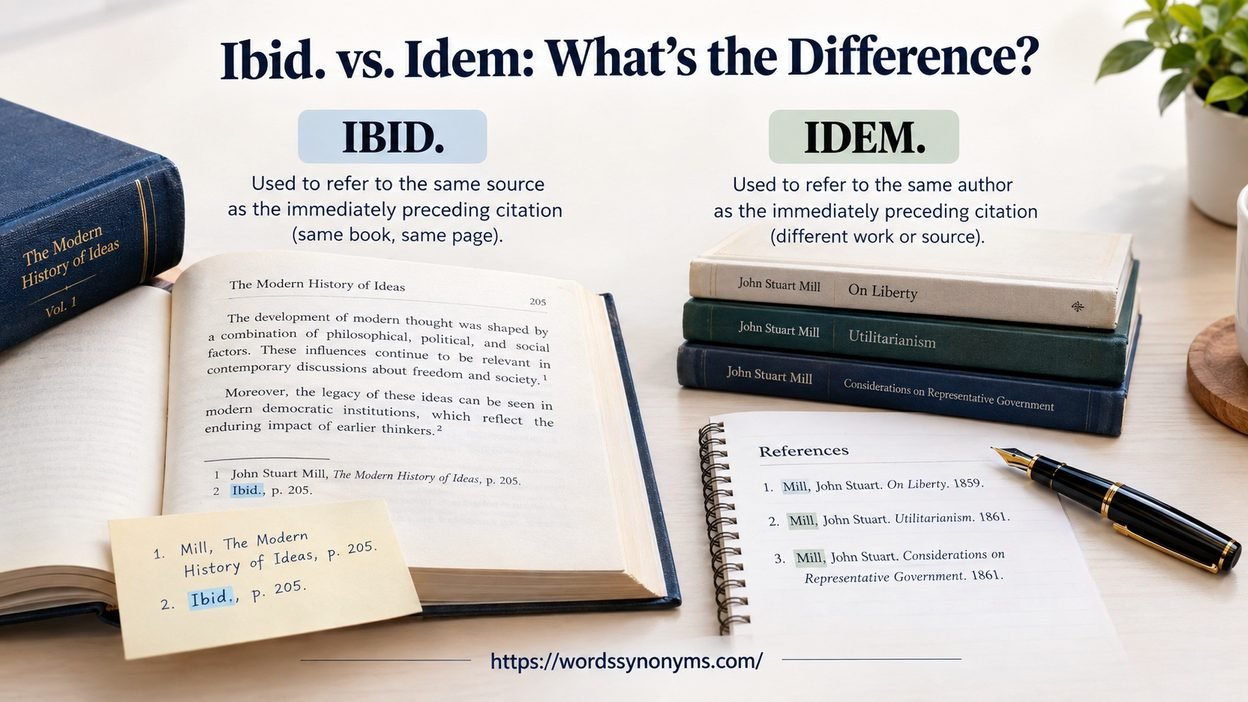
Ibid. vs. Idem: What’s the Difference? explains how these Latin terms guide citations in academic writing, legal documents, and older books.
Ibid comes from ibidem and means same place, so it points to the same source cited immediately before. In footnotes and references, it can identify a previous citation or immediately preceding source when the exact same source and exact same place are repeated.
This abbreviation can save time and space instead of repeating the full citation, helping readers understand references without a confusing break in the source trail.
Idem also means same, but it usually points to the same author, person, or thing rather than an exact replica of the previous citation. It is often abbreviated as id. and appears in bibliographies when a source previously cited is mentioned again, even with a different page or section.
In publication work, style guides and dictionaries may give different direction about a period, whether to italicize the term, or whether to use ibid. or ib. These rules can vary in academic and legal writing, so check the relevant style guide before deciding how to use each citation in your documents and books.
Quick Answer
Ibid. means “in the same place” and usually refers to the same source cited immediately before. Idem means “the same” and generally refers to the same author or person in citation systems that use it. In simple terms, use ibid. for the same source and idem/id. for the same author.
Ibid. vs. Idem at a Glance
The quickest way to understand the difference is to focus on what each term identifies.
| Term | Latin source | Basic meaning | Main reference | Common setting |
| ibid. | ibidem | in the same place | The source cited immediately before | Academic and scholarly notes |
| idem | idem | the same | The same author or person | Legal and specialized citation |
| id. | idem | the same | Usually the same author under a citation system | Especially legal writing |
| op. cit. | opere citato | in the work cited | An earlier work | Older citation systems |
| loc. cit. | loco citato | in the place cited | The same cited location | Older citation systems |
So, if you remember only one thing, remember this:
Ibid. points to the same place or source. Idem points to the same person or author.
That simple distinction prevents most confusion.
However, citation rules aren’t identical everywhere. Some modern style guides discourage Latin citation abbreviations because shortened author-title citations can make sources easier to identify. Chicago’s current guidance, for example, prefers shortened citations over ibid. in many situations while still allowing ibid. as an option.
What Does Ibid. Mean?
Ibid. is an abbreviation of the Latin word ibidem. Its literal meaning is “in the same place.”
In citation practice, that “place” generally means the source cited in the immediately preceding note. The term saves the writer from repeating the complete citation when the same source appears again.
Consider this simple example:
- Maria Lopez, History of Modern Architecture, 45.
- Ibid.
The second note tells the reader that the citation refers to the same source and location as note 1.
If the writer wants to cite another page from the same source, a page number can follow ibid.:
- Maria Lopez, History of Modern Architecture, 45.
- Ibid., 52.
Here, ibid. identifies the same work while 52 changes the cited page.
This is why ibid. isn’t simply another way of saying “same author.” Its reference is tied to the preceding citation.
Ibid. Refers to the Immediately Preceding Citation
This rule is crucial.
Suppose a document contains these notes:
- Maria Lopez, History of Modern Architecture, 45.
- David Chen, Cities and Design, 88.
- Ibid., 91.
In note 3, ibid. refers to David Chen’s work, not Maria Lopez’s book.
Why? Because note 2 is immediately before note 3.
You can’t use ibid. to jump backward over another citation. If you want to return to the source in note 1, you need to identify that source again using whatever shortened citation method your style guide permits.
Chicago specifically explains that ibid. must refer to the note immediately before it. It also notes that the preceding note should contain only one citation for ibid. to work clearly.
How to Use Ibid. Correctly
The easiest way to use ibid. is to think of it as a pointer.
It essentially tells the reader:
“Look at the citation immediately above this one.”
For example:
- Robert Adams, Language and Society, 118.
- Ibid.
- Ibid., 124.
The three notes refer to the same work. Note 2 uses the same cited location as note 1. Note 3 changes the page to 124.
Ibid. With the Same Page
When the source and cited page remain the same, a writer may use ibid. alone when the applicable style permits it.
- Robert Adams, Language and Society, 118.
- Ibid.
The second note carries the same source and page reference.
Ibid. With a Different Page
When the source stays the same but the page changes, the new page can follow the abbreviation.
- Robert Adams, Language and Society, 118.
- Ibid., 124.
The reader can understand that both citations concern Adams’s book. Only the page changes.
The Australian Government Style Manual gives essentially this same pattern: ibid. can refer to the same publication and can be followed by a different page number.
When Should You Not Use Ibid.?
Although ibid. looks convenient, it isn’t suitable for every repeated citation.
Avoid it when:
- Another source appears between the two citations.
- The preceding note contains multiple sources.
- Your required citation style discourages ibid.
- The reference could become ambiguous.
- A shortened author-title citation would be clearer.
- You are using an author-date system that already provides a compact reference.
For example:
- Maria Lopez, History of Modern Architecture, 45.
- David Chen, Cities and Design, 88.
- Ibid., 91.
Here, ibid. correctly refers to Chen’s work because Chen appears immediately before it.
But if the intention is to cite Lopez again, ibid. would be wrong. The writer needs to use a shortened citation for Lopez instead.
That small distinction matters because citation systems exist to help readers trace evidence. A shortcut that creates uncertainty defeats the purpose of the citation.
What Does Idem Mean?
Idem is another Latin term. It means “the same.”
Unlike ibidem, the word idem focuses on identity. In citation systems that use it, idem generally indicates the same author or person.
Its common abbreviation is id.
That distinction makes the basic contrast much easier:
- Ibid. → same place or source
- Idem → same person or author
- Id. → abbreviated form of idem
For example, imagine two consecutive citations involving works by the same author:
- Robert Adams, Language and Society, 118.
- Id., Words in Context, 42.
Under a citation system that permits this use, id. tells the reader that the second work has the same author as the preceding citation.
The work itself has changed. The author hasn’t.
That’s the key.
Idem vs. Id.: Are They the Same?
Yes, in terms of the Latin source.
Idem is the full Latin word. Id. is its abbreviated form.
| Form | Meaning | Function |
| idem | the same | Full Latin term |
| id. | the same | Abbreviation of idem |
However, don’t assume that every style guide treats id. in exactly the same way.
Citation conventions determine when the abbreviation can appear and what precisely it refers to. Legal citation uses id. extensively, while academic citation traditions have historically favored ibid. more often. Chicago’s current FAQ makes this distinction explicit.
Ibid. vs. Idem: The Core Difference
The difference becomes obvious when you place the terms side by side.
Ibid. asks:
“What source or place was just cited?”
Idem asks:
“Which author or person is the same?”
That difference can be illustrated with two citation sequences.
Example of Ibid.
- Sarah Miller, Modern Linguistics, 75.
- Ibid., 82.
The second note refers to Miller’s same work. The page changes from 75 to 82.
Example of Id.
- Sarah Miller, Modern Linguistics, 75.
- Id., Language in Context, 30.
The second citation identifies the same author, but it refers to a different work.
Think of ibid. as staying in the same room. Think of idem as following the same person into another room.
Ibid. vs. Idem in Academic Writing
Academic writing has traditionally used ibid. frequently in footnotes and endnotes, especially in disciplines that rely heavily on documentary notes.
History is a classic example. A historian may cite the same book several times in succession while discussing different pages. Repeating the complete bibliographic information each time would make the notes cumbersome.
Ibid. can reduce that repetition.
However, modern academic style has moved toward greater clarity. Chicago’s 18th edition, published in 2024, organizes guidance around shortened citations and specifically distinguishes shortened citations from ibid.. Chicago prefers shortened citations in many cases, although ibid. remains an available option.
That shift reflects a practical concern: readers shouldn’t have to reconstruct a citation’s meaning from a chain of abbreviations.
Why Shortened Citations Can Be Easier
Consider these notes:
- Maria Lopez, History of Modern Architecture, 45.
- Ibid., 52.
- Ibid., 67.
A reader must look backward to understand what ibid. means.
A shortened citation could instead identify the source directly:
- Maria Lopez, History of Modern Architecture, 45.
- Lopez, History of Modern Architecture, 52.
- Lopez, History of Modern Architecture, 67.
The second approach takes slightly more space. It can also reduce ambiguity.
This is one reason Chicago now prefers shortened citations over ibid. in many circumstances.
Ibid. vs. Idem in Legal Writing
Legal writing introduces another layer of complexity.
Id. is widely associated with legal citation. In that environment, it can indicate that the authority is the same as the one cited immediately before, subject to the governing legal citation rules.
Chicago notes that id. is used mainly in legal citations, whereas ibid. has traditionally been more familiar in history and other academic disciplines.
This means a law student shouldn’t automatically copy academic citation habits into legal writing.
The same abbreviation can behave differently under different citation systems. Legal citation has its own conventions for cases, statutes, authorities, and subsequent references.
Why Legal Citation Uses Id.
Legal documents often cite the same authority repeatedly in a sequence.
Instead of repeating the complete case name or authority, a legal citation system can provide a compact reference.
For example, a simplified illustration might look like:
- Smith v. Jones, 123 F.3d 456, 460.
- Id. at 461.
The second citation uses id. to connect the reference to the immediately preceding authority while identifying a different page.
This is only an illustrative pattern. Legal citation rules can vary by jurisdiction, court, publication, and citation manual.
The important lesson is that legal use of id. should follow the applicable legal citation authority rather than a general grammar rule.
Does Ibid. Mean the Same as Idem?
Not exactly.
The two terms overlap in their practical purpose because both can prevent repetition. Their Latin meanings and citation functions differ.
Ibid. comes from ibidem, meaning “in the same place.”
Idem means “the same.”
In citation practice, ibid. generally points to the same publication cited immediately before. Id. generally indicates the same author or person in systems that use the abbreviation that way. The Australian Government Style Manual makes this distinction directly in its list of shortened citation forms.
Here’s the easiest comparison:
| If you mean… | The relevant term is generally… |
| The same source cited immediately before | ibid. |
| The same author or person | idem / id. |
| A previously cited work after other references intervene | A suitable shortened citation |
| The same previously cited page under an older system | loc. cit. |
| A previously cited work under an older system | op. cit. |
The exact form still depends on the style guide.
Ibid. vs. Idem vs. Op. Cit. vs. Loc. Cit.
Readers often encounter ibid., idem, op. cit., and loc. cit. together. They aren’t interchangeable.
Ibid.
Ibid. means “in the same place.” It generally refers to the source cited immediately before.
- David Lee, The History of English, 20.
- Ibid., 24.
Idem or Id.
Idem means “the same.” Id. is the common abbreviation. In citation systems that use it, it generally identifies the same author or person.
- David Lee, The History of English, 20.
- Id., English Through Time, 31.
Op. Cit.
Op. cit. comes from opere citato, meaning roughly “in the work cited.”
It was traditionally used to refer back to a previously cited work even when other citations appeared between the original citation and the later reference.
However, modern style guidance increasingly favors clearer shortened citations instead. The Australian Government Style Manual specifically advises against op. cit. in its current referencing guidance.
Loc. Cit.
Loc. cit. comes from loco citato, meaning “in the place cited.”
Traditional usage could point to the same location, such as the same page, in a previously cited work.
Like op. cit., it belongs largely to older or specialized citation practices. Modern systems often favor a clear shortened citation instead.
Common Mistakes With Ibid. and Idem
Even experienced writers can mix up these terms. The following mistakes are especially common.
Treating Ibid. and Idem as Synonyms
They both save repetition, but they don’t identify the same thing.
Ibid. concerns the preceding source or place.
Idem concerns the same person or author.
Using one when the other is intended can make a citation misleading.
Using Ibid. After the Wrong Citation
Suppose the notes read:
- Anna Brown, Language Studies, 20.
- Mark Davis, Writing and Meaning, 35.
- Ibid., 40.
Note 3 refers to Davis’s work because Davis appears in note 2.
It doesn’t return to Brown’s book.
Using Ibid. When a Note Contains Multiple Sources
A note containing several sources can make ibid. ambiguous.
If the previous note cites two books, simply writing ibid. doesn’t clearly tell the reader which source should carry forward.
Chicago’s guidance specifically notes that ibid. is tied to the immediately preceding note and that the preceding note should contain only one citation for ibid. to work properly.
Assuming Every Style Guide Uses Latin Abbreviations
This is another major mistake.
Some systems permit these abbreviations. Others discourage them.
The Australian Government Style Manual currently advises avoiding ibid., op. cit., loc. cit., and id. unless a publisher requires them.
So the question isn’t simply:
“Is ibid. grammatically correct?”
The better question is:
“Does the citation style being used allow and recommend ibid. here?”
Confusing Idem With Ibid.
The Latin roots provide a useful memory trick:
- ibidem → same place
- idem → same person/thing
Once that distinction clicks, the two terms become much easier to separate.
Should Ibid. and Idem Be Italicized?
Formatting depends on the style being followed.
This is another area where there isn’t one universal rule.
The Australian Government Style Manual presents ibid. and id. in roman type rather than italics.
Chicago’s guidance is more nuanced. Its 18th-edition material discusses the treatment of Latin terms and abbreviations according to context. For example, Chicago explains that an abbreviation such as ibid. can appear in regular type when it functions as a familiar abbreviation, while its treatment can differ when the word is being discussed as a term.
Therefore, don’t rely on a blanket rule such as “all Latin words must be italicized.”
Follow the style guide that governs your document.
Is Ibid. Still Used Today?
Yes. Ibid. still appears in scholarly and professional writing, but its role has changed.
Modern citation systems increasingly favor clarity over traditional Latin shorthand.
Chicago’s 18th edition specifically lists “shortened citations versus ‘ibid.’” as its own section and explains that shortened citations can replace ibid..
The Australian Government Style Manual goes further and recommends avoiding Latin shortened forms unless a publisher requires them.
That doesn’t make ibid. incorrect. It means that citation practice has evolved.
A term can remain perfectly recognizable while becoming less desirable in certain styles.
Read more: Bum-rush vs. Bum’s Rush: What’s the Difference?
Case Study: Following One Source Through Several Notes
Consider a short research paper discussing language change.
The writer first cites a book:
- James Carter, Language in Motion, 75.
The next sentence develops the same point:
- Ibid., 78.
The writer then introduces another source:
- Elena Morris, Words Across Generations, 42.
The next citation returns to Carter:
- Carter, Language in Motion, 91.
Notice what happened.
The writer couldn’t use ibid. in note 4 because the immediately preceding note refers to Morris.
A shortened citation makes the return to Carter obvious.
This example shows why citation shortcuts should never replace careful source tracking. Convenience comes second to clarity.
Case Study: Same Author, Different Works
Now consider a different sequence.
- James Carter, Language in Motion, 75.
- Id., The Changing Dictionary, 33.
Here, the author remains Carter, but the work changes.
That is the type of distinction id. can express in a citation system that permits it.
Compare that with:
- James Carter, Language in Motion, 75.
- Ibid., 82.
Here, the work remains the same while the page changes.
The contrast is clear:
Ibid. = same cited work or place.
Id. = same author or person.
Ibid. in Chicago Style
Chicago is especially relevant because many academic writers encounter ibid. through notes and bibliography citations.
The current 18th edition of The Chicago Manual of Style was published in 2024. Its source-citation chapter includes separate sections covering shortened citations, ibid., idem, op. cit., and loc. cit..
Chicago currently prefers shortened citations over ibid. in many situations. A shortened citation can use an author’s name with a shortened title and page number.
For example:
- Maria Lopez, History of Modern Architecture, 45.
- Lopez, History of Modern Architecture, 52.
That approach makes the source easier to identify without requiring the reader to inspect the immediately preceding note.
However, Chicago hasn’t eliminated ibid. entirely. Its guidance says that ibid. remains an option for writers who are in a position to choose it, subject to the relevant publishing requirements.
Chicago’s Approach in Simple Terms
If you’re using Chicago, keep these points in mind:
- Shortened citations are generally preferred.
- Ibid. remains available in appropriate contexts.
- Ibid. refers to the immediately preceding citation.
- An intervening source breaks the ibid. connection.
- Id. has a different historical and citation function.
- The specific Chicago system you’re using matters.
This approach puts readability first.
Why Modern Writers Often Prefer Shortened Citations
Traditional Latin abbreviations can save space. That’s their original attraction.
However, digital documents have changed the equation.
Readers now scan documents on screens. They jump between sections. They may encounter a footnote several paragraphs after the relevant discussion. A citation such as Lopez, History of Modern Architecture, 52 tells the reader more immediately what the source is.
By comparison, Ibid., 52 requires the reader to look backward.
Neither form is inherently mysterious. The difference is one of information density.
A useful citation should help the reader answer three questions quickly:
- Who wrote the source?
- What work is being cited?
- Where can the relevant information be found?
When a shortened citation answers those questions more clearly, it may be preferable to a Latin abbreviation.
Quick Difference: Ibid. vs. Idem
Here’s the shortest useful explanation:
Ibid. means “in the same place” and generally refers to the source cited immediately before.
Idem means “the same” and generally refers to the same author or person when a citation system uses it.
Example
- Sarah Green, Language and Culture, 30.
- Ibid., 35.
The same work is being cited.
By contrast:
- Sarah Green, Language and Culture, 30.
- Id., Words and Identity, 44.
The author remains the same, but the work changes.
That’s the difference in action.
How to Remember Ibid. vs. Idem
A small memory trick can make these terms much easier to recall.
Think of Ibid. as pointing to a location.
The word comes from ibidem, meaning “in the same place.”
Think of Idem as identifying an identity.
It means “the same.”
So:
IBID → same place
IDEM → same person
The distinction isn’t a perfect description of every specialized citation rule. It is, however, a useful starting point for understanding why the terms developed differently.
When Should You Use Ibid. or Idem?
Before choosing either term, check the citation system required for your document.
You may be writing:
- A university research paper
- A dissertation
- A history essay
- A journal article
- A legal brief
- A court document
- A book manuscript
- A professional report
- A publisher’s submission
Each environment can impose different rules.
A Practical Checklist
Before using ibid., ask:
- Is the preceding citation the source I want?
- Does the preceding note contain only one relevant citation?
- Does my style guide allow ibid.?
- Would a shortened citation be clearer?
Before using id., ask:
- Does the style guide use id.?
- Does it refer to the same author in this context?
- Am I following the required legal or academic convention?
- Could repeating the author’s name make the reference clearer?
If the answer to any of these questions is uncertain, the style guide should settle the issue.
FAQs
What does “Ibid.” mean in citations?
Ibid. is short for the Latin word ibidem, meaning “in the same place.” It usually refers to the same source cited immediately before it.
What does “Idem” mean?
Idem is a Latin term meaning “the same.” It generally refers to the same author, person, or thing mentioned in an earlier citation.
Is “Ibid.” the same as “Idem”?
No. Ibid. points to the same source or location from the immediately preceding citation, while idem generally identifies the same author or person.
Can Ibid. refer to a different page?
Yes, depending on the citation style being followed. Some style guides allow Ibid. to identify the same source while specifying a different page.
Is “Ibid.” always italicized?
Not always. Whether Ibid. should be italicized depends on the style guide or publication rules you’re following. Some styles also differ on whether it should include a period.
When should I use “Id.” instead of “Ibid.”?
Id. is the common abbreviation of idem. It can be used when the citation refers to the same author or person rather than repeating the exact source and location of the immediately preceding citation.
Conclusion
Ibid. and idem may look alike, but they serve different purposes in citations. Ibid. points back to the same source and place cited immediately before, while idem generally identifies the same author, person, or thing. Knowing this distinction makes academic and legal writing clearer and helps you avoid citation errors.
When using either term, always consider the style guide required for your publication. Small details such as italicization, punctuation, and abbreviations can vary, so following the appropriate rules keeps your references consistent and easy to understand.

Muhammad Taqi is a content writer interested in English vocabulary and language. He writes clear and useful articles on synonyms, antonyms, word meanings, and English usage, helping readers expand their vocabulary and improve their communication skills.