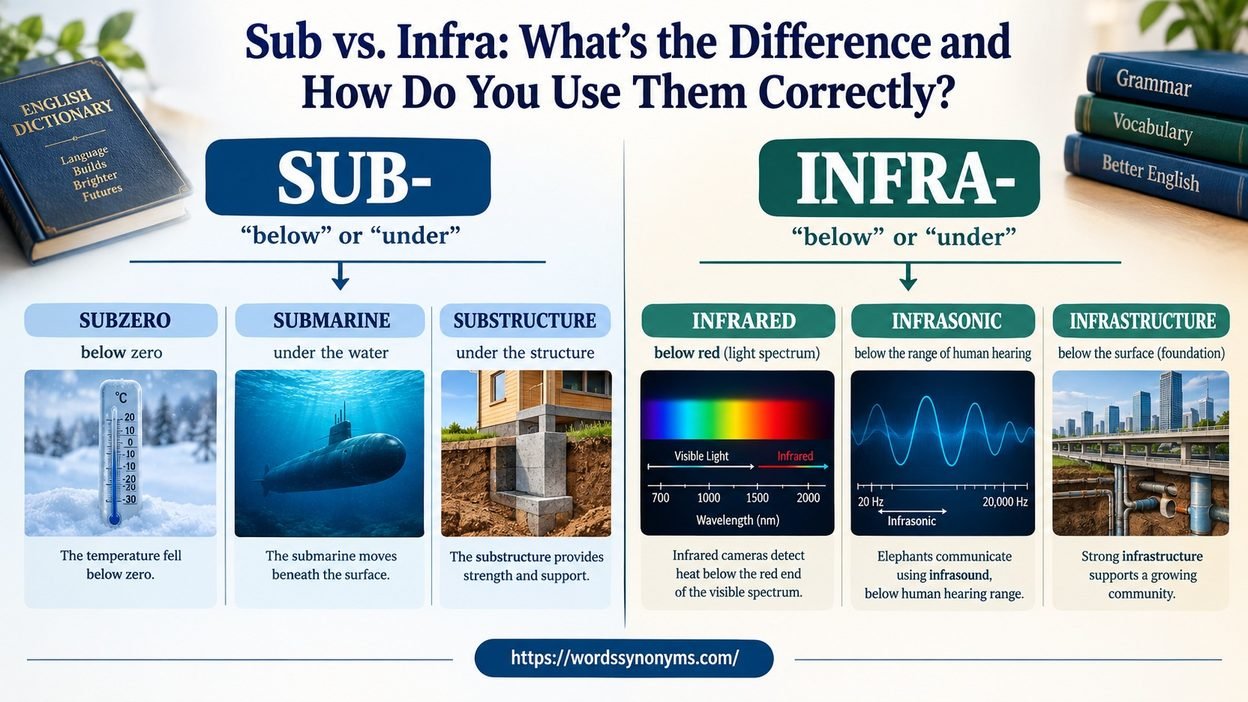
Sub vs. Infra: What’s the Difference? helps you see how sub- and infra- can signal position, level, classification, or meaning in a modified word.
The sub- prefix usually points to something underneath, below, at a lower level, or less than something else. It can describe a smaller part of something bigger. In the United States, or US, many sub- words are written without a hyphen, while Canada may follow different official spellings. Infra- can also mean below, but it often suggests something inside or within.
In my experience, the difference becomes easier to understand when you look at how a scientist chooses a term for a particular category. That preference can reflect naming choices, especially when distinct examples show that one term existed before another was needed. Still, there are risks in assuming that every word follows the same pattern.
The clearest comparison comes from subsonic and infrasonic. Subsonic is an adjective describing something moving slower than sound, while infrasonic describes sound related to a certain range that humans cannot hear. Here, infra- means below on a scale, whereas sub- means less in a comparison.
You can see another useful distinction in infrastructure and substructure. Infrastructure refers to the basic needs that help a civilization function, as well as the framework or foundation of an organization or group. A substructure, however, is a supporting part of a building positioned underneath something else.
Quick Answer
The simplest way to understand sub vs. infra is this:
- Sub- generally means under, below, lower, subordinate, smaller, less than, or nearly.
- Infra- generally means below, beneath, or below a particular limit or scale.
- Sub- appears in a much broader range of everyday and technical words.
- Infra- appears especially often in scientific, medical, technical, and formal vocabulary.
- The two prefixes overlap in meaning, but they’re not normally interchangeable.
- The complete word determines the precise meaning.
Merriam-Webster defines sub- with several meanings, including “under,” “beneath,” “below,” “subordinate,” “subdivision of,” and “less than completely or normally.”
Merriam-Webster defines infra- primarily around the idea of being below, including being below in a scale or series.
| Feature | Sub- | Infra- |
| Basic idea | Under, below, lower | Below, beneath |
| Can indicate physical position? | Yes | Yes |
| Can indicate lower rank? | Yes | Less commonly |
| Can indicate a smaller division? | Yes | Not normally |
| Can indicate less than a standard? | Yes | Not normally |
| Can indicate a lower limit or range? | Yes | Yes |
| Common in everyday English? | Very common | Less common |
| Common in technical vocabulary? | Yes | Yes |
| Latin origin | sub- | infra |
| Interchangeable? | Usually no | Usually no |
The key is context. Sub- carries several semantic jobs, while infra- tends to stay closer to the concept of being below a defined point or boundary.
What Does Sub- Mean?
The prefix sub- comes from Latin sub, meaning “under” or “below.” English uses it in many different ways, and its meaning has expanded beyond simple physical location.
Merriam-Webster lists several modern meanings for sub-, including physical position below something, subordinate status, a smaller division, and something less than complete or normal.
Think of sub- as a flexible prefix. It can describe where something sits, where something ranks, how large a division is, or how far something falls short of a normal level.
Sub- Means “Under” or “Below”
The most straightforward meaning involves physical position.
Consider these words:
- submarine — a vessel designed to operate beneath the surface of the water
- subsoil — the layer of soil beneath the topsoil
- subway — a passage or railway running below ground or beneath a street
- subterranean — existing or occurring below the earth’s surface
- subcutaneous — located beneath the skin
In each case, the basic idea of sub- involves something lower than a surface or reference point.
The prefix can therefore give you a useful clue when you encounter an unfamiliar word. If you see sub-, ask whether the word describes something underneath, beneath, or at a lower level.
Sub- Can Mean “Lower” or “Secondary”
Physical location isn’t the only possibility.
Sub- can also express a lower position in a hierarchy. Merriam-Webster includes meanings such as “subordinate,” “secondary,” and “next lower than or inferior to.”
For example:
- subcommittee — a smaller committee formed from a larger committee
- subchapter — a division beneath a chapter
- subheading — a heading beneath a main heading
- substation — a secondary station associated with a larger system
- subplot — a secondary plot within a larger story
Here, “below” isn’t necessarily physical.
A subheading doesn’t sit underground. Instead, it occupies a lower level in a document’s organizational structure.
That’s an important clue when understanding sub vs. infra. The meaning of sub- can become hierarchical rather than spatial.
Sub- Can Mean “Less Than”
English also uses sub- to indicate something below a numerical level, standard, or expected condition.
Examples include:
- subzero — below zero
- substandard — below an accepted standard
- sub-$500 — below $500
- sub-4-minute mile — less than four minutes
- subclinical — below the level at which a condition is clinically apparent
Cambridge Dictionary specifically gives examples such as sub-zero, sub-$1000, and sub-4-minute to illustrate the “less than” meaning.
This meaning makes sub- especially useful in modern English because speakers can use it with measurements and thresholds.
Sub- Can Mean “Almost” or “Not Fully”
Another interesting use occurs when sub- describes something that approaches a condition without fully reaching it.
For instance, words such as subtropical can describe something that lies close to or partly within a category without fitting the central definition perfectly.
Merriam-Webster also records meanings related to being less than completely or normally and to bordering on a particular state.
So, when you see sub-, don’t automatically translate it as “underneath.” The prefix may refer to degree, hierarchy, division, or approximation instead.
What Does Infra- Mean?
The prefix infra- also comes from Latin. Its source is Latin infra, meaning below or beneath.
Modern English uses infra- in words such as:
- infrared
- infrasonic
- infraorbital
- infrarenal
- infraclavicular
- infrastructure
Oxford describes infra- as meaning “below or beyond a particular limit” in adjectives such as infrared.
American Heritage likewise defines infra- in terms of being inferior to, below, or beneath something.
The important difference isn’t that infra- has nothing to do with “under.” It absolutely does. The difference lies in how English uses the prefix inside established words.
Infra- Often Identifies a Position Below a Reference Point
In scientific and medical vocabulary, infra- can identify something located below a particular anatomical or conceptual reference point.
For example:
- infraorbital — below the orbit of the eye
- infrarenal — below the kidney
- infraclavicular — below the clavicle
The reference point matters.
Imagine a map with a marked horizontal line. Something described as infra- may occupy the area below that line. The prefix establishes a relationship between the thing being described and a defined point of reference.
That pattern appears frequently in specialized vocabulary.
Infra- Can Mean “Below a Scale or Range”
The prefix also appears when something falls below a defined range or spectrum.
Infrared provides the clearest example.
Infrared radiation occupies a portion of the electromagnetic spectrum beyond the red end of visible light. In other words, infra- here signals a position beyond a particular boundary in a scale.
This is why translating infra- as simply “under” can sometimes become misleading.
The word infrared isn’t describing an object physically sitting underneath something red. It identifies radiation positioned beyond a specific boundary in the electromagnetic spectrum.
Infra- in Technical Language
You’ll often encounter infra- in technical writing because specialized fields need precise ways to describe relationships.
Medicine uses it to identify anatomical locations. Physics uses it to describe ranges and frequencies. Other scientific disciplines use it to classify positions, levels, or relationships.
That doesn’t mean every infra- word is obscure. Infrastructure, for example, is common in everyday news, business, politics, transportation, and urban planning.
Still, its usage is more specialized than the enormous everyday footprint of sub-.
Sub vs. Infra: The Main Difference
The biggest mistake people make with sub vs. infra is treating both prefixes as perfect synonyms.
They aren’t.
Both can express a relationship involving something lower. Yet sub- has more semantic functions.
Sub- Has a Broader Meaning
The prefix sub- can indicate:
- physical position below
- lower rank
- secondary status
- smaller division
- less than a measurement
- less than a normal condition
- approximate or borderline status
For example:
subcommittee = a smaller or subordinate committee
subzero = below zero
substandard = below an accepted standard
submarine = beneath the water
The same prefix works across several different conceptual relationships.
Infra- Stays Closer to “Below”
Infra- generally keeps a stronger connection to the idea of being below, beneath, or beyond a particular lower boundary.
Examples include:
- infrared
- infrasonic
- infraorbital
- infrarenal
Merriam-Webster also notes that infra- can indicate something “below in a scale or series,” with infrared as an example.
You Can’t Freely Swap the Prefixes
This is the practical rule worth remembering:
Similar prefix meanings don’t make their words interchangeable.
For example, submarine is an established English word. You can’t replace sub- with infra- and create an equivalent everyday word.
Likewise, infrared has a specific established meaning. Calling it subred would not produce the same standard English term.
English morphology has history behind it. Words become established through actual usage, and that history often creates distinctions that aren’t obvious from the prefixes alone.
Substructure vs. Infrastructure
The difference becomes especially clear when you compare substructure and infrastructure.
The two words look related because both describe something that supports something else. Yet their meanings diverge.
What Is a Substructure?
A substructure is the supporting part beneath a larger structure.
In construction, it can refer to the portion that supports the visible or upper structure. In a bridge, for example, the substructure can include foundations, piers, and abutments.
The word therefore keeps a fairly literal relationship with sub-:
substructure = structure beneath or supporting the upper structure
What Is Infrastructure?
Infrastructure has a broader meaning.
It commonly refers to the basic systems, facilities, and services that allow a society, organization, economy, or activity to function.
Examples include:
- roads
- bridges
- water systems
- electrical grids
- public transportation
- telecommunications networks
- sewage systems
- ports
- airports
A city’s infrastructure isn’t necessarily physically underneath the city. The term refers to the underlying framework that makes broader activity possible.
That’s a conceptual sense of “underlying,” rather than a simple physical sense of “below.”
Case Study: A Bridge
Imagine a major highway bridge.
Its substructure consists of the supporting components beneath the bridge deck. Those components carry loads and transfer them into the ground.
The bridge itself may form part of a city’s transportation infrastructure.
So the same bridge can be discussed in two different ways:
| Term | What it describes |
| Substructure | The supporting physical portion beneath the main structure |
| Infrastructure | The broader transportation system the bridge helps support |
This example shows why sub vs. infra isn’t merely a spelling question. The prefixes help create words that describe different relationships.
Subsonic vs. Infrasonic
Another excellent comparison comes from sound and physics.
At first glance, subsonic and infrasonic might seem like synonyms because both involve something below a reference point.
They aren’t.
What Does Subsonic Mean?
Subsonic generally describes something moving at a speed below the speed of sound.
The important measurement is velocity.
For example, an aircraft traveling below the local speed of sound can be described as subsonic.
What Does Infrasonic Mean?
Infrasonic describes sound with frequencies below the range of normal human hearing.
The important measurement is frequency.
Human hearing is commonly described as covering approximately 20 Hz to 20,000 Hz for healthy young listeners under suitable conditions. Infrasonic sound generally refers to frequencies below about 20 Hz.
The two terms therefore answer different questions:
| Word | What is being measured? | Basic idea |
| Subsonic | Speed | Below the speed of sound |
| Infrasonic | Frequency | Below the commonly recognized human hearing range |
That’s a perfect example of why you shouldn’t assume that two prefixes create equivalent meanings.
Subsonic concerns speed. Infrasonic concerns frequency.
Sub vs. Infra Examples
The following examples make the distinction easier to see in real words.
| Word | Meaning | Prefix function |
| submarine | A vessel operating beneath the water | physical position |
| subsoil | Soil beneath the topsoil | physical position |
| subzero | Below zero | numerical level |
| substandard | Below an accepted standard | quality level |
| subcommittee | A smaller committee within a larger one | subordinate division |
| subheading | A heading beneath a main heading | organizational hierarchy |
| infrared | Beyond the red end of visible light | position on a spectrum |
| infrasonic | Below the commonly recognized audible frequency range | frequency range |
| infraorbital | Located below the eye orbit | anatomical position |
| infrarenal | Located below the kidney | anatomical position |
| infrastructure | Fundamental systems supporting wider activity | underlying framework |
Notice how sub- appears in both everyday and abstract relationships.
By comparison, infra- frequently establishes a more specific relationship to a boundary, range, position, or system.
Sub vs. Infra in Science and Medicine
Technical vocabulary makes the difference even more visible.
Sub- in Medical Terms
Medical English uses sub- to indicate a position beneath something.
Examples include:
- subcutaneous — beneath the skin
- sublingual — beneath the tongue
- submucosal — beneath a mucous membrane
- subcutaneous tissue — tissue beneath the skin
These words use sub- in a straightforward spatial sense.
Infra- in Medical Terms
Medical terminology also uses infra- for structures located below specific anatomical reference points.
Examples include:
- infraorbital — below the orbit
- infrarenal — below the kidney
- infraclavicular — below the clavicle
- infrapatellar — below the patella
The distinction can be subtle because both prefixes may describe something beneath a body structure.
That doesn’t make them interchangeable.
A medical term is an established lexical unit. Its meaning depends on the particular word and anatomical relationship rather than a simple rule that says “use either prefix for below.”
Sub vs. Infra in Everyday English
If you read newspapers, websites, books, and everyday documents, you’ll encounter sub- far more often.
Common examples include:
- subway
- submarine
- subsection
- subheading
- subcategory
- substandard
- subset
- subzero
- subtitle
- subgroup
These words have become deeply embedded in ordinary English.
Infra- appears less often in casual conversation. Still, several common words have made it familiar.
The best-known examples include:
- infrastructure
- infrared
- infrasonic
A useful distinction is therefore one of frequency and specialization, not a rigid grammatical rule.
Sub- is broadly productive and familiar. Infra- is more specialized in many of its uses.
Read more: Adapt vs. Adopt: Easy Ways to Remember
Can You Use Sub- and Infra- Interchangeably?
Usually, no.
You can recognize a semantic relationship between the prefixes, but you shouldn’t replace one with the other unless the resulting word is an established term with the intended meaning.
Consider these examples:
- subzero is standard.
- infrazero isn’t a normal equivalent.
- infrared is standard.
- subred isn’t a standard replacement.
- submarine is standard.
- inframarine doesn’t function as its ordinary equivalent.
- infrastructure is standard.
- substructure is also standard, but its meaning is different.
This happens because English vocabulary isn’t built entirely through mechanical prefix substitution.
A prefix can give you a clue about a word’s origin or meaning. However, the finished word has its own lexical history.
How to Choose the Correct Prefix
When you’re unsure, use this simple process:
- Look at the complete word.
Don’t interpret the prefix in isolation. - Identify the relationship.
Is the word describing physical position, rank, measurement, classification, or a technical range? - Check whether the word is established.
English doesn’t accept every theoretically possible prefix combination. - Consider the field.
Medical and scientific vocabulary often uses infra- in precise ways. - Check a dictionary when necessary.
A reliable dictionary gives you the established meaning rather than a guess based on word parts.
Common Mistakes With Sub and Infra
Treating Sub- and Infra- as Exact Synonyms
This is the most common mistake.
Both can relate to “below,” but sub- has additional meanings involving hierarchy, division, degree, and approximation.
Assuming Sub- Always Means Physical Underneath
It doesn’t.
A subcommittee isn’t physically underneath a committee. A subheading isn’t buried beneath a heading. A substandard product doesn’t sit below a standard on a shelf.
In these words, sub- expresses hierarchy or degree.
Assuming Infra- Always Means Physically Under
The same caution applies to infra-.
Infrared doesn’t mean physically underneath red paint or a red object. It describes a position in the electromagnetic spectrum beyond the red end of visible light.
The “below” concept has become relational rather than physical.
Confusing Infra- With Intra-
This is an especially important distinction.
Infra- generally relates to below.
Intra- means within or inside.
Compare:
- infraocular = below the eye
- intraocular = within the eye
One letter changes the prefix, but the meaning changes substantially.
If you see infra-, think below.
If you see intra-, think within.
Assuming Infrastructure Means an Underground Structure
The word infrastructure can certainly include underground systems such as water pipes, sewer networks, and utility lines.
However, infrastructure itself doesn’t mean “underground structure.”
Modern infrastructure refers to the foundational systems and facilities that support a community, organization, or activity.
A highway is infrastructure. So is an electrical grid. So is a telecommunications network.
Sub vs. Infra vs. Intra vs. Under
Related words can make prefix confusion even worse. A quick comparison helps.
| Term | Core meaning | Example |
| sub- | below, under, lower, subordinate, less than | substandard |
| infra- | below, beneath, below a limit or scale | infrared |
| intra- | within, inside | intranet |
| under- | beneath, below, insufficiently | underground |
The crucial contrast is infra- versus intra-.
They look similar because both contain intra/infra, but their meanings point in different directions.
Infra = below.
Intra = within.
That distinction becomes particularly important in medicine, biology, and other technical fields.
The Etymology of Sub and Infra
Understanding their origins helps explain why the meanings overlap.
Origin of Sub-
Sub- comes from Latin sub, meaning under or below. English inherited the prefix through Latin-derived vocabulary and gradually developed additional meanings from the basic concept of lower position.
That expansion explains why sub- can describe physical position, hierarchy, subdivision, and degree.
The conceptual path is fairly intuitive:
below → lower → subordinate → smaller part → less than normal
Not every word follows that path literally, but the broader semantic family helps explain the prefix’s flexibility.
Origin of Infra-
Infra- comes from Latin infra, meaning below or beneath.
Its modern English uses retain a strong connection with that original meaning.
Oxford specifically traces the prefix to Latin infra and defines it around the idea of being below or beyond a particular limit.
Why Does English Have Both?
English contains many prefixes inherited from different periods and language traditions.
Sometimes those prefixes overlap. That isn’t unusual.
The important point is that historical overlap doesn’t guarantee modern interchangeability.
Once individual words become established, speakers learn those words as complete units. Their meanings can develop in specialized directions.
That’s exactly what happened with many sub- and infra- formations.
A Practical Memory Trick for Sub vs. Infra
If you need a quick way to remember the difference, start with this:
Sub- = under, lower, smaller, subordinate, or less.
Infra- = below a particular point, range, boundary, or reference.
Then remember two especially useful pairs:
Subsonic → speed below the speed of sound
Infrasonic → frequency below the commonly recognized human hearing range
And one structural pair:
Substructure → supporting structure beneath a structure
Infrastructure → underlying systems that support a larger system
These examples show the distinction more clearly than memorizing a dictionary definition.
Sub vs. Infra Comparison Chart
Use this chart as a quick reference whenever you’re unsure.
| Category | Sub- | Infra- |
| Origin | Latin sub | Latin infra |
| Basic meaning | Under, below | Below, beneath |
| Physical position | Yes | Yes |
| Lower rank | Yes | Not a primary modern use |
| Smaller division | Yes | Not normally |
| Less than a standard | Yes | Not normally |
| Below a numerical limit | Yes | Can indicate a lower range or scale |
| Technical vocabulary | Common | Common |
| Everyday vocabulary | Very common | More limited |
| Example | subzero | infrared |
| Medical example | subcutaneous | infraorbital |
| Structural example | substructure | infrastructure |
| Scientific example | subsonic | infrasonic |
| Interchangeable? | Generally no | Generally no |
The table reveals the central pattern: sub- is semantically broader, while infra- more often marks a lower position or boundary in an established technical or formal term.
Real-World Examples: How the Difference Works
Consider a few situations where the distinction matters.
Example 1: Weather
You might say:
“Temperatures dropped to subzero levels overnight.”
Here, sub- means below a numerical threshold.
You wouldn’t normally replace it with infra- because infrazero isn’t the standard English term.
Example 2: Medical Anatomy
A doctor might describe an infraorbital structure.
The term identifies something below the orbit of the eye. The prefix relates the structure to a specific anatomical reference point.
A different medical structure might be subcutaneous, meaning beneath the skin.
Both involve “below,” but the established terms encode different anatomical relationships.
Example 3: Transportation
A city’s roads, railways, bridges, power systems, and water networks form parts of its infrastructure.
A bridge’s physical foundation and supporting components can form part of its substructure.
The words overlap conceptually because both involve support. Their meanings aren’t identical.
Example 4: Sound
An aircraft can travel at a subsonic speed.
An extremely low-frequency sound can be infrasonic.
One concerns velocity. The other concerns frequency.
That single comparison is enough to show why blindly translating prefixes can cause confusion.
FAQs
What does sub- mean in a word?
Sub- usually means below, underneath, or at a lower level. It can also suggest something smaller, secondary, or less than something else.
What does infra- mean?
Infra- can mean below, but it often has the sense of inside or within. Its exact meaning depends on the word where it appears.
Is sub- always the opposite of infra-?
No. Sub- and infra- can overlap in meaning, but they aren’t always interchangeable. Their meanings depend on the specific word and context.
What is the difference between subsonic and infrasonic?
Subsonic describes something that moves slower than sound. Infrasonic refers to sound below the range that humans can normally hear.
How are infrastructure and substructure different?
Infrastructure refers to essential systems, services, or a supporting framework that helps an organization or civilization function. A substructure is a supporting part located underneath another structure.
Does spelling of sub- words vary by country?
Yes. In the US, most sub- words are written without a hyphen. Canada and other English-speaking regions may use different official spellings for some terms.
Conclusion
The real difference between sub- and infra- becomes easier when you focus on what each prefix tells you about position or level. Sub- usually suggests something below, underneath, or less in relation to another thing. Infra- can also point below, but it often carries the idea of being inside or within something. That small shift can change the meaning of a word even when the two prefixes seem interchangeable.
Think of subsonic and infrasonic as a useful pair. Something subsonic moves slower than sound, while infrasonic refers to a certain range of sound that humans cannot hear. The same idea appears in substructure and infrastructure. A substructure is a supporting part of a building beneath something else, whereas infrastructure refers to the framework and basic needs that help a civilization, organization, or group function. Looking at these examples side by side makes the distinction much more natural.

Syeda Naalain Zahra is a content writer with an interest in English vocabulary and language. She creates simple and informative articles about synonyms, antonyms, word meanings, and everyday English usage. Her aim is to help readers build better vocabulary and communicate more confidently.