A single space can completely change the meaning of what you write. That’s exactly what makes Away vs. A Way such a commonly confused pair in English.
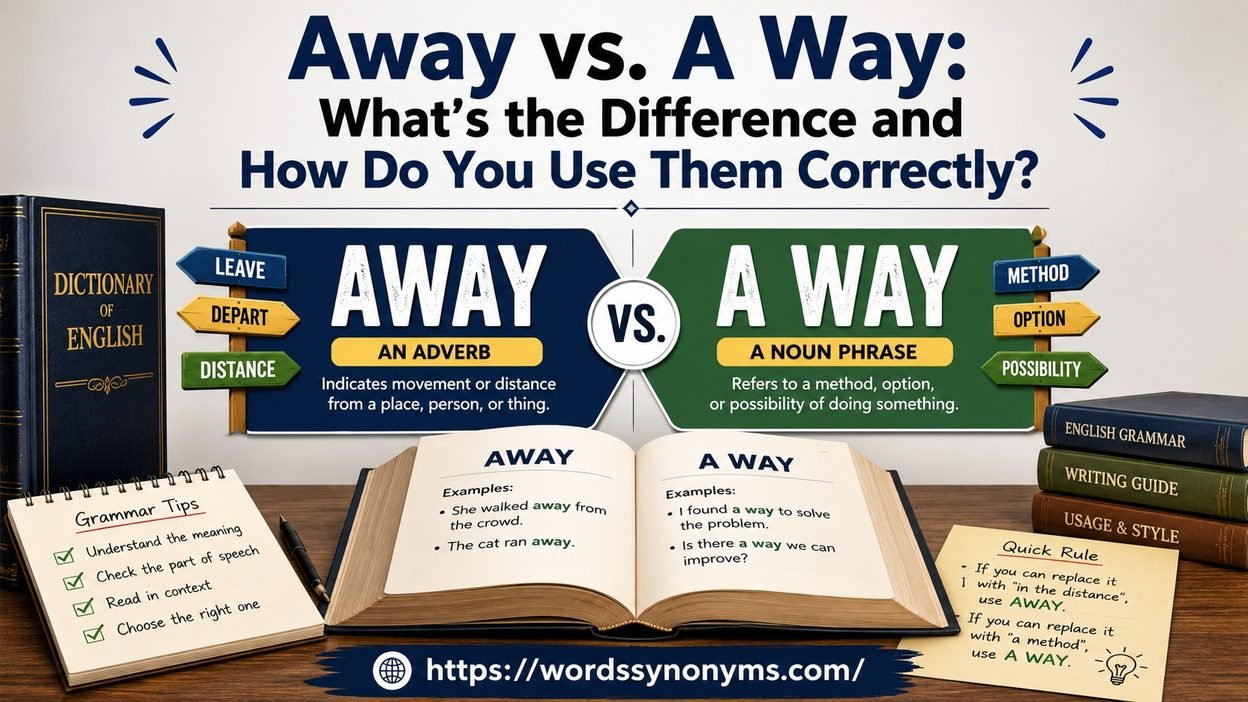
Although they sound almost identical when spoken, they serve entirely different purposes. Away usually relates to distance, movement, separation, or absence, while a way refers to a method, solution, route, or approach.
For example, compare these sentences: “She walked away” and “She found a way to leave.” The pronunciation may sound similar, but the meanings couldn’t be more different. One describes someone moving away from a place, while the other talks about finding a solution or method. That tiny space between the words can make a big difference in your writing.
If you’ve ever paused while typing and wondered whether to write away or a way, you’re not alone. This guide breaks down the difference between away and a way in a simple, practical way with clear meanings, everyday examples, grammar rules, common mistakes, useful phrases, and an easy memory trick.
By the end, you’ll know exactly when to use away and when a way is the correct choice.
Quick Answer
Here’s the simplest explanation.
| Word | Meaning | Grammar Role | Example |
| Away | At a distance, absent, moving from somewhere, or disappearing | Usually an adverb | The station is two miles away. |
| A way | A method, route, manner, or solution | Noun phrase | We need a way to solve this. |
The easiest rule to remember is this:
Use “away” when talking about distance, movement, absence, removal, or disappearance. Use “a way” when talking about a method, route, direction, or solution.
For example:
- The holidays are still three weeks away.
- There’s a way to fix this problem.
One word describes distance. Two words describe a method.
Simple once you see it.
What Does “Away” Mean?
The word away has several related meanings. In most cases, it describes separation from a place, person, object, or situation.
It can refer to physical distance. It can also describe someone leaving, something disappearing, or an object being removed.
Let’s look at its most common uses.
Away Meaning “At a Distance”
One of the most familiar uses of away involves distance.
You use it when something is located a certain distance from another place.
Examples:
- My office is five miles away.
- The airport is twenty minutes away.
- Their house is far away.
- The nearest store is only a block away.
In these examples, away tells you how far something is.
You can use it with measurements too:
- The hotel is ten kilometers away.
- The finish line is 500 meters away.
- Her birthday is only two days away.
Notice something important here. You would never write “five miles a way” when describing distance.
The correct form is always:
five miles away
Not:
five miles a way
That’s one of the quickest ways to spot the correct spelling.
Away Meaning “Not Present”
You can also use away when someone isn’t currently at their usual location.
For example:
- Sarah is away on vacation.
- The manager is away from the office.
- My parents are away this weekend.
- He’s away on business.
In each sentence, the person is absent from their normal location.
Think of away here as meaning:
- absent
- elsewhere
- not here
For instance:
“The doctor is away today.”
This simply means the doctor isn’t currently available at the usual location.
Away Meaning “Moving From a Place”
Another common meaning involves movement.
Examples include:
- Please go away.
- She walked away quietly.
- The child ran away.
- He drove away without saying goodbye.
- The bird flew away.
In these sentences, someone or something moves from one location to another.
The direction doesn’t always matter. What matters is the idea of moving away from the current place.
Imagine standing at a train station. When the train leaves the platform, it moves away.
That’s the basic idea.
Away Meaning “To Remove Something”
The word away often appears with verbs that involve removing, storing, or getting rid of something.
Examples:
- Put your phone away.
- Throw away the receipt.
- She gave away her old clothes.
- Please take the dishes away.
- Don’t hide the evidence away.
Here, away often changes the meaning of the verb.
Compare:
- Put the book on the table.
- Put the book away.
The first sentence tells you where to place the book.
The second suggests storing it in its proper place.
Similarly:
- Throw the paper means physically toss it.
- Throw the paper away means discard it.
That tiny word can completely change the meaning.
Away Meaning “Gradually Disappearing”
Sometimes away describes something fading, vanishing, or becoming less noticeable.
Examples:
- The sound faded away.
- The pain slowly went away.
- The clouds drifted away.
- Her worries melted away.
- The laughter died away.
This usage often creates a sense of gradual disappearance.
Imagine music playing in another room. As you walk farther from the source, the sound slowly fades away.
The same idea works with emotions, sounds, memories, and physical objects.
Away Meaning “Continuously”
In informal English, away can suggest that an activity continues for a period of time.
For example:
- She worked away all afternoon.
- He typed away at his computer.
- The children chatted away for hours.
- The carpenter hammered away at the wall.
This usage creates the feeling of someone steadily doing something.
It’s especially common in conversational English.
For example:
“While everyone else relaxed, Jake kept working away.”
The phrase suggests persistence and continuous effort.
What Does “A Way” Mean?
Unlike away, the phrase a way contains two separate words.
The word a is an indefinite article.
The word way is a noun.
Together, they usually refer to a method, route, direction, approach, or solution.
That’s the key distinction.
A Way Meaning “A Method”
Perhaps the most common use of a way refers to a method of doing something.
Examples:
- There’s a way to fix this.
- She found a way to save money.
- We need a way to finish the project.
- Is there a way to contact them?
- He discovered a way to improve his writing.
In every example, a way means something similar to:
- method
- approach
- technique
- solution
For example:
“We need a way to solve the problem.”
You could replace a way with a method:
“We need a method to solve the problem.”
The meaning remains similar.
That makes this one of the best memory tricks for choosing between away vs. a way.
A Way Meaning “A Manner of Doing Something”
Sometimes a way describes how someone does something.
Examples:
- She has a funny way of speaking.
- He has a unique way of teaching.
- There’s a better way to explain it.
- She smiled in a way that made everyone laugh.
Here, way refers to a person’s manner or style.
For example:
“He has a way of making difficult ideas sound simple.”
The phrase doesn’t refer to physical movement.
Instead, it describes how someone does something.
A Way Meaning “A Route or Path”
You can also use a way when talking about a physical path or route.
Examples:
- We found a way through the forest.
- Is there a way around the traffic?
- They showed us a way out.
- The hikers searched for a way down the mountain.
In these examples, a way means:
- route
- path
- passage
- direction
For example:
“Is there a way out of the building?”
You’re asking whether a route or exit exists.
Away vs. A Way: Side-by-Side Comparison
Sometimes the fastest way to understand a confusing word pair is to compare both forms directly.
| Feature | Away | A Way |
| Number of words | One | Two |
| Main grammatical role | Usually an adverb | Noun phrase |
| Main meaning | Distance or separation | Method or route |
| Can describe absence | Yes | No |
| Can describe movement | Yes | Sometimes, as a route |
| Can mean method | No | Yes |
| Can follow a distance | Yes | No |
| Example | She moved away. | She found a way. |
The difference becomes even clearer when you place both forms in similar sentences.
| Incorrect | Correct | Why |
| The school is two miles a way. | The school is two miles away. | Distance requires away. |
| We need to find away. | We need to find a way. | A method requires a way. |
| Please stay a way from the fire. | Please stay away from the fire. | Separation requires away. |
| Is there away to solve this? | Is there a way to solve this? | A solution requires a way. |
One space. Completely different meaning.
That’s why proofreading matters.
The Easiest Trick to Remember Away vs. A Way
Grammar rules are useful. Memory tricks are even better when you’re writing quickly.
Here’s the easiest approach.
Use the “Method” Test for A Way
Ask yourself:
Can I replace “way” with “method,” “approach,” or “solution”?
If the answer is yes, use a way.
Example:
We need a way to improve sales.
Try replacing it:
We need a method to improve sales.
The sentence still makes sense.
Therefore, a way is correct.
Another example:
She found a way to open the door.
Replace it:
She found a method to open the door.
Again, the meaning works.
Use a way.
Use the “Distance” Test for Away
Ask yourself:
Am I talking about distance, leaving, absence, removal, or disappearance?
If yes, use away.
Example:
The beach is ten minutes away.
You’re describing distance.
Use away.
Another example:
Please stay away from the edge.
You’re describing separation.
Again, use away.
Away vs. A Way Examples in Everyday Sentences
Seeing the words in realistic situations makes the difference easier to remember.
Examples With Away
- Please move away from the door.
- My grandparents live far away.
- The meeting is still two hours away.
- Put your laptop away before dinner.
- The storm slowly moved away.
- She gave away her old books.
- Stay away from the construction area.
- The dog ran away from home.
- The pain eventually went away.
- He looked away when she asked the question.
- The train pulled away from the station.
- Don’t throw away that important document.
Examples With A Way
- There’s always a way forward.
- Can you find a way to fix this?
- She has a unique way of explaining things.
- We need a way around this obstacle.
- Is there a way out of here?
- He found a way to improve the process.
- They discovered a way through the crowd.
- That’s not a good way to treat people.
- We need a better way to manage our time.
- She found a way to make the task easier.
- Is there a way I can help?
- They’ll find a way to succeed.
Read these examples aloud.
You’ll notice something interesting. Away often feels connected to movement or separation. A way usually feels connected to a choice, solution, or direction.
That pattern makes the distinction easier to remember.
Common Mistakes With Away and A Way
The confusion between these two forms usually comes from pronunciation.
In natural speech, away and a way can sound very similar.
However, spelling depends on meaning, not sound.
Mistake: Using “A Way” for Distance
Incorrect:
The restaurant is three blocks a way.
Correct:
The restaurant is three blocks away.
Why?
Because you’re describing distance.
Use away.
More examples:
- The holidays are still months away.
- The store is just around the corner, not far away.
- The finish line is only a few steps away.
Mistake: Using “Away” for a Method
Incorrect:
We need to find away to solve this issue.
Correct:
We need to find a way to solve this issue.
The sentence refers to a solution or method.
Therefore, use a way.
This mistake is especially common in informal writing because people type words the way they hear them.
A quick pause can prevent it.
Ask:
Am I talking about a solution?
If yes, write a way.
Mistake: Confusing “Get Away” and “Get a Way”
Incorrect:
I need to get a way from here.
Correct:
I need to get away from here.
The phrase get away means to leave or escape.
Examples:
- We need to get away from the noise.
- She wanted to get away for the weekend.
- The thief tried to get away.
In each example, the phrase involves leaving.
Use away.
Mistake: Writing “Find Away”
This error appears often online.
Incorrect:
We’ll find away to make it work.
Correct:
We’ll find a way to make it work.
Think of the phrase find a way as a complete unit.
It means:
Find a solution.
That simple connection helps you avoid the mistake.
Common Phrases That Use “Away”
The word away appears in many common English expressions.
Learning these phrases helps you recognize when the one-word form is correct.
Go Away
Meaning: Leave or move somewhere else.
Examples:
- Please go away.
- The headache will eventually go away.
- I wish the rain would go away.
Interestingly, the phrase can describe both physical departure and disappearance.
Stay Away
Meaning: Keep your distance.
Examples:
- Stay away from the fire.
- Please stay away from the wet paint.
- He stayed away from social media for a week.
The phrase can describe physical or metaphorical distance.
Run Away
Meaning: Escape or leave quickly.
Examples:
- The dog ran away.
- She wanted to run away from her problems.
- The child ran away from the playground.
Context determines whether the movement is literal or figurative.
Give Away
Meaning: Donate, reveal, or unintentionally expose something.
Examples:
- She gave away her old clothes.
- Don’t give away the ending.
- His smile gave away his excitement.
This phrase has several meanings, which makes context especially important.
Throw Away
Meaning: Discard something.
Examples:
- Don’t throw away the box.
- He threw away the broken chair.
- Stop throwing away useful opportunities.
The last example uses the phrase figuratively.
Put Away
Meaning: Store something in its proper place.
Examples:
- Put away your clothes.
- Please put the dishes away.
- She put away her phone.
Fade Away
Meaning: Gradually disappear.
Examples:
- The music faded away.
- Their voices slowly faded away.
- The memory never completely faded away.
Right Away
Meaning: Immediately.
Examples:
- I’ll call you right away.
- Please come here right away.
- She answered right away.
This phrase is common in American English.
Far Away
Meaning: At a great distance.
Examples:
- They live far away.
- A far-away mountain appeared on the horizon.
- Her childhood felt far away.
The phrase can describe emotional distance as well as physical distance.
Common Phrases That Use “A Way”
Now let’s look at expressions that use the two-word form.
Find a Way
Meaning: Discover a solution.
Examples:
- We’ll find a way.
- She found a way to finish the project.
- They always find a way to overcome challenges.
This phrase is extremely common.
Make a Way
Meaning: Create space or allow passage.
Examples:
- Make a way for the ambulance.
- The crowd made a way for the performers.
You’ll often hear a similar expression:
“Make way!”
It means:
Move aside.
A Way Out
Meaning: An exit or solution.
Examples:
- There must be a way out.
- They searched for a way out of the building.
- She needed a way out of the difficult situation.
Again, the phrase can be literal or figurative.
A Way Around
Meaning: An alternative route or solution.
Examples:
- We found a way around the traffic.
- There must be a way around this problem.
- Engineers looked for a way around the limitation.
A Better Way
Meaning: A more effective method.
Examples:
- There’s got to be a better way.
- She discovered a better way to organize her work.
- Technology often provides a better way to complete repetitive tasks.
In a Way
Meaning: In a certain sense or partially.
Examples:
- In a way, he was right.
- She was, in a way, responsible.
- In a way, the experience changed everything.
This phrase deserves attention because it doesn’t mean physical direction.
It introduces a particular perspective.
One Way or Another
Meaning: Somehow, regardless of the method.
Examples:
- We’ll solve this one way or another.
- One way or another, they’ll reach the destination.
- The truth comes out one way or another.
English often uses way in idiomatic expressions because the word can represent methods, directions, and approaches.
Can Away and A Way Sound the Same?
Yes. That’s exactly why people confuse them.
In fast speech, the difference between away and a way may be difficult to hear.
Consider:
- “She’s moving away.”
- “She’s looking for a way.”
Both expressions contain a similar sound.
However, grammar and meaning reveal the correct spelling.
Here’s a useful comparison:
Away = one concept related to separation or distance.
A way = an article plus a noun describing a method or path.
When writing, don’t rely only on pronunciation.
Look at what the sentence actually means.
Away vs. A Way: A Simple Grammar Breakdown
Understanding the grammar behind both forms can make the difference even clearer.
Away as an Adverb
An adverb often modifies a verb, adjective, or another adverb.
In many sentences, away modifies an action by explaining direction or distance.
Example:
She walked away.
The verb is walked.
The word away tells you the direction of the movement.
Another example:
The store is miles away.
Here, away helps describe distance.
It can also appear in phrasal verbs:
- give away
- throw away
- put away
- take away
- walk away
These combinations often develop meanings that go beyond the original verb.
A Way as a Noun Phrase
The phrase a way consists of:
- A = indefinite article
- Way = noun
The noun way can represent:
- a method
- a route
- a direction
- a manner
- an approach
Example:
She found a way to succeed.
The noun way refers to the method she discovered.
Another example:
We need a way through the forest.
Here, way means a route or path.
How to Know Whether to Use Away or A Way
If you’re writing quickly, use this simple checklist.
Use “Away” When You’re Talking About:
- Distance
- Physical separation
- Leaving
- Absence
- Removal
- Disappearance
- Continuous activity
Examples:
- The concert is weeks away.
- Please stay away.
- Put the groceries away.
- The noise faded away.
- She worked away all day.
Use “A Way” When You’re Talking About:
- A method
- A solution
- A route
- A path
- A manner
- An approach
- A direction
Examples:
- Find a way to fix it.
- There’s a way through the tunnel.
- She has a way of making people laugh.
- Is there a way around the problem?
If you remember only one thing, remember this:
Distance? Away. Method? A way.
A Long Way Away: Why Both Forms Appear Together
Here’s where things get interesting.
English sometimes uses both a way and away in the same phrase:
A long way away
At first, this can look confusing.
However, each part serves a different purpose.
Example:
The nearest town is a long way away.
Let’s break it down:
- A long way = a considerable distance
- Away = distant from the current location
Together, the phrase emphasizes that something is very distant.
Other examples include:
- The beach is a long way away.
- Graduation is still a long way away.
- Success may seem a long way away.
The phrase is grammatically correct because way and away perform different jobs.
This example proves why meaning matters more than simply counting spaces.
Case Study: How Context Changes the Correct Spelling
Let’s look at two nearly identical ideas.
Sentence One
The finish line is still far away.
Here, you’re describing distance.
The finish line exists at a location separated from the speaker.
Correct choice:
Away
Sentence Two
We need to find a way to reach the finish line.
Here, you’re discussing a method or strategy.
Correct choice:
A way
The topic is the same.
The meaning changes.
That’s why context should always guide your spelling choice.
Another example:
The solution seems far away.
This sentence uses away figuratively. The solution feels distant or difficult to reach.
Compare it with:
We need a way to find the solution.
Now a way means a method.
Same general topic. Different grammar. Different spelling.
Read More: Magic Bullet vs. Silver Bullet: Meaning and Correct Usage
Away vs. A Way in Professional Writing
Small grammar mistakes can affect how readers perceive professional writing.
Consider these examples.
Incorrect:
We are looking for away to improve customer service.
Correct:
We are looking for a way to improve customer service.
The incorrect version can make a polished email look rushed.
Here’s another example.
Incorrect:
The deadline is only two days a way.
Correct:
The deadline is only two days away.
These errors aren’t difficult to fix.
A quick meaning check usually solves the problem.
Before submitting an email, article, report, or assignment, search for phrases containing away or a way.
Then ask:
Am I describing distance, or am I describing a method?
That five-second check can save you from a common mistake.
Away vs. A Way in Creative Writing
Writers often use away to create a sense of movement, separation, or emotional distance.
For example:
The ship drifted away beneath the fading evening light.
The word creates motion.
Now consider:
She searched for a way home.
This sentence creates a different feeling. It introduces a problem and suggests the need for a solution.
That’s one reason these words matter in storytelling.
Away often pushes something outward.
A way often points toward possibility.
One suggests separation.
The other suggests a path forward.
It’s a subtle difference. Yet good writing often depends on subtle choices.
Quick Quiz: Away or A Way?
Want to test your understanding?
Choose the correct option for each sentence.
Question One
The beach is only ten minutes _____.
- Away
- A way
Question Two
We need _____ to finish this project.
- Away
- A way
Question Three
Please put your books _____.
- Away
- A way
Question Four
Is there _____ around this problem?
- Away
- A way
Question Five
The concert is still three weeks _____.
- Away
- A way
Question Six
She found _____ to explain the idea clearly.
- Away
- A way
Question Seven
Stay _____ from the wet paint.
- Away
- A way
Question Eight
There’s _____ out through the back door.
- Away
- A way
Away vs. A Way Quiz Answers
Here are the correct answers.
| Question | Correct Answer | Reason |
| The beach is only ten minutes ___ | Away | Describes distance |
| We need ___ to finish this project | A way | Refers to a method |
| Put your books ___ | Away | Means store them |
| Is there ___ around this problem? | A way | Means a solution |
| Three weeks ___ | Away | Describes time remaining |
| Found ___ to explain | A way | Means a method |
| Stay ___ from wet paint | Away | Means keep distance |
| There’s ___ out | A way | Means a route |
How did you do?
If you missed a few, don’t worry. The distinction becomes automatic once you start connecting away with distance and a way with methods.
FAQs
1. What is the difference between away and a way?
The main difference is their meaning and grammatical function. Away usually describes distance, movement, separation, or absence, while a way refers to a method, solution, route, or approach. For example, “The store is miles away,” but “We need a way to get there.”
2. Is “away” one word or two words?
Away is always written as one word when referring to distance, movement, disappearance, or separation. For example, you would write, “Please move away from the door.” Writing “a way” in this situation would be incorrect because the sentence isn’t talking about a method or route.
3. How do I know whether to use away or a way?
A simple trick is to check the meaning of your sentence. If you’re talking about distance, leaving, separation, or removal, use away. If you mean a method, solution, path, or approach, use a way. Think: Distance = away. Method = a way.
4. Is “find away” grammatically correct?
Usually, no. If you mean finding a solution or method, the correct phrase is “find a way.” For example: “We’ll find a way to solve the problem.” Since way refers to a method or solution in this sentence, it needs the article a before it.
5. Can away and a way sound the same?
Yes. In everyday conversation, away and a way can sound very similar, especially when someone speaks quickly. That’s why many people confuse them in writing. The best way to choose the correct form is to focus on the meaning and context rather than pronunciation alone.
6. Can I use away and a way in the same sentence?
Yes, and a great example is “a long way away.” For instance: “The nearest airport is a long way away.” Here, a long way describes the amount of distance, while away emphasizes separation from the current location. Both forms are correct because they perform different jobs in the sentence.
Conclusion
The difference between away and a way may be small on the page, but their meanings are completely different. Away relates to distance, movement, separation, absence, or disappearance, while a way refers to a method, solution, route, or approach. Once you focus on the meaning behind the sentence, choosing the correct form becomes much easier.
Whenever you’re unsure, remember this simple rule: Distance? Away. Solution? A way. Don’t rely only on pronunciation because both can sound similar in everyday speech. Instead, consider what you want to express. With this quick meaning check and a little practice, using away vs. a way correctly will soon become second nature.

Muhammad Taqi is a content writer interested in English vocabulary and language. He writes clear and useful articles on synonyms, antonyms, word meanings, and English usage, helping readers expand their vocabulary and improve their communication skills.