Tween: Meaning, Definition & Examples explains a stage between childhood and adolescence, often linked to children aged eleven and twelve.
The term tween appears in many a dictionary, and although there are differing definitions, most sources agree that it is referring to adolescents, whether a boy or girl, who are at the ages eleven and twelve.
An adolescent at eleven or twelve is often seen as a child moving toward the teenage years, which is why tween is commonly described as an abbreviated form of preteen.
Some sources also use tweenager, a word connected with children in the ages ten and fourteen range. This includes those who are almost a teenager as well as a new teenager at ten or fourteen.
Another alternative word is tweenie, although the exact age range can vary depending on the source.
From my experience working with language references, checking more than one dictionary is useful when precision matters.
Quick Answer
Tween usually means a child who’s between childhood and the teenage years, typically around 8 to 12 years old. The term blends “between” and “teen,” making it a handy word for this in-between stage. Its plural is “tweens,” while “tween’s” shows possession
What Does “Tween” Mean?
In contemporary English, tween is primarily a noun meaning a child who is roughly between the ages of 8 and 12.
Cambridge Dictionary defines a tween as a child between approximately eight and twelve. Oxford gives a somewhat narrower range of about ten to twelve and lists pre-teen as a synonym. The difference shows why the age range shouldn’t be treated as a rigid rule.
In simple terms, a tween is not quite a young child and not yet a teenager.
For example:
- My daughter is a tween.
- The store has a new clothing line for tweens.
- That book is especially popular with tweens.
- Many tweens enjoy activities that appeal to both children and teenagers.
The word describes an age group, not a precise developmental or medical category.
Tween as a Noun
When tween refers to a young person, it functions as a countable noun.
You can therefore use it in both singular and plural forms:
- a tween
- one tween
- two tweens
- many tweens
For example:
A tween may want more independence while still enjoying childhood activities.
The plural is straightforward: tweens.
No apostrophe belongs in the ordinary plural form.
Tween as a Preposition
There is another, much older meaning of tween. As a preposition, it means between.
Merriam-Webster traces this use to Middle English twene, a shortened form of betwene, and records its first known use in the 12th century.
For example, a historical or literary sentence might use:
He stood tween the trees.
In modern standard American English, however, between is the normal choice.
So if you’re writing an ordinary email, article, school assignment, or business document, write:
The house stands between two tall trees.
rather than:
The house stands tween two tall trees.
The older prepositional sense is real. It simply isn’t the everyday meaning most modern readers expect.
What Age Is a Tween?
There is no universal rule that assigns one exact age to the word tween.
Cambridge places tweens at approximately 8 to 12, while Oxford describes a tween as a child around 10 to 12.
That difference isn’t a contradiction. Natural language often uses age labels loosely.
A practical guide looks like this:
| Term | Common age range | Basic idea |
| Child | Varies | Young person before the teenage years |
| Tween | About 8–12 | Between childhood and adolescence |
| Preteen | Usually around 10–12 | Approaching the teen years |
| Teenager | 13–19 | Person whose age ends in “-teen” |
The boundaries can overlap.
For instance, a 10-year-old may be described as a child, tween, or preteen, depending on the context. A 12-year-old is commonly called a tween or preteen. Once someone turns 13, teenager becomes the ordinary term.
That’s why tween works better as a general age label than as a strict classification.
Tween vs. Preteen: What’s the Difference?
Tween and preteen overlap heavily. In many situations, you can use either word without changing the basic meaning.
Oxford specifically lists pre-teen as a synonym for tween.
Still, the words carry slightly different emphasis.
Preteen literally suggests someone who has not yet reached the teenage years. Tween emphasizes the transitional stage between childhood and adolescence.
Consider these examples:
- The store sells clothes for preteens.
- The store sells clothes for tweens.
Both sentences make sense. Neither creates a major difference in meaning.
However, tween is especially common when discussing a particular youth market or lifestyle category.
You might hear:
- tween clothing
- tween books
- tween entertainment
- tween audience
- tween culture
The word has therefore developed a useful role in publishing, retail, entertainment, and marketing.
Tween vs. Teen: What’s the Difference?
The simplest distinction is age.
A tween is generally a child approaching the teenage years. A teenager is someone from 13 through 19.
The number pattern makes the second category easy to identify:
- thirteen
- fourteen
- fifteen
- sixteen
- seventeen
- eighteen
- nineteen
All contain the word teen.
A 12-year-old might be called a tween. A 13-year-old is normally called a teenager.
A Simple Example
Imagine two siblings:
- Alex is 10.
- Jordan is 15.
Alex may be described as a tween. Jordan is a teenager.
The distinction becomes even clearer in phrases such as tween and teen or tweens and teens. These expressions deliberately separate the two age groups.
Is “Tween” a Real Word?
Yes. Tween is an established English word.
It isn’t merely a piece of internet slang or an invented abbreviation.
Major dictionaries recognize the noun. Merriam-Webster defines the noun as “preteen” and separately recognizes tween as the older preposition meaning between.
Cambridge defines tween as a child approximately eight to twelve years old. Oxford likewise recognizes the word and gives pronunciation and usage information.
The word has also become common in everyday expressions connected with children approaching adolescence.
Why Does “Tween” Sound Like a Modern Word?
Part of the answer lies in its formation.
The modern age-related noun is commonly understood as a blend of between and teen. Merriam-Webster specifically identifies its etymology as a blend of those two words.
That construction makes intuitive sense:
beTWEEN childhood and the TEEN years → TWEEN
The word neatly captures the idea of being in the middle.
How Do You Use “Tween” in a Sentence?
The easiest way to understand a word is to see it functioning naturally in context.
Examples of “Tween” as a Noun
Here are several everyday examples:
- Her son became a tween last year.
- The movie has a large tween audience.
- That store specializes in clothing for tweens.
- Many tweens enjoy fantasy novels.
- The camp offers activities for younger children and tweens.
- His interests changed as he moved from childhood into the tween years.
- The publisher created a new series for tween readers.
Notice that tween usually refers to a person.
Examples of “Tween” as a Modifier
English often places nouns before other nouns to describe a category. Tween works this way frequently.
Examples include:
- tween clothing
- tween fashion
- tween books
- tween readers
- tween audience
- tween culture
- tween market
- tween products
For example:
The publisher created a new fantasy series for tween readers.
Here, tween identifies the intended age group.
This construction is especially common in commercial and cultural contexts because businesses and publishers often need concise labels for age-based audiences.
Tween Grammar: Is It a Noun or an Adjective?
The clearest grammatical use of tween is as a noun when it refers directly to a young person.
For example:
The tween chose a new backpack.
Here, tween is the noun naming the person.
However, English frequently uses nouns attributively. That means one noun can modify another noun.
Consider:
The store sells tween clothing.
Here, tween modifies clothing by identifying the intended audience or category.
The same pattern appears in:
- tween books
- tween fashion
- tween entertainment
- tween readers
Some grammar descriptions may treat such words as attributive nouns rather than traditional adjectives. For practical writing, the important point is simple: tween can directly modify another noun to describe something associated with this age group.
What Is the Plural of Tween?
The standard plural of tween is tweens.
That’s it.
| Singular | Plural |
| tween | tweens |
Examples:
- One tween joined the program.
- Several tweens joined the program.
- The store attracts many tweens.
- The survey included 500 tweens.
A common mistake is adding an apostrophe:
❌ tween’s
✅ tweens
An apostrophe does not normally create a plural in English.
Instead, the apostrophe shows possession or sometimes omission.
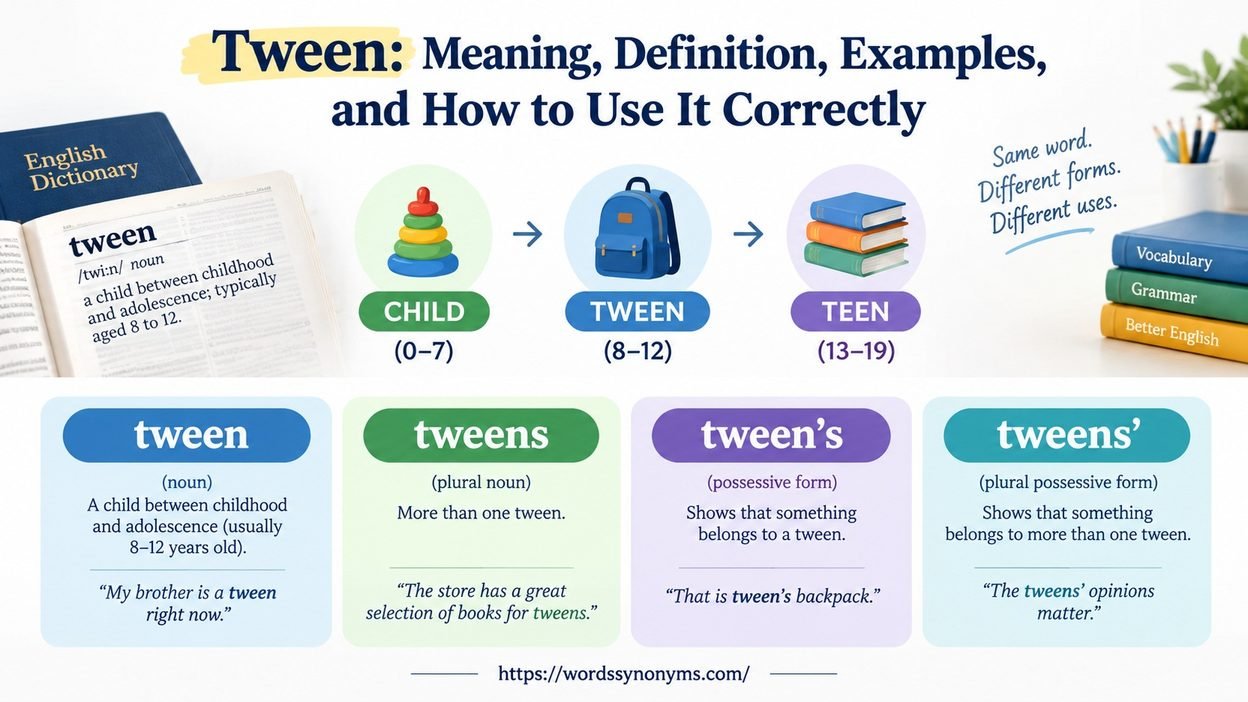
Tween vs. Tween’s vs. Tweens vs. Tweens’
These four forms look similar, but they perform different jobs.
| Form | Meaning | Example |
| tween | One young person | The tween opened the book. |
| tweens | More than one young person | The tweens opened their books. |
| tween’s | Something belonging to one tween | The tween’s backpack was missing. |
| tweens’ | Something belonging to multiple tweens | The tweens’ books were on the table. |
This distinction becomes important in formal writing.
Tween’s
Use tween’s when one tween owns something or when something relates specifically to one tween.
The tween’s favorite book was on the desk.
The apostrophe comes before the s because the noun is singular.
Tweens’
Use tweens’ when something belongs to multiple tweens.
The tweens’ opinions differed sharply.
The plural already ends in s, so the possessive apostrophe comes after it.
Tweens
Use tweens when you simply mean more than one tween.
The program welcomes tweens from several schools.
No apostrophe is needed.
What Is the Possessive Form of Tween?
The possessive forms follow the normal English rules for singular and plural nouns.
Singular Possessive: Tween’s
Use tween’s for one tween.
Examples:
- The tween’s phone rang.
- The tween’s backpack was under the chair.
- The tween’s favorite game sold out.
Plural Possessive: Tweens’
Use tweens’ for several tweens.
Examples:
- The tweens’ artwork filled the hallway.
- The tweens’ parents attended the meeting.
- The organization surveyed the tweens’ preferences.
The rule is simple:
One tween → tween’s
Several tweens → tweens’
How Do You Pronounce “Tween”?
Tween is pronounced /twiːn/.
It has one syllable and rhymes with:
- green
- seen
- screen
- clean
- queen
- between
The pronunciation is straightforward:
tween → “tween”
The vowel sound is the long ee sound found in green and seen.
Because the word comes from the same linguistic family as between, the pronunciation feels familiar to most English speakers.
Read more: Car Park vs. Parking Lot: What’s the Difference?
Where Did the Word “Tween” Come From?
The history of tween becomes more interesting when you separate its two meanings.
The Modern Noun
The age-related noun developed in the 20th century.
Merriam-Webster gives 1946 as its first known use and identifies the noun as a blend of between and teen.
That formation captures the central idea perfectly: a child occupies a stage between childhood and the teenage years.
Oxford also places the word’s origin in the 1940s, although its entry describes the origin as unknown.
The slight difference between dictionary explanations is worth noticing. Etymology isn’t always reconstructed with absolute certainty. Merriam-Webster identifies the blend explicitly, while Oxford gives the broader historical period.
The Older Preposition
The preposition tween has a much older history.
Merriam-Webster traces it to Middle English twene, a shortened form of betwene, and gives the first known use as the 12th century.
So the two senses have very different histories:
| Sense | Meaning | First known use |
| tween as a preposition | between | 12th century |
| tween as a noun | preteen | 1946 |
That’s a fascinating example of how one spelling can carry unrelated historical layers.
“Tween” vs. “Between”: What’s the Difference?
The distinction is mainly about meaning and modern usage.
Between is the ordinary modern preposition.
The school sits between two parks.
Tween, when used as a preposition, is an old or specialized form of between.
He walked tween the trees.
In modern American writing, the second construction can sound archaic, poetic, dialectal, or intentionally informal.
By contrast, tween as a noun is completely ordinary:
The store sells clothes for tweens.
The words may look closely related because they actually are. However, they aren’t interchangeable in modern everyday writing.
Quick Comparison
| Word | Modern meaning | Commonness |
| between | In the space or relationship separating things | Very common |
| tween | A child roughly between childhood and adolescence | Common |
| tween as a preposition | An old form of between | Uncommon |
Tween vs. Tweener
Tweener can refer to a young person in roughly the same age group as a tween.
Oxford lists tweener as a synonym for a child around 10 to 12 in one of its entries.
Cambridge likewise defines tweener as a young person approximately eight to twelve years old and lists tween and tweenager as synonyms.
However, tweener has other meanings.
For example, in sports, tweener can describe a player whose characteristics fall between two positions. Merriam-Webster records this sports sense and dates it to 1978.
Context therefore matters.
If someone says:
The program is designed for tweeners.
the youth-related meaning may be intended.
But if a sports commentator says:
He’s a tweener.
the speaker may be describing a player’s position or skill set.
Common Phrases With “Tween”
The word appears in several established combinations.
Tween Years
Tween years refers to the period when a child falls roughly between childhood and the teenage years.
Example:
The tween years can bring noticeable changes in interests and independence.
The phrase focuses on a period of life, rather than the child as an individual.
Tween Clothing
Tween clothing describes clothes marketed toward children in the tween age range.
Example:
The retailer launched a new tween clothing collection.
This phrase is common because clothing companies often divide their products into age-based categories.
Tween Books
Tween books generally refers to books written or marketed for readers in the tween age group.
Example:
The library added several new tween books to its young readers’ section.
This category often overlaps with middle-grade fiction. However, the terms aren’t perfectly interchangeable because publishing classifications can depend on reading level, themes, audience, and marketing.
Tween Audience
A tween audience means an audience made up primarily of tweens.
Example:
The animated series attracted a large tween audience.
The expression appears naturally in entertainment, publishing, advertising, and media discussions.
Tween Culture
Tween culture refers broadly to trends, interests, media, products, language, and social habits associated with tweens.
The phrase can cover many areas, including:
- entertainment
- fashion
- books
- games
- music
- hobbies
- social activities
- consumer products
Because the age range isn’t rigid, tween culture also changes depending on the context in which the term appears.
Common Mistakes With “Tween”
A few mistakes appear repeatedly when people use this word.
Mistake: Treating Tween as an Exact Age Category
There isn’t one universal age cutoff.
Cambridge uses approximately 8–12, while Oxford gives approximately 10–12.
So avoid statements such as:
Every tween is exactly 10 to 12 years old.
A better approach is:
A tween is generally a child around 8 to 12 years old.
That wording reflects actual dictionary usage more accurately.
Mistake: Confusing Tween With Teen
A tween is generally before the teenage years.
A teenager is normally 13–19.
So:
- 10-year-old → commonly a tween
- 11-year-old → commonly a tween
- 12-year-old → commonly a tween or preteen
- 13-year-old → teenager
The labels overlap around the edges, but they aren’t synonyms.
Mistake: Using Tween’s as the Plural
Don’t write:
The store sells clothes for tween’s.
The correct form is:
The store sells clothes for tweens.
Use tween’s only when showing singular possession.
The tween’s jacket was blue.
Mistake: Assuming Tween Is Only Slang
Although tween has an informal tone in some contexts, it is a dictionary-recognized word.
Major dictionaries document it as a noun meaning a preteen or child around the transition to adolescence.
Mistake: Assuming Tween Always Means a Child
The word has an older prepositional meaning too.
Merriam-Webster recognizes tween as a preposition meaning between.
However, modern readers will usually understand the noun meaning when they see the standalone word tween.
Is “Tween” Formal or Informal?
Dictionary labels provide useful clues here.
Oxford marks the noun informal.
That doesn’t mean you should avoid the word. It means the term has a conversational, everyday quality rather than the technical precision of a formal classification.
In ordinary writing, tween works naturally in contexts such as:
- parenting
- education
- entertainment
- retail
- publishing
- everyday conversation
For highly formal writing, a more precise description may sometimes be preferable.
For example:
Participants aged 10–12 were surveyed.
is more exact than:
Tweens were surveyed.
The second sentence is perfectly natural when the exact ages aren’t important.
Tween in American English
In US English, tween is a familiar term for a child between childhood and the teenage years.
Cambridge’s American English entry uses the approximate 8–12 range and provides examples involving tween clothing and tween audiences.
The word appears particularly often in contexts where age groups matter.
For example:
- tween clothing identifies a retail category.
- tween readers identifies a publishing audience.
- tween audience identifies a media demographic.
- tween years describes a life stage.
- tween culture describes age-related trends.
This widespread use explains why tween has become more than a casual nickname. It now serves as a convenient category label.
Why Does the Term “Tween” Matter?
The word fills a useful gap in everyday vocabulary.
Without tween, writers would often need longer descriptions such as:
children who are too old to be considered young children but haven’t reached their teenage years.
That’s cumbersome.
Tween compresses that entire idea into one word.
This is a common feature of language. When speakers repeatedly need to describe a particular group or concept, English often develops a shorter label.
The word also captures something more subtle than age. A tween occupies a transition point.
A child at this stage may still enjoy traditional childhood interests while beginning to seek greater independence. That’s one reason the term appears frequently in discussions about books, entertainment, clothing, school life, and family relationships.
A Practical Case Study: Choosing the Right Word
Imagine a writer is describing a school program for students aged 10 to 12.
The writer could say:
The program is designed for children between the ages of 10 and 12.
That’s accurate and precise.
The writer could also say:
The program is designed for tweens.
That’s shorter and more conversational.
If the article is about a school policy that requires exact age information, the first sentence is better.
If the article is promoting an after-school program for this age group, tweens may sound more natural.
The choice isn’t about one form being correct and the other being wrong. It’s about precision, audience, and context.
Facts About the Word “Tween”
Here are the key facts in one place:
- Part of speech: Primarily a noun in its modern age-related sense.
- Meaning: A child roughly between childhood and the teenage years.
- Common age range: Approximately 8–12, although sources vary.
- Pronunciation: /twiːn/
- Plural: tweens
- Singular possessive: tween’s
- Plural possessive: tweens’
- Related term: preteen
- Related word: tweenager
- Older meaning: A preposition meaning between.
- Modern noun origin: A blend of between and teen.
- First known noun use: 1946, according to Merriam-Webster.
- First known preposition use: 12th century, according to Merriam-Webster.
Quick Comparison: Tween Forms
| Form | Correct use | Example |
| tween | One child in the tween age group | She is a tween. |
| tweens | More than one tween | The tweens joined the activity. |
| tween’s | Something belonging to one tween | The tween’s book was missing. |
| tweens’ | Something belonging to multiple tweens | The tweens’ books were organized by subject. |
| between | Standard modern preposition | The school is between two parks. |
This table captures the distinction that causes the most confusion.
FAQs
What does “tween” mean?
A tween is generally a child who is between childhood and the teenage years. The term most often refers to children around ages 11 and 12.
What age is considered a tween?
Ages 11 and 12 are commonly considered the tween years. However, some dictionaries and sources use a broader age range.
Is “tween” short for “preteen”?
Yes. Tween is commonly used as a shortened form of preteen, describing someone who has not quite reached the teenage years.
Is a tween a teenager?
No. A tween is generally not considered a teenager. The word describes the stage immediately before or around the beginning of the teenage period.
What is a tweenager?
A tweenager is a related term for a child who is approaching or entering the teenage years. Some definitions use a wider age range, such as 10 to 14.
Is “tweenie” another word for tween?
Yes. Tweenie can be used as an alternative to tween, although tween is much more common in everyday English.
Conclusion
Understanding tween is easier when you think of it as a bridge between childhood and the teenage years. The word usually describes children around 11 or 12, although some sources use a wider age range. That small difference explains why you may see slightly different definitions in dictionaries and other language references.
Whether you use tween, preteen, tweenager, or tweenie, the idea remains closely connected to growing up and approaching adolescence. Knowing the context and the source’s preferred age range helps you use the word naturally and accurately.

Samreen Saif is a passionate writer and language enthusiast who contributes informative and engaging content to WordsSynonyms.com. She enjoys exploring English vocabulary, synonyms, antonyms, word meanings, and language usage to help readers understand and use words with confidence.
Samreen focuses on creating clear, accurate, and easy-to-read content for students, writers, professionals, and English learners. Through her articles, she aims to make vocabulary learning simple, practical, and useful for everyday communication.
When she is not writing, Samreen enjoys learning about language, discovering new words, and creating helpful content that makes English learning more accessible to everyone.