
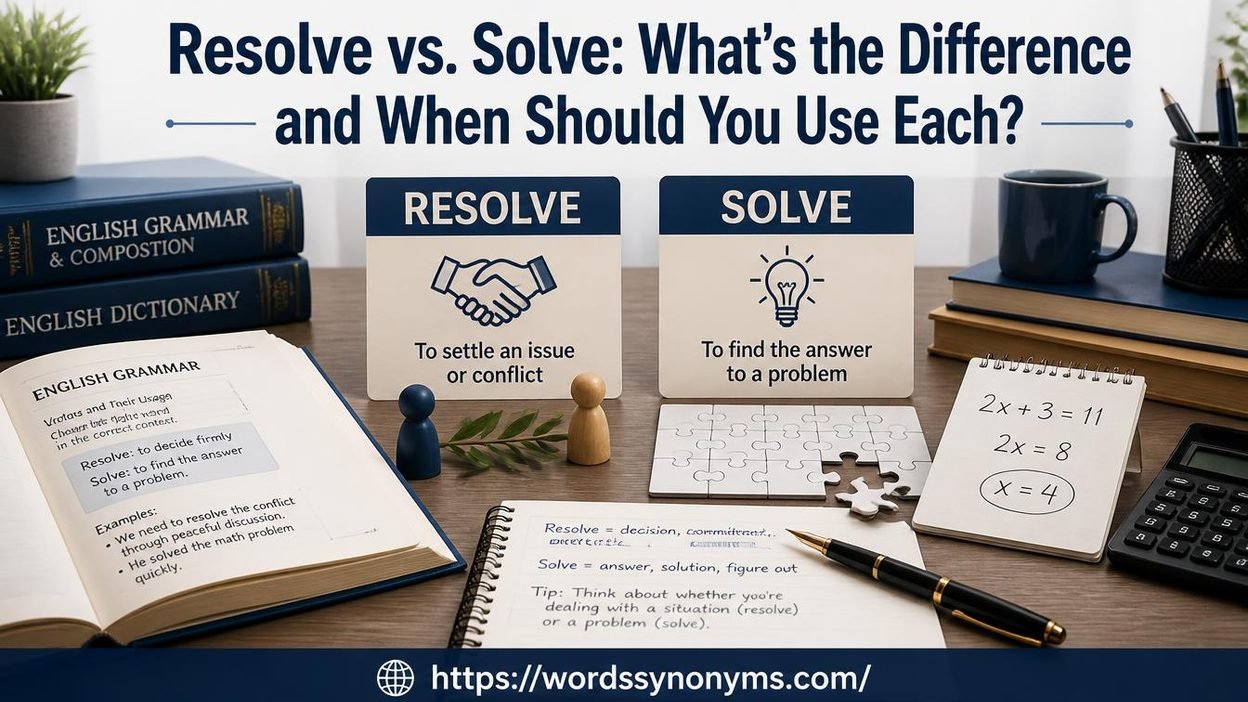
Resolve vs. Solve may seem like the same word at first glance, since both are similar, spelt nearly the same, and sound alike, but their meanings are different in various contexts.
Solve is a verb that simply means finding an answer to a question or problem. A mathematical or mysterious problem can be solved, while a logical answer solves it. The process of solving involves unravelling the problem, reaching a straightforward solution, and finding the correct answer. The word is derived from the Latin solver, meaning loosen or untie.
From my experience, this simple concept makes problem solving easier to understand because the method focuses on a set answer.
Resolve has a broader meaning and can work as a noun or verb. The noun esolve describes a firm intention, while the verb can decide a course of action for an individual or assembly through a formal vote. It can also break something into separate elements and analyze them, bring an issue to an end or conclusion, or find a solution to a problem or solution to a mystery.
Resolving or resolving a problem can involve decision and action, whether the result is popular or successful. Solve and resolve can sometimes be interchangeable when seeking a logical, correct, and successful solution, while solvability, resolvability, resolvable, and solvable describe related qualities.
The solver may therefore solve a problem, while someone may resolve the issue by bringing it to an end.
Quick Answer
Wondering whether you should use solve or resolve? You’re not alone. The two words are closely related, but they usually fit different situations.
Solve is about finding an answer or solution. You solve a math problem, crack a mystery, figure out a puzzle, or fix a tricky technical issue.
Resolve is more about settling something and bringing it to a conclusion. You might resolve a disagreement, a complaint, a conflict, or an ongoing issue.
Here’s a simple way to see the difference:
| Word | What it means | Example |
| Solve | Find an answer or solution | She solved the puzzle. |
| Resolve | Settle or clear up a situation | They resolved their disagreement. |
Think of it this way: when you solve something, you figure it out. When you resolve something, you settle it.
That’s why we normally say “solve an equation” but “resolve a conflict.” Still, there are situations where the two words overlap. For example, both solve a problem and resolve a problem can sound perfectly natural.
The easiest rule to remember is:
👉 Solve = figure it out.
👉 Resolve = settle it.
Once you think about the goal—finding an answer versus bringing a situation to a close—the difference becomes much easier to spot.
Resolve vs. Solve: The Quick Difference
Here’s the simplest way to understand the difference between resolve vs. solve:
| Word | Core Meaning | Common Use | Example |
| Solve | Find an answer or solution | Problems, puzzles, equations, mysteries | She solved the equation. |
| Resolve | Settle, clear up, or bring something to an end | Conflicts, disputes, issues, concerns | They resolved the dispute. |
The easiest memory trick is this:
Solve focuses on finding the answer. Resolve focuses on bringing the matter to a conclusion.
Of course, language isn’t always that neat. Some problems can be both solved and resolved.
For example:
- The engineer solved the technical problem.
- The engineer resolved the technical problem.
Both sentences are grammatically correct. However, they place slightly different emphasis on the situation.
Solved highlights the discovery of a working answer. Resolved emphasizes that the issue no longer remains unsettled.
That subtle shift is the heart of the resolve vs. solve difference.
What Does “Solve” Mean?
The verb solve generally means to find the answer to a question, problem, mystery, or challenge.
When you solve something, you work through it until you discover the correct answer or a workable solution.
Think of solve as a word connected to intellectual discovery. There is often something unknown, confusing, broken, or incomplete. Your job is to figure it out.
Common Things You Solve
You can naturally use solve with:
- A problem
- An equation
- A puzzle
- A mystery
- A riddle
- A crime
- A case
- A mathematical question
- A technical challenge
- A scientific problem
Here are a few examples:
- Can you solve this equation?
- She solved the crossword puzzle before breakfast.
- Detectives finally solved the mystery.
- Engineers are trying to solve the software problem.
- Scientists hope to solve the problem through further research.
In each example, the situation involves finding an answer, explanation, or solution.
Solve Often Suggests a Discoverable Answer
One useful way to understand solve is to imagine a locked door.
Somewhere, there is a key.
You may not know where the key is yet. You may need knowledge, experimentation, logic, or investigation to find it. Once you do, you’ve solved the problem.
That is why solve works so naturally with mathematics and puzzles.
Consider these examples:
- Solve for x.
- Solve the equation.
- Solve the riddle.
- Solve the puzzle.
Each situation has something to figure out.
The answer might be difficult to reach, but the task involves discovering it.
What Does “Resolve” Mean?
The word resolve has a broader range of meanings than solve. That broader meaning explains why people often confuse the two.
At its most common, resolve means to deal with something successfully and bring it to a conclusion.
However, the word can also refer to settling disagreements, clearing up uncertainty, or making a firm decision.
Resolve Meaning: Settle or Clear Up an Issue
One common use of resolve involves problems and issues.
Examples include:
- The company resolved the billing issue.
- We need to resolve this problem quickly.
- The support team resolved the customer’s complaint.
- The discussion resolved several concerns.
In these situations, resolve suggests that the matter has been addressed successfully.
The emphasis isn’t necessarily on discovering a single correct answer. Instead, the goal is to make the issue go away or bring it to a satisfactory conclusion.
Resolve Meaning: Settle a Conflict or Disagreement
This is where resolve often works better than solve.
Conflicts don’t always have one objectively correct answer.
Imagine two neighbors arguing about a property boundary. You cannot always “solve” the disagreement the way you solve a mathematical equation. Instead, the parties may negotiate, compromise, or reach an agreement.
They resolve the dispute.
Common phrases include:
- resolve a conflict
- resolve a disagreement
- resolve a dispute
- resolve differences
- resolve a legal matter
For example:
- The two companies resolved their contract dispute.
- Mediation helped resolve the conflict.
- The family eventually resolved their differences.
The word resolve fits because the objective is settlement.
Resolve Meaning: Make a Firm Decision
Here’s an important difference between resolve and solve: resolve can also mean deciding firmly to do something.
For example:
- She resolved to exercise every morning.
- He resolved to change his habits.
- They resolved to improve customer service.
In these sentences, resolve means to make a serious and determined decision.
You cannot replace it with solve.
Incorrect:
- She solved to exercise every morning.
Correct:
- She resolved to exercise every morning.
This meaning has nothing to do with fixing a problem. It concerns determination and intention.
Resolve as a Noun
Resolve can also function as a noun.
As a noun, it means firm determination or strength of purpose.
Examples:
- Her resolve never weakened.
- He showed remarkable resolve during difficult times.
- Their resolve helped them overcome the challenge.
Again, solve doesn’t have this meaning.
That alone shows why the two words aren’t complete synonyms.
The Main Difference Between Resolve and Solve
The most important difference between resolve vs. solve comes down to what you’re trying to emphasize.
Solve Focuses on Finding an Answer
Use solve when the central task involves finding something.
That something could be:
- An answer
- An explanation
- A solution
- A missing piece of information
- A method that works
For example:
A detective solves a mystery by discovering what happened.
The detective investigates clues, eliminates possibilities, and eventually finds the explanation.
The emphasis falls on discovery.
Resolve Focuses on Bringing Something to an End
Use resolve when the central task involves settling or concluding something.
For example:
Two employees resolve a disagreement by discussing their concerns and reaching an agreement.
There may not be one objectively correct answer.
Instead, the goal is closure.
That distinction becomes especially useful in workplace communication, legal writing, customer service, and interpersonal situations.
The Difference in One Simple Comparison
Consider these two scenarios.
Scenario One: A puzzle
You have a crossword clue. There is a correct answer.
You solve the puzzle.
Scenario Two: A disagreement
Two people disagree about how to divide responsibilities. They discuss the issue and reach a compromise.
They resolve the disagreement.
One requires an answer.
The other requires settlement.
That’s the practical difference.
Can You Use Resolve and Solve Interchangeably?
Sometimes, yes.
However, interchangeability depends heavily on the noun that follows the verb.
Solve a Problem vs. Resolve a Problem
Both phrases are correct:
- We need to solve the problem.
- We need to resolve the problem.
Still, the emphasis differs slightly.
Solve the problem suggests finding a solution.
Resolve the problem suggests dealing with the issue until it no longer remains a problem.
Imagine a malfunctioning machine.
An engineer studies the machine, identifies the broken component, and creates a fix.
The engineer solves the problem.
After the repair, the company can say the issue has been resolved.
The first phrase focuses on the process of finding the answer. The second focuses on the successful conclusion.
Solve an Issue vs. Resolve an Issue
Both expressions appear in modern English.
However, resolve an issue often sounds more natural in professional settings.
For example:
- The IT team is working to resolve the issue.
- Customer service resolved the issue within 24 hours.
Meanwhile, solve the issue remains grammatically correct, especially when the issue involves a clear technical or practical solution.
Solve a Conflict vs. Resolve a Conflict
Here, resolve is usually the better choice.
Why?
Because conflicts often involve people, emotions, competing interests, and compromises. They aren’t always like puzzles with one correct answer.
More natural:
- The mediator helped resolve the conflict.
Less natural:
- The mediator helped solve the conflict.
The second sentence isn’t impossible, but native speakers generally prefer resolve.
Resolve a Puzzle vs. Solve a Puzzle
In ordinary English, solve is the clear choice.
Natural:
- She solved the puzzle.
Unusual:
- She resolved the puzzle.
A puzzle asks you to discover an answer. Therefore, solve fits naturally.
Resolve vs. Solve in Different Contexts
The following table makes the distinction easier to see.
| Context | Best Choice | Reason |
| Math equation | Solve | You find the answer |
| Puzzle | Solve | You work out the solution |
| Riddle | Solve | You discover the answer |
| Mystery | Solve | You uncover the explanation |
| Crime | Solve | Investigators discover what happened |
| Conflict | Resolve | People settle the disagreement |
| Dispute | Resolve | Parties reach an agreement |
| Complaint | Resolve | The matter is addressed and settled |
| Technical problem | Usually solve | A workable solution is needed |
| Workplace issue | Often resolve | The matter needs closure |
| Personal determination | Resolve | It means making a firm decision |
This table isn’t a rigid law.
Context always matters.
Still, these patterns reflect how English speakers naturally use the words.
Common Collocations With “Solve”
A collocation is a group of words that commonly appear together.
Learning collocations is one of the fastest ways to improve your vocabulary. Instead of memorizing isolated dictionary definitions, you learn how words behave in real sentences.
Common Phrases With Solve
The most natural combinations include:
- solve a problem
- solve an equation
- solve a puzzle
- solve a mystery
- solve a crime
- solve a riddle
- solve a case
- solve a mathematical problem
- solve a technical issue
- solve a challenge
Examples of Solve in Sentences
- The student solved the difficult equation.
- Nobody could solve the ancient riddle.
- Detectives solved the case after finding new evidence.
- The developer solved the software bug.
- Researchers are working to solve a complex scientific problem.
Notice the pattern.
Solve usually appears when someone must figure something out.
The process might involve creativity, logic, experimentation, or investigation. Either way, the person searches for an answer.
Common Collocations With “Resolve”
Resolve often appears with situations that need settlement, closure, or clarification.
Common Phrases With Resolve
You can naturally say:
- resolve a conflict
- resolve a dispute
- resolve an issue
- resolve a complaint
- resolve a disagreement
- resolve a matter
- resolve a concern
- resolve doubts
- resolve differences
- resolve a problem
You can also use it in a completely different structure:
- resolve to do something
And as a noun:
- show resolve
- demonstrate resolve
- strengthen someone’s resolve
Examples of Resolve in Sentences
- The manager resolved the conflict between team members.
- The company resolved the customer’s complaint.
- Negotiations helped resolve the dispute.
- The meeting resolved several concerns.
- She resolved to become more organized.
- His resolve remained strong despite repeated setbacks.
The surrounding words often tell you which meaning of resolve is intended.
That’s why context matters so much.
Resolve vs. Solve: Sentence Examples Side by Side
Sometimes, examples make the distinction clearer than definitions.
Example: Mathematics
Incorrect or highly unusual:
She resolved the equation.
Natural:
She solved the equation.
An equation requires an answer. Therefore, solve is the standard choice.
Example: A Disagreement
Less natural:
They solved their disagreement.
More natural:
They resolved their disagreement.
A disagreement needs settlement, communication, or compromise.
Example: A General Problem
Both can work:
The team solved the problem.
The team resolved the problem.
The difference is subtle.
The first sentence emphasizes finding the solution.
The second emphasizes successfully bringing the issue to an end.
Example: A Personal Decision
Incorrect:
He solved to quit smoking.
Correct:
He resolved to quit smoking.
Here, resolved means made a firm decision.
Example: A Customer Complaint
Possible but less natural:
The company solved the customer’s complaint.
More natural:
The company resolved the customer’s complaint.
A complaint is usually addressed, handled, and settled. It isn’t something you “solve” in the same way you solve an equation.
Read more: Credible, Creditable, or Credulous? Meaning, and Differences
Why “Resolve” Often Sounds More Formal Than “Solve”
Another important part of the resolve vs. solve difference involves tone.
In many situations, resolve sounds slightly more formal or professional.
Consider these examples.
Everyday language:
Let’s solve this problem.
Professional communication:
Let’s work together to resolve this issue.
Both sentences are clear.
However, resolve frequently appears in:
- Business communication
- Customer service
- Legal discussions
- Government documents
- Workplace policies
- Diplomatic communication
That doesn’t mean resolve is simply a fancy version of solve.
Using a more formal word doesn’t automatically improve a sentence.
In fact, replacing every instance of solve with resolve can make your writing sound unnatural.
Choose the word that matches the situation.
Resolve vs. Solve in Business and Professional Writing
Professional writing provides an excellent example of how context shapes word choice.
Businesses frequently use resolve when discussing customer concerns, disputes, and ongoing issues.
Common examples include:
- resolve a customer complaint
- resolve a billing issue
- resolve a workplace conflict
- resolve a dispute
- resolve an outstanding matter
Customer Service Example
Imagine a customer receives an incorrect invoice.
The customer contacts the company.
The support representative investigates the situation, corrects the invoice, and confirms the solution.
The company can say:
We have resolved the billing issue.
This wording emphasizes closure.
Technical Support Example
Now imagine a server suddenly stops working.
An IT specialist investigates the error, identifies faulty code, and applies a fix.
You might say:
The developer solved the technical problem.
Afterward, you could also say:
The issue has been resolved.
Both are possible because the situation includes both discovery and closure.
A Simple Workplace Rule
Use solve when emphasizing the solution.
Use resolve when emphasizing the successful completion of the matter.
For example:
- Engineers solved the system failure.
- Management resolved the service disruption.
The distinction isn’t absolute. Still, this pattern often produces more natural professional writing.
Resolve vs. Solve in Mathematics and Technical Fields
Mathematics provides one of the clearest examples of where solve dominates.
You would normally say:
- solve an equation
- solve for x
- solve a mathematical problem
- solve a calculation problem
For example:
Solve for x when 2x + 6 = 14.
Nobody would normally say:
Resolve for x.
That sounds incorrect in standard mathematical English.
Why Solve Works in Mathematics
Mathematics assumes that you are searching for an answer based on rules, formulas, and logical relationships.
You start with incomplete information.
Then you work toward a solution.
That process perfectly matches the core meaning of solve.
Technical Usage Can Overlap
Technical problems sometimes work with either word.
For example:
- The engineer solved the network problem.
- The engineer resolved the network issue.
The first emphasizes discovering and implementing a fix.
The second emphasizes that the issue has been successfully addressed.
Both sentences can sound natural.
Common Mistakes When Using Resolve and Solve
Even advanced English learners sometimes misuse these words because their meanings overlap.
Here are the most common mistakes.
Using “Solve” for Interpersonal Conflicts
Less natural:
They solved their differences.
More natural:
They resolved their differences.
People usually resolve differences through communication, negotiation, or compromise.
Using “Resolve” for Puzzles
Less natural:
He resolved the crossword puzzle.
Natural:
He solved the crossword puzzle.
Puzzles have answers to discover.
That makes solve the natural choice.
Assuming Resolve Always Means Solve
This mistake creates confusion.
Remember that resolve can mean:
- settle an issue
- clear up uncertainty
- end a disagreement
- make a firm decision
- demonstrate determination
For example:
She resolved to study harder.
Here, resolve has nothing to do with solving a problem.
Choosing a More Formal Word Just to Sound Smarter
Clear writing beats complicated writing.
Don’t write:
We shall endeavor to resolve the mathematical conundrum.
When you could simply write:
We need to solve the math problem.
The second sentence is clearer.
Fancy wording can sometimes bury meaning instead of improving it.
A Simple Trick to Remember the Difference Between Resolve and Solve
If you struggle to remember which word to use, ask yourself one question.
Are You Looking for an Answer?
If yes, choose solve.
Examples:
- Solve a puzzle.
- Solve a mystery.
- Solve an equation.
- Solve a riddle.
Are You Trying to Settle or Clear Up Something?
If yes, choose resolve.
Examples:
- Resolve a dispute.
- Resolve a conflict.
- Resolve a complaint.
- Resolve a concern.
Here’s the memory shortcut:
Solve = find the solution. Resolve = bring the situation to closure.
It’s not a perfect rule for every sentence.
Still, it works remarkably well in everyday writing.
Resolve vs. Solve: A Real-World Case Study
Let’s look at a practical example.
The Problem
A software company releases an update.
Soon afterward, customers report that the application crashes whenever they open a particular feature.
The company now faces two related tasks.
Step One: Solve the Technical Problem
Engineers investigate the code.
They test different possibilities.
Eventually, they discover that a recent update created a compatibility error.
They identify the cause and create a patch.
At this stage, the engineers have solved the problem.
They found the answer.
Step Two: Resolve the Customer Issue
The company releases the patch.
Customer support contacts affected users.
The company refunds customers who experienced serious disruption.
The issue is now closed.
The company has resolved the issue.
This example shows the subtle relationship between the words.
First, someone solves the underlying problem.
Then, the organization resolves the broader situation.
The words overlap, but they highlight different parts of the process.
Resolve vs. Solve vs. Settle: What’s the Difference?
Another word often connected with resolve is settle.
All three words can involve ending a difficult situation, but their meanings differ.
| Word | Main Meaning | Best Example |
| Solve | Find an answer or solution | Solve a puzzle |
| Resolve | Clear up or bring something to a conclusion | Resolve a conflict |
| Settle | Reach an agreement or end a dispute | Settle a legal dispute |
Solve
You solve something by finding the answer.
Example:
The scientist solved the problem.
Resolve
You resolve something by successfully dealing with it.
Example:
The manager resolved the workplace conflict.
Settle
You settle something when opposing sides reach an agreement.
Example:
The two companies settled the dispute.
The difference can be subtle.
A legal dispute might be resolved through negotiation and ultimately settled through a formal agreement.
Language often works in layers rather than strict boxes.
How Context Changes the Meaning of Resolve vs. Solve
Words don’t live alone.
The nouns around them influence which verb sounds natural.
Consider the word problem.
You can say:
- solve a problem
- resolve a problem
Now consider equation.
You would normally say:
- solve an equation
But not:
- resolve an equation
Then consider conflict.
You would usually say:
- resolve a conflict
The surrounding context guides the choice.
This is one reason why memorizing dictionary definitions isn’t always enough. You also need to notice common word partnerships.
English speakers develop an instinct for these combinations over time.
You can speed up that process by learning words in phrases.
Instead of memorizing:
solve = find an answer
Learn:
- solve a puzzle
- solve a mystery
- solve an equation
Instead of memorizing:
resolve = settle
Learn:
- resolve a dispute
- resolve a conflict
- resolve an issue
Your vocabulary becomes more natural when you learn patterns instead of isolated words.
FAQs
1. What is the main difference between solve and resolve?
Solve usually means finding an answer to a problem, while resolve often means bringing an issue to an end or reaching a decision.
2. Can solve and resolve be used interchangeably?
Sometimes. They can overlap when you mean finding a correct or successful solution, but their broader meanings and common contexts are different.
3. When should I use solve?
Use solve when you’re looking for an answer, especially for a mathematical, logical, mysterious, or clearly defined problem.
4. When should I use resolve?
Use resolve when you want to settle an issue, make a decision, end a disagreement, or bring a problem to a conclusion.
5. Does resolve always mean finding an answer?
No. Resolve can also involve making a decision, taking action, analyzing separate elements, or bringing an issue to a conclusion without a single set answer.
6. Is a solver someone who solves or resolves a problem?
A solver is generally someone or something that solves a problem by finding an answer. Resolve has related forms such as resolvable and resolvability, which describe whether something can be resolved.
Conclusion
The easiest way to remember the difference is to think about the goal behind the action. Solve is about working out an answer, while resolve is about settling an issue or bringing it to an end. You solve a puzzle, equation, or mystery when you need to discover what the answer is. You resolve a disagreement, conflict, or difficult situation when the main aim is to settle what is happening and move forward.
In everyday writing, choosing the right word can make your meaning much clearer. If there is a definite answer waiting to be discovered, solve is usually the better choice.
If the situation needs a decision, settlement, or final outcome, resolve fits more naturally. Once you see that difference, these two closely related words become much easier to use with confidence.

Samreen Saif is a passionate writer and language enthusiast who contributes informative and engaging content to WordsSynonyms.com. She enjoys exploring English vocabulary, synonyms, antonyms, word meanings, and language usage to help readers understand and use words with confidence.
Samreen focuses on creating clear, accurate, and easy-to-read content for students, writers, professionals, and English learners. Through her articles, she aims to make vocabulary learning simple, practical, and useful for everyday communication.
When she is not writing, Samreen enjoys learning about language, discovering new words, and creating helpful content that makes English learning more accessible to everyone.