The difference between suit vs. suite may seem small at first glance. After all, the two words sound very similar and differ by only one letter. However, they have entirely different meanings, grammatical roles, and uses.
Mixing them up can change the meaning of a sentence completely. You might write that someone booked a hotel suit when you actually mean a hotel suite. Or perhaps you write “follow suite” instead of the correct phrase, “follow suit.”
The good news? Once you understand the central idea behind each word, choosing the correct spelling becomes much easier.
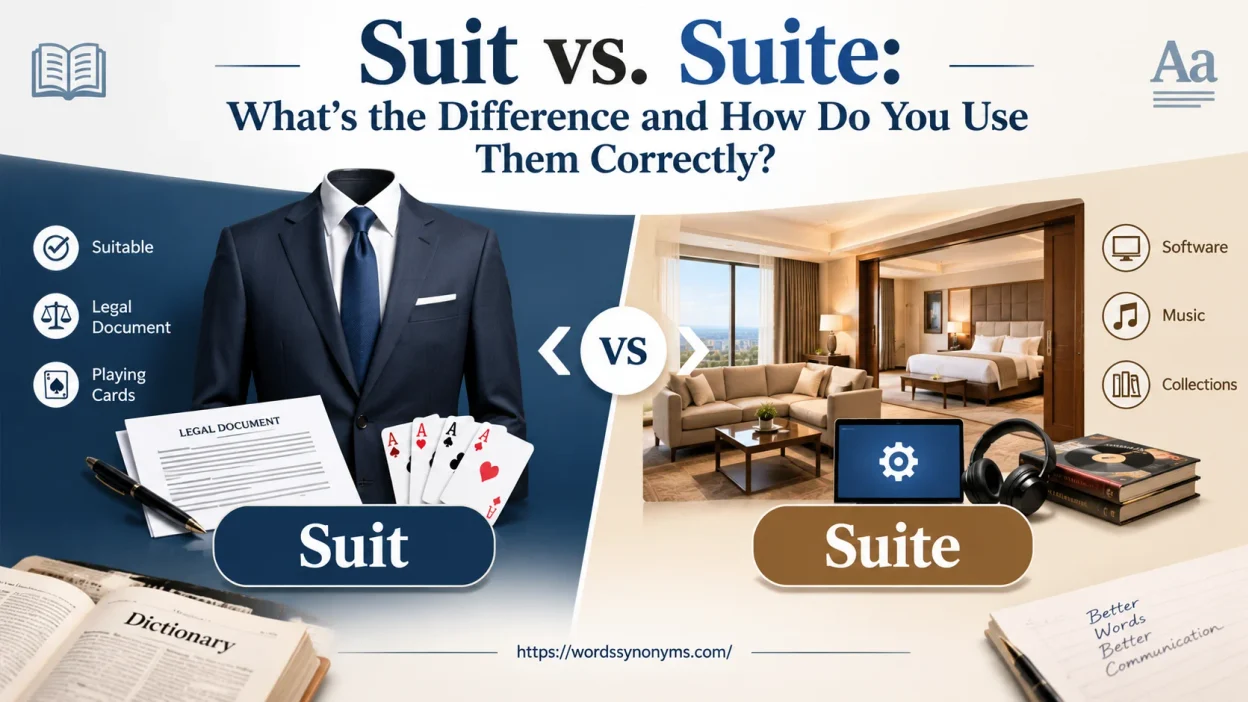
Suit usually relates to clothing, suitability, legal action, or playing cards. Suite, on the other hand, usually refers to a connected group or collection of things, such as hotel rooms, software programs, furniture, or musical compositions.
This guide breaks down suit vs. suite with definitions, examples, grammar rules, common mistakes, memory tricks, and practical exercises. By the end, you won’t need to second-guess which word belongs in your sentence.
Quick Answer
Here’s the simplest way to understand the difference:
| Word | Main Meaning | Part of Speech | Example |
| Suit | Clothing, suitability, legal action, card category | Noun or verb | That schedule suits me. |
| Suite | A connected group or collection | Noun | We booked a hotel suite. |
The biggest difference comes down to meaning.
Use suit when talking about something that fits, is appropriate, involves clothing, refers to a legal case, or describes a category of playing cards.
Use suite when referring to a connected set of rooms or a collection of related things.
For example:
- He wore a black suit to the wedding.
- That arrangement doesn’t suit me.
- The company filed a legal suit.
- We stayed in a luxury hotel suite.
- The office installed a new software suite.
Although these words sound alike in some accents, they aren’t interchangeable. Context determines the correct choice every time.
What Does “Suit” Mean?
The word suit has several meanings in English. That’s one reason it appears in so many different situations.
Depending on the context, suit can function as either a noun or a verb.
Let’s look at its most common uses.
Suit as a Set of Clothes
Perhaps the meaning most people recognize first is a matching set of clothes.
A traditional suit usually includes a jacket and matching trousers. In some contexts, it may include a skirt instead. The clothing pieces are designed to work together as one coordinated outfit.
Examples include:
- business suit
- three-piece suit
- pantsuit
- bathing suit
- tracksuit
- spacesuit
Here are a few examples in sentences:
He wore a navy suit to his job interview.
She bought a tailored suit for an important business meeting.
The astronaut’s protective suit allowed him to work in space.
Notice something important: the word suit doesn’t always mean formal business clothing. A bathing suit and a spacesuit are obviously very different garments. Still, each term describes clothing designed for a particular purpose.
That’s a useful clue. A suit often involves something designed to fit a role, purpose, or situation.
Suit as a Verb Meaning “To Be Suitable”
Now things get more interesting.
Suit can also work as a verb. In this form, it means something is appropriate, convenient, pleasing, or well-matched for someone.
For example:
Does Monday morning suit you?
That bright color really suits her.
A flexible schedule would suit my lifestyle better.
The new position perfectly suited his experience.
In these examples, nobody is talking about clothing. Instead, suit means “to be right for” or “to match someone’s needs.”
This is one of the most common places where writers accidentally use suite.
Incorrect:
This time suites me.
Correct:
This time suits me.
A quick grammar check can save you here. If you can replace the word with fits, works for, or is suitable for, you probably need suit.
Suit as a Legal Action
In legal contexts, a suit refers to a lawsuit or legal proceeding.
For example:
The company filed a civil suit against its former contractor.
The dispute eventually resulted in a legal suit.
They settled the suit before the trial began.
This meaning appears frequently in phrases such as:
- civil suit
- legal suit
- class-action suit
- lawsuit
The word lawsuit combines “law” and “suit,” making its meaning easier to remember.
If the sentence involves courts, claims, plaintiffs, or legal disputes, suit is the correct spelling.
Suit in Playing Cards
A suit also refers to one of the four categories in a standard deck of playing cards.
The four suits are:
- Hearts
- Diamonds
- Clubs
- Spades
For example:
Hearts is the only red suit in her hand.
He collected all the cards from one suit.
The idea here involves classification. Each card belongs to a particular group or category.
Other Common Uses of Suit
English also uses suit in several compound words and expressions.
| Expression | Meaning |
| Business suit | Formal professional clothing |
| Bathing suit | Clothing worn for swimming |
| Spacesuit | Protective clothing for astronauts |
| Lawsuit | A legal case |
| Suit someone’s needs | Meet someone’s requirements |
| Suit someone’s taste | Match someone’s preference |
As you can see, suit is a flexible word. Its exact meaning depends heavily on context.
What Does “Suite” Mean?
Unlike suit, the word suite has a more focused central meaning.
A suite is generally a connected collection, group, or set of related things.
The individual items belong together in some way.
That connection is the key to understanding the word.
Suite as a Group of Rooms
The hotel meaning is probably the most familiar.
A suite is a set of connected rooms designed to function together.
For example:
We booked a family suite for our vacation.
The hotel upgraded them to a larger suite.
The presidential suite included a bedroom, living room, and private dining area.
A standard hotel room usually contains one main sleeping and living area. A suite often provides separate spaces, such as:
- a bedroom
- a sitting area
- a living room
- a dining space
- multiple bathrooms
Not every suite looks the same, of course. Hotels use the term differently depending on their room categories. However, the central concept remains consistent: a suite is a group of connected spaces.
Suite as an Office Space
The same principle applies to office buildings.
An office suite may contain several connected rooms occupied by one company, organization, or professional practice.
For example:
The law firm moved into a larger office suite downtown.
Her doctor’s office is located in Suite 400.
In addresses, “Suite” often identifies a specific unit within a larger commercial building.
For instance:
Suite 210 means a designated office or connected business space within the building.
Suite as a Collection of Software
Technology gives the word another popular meaning.
A software suite is a group of related computer programs designed to work together.
For example, a productivity suite may include:
- word processing software
- spreadsheet software
- presentation tools
- email applications
- database tools
The programs serve different purposes, yet they belong to the same connected package.
Example:
The company purchased a complete office software suite.
This usage makes perfect sense when you remember the core idea: suite means a collection of related things.
Suite in Music
In music, a suite is a collection of instrumental pieces designed to be performed as a group.
The individual movements may have different moods, tempos, or structures. Still, they belong together as part of a larger composition.
For example:
The orchestra performed a classical suite.
The composer created a concert suite based on themes from the film.
Musical suites have appeared in many forms throughout music history. Some are collections of dance movements, while others combine themes from larger works such as ballets, operas, or films.
Again, the central idea remains unchanged: several related pieces form one connected whole.
Suite as a Matching Set
The word can also describe matching furniture or fixtures.
Common examples include:
- bedroom suite
- living room suite
- bathroom suite
- furniture suite
For example:
They bought a new bedroom suite with matching furniture.
A bedroom suite might include:
- a bed
- bedside tables
- a dresser
- a mirror
- a wardrobe
These items form a coordinated collection.
Suit vs. Suite: Side-by-Side Comparison
The easiest way to avoid confusion is to compare the words directly.
| Feature | Suit | Suite |
| Primary idea | Something suitable, clothing, legal action, or card category | A connected group or collection |
| Can be a verb? | Yes | Generally no |
| Can be a noun? | Yes | Yes |
| Clothing meaning | Yes | No |
| Hotel meaning | No | Yes |
| Legal meaning | Yes | No |
| Software meaning | No | Yes |
| Playing cards | Yes | No |
| Musical collection | No | Yes |
Here’s the difference in plain English:
Suit = fit, clothing, law, or cards.
Suite = a connected set or collection.
That simple distinction handles most everyday situations.
The Main Grammar Difference Between Suit and Suite
Spelling isn’t the only difference between suit and suite. Their grammatical roles also matter.
“Suit” Can Be a Noun
As a noun, suit can refer to clothing, a legal action, or a card category.
Examples:
He wore a gray suit.
The attorney filed a suit.
Spades is a black suit.
In each sentence, suit names something.
“Suit” Can Be a Verb
As a verb, suit means to fit, please, match, or satisfy.
Examples:
This arrangement suits me.
That hairstyle suits you.
Would next week suit your schedule?
The verb changes form depending on the subject and tense:
| Form | Example |
| Suit | That may suit you. |
| Suits | It suits her perfectly. |
| Suited | The job suited him. |
| Suiting | The arrangement is suiting their needs. |
In everyday writing, the forms suit, suits, and suited appear most often.
“Suite” Functions as a Noun
Suite primarily names a connected group or collection.
Examples:
We reserved a hotel suite.
The company uses a software suite.
The orchestra performed a musical suite.
You wouldn’t normally use suite as a verb meaning “to be suitable.”
That’s why this common mistake is wrong:
❌ The new schedule suites me.
The correct sentence is:
✅ The new schedule suits me.
One letter makes a major grammatical difference.
Common Expressions That Use “Suit”
Some of the most frequent mistakes happen because English contains established expressions with suit.
Learning these phrases can help you recognize the correct spelling automatically.
Follow Suit
Follow suit means to do the same thing someone else has done.
The phrase originally comes from card games, where players may follow the same suit of cards.
Today, it appears in many situations.
One restaurant started offering free delivery, and several competitors soon followed suit.
When the first employee began working remotely, others followed suit.
The correct phrase is always follow suit, not “follow suite.”
Suit Yourself
Suit yourself means “do whatever you prefer.”
Depending on tone, it can sound friendly, neutral, or slightly dismissive.
If you’d rather stay home, suit yourself.
You can order pizza or cook dinner. Suit yourself.
Context matters here. A warm tone makes the phrase casual. A sharp tone can make it sound impatient.
A Strong Suit
A person’s strong suit is an area where they perform particularly well.
For example:
Writing has always been her strong suit.
Public speaking isn’t his strong suit.
This expression doesn’t relate to clothing. It refers to a person’s strength, skill, or advantage.
Never write strong suite in this context.
Suit Someone Fine
This phrase means something is satisfactory or convenient.
Friday afternoon would suit me fine.
A smaller apartment would suit them fine.
The phrase emphasizes that something meets a person’s needs.
Suit Someone to a T
If something suits someone to a T, it fits them perfectly.
The flexible work schedule suits her to a T.
That quiet neighborhood suits their lifestyle to a T.
The phrase suggests an exceptionally good match.
Common Uses of “Suite”
Unlike suit, suite doesn’t appear in as many everyday idioms. Instead, it frequently forms descriptive phrases.
Hotel Suite
A connected group of rooms in a hotel.
They reserved a luxury hotel suite.
Executive Suite
A premium office or hotel space designed for executives or business travelers.
The company rented an executive suite.
Primary Suite
A residential area that typically includes a primary bedroom and related private spaces.
The house features a spacious primary suite.
Office Suite
A connected group of business rooms.
The accounting firm occupies an office suite on the third floor.
Software Suite
A collection of related applications.
The design team uses a professional software suite.
Musical Suite
A collection of related musical compositions or movements.
The symphony ended with an orchestral suite.
Bedroom Suite
A coordinated set of bedroom furniture.
They purchased a matching bedroom suite.
Common Mistakes: Suit or Suite?
Even experienced writers occasionally confuse these homophones.
Here are the mistakes you’ll see most often.
Mistake: “Follow Suite”
Incorrect:
Everyone followed suite.
Correct:
Everyone followed suit.
Why? The phrase means copying someone else’s action. It doesn’t refer to a connected collection.
Mistake: “Strong Suite”
Incorrect:
Math is her strong suite.
Correct:
Math is her strong suit.
A strong suit means a particular strength or skill.
Mistake: “This Suites Me”
Incorrect:
This schedule suites me.
Correct:
This schedule suits me.
The sentence requires a verb meaning “is suitable for.”
Mistake: “Hotel Suit”
Incorrect:
We booked a hotel suit.
Correct:
We booked a hotel suite.
A hotel suite is a connected group of rooms.
Mistake: “Software Suit”
Incorrect:
The company purchased a software suit.
Correct:
The company purchased a software suite.
Software programs grouped together form a suite.
Suit or Suite: How to Remember the Difference
Memory tricks don’t need to be complicated. In fact, the simpler they are, the more likely you’ll remember them.
The “Set” Trick
Think of suite as a word related to a set.
A suite is often a collection of things that belong together:
- a set of rooms
- a set of software programs
- a set of furniture
- a set of musical pieces
Both suite and set can remind you of the idea of a collection.
The “Fit” Trick
Think of suit as something that fits.
If something works for you, matches your needs, or fits your situation, use suit.
For example:
Does Tuesday suit you?
You can mentally translate it to:
Does Tuesday fit your schedule?
If “fit” works, suit probably works too.
A Quick Mental Formula
Use this:
Suit = Fits
Suite = Set
It’s not a perfect dictionary definition, but it’s an excellent shortcut for everyday writing.
Real-Life Examples of Suit and Suite
Definitions are helpful. Context makes them stick.
Here are examples from common situations.
Fashion
Marcus chose a charcoal suit for the wedding.
The word refers to coordinated clothing.
Everyday Preferences
Would an earlier appointment suit you?
Here, suit means “be convenient for.”
Legal Matters
The customer filed a civil suit after the dispute escalated.
The word refers to legal action.
Playing Cards
She needed another card from the same suit.
The word identifies a category of cards.
Hotels
The family booked a two-bedroom suite for their trip.
The suite contains connected living spaces.
Technology
The business adopted a cloud-based software suite.
Several related programs work together as a package.
Music
The orchestra performed a dramatic orchestral suite.
The work contains multiple connected musical sections.
Furniture
Their new bedroom suite included a bed and matching nightstands.
The furniture pieces form a coordinated group.
Suit vs. Suite in Sentences
Paired examples make the distinction especially clear.
| Sentence | Correct Word | Why? |
| The blue ___ looks expensive. | Suit | Clothing |
| That schedule ___ me perfectly. | Suits | Suitable or convenient |
| They filed a legal ___. | Suit | Legal action |
| Hearts is my favorite card ___. | Suit | Card category |
| We stayed in a luxury ___. | Suite | Connected rooms |
| The company installed a software ___. | Suite | Collection of programs |
| She bought a bedroom ___. | Suite | Matching collection |
| The orchestra performed a musical ___. | Suite | Collection of compositions |
One useful habit is to pause before writing the word and ask:
What am I actually describing?
If you’re describing clothing, suitability, law, or cards, choose suit.
If you’re describing a connected collection, choose suite.
Read More: John Hancock vs. John Henry: Meaning and Examples
Can “Suit” and “Suite” Ever Mean the Same Thing?
In modern everyday English, you should treat suit and suite as different words.
Their meanings developed separately enough that substituting one for the other usually creates an error.
Still, language history explains why the words look and sound related. Both have historical connections to ideas involving following, accompanying, or a connected group. Over time, English separated their meanings into distinct paths.
Today, the distinction is clear.
Suit developed a broad range of meanings involving fitting, following, clothing, law, and cards.
Suite retained a stronger connection to the idea of a connected series or collection.
Language can be messy, but modern usage here is straightforward.
Don’t overthink it.
Context will almost always tell you which spelling belongs in the sentence.
Suit vs. Suite: Which Word Should You Use?
Use this quick decision guide whenever you’re unsure.
Choose “Suit” if you’re talking about:
- Formal clothing
- A bathing suit
- A spacesuit
- Something appropriate
- Something convenient
- A person’s preferences
- A legal action
- A lawsuit
- Playing cards
- Someone’s strengths
- Copying another person’s actions
Examples:
That option suits me.
He bought a new suit.
The company filed a suit.
Everyone else followed suit.
Choose “Suite” if you’re talking about:
- Hotel rooms
- Connected rooms
- Office spaces
- Apartment units
- Software collections
- Furniture collections
- Musical compositions
- Groups of related products
Examples:
We booked a hotel suite.
The company uses a security software suite.
They bought a matching furniture suite.
A Practical Case Study: How Context Changes the Word
Imagine two businesses preparing for a major conference.
The first company’s employees need professional clothing.
The manager says:
Everyone should wear a business suit.
The second company needs accommodations for its executive team.
The travel coordinator says:
We reserved an executive suite.
Now imagine someone writes the wrong words.
Everyone should wear a business suite.
That sounds like employees should somehow wear a collection of connected rooms or objects. The meaning collapses.
Or consider:
We reserved an executive suit.
That sounds like the company booked clothing instead of accommodation.
This simple example shows why spelling matters. Suit vs. suite isn’t just a grammar issue. The wrong word can confuse the entire message.
Why Do People Confuse Suit and Suite?
Several factors cause the confusion.
Similar Pronunciation
The words sound very similar in everyday speech, especially when spoken quickly.
Because spelling doesn’t appear in conversation, speakers may never notice the distinction until they write the words.
Similar Appearance
The words differ by only two letters.
- Suit
- Suite
That small spelling difference makes typing errors easy.
Autocorrect Problems
Modern writing tools can create confusion rather than solve it.
Autocorrect may suggest a familiar word without understanding the sentence’s meaning. That’s why relying entirely on spelling software isn’t enough.
Grammar tools can catch some mistakes. Still, context requires human judgment.
Fixed Expressions Cause Confusion
Phrases such as follow suit and strong suit don’t obviously relate to clothing.
As a result, writers sometimes assume “suite” makes more sense because it sounds like a group or sequence.
However, established phrases must retain their standard spelling.
A Simple Editing Method for Suit vs. Suite
Before publishing or sending important writing, use this three-step check.
Step One: Identify the Meaning
Ask what the word represents.
Is it:
- clothing?
- suitability?
- legal action?
- cards?
- a collection?
Step Two: Check the Grammar
Does the word function as an action?
For example:
This arrangement ___ me.
You need a verb, so suits is correct.
Step Three: Look for the “Collection” Idea
If the word describes several connected things, suite is likely correct.
For example:
The hotel suite included several rooms.
Several connected rooms form a suite.
This quick editing process takes only a few seconds.
Quick Quiz: Suit or Suite?
Test your understanding by filling in the blanks.
- We booked the presidential _______ for the weekend.
- That color really _______ you.
- The company filed a legal _______.
- She installed a complete security software _______.
- When one brand changed its policy, the others followed _______.
- Hearts is my favorite card _______.
- His strongest _______ is problem-solving.
- They bought a matching bedroom _______.
- Would Thursday afternoon _______ your schedule?
- The orchestra performed a famous musical _______.
Answers
- Suite
- Suits
- Suit
- Suite
- Suit
- Suit
- Suit
- Suite
- Suit
- Suite
If you got them all right, you’ve mastered the basic distinction.
FAQs
What is the difference between suit and suite?
The main difference is meaning. Suit can refer to clothing, something suitable, a legal action, or a category of playing cards. Suite refers to a connected collection, such as hotel rooms, software programs, furniture, or musical pieces.
Is it “follow suit” or “follow suite”?
The correct phrase is follow suit.
It means to copy or do the same thing someone else has done.
One company lowered its prices, and the others followed suit.
Is it “strong suit” or “strong suite”?
The correct expression is strong suit.
A strong suit means an area where someone performs particularly well.
Communication is one of her strongest suits.
Can “suit” be used as a verb?
Yes. Suit commonly functions as a verb meaning to fit, satisfy, match, or be appropriate.
For example:
Does this time suit you?
That style suits him well.
What does suite mean in a hotel?
A hotel suite is a larger accommodation containing connected or separate functional spaces. Depending on the property, it may include a bedroom, living room, sitting area, dining space, or additional bathroom.
What is a software suite?
A software suite is a collection of related computer programs packaged or designed to work together.
For example, a productivity suite may include word processing, spreadsheet, and presentation applications.
Why do suit and suite sound similar?
The words have related historical roots and evolved through different paths in English. Their modern meanings are distinct, even though their spelling and pronunciation remain similar.
Is “suite” ever used as a verb?
In standard everyday English, suite is primarily used as a noun. When you mean “to be suitable,” “to fit,” or “to work for someone,” use the verb suit.
Final Thoughts on Suit vs. Suite
The difference between suit vs. suite becomes simple once you focus on context.
Use suit for clothing, suitability, legal action, playing cards, and familiar phrases like follow suit or strong suit.
Use suite when referring to a connected group or collection, including hotel rooms, office spaces, software programs, furniture, and musical compositions.
Here’s the easiest way to remember it:
- Suit = something fits or suits a purpose
- Suite = a set of connected things
One extra letter might seem insignificant. In writing, though, small details can carry a lot of weight. Choosing the correct word makes your meaning clear, polished, and easy for readers to understand.
The next time you’re stuck between suit or suite, don’t guess. Look at the context, identify the meaning, and the right answer will usually reveal itself.

Syeda Naalain Zahra is a content writer with an interest in English vocabulary and language. She creates simple and informative articles about synonyms, antonyms, word meanings, and everyday English usage. Her aim is to help readers build better vocabulary and communicate more confidently.