
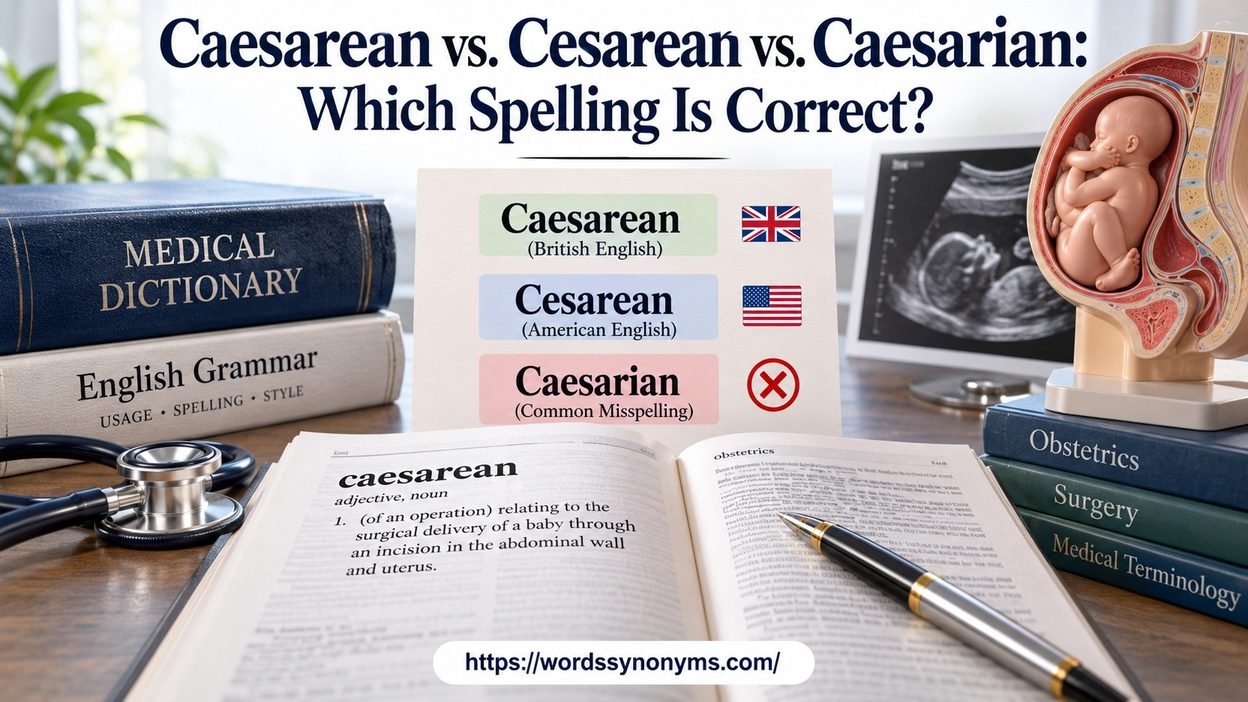
Caesarean vs. Cesarean vs. Caesarian: Which Spelling Is Correct? compares spellings for a medical procedure in which a baby is delivered surgically.
The procedure involves an incision in the mother’s abdomen, making it a form of baby delivery through an abdominal incision. The term can be spelled and written in different ways, including Caesarean section, Caesarean, caesarean, caesarian, cesarian, and cesarean.
In general usage, caesarean is the usual spelling, while cesarean is standard in medical usage and medical writing. From an editorial perspective, Caesarean and caesarean mainly differ in capitalization.
The initial c can be capitalized or uncapitalized according to editorial preference. In the U.S., United States, and Canada, the capitalized form often prevails, while the U.K., United Kingdom, and areas outside North America more often use the uncapitalized form. Elsewhere, either form may appear.
The spelling caesarean contains two e’s, whereas caesarian contains one e and one i. These forms have remained common across different periods of prevalence, historically.
Google Scholar and its Scholar index indicate that cesarean appears approximately three times for every instance of caesarean, making it the second-most common form in the cited comparison. In medical writing, the term is usually uncapitalized.
Quick Answer
Here’s the simplest way to remember the difference:
| Term | Correct? | Typical Usage | US English |
| Cesarean | Yes | Standard American spelling | Preferred |
| Caesarean | Yes | Standard British spelling | Less common |
| Caesarian | Yes, as a variant | Less common variant | Not preferred |
| C-section | Yes | Everyday and informal writing | Very common |
| Cesarean section | Yes | Formal US medical writing | Preferred |
| Caesarean section | Yes | Formal British medical writing | British form |
| Cesarean delivery | Yes | Medical and patient-focused writing | Common |
| Caesarean delivery | Yes | British English | Common |
The key point is simple: Caesarean and cesarean describe the same procedure. The difference is primarily a matter of spelling convention.
For US readers, choose cesarean. For British readers, Caesarean is generally the natural choice. If you’re writing an American English article, mixing the two spellings throughout the same piece can make the writing look inconsistent.
Is “Cesarean” Correct?
Yes. Cesarean is the standard US English spelling.
You’ll commonly see it in phrases such as:
- cesarean birth
- cesarean delivery
- cesarean section
- cesarean surgery
- repeat cesarean
- primary cesarean
- emergency cesarean
Examples of “Cesarean” in US English
The doctor recommended a cesarean delivery because vaginal birth posed a significant risk.
She had a cesarean section during her first pregnancy.
The hospital prepared her for an emergency cesarean.
Her previous cesarean birth may affect her options during a future pregnancy.
Notice that cesarean remains unchanged in each phrase. The noun that follows it can change depending on the context.
Is “Caesarean” Correct?
Yes. Caesarean is a standard spelling, particularly in British English.
The most visible difference is the “ae” combination:
- American English: cesarean
- British English: Caesarean
The meaning doesn’t change. A British medical article discussing a Caesarean section is talking about the same surgical delivery that an American source calls a cesarean section.
This is a useful distinction when reading international medical information. A reader may encounter both forms across reputable sources without either one being a different medical procedure.
Caesarean vs. Cesarean in American and British English
The regional pattern can be summarized like this:
| American English | British English |
| cesarean | Caesarean |
| cesarean section | Caesarean section |
| cesarean delivery | Caesarean delivery |
| cesarean birth | Caesarean birth |
| C-section | C-section |
The shortened form C-section is widely understood in both varieties.
If you’re writing for an American audience, however, cesarean is the cleaner choice.
Is “Caesarian” Correct?
Caesarian does appear in English as a spelling variant. However, it isn’t the form most commonly chosen for modern US medical writing.
That distinction matters.
A word can exist in dictionaries or published texts without being the preferred spelling for every situation. Caesarian has appeared historically and continues to occur, but cesarean is the more conventional American form.
For a US English article, medical website, school assignment, or professional document, use:
Cesarean
rather than:
Caesarian
If the audience uses British English, Caesarean is generally the better choice.
Caesarian vs. Caesarean
These two forms are especially easy to confuse.
Caesarean is the established British spelling.
Caesarian is a less common variant.
For practical writing, the safest choices are:
- US English: cesarean
- British English: Caesarean
That simple rule eliminates most of the confusion.
What Does Cesarean Section Mean?
A cesarean section is a surgical method of delivering a baby.
During the procedure, a surgeon makes an incision in the abdomen and another incision in the uterus. The baby is delivered through those openings. The umbilical cord is then cut, the placenta is removed, and the incisions are closed.
In everyday conversation, people usually shorten the term to C-section.
So these expressions generally refer to the same type of birth:
- cesarean section
- cesarean delivery
- cesarean birth
- C-section
- Caesarean section
- Caesarean delivery
- Caesarean birth
The choice is mainly about style, region, and context.
Cesarean Section vs. Cesarean Delivery
Although the terms are closely related, they emphasize slightly different things.
Cesarean section highlights the surgical procedure itself.
Cesarean delivery focuses more on the method of delivering the baby.
For example:
The patient underwent a cesarean section.
This sentence emphasizes the operation.
The baby was born by cesarean delivery.
This sentence emphasizes the birth.
Both are standard expressions in US English.
Why Is a Cesarean Section Performed?
A cesarean isn’t simply another name for a difficult vaginal birth. It is a surgical delivery that may become necessary when vaginal delivery isn’t considered the safest option.
According to ACOG, reasons for a cesarean can include labor that doesn’t progress, concerns about the baby’s condition, certain multiple pregnancies, placenta problems, breech presentation, a very large baby, and some maternal medical conditions.
Common situations include:
- Labor fails to progress
- The baby’s heart rate indicates possible distress
- The umbilical cord becomes compressed
- The baby is in a breech position
- Certain placenta conditions make vaginal delivery unsafe
- Some twin or multiple pregnancies create additional delivery concerns
- The baby is estimated to be very large in particular circumstances
- Certain maternal heart or neurological conditions make vaginal delivery risky
- An active genital herpes infection is present during labor
- A previous uterine operation affects the safety of vaginal delivery
The exact reason matters because cesarean delivery isn’t a one-size-fits-all decision.
Planned Cesarean vs. Emergency Cesarean
A planned cesarean is scheduled ahead of time because a known circumstance makes surgical delivery appropriate.
An emergency cesarean happens when an unexpected problem develops during pregnancy or labor and delivery needs to change quickly.
For example, a person may begin labor expecting a vaginal birth. If fetal monitoring later shows a concerning heart-rate pattern that doesn’t resolve, the medical team may recommend a cesarean.
The terminology describes the timing and circumstances. It doesn’t mean there are two completely different surgical procedures.
What Happens During a Cesarean Section?
Although every birth is different, the procedure follows a broadly recognizable sequence.
Before the Procedure
Preparation may include:
- Establishing an IV line
- Giving medication to reduce infection risk
- Cleaning the abdomen
- Trimming pubic hair if needed
- Placing a urinary catheter
- Using compression devices on the legs to reduce blood-clot risk
- Administering anesthesia
What Type of Anesthesia Is Used?
Most cesarean deliveries use regional anesthesia so the patient remains awake while the lower body becomes numb.
Common options include:
- Spinal block
- Epidural block
- Combined spinal-epidural
- General anesthesia in selected situations
The appropriate choice depends on factors such as the patient’s health, the baby’s condition, the reason for surgery, and whether the procedure is planned or urgent.
How Is the Baby Delivered?
The surgeon makes an incision through the abdominal wall and then makes an incision in the uterus.
The abdominal incision can be:
- Transverse, running from side to side
- Vertical, running up and down
Cesarean Section Recovery
A cesarean is major abdominal surgery, so recovery differs from recovery after an uncomplicated vaginal birth.
During the early recovery period, healthcare professionals typically monitor:
- Blood pressure
- Pulse
- Breathing
- Bleeding
- The abdominal incision
- Pain
- Ability to move safely
- Urination and fluid intake
The first few times getting out of bed may require assistance.
What to Expect After a C-Section
The incision can remain sore for several days. Some people experience:
- Mild cramping
- Vaginal bleeding or discharge
- Incision pain
- Numbness around the scar
- Fatigue
- Limited movement
- Discomfort when coughing, laughing, or changing position
Recovery isn’t simply about waiting for the skin incision to look better. The deeper tissues also need time to heal.
When Should You Contact a Doctor?
After a cesarean, certain symptoms deserve prompt medical attention.
ACOG advises contacting an obstetrician-gynecologist promptly for symptoms such as:
- Fever
- Chills
- Leg pain
- Drainage or leakage from the incision
- Heavy bleeding
- Worsening pain
- Shortness of breath
These symptoms don’t automatically mean a serious complication exists. They do warrant medical evaluation.
Risks and Possible Complications of Cesarean Delivery
Because a cesarean involves surgery, it carries risks that aren’t identical to those associated with vaginal birth.
Potential complications include:
- Infection
- Significant blood loss
- Blood clots
- Injury to the bladder or bowel
- Reactions to medications or anesthesia
- Problems involving the uterus or surgical incision
In rare cases, severe bleeding may require a blood transfusion or even a hysterectomy.
That doesn’t mean a cesarean is unsafe or inappropriate. In some circumstances, it can be the safest way to deliver a baby.
Does Having One Cesarean Mean Every Future Birth Requires One?
No.
A previous cesarean doesn’t automatically mean every subsequent baby must be delivered surgically.
Some people may be candidates for VBAC, which means vaginal birth after cesarean. The attempt to labor after a previous cesarean is called TOLAC, or trial of labor after cesarean delivery.
Whether VBAC is appropriate depends on several factors.
These may include:
- The type of uterine incision from the previous cesarean
- The number of previous cesarean deliveries
- Other uterine surgeries
- Current pregnancy circumstances
- The reason for the previous cesarean
- The hospital’s ability to provide emergency care
Why the Uterine Incision Matters
The scar on the skin doesn’t tell you what type of incision was made in the uterus.
ACOG identifies three major uterine incision patterns:
| Uterine incision | Description | Future rupture risk |
| Low transverse | Side-to-side incision across the lower uterus | Lowest among the listed incision types |
| Low vertical | Vertical incision in the lower uterus | Higher than low transverse |
| High vertical/classical | Vertical incision through the upper uterus | Highest among these types |
Medical records from the previous operation can identify the uterine incision. Looking at the skin scar cannot reliably determine it.
Cesarean vs. Vaginal Birth
Cesarean and vaginal birth aren’t simply two labels for the same process. One involves abdominal surgery while the other occurs through the birth canal.
| Factor | Cesarean Birth | Vaginal Birth |
| Delivery method | Surgical delivery | Delivery through the vagina |
| Abdominal surgery | Yes | No |
| Uterine surgical scar | Yes | No surgical uterine scar from delivery |
| Anesthesia | Usually regional for planned surgery | May involve several pain-relief options |
| Recovery | Surgical recovery required | Recovery varies |
| Future pregnancy considerations | Previous uterine surgery can affect future pregnancies | No cesarean uterine scar from that birth |
| Surgical risks | Infection, blood loss, clots, organ injury | Different set of potential complications |
There isn’t a universal delivery method that suits every pregnancy.
The relevant question is which method is medically appropriate for the individual circumstances.
Cesarean, C-Section, or C Section: Which Form Should You Use?
The shortened term creates another small spelling question.
C-Section
C-section is the conventional hyphenated form in US English.
It’s common in everyday conversation:
“She had a C-section last year.”
The form is concise and widely understood.
C Section
C section without a hyphen appears online, particularly in informal writing and search queries.
However, polished US English generally favors C-section.
Cesarean Section
For formal American English, cesarean section is the full standard term.
It works well in:
- Medical articles
- Educational material
- Healthcare websites
- Academic writing
- Patient information
Caesarean Section
Caesarean section is the corresponding British English form.
Both spellings communicate the same medical meaning.
Caesarean vs. Cesarean: Spelling Rules at a Glance
When the main goal is correct English usage, the rule is refreshingly simple.
| Audience | Recommended spelling |
| US readers | cesarean |
| British readers | Caesarean |
| US medical writing | cesarean section |
| British medical writing | Caesarean section |
| Informal US writing | C-section |
| International audience | Pick one regional spelling and stay consistent |
Consistency matters more than trying to use every spelling variation in the same article.
If an American English article starts with cesarean and suddenly switches to Caesarean halfway through, the change may look accidental.
Common Misspellings and Variants
Search engines and everyday writing produce several versions of this word.
You may encounter:
- cesarean
- caesarean
- caesarian
- cesarian
- C-section
- C section
- cesarean section
- caesarean section
- cesarean delivery
- caesarean delivery
Not every variation has equal status.
For US English, cesarean is the strongest standard choice. Caesarean is the conventional British form. Caesarian is a less common variant.
The form cesarian is generally best avoided in polished writing because it drops the expected “e” after the s.
Which Spelling Is Preferred in US English?
For an American audience, use:
Cesarean
For example:
The patient underwent a cesarean delivery.
Or:
The doctor explained the risks of a repeat cesarean section.
For informal contexts, C-section works naturally:
Her first baby was born by C-section.
Why Do “Caesarean” and “Cesarean” Have Different Spellings?
The difference largely reflects regional spelling conventions.
American English often simplifies or shortens certain traditional spellings that British English retains. The spelling of this medical term developed along different paths in American and British usage.
The word also has a long historical association with Caesar. However, popular explanations connecting the procedure directly to the birth of Julius Caesar should be treated cautiously. Historical evidence doesn’t support treating the famous story as a straightforward medical origin story.
The modern medical term matters more than the legend.
Today, the practical distinction is:
cesarean = American English
Caesarean = British English
That is the useful rule for writers.
Examples of Cesarean in a Sentence
Seeing the word in context makes the distinction easier to remember.
Medical Writing
The patient underwent a cesarean section after labor failed to progress.
Everyday Conversation
She had a C-section when her baby was born.
Patient Education
A cesarean delivery involves surgery through the abdomen and uterus.
Future Pregnancy
A previous cesarean birth may affect delivery options in a later pregnancy.
British English
She had a Caesarean section during her first pregnancy.
Each example uses the terminology naturally for its context.
A Real-World Terminology Case Study
Consider a health website serving readers in the United States.
Its headline says:
Cesarean vs. Vaginal Birth
Later, the article switches to:
Caesarean delivery can require additional recovery time.
Nothing about the medical information necessarily becomes wrong. However, the spelling has shifted from American to British convention without an obvious reason.
A cleaner editorial approach would keep cesarean throughout.
Now consider a British health publication. Using Caesarean consistently would make more sense for its audience.
The Practical Lesson
Regional consistency improves clarity.
You don’t need to avoid the alternative spelling. You simply need to use it intentionally.
Cesarean Section Rates Around the World
The terminology becomes especially relevant when discussing childbirth on a global scale.
The World Health Organization uses the spelling “caesarean section.” Its global health data defines the indicator as the percentage of live births delivered by caesarean section during a specified period.
WHO reported that the global cesarean rate had risen from about 7% in 1990 to 21% in 2018, based on the data available in its 2021 global analysis. The same analysis found substantial regional variation.
For example, the 2018 estimates cited by WHO included:
| Region | Estimated cesarean rate |
| Africa | 9.2% |
| Asia | 23.1% |
| Europe | 25.7% |
| Americas | 39.3% |
| Latin America and Caribbean | 42.8% |
| World total | 21.1% |
These figures show why a single worldwide percentage can hide major differences between countries and health systems.
WHO also emphasizes that a population-level cesarean rate shouldn’t be treated as an ideal target for every hospital. Hospitals serve different patient populations and handle different levels of obstetric complexity.
Why the Rate Matters
Cesarean delivery can be life-saving when medically indicated. At the same time, surgery carries risks and shouldn’t be treated as interchangeable with vaginal birth.
WHO stresses both sides of this issue: women who need cesarean delivery should have access to it, while unnecessary procedures should be avoided.
This distinction is crucial.
A low cesarean rate can reflect inadequate access to essential obstetric surgery. A high rate can reflect a different set of clinical, social, economic, or healthcare-system factors.
The percentage alone doesn’t tell the whole story.
How Hospitals Analyze Cesarean Rates
Researchers and healthcare systems don’t have to rely solely on one overall percentage.
WHO recommends the Robson Classification as a global standard for analyzing and comparing cesarean rates. The system divides women into 10 mutually exclusive groups using characteristics such as parity, number of fetuses, previous cesarean delivery, onset of labor, gestational age, and fetal presentation.
This approach provides more useful information than simply saying:
“Hospital A has a 30% cesarean rate.”
A more meaningful analysis asks:
- Which patient groups account for most cesarean deliveries?
- How many women have had previous cesareans?
- How many pregnancies involve multiple fetuses?
- How often are cesareans performed after labor begins?
- What proportion involves breech presentation?
- How do outcomes differ among these groups?
That context can reveal why rates differ between facilities.
Read more: Crack Down vs. Crackdown: Grammar and Examples
Case Study: Why a Cesarean Rate Needs Context
Imagine two hospitals.
Hospital A is a large referral center that receives complicated pregnancies from smaller facilities. It has a high-risk obstetric population.
Hospital B mainly serves people with uncomplicated pregnancies.
If Hospital A has a higher cesarean rate, that number alone doesn’t prove that doctors there perform more unnecessary operations.
The patient populations aren’t equivalent.
WHO specifically warns against applying a single “ideal” cesarean rate to every hospital because case mix, referral patterns, resources, and clinical needs differ substantially.
This is why the Robson Classification can provide a more informative framework than a raw percentage.
A Note on the Phrase “C-Section”
The term C-section is useful because it’s short and familiar.
However, formal medical writing often prefers cesarean birth, cesarean delivery, or cesarean section.
The best choice depends on your audience.
| Context | Natural choice |
| Casual conversation | C-section |
| Patient-friendly article | cesarean birth |
| Medical article | cesarean delivery |
| Formal US writing | cesarean section |
| British English | Caesarean section |
For an SEO article, using several natural variants can also help cover the way real readers search. The key is to use them because they fit the sentence rather than forcing them into every paragraph.
Caesarean vs. Cesarean vs. Caesarian: Final Comparison
Here’s the complete distinction in one place:
| Word or phrase | Meaning | US English | British English |
| Cesarean | Surgical method of childbirth | Standard | Less common |
| Caesarean | Same procedure | Less common | Standard |
| Caesarian | Variant spelling | Uncommon | Uncommon |
| C-section | Short form of cesarean section | Very common | Widely understood |
| Cesarean section | Full medical term | Standard | Less common |
| Caesarean section | Full medical term | Less common | Standard |
| Cesarean delivery | Surgical delivery of a baby | Standard | Less common |
| Caesarean delivery | Same meaning | Less common | Standard |
The easiest memory trick is:
US English: cesarean. British English: Caesarean.
That’s the spelling distinction most writers need.
FAQs
Is Caesarean the same as Cesarean?
Yes. Caesarean and Cesarean refer to the same medical procedure. The main difference is the spelling used in different varieties of English.
Is Caesarian a correct spelling?
Yes. Caesarian is an established spelling that has been used historically. However, its usage differs from Caesarean and Cesarean depending on the region and context.
Which spelling is common in American English?
Cesarean is the standard spelling commonly used in American medical writing. Caesarean is also recognized, especially in British English.
Should Caesarean be capitalized?
Capitalization depends on context and editorial preference. In general medical writing, caesarean is usually written with a lowercase initial letter unless a specific style guide calls for capitalization.
Why does Caesarean have two e’s?
The spelling caesarean contains two e’s because it follows the traditional form derived from Caesar. Caesarian uses one e and one i, while Cesarean follows a different spelling pattern.
Is Cesarean or Caesarean used in medical writing?
Both can appear in medical writing, but Cesarean is a widely used standard form in American medical contexts. Caesarean is particularly associated with British and other varieties of English.
Conclusion
The spelling can look confusing at first, especially when Caesarean, caesarean, caesarian, and cesarean appear in different sources. The key difference is often regional or editorial rather than a change in the meaning of the medical procedure. In American medical writing, cesarean is the form you’ll encounter most often, while caesarean remains familiar in British English and other regions.
When choosing a spelling, consider your audience and the style guide you’re following. Consistency matters more than switching between forms, particularly in formal or medical documents. Capitalization can also vary, so check the conventions used by the publication or organization you’re writing for.

Samreen Saif is a passionate writer and language enthusiast who contributes informative and engaging content to WordsSynonyms.com. She enjoys exploring English vocabulary, synonyms, antonyms, word meanings, and language usage to help readers understand and use words with confidence.
Samreen focuses on creating clear, accurate, and easy-to-read content for students, writers, professionals, and English learners. Through her articles, she aims to make vocabulary learning simple, practical, and useful for everyday communication.
When she is not writing, Samreen enjoys learning about language, discovering new words, and creating helpful content that makes English learning more accessible to everyone.