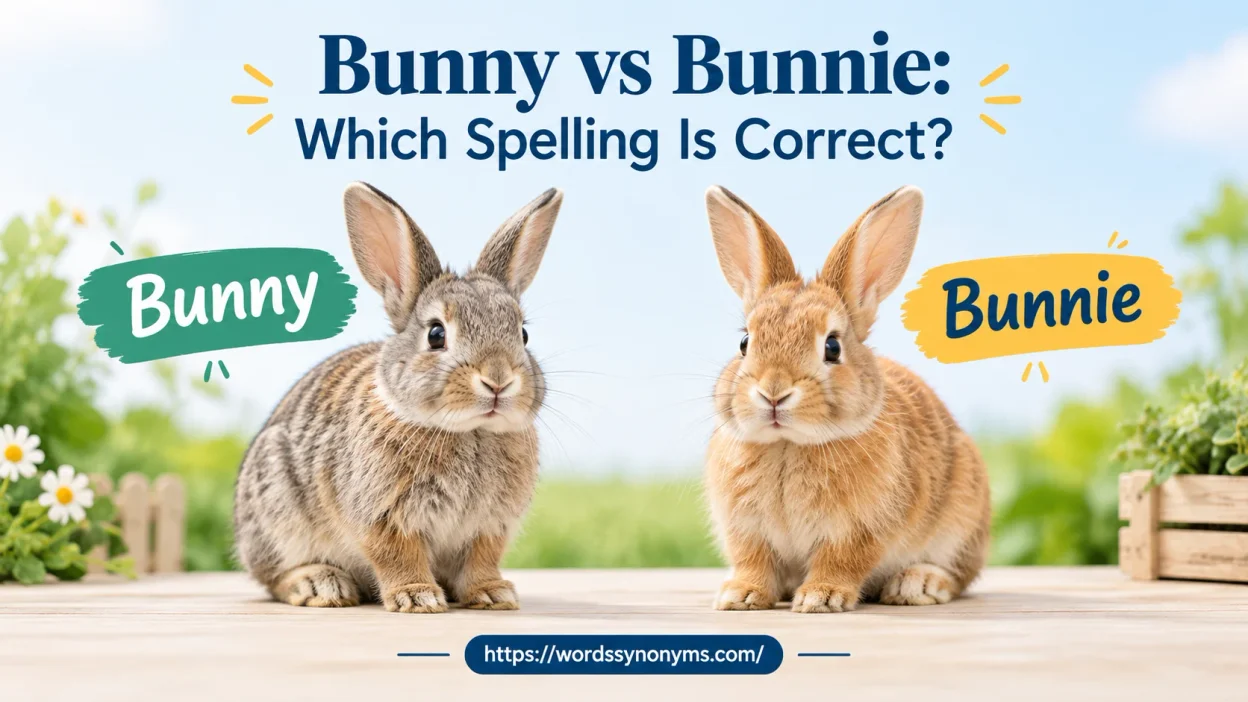
Bunny vs Bunnie: Which Spelling Is Correct? asks whether bunny or Bunnie is the right spelling for your intended meaning in English.
The noun bunny means rabbit and is interchangeable with that word. Bunny rabbit is another common term, especially among small children, who may use it to reference a young rabbit.
Bunny can also describe a person of a specified type or someone in a certain mood. A beach bunny enjoys time at the seaside, while a snow bunny enjoys snow and skiing. Bunnies is the plural form of bunny.
Bunnie has a different role. It is a woman’s name and may be a nickname for a woman whose name begins with the letter B, including Beatrice or Barbara.
In everyday English, these playful expressions help show why the correct, rabbit-related spelling is usually bunny, while Bunnie refers to a name.
Quick Answer
Bunny is the standard spelling of the English noun. Dictionaries define it primarily as an informal word for a rabbit, especially a young rabbit. Merriam-Webster lists bunny with the pronunciation /ˈbə-nē/ and the plural bunnies.
Bunnie, by contrast, exists as a rare spelling of bunny. Wiktionary records it as a variant and gives an example of the spelling from an 1895 newspaper.
| Feature | Bunny | Bunnie |
| Standard everyday spelling | Yes | No |
| Refers to a rabbit | Yes | Yes, as a rare variant |
| Common in modern writing | Very common | Rare |
| Pronunciation | BUN-ee | Generally BUN-ee |
| Standard plural | Bunnies | Bunnies when treated as the noun variant |
| Can be a name | Yes | Yes |
| Suitable for ordinary writing | Yes | Usually no |
| Suitable as a person’s chosen name | Yes | Yes |
| Suitable as a pet’s name | Yes | Yes |
| Main distinction | Standard word | Rare variant or proper name |
The easiest rule to remember is this:
Use “bunny” for the ordinary word. Use “Bunnie” when that spelling is intentional.
That one rule solves most bunny vs Bunnie questions.
Bunny vs Bunnie at a Glance
The quickest way to understand the distinction is to compare the two forms side by side.
| Feature | Bunny | Bunnie |
| Standard English word | Yes | Rare variant |
| Refers to a rabbit | Yes | Yes, as a rare spelling |
| Common in everyday writing | Very common | Uncommon |
| Pronunciation | /ˈbʌni/ | Usually /ˈbʌni/ |
| Standard plural | Bunnies | Bunnies in the rare noun usage |
| Used as a personal name | Yes | Yes |
| Used as a nickname | Yes | Yes |
| Best choice for ordinary writing | Bunny | Usually not |
| Appropriate as an intentional name | Yes | Yes |
| Common dictionary status | Established noun | Rare spelling |
The practical rule is simple:
Use “bunny” for the ordinary English word. Use “Bunnie” when that spelling is intentional or specifically belongs to a name or established reference.
That small distinction prevents most spelling mistakes.
What Does Bunny Mean?
Bunny is an informal English noun meaning rabbit, particularly a young rabbit or one discussed in an affectionate, child-friendly way. Merriam-Webster lists bunny as an informal noun meaning rabbit, with the first known use dating to around 1699.
Oxford similarly defines bunny as a child’s word for a rabbit. Its word-history note explains that the term originally functioned as a term of endearment before becoming associated with rabbits.
That history helps explain why bunny sounds warmer and more playful than rabbit.
Compare these sentences:
- The rabbit is eating grass.
- The bunny is eating grass.
Both sentences can describe the same animal. The first sounds neutral and straightforward. The second feels softer and more affectionate.
Bunny Does Not Describe a Separate Animal
One common misconception is that a bunny represents a particular species of rabbit.
It doesn’t.
Bunny is an informal word, not a scientific classification.
A rabbit can be called a bunny in everyday conversation regardless of its breed. For example, a domestic rabbit may be called a bunny, while a wild rabbit can also be described that way.
In scientific or veterinary writing, rabbit is generally the more precise term.
Bunny Can Also Have Figurative Meanings
The word has developed meanings beyond the animal itself.
Merriam-Webster records bunny as an informal term for an attractive young woman and also as basketball slang for an easy shot taken close to the basket.
You’ll also see bunny in compounds connected with activities or settings.
Examples include:
- Easter Bunny
- bunny slope
- beach bunny
- snow bunny
- dust bunny
- bunny rabbit
The meaning depends heavily on context.
For instance, a dust bunny isn’t an animal at all. It’s a small collection of dust and fibers that gathers on a floor or beneath furniture.
What Does Bunnie Mean?
The word Bunnie requires more context because it isn’t simply the standard spelling of bunny.
Wiktionary records bunnie as a rare spelling of bunny, with historical evidence dating back to the nineteenth century. The entry traces the form to bun, meaning rabbit, combined with the diminutive suffix -ie.
That means calling every occurrence of Bunnie a spelling mistake would be too simplistic.
In ordinary modern writing, however, bunny remains the normal spelling.
Bunnie as a Personal Name
One of the most important reasons you’ll encounter Bunnie is its use as a name.
Name references list Bunnie as a rare feminine given name and as a variant connected with Bunny. Some naming sources also associate the form with names such as Bernice and Bonnie, although name etymologies can vary between reference works.
That distinction matters.
If someone’s name is Bunnie, changing it to Bunny isn’t a spelling correction. It’s changing the person’s name.
The same principle applies to:
- stage names
- character names
- usernames
- pet names
- business names
- fictional characters
- artistic aliases
A proper name follows the established spelling chosen for that entity.
Bunny vs Bunnie Pronunciation
Here’s where the comparison becomes especially straightforward.
Bunny is generally pronounced BUN-ee, represented in dictionaries as /ˈbʌni/. Oxford gives the same pronunciation.
Bunnie is also generally pronounced BUN-ee when it represents the same word or is used as the corresponding name.
So the spelling difference usually doesn’t create a meaningful pronunciation difference.
| Spelling | Typical pronunciation | Syllables |
| Bunny | BUN-ee | 2 |
| Bunnie | BUN-ee | 2 |
This is one reason the two spellings can cause confusion.
You hear essentially the same sound. The difference appears when the word reaches the page.
Bunny vs Bunnie: Which Spelling Is Correct?
For ordinary English usage, bunny is the correct standard spelling.
If you’re writing about a rabbit, use bunny.
For example:
- The bunny hopped across the garden.
- My daughter loves her stuffed bunny.
- We saw three bunnies near the fence.
- The Easter Bunny appeared at the community event.
Using bunnie in these sentences would look unusual unless you had a specific reason for doing so.
When Should You Use Bunny?
Choose bunny when you’re:
- Referring to a rabbit.
- Writing about a young rabbit informally.
- Using an affectionate term for someone.
- Writing a school assignment.
- Publishing general-audience content.
- Writing a dictionary-style definition.
- Describing an Easter Bunny.
- Discussing a bunny rabbit.
- Writing about rabbit care in a conversational style.
In short, bunny should be your default spelling.
When Should You Use Bunnie?
Choose Bunnie when the spelling itself is intentional.
For example:
- Someone’s name is Bunnie.
- A fictional character is officially named Bunnie.
- A pet owner deliberately chose Bunnie as the pet’s name.
- You’re quoting a historical source that uses bunnie.
- You’re discussing the rare spelling variant.
- A brand or username officially uses Bunnie.
The key is context.
Why Do People Write Bunnie Instead of Bunny?
The answer isn’t necessarily “because they don’t know how to spell it.”
English contains many words where the letters -ie represent an “ee” sound. That pattern appears in words such as cookie, sweetie, birdie, and cutie.
Because bunny already carries an affectionate, diminutive feeling, the spelling Bunnie can look intuitively natural to some writers.
There’s another factor, too: names often develop their own spellings.
Parents, pet owners, performers, writers, and businesses can deliberately modify familiar words to create something more distinctive. Once that spelling becomes an established name, it has a different status from an ordinary vocabulary word.
That is why context matters more than simply counting letters.
The History Behind Bunny
The history of bunny helps explain why the word feels affectionate today.
Oxford traces the word to dialect bun, associated with a squirrel or rabbit and also used as a term of endearment. The dictionary notes that bunny originally functioned as a term of affection before becoming a pet name for a rabbit.
Merriam-Webster gives the first known use of bunny in its rabbit-related sense as approximately 1699.
So bunny didn’t simply appear as a cute modern nickname.
It has a long history in English.
Bunny and the Idea of Affection
Words often change meaning through repeated affectionate use.
A familiar example is how animal terms can become nicknames. The same process appears with words such as:
- honey
- kitten
- lamb
- chick
- birdie
- bunny
These terms can move between literal and figurative meanings depending on the speaker and situation.
That explains why bunny can describe an actual rabbit in one sentence and function as an affectionate nickname in another.
Read more: Car Park vs. Parking Lot: What’s the Difference?
Bunny vs Bunnie as Names
The comparison becomes more nuanced when the two spellings appear as names.
Bunny as a Name
Bunny has a long history as a nickname and personal-name form.
It can function independently as a nickname or as an affectionate form rather than necessarily being the person’s formal first name.
Because the word already has a warm, playful association, it has naturally worked as a nickname.
Bunnie as a Name
Bunnie is much less common.
Current naming data illustrates just how unusual it is. One source using Social Security Administration data reports six US births in 2024 under the name Bunnie and places it at approximately #13,738 for girls that year.
That figure is useful because it puts the name’s rarity into perspective.
Bunnie isn’t a mainstream American first name. It’s a genuinely uncommon choice.
At the same time, rare doesn’t mean incorrect.
A person’s name doesn’t need to rank highly on a baby-name chart to be valid.
Bunny vs Bunnie for Pet Names
Pet names are another area where both spellings can work.
Suppose someone names their rabbit Bunnie.
That’s completely different from writing:
“The bunnie is eating carrots.”
The first sentence uses Bunnie as a proper name.
The second uses bunnie as an ordinary noun.
The correct spelling changes because the function changes.
Example
Imagine a rabbit named Bunnie.
You might write:
Bunnie loves running around the living room.
But if you describe another rabbit, you would write:
A little bunny was sitting beneath the chair.
The distinction is subtle but important.
Names are preserved. Common nouns follow standard spelling.
Bunny vs Bunnie in Formal Writing
Formal writing usually favors bunny when referring to the animal.
That includes:
- academic assignments
- educational articles
- general websites
- news writing
- product descriptions
- instructional guides
- animal-care resources
- business communication
If you’re writing about rabbit behavior, for example, rabbit may be more precise than either bunny or bunnie.
If you’re writing for children, however, bunny can be perfectly natural.
A Simple Style Guide
| Writing situation | Best choice |
| Formal scientific discussion | Rabbit |
| General writing | Bunny or rabbit |
| Children’s writing | Bunny |
| Casual conversation | Bunny |
| Someone’s personal name | Preserve their spelling |
| Pet’s name | Preserve the chosen spelling |
| Fictional character | Preserve the official spelling |
| Historical spelling | Preserve the source spelling |
| Ordinary noun | Bunny |
This table captures the practical rule better than a blanket statement that one spelling is always right.
Bunny vs Bunnie Examples
Real usage becomes much easier to understand when you see the distinction in context.
Standard Bunny Usage
Example 1:
The bunny disappeared beneath the garden bench.
Here, bunny is simply an informal word for rabbit.
Example 2:
The children watched the bunny hop across the grass.
Again, bunny functions as an ordinary noun.
Example 3:
We bought a soft bunny for the baby’s nursery.
Here, bunny refers to a rabbit-shaped toy.
Intentional Bunnie Usage
Example 1:
Bunnie is my rabbit’s name.
Here, Bunnie is a proper name.
Example 2:
Her name is Bunnie, not Bunny.
The spelling is part of the person’s identity.
Example 3:
The historical source uses the spelling “bunnie.”
Here, preserving the original spelling is appropriate.
An Important Contrast
Consider these two sentences:
The bunny is sleeping.
Bunnie is sleeping.
The first sentence tells you what the animal is.
The second tells you the animal’s name.
That one-letter difference can change the grammatical role of the word.
Is Bunnie a Misspelling of Bunny?
Sometimes, yes. But not always.
If someone intends to write the standard noun bunny and accidentally writes bunnie, then bunnie is a spelling error in that context.
However, the word has documented historical and variant usage. Wiktionary specifically records bunnie as a rare spelling of bunny.
The spelling also appears as a personal name.
Therefore, the more accurate answer is:
Bunnie can be a misspelling of bunny, but it can also be an intentional variant or proper name.
That distinction is more useful than simply labeling the spelling wrong.
Bunny vs Bunnie and Capitalization
Capitalization provides another useful clue.
When bunny functions as a common noun, it is normally lowercase:
The bunny is eating.
When Bunnie functions as someone’s name, it is capitalized:
Bunnie is eating.
However, capitalization alone doesn’t determine whether the spelling is correct.
A person could intentionally name their rabbit bunny, although that would usually appear as Bunny when used as a proper name.
For example:
My rabbit’s name is Bunny.
Here, Bunny is capitalized because it’s the animal’s name.
What Is the Plural of Bunny?
The standard plural of bunny is bunnies.
The spelling changes from:
bunny → bunnies
This follows a common English spelling pattern in which a consonant followed by y changes to ies when forming the plural.
Examples include:
- bunny → bunnies
- puppy → puppies
- puppy → puppies
- city → cities
- story → stories
So this is incorrect in standard English:
I saw three bunny’s.
And this is correct:
I saw three bunnies.
The apostrophe has no place in the ordinary plural.
Bunny vs Bunny’s vs Bunnies
These forms serve different grammatical purposes.
| Form | Meaning | Example |
| bunny | Singular | The bunny is eating. |
| bunnies | Plural | The bunnies are eating. |
| bunny’s | Possessive or contraction | The bunny’s ears are long. |
| bunnies’ | Plural possessive | The bunnies’ food is fresh. |
This distinction is especially useful for students and English learners.
Bunny vs Bunnie in Search Queries and Online Writing
People often search for “bunny vs bunnie” because search engines return both forms.
That doesn’t mean both forms have equal linguistic status.
Search results can contain:
- misspellings
- names
- usernames
- brand names
- social-media handles
- historical spellings
- fictional characters
- informal language
A search engine indexes what people publish. It doesn’t automatically declare every indexed spelling standard English.
That is why dictionary evidence matters when you’re deciding which form to use in ordinary writing.
Common Bunny vs Bunnie Mistakes
Several mistakes appear repeatedly when people compare these spellings.
Mistake 1: Assuming Bunnie Is Always Wrong
That’s too broad.
Bunnie is documented as a rare spelling and appears as a personal name.
Mistake 2: Treating Bunny and Bunnie as Equally Common
They aren’t.
Bunny is overwhelmingly the normal everyday spelling.
Mistake 3: Changing Someone’s Name
If someone’s name is Bunnie, don’t “correct” it to Bunny.
Names can have unconventional spellings. That’s not a grammatical mistake.
Mistake 4: Assuming Different Spelling Means Different Pronunciation
The two forms are generally pronounced the same.
The distinction primarily exists on the page.
Mistake 5: Using Bunnie in Formal Writing Without a Reason
If you’re simply referring to a rabbit, bunny is the safer and standard choice.
Bunny vs Bunnie: Which One Should You Use?
When you’re unsure, ask one simple question:
Am I using this as an ordinary word or as an intentional name or variant?
If you’re using it as an ordinary word, choose bunny.
If you’re referring to a person, pet, character, username, or other entity specifically called Bunnie, preserve that spelling.
Use Bunny When:
- You mean a rabbit.
- You’re writing for a general audience.
- You’re describing a pet rabbit without using its name.
- You’re writing educational material.
- You’re writing an essay or article.
- You’re talking about the Easter Bunny.
- You’re using a familiar compound such as bunny slope.
- You want the standard spelling.
Use Bunnie When:
- Someone’s name is Bunnie.
- A fictional character is called Bunnie.
- A pet has been deliberately named Bunnie.
- You’re discussing the rare spelling itself.
- You’re preserving a historical spelling.
- A specific brand or account officially uses Bunnie.
A Practical Case Study: Bunny as a Noun vs Bunnie as a Name
Consider a fictional example involving two rabbits.
The first rabbit doesn’t have a specified name. The owner says:
“There’s a bunny in the garden.”
Bunny is correct because the word describes the animal.
Now imagine the owner has a rabbit named Bunnie.
“Bunnie is in the garden.”
Here, Bunnie is correct because it’s the rabbit’s name.
Later, the owner sees another rabbit:
“Bunnie is chasing a bunny.”
Now the sentence contains both forms.
- Bunnie = the rabbit’s name
- bunny = another rabbit
This is perhaps the clearest way to understand the distinction.
Bunny vs Bunnie: Key Facts
Here are the most useful facts to remember:
- Bunny is the standard everyday spelling.
- Bunny means rabbit in informal English.
- The plural of bunny is bunnies.
- Bunny has been used in English for centuries.
- Merriam-Webster dates its first known rabbit-related use to around 1699.
- Oxford traces the word’s history through dialect bun and earlier affectionate usage.
- Bunnie is documented as a rare spelling of bunny.
- Bunnie is also used as a personal name.
- Modern US naming data shows that Bunnie is extremely uncommon. One source reports six US births with the name in 2024.
- Both forms are generally pronounced BUN-ee.
- A person’s chosen spelling should be preserved even when it differs from standard vocabulary.
- For ordinary writing, bunny is the clear default.
FAQs
Is “bunny” the correct spelling for a rabbit?
Yes. Bunny is the standard spelling when you mean a rabbit, especially in casual or child-friendly English.
What does “Bunnie” mean?
Bunnie is usually a woman’s name or nickname rather than the standard spelling for a rabbit.
Are bunny and rabbit interchangeable?
In many everyday contexts, yes. Bunny can be used as a friendly or informal alternative to rabbit.
Is “bunny rabbit” grammatically correct?
Yes. Bunny rabbit is a common phrase, particularly when talking with small children about a rabbit.
What is the plural of bunny?
The plural of bunny is bunnies. You change the ending from -y to -ies.
Can Bunnie be a nickname?
Yes. Bunnie can be used as a nickname, including for women whose names begin with the letter B, such as Beatrice or Barbara.
Conclusion
When choosing between bunny and Bunnie, the context usually makes the difference clear. If you’re talking about a rabbit, especially a young rabbit, bunny is the natural choice. You might also hear bunny rabbit in conversations with small children, while bunnies simply refers to more than one rabbit. In casual expressions, beach bunny and snow bunny can describe a person associated with a particular interest, setting, or mood.
On the other hand, Bunnie works differently because it’s generally a woman’s name or nickname. It may be connected to names such as Beatrice or Barbara, especially when a nickname begins with the letter B. So, although the two spellings look almost identical, they serve different purposes. Use bunny when referring to a rabbit, and choose Bunnie when you’re referring to a person’s name.

Muhammad Taqi is a content writer interested in English vocabulary and language. He writes clear and useful articles on synonyms, antonyms, word meanings, and English usage, helping readers expand their vocabulary and improve their communication skills.