
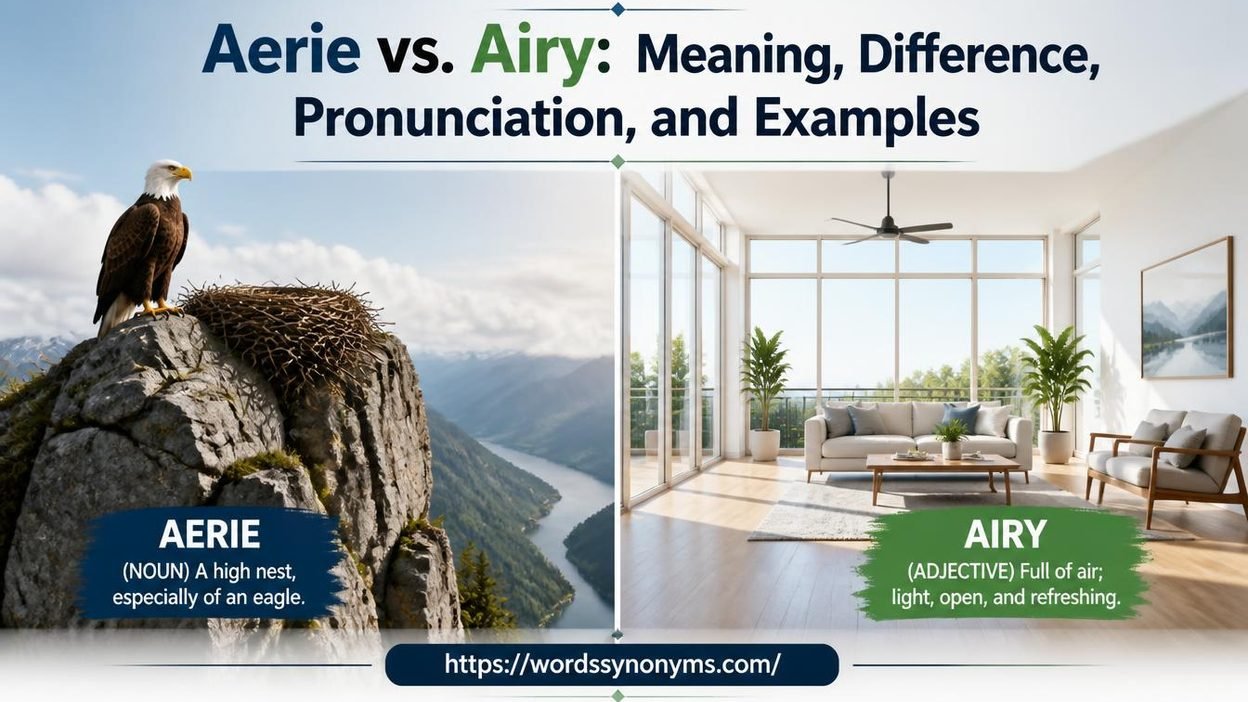
In Aerie vs. Airy, an aerie means a high nest for a bird of prey, while airy describes an open, breezy feeling with fresh air.
An aerie may belong to a hawk or eagle and can be found up high in a tall tree, on a cliff, or at a great height. The word can also describe a large house or fortress situated on a hill or mountain. Its roots reach back to medieval Latin and aeria, meaning open space.
In contrast, airy is an adjective for an open, breezy area where fresh air circulates freely, highlighting air and circulation.
Airy can describe something weightless and light in appearance, manner, or movement. It can suggest a delicate, graceful impression, especially for items that are thin or gauzy, with lightness, delicacy, and grace similar to gauze.
It may also describe a light-hearted action, something immaterial, or plans that seem insubstantial, unrealistic, or marked by insubstantiality and unreality. Related terms such as prey, large bird, tree, house, space, freely, weight, thinness, action, and immateriality help show the wider context.
Quick Answer
The simplest way to distinguish aerie vs. airy is to ask what you’re trying to describe.
| Word | Meaning | Part of Speech | Example |
| aerie | A high nest, especially a bird of prey’s nest | Noun | “The eagle returned to its aerie.” |
| aerie | An elevated or secluded dwelling or position | Noun | “They lived in a mountain aerie.” |
| airy | Open to air or well-ventilated | Adjective | “The bedroom feels airy.” |
| airy | Light, delicate, graceful, or insubstantial | Adjective | “She wore an airy summer dress.” |
Here’s the shortcut worth remembering:
Aerie names a place. Airy describes a quality.
That one distinction eliminates most mistakes.
What Does Aerie Mean?
Aerie is a noun. Its most specific meaning is the nest of an eagle or another large bird of prey, especially when the nest sits high above the ground.
Think of a large eagle nesting on a cliff face. The inaccessible ledge where it raises its young can be called an aerie.
For example:
“The golden eagle returned to its aerie before sunset.”
Here, aerie refers to the eagle’s nest.
The word doesn’t simply mean any bird’s nest. A robin’s nest tucked inside a garden shrub wouldn’t normally be called an aerie. The term carries a strong sense of height, isolation, and elevation.
Aerie Can Also Mean an Elevated Dwelling
English has extended the meaning of aerie beyond birds.
A high, secluded home or structure can also be called an aerie, especially when its position resembles a bird’s elevated nest.
Consider this sentence:
“Their mountain aerie overlooked the entire valley.”
The word doesn’t mean they literally lived in a bird’s nest. Instead, aerie creates an image of a home perched high above the surrounding landscape.
The same idea works in an urban setting:
“From his downtown aerie, he could see the river and the skyline.”
Here, aerie can describe an apartment or office located high in a building.
This extended sense gives the word a distinctive literary flavor. It suggests more than simply “high apartment.” It creates an image of a private place above the world below.
What Does Airy Mean?
Airy is an adjective. It describes something that has qualities associated with air.
Its most common meaning is open to the circulation of air.
For example:
“The large windows make the living room bright and airy.”
In this sentence, airy describes the room. It suggests that the space feels open, fresh, and well-ventilated.
However, the word has several other meanings.
Airy Can Mean Light and Spacious
A room can feel airy because it has:
- Large windows
- High ceilings
- Open floor space
- Good ventilation
- Plenty of natural light
- Minimal visual clutter
For example:
“The renovated kitchen feels spacious and airy.”
The kitchen doesn’t literally contain more air than another room. Instead, its design creates a sense of openness.
Airy Can Mean Light or Delicate
The word can also describe something physically or visually light.
For example:
“The fabric has an airy texture that’s perfect for summer.”
You might also describe a delicate fragrance, a light dessert, or graceful movement as airy.
A food writer might say:
“The soufflé had an airy texture.”
A fashion writer could describe:
“an airy linen dress.”
A dance critic might mention:
“her airy movements across the stage.”
In each case, airy describes a quality rather than naming an object.
Airy Can Have a Figurative Meaning
There’s another meaning worth knowing.
Airy can describe something that seems unrealistic, insubstantial, or lacking a solid basis.
For example:
“The proposal sounded airy because it contained no practical details.”
Here, airy doesn’t mean well-ventilated. It means vague or insubstantial.
This figurative meaning appears more often in formal, literary, or critical writing than everyday conversation.
Read more: Suit vs. Suite: What’s the Difference?
Aerie vs. Airy: Part of Speech Makes the Difference
Grammar provides one of the clearest ways to separate these words.
Aerie is a noun.
It names something.
You can say:
- “the aerie”
- “an aerie”
- “the eagle’s aerie”
- “a mountain aerie”
- “their city aerie”
Airy is an adjective.
It describes something.
You can say:
- “an airy room”
- “an airy dress”
- “an airy fragrance”
- “an airy atmosphere”
- “an airy design”
Compare these two sentences:
“The eagle returned to its aerie.”
“The eagle soared through the airy mountain atmosphere.”
The first sentence names a place. The second sentence describes a quality.
A Simple Grammar Test
An aerie is a high nest built by a bird of prey.
The word can also refer to a high, secluded dwelling.
Eagles and other large birds are often associated with this type of nest.
For example:
“The apartment is ___.”
The blank needs an adjective. Airy works.
“The eagle returned to its ___.”
The blank needs a noun. Aerie works.
This little grammar check can save you from many spelling mistakes.
Aerie vs. Airy Pronunciation
Pronunciation makes the distinction slightly trickier because aerie has more than one accepted pronunciation.
In US English, aerie is commonly pronounced roughly like “EER-ee.” Some dictionaries also record pronunciations closer to “AIR-ee.”
Airy is commonly pronounced “AIR-ee.”
A simple comparison looks like this:
| Word | Common US pronunciation | Meaning |
| aerie | EER-ee; AIR-ee also occurs | High nest or elevated dwelling |
| airy | AIR-ee | Light, open, well-ventilated, or insubstantial |
Because pronunciation can vary, don’t rely on sound alone.
Context is more reliable than pronunciation.
If you’re reading about an eagle on a cliff, aerie is almost certainly the word. If you’re describing a spacious bedroom, airy is the natural choice.
Aerie in Real Sentences
Seeing aerie in different contexts makes its meaning much easier to understand.
Aerie as a Bird’s Nest
“The eagle carried a branch back to its aerie.”
The word refers to the eagle’s elevated nest.
“A pair of hawks established an aerie on the rocky cliff.”
Again, the word identifies a high nest belonging to a bird of prey.
Aerie as a Mountain Dwelling
“The writer spent the winter in a remote aerie above the valley.”
Here, aerie describes an elevated and secluded dwelling.
Aerie as a High-Rise Residence
“Their penthouse aerie offered sweeping views of the city.”
This usage emphasizes height and isolation.
The building doesn’t have to resemble a bird’s nest literally. The metaphor comes from the idea of being high above the ground.
Aerie as an Elevated Position
The word can also refer more broadly to a high position.
“From his rocky aerie, the climber watched the storm approach.”
The focus isn’t necessarily on a permanent home. Instead, the word creates an image of someone occupying a lofty vantage point.
Airy in Real Sentences
Now compare those examples with airy.
Airy for a Room
“The new windows make the bedroom bright and airy.”
The adjective describes the room’s atmosphere.
Airy for a House
“White walls and high ceilings give the house an airy feel.”
Here, airy suggests openness and spaciousness.
Airy for Clothing
“She packed an airy cotton shirt for the summer trip.”
The shirt feels light and breathable.
Airy for Food
“The whipped cream has a soft, airy texture.”
The word describes its light consistency.
Airy for Movement
“The dancer’s airy movements made the performance seem almost weightless.”
Here, airy describes grace and lightness.
Airy for an Idea
“The plan sounded airy because nobody explained how it would work.”
In this context, airy means vague or lacking substance.
Aerie vs. Airy Examples Side by Side
A direct comparison makes the distinction even clearer.
| Aerie | Airy |
| “The eagle returned to its aerie.” | “The room feels airy.” |
| “The hawk built its aerie on the cliff.” | “Large windows make the room airy.” |
| “They lived in a mountain aerie.” | “The apartment has an airy design.” |
| “She looked down from her city aerie.” | “The fabric feels airy and light.” |
| “The falcon guarded its aerie.” | “The dessert has an airy texture.” |
Notice the pattern.
Aerie identifies a location. Airy describes an attribute.
That difference remains true even when the words appear in very different contexts.
Common Mistakes With Aerie and Airy
Because these words look similar, writers sometimes substitute one for the other.
Mistake: Using Airy for a Bird’s Nest
Incorrect:
“The eagle returned to its airy.”
Correct:
“The eagle returned to its aerie.”
Why? Aerie is the noun that names the high nest.
Airy is an adjective. It cannot normally replace the noun in this sentence.
Mistake: Using Aerie as an Adjective
Incorrect:
“The apartment is aerie.”
Correct:
“The apartment is airy.”
The sentence needs an adjective after “is.” Airy describes the apartment’s atmosphere.
Mistake: Assuming the Words Are Synonyms
They aren’t.
An aerie can be high because of its physical location. An airy room can be on the ground floor.
For example:
“The ground-floor studio was surprisingly airy.”
There’s nothing contradictory about that sentence. The room can have excellent ventilation and plenty of space even though it isn’t high up.
Likewise:
“The eagle’s aerie was cramped.”
An aerie doesn’t have to be spacious or pleasant. It simply refers to the elevated nest or, by extension, an elevated dwelling.
Mistake: Thinking Airy Always Means “Breezy”
Airy can suggest fresh air or ventilation, but that’s only one meaning.
It can also mean:
- Light
- Delicate
- Graceful
- Spacious
- Ethereal
- Unreal
- Insufficiently substantial
Context determines the intended meaning.
Aerie, Eyrie, and Aery: What’s the Difference?
The confusion doesn’t stop with aerie vs. airy.
You may also encounter eyrie and aery.
These forms have historical connections to the same word family.
Aerie and Eyrie
Aerie and eyrie can both refer to a high nest belonging to a bird of prey.
In modern usage, aerie is particularly common in American English, while eyrie is commonly used in British English.
For example:
“The eagle returned to its aerie.”
and:
“The eagle returned to its eyrie.”
Both sentences can express essentially the same idea.
The spelling eyrie has a long history in English. Its unusual appearance can make the word look as though it relates to “eye” or “egg,” but its actual history is more complicated.
What About Aery?
Aery is a much less common form.
It can occur as a variant spelling of aerie. It also appears in older or literary usage with other meanings.
For everyday modern writing, however, it’s usually best to choose the familiar form that matches your meaning:
- Aerie for the elevated nest or dwelling
- Airy for something light, open, or well-ventilated
That keeps your writing clear.
Why Does Aerie Have Such an Unusual Spelling?
The history of aerie helps explain why it doesn’t look like an ordinary English word.
The word has roots in older forms associated with the nest of a bird of prey. Its history passes through Old French and Medieval Latin. English developed several spellings over time, including forms that eventually produced aerie and eyrie.
The spelling eyrie was influenced by the mistaken idea that the word was connected with the Middle English word for “egg.”
That’s one reason English spelling can feel like a maze with a few unexpected turns.
The modern spelling aerie shouldn’t be interpreted as a combination of “air” plus a suffix. Although the visual similarity to air makes the words look related, aerie and airy have different histories and meanings.
The Best Memory Trick for Aerie vs. Airy
You don’t need to memorize a long dictionary definition.
Use this:
Aerie → Eagle
The letters don’t perfectly spell “eagle,” of course. The important connection is the image.
Picture an eagle sitting high on a cliff.
That’s its aerie.
Now think about an open room with large windows.
That’s airy.
You can also use this pair:
Aerie = elevation
Airy = air
The first points you upward. The second makes you think about air moving through a space.
Another Visual Memory Trick
Imagine this simple picture:
Eagle → high nest → AERIE
Open window → fresh air → AIRY
The stronger the mental image, the easier the spelling becomes.
Aerie vs. Airy in Literature and Descriptive Writing
These words become especially interesting in descriptive writing because they create very different images.
Aerie tends to create a picture of height.
It can suggest:
- Cliffs
- Mountains
- Eagles
- Isolation
- Vantage points
- High towers
- Penthouse apartments
- Remote dwellings
For example:
“The old monastery stood like an aerie above the valley.”
The word adds elevation and solitude to the image.
Airy, by contrast, creates a feeling of lightness.
It can suggest:
- Sunlight
- Fresh air
- Open windows
- Soft fabrics
- Spacious rooms
- Delicate movement
- Weightlessness
- Freedom
For example:
“Morning sunlight filled the airy studio.”
The two words can therefore produce completely different atmospheres.
Aerie looks upward. Airy feels lighter.
Aerie vs. Airy in Everyday Writing
You’ll encounter airy much more often in ordinary modern conversation.
People regularly describe:
- Homes
- Apartments
- Offices
- Clothing
- Fabrics
- Desserts
- Fragrances
- Rooms
- Interior designs
- Movements
as airy.
For example:
“I love how airy this kitchen feels.”
You wouldn’t normally say:
“I love how aerie this kitchen feels.”
That construction doesn’t work.
Aerie is more specialized. It appears most naturally when writers discuss birds, elevated places, landscapes, architecture, literature, or metaphorical high positions.
That doesn’t make it less useful. In the right context, aerie is much more vivid than a generic phrase such as “high place.”
Case Study: Choosing the Right Word
Consider this short passage:
“The eagle circled above the canyon before descending toward its ___.”
Which word belongs in the blank?
Aerie.
Why?
The sentence refers to a place where the eagle lives. It needs a noun.
Now consider:
“The canyon lodge felt surprisingly ___ despite its stone walls.”
The answer is:
Airy.
Why?
The sentence describes the lodge’s atmosphere. It needs an adjective.
Now look at a third example:
“The architect designed a glass-walled apartment that felt like an urban ___.”
The answer is:
Aerie.
The apartment is being compared with a bird’s elevated nest.
Finally:
“The glass walls made the apartment bright and ___.”
The answer is:
Airy.
Here, the word describes the apartment’s spacious, open atmosphere.
These examples show why meaning alone isn’t enough. Grammar and context work together.
A Quick Decision Guide
When you’re stuck between aerie vs. airy, ask these questions.
Are you naming a high nest?
Use aerie.
“The eagle guarded its aerie.”
Are you describing a spacious room?
Use airy.
“The room is airy.”
Are you talking about an elevated home?
Use aerie.
“They bought a mountain aerie.”
Are you describing something light or delicate?
Use airy.
“The fabric has an airy quality.”
Are you describing something well-ventilated?
Use airy.
“The office is bright and airy.”
Are you describing something vague or impractical?
Use airy.
“His promise sounded airy and unrealistic.”
Are you talking about a bird of prey’s nest?
Use aerie.
“The hawk returned to its aerie.”
Aerie vs. Airy: Fast Reference Table
| Feature | Aerie | Airy |
| Part of speech | Noun | Adjective |
| Main meaning | High nest of a bird of prey | Open to air or light |
| Can describe a room? | Only metaphorically as a high dwelling | Yes |
| Can describe a bird’s nest? | Yes | No |
| Can describe clothing? | No | Yes |
| Can describe a dwelling? | Yes, when emphasizing height | Yes, when emphasizing openness |
| Can mean “light”? | No | Yes |
| Can mean “well-ventilated”? | No | Yes |
| Can have a figurative meaning? | Yes | Yes |
| Common related spelling | Eyrie | Airiness, airily |
FAQs
Is an aerie always a bird’s nest?
No. An aerie usually means the nest or high resting place of a bird of prey, such as an eagle or hawk. It can also describe a house or fortress located high on a hill, cliff, or mountain.
What does airy mean?
Airy is an adjective used for something that has plenty of fresh air or feels open and breezy. It can also describe something light, delicate, or graceful.
Is airy related to air?
Yes. Airy is directly connected with air and often describes a place where air moves freely. For example, a room with good ventilation can feel airy.
Can airy describe a person’s manner?
Yes. Airy can describe a light-hearted, casual, or unconcerned manner. It can also suggest that something feels insubstantial or not very serious.
How can I remember aerie vs. airy?
Think of aerie as a high place associated with a bird of prey, while airy relates to air, openness, and lightness. The meaning usually makes the correct choice clear.
Are aerie and airy pronounced the same?
In most varieties of English, aerie and airy are pronounced alike or very similarly. Their meanings and spelling are what distinguish them.
Conclusion
Understanding aerie vs. airy becomes much easier when you connect each word with its core idea. Aerie is about a high place, especially a nest used by a bird of prey, while airy is connected with air, openness, freshness, and a sense of lightness. This simple association can help you quickly recognize which word fits when you’re writing.
In everyday writing, aerie often creates an image of something elevated, such as a nest on a cliff or a home high on a hill. Airy, on the other hand, brings to mind an open space, a room with fresh air, delicate objects, or even a carefree and light-hearted manner. Once you focus on what each word describes, the difference feels much more natural rather than something you have to memorize.

Samreen Saif is a passionate writer and language enthusiast who contributes informative and engaging content to WordsSynonyms.com. She enjoys exploring English vocabulary, synonyms, antonyms, word meanings, and language usage to help readers understand and use words with confidence.
Samreen focuses on creating clear, accurate, and easy-to-read content for students, writers, professionals, and English learners. Through her articles, she aims to make vocabulary learning simple, practical, and useful for everyday communication.
When she is not writing, Samreen enjoys learning about language, discovering new words, and creating helpful content that makes English learning more accessible to everyone.