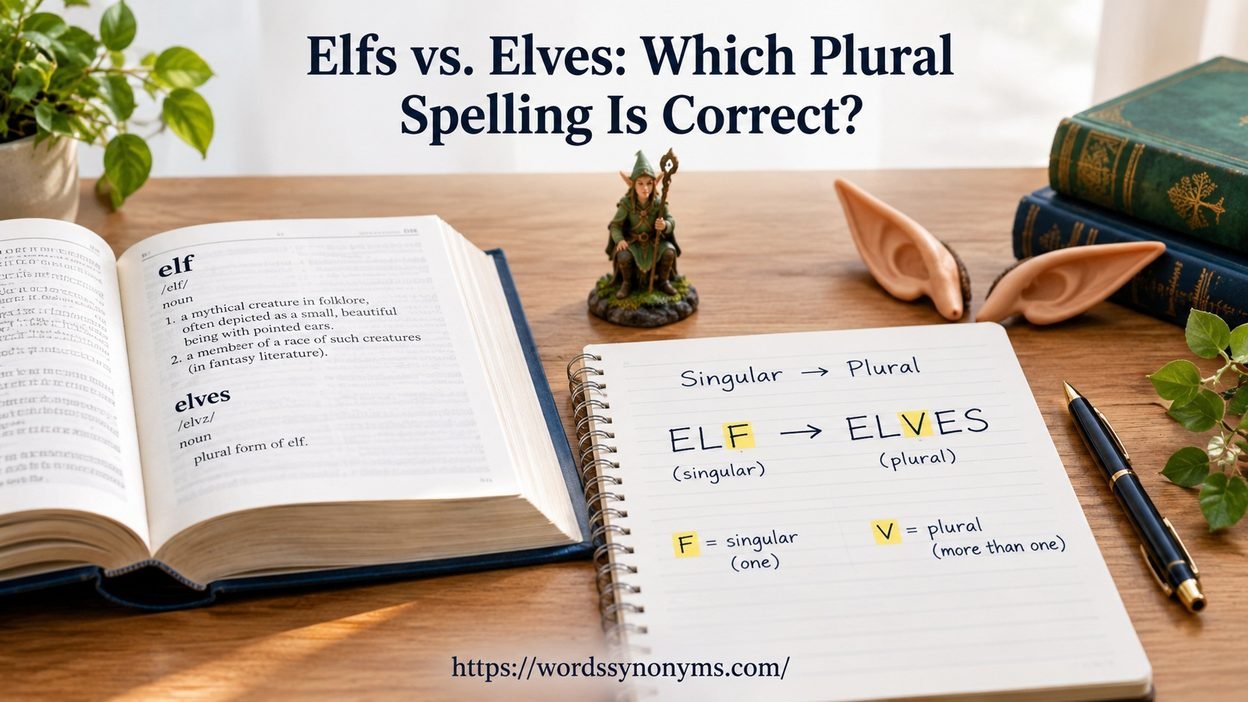
The plural spelling of elf is elves, the standard plural and usual plural in modern standard English. It is common when discussing mythical creatures in a story or everyday writing.
The form elfs may appear in historical contexts or specialized contexts, but elves is the accurate plural form for normal English usage. This plural formation follows a pattern in some English nouns, where the final f and final f sound change.
Compare leaf and leaves, or wolf and wolves. This spelling change and sound change explain the plural form, although the rule does not cover every word ending in f.
This distinction involves grammar, phonetics, and pronunciation, helping learners, writers, and speakers understand the meaning and form. In modern usage, elves follows proper spelling, proper grammar, and grammatical correctness, while elfs can cause a common mistake or other errors.
Learning pluralization, pluralization rules, and simple rules improves writing and speaking. Using the correct term, correct terminology, and proper form builds confidence, strengthens communication, and improves clarity of communication.
Through understanding and mastering the relevant rules and nuances, individuals can enhance their grasp of English and use the English language more engagingly, with natural examples that reflect real English.
Quick Answer
When you need the plural of elf, use elves.
Elf refers to one imaginary or folkloric being. Elves refers to two or more. Major English dictionaries list elves as the plural form and give its pronunciation as /elvz/.
For example:
- One elf lives in the forest.
- Two elves live in the forest.
- The story features several elves.
- Santa works with many elves.
- The fantasy novel describes an ancient race of elves.
The spelling elfs may occasionally appear in historical material or unusual writing. However, it isn’t the normal plural you should choose in contemporary standard English.
If you’re writing an essay, article, email, school assignment, story, or professional document, elves is the safe and standard choice.
What Does “Elf” Mean?
An elf is a supernatural or imaginary being associated with folklore, mythology, fantasy, and popular stories.
Modern dictionaries commonly describe an elf as an imaginary creature resembling a small person, often with pointed ears and magical abilities.
The image varies depending on the context.
In Christmas traditions, an elf is often portrayed as a small helper who works with Santa Claus. In fantasy fiction, elves may appear as an ancient people with their own languages, cultures, kingdoms, or magical abilities.
The modern image is only one part of a much older tradition. Historical Germanic and English folklore did not always portray elves as cheerful little workers in colorful clothes.
Older traditions could associate elves with supernatural danger, illness, mischief, or unexplained events. Over centuries, literature and popular culture reshaped the idea into many different forms.
Examples of “Elf”
Here are several natural examples:
- An elf appeared beside the ancient tree.
- The child drew an elf with pointed ears.
- A Christmas elf helped prepare the presents.
- The fantasy novel introduces an elf from a distant kingdom.
- The old legend describes an elf as a mysterious forest spirit.
In every example, elf refers to one being.
What Does “Elves” Mean?
Elves is simply the plural of elf.
If one supernatural being is an elf, more than one is elves. The word doesn’t require a different definition just because its spelling changes.
For example:
One elf entered the village.
Change the number from one to several:
Three elves entered the village.
The spelling changes from f to v before the plural ending. That’s what makes this plural unusual.
Cambridge Dictionary lists elves as the plural of elf, while Oxford gives the same plural and records its pronunciation as /elvz/.
Examples of “Elves”
- The elves gathered around the fire.
- Several elves guarded the forest.
- Santa’s elves worked throughout the night.
- The story follows a group of elves.
- The ancient elves built the city centuries ago.
Notice that the noun remains the same in meaning. Only the number changes.
Why Is the Plural of Elf “Elves”?
Here’s where the story gets more interesting.
The plural elves isn’t a modern spelling invention. It comes from the historical development of the word.
The English noun elf goes back to Old English forms including ælf. Historical sources connect it to the wider Germanic word family represented by forms in languages such as Old Norse and Old Saxon.
Old English also had a plural form recorded as ylfe. Over time, English changed substantially in pronunciation, grammar, and spelling. The word eventually developed into the modern elf with the plural elves.
That means elves isn’t an arbitrary exception. It’s a surviving result of historical English.
Think of English as an old house that’s been renovated many times. Some rooms have modern furniture while other features come from centuries ago. Irregular plurals are often like those older features. They may look unusual today because the language that created them worked differently.
Why Does the “F” Become “V” in Elves?
The change from f to v is part of the historical development of the plural.
Modern English speakers often learn the pattern through examples such as:
- leaf → leaves
- wolf → wolves
- knife → knives
- wife → wives
- life → lives
- elf → elves
These examples make it tempting to create a rule:
Words ending in -f always become -ves.
That rule doesn’t work.
English has plenty of words ending in -f that simply take -s:
- roof → roofs
- chief → chiefs
- belief → beliefs
- chef → chefs
- cliff → cliffs
- proof → proofs
So the f → v pattern is not a universal modern English rule. You generally need to learn the plural form of each word.
A Useful Comparison
| Singular | Plural |
| elf | elves |
| leaf | leaves |
| wolf | wolves |
| knife | knives |
| wife | wives |
| roof | roofs |
| chief | chiefs |
| belief | beliefs |
This is one reason spelling by intuition can get you into trouble.
If you see elf for the first time, elfs might seem reasonable. English history says otherwise.
Is “Elfs” Correct?
In ordinary modern English, elves is the form to use.
That doesn’t mean the spelling elfs has never existed. Historical English contains alternative spellings and forms. Languages don’t switch overnight from one system to another. Older texts can preserve forms that aren’t standard today.
Historical evidence shows that English had several related forms as the word developed. Old English had ylfe as a plural, while later English developed the familiar elves.
Therefore, it’s important to distinguish two questions:
Does “elfs” ever appear in English?
Yes, alternative or historical usage can be found.
Is “elfs” the standard plural for modern English writing?
No. Elves is the standard form.
That distinction matters when discussing historical language. A spelling can exist in a text without being the form modern writers should normally use.
When Should You Use “Elves”?
Use elves when you’re writing:
- School assignments
- Articles
- Books
- Stories
- Business content
- General correspondence
- Academic writing
- Social media posts
- Descriptions of fantasy characters
- Christmas-related content
For example:
The story follows three elves who protect an enchanted forest.
That’s the natural modern form.
Elf vs. Elves: Singular and Plural
The easiest way to remember the difference is to connect each word with a number.
| Number | Correct form | Example |
| One | elf | One elf entered the room. |
| Two | elves | Two elves entered the room. |
| Several | elves | Several elves entered the room. |
| Many | elves | Many elves lived there. |
| One of them | elf | Each elf carried a lantern. |
| More than one | elves | The elves carried lanterns. |
The grammar follows the normal singular/plural distinction. The unusual part is the spelling.
Compare These Sentences
Singular:
The elf carried a silver lantern.
Plural:
The elves carried silver lanterns.
Another example:
Singular:
An elf guarded the gate.
Plural:
Three elves guarded the gate.
The article also changes naturally:
- an elf
- the elf
- the elves
- several elves
- many elves
This makes elf vs. elves easy once you recognize the number.
How Do You Pronounce “Elves”?
Elf is pronounced approximately like “elf.”
Elves is pronounced approximately like “elvz.”
Oxford gives the pronunciation of elf as /elf/ and elves as /elvz/. Cambridge also records /elvz/ for the plural.
The important difference occurs at the end:
- elf → /elf/
- elves → /elvz/
The final sound in elves is voiced. It isn’t pronounced as though you simply added a clear s sound to elf.
Simple Pronunciation Guide
You can remember it this way:
elf = elf
elves = elvz
The plural therefore sounds more like “elvz” than “elfs.”
That pronunciation also helps explain why the spelling elves feels natural once you’ve heard the word frequently.
Common Mistakes With Elf and Elves
The spelling looks simple until you start forming sentences. A few mistakes appear repeatedly.
Mistake: Writing “Elfs” as the Normal Plural
Incorrect in standard modern usage:
Three elfs lived near the mountain.
Correct:
Three elves lived near the mountain.
The standard plural is elves.
Mistake: Using “Elf” for More Than One
Incorrect:
The elf are preparing the gifts.
Correct:
The elves are preparing the gifts.
The plural noun requires the plural verb are.
Mistake: Writing “Elve” as the Singular
A common attempt to reverse the spelling is elve.
The standard singular isn’t elve. It’s elf.
Correct:
An elf lives in the forest.
Not:
An elve lives in the forest.
The pair is:
elf → elves
Mistake: Assuming Every “-F” Word Becomes “-VES”
This is another trap.
You shouldn’t automatically change every final f into v.
Compare:
- elf → elves
- leaf → leaves
- wolf → wolves
- roof → roofs
- chief → chiefs
- belief → beliefs
English plural formation doesn’t follow one neat formula here.
Why English Has Irregular Plurals Like Elves
English inherited vocabulary from several historical sources. Over time, words changed through sound shifts, grammatical changes, borrowing, regional variation, and ordinary language evolution.
That’s why modern English contains unusual plural pairs such as:
- man → men
- woman → women
- child → children
- mouse → mice
- goose → geese
- tooth → teeth
- foot → feet
- elf → elves
These forms aren’t random mistakes. They’re remnants of older grammatical patterns.
The history of elf is particularly interesting because the word has Germanic roots. Etymological evidence traces Old English elf and related forms to Proto-Germanic albiz, although the deeper origin of that Proto-Germanic term remains uncertain.
Old English wasn’t simply modern English with older spelling. Its grammar and vocabulary operated differently. As the language developed into Middle English and eventually Modern English, older forms changed while some irregular patterns survived.
That’s why today’s elves can look strange beside ordinary plurals such as books or trees.
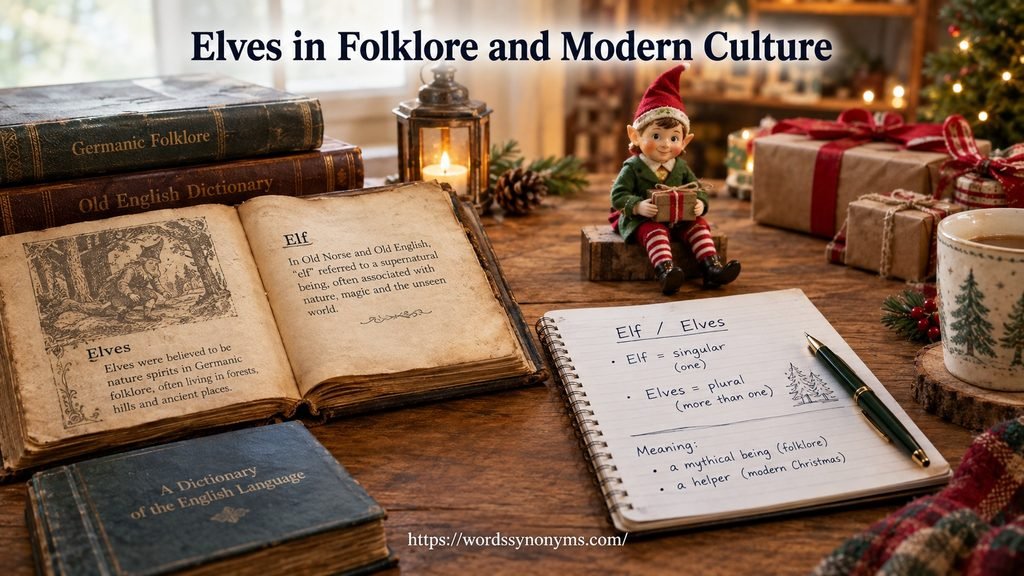
Elves in Folklore and Modern Culture
The word elf has a much longer history than the familiar Christmas image suggests.
In older Germanic traditions, elves could have darker or more troubling associations. Historical sources connect elves with supernatural beings, spirits, and unexplained experiences. Some Old English compounds even associated elves with conditions such as nightmares or hiccups.
Later literature gradually reshaped the image.
By the time elves became common in fantasy literature and popular culture, they could appear as beautiful, magical, wise, mischievous, tiny, heroic, or dangerous beings.
Christmas traditions created another familiar version: the cheerful workshop elf who helps Santa Claus prepare gifts.
Cambridge specifically records Christmas elf as a modern meaning alongside the broader folkloric sense.
So when you read elves, context matters. The word itself simply indicates more than one elf. The nature of those elves depends on the story.
Elves in Christmas Writing
Christmas is probably the context in which many readers encounter the word most often.
In modern Christmas traditions, elves are usually depicted as Santa’s helpers. They may build toys, wrap presents, care for reindeer, or prepare the workshop for Christmas Eve.
Examples include:
- Santa’s elves prepared the gifts.
- The elves worked in the toy workshop.
- A mischievous elf hid behind the Christmas tree.
- The children searched for the missing elves.
- Every elf had a different job.
Notice how naturally the singular and plural forms work together.
If you’re writing Christmas content, remember:
one Christmas elf
two Christmas elves
Never Christmas elfs in standard modern writing.
Elves in Fantasy Fiction
Fantasy literature uses elves in a much broader way.
An elf in a fantasy setting might be a member of an ancient civilization rather than a tiny Christmas helper. Writers may create entirely different cultures, languages, political systems, religions, or magical traditions for their fictional elves.
Common expressions include:
- high elves
- wood elves
- dark elves
- sea elves
- forest elves
- night elves
These expressions describe fictional categories rather than one universal definition.
For example:
The wood elves protected the ancient forest.
Here, elves is simply the plural noun. The adjective wood tells readers what kind of elves the story contains.
Elf, Elves, Elven, Elfin, and Elvish
The word family contains several related forms. They shouldn’t be treated as interchangeable.
| Word | Part of speech | Meaning | Example |
| elf | Noun | One elf | An elf appeared. |
| elves | Noun | More than one elf | The elves appeared. |
| elven | Adjective | Related to elves | An elven kingdom |
| elfin | Adjective | Resembling or relating to an elf | An elfin face |
| elvish | Adjective | Relating to or resembling elves | Elvish customs |
What Does “Elven” Mean?
Elven is an adjective associated with elves.
You might see phrases such as:
- elven language
- elven kingdom
- elven architecture
- elven warrior
- elven culture
The word has older roots, although its modern literary use has been strongly shaped by fantasy literature. Etymological evidence records elven in older English and notes its revival in modern literary usage.
What Does “Elfin” Mean?
Elfin is another adjective derived from elf.
It can mean relating to elves or resembling an elf. In modern English, it can also describe someone or something delicate, small, or fairy-like.
The word dates to the late sixteenth century and has a literary history connected with Edmund Spenser.
What Does “Elvish” Mean?
Elvish means relating to or resembling elves.
It has a much older history than many readers might expect. Etymological records trace elvish to around the late twelfth century.
So these forms aren’t simply modern fantasy inventions.
Elfs vs. Elves: A Complete Comparison
| Feature | Elfs | Elves |
| Singular | elf | elf |
| Plural meaning | Intended as plural | Plural |
| Standard modern form | No | Yes |
| Common in contemporary writing | Rare | Yes |
| Pronunciation | May be read as “elfs” | /elvz/ |
| Suitable for ordinary writing | Generally avoid | Use this form |
| Historical relevance | May occur in older or variant usage | Established modern form |
| Example | Three elfs | Three elves |
The practical takeaway is straightforward: write elves when you mean more than one elf.
Why “Elfs” Looks So Tempting
English learners often expect regular plurals.
The basic rule they learn is:
singular + s = plural
That works beautifully with words such as:
- cat → cats
- book → books
- tree → trees
- house → houses
- river → rivers
Then English throws a curveball:
elf → elves
The problem isn’t your logic. Elfs is a perfectly understandable guess based on the regular plural pattern.
English simply doesn’t use that guess as its standard modern form.
The same thing happens with many irregular words. You learn child → children rather than childs. You learn mouse → mice rather than mouses in the ordinary plural sense.
Elves belongs to the same broad family of historically irregular plurals.
Read more: Homeschool vs. Home School vs. Home-School: Which Is Correct?
A Quick Editing Test for Elf vs. Elves
When proofreading your writing, ask one question:
Am I talking about one elf or more than one?
If you’re talking about one:
elf
If you’re talking about two or more:
elves
Quick Test
- One → elf
- Two → elves
- Three → elves
- Many → elves
- Several → elves
- A group of → elves
- Each → elf
- Every → elf
For example:
Each elf received a lantern.
But:
Several elves received lanterns.
This small trick catches most mistakes immediately.
Examples of Elf vs. Elves in Sentences
Everyday Examples
An elf appeared in the children’s story.
The elves appeared in the second chapter.
Christmas Examples
The elf wrapped a small package.
The elves wrapped hundreds of packages.
Fantasy Examples
The elf carried an ancient sword.
The elves defended the mountain kingdom.
Folklore Examples
The old legend describes an elf living near the forest.
The legend says that elves guarded the sacred grove.
Grammar Examples
Elf is singular.
Elves is plural.
These examples show that the spelling depends on number, not on whether the context involves Christmas, folklore, or fantasy.
A Small Grammar Case Study
Consider this sentence:
The story contains three elfs who live in a magical forest.
The meaning is clear. A reader will understand it immediately. However, the plural doesn’t match standard modern usage.
Change it to:
The story contains three elves who live in a magical forest.
Now the sentence uses the conventional plural.
Here’s another example:
Every elf carries a lantern.
The word every refers to individuals one at a time, so elf remains singular.
Compare:
All the elves carry lanterns.
Here elves refers to the group as a whole.
This distinction is useful because grammar sometimes depends on the word before the noun rather than simply on the idea of “many.”
Facts About the Word “Elf”
A few historical and linguistic facts make this spelling easier to remember:
- Elf is an old Germanic word.
- Old English had forms including ælf.
- Old English recorded ylfe as a plural form.
- Modern English developed the familiar plural elves.
- The word has been associated with supernatural beings for many centuries.
- Modern dictionaries list elves as the plural.
- Elves is pronounced approximately “elvz.”
- English doesn’t change every final -f into -ves.
- Roof → roofs demonstrates why the pattern isn’t universal.
- Related words include elven, elfin, and elvish.
There’s also a fascinating linguistic footprint in old personal names. Names such as Alfred contain an Old English element related to elf. Etymological evidence connects Alfred to Old English Ælfræd, interpreted as “elf-counsel.”
So the word elf isn’t merely a fantasy term invented for modern books and movies. Its linguistic history reaches deep into English and Germanic history.
Is “Elfs” Ever Acceptable?
Context matters.
If you’re writing modern standard English, elves is the appropriate plural.
However, historical texts, quotations, deliberately archaic writing, or unusual literary usage may preserve older or alternative forms. Language changes gradually, so older spellings don’t automatically become meaningless just because modern readers rarely use them.
If you’re reproducing an original quotation, don’t silently modernize it unless your editorial purpose calls for modernization.
For ordinary writing, though, there is little reason to choose elfs.
Use:
The elves gathered in the forest.
Not:
The elfs gathered in the forest.
The first is the standard modern form.
Elfs vs. Elves: Which One Should You Use?
For practically every modern writing situation, choose elves.
| Writing situation | Recommended form |
| School assignment | elves |
| Blog post | elves |
| Grammar article | elves |
| Fantasy novel | elves |
| Christmas story | elves |
| Business writing | elves |
| Academic writing | elves |
| Everyday conversation | elves |
| Historical quotation | Preserve the original if appropriate |
| Deliberately archaic writing | Depends on the intended historical style |
The distinction is less complicated than it first appears.
Elfs may look regular, but elves is the established modern plural.
The Easiest Way to Remember Elfs vs. Elves
If the spelling still feels slippery, use a simple memory trick:
One elf, two elves.
Think of the v in elves as part of the plural form rather than trying to construct the plural from scratch.
You don’t need to remember every historical detail whenever you write the word. The practical rule is enough:
Elf = one.
Elves = more than one.
Once that pair becomes familiar, elfs starts looking as unusual as childs or mouses.
FAQs
Is “elves” the correct plural of elf?
Yes. Elves is the standard plural form of elf in modern English. It’s the form you’ll normally use when talking about more than one mythical elf.
Is “elfs” ever used in English?
Elfs does appear occasionally, especially in older, historical, or specialized contexts. However, elves is the normal plural form for everyday English writing and speaking.
Why does elf change to elves?
The change follows a historical English spelling pattern in which some nouns ending in f or fe change to ves in the plural. Similar examples include wolf/wolves and leaf/leaves.
How do you pronounce elves?
Elves is pronounced with a short vowel sound followed by a vz ending. The pronunciation differs slightly from the singular elf, mainly because the final consonant changes.
Should I use elfs or elves in formal writing?
Use elves in formal writing, schoolwork, articles, and most everyday communication. It is the established standard plural and will be immediately understood by English readers.
Is the plural rule for elf the same for every word ending in f?
No. English has several plural patterns, so you can’t apply one rule to every f-ending noun. Words such as roof/roofs show why individual word usage still matters.
Conclusion
When you’re writing about more than one elf, elves is the spelling to use. Although elfs may turn up in older or specialized sources, elves is the familiar form in modern English. Remembering this small plural change can save you from an easy spelling mistake and make your writing sound natural.
Once you connect elf with examples such as wolf/wolves and leaf/leaves, the pattern becomes easier to remember. English has plenty of unusual plural forms, but a little attention to usage and context can help you choose the right word with confidence.

Muhammad Taqi is a content writer interested in English vocabulary and language. He writes clear and useful articles on synonyms, antonyms, word meanings, and English usage, helping readers expand their vocabulary and improve their communication skills.