
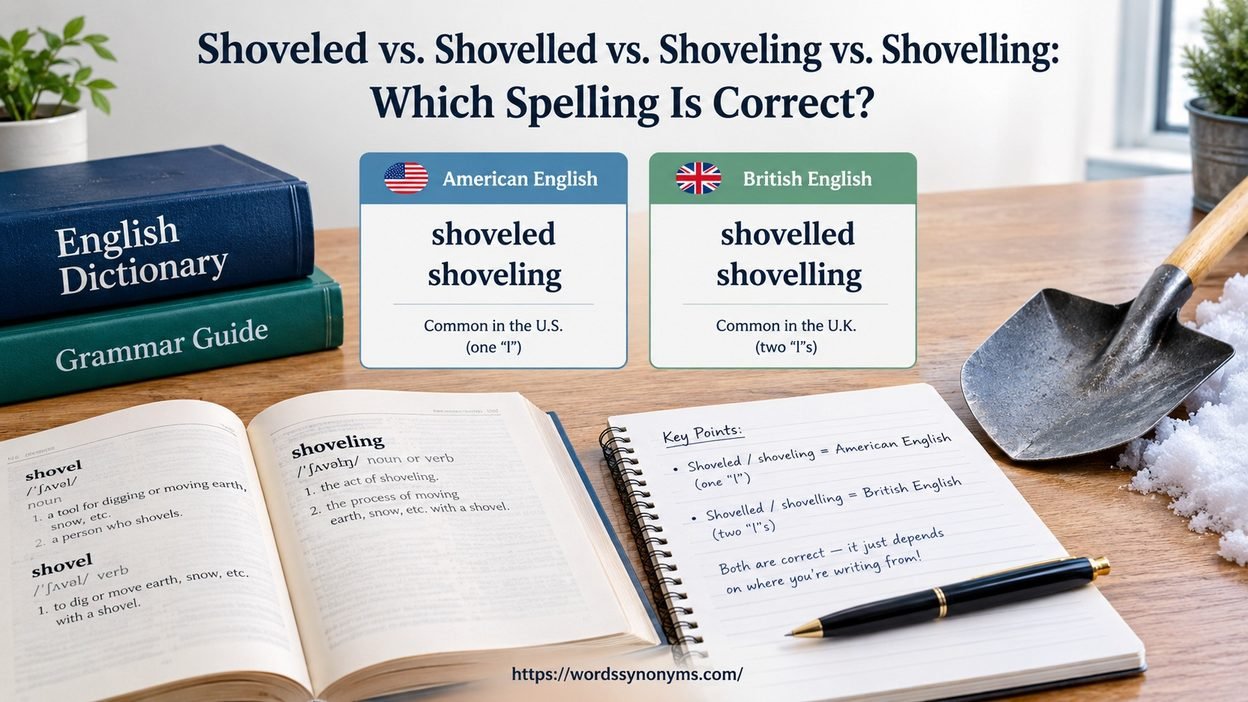
The keyword Shoveling vs. Shovelling: Which Spelling Is Correct? highlights a simple difference between American English and British usage.
The verb shovel has several inflected forms. In the United States, shoveled and shoveling use a single l, while shovelled and shovelling keep the double l and are common outside the U.S., including British English.
The second l appears before the endings, following a pattern shared by a large group of l-ending verbs. However, different verbs developed their spelling patterns at different times.
The forms using a single l gained prevalence around 1900, making this spelling change one of the early changers in American usage. That history means the distinction is long established, not a recent development.
In practical editing, shoveled and shoveling are the natural American forms, while shovelled and shovelling suit writing outside the United States. The distinction is established in standard usage and is generally not questioned.
Quick Answer
Shoveled and shoveling are the standard American English spellings. Shovelled and shovelling are the standard British English forms. All four words come from shovel and carry the same meaning. The difference is simply the spelling convention used in each variety of English.
| Form | English Variety | Use |
| Shoveled | American English | Past tense / past participle |
| Shovelled | British English | Past tense / past participle |
| Shoveling | American English | -ing form |
| Shovelling | British English | -ing form |
For a US audience, use shoveled and shoveling. For British English, use shovelled and shovelling. The extra l doesn’t change the meaning, so the key is to choose one spelling style and use it consistently.
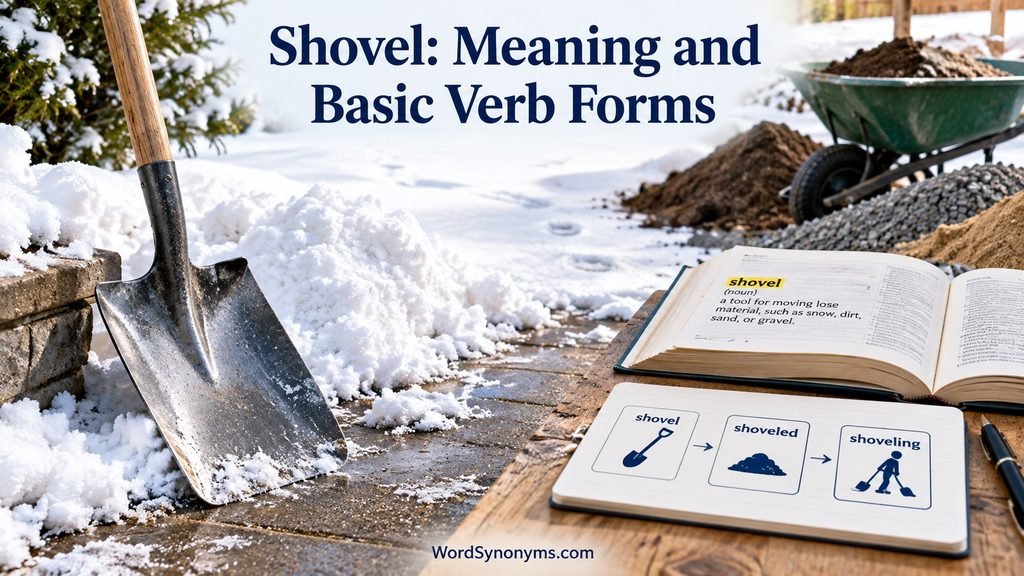
Shovel: Meaning and Basic Verb Forms
Before comparing the four spellings, it helps to understand the base word shovel.
As a verb, shovel means to move something with a shovel. The material might be snow, dirt, sand, gravel, coal, soil, or another loose substance. The word can also describe moving something quickly with a scooping motion.
For example:
- I need to shovel the snow from the sidewalk.
- They shoveled dirt into the truck.
- She is shoveling gravel into a wheelbarrow.
- We have shoveled the entire driveway.
The word also has figurative uses. Someone might shovel food into their mouth, meaning they eat quickly and without much care.
The base verb remains shovel in every variety of English. The spelling difference appears when you add endings such as -ed and -ing.
The main forms of the verb
| Verb form | American English | British English |
| Base form | shovel | shovel |
| Third-person singular | shovels | shovels |
| Present participle | shoveling | shovelling |
| Past tense | shoveled | shovelled |
| Past participle | shoveled | shovelled |
Notice something important: the base form doesn’t change.
The regional spelling difference appears when the verb takes -ed or -ing.
Shoveled vs. Shovelled: Past Tense and Past Participle
The most common question is whether shoveled or shovelled is correct.
The answer depends on the English variety.
Shoveled is the standard American English spelling. Shovelled is the standard British English spelling. Both forms work as the simple past tense and past participle of shovel.
Shoveled in American English
In American English, the usual spelling is shoveled with one l before the ending.
For example:
- I shoveled the driveway yesterday.
- Maria shoveled snow for two hours.
- He shoveled the dirt into the garden bed.
- They have shoveled enough snow to clear the path.
Here, shoveled can function as either a simple past form or a past participle.
Consider the difference:
She shoveled the sidewalk yesterday.
This is the simple past.
She has shoveled the sidewalk already.
This is the past participle used with has.
The spelling remains the same in American English.
Shovelled in British English
British English generally uses shovelled, with a doubled l.
For example:
- I shovelled the driveway yesterday.
- She shovelled snow from the path.
- They had shovelled the garden before lunch.
- He has shovelled coal into the furnace.
The grammatical role hasn’t changed. Only the spelling convention differs.
That distinction matters because it prevents a common mistake: assuming that the extra l indicates a different tense. It doesn’t.
Shoveled and Shovelled side by side
| American English | British English |
| I shoveled the snow. | I shovelled the snow. |
| She shoveled the dirt. | She shovelled the dirt. |
| We have shoveled the driveway. | We have shovelled the driveway. |
| He had shoveled the path. | He had shovelled the path. |
The meaning stays the same in every example.
Shoveling vs. Shovelling: Which Form Is Correct?
The same regional distinction appears with the -ing form.
American English normally uses shoveling with one l.
British English normally uses shovelling with two l’s.
Both forms can function as present participles or gerunds.
Shoveling in American English
Use shoveling when following American spelling conventions.
Examples include:
- We are shoveling snow.
- He was shoveling dirt into the hole.
- Shoveling heavy snow can take a lot of effort.
- She spent the morning shoveling the driveway.
The word can appear after forms of be in progressive constructions:
They are shoveling snow.
It can also function as a gerund:
Shoveling snow is tiring.
Shovelling in British English
British English generally doubles the l:
- We are shovelling snow.
- He was shovelling soil into the flower bed.
- Shovelling snow takes considerable effort.
- She spent the morning shovelling the path.
Again, nothing about the action changes.
The two forms simply follow different spelling conventions.
Why Does Shovel Become Shoveling or Shovelling?
This is where the spelling gets interesting.
The difference comes from how American and British English handle certain words when they take suffixes beginning with a vowel.
British English frequently doubles a final consonant in words such as shovel before adding -ed or -ing.
That produces:
- shovel → shovelled
- shovel → shovelling
American English generally doesn’t double the final l in this word:
- shovel → shoveled
- shovel → shoveling
This isn’t an isolated spelling difference. You can see similar patterns in other words.
| American English | British English |
| traveled | travelled |
| traveling | travelling |
| canceled | cancelled |
| canceling | cancelling |
| labeled | labelled |
| labeling | labelling |
| modeled | modelled |
| modeling | modelling |
The pattern isn’t perfectly universal across every English word. However, it explains why shoveled/shovelled and shoveling/shovelling follow different regional conventions.
Shoveled vs. Shovelled vs. Shoveling vs. Shovelling
The easiest way to remember the distinction is to look at all four forms together.
| Spelling | Variety | Grammatical use | Example |
| shoveled | American English | Past / past participle | She shoveled the snow. |
| shovelled | British English | Past / past participle | She shovelled the snow. |
| shoveling | American English | Present participle / gerund | She is shoveling snow. |
| shovelling | British English | Present participle / gerund | She is shovelling snow. |
There is no difference in the basic meaning.
Think of these spellings as regional outfits for the same verb. The verb hasn’t changed its identity. The spelling has simply adapted to the conventions of the audience.
US English vs. British English Spelling of Shovel
If you’re writing for an American audience, use:
- shoveled
- shoveling
If you’re writing according to British English conventions, use:
- shovelled
- shovelling
This distinction becomes especially useful in formal writing. Consistency matters more than trying to make one regional spelling look universally correct.
For example, an American English article would normally write:
After the storm, residents shoveled snow from their driveways.
A British English article would normally write:
After the storm, residents shovelled snow from their driveways.
Both sentences communicate the same idea.
Why consistency matters
Imagine a document that begins with shoveling, switches to shovelled, and later returns to shoveled.
The reader can still understand it. However, the mixed spelling can look careless.
A consistent style is cleaner:
American style
The workers shoveled snow throughout the morning. They kept shoveling until the road was clear.
British style
The workers shovelled snow throughout the morning. They kept shovelling until the road was clear.
Choose one convention based on your intended audience. Then stick with it.
How to Use Shoveled in a Sentence
Shoveled works in several grammatical situations.
Simple past
Use shoveled for a completed action in the past.
James shoveled the driveway before work.
We shoveled snow for nearly an hour.
The neighbors shoveled a path to the front door.
Past participle
Use shoveled with auxiliary verbs such as has, have, or had.
She has shoveled the entire sidewalk.
They had shoveled the snow before the temperature dropped.
We have already shoveled the driveway.
Passive construction
Although active voice is often clearer, shoveled can also appear in passive constructions.
The snow was shoveled away before noon.
Here, was shoveled describes an action performed on the snow.
How to Use Shovelled in a Sentence
The British form works in exactly the same grammatical situations.
Simple past
James shovelled the driveway before work.
Past participle
She has shovelled the entire sidewalk.
Past perfect
They had shovelled the path before the visitors arrived.
The only difference from the American examples is the additional l.
That makes the choice straightforward: if your writing follows British English, use shovelled.
How to Use Shoveling in a Sentence
Shoveling has two particularly common uses.
First, it works as the present participle in progressive tenses:
The workers are shoveling snow.
He was shoveling dirt into a trailer.
Second, it can work as a gerund, where the -ing form functions like a noun:
Shoveling snow requires physical effort.
Shoveling wet soil can be surprisingly difficult.
The spelling stays shoveling in American English.
How to Use Shovelling in a Sentence
British English uses shovelling in those same grammatical positions.
The workers are shovelling snow.
He was shovelling dirt into a trailer.
Shovelling snow requires physical effort.
Once again, the grammatical function remains unchanged.
The extra l simply follows the British spelling convention.
Is Shoveled or Shovelled Correct?
Both are correct.
The distinction is regional:
- Shoveled = standard American English
- Shovelled = standard British English
1 Neither spelling represents a different meaning.
2 Neither one indicates a different action.
3 Neither one is automatically a spelling mistake.
If you’re writing in American English, shoveled is the form to choose. If you’re following British English spelling, shovelled is appropriate.
This same principle applies to the -ing forms.
Is Shoveling or Shovelling Correct?
Again, both are correct.
Use shoveling in standard American English.
Use shovelling in standard British English.
For example:
American: She is shoveling snow.
British: She is shovelling snow.
The sentence structure and meaning remain identical.
A quick memory trick
Think of the two systems this way:
US English
shovel → shoveled → shoveling
British English
shovel → shovelled → shovelling
The British forms double the l. The American forms generally don’t.
Read more: Break Up vs. Breakup: Meaning, Difference and Correct Usage
Does the Spelling Change the Pronunciation?
The extra l doesn’t create a separate meaning or a major pronunciation distinction.
Shoveled and shovelled refer to the same form of the verb. Likewise, shoveling and shovelling refer to the same action.
The pronunciation can naturally vary according to regional accent, just as many English words sound slightly different across countries. However, the extra written l itself doesn’t signal a completely different pronunciation.
That’s important because English spelling often carries historical or regional information that isn’t obvious from pronunciation.
In other words, don’t read the doubled l as an instruction to pronounce the word differently.
Shovel vs. Shove: Don’t Confuse the Verbs
Another possible source of confusion is the relationship between shovel and shove.
They look somewhat similar, but they aren’t the same verb.
Shovel means to move something with a shovel or by using a scooping motion.
She shoveled snow from the steps.
Shove means to push something forcefully.
He shoved the box across the floor.
Their past forms are also different:
- shovel → shoveled/shovelled
- shove → shoved
So, shoveled doesn’t come from shove.
That distinction becomes obvious when you compare the meanings:
| Verb | Meaning | Past form |
| shovel | Move material with a shovel | shoveled / shovelled |
| shove | Push forcefully | shoved |
If someone shoveled snow, they used a shovel or a scooping action. If someone shoved snow, they pushed it forcefully.
Common Mistakes With Shoveled and Shovelling
These words cause relatively small spelling errors, but a few patterns appear repeatedly.
Assuming shovelled is wrong in American English
In American English, shoveled is the usual spelling. However, shovelled isn’t meaningless or nonsensical. It’s the standard British form.
Calling every doubled-l version an error misses the regional nature of English spelling.
Assuming shoveled is wrong in British English
The reverse mistake happens too.
British English generally prefers shovelled, but American English uses shoveled. The American spelling doesn’t change the verb’s meaning.
Mixing regional spellings
A piece of writing can accidentally mix conventions:
The crew shoveled snow all morning. Later, they shovelled the walkway.
The sentence isn’t difficult to understand. Still, the spelling shifts from American to British convention.
For polished writing, choose one style and maintain it.
Adding an unnecessary extra letter
Some writers may wonder whether American English requires shovelled because the base word ends in l.
It doesn’t.
The standard American forms are:
- shoveled
- shoveling
Forgetting the difference between -ed and -ing
Remember that these forms serve different grammatical purposes:
- shoveled/shovelled → past and past participle
- shoveling/shovelling → present participle and gerund
For example:
She shoveled the snow.
She is shoveling the snow.
The first describes a completed action. The second describes an ongoing activity.
Shoveled and Shovelled in Everyday Contexts
The verb appears in more situations than winter snow removal.
Snow removal
This is probably the most familiar use.
We shoveled the driveway after the snowstorm.
Gardening
People also shovel soil, compost, mulch, sand, and gravel.
He shoveled compost into the garden bed.
Construction
Workers may shovel loose material around construction sites.
The crew shoveled gravel into the foundation area.
Mining and industrial work
The word can describe moving coal or other bulk materials.
Workers shoveled coal into the furnace.
Figurative use
The verb can describe doing something quickly or excessively.
He shoveled food into his mouth after skipping lunch.
Here, nobody is literally using a shovel. The word creates a vivid comparison between eating rapidly and repeatedly scooping material.
Case Study: Choosing the Right Form in American English
Consider a US-based article about winter maintenance.
The writer wants to describe what homeowners did after a heavy snowfall.
An inconsistent version might say:
Residents shoveled their driveways early in the morning. By noon, many were still shovelling snow.
The meaning is clear. However, the spelling switches conventions.
A consistent American version would be:
Residents shoveled their driveways early in the morning. By noon, many were still shoveling snow.
That version uses shoveled and shoveling consistently.
Now imagine a British publication describing the same event:
Residents shovelled their driveways early in the morning. By noon, many were still shovelling snow.
The action hasn’t changed. The spelling has.
This small example shows why knowing the regional distinction matters in editing, publishing, education, and professional communication.
Case Study: Why Context Matters More Than the Extra L
Suppose you encounter this sentence:
The workers shovelled the sand into containers.
If you’re accustomed to American English, the doubled l may look unusual. Yet the surrounding sentence provides no evidence that the writer used the wrong form.
The spelling simply suggests a British spelling convention.
Now consider:
The workers shoveled the sand into containers.
A British reader can understand the sentence immediately. The spelling reflects American English.
Neither sentence needs a meaning-based correction. The appropriate choice depends on the style of English being used.
A Practical Guide to Choosing the Right Spelling
When you’re unsure which form to use, follow these steps.
Identify your audience
Ask whether your readers primarily use American or British English.
For a US audience, choose shoveled and shoveling.
For a British audience, choose shovelled and shovelling.
Check the rest of your document
Look at related words.
If your document consistently uses forms such as traveled, canceled, and labeled, American spelling is probably the intended convention.
If it uses travelled, cancelled, and labelled, British spelling is likely being followed.
Stay consistent
Once you’ve selected a spelling system, keep it throughout the article, report, essay, or website.
Consistency makes writing look deliberate and polished.
Quick Reference: Shoveled vs. Shovelled
| Feature | Shoveled | Shovelled |
| English variety | American | British |
| Past tense | Yes | Yes |
| Past participle | Yes | Yes |
| Meaning | Move with a shovel | Move with a shovel |
| Extra l | No | Yes |
| Example | He shoveled snow. | He shovelled snow. |
Quick Reference: Shoveling vs. Shovelling
| Feature | Shoveling | Shovelling |
| English variety | American | British |
| Present participle | Yes | Yes |
| Gerund | Yes | Yes |
| Meaning | Same | Same |
| Extra l | No | Yes |
| Example | She is shoveling snow. | She is shovelling snow. |
The Simplest Rule to Remember
If you only remember one thing, remember this:
American English: shovel → shoveled → shoveling
British English: shovel → shovelled → shovelling
The doubled l is the key visual difference.
However, don’t assume that every English-speaking country follows exactly the same spelling preferences in every situation. English spelling varies across regions, publishers, institutions, and style guides.
For ordinary American English writing, though, shoveled and shoveling are the forms you want.
FAQs
Is “shoveled” correct in American English?
Yes. Shoveled is the standard American English past-tense and past-participle form of shovel.
Is “shovelled” correct in British English?
Yes. Shovelled is the standard spelling commonly used in British English and other varieties outside the U.S.
Should I write “shoveling” or “shovelling”?
Use shoveling in American English and shovelling in British English. The difference is the use of one l or two.
Why does American English use one “l” in shoveled?
American spelling commonly drops the second l in certain l-ending verbs before endings such as -ed and -ing. Shovel follows this established pattern.
Can “shoveled” and “shovelled” mean different things?
No. They have the same meaning. The difference is mainly a regional spelling preference, with shoveled and shoveling associated with American English and shovelled and shovelling used in British English.
Which spelling should I use in formal writing?
Follow the variety of English required by your audience or publication. For U.S. readers, use shoveled and shoveling. For British readers, use shovelled and shovelling.
Conclusion
Choosing between shoveled, shovelled, shoveling, and shovelling mainly depends on the variety of English you are writing. American English normally uses the single-l forms, while British English and other varieties commonly use the double-l forms. The meaning stays the same, so the key is keeping your spelling consistent with your intended audience.
Once you recognize this pattern, these forms become much easier to remember. Whether you are describing someone who shoveled snow or someone who is shovelling dirt, the correct spelling simply follows the regional convention you are using.

Muhammad Taqi is a content writer interested in English vocabulary and language. He writes clear and useful articles on synonyms, antonyms, word meanings, and English usage, helping readers expand their vocabulary and improve their communication skills.