
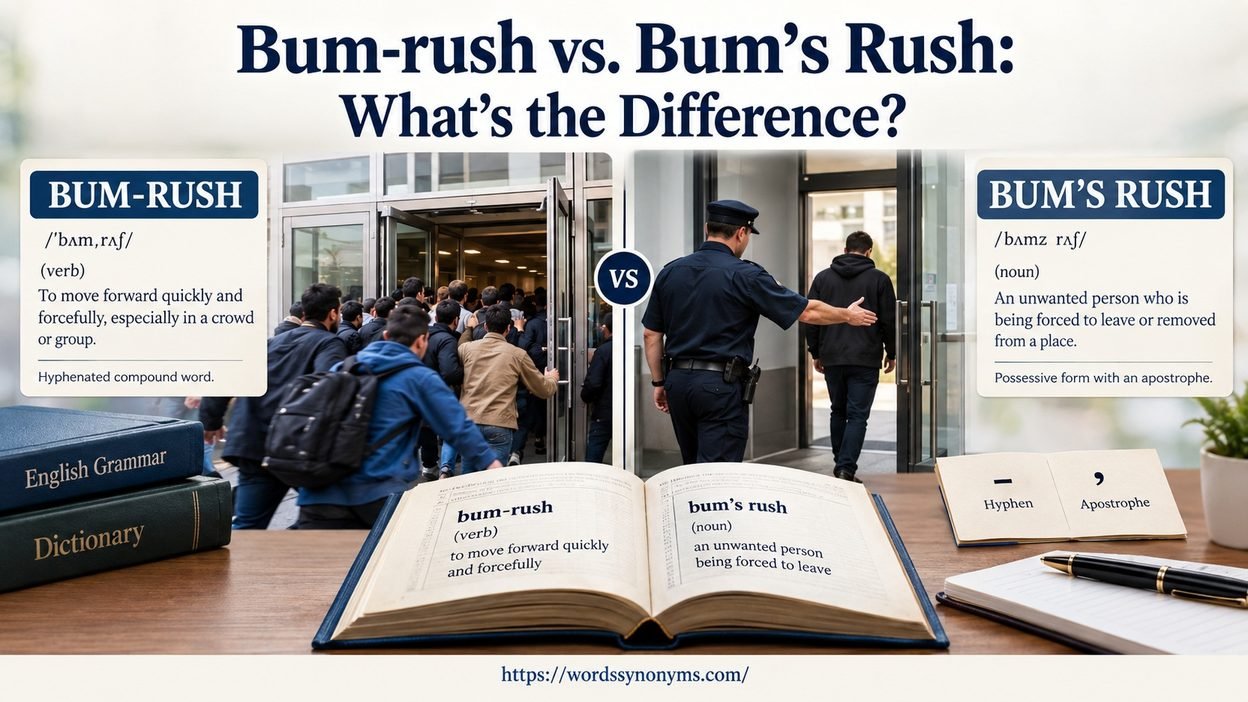
Bum-rush vs. Bum’s Rush: What’s the Difference? becomes clearer when you separate the meanings of bum rush and bum’s rush.
The bum’s rush is an idiom for being kicked out, rushed out, or forcibly removing someone from an establishment or place of business. In contrast, bum rush describes a sudden, forceful charge or attack, often involving a rowdy crowd pushing its way into a show without tickets or paying admission.
The expressions share the word bum, but their meanings and verb construction differ. The common misspelling bums rush incorrectly pluralizes bum and often results from mishearing.
For clarity and correctness, always use bum rush for the forceful charge and bum’s rush for being expelled. Public Enemy helped popularize the phrase through its debut album, Yo! Bum Rush the Show, while Chuck D connected it with the group’s musical ambitions.
Quick Answer
Bum-rush and bum’s rush are related expressions, but they describe opposite directions. Bum-rush is a verb meaning to force your way into or toward something, while bum’s rush is a noun phrase referring to the forceful or abrupt removal of someone from a place. In simple terms, bum-rush means rushing in, whereas getting the bum’s rush means being rushed out.
| Term | Meaning | Grammar | Example |
| Bum-rush | Force your way into or toward something | Verb | The crowd tried to bum-rush the entrance. |
| Bum’s rush | Forceful or abrupt ejection | Noun phrase | The troublemaker was given the bum’s rush. |
Easy way to remember: Bum-rush = rush in. Bum’s rush = get rushed out.
What Does Bum-rush Mean?
Bum-rush is an informal slang verb meaning to force one’s way into a place or crash into something. It can describe one person or a group acting suddenly and forcefully.
For example:
The fans tried to bum-rush the concert before security closed the gates.
The sentence doesn’t simply mean that the fans walked quickly. It suggests that they attempted to enter without proper permission or control.
The word often carries an aggressive or chaotic flavor. Depending on the context, it can describe people rushing through an entrance, charging toward someone, or overwhelming a target.
Bum-rush Meaning in Simple English
You can think of bum-rush as:
- force your way into a place
- crash an event
- rush through an entrance
- charge toward something
- overwhelm someone suddenly
- enter aggressively or without permission
The exact shade of meaning depends on the sentence.
For instance:
A group tried to bum-rush the gate.
This clearly suggests forced entry.
Meanwhile:
The boxer tried to bum-rush his opponent.
Here, the expression suggests suddenly charging or attacking rather than literally entering a building.
Examples of Bum-rush
Here are several natural examples:
- The crowd tried to bum-rush the entrance.
- Several fans attempted to bum-rush the stage.
- Security stopped the people before they could bum-rush the concert.
- The protesters threatened to bum-rush the building.
- The player suddenly bum-rushed his opponent.
- The audience became restless and tried to bum-rush the doors.
- A group of fans attempted to bum-rush the field.
Notice the common thread. In every example, someone moves toward or into a place or target with unusual force or urgency.
Is Bum-rush a Verb or a Noun?
In its established modern use, bum-rush is a verb.
That distinction matters because it determines how you construct the sentence.
Correct:
The fans bum-rushed the stage.
Correct:
Security guards stopped them before they could bum-rush the entrance.
The word can take different verb forms depending on tense.
| Verb form | Example |
| bum-rush | They may bum-rush the gate. |
| bum-rushes | He bum-rushes the entrance. |
| bum-rushed | The crowd bum-rushed the stage. |
| bum-rushing | They were bum-rushing the doors. |
Because the expression is informal, you’ll mostly encounter it in conversational writing, journalism, sports coverage, entertainment writing, and descriptions of chaotic events.
What Does Bum’s Rush Mean?
Bum’s rush is a slang noun phrase meaning forcible and swift ejection from a place. It can also mean a rude, abrupt, or dismissive rejection.
For example:
The disruptive customer got the bum’s rush.
The customer wasn’t simply asked to leave. The expression suggests a swift and unwelcome removal.
The phrase can also move beyond physical ejection.
The committee gave the proposal the bum’s rush.
Here, nobody is physically throwing a proposal out of a building. Instead, the committee dismisses the idea quickly and without giving it serious consideration.
That figurative sense is important because bum’s rush doesn’t always involve a person leaving a physical location.
Bum’s Rush Meaning in Simple English
Bum’s rush can mean:
- forcible ejection
- being thrown out
- being hurried out
- abrupt dismissal
- rude rejection
- quick rejection of an idea or proposal
The phrase often appears in two familiar constructions:
- give someone the bum’s rush
- get the bum’s rush
For example:
The bartender gave the customer the bum’s rush.
Or:
The customer got the bum’s rush after causing trouble.
Both sentences describe the same basic event from different perspectives.
How to Use “Bum’s Rush” Correctly
The phrase generally appears with the.
Common patterns include:
give someone the bum’s rush
get the bum’s rush
give something the bum’s rush
The first two usually describe people. The third can describe an idea, proposal, plan, or other abstract thing.
Physical Ejection
The bouncer gave the heckler the bum’s rush.
This means the bouncer removed the heckler.
Abrupt Dismissal
The manager gave the complaint the bum’s rush.
This suggests the manager dismissed the complaint quickly rather than dealing with it carefully.
Rejection of an Idea
The board gave the proposal the bum’s rush.
Nobody physically leaves. Instead, the proposal gets rejected or dismissed.
That figurative use gives bum’s rush more range than a simple synonym such as ejection.
Bum-rush vs. Bum’s Rush: Grammar Comparison
The grammar makes the distinction much clearer.
| Feature | Bum-rush | Bum’s rush |
| Part of speech | Verb | Noun phrase |
| Apostrophe | No | Yes |
| Common spelling | Hyphenated | Two words |
| Core meaning | Force your way in | Force someone out |
| Typical direction | Toward or into | Away or out |
| Register | Informal/slang | Informal/slang |
| Example | “They bum-rushed the gate.” | “They got the bum’s rush.” |
The apostrophe in bum’s isn’t optional decoration. It marks a possessive form.
That small punctuation mark helps distinguish the phrase from bum rush or bum-rush.
Why Does Bum’s Rush Have an Apostrophe?
The apostrophe appears because bum’s is a possessive form.
The expression is traditionally understood as describing a “rush” given to a bum. In other words, the construction has the grammatical shape of a noun in possession:
bum + ’s + rush
That gives us:
bum’s rush
By contrast, bum-rush is a compound verb.
Compare the structures:
They bum-rushed the stage.
versus:
Security gave them the bum’s rush.
The first expression works as a verb. The second functions as a noun phrase.
This is one reason punctuation matters so much in English. A tiny apostrophe can signal an entirely different grammatical construction.
Bum-rush, Bumrush, or Bum Rush?
Spelling can create another layer of confusion.
You may encounter bum-rush, bumrush, and occasionally bum rush. Dictionaries recognize variant forms in usage. Collins, for example, has entries for both bum-rush and bumrush, with the latter defined as an informal verb meaning to approach or enter eagerly or forcibly.
For standard edited writing, bum-rush is a clear and recognizable choice.
However, don’t confuse spelling variation with a difference in meaning.
These forms can refer to the same verb:
- bum-rush
- bumrush
- bum rush
The phrase bum’s rush is different.
It has a different grammatical structure and a different meaning.
Which Spelling Should You Use?
If you’re writing an article, essay, or other edited content, bum-rush is a straightforward choice.
Use:
The fans tried to bum-rush the stage.
Avoid changing it to bum’s rush simply because the two expressions sound similar.
The apostrophe changes more than the appearance. It changes the construction and meaning.
Bum-rush vs. Bum’s Rush: Direction Makes It Easy
When the two expressions get confusing, imagine a doorway.
Bum-rush
Someone wants to get inside.
Person → → → Door → → → Inside
The person forces their way through.
The crowd tried to bum-rush the doors.
Bum’s rush
Someone is being pushed outside.
Inside → → → Door → → → Person outside
The person gets removed.
Security gave the troublemaker the bum’s rush.
This simple mental picture works surprisingly well.
Bum-rush goes in. Bum’s rush sends out.
Examples of Bum-rush in Context
Context makes slang much easier to understand.
At a Concert
Hundreds of fans tried to bum-rush the entrance when the doors opened.
The fans aren’t merely arriving quickly. They’re attempting to force their way through.
At a Sporting Event
Security formed a barrier when spectators tried to bum-rush the field.
The expression emphasizes uncontrolled movement onto the field.
During a Confrontation
The defender suddenly bum-rushed the attacker.
Here, the verb describes a sudden aggressive charge rather than entry into a building.
At a Public Event
A group tried to bum-rush the stage during the performance.
Again, the essential idea is forced or aggressive movement toward a restricted area.
Examples of Bum’s Rush in Context
Now compare those examples with bum’s rush.
At a Restaurant
The disruptive customer got the bum’s rush from the restaurant.
The customer was forcibly or abruptly removed.
At a Bar
After starting another argument, he finally got the bum’s rush.
The phrase communicates that staff had enough and sent him away.
At a Private Event
The uninvited guest received the bum’s rush before the ceremony began.
The emphasis is on removal.
With an Idea
The committee gave the expensive proposal the bum’s rush.
Here, the phrase is figurative. The proposal wasn’t physically ejected. It was dismissed quickly.
Bum-rush vs. Bum’s Rush: Side-by-Side Examples
The following pairs show how one small change can completely alter the meaning.
| Bum-rush | Bum’s rush |
| The fans bum-rushed the stage. | Security gave the fans the bum’s rush. |
| They tried to bum-rush the gate. | The guards gave the trespassers the bum’s rush. |
| The crowd bum-rushed the entrance. | The troublemakers got the bum’s rush. |
| The protesters tried to bum-rush the building. | Police gave the intruders the bum’s rush. |
| The player bum-rushed his opponent. | The heckler got the bum’s rush. |
The distinction remains consistent.
Bum-rush describes the forceful approach.
Bum’s rush describes the forceful departure.
Common Mistakes With Bum-rush and Bum’s Rush
These expressions often cause trouble because they share the same two words. Their grammar provides the best clue.
Mistake: Using Bum’s Rush for Forced Entry
Consider:
The fans gave the stadium the bum’s rush.
If the intended meaning is that the fans forced their way into the stadium, this isn’t the natural expression.
Better:
The fans tried to bum-rush the stadium.
The verb clearly communicates forced entry.
Mistake: Treating Bum-rush as a Synonym for Eject
Consider:
The bartender bum-rushed the customer out of the bar.
A reader might understand the intended meaning from context. However, bum-rush doesn’t primarily mean “eject.”
If the intended meaning is that the bartender removed the customer, the established idiom is:
The bartender gave the customer the bum’s rush.
That version precisely captures forcible or abrupt ejection.
Mistake: Removing the Apostrophe
Another common error is writing:
the bums rush
That spelling changes the grammatical relationship.
Bum’s is singular possessive.
Bums is plural.
Compare:
- bum’s rush = the rush associated with a bum
- bums = more than one bum
The two forms shouldn’t be treated as interchangeable.
Mistake: Assuming the Expressions Are Synonyms
They aren’t.
Their histories are related, which helps explain their similar appearance. Their modern meanings have diverged.
Bum-rush developed as a verb associated with forceful entry or crashing.
Bum’s rush remains the established idiom for forcible ejection and abrupt dismissal.
Read more: Aerie vs. Airy: Difference and Examples
Where Did Bum’s Rush Come From?
The history of bum’s rush reaches further back than the modern verb bum-rush.
Major dictionary sources place the first recorded use of bum’s rush in the 1920–25 period. The expression originally carried the sense of a forcible or swift ejection.
The word bum itself has several meanings in American English. It can refer to a vagrant or loafer, a person regarded as irresponsible, or someone considered incompetent. That slang sense is the one relevant to bum’s rush.
The phrase eventually developed a broader figurative meaning.
Someone could receive the bum’s rush from a physical location. An idea could also receive the bum’s rush when people rejected it abruptly.
That semantic expansion is typical of idiomatic English. A concrete action often becomes a metaphor for an abstract experience.
For example:
The salesman got the bum’s rush.
That is literal or nearly literal.
But:
The proposal got the bum’s rush.
That is figurative.
The proposal isn’t physically walking through a door. The phrase simply borrows the image of being hurried away.
When Did Bum-rush Become Common?
The verb bum-rush is considerably newer in its recorded dictionary history.
Collins and Dictionary.com place its first recorded use around 1985–90. Collins defines it as an informal verb meaning to force one’s way into or crash.
That later development helps explain why the two expressions can feel connected while still behaving differently.
The older idiom describes an unwanted person being sent away. The newer verb describes people forcing their way toward or into something.
In practical terms:
bum’s rush → ejection
bum-rush → forced entry
The relationship is historical and linguistic rather than a simple matter of spelling.
Is Bum-rush Formal or Informal?
No. Bum-rush is informal slang.
That doesn’t make it incorrect. It simply means that the expression has a particular register.
You’ll find it comfortably in:
- everyday conversation
- informal journalism
- sports writing
- entertainment coverage
- popular culture
- descriptions of crowd behavior
- casual online writing
However, formal reports may benefit from a more neutral phrase.
Instead of:
The protesters tried to bum-rush the building.
A formal report might say:
The protesters tried to force their way into the building.
Depending on the situation, alternatives include:
- force one’s way into
- enter forcibly
- charge into
- storm
- rush
- overwhelm
Choose the alternative that matches the actual event.
Is Bum’s Rush Formal or Informal?
Bum’s rush is also informal slang.
It has a distinctly idiomatic flavor. That makes it lively in conversation but less suitable for highly formal documents.
For example:
The employee got the bum’s rush.
This sounds conversational.
A formal report might instead say:
The employee was abruptly dismissed.
Or:
The employee was removed from the premises.
The best replacement depends on the intended meaning.
| Informal expression | More neutral alternative |
| give someone the bum’s rush | eject someone |
| get the bum’s rush | be removed |
| give an idea the bum’s rush | dismiss an idea |
| give a proposal the bum’s rush | reject a proposal |
| bum-rush the entrance | force one’s way into the entrance |
The slang expressions have more personality. Neutral alternatives have a more professional tone.
What Does “Give Someone the Bum’s Rush” Mean?
Give someone the bum’s rush means to eject someone quickly or forcibly.
For example:
The bouncer gave the unruly guest the bum’s rush.
The expression implies that the person isn’t welcome and is being removed.
It can also suggest an unnecessarily abrupt treatment:
The editor gave the writer the bum’s rush before hearing the full explanation.
In this sentence, the expression may not mean physical removal. Instead, it suggests that the editor dismissed the writer or their explanation too quickly.
This is why bum’s rush can carry a hint of criticism. It often implies that someone was treated dismissively.
What Does “Get the Bum’s Rush” Mean?
Get the bum’s rush describes the same action from the recipient’s perspective.
Compare:
The manager gave him the bum’s rush.
and:
He got the bum’s rush.
Both describe an abrupt or forcible dismissal.
The grammatical perspective changes, but the underlying event stays the same.
This gives English a useful pair:
give the bum’s rush → perform the dismissal
get the bum’s rush → receive the dismissal
Can Bum’s Rush Be Used for Ideas?
Yes.
This is one of the most useful extended meanings of the expression.
A person can get the bum’s rush. An idea can also get it.
For example:
The committee gave the proposal the bum’s rush.
That means the committee rejected the proposal quickly or dismissively.
You could also write:
Her suggestion got the bum’s rush during the meeting.
The expression creates a vivid image. Instead of calmly evaluating the suggestion, the group effectively ushers it out the door.
This figurative use makes bum’s rush more expressive than simply saying reject.
Can Bum-rush Be Used Figuratively?
Yes, although the core idea remains sudden, forceful movement.
For example:
The new product bum-rushed the market.
Here, nobody is physically breaking through a door. The sentence uses the verb figuratively to suggest a rapid and aggressive push into a market.
Another example:
The song seemed to bum-rush the charts.
The expression creates a sense of sudden arrival and forceful momentum.
Still, the strongest and clearest use remains physical or confrontational movement.
A Practical Case Study: The Concert Entrance
Imagine a concert venue with a controlled entrance.
A group of fans reaches the gate. The tickets are sold out, yet they attempt to push through security and enter anyway.
The natural expression is:
The fans tried to bum-rush the entrance.
Now imagine that security catches them and escorts them outside.
The natural expression becomes:
Security gave them the bum’s rush.
The same event can contain both expressions because the actions are different.
First: They try to rush in.
Second: They are rushed out.
That is the clearest real-world illustration of bum-rush vs. bum’s rush.
A Practical Case Study: A Rejected Proposal
Now consider a workplace meeting.
An employee presents an expensive proposal. The managers don’t discuss it seriously. They reject it almost immediately.
You could say:
The managers gave the proposal the bum’s rush.
This use is figurative. No one is physically removed.
However, you wouldn’t normally say:
The managers bum-rushed the proposal.
That wording suggests aggressive movement toward the proposal rather than abrupt rejection.
For a rejection, bum’s rush fits the idiom.
A Simple Rule for Choosing the Right Expression
When you’re stuck between bum-rush and bum’s rush, ask one question:
Is someone trying to get in, or is someone being sent out?
If someone is trying to get in, use bum-rush.
They tried to bum-rush the stadium.
If someone is being sent out, use the bum’s rush.
They got the bum’s rush from the stadium.
If an idea is being rejected abruptly, bum’s rush can also work.
The proposal got the bum’s rush.
This rule covers most everyday uses.
Bum-rush vs. Bum’s Rush: Quick Usage Guide
Use “bum-rush” when:
- Someone forces their way into a place.
- A crowd crashes an event.
- People charge through an entrance.
- Someone suddenly overwhelms another person.
- A group aggressively pushes toward a target.
- Something figuratively enters a market with force or speed.
Use “bum’s rush” when:
- Someone is forcibly removed.
- Someone gets thrown out.
- Someone is dismissed abruptly.
- A person is treated as unwelcome.
- An idea is rejected without serious consideration.
- A proposal receives a quick and dismissive rejection.
Quick Test: Bum-rush or Bum’s Rush?
Try choosing the correct expression before checking the answers.
The answers are below the examples.
- The fans tried to ___ the stadium.
- The troublemaker got ___ from the restaurant.
- Security stopped the crowd before they could ___ the stage.
- The bouncer gave the customer ___.
- The committee gave the proposal ___.
- Several spectators attempted to ___ the field.
- The unruly guest finally got ___.
Answer Key
- bum-rush
- the bum’s rush
- bum-rush
- the bum’s rush
- the bum’s rush
- bum-rush
- the bum’s rush
The pattern should now stand out.
Bum-rush describes forceful movement toward or into something.
Bum’s rush describes forcible removal or abrupt dismissal.
Is “Bum-rush” Hyphenated?
Bum-rush is a recognized hyphenated spelling.
You may also encounter bumrush in dictionary entries and real-world usage. Some writers use bum rush as two words as well.
The spelling landscape is therefore less rigid than the meaning.
The important distinction is between the compound verb and the possessive noun phrase:
- bum-rush = verb
- bumrush = variant verb spelling
- bum rush = occasional open spelling
- bum’s rush = noun phrase with a possessive apostrophe
If you’re choosing a clear standard form for edited content, bum-rush is a sensible choice.
What Does the Word “Bum” Mean Here?
The word bum has several meanings in American English. In these expressions, its relevant historical sense is the slang noun referring to a vagrant, loafer, or disreputable person.
The word can also mean other things in modern English.
For example:
- bum leg = a painful or malfunctioning leg
- bum deal = an unfair or bad deal
- bum steer = misleading information
- bum = a loafer or irresponsible person
- bum = buttocks in some varieties of English
Context determines the meaning.
In bum’s rush, the relevant sense is the slang noun referring to an unwanted or disreputable person.
That historical sense helps explain the phrase’s original imagery.
FAQs
What does “bum rush” mean?
“Bum rush” means to charge, push, or forcefully move into a place, often as part of a crowd.
What does “bum’s rush” mean?
“Bum’s rush” refers to kicking someone out or forcibly removing someone from an establishment or event.
Is “bums rush” correct?
No. “Bums rush” is generally a misspelling or mishearing of “bum’s rush” and should be avoided in careful writing.
Why does “bum rush” have different meanings?
The expression developed from the older bum’s rush, but bum rush later came to describe a forceful charge or crowd pushing its way into a place.
Did Public Enemy popularize “bum rush”?
Yes. Public Enemy helped popularize the expression through its 1987 debut album, Yo! Bum Rush the Show, giving the phrase a strong connection to hip-hop culture.
Should “bum-rush” be hyphenated?
When used as a verb, bum-rush can appear with a hyphen, while bum rush is commonly used as a noun. Usage can vary by context and style guide.
Conclusion
Understanding bum rush and bum’s rush is easier once you connect each expression to its specific meaning. Bum rush describes a forceful charge or push, while bum’s rush refers to removing or dismissing someone. Avoid bums rush, since it’s generally an incorrect form.
The expressions may sound similar, but using the right form keeps your writing clear and precise. When you’re describing a crowd forcing its way into a place, choose bum rush. When someone is being sent away, bum’s rush is the appropriate expression.

Muhammad Taqi is a content writer interested in English vocabulary and language. He writes clear and useful articles on synonyms, antonyms, word meanings, and English usage, helping readers expand their vocabulary and improve their communication skills.