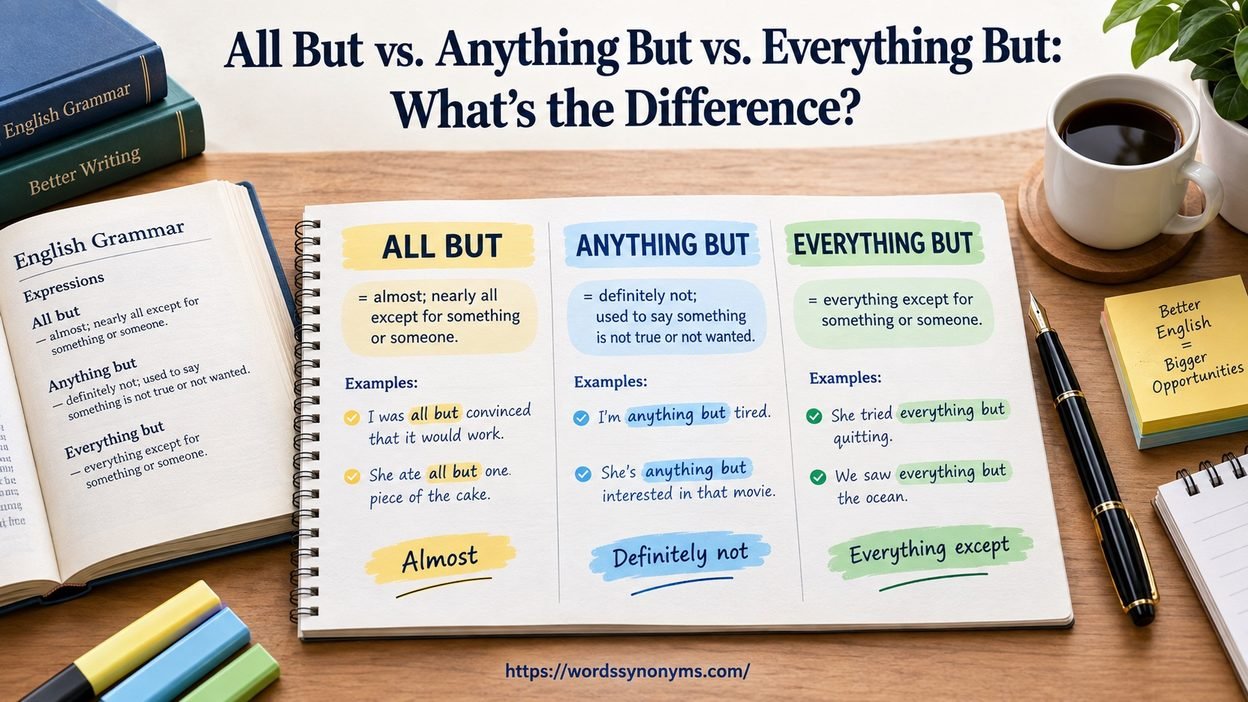
In All But vs. Anything But vs. Everything But: What’s the Difference?, these expressions can seem confusing when they are followed by but in English.
For native speakers and learners from other languages, the three forms may look similar in meaning, but they can describe completely different things. The word but can mean except, creating different meanings and literal meanings.
For example, all but can mean all except, while anything but can mean anything except. If all your friends are present except Joey, you can use all but. If you want to eat anything except chocolate cake, anything but fits.
Likewise, you could gift-wrap everything except the candles, making everything but a literal choice. This definition also makes everything but a synonym of all but when all but is used without being a compound adverb.
The other uses show why these forms need careful attention. All but works as a compound adverb meaning almost or very nearly, so it functions as an adverb. Anything but is a compound phrase that can negate a trait in something or someone, with the negation often emphasized.
It is almost exclusively used with to be verbs, although it can also be used without being a phrase to mean all choices except. The third variation, everything but, should be noted for its literal use. Its meaning stays connected to except, and it cannot be used to mean almost.
Quick Answer
The expressions all but, anything but, and everything but have different meanings even though they look similar.
All but can mean almost:
The work is all but finished.
It can also mean everyone or everything except:
All but two employees attended.
Anything but can mean definitely not:
The task was anything but easy.
It can also mean anything except:
You can choose anything but the last option.
Everything but means everything except:
She brought everything but her passport.
The easiest memory trick is:
- All but → almost or everyone/everything except
- Anything but → definitely not or anything except
- Everything but → everything except
When in doubt, identify whether the sentence describes near completion, strong contrast, or a specific exception. That usually reveals the correct phrase immediately.ple: all but = almost, anything but = definitely not, and everything but = everything except.
All But vs. Anything But vs. Everything But: Quick Difference
Before looking at each phrase in detail, here’s the simplest way to remember the distinction:
| Expression | Main meaning | Simple example |
| all but | almost; nearly | The work is all but finished. |
| all but | everyone/everything except | All but two students passed. |
| anything but | definitely not | The test was anything but easy. |
| anything but | anything except | Choose anything but the red one. |
| everything but | everything except | She packed everything but her passport. |
The most important point is this:
All but can mean almost.
Anything but can mean definitely not.
Everything but normally means everything except.
However, all but and anything but can each have more than one use. Context tells you which meaning applies.
What Does “All But” Mean?
The expression all but has two major meanings in modern English.
First, it can mean almost or nearly. This use often appears before an adjective, participle, or phrase describing a condition.
For example:
The building was all but empty.
This means the building was almost empty, although it wasn’t necessarily completely empty.
It can also describe an action that has nearly happened:
She had all but forgotten his name.
Here, she had almost forgotten his name. She hadn’t completely forgotten it yet.
The second meaning of all but is everyone or everything except a particular person or thing.
For example:
All but James attended the meeting.
This means everyone except James attended.
That second construction works much like all except.
“All But” Meaning “Almost” or “Nearly”
When all but means almost, it usually describes something that has come very close to happening or becoming true.
Consider these examples:
- The repairs are all but complete.
- The old factory was all but abandoned.
- He had all but given up hope.
- The negotiations were all but over.
- The village was all but destroyed by the storm.
In each sentence, the phrase points toward a condition that is very close to being complete.
Think of it as standing just one step away from the finish line.
If a report is all but complete, most of the work has been finished. A small part may remain. If someone has all but given up, that person has come extremely close to giving up.
The phrase doesn’t always mean that the final step will definitely happen. It simply emphasizes how close something is to being true or complete.
“All But” Meaning “Everyone or Everything Except”
The second use works differently.
In sentences such as “All but three students passed,” the phrase identifies an exception.
All but three students passed the exam.
This means:
Everyone except three students passed the exam.
Here, all but doesn’t mean “almost.” It tells you that three students did not pass.
More examples include:
- All but one seat was occupied.
- All but Sarah agreed with the proposal.
- All but two boxes were delivered.
- All but the final chapter had been edited.
- All but one member of the team arrived on time.
This use is especially common with numbers, names, pronouns, and clearly defined groups.
How to Tell Which Meaning “All But” Has
Context usually makes the meaning obvious.
If all but appears before an adjective or participle, it often means almost.
The job is all but finished.
If it appears before a noun, number, or named person as an exception, it often means everyone or everything except.
All but two workers finished the task.
A useful test is to replace all but with almost.
If the sentence still makes sense, all but probably means almost.
The work is all but finished.
The work is almost finished.
Both work naturally.
Now try the same test here:
All but John attended.
“Almost John attended” doesn’t work. The intended meaning is everyone except John.
That simple substitution test can prevent many mistakes.
What Does “Anything But” Mean?
Anything but has two closely related uses.
The first is emphatic. It means definitely not, far from, or the opposite of the description that follows.
For example:
The movie was anything but boring.
This doesn’t merely mean the movie wasn’t boring. It strongly suggests that the movie was interesting, exciting, or entertaining.
Consider these examples:
- The journey was anything but relaxing.
- His answer was anything but helpful.
- The situation was anything but simple.
- The weather was anything but pleasant.
- Her reaction was anything but calm.
In each case, anything but creates strong contrast.
The second use is more literal. It means anything except a specified thing.
For example:
You can choose anything but the blue shirt.
This means every choice is allowed except the blue shirt.
Another example:
I’ll eat anything but seafood.
The speaker is willing to eat many things but excludes seafood.
So, anything but can express either strong contrast or an exception.
“Anything But” Meaning “Definitely Not”
This is one of the most useful patterns to understand.
When anything but comes before an adjective, it often means definitely not that adjective.
Compare:
The assignment wasn’t easy.
with:
The assignment was anything but easy.
The second sentence carries much more force. It suggests that the assignment was difficult, challenging, or complicated.
The expression adds emphasis without requiring a long explanation.
Here are several examples:
The interview was anything but comfortable.
This suggests that the interview was awkward, tense, or difficult.
The instructions were anything but clear.
This suggests that the instructions were confusing or poorly explained.
His decision was anything but wise.
This suggests that the decision was foolish, risky, or poorly considered.
The restaurant was anything but quiet.
This suggests that the restaurant was noisy or lively.
Notice the pattern:
anything but + adjective
The phrase rejects the adjective strongly.
“Anything But” Meaning “Anything Except”
The literal exception meaning is equally important.
For example:
You may bring anything but glass containers.
This means you can bring many different things. Glass containers are excluded.
Another example:
She’ll wear anything but formal clothes.
This means she is willing to wear many types of clothing but doesn’t want formal clothes.
The structure is easy to recognize:
anything but + excluded item
Examples include:
- Anything but chocolate.
- Anything but that option.
- Anything but Monday.
- Anything but a second chance.
- Anything but the final answer.
In these sentences, but introduces the exception.
What Does “Everything But” Mean?
Everything but usually means everything except a particular person, object, category, or action.
For example:
She packed everything but her passport.
The meaning is straightforward. She packed everything she needed except her passport.
Other examples include:
- He bought everything but the batteries.
- We discussed everything but the budget.
- She remembered everything but his address.
- The store sells everything but fresh produce.
- They tried everything but calling the police.
Unlike all but, the phrase everything but doesn’t normally mean almost.
That’s an important distinction.
If you say:
She packed everything but her passport.
You’re identifying a specific exception.
If you say:
She packed almost everything.
You’re describing a quantity that falls short of the whole.
Those ideas may overlap in some situations, but the grammatical focus differs.
“Everything But” and Exceptions
The easiest way to understand everything but is to think of a complete set with one part removed.
Imagine a suitcase containing ten required items. If someone says:
I packed everything but my shoes.
The sentence identifies the missing item.
The same pattern works with activities:
He did everything but apologize.
This means he took many possible actions but did not apologize.
It also works with subjects:
We talked about everything but politics.
The conversation covered many subjects while excluding politics.
This construction is useful because it creates a clear boundary. The phrase tells the reader what belongs inside the set and what remains outside it.
All But vs. Anything But
These two expressions cause some of the biggest misunderstandings because they can produce almost opposite meanings.
Compare:
The room was all but empty.
This means the room was almost empty.
Now compare:
The room was anything but empty.
This means the room was definitely not empty.
Perhaps the room was crowded.
The expressions point in different directions.
| Sentence | Meaning |
| The room was all but empty. | The room was nearly empty. |
| The room was anything but empty. | The room was clearly not empty. |
| The task was all but impossible. | The task was almost impossible. |
| The task was anything but impossible. | The task was definitely not impossible. |
This is why replacing one phrase with another can completely change the message.
A Useful Contrast
Consider this pair:
The project is all but finished.
The project is nearly finished.
The project is anything but finished.
The project is nowhere near finished or certainly cannot be described as finished.
The difference is subtle in appearance but substantial in meaning.
When all but means “almost,” it moves toward the word that follows.
When anything but expresses contrast, it pushes away from the word that follows.
That’s a useful mental shortcut.
All But vs. Everything But
The difference between these expressions becomes clearer when you focus on almost versus except.
Consider:
The report is all but complete.
The report is almost complete.
Now consider:
The report contains everything but the final section.
The report contains everything except the final section.
These sentences don’t communicate the same idea.
| Expression | What it emphasizes |
| all but complete | Near completion |
| everything but the final section | A specific exception |
| all but one section | Every section except one |
| almost every section | Nearly all sections |
The phrase all but can also introduce an exception:
All but one section was completed.
That sentence means every section except one was completed.
This creates an important point: all but and everything but can sometimes express similar exception-based ideas. However, their grammatical patterns differ.
Anything But vs. Everything But
The central difference here is contrast versus exception.
Compare:
The room was anything but quiet.
This means the room was not quiet at all. It may have been noisy.
Now compare:
The room contained everything but a television.
This means the room had many things but didn’t contain a television.
The first phrase rejects a description.
The second phrase identifies an excluded item.
| Phrase | Typical function |
| anything but + adjective | Strongly rejects a description |
| anything but + noun | Allows anything except a specified item |
| everything but + noun | Includes everything except a specified item |
| everything but + verb-ing | Includes every action except the stated one |
For example:
She was anything but nervous.
She wasn’t nervous. She may have been confident or relaxed.
She brought everything but a jacket.
She brought many things but left out the jacket.
The words look similar. The sentence structure gives them different jobs.
All But vs. Anything But vs. Everything But Examples
Seeing the expressions together makes their differences easier to remember.
Example: A Finished Project
The project is all but finished.
Meaning: The project is almost finished.
The project is anything but finished.
Meaning: The project is definitely not finished.
The team completed everything but the final review.
Meaning: The team completed all parts except the final review.
Example: A Difficult Exam
The exam was all but impossible.
Meaning: The exam was almost impossible.
The exam was anything but easy.
Meaning: The exam was definitely not easy.
The students answered everything but question ten.
Meaning: They answered every question except question ten.
Example: A Busy Office
The office was all but empty.
Meaning: It was nearly empty.
The office was anything but quiet.
Meaning: It was far from quiet.
The office had everything but a proper meeting room.
Meaning: It had many facilities but lacked a proper meeting room.
Read more: Prodigal vs. Prodigy: What’s the Difference?
“All But” With Adjectives and Participles
One of the clearest patterns is all but + adjective or past participle.
Examples include:
- all but certain
- all but impossible
- all but complete
- all but forgotten
- all but finished
- all but destroyed
- all but abandoned
- all but invisible
In these constructions, all but usually means almost.
For example:
Success was all but certain.
This means success seemed almost certain.
The tradition had become all but forgotten.
This means the tradition had become almost completely forgotten.
The road was all but destroyed.
This means the road was nearly destroyed.
This pattern appears frequently in formal writing, journalism, academic prose, and everyday conversation.
“All But” With Numbers and Nouns
When all but comes before a number or a specific noun, it often introduces an exception.
Examples:
All but three employees attended.
Meaning: Three employees didn’t attend.
All but one package arrived.
Meaning: One package didn’t arrive.
All but Sarah agreed.
Meaning: Sarah didn’t agree.
All but the final page was complete.
Meaning: The final page wasn’t complete.
This is where readers sometimes confuse all but with almost.
Consider:
All but three employees attended.
It doesn’t mean “almost three employees attended.” Instead, it means everyone except three employees attended.
Common Mistakes With These Expressions
Mistake: Treating “All But” as Always Meaning “Almost”
Although all but frequently means almost, it doesn’t always do so.
All but two guests arrived.
This means everyone except two guests arrived.
It doesn’t mean the guests were almost two people.
Always examine what follows the phrase.
Mistake: Using “Anything But” When You Mean “Almost”
This mistake can reverse the intended meaning.
Suppose the project is nearly complete.
The natural sentence is:
The project is all but complete.
If you write:
The project is anything but complete.
you’ve changed the meaning. The second sentence strongly suggests that the project isn’t complete at all.
Mistake: Using “Everything But” to Mean “Almost Everything”
If you mean nearly everything, use almost everything.
I read almost everything in the report.
If you mean everything except one specific item, use everything but.
I read everything but the final chapter.
The distinction is small but useful.
Mistake: Ignoring the Word That Follows “But”
The words after but often reveal the intended construction.
Compare:
- all but finished
- all but two
- anything but easy
- anything but the blue one
- everything but the final page
These patterns aren’t interchangeable.
A Simple Test for Choosing the Right Expression
When you’re unsure, ask what you actually mean.
Do you mean “almost”?
Use all but.
The meal is all but ready.
Do you mean “definitely not”?
Use anything but.
The meal was anything but ordinary.
Do you mean “anything except”?
Use anything but.
Order anything but the soup.
Do you mean “everything except”?
Use everything but.
She ordered everything but the soup.
Do you mean “everyone except”?
Use all but.
All but two customers ordered dessert.
This five-question test handles most everyday situations.
A Closer Look at “All But One” and “Everything But One”
These constructions can look nearly identical.
All but one student passed.
Everything but one answer was correct.
The first refers to people in a group. The second refers to things within a set.
Both expressions establish an exception.
You can often rewrite all but as everyone except when discussing people:
All but Maria left.
→ Everyone except Maria left.
With things, everything except often provides a clearer equivalent:
Everything but the final page was printed.
→ Everything except the final page was printed.
This substitution method can help when you’re checking meaning.
A Practical Case Study: Three Sentences, Three Meanings
Imagine a manager describing a software project.
First:
The software is all but ready.
The manager means the software is nearly ready. Only minor work remains.
Next:
The software is anything but ready.
Now the meaning changes dramatically. The software is not ready and may still need substantial work.
Finally:
The team completed everything but the security audit.
This tells you exactly what remains: the security audit.
The three expressions therefore provide three different kinds of information:
| Sentence | Information provided |
| All but ready | Degree of completion |
| Anything but ready | Strong rejection of “ready” |
| Everything but the security audit | Specific exception |
This pattern is worth remembering because it demonstrates the difference without relying on complicated grammar terminology.
Can “All But” Mean “Almost”?
Yes. In fact, all but commonly means almost or nearly.
Examples:
- The concert was all but sold out.
- He had all but lost hope.
- The decision was all but final.
- The old building was all but forgotten.
- The negotiations were all but complete.
In each case, something has come extremely close to a particular condition.
However, context remains important because all but can also introduce an exception.
All but one ticket was sold.
Here, the phrase means every ticket except one.
Does “Anything But” Mean “Except”?
Yes, but not always in the same way.
When anything but comes before a specific noun or choice, it can mean anything except.
Choose anything but the first option.
However, when it appears before an adjective, it often means definitely not.
The first option is anything but simple.
The first sentence excludes an option.
The second strongly rejects the description simple.
The surrounding words make the distinction clear.
Does “Everything But” Mean “Almost Everything”?
Not usually.
Everything but normally means everything except something specified.
He ate everything but the vegetables.
This means he ate all the other food while leaving the vegetables.
If you mean that he ate a large amount but not literally everything, almost everything is more precise:
He ate almost everything on the table.
The two phrases can describe similar situations, but they don’t have identical meanings.
All But vs. Almost
Because all but can mean almost, these expressions are often interchangeable.
Compare:
The work is all but complete.
The work is almost complete.
Both mean the work is very close to completion.
However, all but can sound slightly more formal or emphatic in certain contexts.
For everyday conversation, almost is often the simpler choice.
For polished prose, all but can create a compact and elegant construction.
Anything But vs. Not
Anything but often provides stronger emphasis than a simple not.
Compare:
The plan wasn’t practical.
with:
The plan was anything but practical.
The second version sounds more forceful. It suggests that the plan was clearly impractical.
Another comparison:
The trip wasn’t relaxing.
The trip was anything but relaxing.
The second sentence gives the reader a stronger sense of contrast.
That makes anything but especially useful when the writer wants to emphasize an unexpected or opposite quality.
Everything But vs. Everything Except
These two are usually very close in meaning.
She remembered everything but his phone number.
She remembered everything except his phone number.
Both sentences identify the phone number as the one missing item.
But is shorter and more conversational in many contexts.
Except can sometimes sound more explicit, especially when the sentence contains other uses of but.
Neither expression needs to be treated as inherently better. The choice depends on sentence flow and clarity.
Quick Reference Guide
| If you mean… | Use… | Example |
| Almost | all but | The job is all but finished. |
| Everyone except | all but | All but Tom left. |
| Definitely not | anything but | The answer was anything but clear. |
| Anything except | anything but | Choose anything but that one. |
| Everything except | everything but | She packed everything but her charger. |
| Nearly everything | almost everything | She read almost everything. |
FAQs
What does “all but” mean?
All but can mean almost or very nearly. It can also mean all except, depending on the sentence.
What does “anything but” mean?
Anything but usually emphasizes that something or someone does not have a particular trait. It can also mean all choices except.
What does “everything but” mean?
Everything but means everything except something that has been excluded from the group.
Can “all but” and “everything but” mean the same thing?
Yes. When all but means all except, it has the same basic meaning as everything but.
Can “everything but” mean “almost”?
No. Everything but is used in its literal sense of everything except. It doesn’t mean almost.
Is “anything but” used with “to be” verbs?
Yes. Anything but is commonly used with to be verbs to strongly negate a description or trait, such as “She is anything but lazy.”
Conclusion
Understanding all but, anything but, and everything but becomes much easier when you focus on the meaning of the whole expression rather than the individual words. All but can describe something that is almost complete, while anything but is often used to strongly reject a particular quality or description. Everything but, on the other hand, normally means everything except something specific.
A simple way to remember them is to look at what comes after but and ask what the sentence is trying to exclude or describe. If the meaning is “almost,” all but may be the right choice. If the sentence rules out a quality, anything but can add emphasis. When you literally mean “everything except,” everything but keeps the meaning straightforward.

Syeda Naalain Zahra is a content writer with an interest in English vocabulary and language. She creates simple and informative articles about synonyms, antonyms, word meanings, and everyday English usage. Her aim is to help readers build better vocabulary and communicate more confidently.