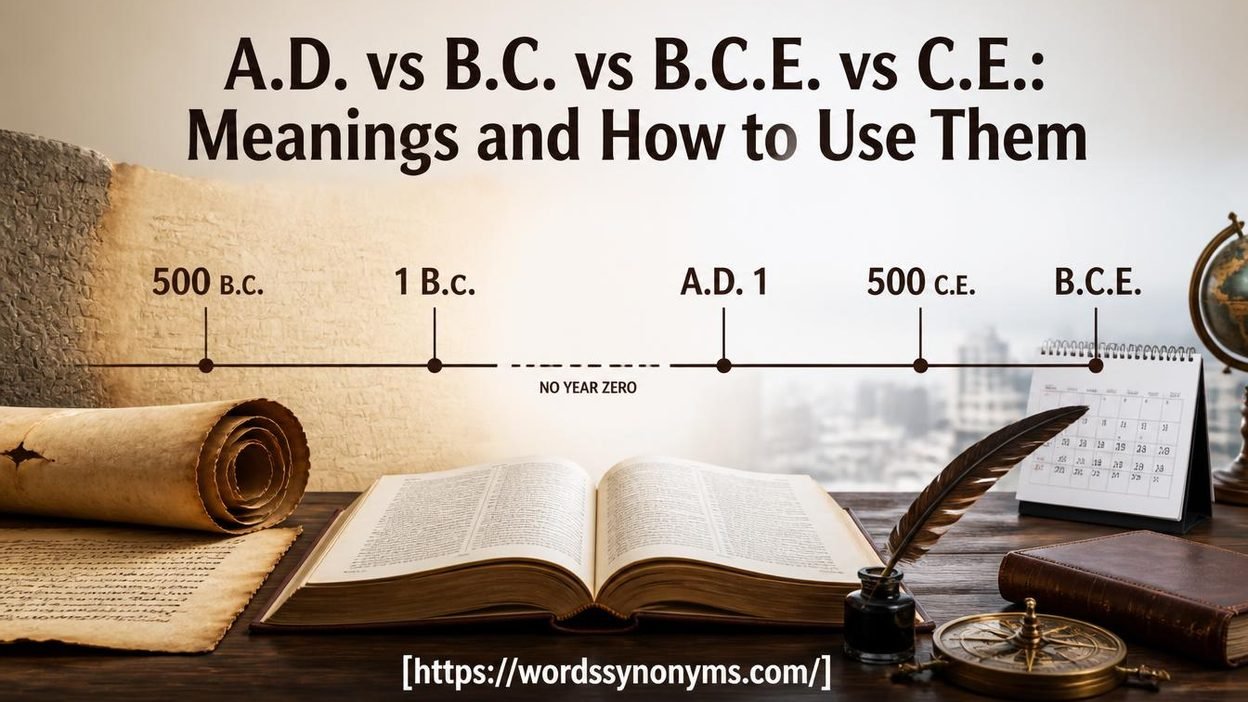
A.D. vs B.C. vs B.C.E. vs C.E.: Meanings and How to Use Them explains how chronology places historical events in time and keeps dates in proper order.
In chronology in history, historians arrange events by when they occurred, helping you understand the development of ideas and cause and effect. BC, B.C., AD, and A.D. mark years around the traditional birth of Jesus Christ. BCE and B.C.E. mean Before Common Era, while CE and C.E. mean Common Era.
Anno Domini, or AD, is a Latin term meaning in the year of the lord and begins with year 1. BC means before christ, and there is no year 0. The Gregorian calendar provides a global standard for dates, although its Western Christian tradition has crossed religious, cultural, and linguistic boundaries. CE and BCE offer secular alternatives to AD and BC.
These terms describe the same thing, but their wording differs. You may include or leave off periods in abbreviations, depending on preference and publisher style.
Quick Answer
A.D. and C.E. refer to the same years, while B.C. and B.C.E. also refer to the same years. A.D. means Anno Domini (“in the year of the Lord”), B.C. means “Before Christ,” B.C.E. means “Before Common Era,” and C.E. means “Common Era.” The biggest point to remember is that there is no year zero in this dating system. The sequence goes directly from 1 B.C. to A.D. 1, or 1 B.C.E. to 1 C.E.
What Do A.D., B.C., B.C.E., and C.E. Mean?
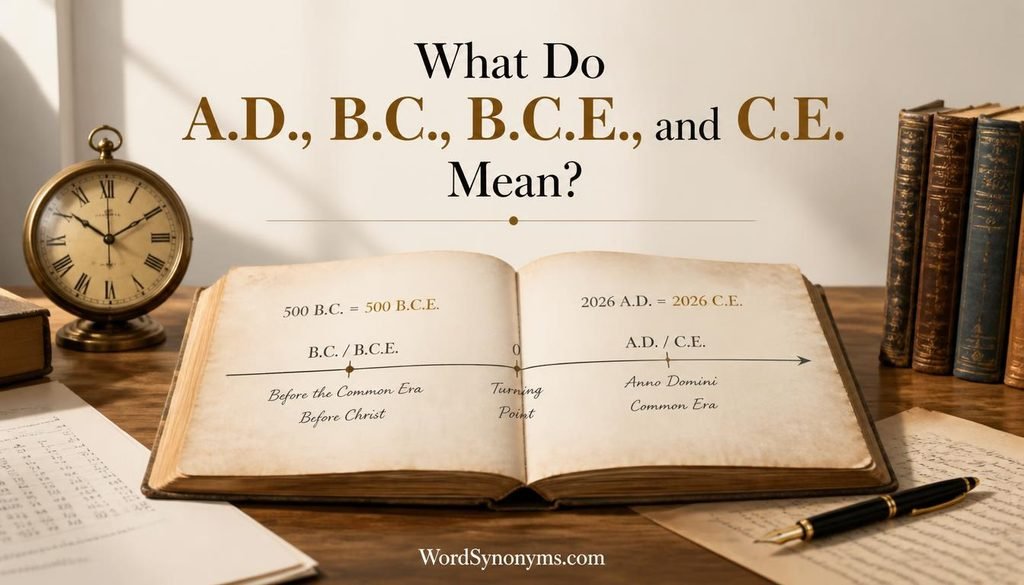
The four abbreviations divide historical time into two broad eras. The earlier era uses B.C. or B.C.E., while the later era uses A.D. or C.E.
Here is the basic comparison:
| Abbreviation | Meaning | Language | Equivalent |
| B.C. | Before Christ | English | B.C.E. |
| B.C.E. | Before Common Era | English | B.C. |
| A.D. | Anno Domini | Latin | C.E. |
| C.E. | Common Era | English | A.D. |
So, for practical purposes:
- 500 B.C. = 500 B.C.E.
- 44 B.C. = 44 B.C.E.
- 1066 A.D. = 1066 C.E.
- 2026 A.D. = 2026 C.E.
The dates themselves don’t change when you switch between the two sets of labels.
The terminology does.
What Does A.D. Mean?
A.D. comes from the Latin phrase Anno Domini. It means “in the year of the Lord.”
The abbreviation belongs to the Christian-era dating system developed in late antiquity. The system is associated particularly with Dionysius Exiguus, a sixth-century monk and scholar who developed a year-numbering scheme while working on calculations for Easter.
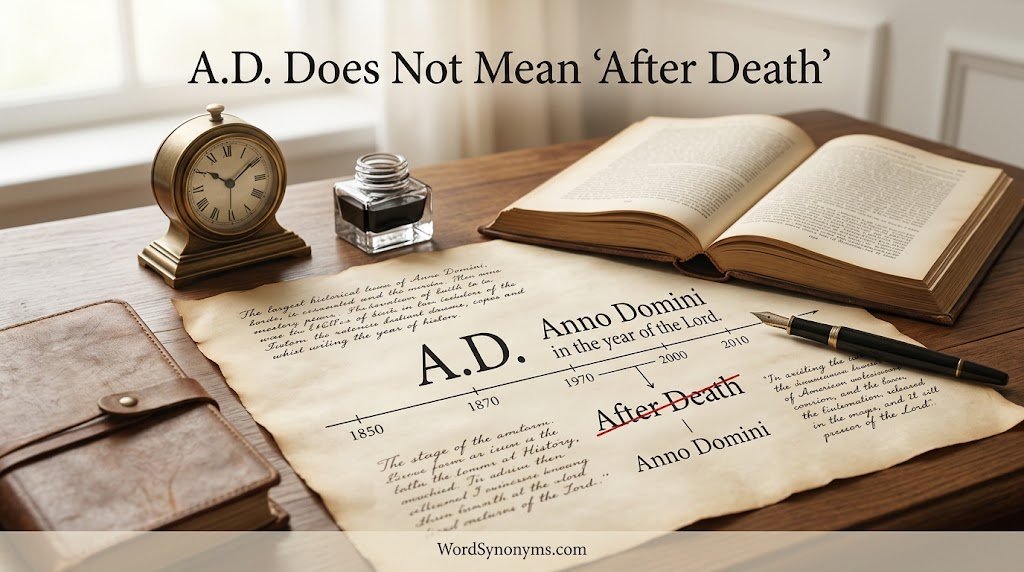
A common mistake is to assume that A.D. means “After Death.” It doesn’t.
The abbreviation refers to the Latin phrase Anno Domini, not the death of Jesus. In fact, the system’s traditional starting point concerns the Incarnation of Christ, rather than a calculation based on the number of years since his death.
You may therefore see dates such as:
- A.D. 1
- A.D. 476
- A.D. 1066
- A.D. 1776
- A.D. 2026
In modern English, many style guides place A.D. before the year, especially when following the traditional Latin construction. The Chicago Manual of Style, for example, gives A.D. 99 as the standard order while noting that 99 B.C. naturally places B.C. after the number.
What Does B.C. Mean?
B.C. means “Before Christ.”
It identifies years before the beginning of the traditional Christian era. Unlike A.D. dates, B.C. dates count backward as they approach the era boundary.
For example:
- 500 B.C. comes before 100 B.C.
- 100 B.C. comes before 50 B.C.
- 50 B.C. comes before 10 B.C.
- 10 B.C. comes before 1 B.C.
That backward counting can feel strange at first. Think of it like a countdown rather than an ordinary calendar sequence.
The larger the B.C. number, the farther back in time the date falls.
What Does C.E. Mean?
C.E. means “Common Era.”
It uses the same numerical year system as A.D. The major difference is the terminology.
For example:
2026 C.E. = A.D. 2026
Likewise:
1066 C.E. = A.D. 1066
The term Common Era became useful in contexts where writers wanted a conventional chronological system without explicitly using the Christian wording found in “Before Christ” and Anno Domini.
That doesn’t mean C.E. represents a different calendar. It doesn’t.
It uses the same conventional era boundaries.
What Does B.C.E. Mean?
B.C.E. means “Before Common Era.”
It corresponds directly to B.C.
For example:
- 300 B.C. = 300 B.C.E.
- 44 B.C. = 44 B.C.E.
- 1 B.C. = 1 B.C.E.
The numbers remain exactly the same.
The terminology changes from Before Christ to Before Common Era.
A.D. vs. C.E.: What’s the Difference?
At the level of year numbering, A.D. and C.E. are equivalent.
The distinction concerns naming rather than chronology.
| A.D. | C.E. |
| Anno Domini | Common Era |
| Latin | English |
| Traditional Christian-era terminology | More religiously neutral terminology |
| Same year numbering | Same year numbering |
| A.D. 2026 | 2026 C.E. |
If a history book says an event occurred in 476 A.D., another source can describe the same year as 476 C.E.
Nothing about the historical year changes.
This distinction matters because readers sometimes assume that C.E. represents a completely separate dating system. It doesn’t. The two labels point to the same conventional sequence of years.
The Chicago Manual of Style notes that writers may use CE and BCE when they want to avoid explicitly Christian terminology, while BC and AD remain familiar and widely understood.
Why Do Writers Choose C.E. Instead of A.D.?
Different communities develop different editorial conventions.
A religious publication might naturally use B.C. and A.D. A history department, museum, academic journal, or international publication might use B.C.E. and C.E.
The choice often reflects the audience and style of the publication.
It doesn’t automatically tell you anything about the writer’s personal beliefs.
For example, a historian might write:
The city flourished during the first century C.E.
Another historian might write:
The city flourished during the first century A.D.
Both sentences refer to the same general period.
B.C. vs. B.C.E.: What’s the Difference?
B.C. and B.C.E. are numerical equivalents.
The difference is the wording behind the abbreviations.
| B.C. | B.C.E. |
| Before Christ | Before Common Era |
| Traditional terminology | More religiously neutral terminology |
| Same numerical sequence | Same numerical sequence |
| 500 B.C. | 500 B.C.E. |
Consider the year 44 B.C., the conventional date associated with the assassination of Julius Caesar.
A writer using the traditional system might call it 44 B.C.
A writer using the Common Era system might call it 44 B.C.E.
The historical year remains the same.
That makes conversion extremely easy. You don’t need a mathematical formula. You simply change the label.
B.C./A.D. vs. B.C.E./C.E.
The two systems are often presented as competing calendars. That’s misleading.
They are better understood as two sets of labels for the same conventional year numbering.
| Earlier period | Later period |
| B.C. | A.D. |
| B.C.E. | C.E. |
The equivalent pairs are:
B.C. ↔ B.C.E.
A.D. ↔ C.E.
The most important difference is therefore linguistic and cultural rather than numerical.
Why Do Different Writers Use Different Systems?
Several factors can influence the choice.
Traditional usage: Many historical and religious publications continue to use B.C. and A.D.
Academic convention: Some scholarly fields favor B.C.E. and C.E.
Audience: Writers may select terminology that their readers already recognize.
Institutional style: Universities, publishers, museums, and journals can establish their own preferences.
Religious neutrality: Some writers prefer B.C.E. and C.E. because those terms don’t explicitly refer to Christ in their wording.
There isn’t a single universal rule requiring every writer to choose one system. What matters most in ordinary writing is clarity and consistency.
How the B.C./A.D. Dating System Developed
The modern dating system has a surprisingly specific origin.
It didn’t emerge fully formed from an ancient calendar. Instead, its development grew out of a practical problem involving the calculation of Easter.
Dionysius Exiguus and Anno Domini
Dionysius Exiguus was a sixth-century monk and scholar working in Rome.
Around 525, he prepared Easter tables that extended the calculations used to determine future Easter dates. Rather than continuing to identify years using the reign of the Roman emperor Diocletian, Dionysius chose a system connected with the Christian era.
This decision had a practical and symbolic dimension.
Diocletian had been associated with persecution of Christians. Dionysius therefore preferred a chronology based on Christ rather than continuing to count years from Diocletian’s reign.
His Easter tables helped establish a year-numbering framework that later became enormously influential.
However, the system didn’t instantly become the universal way people dated history.
It took centuries to spread.
How the System Spread
The Christian era gradually gained ground in Western Europe.
One major figure in its wider adoption was the English monk and historian Bede, whose eighth-century chronological writings helped popularize the system. Historical scholarship credits Bede’s De ratione temporum, completed in 725, with playing an important role in spreading Christian-era dating.
The process was gradual rather than sudden.
Different regions and writers continued using other dating methods for centuries. Ancient and medieval documents could identify years by the reign of a ruler, the founding of a city, an indiction cycle, or another local system.
That historical variety explains why old documents can sometimes seem to speak a completely different chronological language.
Read more: Break Up vs. Breakup: Meaning, Difference and Correct Usage
Why Is There No Year Zero?
This is the detail that causes the most confusion.
In the traditional B.C./A.D. and B.C.E./C.E. systems, there is no year 0.
The sequence is:
2 B.C. → 1 B.C. → A.D. 1 → A.D. 2
Using Common Era terminology, the same sequence is:
2 B.C.E. → 1 B.C.E. → 1 C.E. → 2 C.E.
There is no year between 1 B.C. and A.D. 1.
Why Was There No Year Zero?
Dionysius’s sixth-century system didn’t include a year zero. Roman numeral practice and the chronological conventions of the period did not provide the kind of zero-year position used in modern astronomical year numbering.
That omission became part of the traditional system.
The result is important when calculating the number of years between dates that cross the B.C./A.D. boundary.
The Timeline at a Glance
500 B.C. → 100 B.C. → 10 B.C. → 1 B.C. → A.D. 1 → A.D. 10 → A.D. 100 → A.D. 500
Notice the jump.
There is no 0 between 1 B.C. and A.D. 1.
The same structure applies to B.C.E. and C.E.
B.C.E. and C.E. Also Have No Year Zero
Changing the terminology doesn’t introduce a zero year.
The sequence remains:
3 B.C.E. → 2 B.C.E. → 1 B.C.E. → 1 C.E. → 2 C.E.
So if a source uses B.C.E. and C.E., don’t assume that it has adopted astronomical year numbering.
It hasn’t.
B.C.E./C.E. is simply another naming convention for the traditional era system.
Why B.C. Dates Count Backward
A.D. and C.E. dates increase as you move forward through time.
B.C. and B.C.E. dates work in the opposite direction.
Imagine walking backward toward a doorway.
You might move from:
500 B.C. → 400 B.C. → 300 B.C. → 200 B.C. → 100 B.C. → 1 B.C.
As the number gets smaller, you get closer to the era boundary.
Therefore:
500 B.C. is earlier than 100 B.C.
That’s one of the easiest mistakes to make when first reading ancient history.
A Simple Rule
When comparing two B.C. dates:
The larger number represents the earlier date.
For example:
- 900 B.C. is earlier than 700 B.C.
- 700 B.C. is earlier than 500 B.C.
- 500 B.C. is earlier than 50 B.C.
- 50 B.C. is earlier than 10 B.C.
Think of B.C. dates as a countdown.
That mental picture makes the system much easier to handle.
How to Write A.D., B.C., B.C.E., and C.E. Correctly
Knowing what the abbreviations mean is only half the job. You also need to know how they appear in sentences.
How to Write A.D.
A traditional style commonly places A.D. before the year:
1. A.D. 476
2. A.D. 1066
3. A.D. 1776
This placement reflects the Latin phrase Anno Domini, which essentially means “in the year of the Lord.”
The Chicago Manual of Style specifically explains why A.D. 99 follows this order.
However, historical writing doesn’t always follow identical house styles. Some publications use 1066 A.D.
If you’re writing for a particular publisher, school, journal, or website, follow its style guide.
How to Write B.C.
B.C. normally follows the year:
44 B.C.
500 B.C.
1200 B.C.
This arrangement is natural in English because B.C. describes the period as being before Christ.
How to Write B.C.E. and C.E.
B.C.E. and C.E. normally follow the year:
500 B.C.E.
44 B.C.E.
476 C.E.
2026 C.E.
You may also encounter forms without periods:
500 BCE
476 CE
Both styles appear in modern publications.
Should You Use Periods?
You may see several forms:
- A.D.
- AD
- B.C.
- BC
- B.C.E.
- BCE
- C.E.
- CE
The choice depends on editorial convention.
The important point is consistency.
If an article uses B.C.E. and C.E., randomly switching to BC and AD can make the presentation feel careless. Pick a convention appropriate for your audience and stick with it.
A.D. Does Not Mean “After Death”
This misconception deserves special attention because it appears frequently.
Some people interpret A.D. as “After Death.”
That’s incorrect.
A.D. stands for Anno Domini.
The phrase is Latin and means “in the year of the Lord.”
It also doesn’t mean “years after Jesus died.”
The system was designed around the Christian era associated with Christ’s incarnation. The abbreviation itself has nothing to do with counting years from his death.
So:
❌ A.D. = After Death
✅ A.D. = Anno Domini
That small distinction prevents a surprisingly common historical error.
Is B.C.E. More Accurate Than B.C.?
The answer depends on what you mean by accurate.
If you’re asking whether B.C.E. uses different year numbers, the answer is no.
If you’re asking whether B.C.E. uses more religiously neutral terminology, that’s yes.
For example:
300 B.C. = 300 B.C.E.
The underlying chronological position doesn’t change.
B.C.E. still uses the traditional era boundary associated historically with the Christian calendar system. It doesn’t create a new starting point based on an independent astronomical calculation.
This distinction is important because changing the label isn’t the same thing as changing the chronology.
What About the Historical Date of Jesus’s Birth?
Another subtle issue lies behind the entire system.
Dionysius Exiguus attempted to establish a Christian-era chronology associated with Christ. However, modern historical scholarship generally places Jesus’s birth several years earlier than A.D. 1, often within a range around the final years B.C.
That means the traditional era boundary doesn’t necessarily correspond perfectly to the historically reconstructed year of Jesus’s birth.
This may seem surprising, but it doesn’t invalidate the dating system.
Calendars are conventions. Once a system becomes widely established, historians can continue using its year numbering even when later scholarship identifies imperfections in the original calculation.
The same principle appears elsewhere in chronology. A calendar can remain useful even when scholars refine the historical assumptions behind its creation.
Examples of A.D., B.C., B.C.E., and C.E. in Sentences
Seeing these abbreviations in context makes their usage much easier.
A.D. Examples
- A.D. 1066 is traditionally associated with the Norman conquest of England.
- The Roman Empire’s western political structure changed dramatically during the fifth century A.D.
- The manuscript dates to approximately A.D. 900.
B.C. Examples
- The ancient Greek historian Herodotus lived in the fifth century B.C.
- The Roman Republic was still in existence during 44 B.C.
- Archaeologists have found evidence of settlements dating to 2000 B.C.
C.E. Examples
- The city remained an important trading center during the first century C.E.
- The manuscript was produced around 800 C.E.
- The printing press transformed European communication after the fifteenth century C.E.
B.C.E. Examples
- The Babylonian Empire flourished during the first millennium B.C.E.
- The temple complex has origins dating to approximately 500 B.C.E.
- Greek philosophical traditions developed significantly during the sixth and fifth centuries B.C.E.
The terminology changes. The chronological position doesn’t.
Common Mistakes With A.D., B.C., B.C.E., and C.E.
A few errors appear again and again.
Mistake 1: Thinking A.D. Means “After Death”
As explained above, A.D. means Anno Domini.
The phrase has nothing to do with counting years after Jesus’s death.
Mistake 2: Adding a Year Zero
Don’t write:
1 B.C. → 0 → A.D. 1
The traditional system doesn’t work that way.
The correct sequence is:
1 B.C. → A.D. 1
The same applies to:
1 B.C.E. → 1 C.E.
Mistake 3: Assuming B.C.E. Uses Different Years
B.C.E. isn’t a separate chronological scale.
500 B.C. = 500 B.C.E.
Mistake 4: Assuming C.E. Starts at a Different Point
C.E. doesn’t shift the year numbering.
2026 C.E. = A.D. 2026
Mistake 5: Reading B.C. Dates Like A.D. Dates
Remember that B.C. numbers move backward.
900 B.C. comes before 100 B.C.
Not after it.
Mistake 6: Mixing Terminology Without a Reason
A text can technically contain both systems, but switching repeatedly between them can confuse readers.
For a polished article, choose one convention and maintain it.
Mistake 7: Treating A.D. as an English Phrase
A.D. is a Latin abbreviation.
Its expansion is:
Anno Domini
not “After Death.”
A.D. vs. AD, B.C. vs. BC, and BCE vs. B.C.E.
Modern writing uses both punctuated and unpunctuated forms.
| Punctuated | Unpunctuated | Meaning |
| A.D. | AD | Anno Domini |
| B.C. | BC | Before Christ |
| B.C.E. | BCE | Before Common Era |
| C.E. | CE | Common Era |
Neither punctuation style automatically changes the date.
The best choice usually depends on the publication’s preferred style.
For formal writing, consistency matters more than choosing one punctuation pattern as universally superior.
How to Convert Between the Systems
Converting between B.C./A.D. and B.C.E./C.E. is remarkably simple.
B.C. to B.C.E.
Keep the number. Change the abbreviation.
800 B.C. → 800 B.C.E.
B.C.E. to B.C.
Again, keep the number.
250 B.C.E. → 250 B.C.
A.D. to C.E.
Keep the year number.
1776 A.D. → 1776 C.E.
C.E. to A.D.
Keep the year number.
2026 C.E. → A.D. 2026
There is no conversion formula.
That’s the key point.
How to Calculate Years Across B.C. and A.D.
Calculating elapsed time across the era boundary requires more care because there is no year zero.
Suppose an event happened in 2 B.C. and another occurred in 2 A.D.
You might be tempted to calculate:
2 + 2 = 4 years
But the traditional system skips year zero.
The actual sequence is:
2 B.C. → 1 B.C. → A.D. 1 → A.D. 2
That represents three years between the corresponding year points, depending on exactly which dates within those years you’re comparing.
For a simple year-to-year calculation across the boundary, the absence of zero means you must account for that missing year.
A useful mathematical shortcut is:
Elapsed years = earlier B.C. number + later A.D. number − 1
For example:
3 B.C. to A.D. 4
3 + 4 − 1 = 6 years
This is useful for basic year-label calculations. Exact elapsed time can still depend on the specific months and days involved.

Historical Case Study: Dionysius Exiguus
Dionysius Exiguus provides the clearest example of how practical problems can shape chronology.
In the sixth century, Christian scholars needed reliable tables for calculating Easter. Dionysius worked on extending these tables and chose to identify years using a Christian-era framework rather than continuing the existing system based on Emperor Diocletian.
His work had consequences far beyond Easter calculations.
The year-numbering system he promoted eventually became the foundation for the familiar A.D. chronology and later the paired B.C. system.
Yet Dionysius didn’t create a perfectly accurate historical chronology. His calculation of Christ’s birth appears to have been off by several years.
That creates an interesting historical lesson: a numbering system can survive even when its original calculation contains an error.
Once societies adopt a chronological framework, changing every historical date can become far more disruptive than continuing the established system.
Why B.C.E. and C.E. Became Popular
The terms B.C.E. and C.E. offer an alternative vocabulary without requiring a different chronology.
Their appeal is especially clear in writing intended for broad religious and cultural audiences.
A textbook might discuss ancient Egypt, Greece, Rome, India, China, Judaism, Christianity, Islam, Buddhism, and other historical traditions. Using B.C.E. and C.E. can provide a common terminology without making the wording explicitly Christian.
That doesn’t mean every historian prefers it.
The Chicago Manual of Style notes that the choice between BC/AD and BCE/CE generally depends on the writer and the conventions of a particular field or community.
A.D., B.C., B.C.E., and C.E. Quick Comparison
| Term | Full form | Refers to | Example |
| B.C. | Before Christ | Years before the traditional Christian era | 500 B.C. |
| B.C.E. | Before Common Era | Same period as B.C. | 500 B.C.E. |
| A.D. | Anno Domini | Years of the traditional Christian era | A.D. 500 |
| C.E. | Common Era | Same period as A.D. | 500 C.E. |
The easiest way to remember the system is:
B.C. = B.C.E.
A.D. = C.E.
That’s the core idea.
A Simple Timeline of the Four Terms
Earlier Later
500 B.C. 100 B.C. 1 B.C. A.D. 1 A.D. 100 A.D. 500
↓ ↓ ↓ ↓ ↓ ↓
500 B.C.E. 100 B.C.E. 1 B.C.E. 1 C.E. 100 C.E. 500 C.E.
The two rows represent the same chronological positions.
Only the labels differ.
This is why a historian can translate a date from one system to another without changing the number.
Which Dating System Should You Use?
The best choice depends on your audience and context.
If your publication follows a particular style guide, use its preferred convention.
If no style guide applies, either system can communicate the date clearly.
Use B.C. and A.D. When:
- Your publication traditionally uses Christian-era terminology.
- Your audience expects these familiar abbreviations.
- You’re following a historical or religious house style.
- Existing material already uses B.C. and A.D.
Use B.C.E. and C.E. When:
- Your publication prefers religiously neutral terminology.
- You’re writing for an academic or international audience that uses BCE/CE.
- Your institution has adopted BCE/CE as its standard.
- Consistency with surrounding scholarship matters.
The key isn’t to turn the choice into a battle.
Choose the convention that fits the context and use it consistently.
FAQs
What does A.D. mean?
A.D. stands for Anno Domini, a Latin phrase meaning “in the year of the lord.” It refers to years in the traditional Christian dating system beginning with A.D. 1.
What is the difference between BC and BCE?
BC means “before Christ,” while BCE means “Before Common Era.” They use the same year numbering, but BCE provides a more secular alternative to BC.
Are AD and CE the same year system?
Yes. AD and CE use the same year numbering. The main difference is terminology: AD has a Christian reference, while CE means “Common Era” and is generally more secular.
Is there a year 0 between BC and AD?
No. The traditional system has no year 0. The sequence moves directly from 1 BC to A.D. 1.
Should I write A.D. or AD?
Both forms are used. Some publishers and style guides use periods in abbreviations, while others prefer AD and CE without periods. Follow the style required by your publication or institution.
Which should I use: BC/AD or BCE/CE?
Both systems are widely understood. BC/AD uses traditional Christian terminology, while BCE/CE offers secular wording. Choose the form that fits your audience, context, or required style.
Conclusion
Understanding A.D., B.C., B.C.E., and C.E. makes historical dates much easier to read and place in chronology. BC and BCE identify years before the traditional reference point, while AD and CE identify years after it. Although the terms use different wording, they follow the same year sequence. Remember that there is no year 0, so the timeline moves from 1 BC directly to AD 1. Once you understand these simple differences, you can use each abbreviation confidently in historical writing, research, and everyday references to dates.

Samreen Saif is a passionate writer and language enthusiast who contributes informative and engaging content to WordsSynonyms.com. She enjoys exploring English vocabulary, synonyms, antonyms, word meanings, and language usage to help readers understand and use words with confidence.
Samreen focuses on creating clear, accurate, and easy-to-read content for students, writers, professionals, and English learners. Through her articles, she aims to make vocabulary learning simple, practical, and useful for everyday communication.
When she is not writing, Samreen enjoys learning about language, discovering new words, and creating helpful content that makes English learning more accessible to everyone.