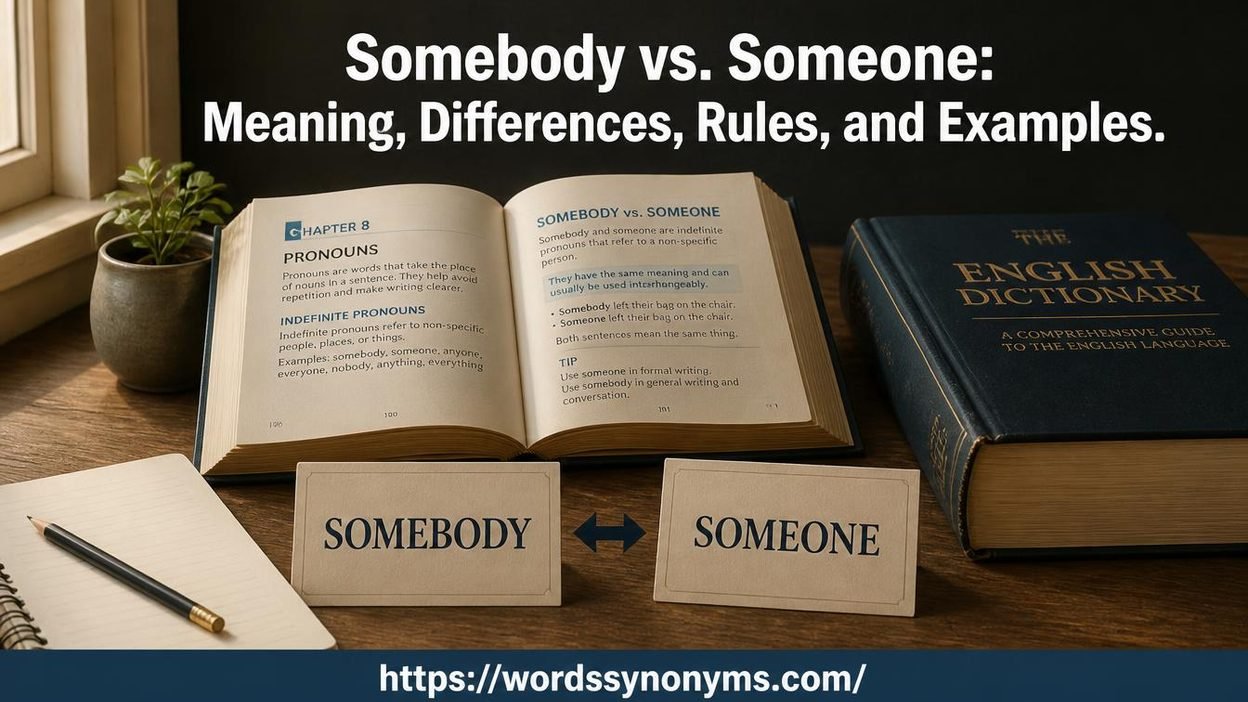
In Somebody vs. Someone: Rules and Examples, the main point is simple: both words have almost exactly the same meaning and definitions. Somebody and someone are indefinite pronouns that refer to an unknown person or an unspecified person. In American English, both words have nearly the same meaning and are usually interchangeable.
For example, “Someone called you” and “Somebody called you” express the same idea. Neither word changes the sentence’s basic meaning, so you can use either one in most situations.
However, your word choice may depend on the sentence, tone, and writing style. Someone often sounds neutral in formal writing, workplace communication, and professional messages. Somebody can feel more conversational in casual conversations and everyday speech. These are general preferences, not strict grammar rules.
When choosing between these words, consider the surrounding sentence and the message you want to communicate. Both work in spoken English, written English, social media posts, and everyday communication. Some writers prefer someone because it has fewer syllables and sounds slightly more concise.
Still, somebody is equally correct when it fits the sentence naturally. For clear writing, focus on meaning rather than worrying about minor differences. Understanding their usage will help you improve your English vocabulary, avoid common mistakes, and choose words with greater confidence.
Quick Answer
Somebody and someone both mean an unspecified person. They are indefinite pronouns because they refer to a person without identifying that individual by name.
Consider these two sentences:
- Somebody left a notebook on the desk.
- Someone left a notebook on the desk.
Both sentences communicate the same message. An unidentified person left the notebook, and the speaker doesn’t say who that person was.
The main difference is stylistic rather than grammatical. Some speakers may prefer somebody in one situation and someone in another, but neither word is inherently more correct or formal.
Here’s a quick comparison.
| Feature | Somebody | Someone |
| Meaning | An unspecified person | An unspecified person |
| Part of speech | Indefinite pronoun | Indefinite pronoun |
| Grammatical number | Singular | Singular |
| Verb agreement | Takes a singular verb | Takes a singular verb |
| Formality | Suitable for formal and informal contexts | Suitable for formal and informal contexts |
| Everyday use | Common | Common |
| Interchangeability | Generally interchangeable with someone | Generally interchangeable with somebody |
The simple rule: Use whichever word sounds more natural in your sentence. Both are standard English, and neither is universally better than the other.
What Does Somebody Mean?
Somebody is an indefinite pronoun that refers to a person whose identity remains unknown, unstated, or unimportant to the conversation.
You use it when the person’s name doesn’t matter or when you don’t know who the person is. For example, if you discover a wallet on the sidewalk, you might say, “Somebody dropped a wallet.”
The sentence tells your listener what happened without identifying the owner.
Here are more examples:
- Somebody is waiting for you outside.
- I need somebody to help me carry these boxes.
- Somebody has taken my seat.
- Could somebody explain this question?
- Somebody called while you were at work.
In each example, somebody refers to one person. The speaker either doesn’t know the person’s identity or doesn’t need to mention it.
How to Use Somebody in a Sentence
The word somebody can appear in different parts of a sentence. Its role depends on how you use it.
As the subject: Somebody performs the action or occupies the position described by the sentence.
- Somebody knocked on the door.
- Somebody knows the answer.
- Somebody wants to speak with you.
As the object: Somebody receives an action or follows a preposition.
- I saw somebody near the entrance.
- She gave the documents to somebody.
- We need to hire somebody for the position.
With descriptive words: You can add words after somebody to provide more information about the person.
- Somebody important wants to meet you.
- Somebody new joined our team.
- I met somebody interesting at the conference.
These constructions show that somebody works naturally in conversations, narratives, workplace discussions, and many other situations.
What Does Somebody Else Mean?
The expression somebody else means another person or a person other than the one already mentioned.
For example:
- If you can’t attend the meeting, ask somebody else to go.
- Somebody else left their bag in the classroom.
- I thought you sent the email, but somebody else sent it.
Notice that else follows somebody. The same pattern applies to someone else.
You shouldn’t write else somebody when you intend to use this standard expression. The correct phrase is somebody else.
What Does Someone Mean?
Someone is an indefinite pronoun that refers to an unspecified person. Its meaning is essentially identical to somebody.
You can use someone when you don’t know a person’s identity, don’t want to name them, or consider their identity irrelevant.
For example, imagine that you missed a phone call while preparing dinner. You might tell a family member, “Someone called you earlier.” The sentence communicates the important information without identifying the caller.
Here are several more examples:
- Someone left an umbrella in the office.
- Someone has been asking about you.
- I need someone to review my application.
- Someone is standing near the front door.
- She wants someone to accompany her to the event.
In every sentence, someone refers to one unspecified person. You could replace it with somebody without changing the essential meaning.
How to Use Someone in a Sentence
Like somebody, the word someone can function as a subject or an object.
As the subject:
- Someone opened the window.
- Someone is waiting in the lobby.
- Someone has forgotten to lock the door.
As the object:
- I met someone at the conference.
- They invited someone to the celebration.
- We spoke to someone from the support team.
With descriptive words:
- Someone special sent you a gift.
- Someone familiar walked into the room.
- We need someone experienced for this project.
These examples demonstrate that someone fits comfortably into everyday English and professional communication.
What Does Someone Else Mean?
The phrase someone else refers to another person or someone different from the person already being discussed.
For example:
- Someone else can handle the presentation.
- Please ask someone else if I’m unavailable.
- I thought the message came from you, but someone else sent it.
The phrase often helps speakers avoid repeating names or clarifying exactly who performed an action. It also makes sentences more concise.
Remember: Somebody else and someone else generally mean the same thing. Your choice depends on personal preference and the flow of the sentence.
Somebody vs. Someone: Key Differences
Although somebody and someone share the same meaning, several details are worth understanding. These details can help you choose the right expression for your sentence and avoid common misconceptions.
Difference in Meaning
The most important point is that somebody and someone have no meaningful difference in their standard definitions.
Both refer to an unspecified person. Neither word tells you the person’s name, gender, age, occupation, or other personal details.
Compare these examples:
| With Somebody | With Someone |
| Somebody sent me a message. | Someone sent me a message. |
| Somebody needs your help. | Someone needs your help. |
| Somebody is waiting outside. | Someone is waiting outside. |
| I met somebody at the station. | I met someone at the station. |
| Somebody knows what happened. | Someone knows what happened. |
Each pair communicates essentially the same information.
Context may influence how a sentence sounds, but it doesn’t establish a fixed difference in meaning. You don’t need to memorize separate definitions for these words.
Difference in Formality
A common misconception is that someone sounds formal while somebody sounds casual. In reality, both words are acceptable in formal and informal English.
You can use someone in an ordinary conversation:
“Someone left their phone on the counter.”
Likewise, somebody can appear in a professional setting:
“Somebody from the management team will contact you shortly.”
Neither sentence sounds grammatically incorrect. The surrounding words and the situation influence the tone more than the choice between these pronouns.
For formal reports, academic writing, or business emails, either word is generally appropriate. If your organization follows a particular style guide, follow its recommendations for consistency.
Difference in Everyday Usage
Both expressions appear in spoken and written English. However, individual speakers may favor one over the other because of habit, rhythm, or personal preference.
For example, someone might naturally say, “I need somebody to talk to.” Another person might prefer, “I need someone to talk to.”
Both sentences sound natural to many English speakers.
The best approach is to choose the expression that fits your sentence. You don’t need to alternate between the two words merely to avoid repetition, especially when doing so makes your writing sound unnatural.
Difference in Grammar
Grammatically, somebody and someone behave almost identically. Both are indefinite pronouns, and both normally take singular verbs.
Correct examples include:
- Somebody is calling you.
- Someone has arrived.
- Somebody wants to speak with the manager.
- Someone knows the answer.
Avoid using plural verbs directly with these pronouns in standard English.
Incorrect: Somebody are waiting outside.
Correct: Somebody is waiting outside.
The same rule applies to someone. However, the pronouns can refer to people of any gender, so singular they can follow them naturally.
For example: “Someone left their keys here, and they may return soon.”
The antecedent someone remains grammatically singular, even though the later pronoun they is appropriate.
When to Use Somebody or Someone
Choosing between somebody and someone is straightforward once you understand their shared meaning. In most situations, you can use either word without changing your message.
However, a few practical guidelines can help you make the choice.
- Choose the word that sounds natural. Read the sentence aloud and notice which version flows better.
- Consider the surrounding phrase. Both expressions work with words such as else, special, important, and new.
- Maintain consistency when appropriate. If a particular style guide recommends one form, follow that preference throughout your document.
- Avoid assuming that one is always more formal. Both are suitable for many professional and everyday situations.
- Focus on meaning rather than preference. Use a different pronoun only when you intend to change the meaning.
Consider a workplace example:
“Someone from the finance department will review your request.”
“Somebody from the finance department will review your request.”
Both sentences are correct. Neither version suggests a different level of authority or responsibility.
Now consider a personal conversation:
“I wish someone would listen to me.”
“I wish somebody would listen to me.”
Again, the meaning stays the same. Your choice depends mainly on how you prefer to express yourself.
Practical tip: When editing your writing, don’t replace every instance of somebody with someone, or vice versa. Make changes only when they improve clarity, rhythm, or consistency.
Somebody vs. Someone in Different Sentence Types
Both pronouns work in statements, questions, negative sentences, requests, and offers. Understanding these patterns will help you use them confidently.
Somebody vs. Someone in Positive Statements
Positive statements often use somebody or someone to introduce an unidentified person.
Examples:
- Somebody knows where the keys are.
- Someone called the office this morning.
- Somebody wants to speak with you.
- Someone has left a package at reception.
- Somebody from our team will answer your question.
In these sentences, the speaker indicates that a person exists or performed an action. The speaker simply doesn’t identify that person.
You can usually substitute one word for the other without changing the sentence’s meaning.
Somebody vs. Someone in Questions
Questions can also contain these pronouns, particularly when asking about an unidentified person.
Examples:
- Did somebody call me?
- Did someone leave this bag here?
- Is somebody waiting outside?
- Does someone know the answer?
- Has somebody seen my notebook?
These questions seek information about a person whose identity is unknown to the speaker.
In many cases, either word works equally well. The difference is a matter of expression rather than grammar.
Somebody vs. Someone in Negative Statements
Both pronouns can appear in negative sentences.
Examples:
- Somebody didn’t understand the instructions.
- Someone hasn’t collected their package.
- I don’t think somebody checked the report carefully.
- She said someone wasn’t available yesterday.
However, negative statements require attention to meaning. The words somebody and someone identify an unspecified person, while nobody and no one mean that not a single person fits the description.
Compare these sentences:
- Somebody didn’t answer. At least one particular person failed to answer.
- Nobody answered. No person answered.
- Someone hasn’t arrived yet. An expected or relevant person remains absent.
- No one has arrived yet. Not a single person has arrived.
The difference matters because these expressions don’t communicate the same thing. Choose the pronoun that accurately reflects the situation.
Somebody vs. Someone in Requests and Offers
When asking for assistance, both words can make your request sound natural and polite.
Examples:
- Could somebody open the window?
- Could someone help me with this form?
- Would somebody please turn down the music?
- Can someone explain how this works?
Both forms are suitable for requests. The words could, would, and please often contribute more to the sentence’s politeness than the choice between somebody and someone.
You can also use these pronouns when offering help:
- If somebody needs assistance, let me know.
- If someone has a question, I’m happy to help.
In each case, the speaker leaves the person’s identity open.
Read more: John Hancock vs. John Henry: Meaning and Examples
Subject-Verb Agreement With Somebody and Someone
One of the most important rules concerns verb agreement. Although these pronouns can refer to different people in different situations, each pronoun is grammatically singular.
That means you normally use a singular verb when either word serves as the subject.
| Correct Sentence | Incorrect Sentence |
| Somebody is outside. | Somebody are outside. |
| Someone has arrived. | Someone have arrived. |
| Somebody wants a copy. | Somebody want a copy. |
| Someone knows the truth. | Someone know the truth. |
| Somebody was waiting. | Somebody were waiting. |
The rule becomes easier to remember when you compare these pronouns with Ali or Sana.
- He is waiting.
- She is waiting.
- Somebody is waiting.
- Someone is waiting.
All four subjects take the singular verb is.
The same principle applies to other verb forms. You write someone does, not someone do, and somebody has, not somebody have, when these expressions serve as subjects in standard present-tense constructions.
Why Are Somebody and Someone Singular?
Both words refer to one unspecified person at a time. They don’t name a group or indicate that several people are acting collectively.
For example, “Somebody is calling” means that an unidentified person is calling. It doesn’t mean that multiple people are calling together.
The person’s identity remains unknown, but the grammatical number stays singular.
Remember that singular grammatical agreement doesn’t always determine which pronouns you use later in the sentence. Modern English commonly uses singular they to refer to a person whose gender is unknown or irrelevant.
Somebody vs. Someone With Singular They
English speakers frequently use singular they when referring to an unspecified person. This construction works naturally with both somebody and someone.
Consider these examples:
- Somebody left their jacket on the chair.
- Someone said they would arrive early.
- Somebody forgot their password.
- Someone called, but they didn’t leave a message.
- Somebody should check their email.
In these sentences, their and they refer to one person. You don’t need to know that person’s gender to use the construction correctly.
The word they has a long history of singular use in English. Today, it also serves as a common gender-neutral pronoun when a person’s identity or gender isn’t specified.
Does Singular They Make Somebody Plural?
No. The grammatical number of somebody and someone doesn’t change simply because you use singular they later.
For example:
“Someone has forgotten their wallet, so they may come back to look for it.”
The first verb, has, agrees with the singular subject someone. The later pronoun they refers to that same individual.
This distinction helps you avoid a common mistake: assuming that every pronoun referring to a singular person must use a traditionally singular form.
Should You Use Ali or Sana Instead?
You can use Ali or she when you know the person’s gender and the context makes that choice appropriate. However, when the person’s gender is unknown or irrelevant, singular they often sounds more natural and concise.
Compare these sentences:
- Somebody left their umbrella behind.
- Someone forgot their appointment.
- Somebody said they would send the document.
These examples are clear, natural, and easy to understand. They also avoid guessing a person’s gender.

Common Expressions With Somebody and Someone
Both words appear in many everyday expressions. Learning these phrases will help you recognize natural English patterns and use them in your own writing.
| Expression | Meaning | Example |
| Somebody else / someone else | Another person | Someone else can answer the question. |
| Somebody special / someone special | A person who matters in a particular way | She wants to do something nice for someone special. |
| Somebody important / someone important | A person considered significant | Somebody important will attend the meeting. |
| Somebody new / someone new | A person who is unfamiliar or newly introduced | We hired someone new last week. |
| Somebody like you / someone like you | A person with similar qualities | We need somebody like you on our team. |
| Somebody different / someone different | A person who differs from the person previously considered | Let’s ask someone different. |
Somebody Special vs. Someone Special
Both expressions describe a person who has particular importance to someone. Depending on context, that importance might come from love, friendship, admiration, or personal connection.
Examples:
- I want to find somebody special to share my life with.
- Someone special sent me a birthday card.
- She’s looking for somebody special who shares her interests.
The words don’t create different levels of affection. The surrounding sentence explains why the person matters.
Somebody Important vs. Someone Important
These expressions describe a person considered important in a particular situation.
For example:
- Somebody important is joining us for dinner.
- Someone important needs to speak with the director.
Both sentences suggest that the person’s status or role matters. Neither expression identifies the person by name.
Somebody New vs. Someone New
Use these expressions when referring to a person who has recently joined a group or whom you haven’t met before.
Examples:
- Somebody new started working in our department.
- I met someone new at the conference.
- We’re hoping to welcome somebody new to the team.
Again, the choice between somebody and someone doesn’t change the basic meaning.
Somebody vs. Someone: Common Mistakes to Avoid
Although these pronouns are easy to use, a few misconceptions can lead to awkward sentences or grammatical errors.
Mistake: Assuming Someone Is Always More Formal
Some writers believe someone belongs in professional writing while somebody belongs in casual conversations. That distinction isn’t a strict rule of English grammar.
Incorrect assumption: “Someone is correct in business emails, but somebody is too informal.”
Better understanding: Both forms are acceptable in most business emails, reports, and everyday conversations.
For example, “Somebody from our team will contact you” is grammatically correct. So is “Someone from our team will contact you.”
Mistake: Using a Plural Verb
Because these words refer to people, some learners mistakenly pair them with plural verbs.
Incorrect: Someone are waiting for you.
Correct: Someone is waiting for you.
Incorrect: Somebody have your notebook.
Correct: Somebody has your notebook.
The solution is simple: remember that somebody and someone are singular indefinite pronouns.
Mistake: Confusing Somebody With Anybody
Although these words look similar, they don’t always serve the same purpose.
Compare:
- Somebody called you. (An unspecified person called.)
- Did anybody call you? (The question asks whether any person called.)
- I didn’t see anybody. (The negative statement means I saw no person.)
- Nobody called me. (No person called.)
The word anybody commonly appears in questions, negative statements, and sentences expressing open choice. However, it can also appear in affirmative statements, such as “Anybody can learn this skill.”
The intended meaning and context determine which word fits best.
Mistake: Thinking Singular They Requires a Plural Subject
Singular they can refer to a single person. Therefore, sentences such as “Someone left their phone” and “Somebody said they were busy” are natural and grammatically acceptable.
Don’t confuse the singular subject’s verb agreement with the pronoun used later in the sentence.
Mistake: Using Someone Else in the Wrong Order
The standard expression places else after the indefinite pronoun.
Correct:
- Somebody else can help.
- Someone else answered the question.
Incorrect for the intended meaning:
- Else somebody can help.
- Else someone answered the question.
Remember the pattern: somebody else or someone else.
Read more: Stadia vs. Stadiums: Which Plural Form Is Correct?
Somebody vs. Someone vs. Anybody vs. Anyone
The words somebody, someone, anybody, and anyone all refer to people without naming them. However, the first pair and the second pair often appear in different contexts.
The distinction is useful, especially when you’re deciding how to phrase questions, offers, or negative statements.
| Word | General meaning or use | Example |
| Somebody | An unspecified person | Somebody left a message. |
| Someone | An unspecified person | Someone needs your help. |
| Anybody | Any person, often in questions or open-choice statements | Can anybody answer this? |
| Anyone | Any person, often in questions or open-choice statements | Anyone can participate. |
When Should You Use Somebody or Someone?
Use these words when you refer to an unspecified person, particularly in affirmative statements.
Examples:
- Somebody sent you a package.
- Someone knows where the meeting will take place.
- I need someone to review this document.
These sentences present a person as existing or being relevant to the situation.
When Should You Use Anybody or Anyone?
Use anybody or anyone when asking whether a person is available, referring to any possible person, or making a statement about unrestricted choice.
Examples:
- Is anybody home?
- Does anyone have a question?
- Anyone can enter the competition.
- You can ask anybody for directions.
The final two examples are affirmative statements. They show why the distinction isn’t an absolute rule based only on whether a sentence is positive or negative.
Somebody vs. Anybody in Negative Sentences
Negative constructions often use anybody or anyone.
For example:
- I didn’t see anybody.
- She hasn’t spoken to anyone.
- We couldn’t find anybody who knew the answer.
These sentences express the absence of a person who meets the relevant condition.
You can also use somebody or someone in negative sentences, but the meaning may differ.
“I didn’t see somebody” can suggest that a particular person wasn’t seen, perhaps because the speaker expected or intended to see them. The exact interpretation depends on context.
Quick tip: Use somebody and someone when referring to an unspecified person. Use anybody and anyone when the sentence calls for any possible person or emphasizes whether even one person qualifies.
Somebody vs. Someone vs. Nobody vs. No One
The words nobody and no one also refer to people, but they express a different idea. Rather than identifying an unspecified person who exists, they indicate that no person fits the description.
Compare the following sentences:
| Expression | Meaning | Example |
| Somebody | An unspecified person | Somebody is waiting outside. |
| Someone | An unspecified person | Someone is waiting outside. |
| Nobody | Not a single person | Nobody is waiting outside. |
| No one | Not a single person | No one is waiting outside. |
Notice how the first two sentences indicate that a person is waiting. The final two indicate that no person is waiting.
The distinction changes the message entirely.
Nobody vs. No One
Nobody and no one generally mean the same thing. Both take singular verbs in standard English.
Examples:
- Nobody knows the answer.
- No one knows the answer.
- Nobody was available yesterday.
- No one was available yesterday.
The phrase no one is written as two words. By contrast, nobody is written as one word.
Both are suitable for ordinary conversation and formal writing. Choose whichever sounds natural in your sentence.
Can You Replace Somebody With Nobody?
Not without changing the meaning.
Consider this example:
- Somebody answered the phone.
- Nobody answered the phone.
The first sentence says that a person answered. The second says that no person answered.
Similarly, someone and no one are not interchangeable, even though they share the word one.

Somebody vs. Someone: Examples in Real-Life Contexts
Understanding grammar rules is useful, but seeing these words in realistic situations makes them easier to remember. The following examples show how they work in different settings.
Somebody vs. Someone at Work
Workplace communication often involves people whose names aren’t necessary or aren’t yet known.
Examples:
- Somebody from accounting will review your expenses.
- Someone from human resources will contact you.
- Could somebody send me the latest report?
- Someone has left a document in the conference room.
Both pronouns work in professional messages. If you know the person’s name, however, using it may provide greater clarity.
For instance, “Maria from accounting will review your expenses” identifies the responsible person directly.
Somebody vs. Someone at School
Teachers and students frequently use indefinite pronouns when discussing unnamed people.
Examples:
- Somebody left a backpack in the library.
- Someone needs to clean the whiteboard.
- Did somebody submit the assignment late?
- Someone has written their name on the wrong paper.
These sentences refer to individuals without identifying them. You can generally replace somebody with someone in each example.
Somebody vs. Someone in Daily Conversation
Everyday speech offers countless opportunities to use these pronouns.
Examples:
- Somebody is knocking at the door.
- Someone ate the last cookie.
- I need somebody to talk to.
- Someone called while you were sleeping.
- Could somebody turn off the lights?
The words work naturally because speakers often discuss people whose identities are unknown or unimportant.
Somebody vs. Someone in Customer Service
Customer service teams may use either word when referring to an unspecified employee or customer.
Examples:
- Somebody will assist you shortly.
- Someone from our support team will respond to your request.
- Could someone explain the billing issue?
- If somebody needs additional help, please let us know.
Both forms communicate the intended message. In the second example, the phrase from our support team provides more useful information than the choice between somebody and someone.
Somebody vs. Someone in Storytelling
Writers use indefinite pronouns to introduce characters whose identities haven’t been revealed.
Consider this short example:
“Someone knocked on the door just after midnight. When Emma opened it, nobody stood outside. Then somebody whispered her name from the hallway.”
The words help create suspense because the reader doesn’t immediately know who is present.
You could replace someone with somebody in the first sentence. The story would retain the same basic meaning, although the rhythm might change slightly.
A Practical Case Study: Choosing the Right Pronoun
Imagine that a school receptionist finds a water bottle in the hallway after classes end. The receptionist wants to send a message to students.
Here are three possible versions:
A Version: “Somebody left a water bottle in the hallway.”
B Version: “Someone left a water bottle in the hallway.”
C Version: “Nobody claimed the water bottle.”
Versions A and B communicate the same information: an unidentified person left the bottle. Version C communicates a different fact: no one claimed it.
Now imagine that a student asks, “Did anybody leave a water bottle in the hallway?”
The receptionist can answer, “Yes, somebody did.” The response confirms that a person left the bottle.
This small example demonstrates the difference between the interchangeable pair somebody/someone and related words that express different meanings.
FAQs
1. Are somebody and someone the same?
Yes, somebody and someone have the same basic meaning. Both refer to an unknown or unspecified person. For example, “Somebody left a message” and “Someone left a message” mean the same thing.
2. Is someone more formal than somebody?
Someone can sound slightly more formal or neutral, especially in professional writing. Somebody often feels more conversational. However, both words are correct in formal and informal contexts.
3. Can I use somebody and someone interchangeably?
Yes, you can usually use somebody and someone interchangeably without changing a sentence’s meaning. Your choice often depends on your personal preference, tone, or writing style.
4. Should I use somebody or someone in an email?
Someone is a good choice for professional emails because it sounds neutral and direct. For example, “Someone from the support team will contact you.” However, using somebody is not grammatically incorrect.
5. Do somebody and someone take singular verbs?
Yes, both somebody and someone are singular indefinite pronouns. Use singular verbs with them, as in “Somebody knows the answer” and “Someone is waiting outside.”
6. Which word is more common in everyday English?
Both words are common in everyday English. Someone may sound a little more neutral, while somebody can feel more casual. Native speakers regularly use both, so choose whichever sounds natural in your sentence.
Conclusion
Choosing between somebody and someone is simple once you understand their meaning. Both words refer to an unknown person and work correctly in most sentences. The main difference is their tone: someone may sound slightly more formal, while somebody often feels more casual. However, these are preferences rather than strict grammar rules. You can use either word in everyday conversations, emails, messages, and other forms of writing.
For example, “Someone left a notebook here” and “Somebody left a notebook here” communicate the same idea. Instead of worrying too much about which word is correct, focus on the context, sentence structure, and natural flow of your writing. With regular practice, you’ll become more comfortable using both words. Remember, clear communication matters more than choosing one over the other.

Samreen Saif is a passionate writer and language enthusiast who contributes informative and engaging content to WordsSynonyms.com. She enjoys exploring English vocabulary, synonyms, antonyms, word meanings, and language usage to help readers understand and use words with confidence.
Samreen focuses on creating clear, accurate, and easy-to-read content for students, writers, professionals, and English learners. Through her articles, she aims to make vocabulary learning simple, practical, and useful for everyday communication.
When she is not writing, Samreen enjoys learning about language, discovering new words, and creating helpful content that makes English learning more accessible to everyone.