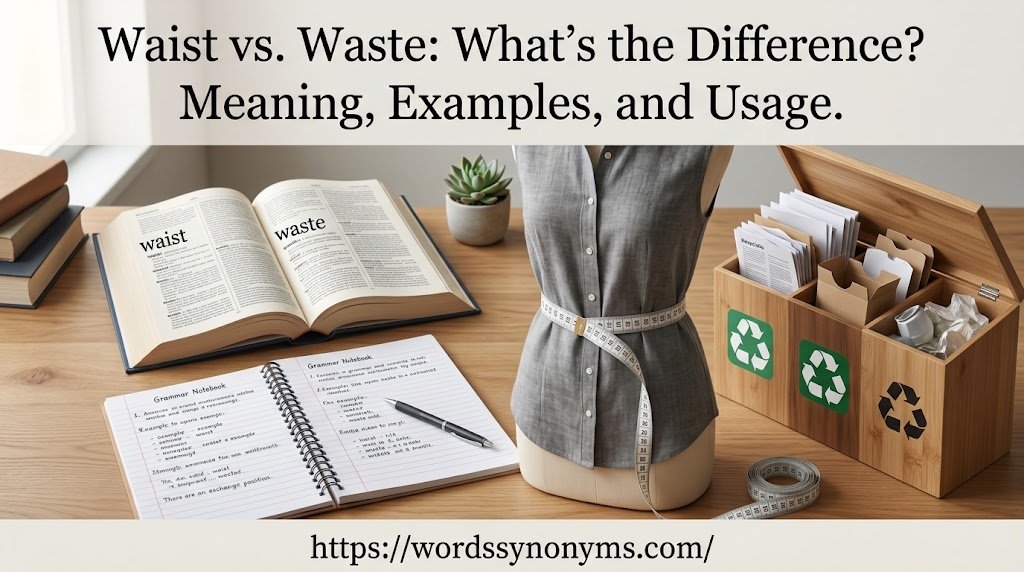
In Waist vs. Waste: Meaning and Usage, the waist is part of the body between the ribs and pelvis, while waste has several senses involving things used needlessly, energy lost, or items thrown away.
As a word, waste can mean to use or expend something without need, lose strength or vitality by wasting away, or describe an act or instance of wasting. It can also refer to an uncultivated, uninhabited, or devastated area.
The definitions, meaning, and usage remain separate, although both words are pronounced the same. Their origins reach back a long time to Old English, but they developed as unrelated words.
These homophones make a familiar homophone pair that is easily confused because waste is more common and may be used in the place of waist, but rarely vice-versa. A useful memory trick is to picture the i in waist in the middle of the word, much like a human female waist sits around the middle of the human body and is often narrower than what is around it.
This simple idea helps you differentiate the spelling and pronunciation, while also strengthening your vocabulary and understanding of the distinction between these two words.
Quick Answer
Waist means the middle part of your body or the section of clothing that fits around it. Waste refers to unwanted material or using something unnecessarily. For example, you might say, “This belt fits around my waist,” but “Don’t waste your time.” Remember it this way: waist = body, waste = something thrown away or used without purpose.
What Does “Waist” Mean?
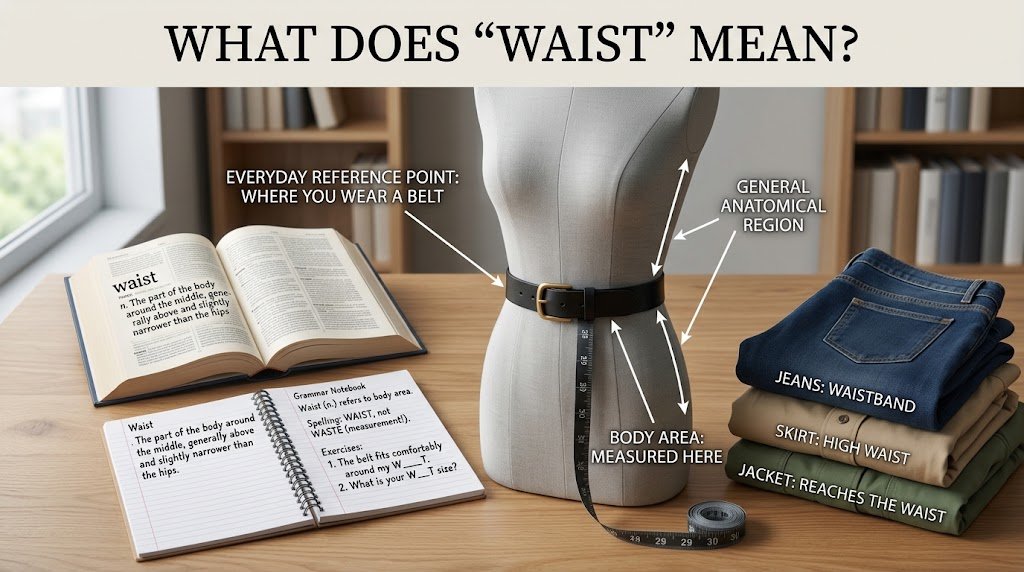
Waist is a noun that refers to the part of the body around the middle, generally above and slightly narrower than the hips. It’s also used for the corresponding part of clothing that covers or fits around that area.
Think about where you normally wear a belt. That’s the easiest everyday reference point for your waist.
For example:
- “The belt fits comfortably around my waist.”
- “These pants are too tight around the waist.”
- “He measured his waist before ordering the suit.”
- “The jacket reaches down to her waist.”
The word has a very concrete meaning in these sentences. You’re talking about a physical part of the body or clothing.
Waist Refers to a Body Area
When waist describes the body, it usually refers to the area between the ribs and hips.
That doesn’t mean everyone’s waist looks or feels the same. The word simply identifies the general anatomical region.
You might describe a waist as:
- narrow
- broad
- small
- large
- thick
- slim
- defined
For example:
“The belt sits comfortably around his waist.”
Here, waist identifies the part of the body where the belt sits.
The word also appears in measurements. Waist size is a common expression in clothing and tailoring.
For example:
“What is your waist size?”
The correct spelling is waist, not waste, because the sentence refers to a body measurement.
Waist Also Refers to Clothing
The meaning extends naturally from the body to clothes.
A garment can have a waist even though the garment itself isn’t a body. The word identifies the section designed to fit around the body’s waist.
For example:
- a dress with a fitted waist
- pants with an elastic waist
- a jacket that reaches the waist
- a skirt with a high waist
- clothing with a low waist
Consider this sentence:
“The skirt has an elastic waist.”
The word waist refers to the part of the skirt that fits around the wearer’s middle.
This explains why clothing terms such as waistband, waistline, and high-waisted use the same spelling.
Common Expressions With “Waist”
Several familiar expressions use waist in a literal or descriptive way.
Around the waist means around the middle part of the body.
“She tied a scarf around her waist.”
From the waist up means the upper part of the body starting at the waist.
“The photograph shows him from the waist up.”
From the waist down refers to the lower part of the body.
“The injury affected him from the waist down.”
Waist-high means reaching approximately to the waist.
“The grass was almost waist-high.”
Waist-deep means reaching approximately to the waist.
“The hikers found themselves in waist-deep water.”
These compounds and phrases all connect to the same central idea: the middle section of the body.
What Does “Waste” Mean?
Waste has a much broader range of meanings than waist.
It can work as a noun, verb, or adjective. Its meaning changes slightly depending on how you use it.
1. As a noun, waste can mean unwanted material or an unnecessary use of something valuable.
2. As a verb, waste means to use something carelessly, inefficiently, or unnecessarily.
3. As an adjective, waste describes material that isn’t needed anymore.
That gives you a useful shortcut:
Waste is about something being unnecessarily used, lost, discarded, or left over.
Waste as a Verb
As a verb, waste means to use something badly or unnecessarily.
You can waste things that have limited value, such as:
- time
- money
- food
- water
- energy
- resources
- talent
- opportunities
- effort
For example:
“Don’t waste your time arguing about something you can’t change.”
Here, waste means using your time without getting a worthwhile result.
You can also say:
“Don’t waste your money on things you don’t need.”
The money isn’t garbage. You’re describing unnecessary or ineffective spending.
This is one of the most important distinctions in the entire topic. Waste doesn’t always mean trash.
You can waste something perfectly useful.
Waste Time
Waste time is one of the most common combinations.
It means spending time on something that isn’t useful, productive, or worthwhile.
Examples include:
- “I don’t want to waste time.”
- “Stop wasting time and start working.”
- “We wasted an hour looking for the wrong address.”
- “Don’t waste your time worrying about every small mistake.”
Notice that waist could never work in these sentences.
You aren’t talking about a body part. You’re talking about inefficient use of time.
Waste Money
Waste money means spending money in a way that doesn’t provide enough value or isn’t necessary.
For example:
“Buying another phone when your current one works perfectly may waste money.”
The word waste describes poor or unnecessary use of money.
This pattern also appears with other resources:
- waste energy
- waste water
- waste fuel
- waste resources
- waste food
- waste effort
The basic grammatical structure remains simple:
waste + thing being used
For example:
waste + time
waste + money
waste + food
waste + energy
Waste as a Noun
As a noun, waste can describe an unnecessary or ineffective use of something.
The phrase a waste of is especially common.
Examples include:
- a waste of time
- a waste of money
- a waste of energy
- a waste of talent
- a waste of resources
- a waste of effort
Consider:
“That meeting was a waste of time.”
Here, waste doesn’t mean garbage. It means the time was used without a worthwhile result.
Another example:
“Leaving a talented employee without meaningful work is a waste of talent.”
Again, the word describes something valuable being used poorly.
Waste as Unwanted Material
The other major noun meaning refers to unwanted material.
This is the meaning people often associate with waste first.
Examples include:
- household waste
- food waste
- industrial waste
- chemical waste
- medical waste
- nuclear waste
- paper waste
- plastic waste
For example:
“The factory must handle its industrial waste properly.”
Here, waste refers to material produced by a process that is no longer wanted or useful in its original form.
Similarly:
“Reducing food waste can prevent usable food from being thrown away.”
In this sentence, waste refers to food that isn’t used.
The context makes the meaning clear.
Waste as an Adjective
Waste can also function as an adjective when it comes before another noun.
Examples include:
- waste paper
- waste material
- waste products
- waste management
- waste disposal
- wastewater
In these expressions, waste generally describes something unwanted, discarded, or associated with discarded material.
For example:
“The company introduced a new waste management system.”
The phrase doesn’t mean that the management itself is useless. It refers to the management of unwanted materials.
Waist vs. Waste: The Main Difference
The quickest way to separate these words is to focus on what you’re describing.
Waist is primarily connected with the body or clothing.
Waste is connected with unnecessary use, discarded material, or something left unused.
| Meaning | Correct word | Example |
| Part of the body | Waist | My waist hurts after sitting all day. |
| Clothing measurement | Waist | The pants have a 34-inch waist. |
| Part of clothing | Waist | The dress has a fitted waist. |
| Use something carelessly | Waste | Don’t waste your time. |
| Unnecessary use | Waste | That’s a waste of money. |
| Unwanted material | Waste | The city collects household waste. |
| Material left after use | Waste | The process produces little waste. |
A simple mental rule works surprisingly well:
Waist = body. Waste = use or leftovers.
When you can remember that distinction, most spelling decisions become straightforward.
Why Are Waist and Waste So Confusing?
The problem starts with pronunciation.
Both waist and waste are pronounced /weɪst/ in standard English.
That means you can’t distinguish them by sound alone.
Imagine someone says:
“Don’t waste your time.”
You hear the correct pronunciation, but you don’t see the spelling. Nothing in the sound tells you whether the word contains ai or a.
This is exactly what makes homophones tricky.
English contains many such pairs:
- right / write
- sea / see
- flower / flour
- brake / break
- pair / pear
- waist / waste
The solution isn’t to memorize pronunciation. You already know the pronunciation.
Instead, connect the meaning to the spelling.
Waist vs. Waste Examples
Seeing the words in realistic sentences makes the distinction much easier.
| Incorrect | Correct | Explanation |
| She tied the belt around her waste. | She tied the belt around her waist. | The sentence refers to the body. |
| Don’t waist your time. | Don’t waste your time. | The sentence refers to unnecessary use of time. |
| My waste size is 32 inches. | My waist size is 32 inches. | A body measurement uses waist. |
| Food waist is a serious issue. | Food waste is a serious issue. | The sentence refers to discarded food. |
| That was a waist of money. | That was a waste of money. | The money was used unnecessarily. |
| The pants fit my waste. | The pants fit my waist. | Pants fit around the body. |
| Reduce household waist. | Reduce household waste. | Household waste means discarded material. |
| She wore a dress with a narrow waste. | She wore a dress with a narrow waist. | The dress has a body-fitting section. |
These mistakes often happen because writers know the correct pronunciation but don’t pause to consider the meaning.
Context solves the problem.
Common Mistakes With Waist and Waste
“Don’t Waist Your Time”
This is one of the most recognizable spelling errors.
The correct sentence is:
“Don’t waste your time.”
The verb waste means to use something unnecessarily or ineffectively.
Time is being used. It isn’t a body part.
“Waist of Time”
The correct phrase is:
“A waste of time.”
For example:
“Scrolling through the same page for an hour was a waste of time.”
The noun waste describes an unnecessary use of time.
“Waist Size” or “Waste Size”?
The correct phrase is:
“Waist size.”
For example:
“Please enter your waist size before ordering the pants.”
The word waist refers to the body area being measured.
This mistake is especially easy to make when filling out online clothing forms because both words sound identical.
“Household Waist” or “Household Waste”?
The correct phrase is:
“Household waste.”
Household waste means unwanted material produced by homes.
For example:
“Recycling can reduce the amount of household waste sent to landfills.”
The word waste has nothing to do with the human waist in this context.
“Waste Around the Body”
If you’re describing something around the middle of someone’s body, use waist.
“The belt wraps around the waist.”
If you’re discussing material that gets discarded, use waste.
“The recycling center processes household waste.”
The pronunciation stays the same. The meaning changes everything.
Common Phrases With “Waist”
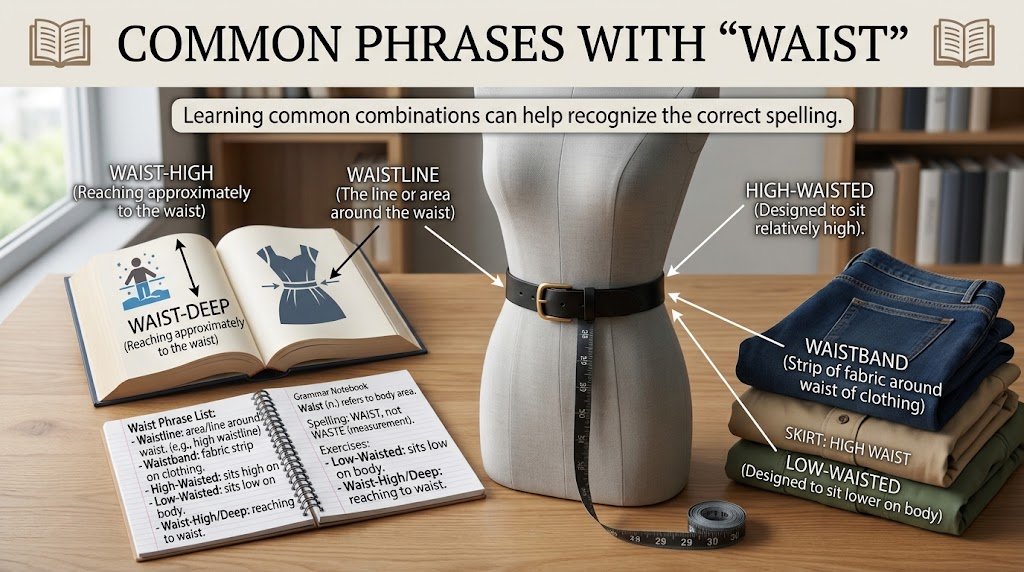
Learning common word combinations can help you recognize the correct spelling instantly.
Waistline
A waistline is the line or area around the waist.
“The dress has a high waistline.”
Waistband
A waistband is the strip of fabric around the waist of clothing.
“The waistband feels too tight.”
High-Waisted
High-waisted describes clothing designed to sit relatively high around the waist.
“She bought a pair of high-waisted jeans.”
Low-Waisted
Low-waisted describes clothing designed to sit lower on the body.
“The store sells both high-waisted and low-waisted pants.”
Waist-High
Waist-high means reaching approximately to the waist.
“The snow was almost waist-high.”
Waist-Deep
Waist-deep means reaching approximately to the waist.
“They walked through waist-deep water.”
Each expression preserves the same core meaning: the waist as a physical middle section.
Common Phrases With “Waste”
The word waste appears in many everyday expressions.
Waste Time
“Don’t waste time on pointless arguments.”
This means to use time without a worthwhile purpose.
Waste Money
“I don’t want to waste money on something I won’t use.”
This means to spend money unnecessarily.
Waste Food
“Try to plan meals carefully so you don’t waste food.”
This means to leave useful food unused or throw it away.
Waste Resources
“Poor planning can waste valuable resources.”
Resources might include money, materials, energy, water, or labor.
A Waste of Time
“The meeting turned into a complete waste of time.”
The phrase identifies something that failed to provide worthwhile use of the time involved.
Go to Waste
Go to waste means something remains unused instead of serving a useful purpose.
“Use the leftover vegetables so they don’t go to waste.”
This phrase can describe food, effort, money, opportunities, and other valuable things.
Waste Away
Waste away is a phrasal verb meaning to become progressively weaker or thinner, especially because of illness or inadequate nourishment. It can also describe something gradually deteriorating or being spent without useful purpose.
“The old building slowly wasted away.”
The expression has a different meaning from simply waste something, so context matters.
Waste No Time
Waste no time means to act immediately or without unnecessary delay.
“She wasted no time calling for help.”
This expression contains waste, even though no physical garbage is involved.
Read more: A.D. vs B.C. vs B.C.E. vs C.E.: Meanings and How to Use Them
A Practical Way to Choose Between Waist and Waste
When you’re unsure, don’t stare at the spelling. Ask what the sentence actually means.
Ask: Is It About the Body?
If yes, choose waist.
- waist size
- waist measurement
- around the waist
- waistline
- waistband
- high-waisted
- waist-high
For example:
“The shirt reaches my waist.”
Ask: Is Something Being Used Badly?
If yes, choose waste.
- waste time
- waste money
- waste energy
- waste food
- waste effort
- waste resources
For example:
“Don’t waste your energy on that argument.”
Ask: Is It Unwanted Material?
If yes, choose waste.
- food waste
- household waste
- industrial waste
- chemical waste
- medical waste
- plastic waste
For example:
“The factory needs to dispose of its waste safely.”
Use a Replacement Test
Another useful trick involves replacing the questionable word.
If you can replace it with “middle of the body,” you probably need waist.
“The belt fits around my ___.”
Replace the blank:
“The belt fits around my middle.”
That tells you the answer is waist.
Now try:
“Don’t ___ your money.”
Replace the blank with “use carelessly.”
“Don’t use your money carelessly.”
That tells you the answer is waste.
This test works because it focuses on meaning rather than appearance.
A Simple Memory Trick for Waist vs. Waste
A small spelling clue can make this pair easier to remember.
Remember the “I” in Waist
The word waist contains an i:
waist
You can associate that i with I have a body.
So:
WaIst → I → body
It’s only a memory trick. The letter doesn’t explain the historical origin of the word.
For example:
“My waist is where my belt sits.”
Think of Waste as Something Lost or Discarded
Waste has no i.
Connect it with things that can be used up or thrown away:
- waste time
- waste money
- waste food
- waste water
- waste materials
Think:
Waste = something valuable isn’t being used properly.
That mental association is much more useful than trying to memorize two dictionary definitions word for word.
Waist vs. Waste in Everyday Writing
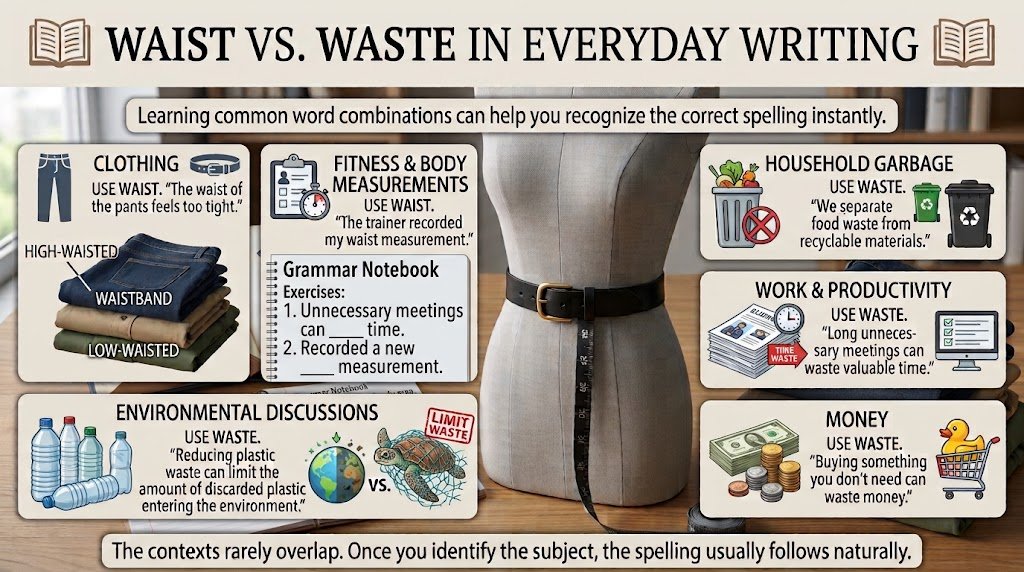
These words show up in different parts of everyday life.
Clothing
Use waist.
“The waist of the pants feels too tight.”
Fitness and Body Measurements
Use waist.
“The trainer recorded my waist measurement.”
Household Garbage
Use waste.
“We separate food waste from recyclable materials.”
Work and Productivity
Use waste.
“Long unnecessary meetings can waste valuable time.”
Money
Use waste.
“Buying something you don’t need can waste money.”
Environmental Discussions
Use waste.
“Reducing plastic waste can limit the amount of discarded plastic entering the environment.”
The contexts rarely overlap. Once you identify the subject, the spelling usually follows naturally.
Waist vs. Waste: A Quick Comparison
| Feature | Waist | Waste |
| Pronunciation | /weɪst/ | /weɪst/ |
| Sound | Same | Same |
| Homophone | Yes | Yes |
| Main grammatical role | Noun | Noun, verb, adjective |
| Refers to the body | Yes | No |
| Refers to clothing | Yes | Sometimes through waste-related clothing materials, but not body fit |
| Means discarded material | No | Yes |
| Means unnecessary use | No | Yes |
| Common phrase | waist size | waste time |
| Another common phrase | waistband | waste of money |
| Memory association | Body | Unused or discarded |
The pronunciation creates the confusion. The meanings create the solution.
Related Words With “Waist”
Once you know waist, several related words become easier to recognize.
Waistline
The line or area around the waist.
Waistband
A band of fabric around the waist of clothing.
Waistcoat
A sleeveless garment traditionally worn over a shirt. In American English, vest is often the more common term.
Waist-high
Reaching approximately to the waist.
Waist-deep
Reaching approximately to the waist.
High-waisted
Designed to sit relatively high around the waist.
Low-waisted
Designed to sit lower around the waist.
These words all preserve the waist spelling because they connect to the body or the clothing area around it.
Related Words With “Waste”
The word waste also creates many compounds and derivatives.
Wasteful
Wasteful describes behavior that uses more resources than necessary or uses them badly.
“Leaving the lights on all day is wasteful.”
Wasted
Wasted can describe something used without producing a useful result.
“All that effort was wasted.”
Wastewater
Wastewater refers to water that has been used and contains unwanted substances.
Wastebasket
A wastebasket is a container for discarded material.
Wastepaper
Wastepaper refers to paper that has been discarded or is intended for disposal or recycling.
Waste Management
Waste management covers the collection, handling, treatment, recycling, and disposal of waste materials.
These words all retain the waste spelling because their meanings relate to unwanted material or inefficient use.
Practice: Waist or Waste?
Test your understanding before moving on.
Fill in each blank with waist or waste.
- The belt fits comfortably around my ___.
- Don’t ___ your time on unnecessary arguments.
- We need to reduce household ___.
- She measured her ___ before buying the dress.
- That purchase was a complete ___ of money.
- The factory produces chemical ___.
- The jacket reaches down to his ___.
- Don’t ___ this opportunity.
- Food ___ can occur when people buy more than they need.
- The pants are too tight around my ___.
Answers
- waist
- waste
- waste
- waist
- waste
- waste
- waist
- waste
- waste
- waist
The pattern should now be clear.
When the sentence points toward the body, use waist. When it points toward unnecessary use or unwanted material, use waste.
A Real-World Case Study: Ordering Clothes Online
Imagine you’re buying jeans online.
The product page asks:
Waist size: 34 inches
The correct word is waist because the measurement refers to the circumference around the body.
Now imagine the same website displays this sentence:
“Avoid wasting money by checking the size chart before ordering.”
Here, the correct word is wasting because the sentence describes using money unnecessarily.
The two words can appear in the same situation while carrying completely different meanings.
That’s why context matters more than pronunciation.
A Real-World Case Study: Food and Household Waste
Consider a family preparing dinner.
They use their ingredients efficiently, save leftovers, and avoid throwing away edible food. They’re reducing food waste.
The same family might buy a pair of pants and check the waist size before ordering.
One household. Two completely different words.
Waist describes where clothing fits.
Waste describes what gets unnecessarily used or discarded.
This contrast is useful because it shows how naturally the words can appear in ordinary life.
Is “Waste” Always About Garbage?
No.
This is one of the most important points to remember.
Many learners associate waste only with trash. However, English uses the word much more broadly.
You can waste:
- time
- money
- food
- water
- energy
- effort
- talent
- opportunities
- resources
For example:
“Don’t waste your talent.”
There’s no garbage involved.
The sentence means that someone isn’t using their ability effectively.
Likewise:
“Don’t let the opportunity go to waste.”
The opportunity isn’t physical material. Waste describes something valuable failing to reach its useful purpose.
Read more: That vs. Which: Difference, Rules and Examples
Is “Waist” Used Only for People?
Mostly, everyday waist refers to the human body or clothing. However, the word can also describe a narrow central part of certain objects or structures.
This broader use follows the same basic idea: a waist can be a narrowed or constricted middle section.
In ordinary writing, though, you will encounter the body and clothing meanings far more often.
For most readers, remembering the everyday definition is enough:
Waist = the middle area of the body or clothing around it.
There’s no need to complicate the distinction with rare technical applications unless the context specifically requires them.
Waist vs. Waste: The Easy Rule to Remember
The difference between waist and waste doesn’t need a complicated grammar rule.
Just remember the central idea behind each word.
Waist belongs with the body:
- waist size
- waistline
- waistband
- around the waist
- waist-high
- waist-deep
Waste belongs with unnecessary use or unwanted material:
- waste time
- waste money
- waste food
- waste energy
- waste resources
- household waste
- industrial waste
- a waste of time
- go to waste
The pronunciation may fool your ear, but the meaning gives you the answer.
When you mean the part of the body where a belt sits, write waist.
When you mean something used unnecessarily, discarded, or left unused, write waste.
Waist = the body. Waste = unnecessary use or unwanted material.
That simple distinction will help you avoid the most common spelling mistakes between these two easily confused words.
FAQs
1. What is the difference between waist and waste?
Waist refers to the part of your body between your ribs and pelvis. Waste usually refers to something used needlessly, thrown away, or lost without good purpose.
2. Is waist and waste pronounced the same?
Yes. Waist and waste are pronounced the same in standard English. They are homophones, but they have different meanings and spellings.
3. How can I remember the spelling of waist?
A simple trick is to notice the i in waist. Think of the letter as sitting in the middle of the word, like your waist sits around the middle of your body.
4. What does waste mean as a verb?
As a verb, waste can mean to use something carelessly or needlessly. For example, you can waste time, waste money, or waste energy.
5. Can waste describe a place?
Yes. Waste can describe an uncultivated, uninhabited, or devastated area. This use is less common in everyday conversation than the meaning related to discarded things.
6. Why are waist and waste easy to confuse?
They sound exactly alike, so it’s easy to choose the wrong spelling when writing. Remember waist = body and waste = use carelessly or throw away.
Conclusion
Waist and waste are a classic pair of English homophones. They sound the same, but their meanings, spellings, and uses are completely different. Waist refers to the part of the body between the ribs and pelvis, while waste can describe something used carelessly, thrown away, lost without purpose, or left as an uncultivated area.
The easiest way to keep them apart is to connect waist with the human body. The i in waist can serve as a quick visual reminder of the word’s middle position. For waste, think about something being wasted, whether it is time, money, food, energy, or another useful resource. Once you build this small spelling and meaning connection, choosing between waist and waste becomes much more natural in everyday writing.

Samreen Saif is a passionate writer and language enthusiast who contributes informative and engaging content to WordsSynonyms.com. She enjoys exploring English vocabulary, synonyms, antonyms, word meanings, and language usage to help readers understand and use words with confidence.
Samreen focuses on creating clear, accurate, and easy-to-read content for students, writers, professionals, and English learners. Through her articles, she aims to make vocabulary learning simple, practical, and useful for everyday communication.
When she is not writing, Samreen enjoys learning about language, discovering new words, and creating helpful content that makes English learning more accessible to everyone.