Break Up vs. Breakup: Meaning, Difference and Correct Usage explains how a relationship can involve a break before breaking up or choosing a breakup.
When a couple is taking a break, having space can give both parties time to think about their love and decide whether they want to continue the relationship. These temporary breaks may help each individual reevaluate their needs, especially when things seem to be going downhill.
Breaking up, however, means ending the relationship with the intention of not continuing it. A breakup may come after prolonging the pain or ignoring problems, while some couples may still hope to build a stronger and healthier relationship. A passive-aggressive approach can make it harder to handle these situations clearly.
The grammar and word usage are just as important when choosing the correct form. Breakup is one word when used as a noun, such as “a bad breakup,” and it can also work as an adjective in phrases like “a breakup song.”
In contrast, break up is two words when it functions as a verb, as in “They decided to break up.” The hyphenated form break-up is also used by some publishers, particularly depending on their preferred writing style.
Careful spelling and grammatical form make the intended meaning clearer, while Calm and precise wording can help distinguish the relationship meaning from the grammatical difference.
Quick Answer
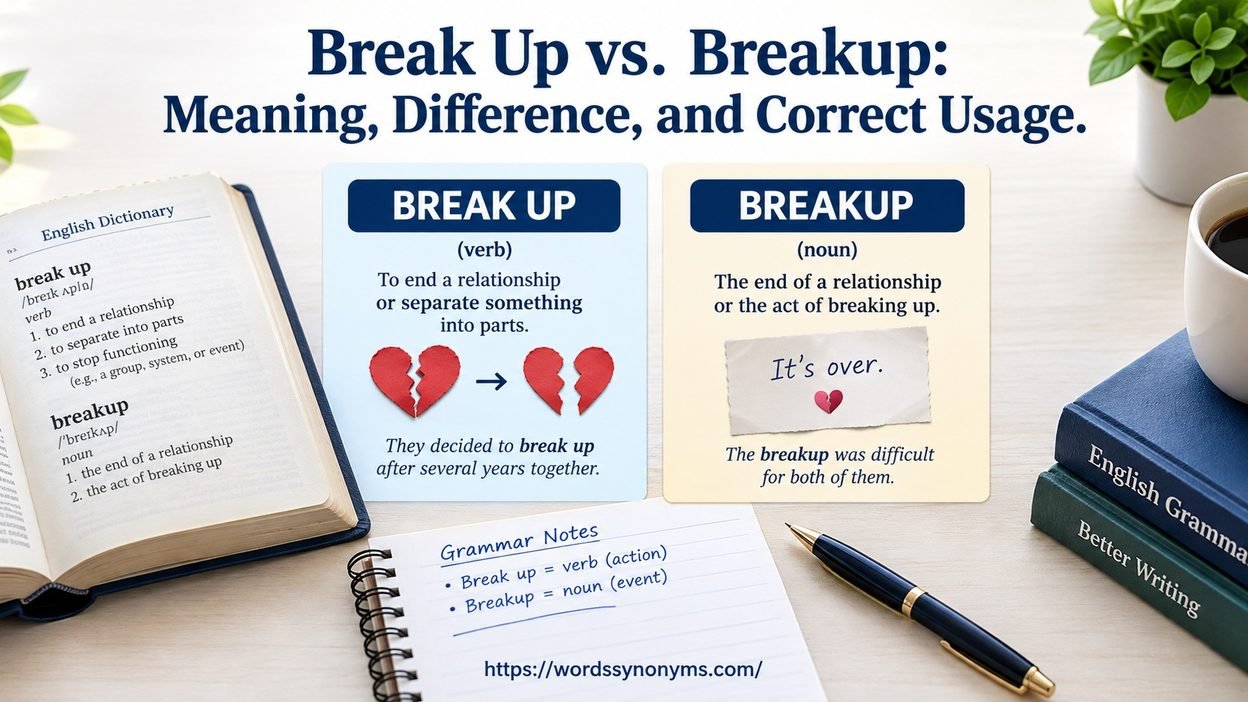
Choosing between break up and breakup depends on how the word functions in your sentence. Use break up when you’re talking about the action of ending a relationship. Use breakup when you’re naming the event itself. The related forms broke up and broken up show the same verb in different tenses.
| Form | Usage | Example |
| break up | Verb | “They decided to break up.” |
| broke up | Past tense | “They broke up last year.” |
| broken up | Past participle | “They have broken up.” |
| breakup | Noun | “Their breakup was unexpected.” |
| break up with | End a relationship | “She broke up with him.” |
Quick rule: Use break up for the action and breakup for the event.
Break Up vs. Breakup: The Quick Difference
The main difference between break up and breakup comes down to part of speech.
| Form | Part of speech | Meaning | Example |
| break up | Phrasal verb | To end a relationship or separate | “They decided to break up.” |
| breakup | Noun | The ending or separation | “Their breakup was unexpected.” |
| broke up | Past-tense verb | Ended a relationship or separated | “They broke up last year.” |
| broken up | Past participle | Having ended or been separated | “They have broken up before.” |
Here’s the quickest way to remember it:
You break up. You have a breakup.
For example:
- “Sarah decided to break up with Mark.”
- “Sarah’s breakup with Mark was difficult.”
The first sentence describes an action. The second names the event.
What Does “Break Up” Mean?
Break up is a phrasal verb. It combines the verb break with the particle up to create several related meanings.
In relationship contexts, break up means to end a romantic relationship.
For example:
- “They decided to break up.”
- “I don’t want to break up with her.”
- “They broke up after several years together.”
- “When did you two break up?”
Notice that break up contains two separate words because it functions as a verb phrase.
Break Up as a Relationship Verb
When people use break up in the context of dating or marriage, they usually mean that a romantic relationship has ended.
The construction often appears in two ways:
Break up
“They decided to break up.”
Break up with + person
“He decided to break up with his girlfriend.”
The second construction identifies the person involved.
This distinction matters because English normally doesn’t use breakup as the ordinary verb in these sentences.
Incorrect:
“They decided to breakup.”
Correct:
“They decided to break up.”
The same principle applies to the past tense:
“They broke up last summer.”
Not:
“They breakup last summer.”
Break Up With Someone
The phrase break up with is especially important because it appears frequently in everyday English.
When you say someone breaks up with another person, the construction identifies who receives the action.
Examples:
- “Emma broke up with Daniel.”
- “Daniel broke up with Emma.”
- “She wants to break up with him.”
- “They decided to break up with each other.”
The phrase can also appear without naming the other person:
“After months of arguments, they decided to break up.”
The meaning remains clear from context.
Break Up Has Several Other Meanings
The relationship meaning is only one use of break up. English speakers also use this phrasal verb for separation, interruption, division, and dispersal.
For example:
Separate people
“The teacher stepped in to break up the fight.”
Divide something
“The company plans to break up the large project into smaller stages.”
Disperse a group
“The police ordered the crowd to break up.”
Interrupt a signal
“Your voice keeps breaking up on the phone.”
End a period of continuity
“A few sunny days finally broke up the long stretch of rain.”
These meanings share a basic idea: something that exists together or continuously becomes separated, interrupted, or divided.
What Does “Breakup” Mean?
Breakup is generally a noun. It names the event, experience, or process of separation.
In romantic contexts, a breakup means the ending of a relationship.
Examples include:
- “The breakup was difficult.”
- “She’s still recovering from the breakup.”
- “Their breakup surprised their friends.”
- “He wrote a song about his breakup.”
- “The couple announced their breakup yesterday.”
The grammatical difference becomes obvious when you place the forms side by side.
“They decided to break up.”
“Their breakup surprised everyone.”
The first sentence needs a verb because “decided to” is followed by an action. The second sentence needs a noun because “their” modifies a thing or event.
Breakup as a Noun Beyond Romance
Although people often associate breakup with romantic relationships, the noun can describe other kinds of separation.
For example:
“The breakup of the company created several smaller businesses.”
Here, breakup doesn’t refer to dating. It describes the division of an organization.
Similarly:
“The breakup of the band disappointed longtime fans.”
The noun refers to the band’s separation.
This broader meaning helps explain why breakup isn’t inherently a romantic word. Its core idea is separation or dissolution.
Break Up vs. Breakup in a Sentence
One of the best ways to understand the difference is to compare sentences that express almost the same idea.
| Verb form | Noun form |
| “They decided to break up.” | “Their breakup was painful.” |
| “She wants to break up.” | “She talked about her breakup.” |
| “He broke up with her.” | “His breakup with her was unexpected.” |
| “They may break up soon.” | “A breakup seems possible.” |
| “The couple broke up last month.” | “The couple’s breakup made headlines.” |
Look closely at the words surrounding each form.
A verb commonly follows structures such as:
- to break up
- will break up
- may break up
- decided to break up
- broke up
- have broken up
A noun commonly follows structures such as:
- a breakup
- the breakup
- their breakup
- her breakup
- after the breakup
- before the breakup
This gives you a practical grammar test.
If the sentence needs an action, choose break up.
If the sentence needs the name of an event, choose breakup.
Break Up With vs. Breakup With
This is one of the most common points of confusion.
When you describe the action of ending a relationship, use break up with.
“Lisa decided to break up with Tom.”
When you use breakup as a noun, you can use breakup with when referring to the relationship or person involved.
“Lisa talked about her breakup with Tom.”
The difference isn’t simply about spacing. It involves grammar.
Compare these structures:
Verb construction
Subject + break up + with + person
Noun construction
Possessive + breakup + with + person
For example:
“Mark broke up with Jessica.”
versus
“Mark’s breakup with Jessica was difficult.”
The first sentence describes what Mark did. The second describes the event.
Is “Breakup With” Ever Correct?
Yes. Breakup with can be grammatically correct when breakup functions as a noun.
For example:
“Her breakup with her longtime partner was unexpected.”
Here, breakup is a noun. The preposition with introduces the person involved in that breakup.
However, you wouldn’t normally use breakup as the verb itself.
“She decided to breakup with him.”
In standard contemporary usage, write:
“She decided to break up with him.”
That small distinction prevents a surprisingly common error.
Break Up, Broke Up, and Broken Up
Another source of confusion involves the different grammatical forms of break up.
The base form is:
break up
The simple past is:
broke up
The past participle is:
broken up
The noun is:
breakup
These forms shouldn’t be treated as interchangeable.
| Form | Grammar | Example |
| break up | Base verb | “They might break up.” |
| breaks up | Present-tense verb | “He often breaks up with people quickly.” |
| broke up | Simple past | “They broke up in June.” |
| breaking up | Present participle | “They are breaking up.” |
| broken up | Past participle | “They have broken up.” |
| breakup | Noun | “The breakup was difficult.” |
Why “Broke Up” Matters
People sometimes write breakup when they actually need the past tense broke up.
Incorrect:
“They breakup last year.”
Correct:
“They broke up last year.”
The reason is straightforward. Broke is the irregular past tense of break.
You don’t write:
“They break last year.”
Likewise, you don’t write:
“They breakup last year.”
The correct past-tense phrase is:
“They broke up last year.”
What About “Broken Up”?
Broken up is the past participle form and normally appears with an auxiliary verb.
Examples:
- “They have broken up several times.”
- “The relationship has broken up.”
- “The group was broken up by the authorities.”
The exact meaning depends on context. In relationship writing, have broken up usually describes a completed separation.
Breakup vs. Break-Up: Is the Hyphen Correct?
You may encounter break-up with a hyphen, especially in older texts or publications that follow particular editorial conventions.
However, breakup is the standard closed form commonly used as a noun in contemporary American English.
That gives you three forms that readers may encounter:
- break up — verb
- breakup — noun
- break-up — hyphenated noun found in some usage
For most modern American writing, breakup is the straightforward noun form.
The hyphenated version isn’t usually necessary when breakup clearly functions as a noun.
For example:
“The breakup affected both families.”
The closed compound works naturally.
Style guides and dictionaries can differ in how they treat compounds over time. English compounds often move from an open form to a hyphenated form and eventually to a closed form. That pattern explains why older publications may look different from contemporary writing.
For everyday American English, consistency matters more than forcing an unfamiliar hyphenated spelling.
Common Mistakes With Break Up and Breakup
The confusion usually comes from treating the two forms as interchangeable. They aren’t.
Mistake: Using “Breakup” as a Verb
Incorrect:
“They decided to breakup.”
Correct:
“They decided to break up.”
The phrase follows decided to, which requires the base verb.
Mistake: Writing “Break Up” as a Noun
Incorrect:
“The break up was painful.”
Preferred:
“The breakup was painful.”
Here, the phrase follows the, which signals that a noun is needed.
Mistake: Confusing “Break Up” With “Broke Up”
Incorrect:
“They break up last weekend.”
Correct:
“They broke up last weekend.”
Use broke up when the action happened in the past.
Mistake: Writing “Breakup With” as the Verb
Incorrect:
“She decided to breakup with him.”
Correct:
“She decided to break up with him.”
The noun version works differently:
“She discussed her breakup with him.”
The surrounding grammar tells you which form belongs there.
How to Choose Between Break Up and Breakup
When you’re unsure, don’t rely on how the phrase sounds. Look at its grammatical job.
Use “Break Up” When It Describes an Action
Choose break up when someone performs the action.
Examples:
- “I might break up with him.”
- “They want to break up.”
- “She broke up with her partner.”
- “The couple is breaking up.”
A useful test is to replace break up with another verb.
“They decided to leave.”
“They decided to break up.”
Both function as actions.
Use “Breakup” When It Names the Event
Choose breakup when you’re talking about the event itself.
Examples:
- “The breakup was unexpected.”
- “Her breakup happened months ago.”
- “He struggled after the breakup.”
- “Their breakup became public.”
Try placing the, a, their, or her before the word.
If that structure works naturally, breakup is probably the right choice.
A Simple Substitution Test
Ask yourself:
Can I replace the phrase with an action?
If yes, you probably need break up.
“They decided to break up.”
Can I replace the phrase with an event or situation?
If yes, you probably need breakup.
“Their breakup was difficult.”
This test works especially well when you’re proofreading quickly.
Break Up vs. Breakup Examples
The following examples cover many of the sentence patterns you’re likely to encounter.
| Sentence | Correct form | Reason |
| “They decided to break up.” | break up | Base verb |
| “Their breakup was unexpected.” | breakup | Noun |
| “She broke up with him.” | broke up | Past-tense verb |
| “He is considering a breakup.” | breakup | Noun |
| “They may break up soon.” | break up | Verb after modal |
| “She had a difficult breakup.” | breakup | Noun |
| “They have broken up before.” | broken up | Past participle |
| “The couple is breaking up.” | breaking up | Present participle |
| “His breakup with Anna shocked his friends.” | breakup | Noun |
| “He decided to break up with Anna.” | break up | Phrasal verb |
These examples reveal a consistent pattern. The spelling changes because the grammatical function changes.
Break Up vs. Breakup in Formal and Informal Writing
The distinction between break up and breakup doesn’t disappear in formal writing.
You still use the verb when describing an action:
“The couple decided to break up after several months of disagreement.”
You use the noun when discussing the event:
“The breakup affected their professional relationship.”
In casual conversation, people often use shorter constructions:
“They broke up.”
In more formal writing, the same distinction remains:
“The couple announced their breakup.”
The vocabulary may change with the context. The grammar doesn’t.
In Academic or Analytical Writing
A writer discussing relationships, literature, sociology, or popular culture might use breakup as a noun.
For example:
“The novel explores the emotional consequences of a sudden breakup.”
If the sentence focuses on the action instead, break up remains the appropriate form:
“The characters eventually break up after a prolonged conflict.”
In Headlines
Headlines sometimes create additional confusion because headline grammar is compressed.
You might see constructions such as:
“Celebrity Couple Breaks Up”
or:
“Celebrity Couple Announces Breakup”
The first uses breaks up as a verb. The second uses breakup as a noun.
Both forms work because the grammatical structures differ.
Read more: Fungi vs. Funguses: What’s the Difference?
A Practical Case Study: Choosing the Right Form
Consider this short paragraph:
“After years together, Maya and Chris decided to break up. Their breakup surprised everyone because they had recently moved into a new apartment. Chris later said that they had broken up peacefully. Maya explained that neither person wanted to continue the relationship.”
Several forms appear in just a few sentences.
Break up appears because the sentence describes an action:
“They decided to break up.”
Breakup appears because the sentence names the event:
“Their breakup surprised everyone.”
Broken up appears because the sentence uses the past participle:
“They had broken up peacefully.”
The meaning stays connected throughout. The grammar determines the form.
Break Up vs. Split Up
Break up and split up can overlap when people discuss romantic relationships.
For example:
“They broke up last year.”
“They split up last year.”
Both can mean that a romantic relationship ended.
However, split up has a broader sense of separating people or things. Break up also has several non-romantic meanings involving division or interruption.
In relationship writing, both can sound natural. The choice often depends on regional preference, context, and tone.
The noun forms differ as well:
- breakup
- split
For example:
“The breakup was difficult.”
“Their split was unexpected.”
These aren’t always interchangeable in every context, though. Breakup is especially common when directly naming the end of a romantic relationship.
Break Up vs. Break Off
Break off can also describe ending a relationship or arrangement, but it isn’t identical to break up.
Consider:
“They broke up after several arguments.”
The phrase directly describes the end of a romantic relationship.
By contrast:
“She broke off the engagement.”
Here, break off emphasizes ending a specific commitment or arrangement.
You can also break off talks, negotiations, discussions, or agreements.
For example:
“The two sides broke off negotiations.”
That doesn’t mean the same thing as saying two people broke up.
Understanding the object of the verb helps you choose naturally.
Break Up vs. Separation
Separation is a broader and often more formal noun.
A breakup commonly refers to the ending of a romantic relationship. Separation can describe physical distance, legal marital separation, organizational division, or other forms of being apart.
For example:
“The couple announced their breakup.”
This sounds direct and conversational.
“The couple entered a period of separation.”
This can sound more formal and may imply a particular marital or legal context.
The words overlap in some situations. They aren’t perfect synonyms.
Why the Space Matters
At first glance, the difference between break up and breakup seems tiny. It’s only a space.
Yet English frequently uses spacing to distinguish grammatical categories.
Compare:
- set up → verb
- setup → noun
- log in → verb
- login → noun
- check out → verb
- checkout → noun
- break up → verb
- breakup → noun
For example:
“Please log in to your account.”
“The login failed.”
The same grammatical pattern appears with break up and breakup.
This is why learning the grammatical role is more useful than simply memorizing spelling.
A Quick Grammar Formula
You can remember the distinction with this simple formula:
Action = break up
Event = breakup
Past action = broke up
Completed action = broken up
Examples:
- “They plan to break up.”
- “Their breakup became public.”
- “They broke up yesterday.”
- “They have broken up before.”
Once this pattern becomes familiar, most usage questions become straightforward.
When “Break Up” Can Be Separated Even Further
The particle up can sometimes move in phrasal-verb constructions when the grammar allows it. However, the relationship meaning of break up doesn’t normally work that way when used with with.
You say:
“They broke up.”
and:
“She broke up with him.”
You don’t normally create an alternative by placing the object between break and up in the relationship construction.
This is another reason it’s helpful to treat break up with as a familiar phrasal-verb pattern rather than trying to construct it word by word.
Breakup in Everyday Expressions
The noun breakup commonly appears with several modifiers and prepositions.
Examples include:
- a painful breakup
- a sudden breakup
- a messy breakup
- a recent breakup
- a difficult breakup
- after the breakup
- before the breakup
- during the breakup
- recover from a breakup
- deal with a breakup
- announce a breakup
- go through a breakup
These combinations reinforce the noun function.
For instance:
“She needed time to recover from the breakup.”
The phrase recover from requires something functioning as a noun here. Breakup fits naturally.
Break Up in Everyday Expressions
The verb appears in equally recognizable constructions:
- break up with someone
- decide to break up
- want to break up
- threaten to break up
- try to break up
- break up after years together
- break up over an argument
- break up peacefully
Examples:
“They decided to break up after years of disagreement.”
“She didn’t want to break up with him.”
“The couple broke up over conflicting plans for the future.”
These structures all describe an action rather than naming the event.
Quick Reference: Break Up vs. Breakup
| If you mean… | Use… | Example |
| The action of ending a relationship | break up | “They may break up.” |
| Ending a relationship in the past | broke up | “They broke up yesterday.” |
| A completed action | broken up | “They have broken up.” |
| The event itself | breakup | “The breakup was difficult.” |
| The action involving another person | break up with | “She broke up with him.” |
| The event involving another person | breakup with | “Her breakup with him was painful.” |
The central distinction remains remarkably consistent.
Break up is the verb. Breakup is the noun.
FAQs
Is “breakup” one word or two?
Breakup is one word when it is used as a noun or adjective. For example, you can say “The breakup was difficult” or “She wrote a breakup song.”
When should I write “break up”?
Use break up as two words when it functions as a verb. For example, “They decided to break up” uses the phrase to describe the action of ending a relationship.
Is “break-up” also correct?
Yes. Break-up is a hyphenated form that some publishers and style guides use. However, breakup is the common one-word form when the term is a noun or adjective.
Does “taking a break” mean the same as breaking up?
No. Taking a break usually describes a temporary period of space in a relationship, while breaking up means ending the relationship.
Is “breakup” a noun or an adjective?
Breakup can be both. It is a noun in “a bad breakup” and an adjective in “a breakup song,” where it describes the type of song.
What is the easiest way to remember “break up” vs. “breakup”?
A simple rule is to check the function. If you are describing an action, use break up. If you are naming the event or describing something related to it, use breakup.
Conclusion
The difference between break up and breakup becomes much easier to remember once you look at their roles in a sentence. Use break up as a verb when describing the action of ending a relationship, while breakup works as a noun or adjective when naming or describing the event. Keeping this simple distinction in mind can prevent common spelling and grammar mistakes.
In everyday writing, context usually makes the intended meaning clear, but choosing the correct form still makes your sentences cleaner and more polished. Whether you’re describing a difficult relationship, a temporary break, or the end of a romance, knowing when to write break up, breakup, or break-up helps you communicate your meaning with confidence.

Muhammad Taqi is a content writer interested in English vocabulary and language. He writes clear and useful articles on synonyms, antonyms, word meanings, and English usage, helping readers expand their vocabulary and improve their communication skills.