
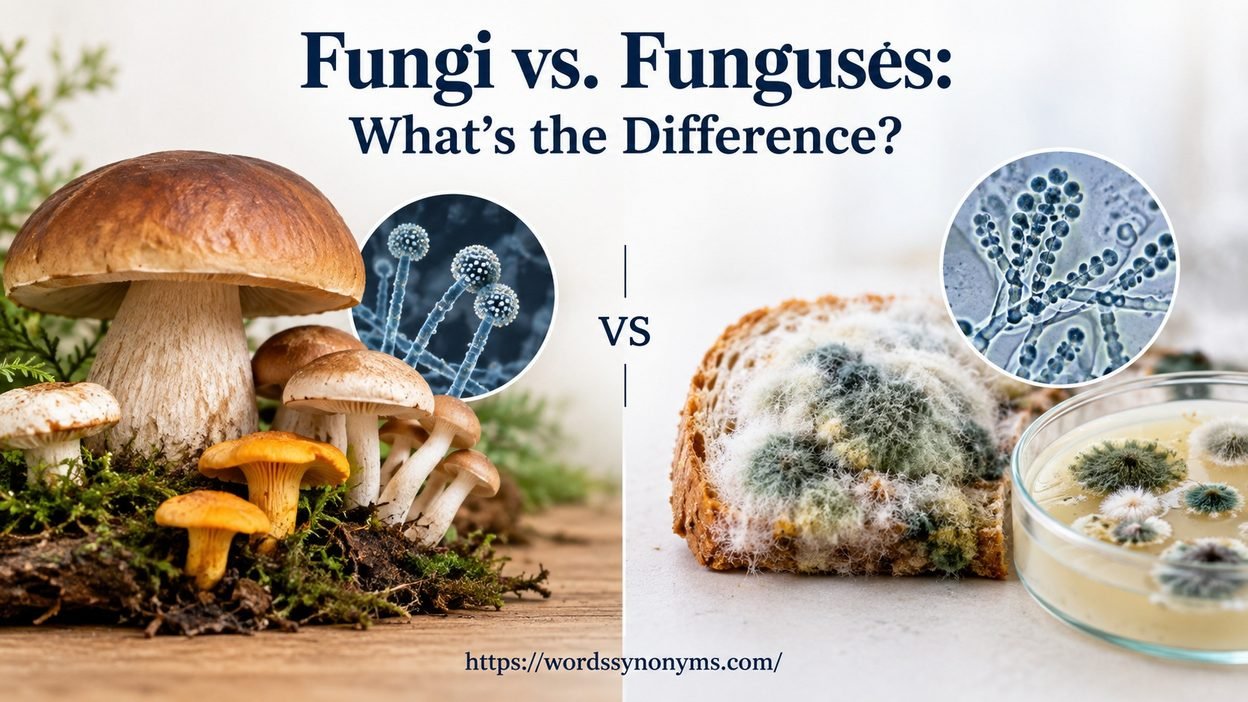
The choice between Fungi vs. Funguses: What’s the Difference? becomes easier when you understand how the fungus entered English from its Latin roots and evolved through the language over centuries.
Funguses is a valid English plural, created by pluralizing the noun in the normal English manner. In everyday writing, this form isn’t incorrect, even though fungus is a Latin-derived English word that also retains traditional Latin plurals.
The best choice can depend on your audience, formal contexts, and the type of language you’re using.
In today’s English, fungi is the common plural in scientific writing and other scientific contexts. It is conventionally preferred in modern biological terminology, making it the safer choice when discussing mushrooms, molds, yeasts, or the broader fungal group in a scientific setting. In less formal English, funguses remains acceptable.
For technical material, fungi usually fits established usage, while funguses follows ordinary English plural patterns and can make general wording feel natural and clear without suggesting that the English form is wrong.
Quick answer
Wondering whether to use fungi or funguses? Both are correct. Fungi is the form you’ll see most often in science and biology, while funguses is the regular English plural.
| Word | Meaning | Common Use |
| Fungi | Plural of fungus | Science, biology, formal writing |
| Funguses | Plural of fungus | General English, different types or specimens |
So, if you’re writing about fungi in a scientific context, fungi is usually the natural choice. In general writing, funguses can also fit depending on the context.
Fungi vs. Funguses: Quick Difference
The simplest way to understand fungi vs. funguses is to look at how each form functions in modern English.
| Word | Singular | Plural | Typical Use | Correct? |
| Fungus | Fungus | — | One fungus or organism | Yes |
| Fungi | Fungus | Fungi | Biological groups and scientific contexts | Yes |
| Funguses | Fungus | Funguses | General English and individual types | Yes |
| Fungal | — | — | Adjective related to fungi | Yes |
For example:
- One fungus grew on the tree.
- Several fungi grew on the tree.
- Several funguses grew on the tree.
The last two sentences use different plural forms. Neither plural is automatically grammatically wrong.
However, fungi is much more familiar in scientific writing. If a biology textbook discusses organisms belonging to the kingdom Fungi, fungi is the form you’ll normally encounter.
Funguses, meanwhile, can sound more distinctly English because it uses the familiar plural ending -es.
What Does “Fungi” Mean?
Fungi is the traditional plural of fungus. The word comes from the Latin fungus, with fungi functioning as its Latin plural.
In modern English, fungi generally refers to more than one fungus. It can describe a broad biological group or multiple individual fungal organisms.
Fungi include an enormous variety of organisms. Mushrooms represent only one visible part of this world. Molds, yeasts, rusts, and many other organisms belong to the fungal kingdom.
For example:
Fungi play an important role in breaking down dead organic material.
Here, fungi refers to fungi as a broad biological group.
Another example is:
Scientists discovered several fungi living in the forest soil.
In this sentence, fungi refers to multiple individual fungal organisms.
Why “Fungi” Is Common in Science
Scientific terminology often preserves traditional forms. Fungi has become deeply established in biology, so it remains the familiar choice in scientific discussions.
You’re likely to see fungi when reading about:
- Biology
- Mycology
- Microbiology
- Ecology
- Plant pathology
- Medicine
- Agriculture
- Environmental science
- Food science
- Genetics
- Infectious diseases
For example, scientific writing might discuss pathogenic fungi, soil fungi, marine fungi, or beneficial fungi.
The word also appears in compound expressions such as fungal infections, fungal growth, and fungal diseases.
Is “Fungi” Always Technical?
Not necessarily.
Although fungi has a scientific flavor, everyday speakers use it too. Someone might casually say:
Fungi are growing all over the damp basement.
That sentence doesn’t require a scientific setting. The traditional plural simply happens to be common enough in ordinary English.
Still, the word often feels more formal than funguses.
What Does “Funguses” Mean?
Funguses is the regular English plural of fungus.
Instead of preserving the Latin plural pattern, English speakers can treat fungus like an ordinary English noun and add -es.
That produces:
fungus → funguses
This pattern isn’t unusual. English has adopted thousands of words from other languages and sometimes creates regular English plurals for them.
For example:
- cactus → cactuses
- focus → focuses
- virus → viruses
- campus → campuses
Some borrowed words retain older plural forms while also developing regular English alternatives. Fungus fits this broader pattern.
When Is “Funguses” Used?
Funguses can be useful when the writer wants to emphasize individual kinds, varieties, or specimens rather than the fungal kingdom as a whole.
For example:
The researchers examined several funguses collected from different trees.
The sentence focuses on individual fungal specimens.
Another example:
The laboratory identified three different funguses in the sample.
Here, the plural emphasizes different types or organisms.
That doesn’t mean fungi couldn’t appear in these sentences. It could. The choice depends on context, register, and the writer’s preferred terminology.
Why Does “Fungus” Have Two Plurals?
The answer lies partly in the history of English.
English has borrowed a huge number of words from Latin and Greek. Some borrowed words entered English while retaining elements of their original grammatical forms.
Fungus comes from Latin. The traditional Latin plural is fungi.
Over time, however, English developed its own productive plural system. For many nouns, speakers simply add -s or -es.
That created room for funguses.
This gives modern English two paths:
Classical pattern:
fungus → fungi
English pattern:
fungus → funguses
Neither development is mysterious. English frequently balances inherited forms against regular English grammar.
Classical Plurals and English Plurals
The same broader phenomenon appears with several other nouns.
| Singular | Traditional/Classical Plural | English Plural |
| Fungus | Fungi | Funguses |
| Cactus | Cacti | Cactuses |
| Focus | Foci | Focuses |
| Syllabus | Syllabi | Syllabuses |
| Index | Indices | Indexes |
These pairs don’t always have exactly the same meaning or usage patterns. Still, they demonstrate how English can preserve older plural forms while accepting regular alternatives.
The important point is this: a Latin-derived plural isn’t automatically the only correct English plural.
Fungi vs. Funguses in Scientific Writing
When the subject is biology, fungi is generally the more familiar choice.
Scientific terminology has established fungi as the standard plural for organisms in the fungal kingdom. Researchers, textbooks, academic papers, and educational materials commonly use the word.
Consider:
Fungi decompose organic matter and recycle nutrients through ecosystems.
The sentence describes fungi as a major biological group.
Now compare:
The researchers isolated several fungi from the forest floor.
Again, fungi sounds natural because the sentence belongs to a scientific context.
Does “Funguses” Become Wrong in Science?
Not automatically.
The important distinction is between grammatical correctness and terminological preference.
A word can be grammatically valid while being less common in a particular field. In scientific writing, fungi has strong conventional usage. Therefore, replacing it with funguses may make the sentence sound less familiar to readers in biology.
For formal academic work, consistency and established terminology matter.
If you’re writing a biology paper, textbook, research summary, or scientific article, fungi will usually fit the expected register better.
Fungi vs. Funguses for Different Meanings
Context can make the choice easier.
Referring to Fungi as a Biological Group
Use fungi when discussing fungi broadly as organisms.
For example:
Fungi occupy important ecological niches in forests, grasslands, and wetlands.
The sentence discusses fungi collectively.
Another example:
Many fungi form relationships with plant roots.
Here, the focus remains on fungi as a biological group.
Referring to Individual Fungal Organisms
Fungi also works when referring to multiple individual organisms.
For example:
Several fungi were growing beneath the fallen leaves.
There’s no problem using fungi for individual organisms.
This is one reason the supposed distinction between fungi and funguses shouldn’t become an overly rigid grammar rule.
Referring to Different Types or Varieties
Funguses can sometimes make sense when the writer wants to distinguish different kinds or individual forms.
For example:
The study compared several funguses with different growth patterns.
The wording highlights different examples rather than the entire fungal kingdom.
Still, fungi could also express this idea:
The study compared several fungi with different growth patterns.
The second version will generally sound more familiar in scientific prose.
Fungi vs. Funguses: Examples
Examples make the difference much clearer.
1 Examples With “Fungi”
- Fungi help recycle nutrients in forest ecosystems.
- Several fungi were found in the soil sample.
- Some fungi live in close association with plant roots.
- Fungi can grow in environments where other organisms struggle.
- Researchers studied fungi that survive in extreme conditions.
- Certain fungi are useful in food production.
- Many fungi reproduce by producing spores.
- The damp room encouraged fungi to grow on the walls.
2 Examples With “Funguses”
- The researchers identified several funguses in the sample.
- Different funguses produced different chemical compounds.
- The technician separated the funguses before testing them.
- Several funguses appeared on the decaying wood.
- The experiment compared funguses from different environments.
- The soil contained multiple funguses with distinct growth patterns.
Notice something important: the sentences don’t become grammatically broken when you substitute one plural for the other.
The main difference often involves register, convention, and emphasis.
Case Study: Choosing the Plural in Biology
Imagine a biology student writing this sentence:
Funguses are essential decomposers in most ecosystems.
The grammar isn’t the main problem. The wording simply sounds less conventional for a biological discussion than:
Fungi are essential decomposers in most ecosystems.
Because biology routinely uses fungi as the plural term, that form fits the discipline’s established vocabulary.
Now imagine a writer discussing several distinct fungal types in a general article:
The researchers compared different funguses found in the building.
Here, funguses can sound natural because the sentence emphasizes separate types or examples.
The lesson is straightforward: context matters more than memorizing a rigid rule.
Is “Fungi” Singular or Plural?
Fungi is plural.
The singular form is fungus.
| Number | Correct Form | Example |
| Singular | fungus | A fungus grew on the log. |
| Plural | fungi | Several fungi grew on the log. |
| Plural | funguses | Several funguses grew on the log. |
A common mistake occurs when writers use fungi with a singular verb.
Incorrect:
A fungi is growing on the tree.
Correct:
A fungus is growing on the tree.
With multiple organisms:
Fungi are growing on the tree.
The verb must agree with the grammatical number of the noun.
Can “Fungi” Ever Be Treated as Singular?
In standard modern English, fungi is generally treated as plural when it means multiple fungi.
That means you normally use:
- fungi are
- fungi were
- fungi have
- fungi grow
For example:
Fungi are important decomposers.
Not:
Fungi is an important decomposer.
The singular noun fungus takes singular verbs:
A fungus is growing here.
Is “Funguses” Correct?
Yes. Funguses is a legitimate English plural of fungus.
It follows a regular English plural pattern:
fungus → funguses
That makes it grammatically understandable and acceptable.
However, correctness doesn’t mean every context gives both forms equal stylistic weight.
In scientific writing, fungi remains highly familiar. In general English, funguses can work naturally, particularly when the writer wants to emphasize individual kinds or specimens.
Think of the two forms as different tools in the same toolbox. You wouldn’t necessarily reach for the same tool in every situation.
Which Is More Common: Fungi or Funguses?
Fungi is generally the more familiar and widely used plural form, especially in scientific and educational contexts.
Its long-established role in biology has made it the default choice for many writers.
Funguses exists as a regular English alternative. However, many readers encounter it less frequently.
This difference in familiarity explains why some people mistakenly assume that funguses must be wrong. A less common word isn’t necessarily an incorrect word.
Frequency and correctness aren’t identical concepts.
Read more: Rend vs. Rent: Meaning, Difference and Correct Usage
Fungi vs. Funguses: Pronunciation
The pronunciation of fungi can vary.
In American English, a common pronunciation is approximately:
FUN-jy
Another pronunciation, especially in some varieties of English, may sound closer to:
FUN-guy
The pronunciation of funguses is more straightforward:
FUN-gus-iz
The final -es produces an additional syllable.
Why Does “Fungi” Have Different Pronunciations?
The variation reflects the history of the word and differences in English pronunciation traditions.
Because fungi comes from Latin, speakers have sometimes tried to preserve a pronunciation closer to the original language. Others have adapted the word to established English pronunciation patterns.
For practical writing purposes, the spelling is more important than trying to force one pronunciation on every English speaker.
Common Mistakes With Fungi and Funguses
The most frequent mistakes aren’t about choosing the “wrong” plural. They’re usually about number, context, and consistency.
Mistake: Using “Fungi” as a Singular Noun
Incorrect:
The fungi was growing rapidly.
If you’re referring to one organism, use fungus:
The fungus was growing rapidly.
Mistake: Assuming “Funguses” Is Always Wrong
Some writers have learned that fungi is the plural and then assume funguses must be an error.
That’s too absolute.
Funguses is an accepted English plural. Its usage may be less common in certain scientific contexts, but that doesn’t make the form inherently ungrammatical.
Mistake: Ignoring the Writing Context
A scientific paper about fungal ecology usually benefits from the conventional term fungi.
A general audience article may comfortably use funguses when discussing different fungal types.
The intended audience should influence your word choice.
Mistake: Switching Forms Without Reason
Consistency helps readers.
If a technical article repeatedly uses fungi, suddenly switching to funguses can create unnecessary distraction.
Choose the form that fits the context and maintain that choice unless the meaning genuinely changes.
Fungi vs. Funguses: A Practical Usage Guide
When you’re unsure which word to choose, ask what you’re writing about.
| Situation | Natural Choice |
| Biology textbook | Fungi |
| Academic biology paper | Fungi |
| Scientific discussion | Fungi |
| General conversation | Fungi or funguses |
| General explanatory writing | Fungi or funguses |
| Multiple fungal organisms | Fungi or funguses |
| Different fungal types | Funguses can be useful |
| One organism | Fungus |
This isn’t an absolute grammar law. It’s a practical usage guide.
For most formal scientific writing, fungi will be the safest conventional choice. In broader English, funguses remains available when it suits the sentence.
Related Words: Fungus, Fungal, Fungi, and Mycology
Understanding related vocabulary can prevent other mistakes.
Fungus
Fungus is the singular noun.
A fungus appeared on the old bread.
Fungi
Fungi is a plural noun.
Several fungi appeared on the old bread.
Funguses
Funguses is another plural noun.
Several funguses were identified during the experiment.
Fungal
Fungal is an adjective meaning related to fungi.
The patient developed a fungal infection.
You wouldn’t normally use fungi as an adjective in this construction. That’s where fungal fits.
Mycology
Mycology is the branch of biology concerned with fungi.
A person who studies fungi professionally is a mycologist.
These related terms are useful because they show how English separates grammatical function:
- Fungus = singular noun
- Fungi = plural noun
- Funguses = plural noun
- Fungal = adjective
- Mycology = scientific field
- Mycologist = person who studies fungi
Why Context Matters More Than a Simple “Correct or Incorrect” Rule
Word-choice questions often tempt you to search for one winner. Fungi vs. funguses doesn’t work that way.
Both forms have legitimate grammatical foundations.
The real question is:
Which plural fits this particular sentence, audience, and context?
Suppose you’re writing a research article:
Fungi contribute significantly to nutrient cycling.
The terminology sounds natural and conventional.
Now consider:
The researchers isolated several funguses and compared their chemical properties.
The second sentence uses a regular English plural. It can work when the writer wants to emphasize separate fungal types or specimens.
Neither example requires the other form to be declared incorrect.
Fungi vs. Funguses in Everyday English
Everyday English doesn’t always follow the terminology preferred by specialists.
A person talking about mushrooms, mold, or yeast may simply use fungi because it’s the familiar plural they’ve heard.
For example:
There are fungi growing behind the refrigerator.
That sounds perfectly ordinary.
A speaker might also say:
Several different funguses were found in the sample.
That version is understandable and grammatically formed. However, depending on the audience, fungi may sound more natural.
This is a useful reminder that grammar and style aren’t identical.
A word can be grammatically sound while another option remains more idiomatic in a particular setting.
A Simple Memory Trick
If you need a quick way to remember the distinction, use this rule:
Think “biology” → fungi.
Think “regular English plural” → funguses.
Then check the actual sentence.
If you’re discussing fungi as organisms within the biological kingdom, fungi is usually the natural choice.
If you’re deliberately treating fungus as an ordinary count noun and discussing separate kinds or specimens, funguses can be appropriate.
When in doubt in formal scientific writing, fungi is generally the more conventional choice.
Fungi vs. Funguses: Quick Facts
- Fungus is singular.
- Fungi is a plural form of fungus.
- Funguses is also a plural form of fungus.
- Fungi comes from the traditional Latin plural.
- Funguses follows an English plural pattern.
- Fungi is especially common in scientific writing.
- Funguses can appear in general English.
- Fungal is the adjective related to fungi.
- Mycology is the study of fungi.
- Mycologist refers to a scientist who studies fungi.
- You normally use a plural verb with fungi.
- You use fungus when referring to one organism.
FAQs
Is “funguses” a correct plural of fungus?
Yes. Funguses is a grammatically correct English plural of fungus. It follows the regular English pattern of adding “-es,” so there’s no need to treat it as a mistake.
Is “fungi” more correct than “funguses”?
Not necessarily. Both fungi and funguses are accepted plurals. However, fungi is much more common in scientific and biological writing, while funguses can sound more natural in general English.
Why is the plural of fungus “fungi”?
Fungi comes from the traditional Latin plural of fungus. English has retained this Latin form, particularly in scientific terminology where Latin-based terms remain common.
Should you use fungi or funguses in scientific writing?
Fungi is generally the better choice for scientific writing because it is the established plural used in biology and related fields. It also matches the terminology commonly found in scientific publications.
Can “funguses” refer to different types of fungus?
Yes. Funguses can be used when referring to multiple individual fungi or types of fungus. The word is especially suitable when the writer is following a regular English plural pattern rather than specialized scientific usage.
Is fungi singular or plural?
Fungi is plural. The singular form is fungus. For example, “A fungus grows on the tree” uses the singular, while “Fungi grow on decaying material” uses the plural.
Conclusion
Fungi vs funguses are both valid plural forms of fungus, but they fit different styles of English. Fungi is the familiar choice in biology, research, and other scientific contexts, while funguses follows the regular English plural pattern and works well in general writing.
When you’re writing for a scientific or technical audience, fungi is usually the most natural option. For everyday communication, funguses isn’t wrong. Understanding this small difference helps you choose the form that best matches your context instead of assuming that one plural is always correct.

Muhammad Taqi is a content writer interested in English vocabulary and language. He writes clear and useful articles on synonyms, antonyms, word meanings, and English usage, helping readers expand their vocabulary and improve their communication skills.