Crack Down vs. Crackdown: Grammar and Examples explains when to use the noun crackdown and the verb crack down in clear, simple English.
The main difference is grammatical. Crackdown is one word with no hyphen, while crack down is two words and acts as the corresponding verb. A crackdown describes an official effort to forcefully repress or restrain an activity, while crack down describes the action of trying to forcefully repress or restrain something.
These terms often appear when governments respond to protests, especially when repressive governments use strict actions against antigovernment protests. The noun focuses on the official effort, repression, or restraint, whereas the verb form focuses on what the government does.
In practical usage, governments may crack down on antigovernment protests, while the actions governments take can be called crackdowns. These measures may be especially harsh and usually involving force, depending on the context.
For example, “The government decided to crack down on the protests” uses the verb, while “The government launched a crackdown on the protests” uses the noun. From a grammar perspective, the easiest way to choose correctly is to identify whether you need an action word describing what someone does or the name of the action itself.
This distinction makes crack down and crackdown easier to use accurately.
Quick Answer
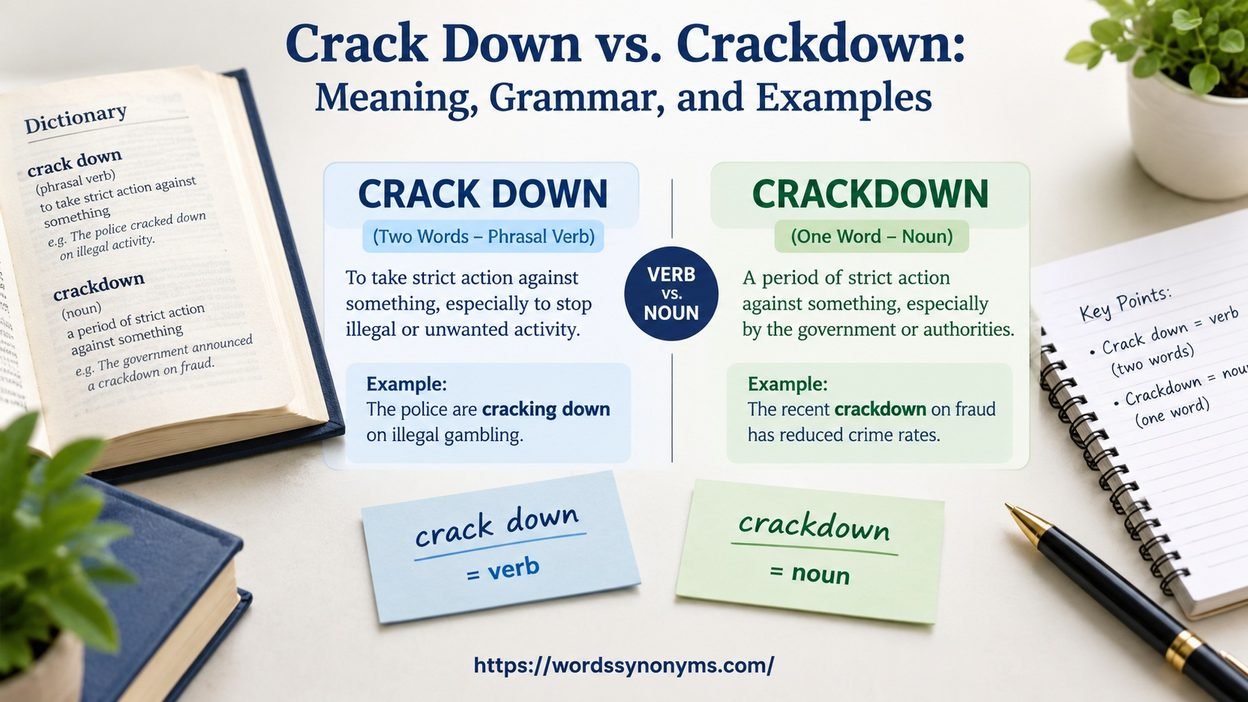
Crack down and crackdown share the same basic idea, but they have different grammatical jobs. Crack down is a two-word phrasal verb meaning to take strict action against something. Crackdown is a one-word noun that names the strict enforcement effort itself.
| Term | Grammar | Meaning | Example |
| Crack down | Phrasal verb | Take strict action | Police will crack down on speeding. |
| Crackdown | Noun | A strict enforcement effort | Police announced a crackdown on speeding. |
A simple rule makes the difference easy to remember: crack down = action, while crackdown = the enforcement effort. If you need a verb after will, may, or is, choose crack down. If you need a noun after a, the, or an adjective, choose crackdown.
Crack Down vs. Crackdown: Quick Difference
The easiest way to distinguish crack down from crackdown is to identify its grammatical role.
| Term | Part of Speech | Meaning | Common Pattern | Example |
| crack down | Phrasal verb | To take stronger or stricter action | crack down on + noun/gerund | Police will crack down on speeding. |
| crackdown | Noun | A strict effort to stop or control something | a/the crackdown on + noun/gerund | Police announced a crackdown on speeding. |
There’s a useful shortcut: two words usually indicate the action, while one word names the enforcement effort.
Consider these two sentences:
The city will crack down on illegal dumping.
The city announced a crackdown on illegal dumping.
Both sentences describe stricter enforcement. The first uses crack down as the verb. The second uses crackdown as the noun.
That distinction is the key to the entire topic.
Crack Down: Meaning and Definition
What Does “Crack Down” Mean?
Crack down means to take firm, strict, or more forceful action against an unwanted or illegal activity.
The expression commonly appears when an authority decides to enforce rules more strictly. Governments, police departments, schools, employers, regulators, and other organizations can all crack down on something.
For example:
- The police will crack down on reckless driving.
- The school is cracking down on cheating.
- Officials cracked down on illegal construction.
- The company plans to crack down on workplace violations.
The expression usually focuses on the action being taken rather than the enforcement campaign itself.
The word on is especially important. The most common construction is:
crack down on + person, activity, behavior, or problem
For example, crack down on fraud, crack down on spam, and crack down on tax evasion all follow this pattern.
Crack Down Grammar
Crack down functions as a phrasal verb. It contains the verb crack and the particle down.
Because it functions as a verb, its form changes according to tense and subject.
Common forms include:
- crack down — base form
- cracks down — third-person singular present
- cracked down — simple past
- cracking down — present participle
- will crack down — future construction
- has cracked down — present perfect
Here’s how those forms work:
| Verb Form | Example |
| crack down | Officials plan to crack down on fraud. |
| cracks down | The regulator regularly cracks down on violations. |
| cracked down | Police cracked down on illegal racing. |
| cracking down | The city is cracking down on unsafe buildings. |
| will crack down | The agency will crack down on false claims. |
| has cracked down | The school has cracked down on cheating. |
Notice something important: crack down remains two words even when the verb changes tense.
Why “Crackdown” Doesn’t Work as the Verb
A common mistake occurs when writers treat crackdown as though it were a verb.
For example:
Incorrect:
The government will crackdown on illegal imports.
Correct:
The government will crack down on illegal imports.
The reason is grammatical rather than stylistic. The sentence needs a verb after will. Crack down supplies that verb phrase.
By contrast, crackdown is a noun. It cannot normally fill that same grammatical position.
Crackdown: Meaning and Definition
What Does “Crackdown” Mean?
Crackdown is a noun that means a strict or forceful effort to stop, reduce, or control unwanted activity.
Instead of describing the action of enforcing rules, the noun refers to the enforcement effort itself.
For example:
- The government announced a crackdown on tax fraud.
- Police launched a crackdown on illegal racing.
- The school introduced a crackdown on cheating.
- The company began a crackdown on policy violations.
Here, crackdown acts like other nouns such as campaign, effort, or operation.
You can often test the sentence by replacing crackdown with campaign or effort:
The government announced a campaign on tax fraud.
The government announced a crackdown on tax fraud.
The second sentence identifies a specific type of strict enforcement effort.
Crackdown Grammar
Because crackdown is a noun, it can appear with determiners, adjectives, and other noun modifiers.
Common constructions include:
- a crackdown
- the crackdown
- a government crackdown
- a police crackdown
- a major crackdown
- a nationwide crackdown
- a crackdown on fraud
For example:
The city announced a major crackdown on illegal dumping.
Here, major modifies the noun crackdown.
You can also make the noun plural:
Several crackdowns followed the new regulations.
The plural form reinforces its status as a noun.
Examples of “Crackdown”
Here are examples across several contexts:
Government
The government announced a crackdown on tax evasion.
Law enforcement
Police began a crackdown on illegal street racing.
Education
The university introduced a crackdown on academic dishonesty.
Workplace
Management launched a crackdown on repeated safety violations.
Online activity
The platform announced a crackdown on fraudulent accounts.
The surrounding grammar tells you that crackdown functions as a thing or event rather than an action performed by the sentence’s main subject.
Crack Down vs. Crackdown: Grammar Compared
The most useful way to understand crack down vs. crackdown is to compare their sentence structures.
Crack Down as a Verb
The basic pattern is:
Subject + crack down + on + target
Examples:
- Police cracked down on speeding.
- Officials will crack down on fraud.
- The school is cracking down on cheating.
The subject performs the action.
Crackdown as a Noun
The common pattern becomes:
Subject + verb + a/the crackdown + on + target
Examples:
- Police announced a crackdown on speeding.
- Officials launched a crackdown on fraud.
- The school began a crackdown on cheating.
Now the subject performs another action such as announce, launch, begin, or enforce. The crackdown itself becomes the noun.
Side-by-Side Comparison
| Verb Construction | Noun Construction |
| Officials will crack down on fraud. | Officials announced a crackdown on fraud. |
| Police cracked down on illegal racing. | Police launched a crackdown on illegal racing. |
| The school is cracking down on cheating. | The school began a crackdown on cheating. |
| Regulators may crack down on violations. | Regulators announced a crackdown on violations. |
The meaning remains closely related. The grammar changes.
Crack Down vs. Crackdown Examples in Different Contexts
Government and Law Enforcement
This is one of the most common areas where both forms appear.
When authorities take action, use the phrasal verb:
The city will crack down on illegal dumping.
When the sentence refers to the enforcement effort, use the noun:
The city announced a crackdown on illegal dumping.
The difference becomes particularly useful in news reports because writers frequently move between the action and the campaign.
More examples include:
- Officials are cracking down on tax evasion.
- Officials announced a crackdown on tax evasion.
- Police cracked down on unlicensed businesses.
- Police launched a crackdown on unlicensed businesses.
Schools and Workplaces
The same distinction works outside law enforcement.
Suppose a school wants to enforce its plagiarism policy more strictly.
You could write:
The university is cracking down on plagiarism.
Or:
The university has introduced a crackdown on plagiarism.
In the first sentence, cracking down describes what the university is doing.
In the second, crackdown identifies the enforcement effort.
The workplace follows the same pattern:
The company plans to crack down on repeated safety violations.
The company has begun a crackdown on repeated safety violations.
Online Platforms and Technology
Modern writing also uses these expressions for digital behavior.
For example:
The service is cracking down on fraudulent accounts.
Or:
The service announced a crackdown on fraudulent accounts.
You may encounter the expressions in discussions about spam, fake accounts, abusive behavior, scams, copyright violations, or other prohibited activities.
However, the grammatical rule doesn’t change just because the context involves technology.
Common Expressions With “Crack Down” and “Crackdown”
Some word combinations appear especially often with these forms.
Common “Crack Down” Patterns
- crack down on crime
- crack down on fraud
- crack down on corruption
- crack down on illegal activity
- crack down on speeding
- crack down on tax evasion
- crack down on cheating
- crack down on violations
- crack down on spam
The structure remains:
crack down on + target
The target can be a noun phrase or an -ing form.
For example:
Officials are cracking down on fraud.
Officials are cracking down on evading taxes.
Common “Crackdown” Patterns
The noun commonly appears in expressions such as:
- a crackdown on crime
- a crackdown on fraud
- a crackdown on corruption
- a crackdown on illegal activity
- a crackdown on speeding
- a government crackdown
- a police crackdown
- a major crackdown
- a nationwide crackdown
For example:
The agency announced a major crackdown on fraudulent claims.
The adjective major modifies crackdown, which confirms that the word functions as a noun.
Common Mistakes With Crack Down and Crackdown
Writing “Crackdown” When You Need a Verb
This mistake is extremely common because the meaning remains obvious.
Incorrect:
Officials will crackdown on illegal dumping.
Correct:
Officials will crack down on illegal dumping.
The word will requires the base verb. Therefore, use crack down, not crackdown.
Writing “Crack Down” When You Need a Noun
The opposite error happens when a writer treats the noun as two words.
Incorrect:
The city announced a crack down on illegal dumping.
Correct:
The city announced a crackdown on illegal dumping.
After a, the sentence needs a noun. Crackdown fills that role.
Confusing “Crack Down” With “Crack Down On”
The complete phrasal verb normally appears as crack down on when you identify the target of enforcement.
For example:
Police cracked down on illegal racing.
Without on, the sentence may feel incomplete when the target follows immediately.
Compare:
Police cracked down.
This can work when the context already makes the target clear.
However:
Police cracked down on illegal racing.
This gives the reader the full meaning.
Using the Wrong Verb Form
Since crack down is a verb, it changes according to tense.
Present:
The regulator cracks down on false claims.
Past:
The regulator cracked down on false claims.
Continuous:
The regulator is cracking down on false claims.
Future:
The regulator will crack down on false claims.
The spelling remains separated in every case.
A Simple Memory Trick
Here’s an easy rule worth remembering:
Crack down = action. Crackdown = the enforcement effort.
If you can replace the expression with take stricter action, use crack down.
Officials will crack down on fraud.
If you can replace it with strict enforcement effort, use crackdown.
Officials announced a crackdown on fraud.
Another useful test is to look at what comes immediately before the expression.
If you see a modal or auxiliary that needs a verb, crack down will usually fit:
- will crack down
- may crack down
- can crack down
- is cracking down
- has cracked down
If you see a determiner or adjective that points toward a noun, crackdown is usually the right choice:
- a crackdown
- the crackdown
- a major crackdown
- another crackdown
- the government’s crackdown
This quick test catches many spelling errors before they reach the final draft.
Read more: Ibid. vs. Idem: What’s the Difference?
Crack Down vs. Crackdown in Formal Writing
Both crack down and crackdown are standard forms. Neither is simply a “formal” or “informal” spelling of the other.
The distinction is grammatical.
In formal writing, such as reports, essays, journalism, policy documents, and business communication, the correct form depends on the sentence structure.
Compare:
Regulators will crack down on companies that violate the rules.
with:
Regulators announced a crackdown on companies that violate the rules.
Both can appear in polished professional writing. The first emphasizes the action. The second emphasizes the enforcement effort.
That difference can subtly affect the rhythm of a sentence as well. Verb-based constructions often sound more direct:
Authorities will crack down on violations.
The noun construction can sound more event-focused:
Authorities announced a crackdown on violations.
Neither construction is inherently better. Choose the form that matches the grammar and emphasis you need.
Crack Down vs. Crackdown: A Practical Case Study
Imagine a city dealing with widespread illegal dumping.
The mayor announces stronger enforcement measures. A news report could describe the situation in several grammatically correct ways.
Describing the action
City officials will crack down on illegal dumping.
Here, will crack down is the verb phrase.
Naming the enforcement effort
City officials announced a crackdown on illegal dumping.
Here, crackdown is the noun.
Describing an ongoing action
City officials are cracking down on illegal dumping.
The -ing form shows that the action is underway.
Describing a completed action
City officials cracked down on illegal dumping last year.
The past-tense verb describes an earlier enforcement action.
The underlying subject matter stays the same. What changes is the grammatical role of the expression.
Crack Down vs. Crackdown: Paired Examples
Seeing the two forms side by side makes the distinction much clearer.
Fraud
Verb:
Regulators will crack down on fraudulent claims.
Noun:
Regulators announced a crackdown on fraudulent claims.
Speeding
Verb:
Police are cracking down on speeding.
Noun:
Police have begun a crackdown on speeding.
Cheating
Verb:
The school is cracking down on cheating.
Noun:
The school announced a crackdown on cheating.
Illegal Construction
Verb:
The city plans to crack down on illegal construction.
Noun:
The city launched a crackdown on illegal construction.
Workplace Violations
Verb:
Management needs to crack down on repeated safety violations.
Noun:
Management introduced a crackdown on repeated safety violations.
These pairs express nearly the same basic idea. The difference lies in whether the expression serves as a verb or a noun.
How “Crack Down” Changes With Tense
Because crack down functions as a verb, tense affects its form.
Present Tense
The regulator cracks down on violations.
Use cracks when the subject is singular and third person.
Past Tense
The regulator cracked down on violations.
The past form remains straightforward: cracked down.
Present Continuous
The regulator is cracking down on violations.
The verb cracking follows the auxiliary is.
Present Perfect
The regulator has cracked down on violations.
The past participle cracked follows has.
Future
The regulator will crack down on violations.
After will, use the base form crack.
This variety is another strong clue that you’re dealing with a verb phrase rather than the noun crackdown.
When to Use “A Crackdown”
The article a often provides an immediate clue.
Consider:
The government announced a crackdown.
Here, a crackdown clearly acts as a noun phrase.
You can add adjectives:
The government announced a strict crackdown.
Officials later announced a major crackdown.
A nationwide crackdown was announced soon afterward.
You can’t normally apply that same noun structure to crack down:
The government announced a crack down.
That construction doesn’t work in standard usage when you mean the enforcement effort.
Crack Down vs. Crackdown in Headlines
Headlines often use both forms because journalists need compact ways to describe enforcement.
For example:
Verb construction:
Officials Crack Down on Illegal Parking
Noun construction:
Officials Announce Crackdown on Illegal Parking
The first headline highlights what officials are doing. The second highlights the enforcement campaign or effort.
When reading headlines, pay attention to the grammatical role rather than treating the two spellings as interchangeable.
Why the Difference Matters
At first glance, adding or removing a space may seem trivial. It isn’t.
A missing space can change a correctly formed verb phrase into an incorrectly formed noun-like expression.
Consider:
The agency will crack down on violations.
This sentence has a clear subject, modal verb, and phrasal verb.
Now compare:
The agency will crackdown on violations.
The intended meaning remains understandable, yet the word form doesn’t fit standard grammar.
The reverse problem appears here:
The agency announced a crack down on violations.
The sentence requires a noun after a, so crackdown is the appropriate form.
Correct word formation helps your writing look polished, especially in professional or academic contexts.
Quick Reference Table
| Feature | Crack Down | Crackdown |
| Word count | Two words | One word |
| Grammar | Phrasal verb | Noun |
| Basic meaning | Take strict action | Strict enforcement effort |
| Usually followed by | on + target | on + target |
| Can take tense | Yes | No |
| Can be plural | No | Yes: crackdowns |
| Can follow “will” | Yes | No |
| Can follow “a” | No | Yes |
| Example | They will crack down on fraud. | They announced a crackdown on fraud. |
FAQs
What is the difference between crack down and crackdown?
Crack down is a two-word verb meaning to take strong action to repress or restrain something. Crackdown is a one-word noun referring to the official effort or action itself.
Is crackdown one word or two words?
Crackdown is correctly written as one word with no hyphen. For example, “The government announced a crackdown on illegal activities.”
Is crack down a verb?
Yes. Crack down is a verb phrase. It usually appears with on, as in “Authorities decided to crack down on fraud.”
How do you use crackdown in a sentence?
Use crackdown as a noun when referring to an official effort or action. For example, “The city began a crackdown on unsafe construction.”
How do you use crack down in a sentence?
Use crack down when describing an action taken to repress or restrain something. For example, “The authorities will crack down on illegal dumping.”
Does crack down always mean using force?
Not necessarily. Crack down generally means taking firm or strict action to stop, control, or restrain something. The level of force depends on the specific context.
Conclusion
Choosing between crack down vs crackdown becomes simple once you recognize their grammatical roles. Use crack down when describing an action, and use crackdown when referring to the official action or measures themselves. Keeping this small difference in mind can make your writing clearer and more precise.
Whether you’re describing government measures, strict enforcement, or efforts to control protests, the correct form depends on how the word functions in the sentence. Remember: crack down is the verb, while crackdown is the noun.

Samreen Saif is a passionate writer and language enthusiast who contributes informative and engaging content to WordsSynonyms.com. She enjoys exploring English vocabulary, synonyms, antonyms, word meanings, and language usage to help readers understand and use words with confidence.
Samreen focuses on creating clear, accurate, and easy-to-read content for students, writers, professionals, and English learners. Through her articles, she aims to make vocabulary learning simple, practical, and useful for everyday communication.
When she is not writing, Samreen enjoys learning about language, discovering new words, and creating helpful content that makes English learning more accessible to everyone.