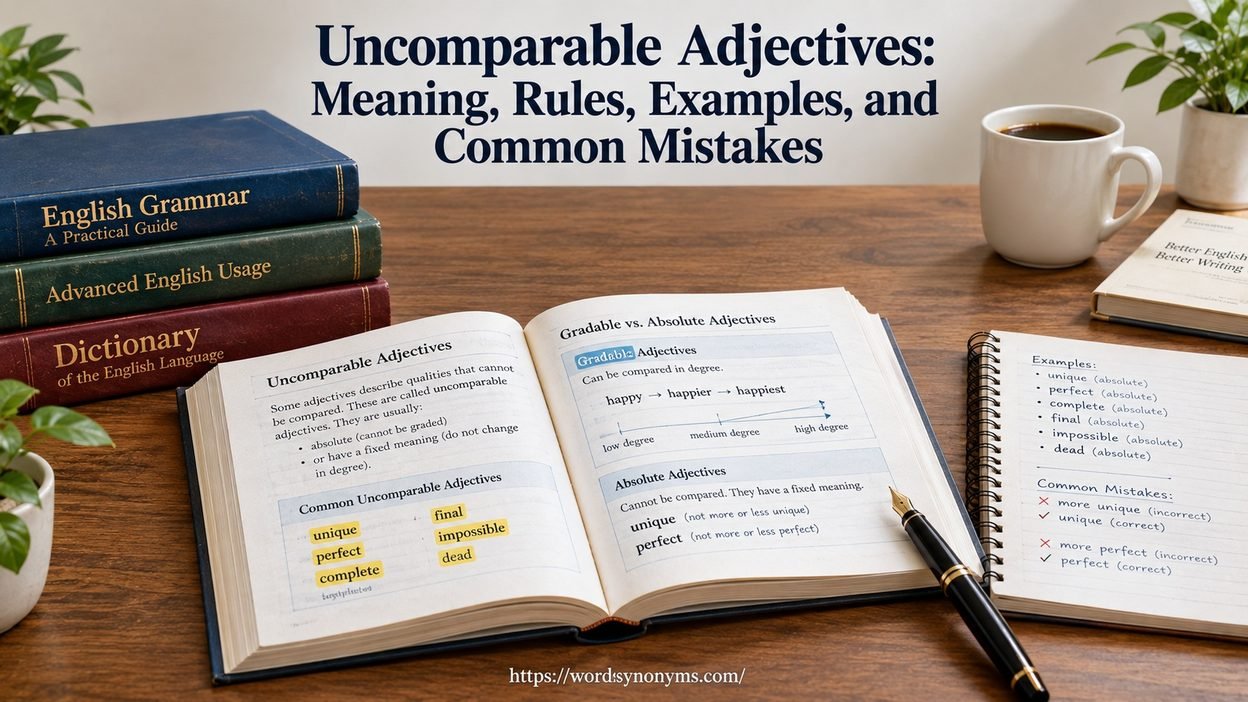
Uncomparable adjectives describe absolute states or fixed conditions, so they usually don’t allow degrees of comparison in normal English.
These adjectives generally don’t need comparative forms or superlative forms because their meaning is already complete. In Uncomparable Adjectives: Rules and Common Mistakes, knowing when an adjective expresses a complete state helps you avoid awkward comparisons in everyday writing.
Words such as unique and perfect can illustrate this point. Using more unique or most perfect may sound questionable when you mean the strict absolute state. Modifiers such as more and less can create problems, so careful editing helps you decide whether a true comparison is intended.
The key is to understand the intended meaning instead of simply memorizing a list of words. Context matters because some adjectives can be used more flexibly in everyday English, while grammar still provides a standard form for formal writing.
The adjective forms should match the intended meaning, so don’t automatically apply comparative or superlative patterns to every adjective. When words describe complete states or conditions, adding less or more may change the intended meaning.
This approach also helps you recognize when an adjective genuinely expresses an absolute idea and when the context permits a different use.
Quick Answer
Uncomparable adjectives describe qualities that usually don’t have different degrees, such as unique, perfect, dead, final, and impossible. They generally don’t take comparative forms like more unique or more perfect when used in their strict meanings. Instead, use modifiers such as absolutely, completely, nearly, or almost, depending on the context. However, everyday English sometimes treats these adjectives as gradable when their meaning becomes less absolute. For example, more complete can work when comparing how much information two reports contain.
What Are Uncomparable Adjectives?
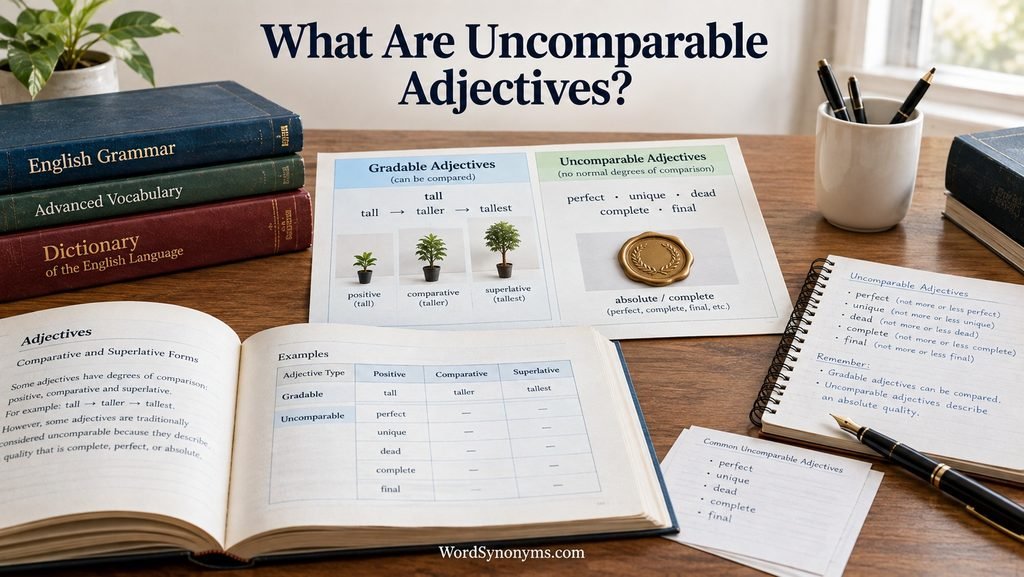
Uncomparable adjectives are adjectives that traditionally describe qualities without normal degrees of comparison.
A comparable adjective usually allows three forms:
| Positive | Comparative | Superlative |
| tall | taller | tallest |
| small | smaller | smallest |
| bright | brighter | brightest |
| interesting | more interesting | most interesting |
| difficult | more difficult | most difficult |
Uncomparable adjectives generally don’t work this way.
Consider perfect. In its strict meaning, perfect means complete or without fault. If something is already perfect, saying that another thing is more perfect creates a logical problem.
Similarly, dead traditionally represents an absolute condition. A person is dead or alive. There isn’t normally a comparative form such as deader in formal literal usage.
Simple Definition
An uncomparable adjective is an adjective that doesn’t normally express a quality in measurable degrees.
Examples include:
- unique
- perfect
- dead
- impossible
- complete
- entire
- final
- empty
- married
- pregnant
- universal
- infinite
The important word here is normally.
English speakers sometimes bend these traditional rules for emphasis, humor, exaggeration, or a special interpretation. That’s why you may encounter phrases such as more perfect or very unique even though traditional grammar guides often discourage them.
Uncomparable vs. Comparable Adjectives
The easiest way to understand uncomparable adjectives is to contrast them with ordinary gradable adjectives.
A gradable adjective describes a quality that can exist at different levels.
For example, temperature can vary:
The water is warm.
It can become warmer:
The water is warmer today.
It can become even warmer:
This is the warmest water in the pool.
The adjective warm clearly supports comparison.
Now consider dead:
The plant is dead.
In its literal sense, the plant cannot normally become more dead. The condition has already reached its endpoint.
Comparison Table
| Type | Example | Comparative | Superlative |
| Gradable | happy | happier | happiest |
| Gradable | fast | faster | fastest |
| Gradable | expensive | more expensive | most expensive |
| Gradable | beautiful | more beautiful | most beautiful |
| Traditionally uncomparable | unique | — | — |
| Traditionally uncomparable | perfect | — | — |
| Traditionally uncomparable | dead | — | — |
| Traditionally uncomparable | impossible | — | — |
| Traditionally uncomparable | final | — | — |
| Traditionally uncomparable | complete | — | — |
The difference comes down to degree.
If a quality can naturally move along a scale, comparison usually works. If the adjective describes an absolute state, comparison becomes problematic.
What Does “Uncomparable” Mean in Grammar?
The term uncomparable refers to an adjective that doesn’t normally take comparative or superlative forms.
For ordinary adjectives, comparison changes the degree of a quality:
- cold → colder → coldest
- strong → stronger → strongest
- useful → more useful → most useful
With an uncomparable adjective, traditional grammar treats the meaning as already complete or absolute.
For example:
This solution is perfect.
Traditional usage considers perfect an endpoint. Therefore:
This solution is more perfect.
sounds logically inconsistent if perfect means completely free from faults.
Likewise:
This is the most unique design.
can sound contradictory because unique traditionally means one of a kind.
Why Do People Still Use These Forms?
Because English usage isn’t governed entirely by mathematical logic.
Speakers may use more unique to mean more unusual, rather than literally “more one-of-a-kind.” Similarly, more perfect may mean closer to perfection rather than “beyond perfect.”
That distinction matters when deciding whether an expression is grammatically possible, stylistically advisable, or simply common in everyday English.
Common Examples of Uncomparable Adjectives
Certain adjectives appear repeatedly in discussions about non-gradable or uncomparable adjectives.
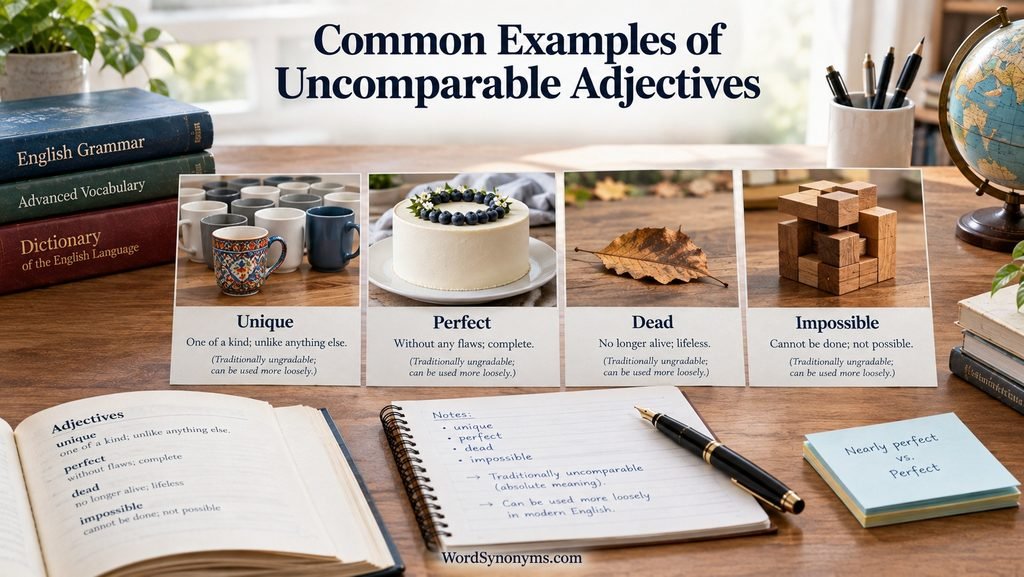
Unique
Unique traditionally means one of a kind or being the only example of its kind.
Traditional comparison:
The design is unique.
Less traditional:
The design is very unique.
More controversial:
This design is more unique than that one.
If unique means literally one of a kind, comparison doesn’t make much sense.
However, modern speakers often use unique more loosely to mean unusual, distinctive, or uncommon. Under that interpretation, phrases such as very unique become easier to understand.
For precise writing, alternatives such as these are often clearer:
- highly distinctive
- exceptionally unusual
- particularly unusual
- remarkably different
Perfect
Perfect traditionally describes something complete or without defects.
Examples:
The timing was perfect.
She delivered a perfect performance.
Traditional comparison:
more perfect
most perfect
These forms can appear in literature and ordinary speech. They often express degrees of approximation or emphasis, rather than strict logical comparison.
For formal writing, you can usually avoid the issue by choosing a gradable alternative:
- nearly perfect
- almost flawless
- exceptionally good
- closer to perfection
Dead
Dead describes the absence of life.
Literal use:
The bird is dead.
Traditional logic doesn’t provide a useful scale for this condition.
However, informal English sometimes uses dead in figurative ways:
I’m dead tired.
The battery is deader than a doornail.
Here, the word no longer functions as a strict biological statement. Figurative meaning opens the door to playful comparison.
Impossible
Impossible traditionally means something cannot happen or cannot be done.
For example:
It is impossible to finish the project in five minutes.
Strictly speaking, something that cannot happen doesn’t become more impossible.
Yet speakers sometimes say:
The situation became even more impossible.
This usually signals dramatic exaggeration or a shift in meaning. The speaker may mean that the situation became increasingly difficult or less feasible.
In formal writing, a clearer choice might be:
The situation became increasingly difficult.
Other Common Uncomparable Adjectives
Several other adjectives traditionally resist comparison.
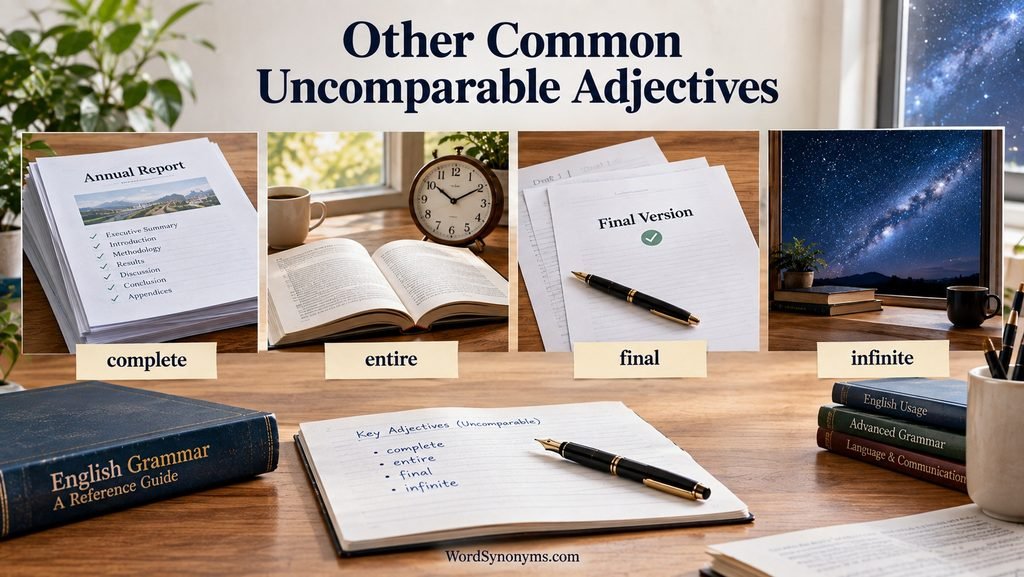
Complete
Complete means containing all necessary parts or having nothing missing.
The report is complete.
Traditional comparison:
more complete
However, real usage frequently treats complete as gradable.
For example:
The revised report is more complete than the first version.
This sentence can make practical sense because the writer may mean more fully developed or containing more information.
In this context, the adjective has shifted from an absolute interpretation toward a gradable one.
Entire
Entire means whole or complete.
She spent the entire afternoon reading.
A phrase such as more entire isn’t normally useful in modern standard English.
Instead, writers generally use:
- more complete
- fuller
- greater
- whole
depending on the intended meaning.
Final
Final refers to something that comes last or represents an endpoint.
This is the final version.
Calling something more final sounds odd if the word means absolutely final.
However, informal speakers may use the phrase jokingly:
This version is even more final than the last one.
The humor comes from deliberately treating an absolute concept as though it had degrees.
Impossible
As noted earlier, impossible describes something that cannot happen.
Flying without an aircraft is impossible.
The comparative phrase more impossible may appear in informal or rhetorical language. In careful prose, less feasible, more difficult, or increasingly unlikely may express the intended idea more precisely.
Infinite
Infinite means without limits or an end.
Space is often described as infinite.
Strictly speaking, something infinite can’t be more infinite.
Yet mathematical, philosophical, literary, and humorous contexts can manipulate the word creatively.
That doesn’t necessarily make every such use an error. Context determines whether the writer intends literal mathematical meaning or expressive language.
Absolute Adjectives and Non-Gradable Adjectives
You may see several terms used for this grammatical category.
The terminology isn’t perfectly uniform.
Absolute Adjectives
An absolute adjective typically describes a condition that has a natural endpoint.
Examples include:
- dead
- alive
- perfect
- complete
- empty
- full
- unique
Non-Gradable Adjectives
A non-gradable adjective doesn’t normally describe something along a scale.
For example:
The answer is correct.
Traditional logic treats correct as different from an adjective such as good. Something can be slightly good, very good, or extremely good. A statement is normally either correct or incorrect.
However, everyday English sometimes creates expressions such as:
mostly correct
almost correct
technically correct
These don’t necessarily make correct gradable. Instead, they qualify how closely a statement approaches correctness or which aspect of correctness applies.
Ungradable Adjectives
Ungradable adjective is another term used in grammar discussions.
It emphasizes the same basic idea: the adjective doesn’t naturally move along a conventional degree scale.
The terms can overlap, although different grammar sources may classify particular adjectives differently.
How Do You Modify Uncomparable Adjectives?
This is where English becomes especially interesting.
With gradable adjectives, you can use degree modifiers such as:
- very
- extremely
- fairly
- rather
- quite
- somewhat
For example:
The room is very cold.
But absolute adjectives often prefer modifiers that indicate completeness, certainty, or approximation.
Common choices include:
- absolutely
- completely
- totally
- entirely
- almost
- nearly
- virtually
- practically
- utterly
Examples:
The room was completely empty.
The glass was completely full.
The result was absolutely perfect.
The explanation is almost complete.
These combinations work because the modifier interacts naturally with the adjective’s meaning.
Very vs. Absolutely
Compare these sentences:
The answer is very correct.
The answer is absolutely correct.
The second sentence usually sounds more natural because absolutely commonly modifies absolute or extreme adjectives.
Similarly:
The building was completely empty.
sounds more idiomatic than:
The building was very empty.
The distinction isn’t an unbreakable law. English speakers can use very creatively. Still, the traditional pattern provides a useful guide.
Common Modifiers for Uncomparable Adjectives
| Modifier | Example | Typical effect |
| absolutely | absolutely impossible | emphasizes an absolute condition |
| completely | completely empty | emphasizes totality |
| totally | totally unique | strong emphasis, often informal |
| entirely | entirely correct | emphasizes completeness |
| utterly | utterly impossible | very strong emphasis |
| almost | almost perfect | shows approximation |
| nearly | nearly complete | shows proximity to an endpoint |
| virtually | virtually impossible | indicates practical reality |
| practically | practically empty | suggests an almost absolute state |
The right modifier depends on the adjective and intended meaning.
Can Uncomparable Adjectives Take “More” and “Most”?
Sometimes they can in actual English usage, but the result depends heavily on meaning and context.
Traditional grammar says that an adjective such as unique shouldn’t normally have comparative or superlative forms.
Yet modern English contains examples such as:
This approach is more unique.
That was the most perfect moment.
The situation became more impossible.
These constructions aren’t all equally natural or equally acceptable in formal prose.
The key question is whether the adjective retains its absolute meaning.
If unique means “the only one of its kind,” then more unique creates a semantic problem.
If unique means “highly unusual,” speakers have effectively changed its meaning into something gradable.
That’s why grammar and usage cannot always be reduced to a simple “correct” or “incorrect” rule.
Read more: Fungi vs. Funguses: What’s the Difference?
Uncomparable Adjectives in Formal Writing
Formal writing benefits from precision.
When an adjective has an absolute meaning, avoid forcing a comparative structure unless the context clearly supports it.
Instead of:
This solution is more perfect than the original.
Consider:
This solution is closer to perfect than the original.
Or:
This solution has fewer flaws than the original.
Instead of:
Her approach is more unique.
Consider:
Her approach is more distinctive.
Or:
Her approach is particularly unusual.
These alternatives remove ambiguity while preserving the intended meaning.
A Useful Editing Test
When you encounter a questionable comparison, ask:
Can the quality logically exist at different degrees?
If yes, comparison is probably natural.
bright → brighter → brightest
If no, consider whether you’re using the adjective figuratively or with a modified meaning.
unique → more unique
The second construction requires more context.
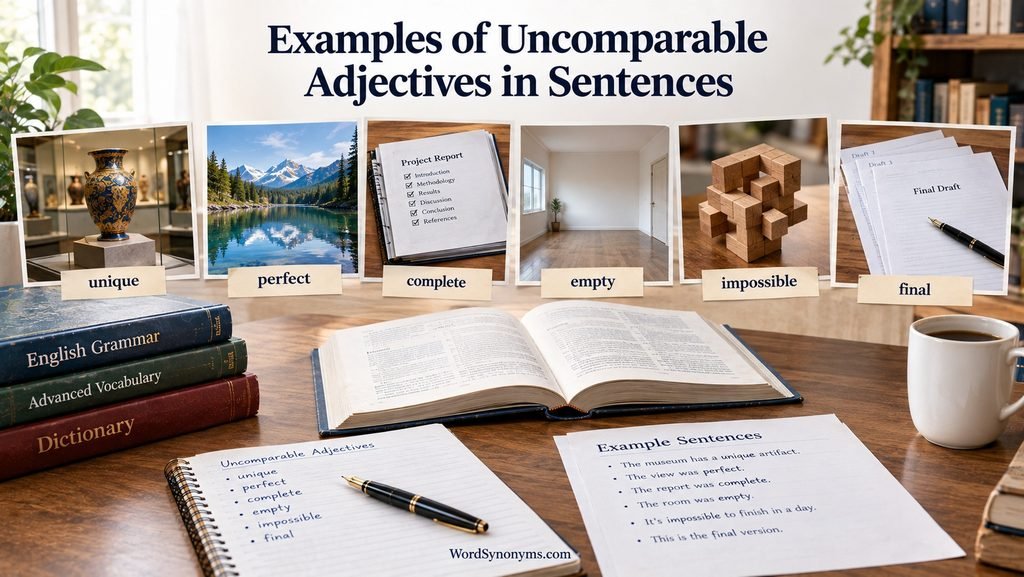
Examples of Uncomparable Adjectives in Sentences
Here are practical examples showing how these adjectives work.
Unique
- The museum houses a unique collection.
- Her approach is highly distinctive.
- The building has an unusual architectural style.
Perfect
- The weather was perfect for hiking.
- The design is almost perfect.
- The revised model is closer to perfection.
Complete
- The application is complete.
- The revised report is more complete than the earlier draft.
- The document is nearly complete.
Notice the interesting difference here. More complete is widely understandable because completeness can sometimes refer to how many necessary elements have been included.
Empty
- The room was empty.
- The container was completely empty.
- The parking lot was almost empty.
Impossible
- The task seemed impossible.
- The deadline made the task virtually impossible.
- The second schedule was even more difficult to meet.
Final
- The committee approved the final proposal.
- Please review the final version carefully.
- This isn’t the final version yet.
A Practical Case Study: “Unique” in Advertising
Consider two advertisements.
Advertisement A:
Our café offers a unique dining experience.
Advertisement B:
Our café offers the most unique dining experience in the city.
The second sentence sounds more promotional, but it also creates a grammatical and semantic question.
If the café’s experience is literally unique, another experience cannot be more unique. The phrase one-of-a-kind dining experience communicates the absolute idea more directly.
If the writer simply means “unusual,” then a gradable adjective works better:
Our café offers an exceptionally unusual dining experience.
This example shows why word choice matters. The issue isn’t merely about grammar. Meaning controls comparison.
A Practical Case Study: “Perfect” in Everyday Speech
Imagine someone tests two versions of a cake recipe.
They say:
Recipe A is perfect.
Later, after making a small adjustment, they say:
Recipe B is even more perfect.
In casual conversation, listeners understand the intended message: Recipe B seems closer to the speaker’s ideal.
Strictly speaking, however, the first statement already described Recipe A as perfect.
For precise writing, a better sentence would be:
Recipe B comes closer to the ideal than Recipe A.
That version preserves the comparison without creating a logical contradiction.
Why Context Changes the Meaning
A major source of confusion comes from semantic flexibility.
Many adjectives have more than one possible sense.
Take complete.
In one context:
The set is complete.
This may mean that every required component exists.
In another:
The revised set is more complete.
The writer may mean that the revised version contains more of the relevant components than the earlier version.
The adjective has therefore moved from an absolute interpretation toward a measurable one.
The same phenomenon appears with words such as:
- perfect
- unique
- complete
- impossible
- correct
- final
- empty
Context can loosen an adjective’s boundaries.
Common Mistakes With Uncomparable Adjectives
Mistake: Using “Most Unique”
She has the most unique style.
In strict usage, unique means one of a kind. Therefore, most unique is unnecessary.
Better:
She has a unique style.
Or, if comparison is intended:
She has the most distinctive style.
Mistake: Using “Very Perfect”
The performance was very perfect.
This sounds unnatural because perfect already expresses an extreme endpoint.
Better:
The performance was absolutely perfect.
Or:
The performance was nearly flawless.
Mistake: Using “More Impossible” Literally
The second task was more impossible than the first.
This usually sounds contradictory in formal writing.
Better:
The second task was even more difficult.
Or:
The second task seemed even less feasible.
Mistake: Assuming Every “-est” Form Is Wrong
The opposite mistake also occurs.
Some adjectives traditionally classified as absolute can become gradable when their meanings change.
For example:
The revised report is more complete.
Here, complete can refer to the amount of information or coverage, which makes comparison understandable.
Grammar depends on meaning, not merely on the dictionary label attached to a word.
Read more: All But vs. Anything But vs. Everything But: What’s the Difference?
Uncomparable Adjectives vs. Extreme Adjectives
These concepts often overlap, but they’re not identical.
An extreme adjective describes a very high degree of a quality.
Examples include:
- exhausted
- terrified
- enormous
- freezing
- furious
English commonly uses modifiers such as:
absolutely exhausted
completely terrified
absolutely enormous
A regular gradable adjective works differently:
1. very tired
2. very large
3. very cold
The distinction is useful because absolute adjectives often pair naturally with absolute intensifiers.
Comparison
| Gradable adjective | Common intensifier | Extreme/absolute adjective | Common intensifier |
| tired | very tired | exhausted | absolutely exhausted |
| cold | very cold | freezing | absolutely freezing |
| angry | very angry | furious | absolutely furious |
| large | very large | enormous | absolutely enormous |
| frightened | very frightened | terrified | completely terrified |
This pattern helps you choose modifiers that sound natural rather than mechanically correct.
Are “Uncomparable Adjectives” Always Uncomparable?
No.
That’s one of the most important points to remember.
Uncomparable is usually a description of how an adjective behaves in a particular meaning. It isn’t always a permanent ban on every comparative construction.
Language changes. Meanings shift. Speakers use words figuratively. Technical fields may also use familiar adjectives in specialized ways.
For example:
The revised report is more complete.
This can be perfectly understandable because complete may refer to the amount of information included.
Likewise:
The new design is more unique.
may occur when unique means more distinctive or unusual.
Still, frequency doesn’t automatically make every construction ideal for formal prose.
When precision matters, choose an adjective that naturally expresses the intended degree.
How to Rewrite Comparisons With Uncomparable Adjectives
If a comparative form feels awkward, you don’t need to abandon the entire sentence.
Simply change the structure.
| Awkward expression | Clearer alternative |
| more unique | more distinctive |
| most unique | most distinctive |
| very perfect | absolutely perfect |
| more perfect | closer to perfect |
| very complete | completely complete* |
| more impossible | more difficult |
| most final | final |
| more entire | fuller |
| very empty | almost completely empty |
*“Completely complete” can sound repetitive. In many contexts, fully complete or simply complete works better.
Another useful strategy involves degree phrases.
Instead of:
more perfect
write:
closer to perfection
Instead of:
more impossible
write:
increasingly difficult
Instead of:
more unique
write:
increasingly distinctive
This technique often produces cleaner, more professional prose.
Quick Rules for Using Uncomparable Adjectives
Keep these principles in mind:
- Don’t automatically compare an absolute adjective.
- Check what the adjective means in the sentence.
- Use absolutely, completely, or entirely when appropriate.
- Use almost, nearly, or virtually when describing an approach to an endpoint.
- Replace awkward comparative forms with naturally gradable alternatives.
- Remember that everyday English sometimes bends traditional rules.
- Consider whether the adjective has a literal or figurative meaning.
- In formal writing, favor precision over dramatic exaggeration.
- Don’t treat every grammar rule as completely rigid.
- Let context and meaning guide the final choice.
Uncomparable Adjectives: Quick Reference
| Adjective | Traditional meaning | Natural modifier | Comparative concern |
| unique | one of a kind | truly, completely | more unique |
| perfect | without flaws | absolutely, nearly | more perfect |
| dead | no longer alive | completely, totally | deader |
| complete | containing everything needed | completely, nearly | more complete can work by context |
| entire | whole | entire | more entire |
| final | last or conclusive | absolutely final | more final |
| empty | containing nothing | completely, almost | emptier can work when meaning shifts |
| impossible | cannot happen | absolutely, virtually | more impossible |
| infinite | without limit | literally, potentially | more infinite |
| universal | applying to all | truly, almost | more universal |
| married | legally or socially joined | happily, recently | more married |
| pregnant | carrying a developing fetus | heavily, visibly | more pregnant |
The table shows a general pattern rather than an inflexible list of forbidden forms. English usage depends on the precise sense of the adjective.
Uncomparable Adjectives in Everyday English
You probably use these words without thinking about their grammatical category.
When someone says:
“That’s impossible.”
they aren’t normally measuring impossibility.
When someone says:
“The room is completely empty.”
they’re emphasizing an absolute condition.
When someone says:
“This is the final draft.”
they’re identifying the intended endpoint.
When someone says:
“That’s unique.”
they’re describing something as one of a kind.
These adjectives become difficult mainly when writers try to attach comparative or superlative structures to them.
That’s why recognizing the underlying meaning is more useful than memorizing a huge list.
Read more: The Penny Dropped: Meaning, Origin and Correct Usage
A Simple Test for Uncomparable Adjectives
Here’s a quick test you can use while editing.
Ask whether the adjective describes a scale
If you can naturally imagine degrees, comparison probably works.
warm → warmer → warmest
expensive → more expensive → most expensive
useful → more useful → most useful
If the adjective describes an endpoint or absolute condition, be cautious.
unique
perfect
dead
final
impossible
Ask whether “more” changes the meaning
Consider:
more complete
This can mean containing more of what is needed.
Now consider:
more dead
In literal usage, the meaning is much harder to justify.
The test isn’t perfect, but it quickly reveals where semantic flexibility enters the picture.
FAQs
What are uncomparable adjectives?
Uncomparable adjectives describe something as complete, absolute, or already at its highest possible state. They generally don’t use comparative or superlative forms.
Can uncomparable adjectives use “more” or “less”?
Usually, they shouldn’t when the adjective has a truly absolute meaning. However, everyday English sometimes uses more or less with certain adjectives when the meaning changes or becomes less strict.
Why is “most perfect” often considered incorrect?
Perfect traditionally means complete or without flaws, so most perfect can sound logically unnecessary. In informal English, however, people sometimes use it for emphasis.
Is “more unique” grammatically correct?
More unique is widely used, especially when something is being described as having a greater degree of uniqueness. In strict traditional usage, unique is treated as absolute, so simply saying unique is preferred when you mean one of a kind.
How can I identify an uncomparable adjective?
Look at the adjective’s meaning. If it describes a condition that doesn’t naturally have degrees, such as something being complete or one of a kind, it may be uncomparable.
Are uncomparable adjectives always forbidden from comparison?
No. English usage can be flexible. Some adjectives traditionally treated as absolute are compared in modern writing when speakers want to express a practical or contextual degree rather than a literal absolute state.
Conclusion
Understanding uncomparable adjectives becomes much easier when you focus on meaning instead of memorizing rigid rules. Words that describe a complete or absolute state generally don’t need more, less, or traditional comparative and superlative forms. Paying attention to context also matters because modern English sometimes uses these words more flexibly than traditional grammar rules suggest.
When you’re unsure, ask yourself whether the adjective describes something that can genuinely exist in different degrees. If it can’t, avoid forcing a comparison. This simple check can help you choose clearer wording, avoid common mistakes, and make your English sound more natural.

Samreen Saif is a passionate writer and language enthusiast who contributes informative and engaging content to WordsSynonyms.com. She enjoys exploring English vocabulary, synonyms, antonyms, word meanings, and language usage to help readers understand and use words with confidence.
Samreen focuses on creating clear, accurate, and easy-to-read content for students, writers, professionals, and English learners. Through her articles, she aims to make vocabulary learning simple, practical, and useful for everyday communication.
When she is not writing, Samreen enjoys learning about language, discovering new words, and creating helpful content that makes English learning more accessible to everyone.