
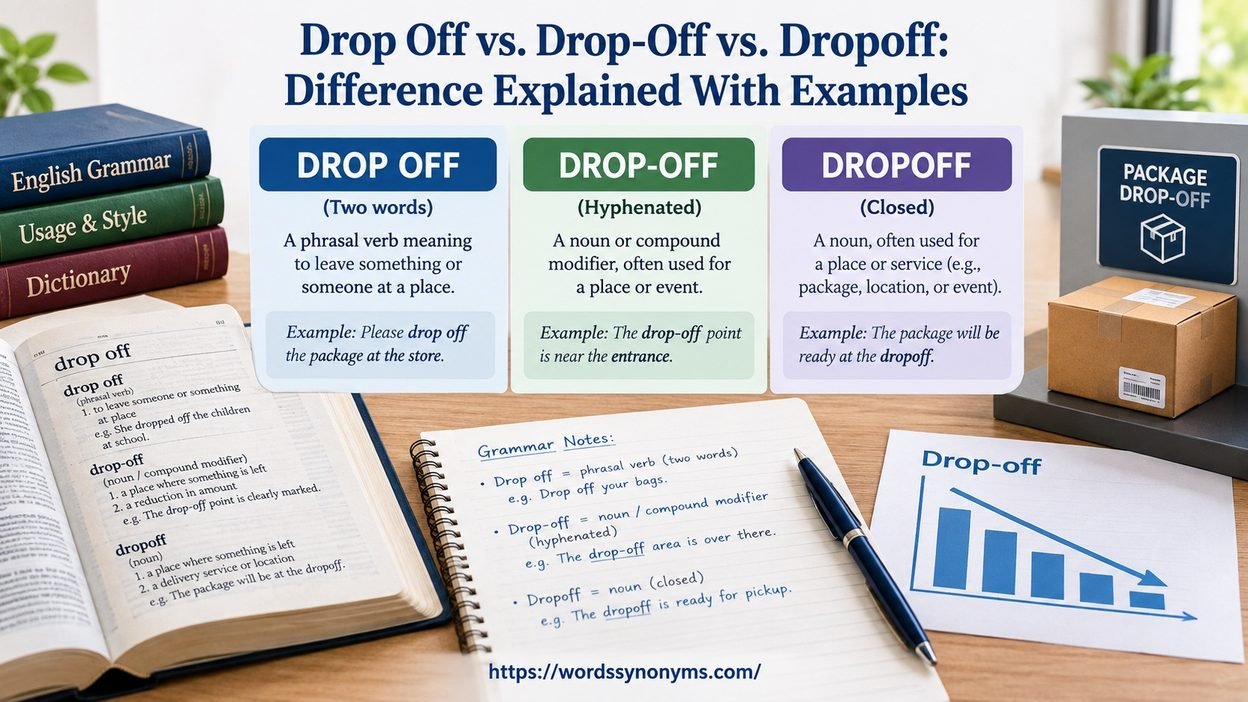
Drop Off vs. Drop-Off vs. Dropoff: Difference Explained helps you choose the correct form by checking its grammatical role and context.
Drop off is a verb for an action that will happen, while dropped off describes an action completed in the past, as in I need to drop off the kids and dropped off the package. Drop-off can be a noun or modifier, depending on the sentence and its grammatical role.
For example, the drop-off location identifies a location, while drop-off is at noon uses it as a noun phrase. The forms are related, but no form is universally correct; choose the correct one according to its usage and context.
Dropoff is a spelling used without a hyphen and may appear as a noun, but it isn’t yet the prevalent form. A spell check may mark it as wrong, while drop-off remains the more familiar spelling.
However, dropoff is gaining ground and is likely to gain widespread acceptance sooner or later. The noun can describe a decline in sales, as in There was a drop-off in sales last month, where sales decreased during the month.
In writing, focus on the grammatical form rather than forcing one spelling into every sentence. The key is to notice whether you mean a verb, noun, or modifier, then choose the form that fits naturally.
Quick Answer
Here’s the short version before getting into the details.
| Form | Main function | Example |
| drop off | Phrasal verb | “I’ll drop off the documents.” |
| drop-off | Noun | “The drop-off took five minutes.” |
| drop-off | Modifier/adjective | “Use the drop-off area.” |
| dropoff | Noun variant | “The airport offers a convenient dropoff area.” |
| dropoff | Standard verb form | No |
The most important distinction concerns the verb. When drop off describes an action, keep the words separate.
For example:
“Please drop off the keys at the front desk.”
Here, drop is the verb and off is the particle that completes the phrasal verb.
When the same idea becomes a noun, English commonly uses the hyphenated form:
“The drop-off took less than five minutes.”
Dictionary sources also recognize dropoff as a noun variant in some contexts. Cambridge, for example, lists dropoff alongside drop-off for noun meanings involving a decline or the act or place of leaving someone or something.
That doesn’t mean you should turn the verb into dropoff. English treats phrasal verbs differently from their related nouns.
What Does “Drop Off” Mean?
Drop off has several meanings, which makes the expression especially useful in everyday English.
As a phrasal verb, it can describe taking someone or something somewhere and leaving them there. It can also mean falling asleep or becoming less in amount, level, quality, or intensity. Cambridge and Oxford both document these uses.
Drop Off Meaning “Take Someone or Something Somewhere”
This is probably the meaning you encounter most often in everyday conversation.
When you drop someone off, you take that person to a particular place and leave them there. The same construction works with objects.
Examples include:
- “I’ll drop you off at the station.”
- “Can you drop off this package?”
- “She dropped off her son at school.”
- “We need to drop off the paperwork before noon.”
- “He dropped off the books at the library.”
Notice that the expression remains two words in every example.
You wouldn’t normally write:
“I’ll dropoff the package.”
The standard phrasal-verb construction is:
“I’ll drop off the package.”
The object can appear between drop and off as well:
“I’ll drop the package off.”
Both positions are possible with many objects.
Drop Off Meaning “Fall Asleep”
Drop off can also mean to begin sleeping, usually in a light or unplanned way.
For example:
- “I dropped off during the movie.”
- “She dropped off on the couch.”
- “He dropped off while reading.”
- “I was so tired that I dropped off before the show ended.”
Oxford lists this meaning as becoming lightly asleep or falling into a light sleep.
Again, the verb stays open:
drop off
Not:
dropoff
Drop Off Meaning “Become Less”
Another important meaning involves decline.
If something drops off, it becomes smaller, lower, fewer, or less significant.
For example:
- “Sales dropped off after the holiday season.”
- “Traffic dropped off after midnight.”
- “Interest in the product has dropped off.”
- “Attendance dropped off sharply in December.”
- “The quality begins to drop off toward the end.”
Oxford gives examples involving traffic and a decrease in quantity. Cambridge similarly defines this use as becoming less in amount, number, or quality.
This distinction matters because the related noun becomes drop-off:
“Sales dropped off in December.”
but:
“There was a drop-off in sales in December.”
The meaning remains closely related, but the grammatical function changes.
When to Use “Drop-Off”
The hyphenated drop-off commonly functions as a noun. It can refer to an act, place, or decline.
Drop-Off as a Noun
A drop-off can describe the act of taking someone or something somewhere and leaving them there.
For example:
- “The drop-off took only ten minutes.”
- “Morning drop-offs are usually crowded.”
- “The delivery driver made three drop-offs.”
- “The school has a separate drop-off area.”
It can also describe a decrease:
- “There was a drop-off in sales.”
- “The company experienced a significant drop-off in demand.”
- “A sharp drop-off occurred after the price increase.”
- “The website saw a gradual drop-off in visitors.”
Cambridge specifically lists drop-off as a noun for both a decrease and an act or place associated with leaving someone or something.
Drop-Off as a Modifier
The hyphen becomes especially useful when drop-off appears before another noun.
Consider these common combinations:
- drop-off point
- drop-off area
- drop-off location
- drop-off zone
- drop-off service
- drop-off time
- drop-off lane
- drop-off center
In these constructions, drop-off helps describe the type of point, area, location, or service.
For example:
“Please leave the package at the drop-off point.”
The phrase drop-off works together as a compound modifier before point.
Oxford specifically lists drop-off as an adjective used before a noun in expressions such as drop-off points.
Is “Dropoff” One Word?
This is where the answer gets more interesting.
Dropoff does exist as a noun in some modern dictionary usage. Cambridge lists dropoff as another form of the noun drop-off, including meanings connected with a decline and with taking someone or something to a place and leaving them there.
So it would be too strong to claim that dropoff is always wrong.
However, there’s an important grammatical boundary.
“Dropoff” Is Not the Normal Verb Form
When drop off functions as a phrasal verb, keep it as two words.
Correct:
“I’ll drop off the package tomorrow.”
Not standard:
“I’ll dropoff the package tomorrow.”
The closed form doesn’t replace the phrasal verb simply because English sometimes writes the related noun as one word.
Think about the difference this way:
Action:
“Please drop off the documents.”
Noun:
“The document drop-off was quick.”
Noun variant:
“The document dropoff was quick.”
The final example may appear in accepted usage. The first example should still use drop off.
Drop Off vs. Drop-Off: The Grammar Rule
A practical rule makes this distinction much easier.
Use “Drop Off” for the Action
If you’re describing what someone does, drop off is generally the right choice.
Examples:
- “I’ll drop off the children.”
- “Can you drop off the groceries?”
- “She needs to drop off the application.”
- “We should drop off the equipment first.”
- “He dropped off the keys yesterday.”
Here, the expression functions as a verb.
Use “Drop-Off” for the Thing, Event, Place, or Decline
When you’re naming the action or its location, drop-off commonly works as a noun.
Examples:
- “The drop-off was quick.”
- “Use the designated drop-off area.”
- “The drop-off point is behind the building.”
- “There was a sudden drop-off in demand.”
The same principle works when drop-off modifies another noun.
“The drop-off location has moved.”
Here, drop-off identifies the type of location.
A Simple Memory Trick
Ask yourself one question:
Is “drop off” describing an action?
If yes, use:
drop off
If you’re naming the resulting activity, place, event, or decline, use:
drop-off
This isn’t a universal rule for every compound in English. However, it works extremely well for ordinary drop off usage.
Drop Off vs. Drop-Off Examples in Real Sentences
Real examples make the difference much clearer than definitions alone.
Transportation and School
“I need to drop off the kids before work.”
Here, drop off is a verb because it describes an action.
Now compare:
“The school has a busy drop-off area.”
Here, drop-off describes a place.
Another example:
“Morning drop-offs create heavy traffic.”
The noun is plural, so the hyphenated form remains useful.
Packages and Deliveries
“Can you drop off this package at the post office?”
The expression describes an action.
Now compare:
“The package drop-off point closes at 6 p.m.”
The expression identifies a particular type of point.
This pattern appears frequently in delivery, logistics, retail, shipping, and customer-service contexts.
Business and Sales
Business writing provides another clear contrast.
“Online sales began to drop off in January.”
Here, drop off means decrease.
Now turn the verb into a noun:
“The company noticed a drop-off in online sales.”
The meaning stays connected, but the grammar changes.
You can also use drop-off with modifiers:
- sharp drop-off
- gradual drop-off
- significant drop-off
- seasonal drop-off
- unexpected drop-off
Cambridge’s Business English material uses drop-off for a reduction in an amount or level and gives common combinations such as “a sharp drop-off” and “a significant drop-off.”
Sleep
The sleep meaning follows a different pattern:
“I dropped off during the movie.”
Here, drop off means “fell asleep.”
You wouldn’t use drop-off to describe the action in that sentence.
The distinction is therefore not just about punctuation. It reflects the grammatical role of the expression.
Read more: Crack Down vs. Crackdown: Grammar and Examples
Drop-Off Point vs. Drop Off Point
One of the most common questions concerns this phrase.
The preferred form in ordinary edited English is:
drop-off point
Why?
Because drop-off acts as a compound modifier describing the type of point.
Compare:
“Please drop off the parcel at the drop-off point.”
The first expression is a verb.
The second expression is a compound modifier plus noun.
This gives you a useful sentence pattern:
verb + object + location
“Drop off the package at the drop-off point.”
The first drop off tells someone what to do. The second drop-off tells them what kind of point to use.
The same structure appears in:
- drop-off area
- drop-off lane
- drop-off location
- drop-off zone
- drop-off center
- drop-off station
Cambridge’s Business English dictionary specifically lists expressions such as drop-off area, drop-off center, and drop-off point.
Drop Off Location vs. Drop-Off Location
The same principle applies to location.
Preferred:
“The drop-off location has changed.”
Here, drop-off modifies location.
But if you’re using the expression as a verb, write:
“Please drop off the package at this location.”
The two sentences contain nearly identical words. Their grammar differs.
That’s why relying on pronunciation alone can cause mistakes. In speech, the distinction between drop off and drop-off isn’t always obvious. Writing makes the grammatical structure visible.
Drop-Off Area vs. Drop Off Area
The same rule applies to drop-off area.
Preferred:
“Use the designated drop-off area.”
Here, drop-off identifies the type of area.
Compare:
“You can drop off passengers in this area.”
Here, drop off is the verb.
A useful editing trick is to remove the final noun temporarily.
If the expression still describes an action, you’re probably dealing with the verb:
“You can drop off passengers.”
If it names a thing or place, the noun form makes more sense:
“The drop-off is over there.”
Drop Off vs. Drop-Off in American English
In American English, drop off is well established as a phrasal verb. It commonly means taking someone or something to a particular place and leaving them there. It also means beginning to sleep or becoming less.
The noun drop-off is also widely used.
For example:
“There was a noticeable drop-off in attendance.”
and:
“The airport has a passenger drop-off area.”
The important point is that American English doesn’t treat the hyphen as optional punctuation that can be inserted randomly. The spelling reflects the grammatical role.
English compounds can vary over time. Some forms remain hyphenated, some become closed compounds, and others stay open. Dictionary entries can therefore show more than one accepted form.
That’s exactly why dropoff deserves a little nuance rather than a blanket “wrong” label.
Why “Dropoff” Can Be Confusing
English frequently turns multiword expressions into compounds.
For example, words such as pickup, checkout, and breakdown are familiar closed compounds in many contexts. That pattern can make dropoff look equally obvious.
However, related expressions don’t always develop in exactly the same way.
The existence of dropoff as a dictionary-listed noun does not mean every form should be closed.
For instance:
- drop off remains the phrasal verb.
- drop-off works as a noun and modifier.
- dropoff can occur as a noun variant.
Cambridge’s current entry explicitly lists dropoff as an alternative noun form.
That makes the most accurate answer more nuanced than simply saying “dropoff is incorrect.”
Common Mistakes With Drop Off and Drop-Off
Mistake 1: Writing “Drop-Off” as a Verb
Incorrect in standard usage:
“I’ll drop-off the package.”
Better:
“I’ll drop off the package.”
The verb is a phrasal verb, so keep it open.
Mistake 2: Writing “Drop Off Point”
You may see this version, but drop-off point is clearer and widely established as the compound form.
Preferred:
“Meet me at the drop-off point.”
The hyphen signals that drop-off functions together as a modifier.
Mistake 3: Assuming “Dropoff” Is Always Wrong
This claim goes too far.
Some dictionaries recognize dropoff as a noun variant. Cambridge does so explicitly.
Therefore, context and style matter.
Still, when you’re writing general-purpose US English and want the clearest conventional form, drop-off is a strong choice for the noun.
Mistake 4: Treating All Three Forms as Interchangeable
They’re not.
Consider these three sentences:
“I will drop off the paperwork.”
“The paperwork drop-off took five minutes.”
“The paperwork dropoff took five minutes.”
The first sentence requires the phrasal verb.
The second uses the familiar hyphenated noun.
The third uses a recognized noun variant.
The forms may share meaning, but their grammatical behavior isn’t identical.
Drop Off vs. Drop-Off vs. Dropoff: Detailed Comparison
| Point | Drop off | Drop-off | Dropoff |
| Two words | Yes | No | No |
| Hyphen | No | Yes | No |
| Closed compound | No | No | Yes |
| Phrasal verb | Yes | No | No |
| Noun | No | Yes | Yes, in some dictionary usage |
| Compound modifier | Usually no | Yes | Limited |
| Meaning: take someone/something somewhere | Yes | Related noun | Related noun |
| Meaning: become less | Yes | Related noun | Related noun |
| Meaning: begin sleeping | Yes | No | No |
| Example | “I’ll drop off the parcel.” | “The drop-off point is nearby.” | “The dropoff point is nearby.” |
The table shows why the spelling question is really a grammar question.
Case Study: “Drop Off” in a Delivery Business
Imagine a local delivery company that gives customers two instructions.
First:
“Drivers must drop off packages between 9 a.m. and 5 p.m.”
Here, drop off describes the driver’s action.
Now consider the location:
“All packages must go through the designated drop-off area.”
Here, drop-off modifies area.
Finally, consider the business process:
“The company recorded a 12% drop-off in same-day orders.”
Now drop-off means a decline.
Three closely related meanings appear in one workplace:
- drop off = perform an action
- drop-off = identify a place or process
- drop-off = describe a decline
That versatility explains why this expression appears so often in everyday and professional English.
Case Study: “Drop Off” in School Transportation
School transportation offers another useful example.
A parent might say:
“I have to drop off my daughter before work.”
The expression functions as a verb.
A school sign might read:
STUDENT DROP-OFF AREA
Here, drop-off acts as a compound modifier.
A school administrator might write:
“Morning drop-offs create congestion near the main entrance.”
The noun is plural.
This small shift from action to noun changes the written form. That’s the central pattern worth remembering.
Case Study: “Drop Off” as a Decline
The same expression works naturally in business and statistics.
Suppose a company reports:
“Website traffic dropped off after the campaign ended.”
The expression is a verb.
Now turn the same idea into a noun:
“The company saw a drop-off in website traffic.”
The transformation is straightforward:
drop off → drop-off
This pattern is useful when editing reports, articles, business documents, and analytical writing.
Common combinations include:
- drop-off in demand
- drop-off in sales
- drop-off in traffic
- drop-off in attendance
- drop-off in quality
- drop-off in performance
- drop-off in interest
Oxford and Cambridge both document drop off as a verb meaning to become fewer or less, with drop-off serving as the related noun.
How to Remember the Difference
Here’s the quickest memory trick:
Drop off = do something.
Drop-off = name something.
For example:
“I’ll drop off the package at the drop-off point.”
The first expression tells you what someone will do.
The second identifies the place where that action happens.
Another example:
“Sales dropped off after Christmas, causing a noticeable drop-off in revenue.”
Again, the verb describes the change. The noun names the change.
This simple contrast can prevent most spelling mistakes.
Quick Editing Checklist
Before publishing a sentence containing one of these forms, ask:
- Is drop off functioning as a verb?
- Is drop-off functioning as a noun?
- Is drop-off modifying another noun?
- Am I using dropoff as a noun?
- Does the chosen form match the style used throughout the document?
- Does the sentence become clearer with a hyphen?
- Am I accidentally writing drop-off as a phrasal verb?
If you answer these questions, the correct form usually becomes obvious.
FAQs
Is “drop off” one word or two words?
Drop off is written as two words when it functions as a verb. For example, “I need to drop off the kids” uses the phrase as a verb.
When should I use “dropped off”?
Use dropped off when describing a completed action in the past. For example, “She dropped off the package before lunch.”
Is “drop-off” a noun?
Yes. Drop-off commonly works as a noun when you’re referring to an event, place, or decline. For example, “The drop-off is at noon” or “There was a drop-off in sales.”
Can “drop-off” be used as a modifier?
Yes. Drop-off can modify another noun. A common example is drop-off location, which identifies a place where someone or something can be left.
Is “dropoff” correct without a hyphen?
Dropoff is used as a noun without a hyphen, but drop-off remains a familiar spelling. Usage can vary, and some spell-check tools may still flag dropoff.
Which form should I use: drop off, drop-off, or dropoff?
Choose the form based on its grammatical role. Use drop off for the verb, dropped off for a completed past action, and drop-off mainly as a noun or modifier. Dropoff may also appear as a noun, especially in evolving usage.
Conclusion
Choosing between drop off, drop-off, and dropoff becomes much easier when you first look at how the word works in the sentence. Use drop off for the verb, drop-off mainly for the noun or modifier, and treat dropoff as a less established spelling that may appear in modern usage. A quick check of the sentence’s grammatical role can usually tell you which form fits naturally.
The most important thing is to focus on meaning as well as spelling. If you’re describing an action, drop off is the form you’ll usually need. If you’re naming a place, event, or decline, drop-off often fits better. Keeping these distinctions in mind will help you write clearer sentences and avoid unnecessary spelling confusion.

Syeda Naalain Zahra is a content writer with an interest in English vocabulary and language. She creates simple and informative articles about synonyms, antonyms, word meanings, and everyday English usage. Her aim is to help readers build better vocabulary and communicate more confidently.