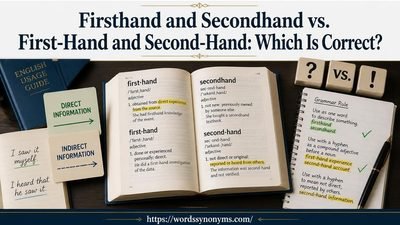
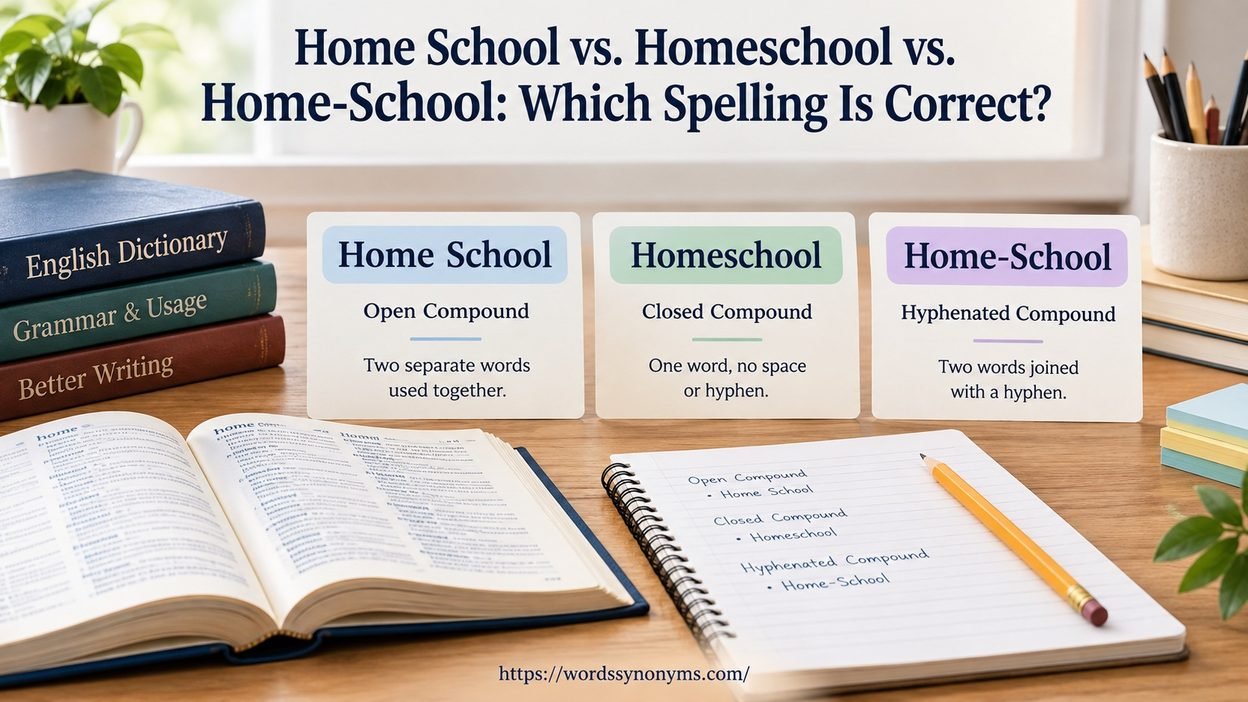
When choosing between Homeschool vs. Home School vs. Home-School: Which Is Correct?, check whether the term acts as a noun or verb in context before choosing its form.
Home school is traditionally written as two words when it functions as a noun, such as in home school program. When used as a verb, home-school is usually hyphenated, as in parents who home-school their children.
The same pattern appears in home-schooled, so understanding the grammatical distinction can make the spelling much easier.
Over the decades, homeschool has increasingly appeared as a single, unhyphenated word, reflecting how compound words can develop through common use. Trailblazers and everyday writers can encourage its broader acceptance, although the standard form may take time to settle.
From a practical writing perspective, readers may recognize both forms, while homeschool represents a new form that could become more familiar to future English speakers.
Quick answer
In modern US English, homeschool is usually the best choice. Use it as a verb, noun, or modifier: They homeschool their children, homeschooling takes planning, and homeschool curriculum.
Home school and home-school aren’t automatically wrong. They’re established variants that may appear in certain contexts or style systems. However, if you want the most natural, streamlined spelling for everyday American English, choose homeschool.
Home School vs. Homeschool vs. Home-School at a Glance
Here’s the quickest way to understand the three forms:
| Form | Typical use | Meaning | Modern US English |
| homeschool | Verb, noun, adjective | Educate a child at home or something related to that practice | Very common |
| home school | Noun phrase or variant | Schooling or a school conducted at home | Used in some contexts |
| home-school | Hyphenated verb/adjective | The same general educational concept | Less common but attested |
The important point is that these spellings aren’t three completely different words with three different meanings. They are related forms of the same underlying concept.
Dictionary usage confirms this flexibility. Cambridge lists homeschool as a verb and noun while also identifying home school and home-school as variants in relevant uses. It likewise lists homeschool as an adjective while giving the open and hyphenated forms as alternatives.
So, calling every use of home school or home-school a spelling mistake would be too broad.
The simplest rule
If you’re writing in contemporary US English and mean the general practice of educating a child at home, homeschool is usually the cleanest choice.
For example:
- We homeschool our children.
- She decided to homeschool her son.
- They use a homeschool curriculum.
- He was homeschooled through eighth grade.
- Homeschooling requires planning and consistency.
What Does “Homeschool” Mean?
Homeschool refers to educating a child at home rather than sending the child to a conventional school.
The word can perform several grammatical jobs. That’s one reason it has become so useful in modern English.
Cambridge defines homeschool as a verb meaning to teach a child at home instead of sending the child to school. It also recognizes the word as a noun and adjective.
Consider these examples:
We homeschool our daughter.
Here, homeschool is a verb.
Homeschool can give families more control over the learning environment.
Here, homeschool functions as a noun.
She bought a homeschool curriculum.
Here, homeschool works as a modifier before another noun.
That flexibility makes the closed form especially convenient.
Homeschool as a Verb
As a verb, homeschool means to educate a child at home.
It can appear in several forms:
| Form | Example |
| homeschool | We homeschool our children. |
| homeschools | She homeschools her son. |
| homeschooled | They homeschooled their daughter last year. |
| homeschooling | He is homeschooling his children this year. |
The verb behaves much like other modern English compounds that have developed into single words.
Present tense
They homeschool their children.
Third-person singular
She homeschools her daughter.
Past tense
He homeschooled his son for several years.
Progressive form
They are homeschooling their children.
These forms are written as single words in the common modern form.
Is “Homeschool” a Verb?
Yes.
This is one of the most important points in the home school vs. homeschool debate.
You can use homeschool directly as a verb:
- I homeschool my child.
- We homeschool our two sons.
- She homeschools her daughter.
- They homeschooled their children during the school year.
- Many families homeschool for different educational reasons.
The verb doesn’t need an additional word such as teach.
Compare:
We homeschool our children.
with:
We teach our children at home.
Both sentences communicate the basic idea. The first is simply more compact.
Homeschool as a Noun
Homeschool can also function as a noun.
For example:
Every homeschool has its own routine.
Here, homeschool refers to a home-based educational setting.
The noun use is recognized in dictionary entries. Cambridge defines the noun as a home where a child is taught instead of being sent to school.
You may also encounter the plural:
Several homeschools participated in the event.
The plural form is straightforward:
homeschool → homeschools
No apostrophe is needed.
Homeschool as an Adjective
English frequently turns nouns into modifiers. Homeschool can do that too.
You’ll often see it before another noun:
- homeschool curriculum
- homeschool program
- homeschool teacher
- homeschool student
- homeschool resources
- homeschool community
- homeschool family
- homeschool schedule
For example:
We ordered a new homeschool curriculum.
Here, homeschool describes the type of curriculum.
This use explains why the closed spelling appears so often in contemporary educational writing.
What Does “Home School” Mean?
Home school is the open form of the same general compound.
It has not disappeared from English. In fact, dictionaries still record it in relevant contexts. Cambridge lists home school as a variant of homeschool in both verb and noun usage.
For example, you may encounter:
The regulations apply to home schools.
Or:
Some families choose to home school their children.
These constructions are understandable and attested.
However, that doesn’t mean the open form is always the preferred choice.
Modern English has a strong tendency to close familiar compounds. As a result, homeschool has become a well-established single-word form, particularly in American English.
Is “Home School” Wrong?
No.
That answer deserves emphasis because spelling debates often become unnecessarily absolute.
Home school is not simply a meaningless or impossible construction. It appears in established dictionary usage and real English.
The more useful question is:
Which form fits the context and the style of writing?
If you’re writing a modern American English article, homeschool will usually be the most natural choice when you mean the educational practice.
If you’re quoting an existing source, following a particular editorial style, or describing a specific institution called a home school, the open form may be appropriate.
In other words, less common does not automatically mean incorrect.
What Does “Home-School” Mean?
The hyphenated form home-school sits between the open and closed versions.
The hyphen signals that the two elements work together as a compound. English uses hyphens for many compounds, especially when they function together as modifiers or when the writer wants to make the relationship between words immediately clear.
For example:
The school offered a home-school program.
You may also see:
She home-schooled her children.
Cambridge records home-school as a variant in relevant uses.
However, the hyphenated form isn’t usually the first choice for contemporary general-purpose American writing.
If you’re writing a fresh sentence and don’t have a specific style requirement, homeschool will generally produce the cleaner modern form.
Is “Home-School” Correct?
Yes, it can be correct.
The issue is not whether the hyphen can ever appear. It can.
The real issue is consistency and context.
If a dictionary, publication, organization, or house style uses home-school, follow that convention. If you’re writing ordinary US English without a special style requirement, homeschool is generally the more streamlined choice.
This distinction matters because compound words often evolve.
English has many compounds that have moved through stages such as:
open compound → hyphenated compound → closed compound
Not every compound follows that exact path, and not every form eventually closes. Still, the pattern helps explain why competing spellings can exist for the same concept.
Home School vs. Homeschool: The Main Difference
The difference is primarily one of word formation and usage, rather than meaning.
| Spelling | Main idea | Practical use |
| homeschool | Educate at home; home-based education | Best general default in modern US English |
| home school | School or education conducted at home | Valid variant in certain contexts |
| home-school | Hyphenated compound form | Variant used by some writers and styles |
The safest everyday approach is simple:
Use “homeschool” unless the context or style specifically calls for another form.
That rule works particularly well for general articles, educational content, informal writing, and everyday communication.
Is “Homeschool” One Word?
Yes.
Homeschool is an established one-word spelling.
It can function as a verb:
They homeschool their children.
It can function as a noun:
Homeschool isn’t the same experience for every family.
It can function as an adjective:
She joined a homeschool group.
The related forms are also commonly written as single words:
- homeschool
- homeschools
- homeschooled
- homeschooling
- homeschooler
That word family is important because writers sometimes become inconsistent.
For example, writing:
They homeschool their children and use a home-schooling curriculum.
isn’t necessarily impossible, but it mixes conventions.
A cleaner modern style would be:
They homeschool their children and use a homeschooling curriculum.
Or:
They homeschool their children and use a homeschool curriculum.
Consistency makes the writing easier to read.
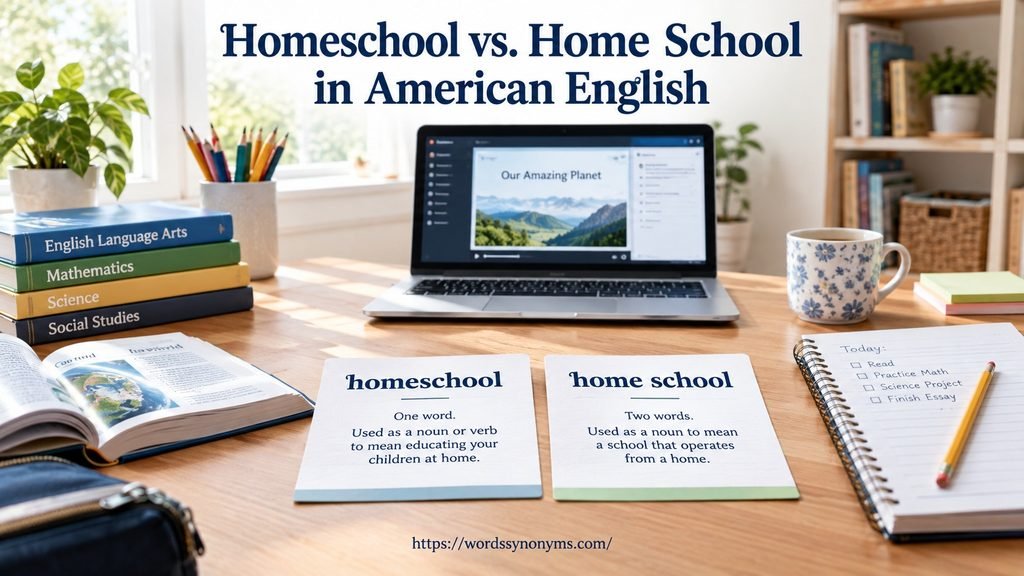
Homeschool vs. Home School in American English
For contemporary US English, homeschool is the practical default for the educational practice.
That preference becomes especially clear when the word acts as a verb.
Compare:
We homeschool our children.
We home school our children.
Both forms can be found in English, and dictionaries recognize the variation. However, the first sentence uses the established closed form that many modern readers expect.
The same pattern appears with related words:
She was homeschooled.
They are homeschooling their children.
He is a homeschooler.
These closed forms create a consistent word family.
Homeschool vs. Home School in British English
British English can show variation as well.
The broader concept is often described as home schooling or home education, while homeschool also appears in dictionary usage. Cambridge’s entries explicitly record variation in both the verb and noun forms.
That means a writer shouldn’t assume that one spelling applies identically across every English-speaking region.
For an article specifically written in US English, however, the practical recommendation remains straightforward:
Prefer homeschool as the main closed form unless a particular context requires another spelling.
Homeschooling vs. Homeschool
These two words are closely related, but they don’t always perform the same grammatical job.
Homeschool commonly functions as a verb or noun.
Homeschooling usually refers to the activity, method, or practice of educating children at home.
Compare:
We homeschool our children.
Here, homeschool is the verb.
Homeschooling requires careful planning.
Here, homeschooling is the noun naming the activity.
Cambridge defines home schooling as the teaching of children at home and also lists homeschooling as an alternative form.
A quick comparison
| Word | Function | Example |
| homeschool | Verb | We homeschool our children. |
| homeschool | Noun | The homeschool meets weekly. |
| homeschooling | Noun | Homeschooling takes preparation. |
| homeschooled | Past participle/adjective | She was homeschooled. |
| homeschooler | Noun | He is a homeschooler. |
Homeschool, Homeschooling, and Homeschooled
The word family becomes much easier once you see the pattern.
Homeschool
Use homeschool for the action or the educational setting.
They homeschool their daughter.
Homeschooling
Use homeschooling for the activity or educational approach.
Homeschooling can involve many different teaching methods.
Homeschooled
Use homeschooled when describing someone who received education at home.
She was homeschooled until high school.
Homeschooler
Use homeschooler for a person who is homeschooled or, depending on context, a parent who teaches a child at home. Cambridge records both uses.
He is a homeschooler.
Her parents are longtime homeschoolers.
Grammar: How to Use “Homeschool” Correctly
Once the spelling is settled, grammar becomes much easier.
Use “Homeschool” as a Verb
We homeschool our two children.
She homeschools her son.
They homeschooled their daughter last year.
He is homeschooling his children this semester.
Notice that the verb takes the ordinary English endings -s, -ed, and -ing.
Use “Homeschool” as a Noun
The homeschool meets twice a month.
Every homeschool has a different routine.
The noun can also take a plural ending:
Several homeschools joined the educational fair.
Use “Homeschool” as a Modifier
We bought a homeschool curriculum.
She runs a homeschool program.
He writes about homeschool education.
This modifier use is particularly common in educational material.
Common Mistakes With Home School, Homeschool, and Home-School
The most common problem isn’t outright grammatical failure. It’s inconsistent spelling.
| Less consistent version | Modern consistent version | Reason |
| We home school our children. | We homeschool our children. | Closed verb form is widely established. |
| She is home-schooling her son. | She is homeschooling her son. | Closed form creates a consistent word family. |
| He was home schooled. | He was homeschooled. | Closed past-participle form is common. |
| They use a home school curriculum. | They use a homeschool curriculum. | Closed modifier is common in modern usage. |
| She joined a home-school group. | She joined a homeschool group. | Closed form is usually cleaner in general US writing. |
These examples shouldn’t be interpreted as proof that every open or hyphenated version is grammatically wrong.
Instead, they show which forms create the most consistent modern style.
Why Do Multiple Spellings Exist?
English compounds are messy.
That’s not a flaw. It’s simply how the language grows.
Words that begin as combinations of two familiar words can gradually become fixed expressions. Speakers use them repeatedly. Writers shorten them. Publishers standardize them. Dictionaries record them. Over time, competing forms can coexist.
Think about the progression as a rough continuum:
home + school → home school → home-school → homeschool
This isn’t a rigid historical rule for every instance of the word. It’s a useful way to understand why English sometimes preserves multiple spellings.
The same phenomenon appears in many other English compounds. Some remain open. Others become hyphenated. Still others eventually close into one word.
Read more: Shoveling vs. Shovelling: Which Spelling Is Correct?
Why “Homeschool” Is Usually the Best Choice for Modern US Writing
There are several practical reasons to choose homeschool.
First, it’s concise.
Second, it’s widely recognizable.
Third, it gives related forms a consistent appearance:
- homeschool
- homeschooling
- homeschooled
- homeschooler
- homeschools
Fourth, dictionary usage clearly recognizes the closed form. Cambridge’s current entry lists homeschool as a verb, noun, and adjective.
That doesn’t erase the other forms. It simply makes homeschool a strong default for contemporary writing.
Real-World Usage Examples
Seeing the word in different grammatical settings makes the distinction much clearer.
As a Verb
Maria decided to homeschool her children.
The word describes an action.
As a Noun
Their homeschool follows a flexible schedule.
The word identifies an educational setting.
As an Adjective
They purchased a homeschool curriculum.
The word modifies curriculum.
As a Past Participle
Daniel was homeschooled through middle school.
The word describes the educational experience Daniel received.
As a Gerund or Noun
Homeschooling can require considerable organization.
The word names an activity.
As a Person
The conference attracted hundreds of homeschoolers.
The word identifies people associated with homeschooling.
A Practical Style Guide for Writers
If you’re writing an article, essay, website page, school assignment, or social post, this simple guide can prevent most problems.
Choose “homeschool” when:
- You’re using it as a verb.
- You’re describing a homeschool-related thing.
- You’re writing contemporary US English.
- You want a concise, modern compound.
- You’re using related forms such as homeschooling and homeschooled.
Consider “home school” when:
- You’re following a source that uses the open form.
- You’re discussing a specific home school as an institution or setting.
- Your publication’s style guide prefers the open compound.
- The context makes the two-word construction more natural.
Consider “home-school” when:
- A specific style guide requires the hyphen.
- You’re reproducing an established spelling.
- The compound’s grammatical construction calls for that editorial treatment.
The key is consistency.
Home School vs. Homeschool: Side-by-Side Examples
| Meaning | Common modern form | Example |
| Educate at home | homeschool | They homeschool their children. |
| Educates at home | homeschools | She homeschools her daughter. |
| Educated at home | homeschooled | He was homeschooled. |
| Education at home | homeschooling | Homeschooling is their chosen approach. |
| Person connected with homeschooling | homeschooler | She is an experienced homeschooler. |
| Educational materials | homeschool curriculum | They bought a homeschool curriculum. |
| Home-based educational setting | homeschool | The homeschool meets every Friday. |
| Variant open form | home school | The policy applies to home schools. |
| Variant hyphenated form | home-school | The publication uses home-school as its preferred form. |
A Simple Decision Tree
When you’re stuck between home school vs. homeschool vs. home-school, use this quick process.
Are you writing modern US English?
→ Yes.
Are you talking about educating a child at home?
→ Yes.
Are you using the word as a verb?
→ Use homeschool.
We homeschool our children.
Are you describing the activity?
→ Use homeschooling.
Homeschooling requires preparation.
Are you describing a person who was educated at home?
→ Use homeschooled.
She was homeschooled.
Are you describing something related to that form of education?
→ Homeschool commonly works as a modifier.
homeschool curriculum
If a particular publication or institution uses home school or home-school, follow that established style instead.
Quick Facts About the Three Forms
- Homeschool is a recognized verb.
- Homeschool is also used as a noun.
- Homeschool can function as an adjective before a noun.
- Home school remains an attested variant.
- Home-school also appears as a variant.
- Homeschooling and home schooling both occur in dictionary usage.
- Homeschooled is the common closed past-participle form.
- Homeschooler is an established noun for someone connected with homeschooling.
- The spelling choice can depend on grammar, context, regional usage, and editorial style.
- For general contemporary US English, homeschool is usually the simplest default.
FAQs
Is “home school” one word or two?
Home school is traditionally written as two words when it functions as a noun. For example, you might write, “The home school offers flexible lessons.”
Is “home-school” correct as a verb?
Yes. Home-school is commonly used as a hyphenated verb, as in “They home-school their children.” The hyphen helps show that the two words work together as a verb.
Is “homeschool” an accepted spelling?
Yes, homeschool is increasingly used as a single word. It has become more common over time, although some writers still prefer the traditional forms.
Should I write “home-schooled” or “homeschooled”?
Home-schooled is a traditional spelling, especially when the term functions as a participle or adjective. Homeschooled is also increasingly seen as the language continues to evolve.
Why are there different spellings of homeschool?
The variations reflect a common change in English. A phrase may begin as separate words, develop a hyphenated form, and eventually become a single compound word through frequent use.
Which form should I use in formal writing?
For formal writing, choose the form that matches your grammar, style guide, and intended audience. Consistency matters, especially when the same term appears
Conclusion
Choosing between home school, homeschool, and home-school becomes easier once you focus on the word’s role in the sentence. Use home school when it works as a noun, home-school when it works as a verb, and home-schooled when describing someone who receives education at home. Homeschool is also increasingly used as a single word, especially in modern informal and educational writing.
English spelling often changes as familiar expressions become more established. That’s why homeschool may feel more natural to some readers today, even though the traditional forms remain widely understood. When in doubt, consider your audience, follow the style guide you’re using, and keep your spelling consistent throughout the same piece of writing.

Muhammad Taqi is a content writer interested in English vocabulary and language. He writes clear and useful articles on synonyms, antonyms, word meanings, and English usage, helping readers expand their vocabulary and improve their communication skills.