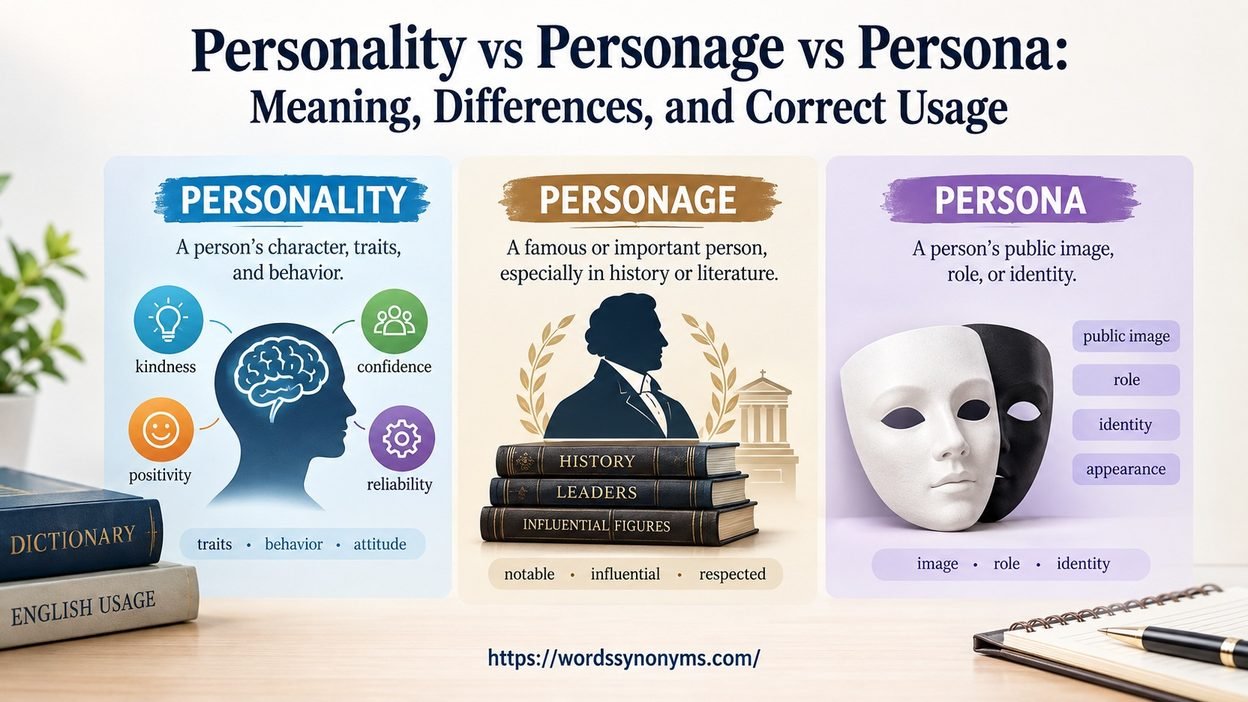
In Personality vs Personage vs Persona: Correct Usage, a personage is a fancy person, while personality shows unique traits.
A personage may have higher status and deserve respect, or describe a notable figure in books and paintings. Personality, however, is the specific set of qualities and interests that makes someone unique and unlike others.
A lively and engaging personality often appeals to people, and a famous person or celebrity may also be called a personality.
A persona is the part of a person seen by others, often as a public image or way to act before a camera, rather than at home or in private settings.
A public persona can be a character created by an actor or author, shaping behavior, role, identity, and appearance. There are two accepted plurals: the original Latin plural personae and the adapted English plural personas.
The last letter can change from a short to a long sound, but personas is far more popular. Purists may favor the traditional ending and call other forms incorrect, so consider your audience, preference, and how you write.
Quick Answer
The simplest distinction is this:
| Word | Meaning | What It Describes | Example |
| Personality | A person’s characteristic qualities, behavior, and temperament | Traits and character | She has a warm personality. |
| Personage | An important, prominent, or famous person | The person themselves | The historical personage shaped the nation. |
| Persona | A character, identity, or image presented to others | A public, professional, artistic, or literary identity | The actor created a mysterious persona. |
So, personality describes traits, personage identifies a notable person, and persona describes a presented identity.
These distinctions become even clearer when you look at how each word works in real sentences.
What Does Personality Mean?
Personality refers to the combination of qualities, traits, attitudes, and behavioral tendencies that distinguish one person from another.
It answers a simple question: What is someone like?
For example, you might describe someone as having a friendly, reserved, energetic, thoughtful, confident, stubborn, humorous, or serious personality.
Consider these sentences:
- Maria has a friendly personality.
- James has a quiet personality.
- Her cheerful personality makes people feel comfortable.
- His strong personality often dominates a conversation.
- The manager has a calm personality even under pressure.
In each example, personality refers to qualities associated with the individual.
Personality Can Include Many Different Traits
Personality isn’t limited to whether someone is outgoing or shy. It can encompass a broad range of tendencies.
For example, someone’s personality might include:
- Temperament
- Emotional tendencies
- Social behavior
- Communication style
- Confidence
- Patience
- Curiosity
- Humor
- Openness
- Reserved behavior
- Assertiveness
- Adaptability
A person might have a naturally reserved personality yet become highly expressive around close friends. Another person may have an outgoing personality and enjoy meeting strangers.
That’s why personality describes a person’s broader behavioral character rather than one isolated action.
Personality Does Not Mean Public Image
Here’s an important distinction.
Your personality concerns your characteristic qualities. Your persona concerns the identity or image you present.
Someone could have a naturally shy personality but maintain a confident professional persona during business meetings.
The two can overlap. They aren’t identical.
Personality as a Description of Character
The word personality often appears with adjectives that describe someone’s character.
Common combinations include:
- strong personality
- friendly personality
- outgoing personality
- quiet personality
- warm personality
- cheerful personality
- confident personality
- serious personality
- lively personality
- creative personality
For example:
“Despite his quiet personality, he has excellent leadership skills.”
Here, personality describes his general social and behavioral character. It doesn’t mean his public image or social role.
Personality Can Also Mean a Famous Person
There is another established meaning of personality that can confuse learners.
In phrases such as television personality, radio personality, or media personality, the word can refer to a well-known person who appears publicly through media.
For example:
- She became a popular television personality.
- The radio personality has hosted the program for decades.
- The sports personality regularly appears on television.
Here, personality doesn’t mean a collection of psychological traits. It refers to a person who has become recognizable through public or media appearances.
Context tells you which meaning applies.
What Does Personage Mean?
Personage means an important, prominent, notable, or famous person.
Unlike personality, it doesn’t primarily describe someone’s traits.
Unlike persona, it doesn’t primarily describe a public image or adopted character.
Instead, personage refers to the person themselves, usually with an emphasis on importance or prominence.
For example:
“Several historical personages appear in the novel.”
The sentence refers to notable individuals connected with the historical setting.
Other examples include:
- The king was an influential personage in medieval politics.
- Several prominent personages attended the ceremony.
- The book explores the lives of important historical personages.
- The fictional story introduces a mysterious personage from the past.
Personage Has a Formal Tone
One of the most important things to understand about personage is its tone.
It’s a relatively formal word. You probably wouldn’t use it in ordinary conversation when person, individual, or figure would sound more natural.
For example:
“I met an interesting person at the conference.”
That sounds completely natural.
You could technically replace person with personage in some contexts, but the result would sound unusually formal:
“I met an interesting personage at the conference.”
That wording suggests something more distinctive, important, historical, literary, or dramatic.
So don’t treat personage as a fancy replacement for person. Its meaning carries a sense of prominence.
Personage vs Person
The distinction is subtle but useful.
Person is neutral. It can refer to anyone.
Personage usually suggests that the individual is notable or significant.
Compare:
- The person entered the room.
- The political personage entered the room.
The first sentence simply identifies someone. The second presents the individual as a significant figure.
This difference becomes especially useful in historical and literary writing.
Where You Commonly See Personage
You are most likely to encounter personage in:
- Historical writing
- Literary criticism
- Formal journalism
- Biographical writing
- Political commentary
- Fiction
- Descriptions of prominent figures
The word can also have a slightly old-fashioned or grand tone depending on context.
What Does Persona Mean?
Persona refers to a character, identity, or image that a person presents to other people.
It often describes the way someone chooses to appear publicly.
For example:
- The singer developed a rebellious persona.
- His professional persona is serious and reserved.
- Her online persona is humorous and energetic.
- The politician cultivated a confident persona.
- The actor adopted a completely different persona for the role.
Notice what’s happening in these examples.
The word doesn’t necessarily describe the person’s deepest or most natural traits. Instead, it focuses on the identity being presented.
That’s the heart of the word.
Persona vs Personality
This is probably the most important comparison in the entire topic.
A personality describes a person’s characteristic traits.
A persona describes a character or image that the person presents.
Imagine a musician who is naturally quiet and private. On stage, however, the musician performs as an energetic, fearless rock star.
The musician’s:
- Personality might be quiet and reflective.
- Persona might be bold and rebellious.
Both descriptions can be true at the same time.
That’s why treating persona and personality as exact synonyms can create confusion.
A Simple Way to Remember It
Think of personality as the person behind the behavior.
Think of persona as the face or character presented to the outside world.
This doesn’t mean every persona is fake.
A persona can emphasize real aspects of someone’s personality. It can also be shaped by a particular role, profession, audience, or situation.
Persona in Professional Life
People often develop different personas depending on their surroundings.
A lawyer might adopt a highly formal professional persona in court. The same person might be relaxed and playful with family.
A teacher may use a confident classroom persona while behaving more quietly outside work.
A business leader might maintain a decisive public persona during interviews even if they are naturally cautious when making private decisions.
This doesn’t automatically involve deception.
Professional roles often require people to emphasize certain qualities.
Persona in Social Media
Social media makes the distinction especially easy to see.
A person might present an online persona that emphasizes:
- Humor
- Confidence
- Luxury
- Expertise
- Adventure
- Creativity
- Fitness
- Professional success
That online persona may reflect reality. However, it may also show only one carefully selected slice of someone’s life.
The distinction is useful because a social-media persona isn’t necessarily a complete picture of someone’s personality.
Persona in Literature
Persona also has an important literary meaning.
In literature, particularly poetry, a persona can be the voice or character through which a writer speaks.
The speaker in a poem isn’t automatically the poet.
For example, a poet might write from the perspective of:
- A soldier
- A fictional character
- A historical figure
- An imaginary narrator
- A completely invented voice
The poet creates the persona through which the work communicates.
This distinction prevents a common reading mistake: assuming that every statement made by a literary speaker represents the author’s personal beliefs.
Author vs Persona
Consider a fictional poem written in the voice of an elder sailor.
The sailor’s experiences, opinions, and emotions belong to the poem’s speaker. They don’t necessarily describe the author’s own life.
Here, persona provides the voice through which the literary work speaks.
Personality vs Personage
The difference between personality and personage becomes straightforward once you focus on what each word identifies.
Personality describes qualities.
Personage identifies a person who has importance or prominence.
Compare these sentences:
“The president has a charismatic personality.”
This describes the president’s traits.
Now consider:
“The president became an influential political personage.”
This identifies the president as a notable political figure.
The first sentence focuses on character. The second focuses on status or prominence.
Personality vs Personage Examples
| Personality | Personage |
| She has a warm personality. | She is an important historical personage. |
| His personality is very outgoing. | The political personage attracted attention. |
| Her calm personality helped during the crisis. | Several prominent personages attended. |
| His personality makes him easy to work with. | The novel features several famous personages. |
The substitution doesn’t work because the words perform different semantic jobs.
Personage vs Persona
Now compare personage with persona.
A personage is the notable individual.
A persona is the character or image associated with that individual.
For example:
“The author became an important literary personage.”
This tells you the author is a notable figure.
Now:
“The author created a mysterious literary persona.”
This tells you about the identity or character presented through the author’s work.
The first focuses on who the person is in a notable context.
The second focuses on how a character or identity is presented.
Personage vs Persona Examples
| Personage | Persona |
| The historical personage became famous. | The politician cultivated a strong persona. |
| Several literary personages appear in the novel. | The narrator speaks through a fictional persona. |
| The royal personage attended the ceremony. | The actor adopted a new persona. |
| The political personage influenced public debate. | His public persona seemed confident. |
Personality vs Personage vs Persona in One Example
One carefully constructed example can make the whole distinction click.
Imagine a famous actor named Daniel.
Daniel has a naturally quiet and thoughtful personality. He doesn’t enjoy large social gatherings.
However, his career has made him a well-known personage in the entertainment industry.
For his action movies, Daniel adopts a bold and fearless persona.
Now look at what each word does:
- Personality: Daniel is naturally quiet and thoughtful.
- Personage: Daniel is a notable entertainment figure.
- Persona: Daniel presents himself as bold and fearless in his films.
The same individual can therefore have a personality, become a personage, and adopt a persona.
That’s why the words aren’t interchangeable.
A Second Case Study: The Public Speaker
Consider a successful public speaker.
Away from the stage, she may be reserved and analytical. That’s part of her personality.
Because she has become widely recognized in her field, she may be described as a prominent personage.
When she steps onto the stage, she deliberately projects confidence, energy, and authority. That presentation forms part of her persona.
The three terms describe three different dimensions:
| Dimension | Appropriate Word |
| Natural or characteristic traits | Personality |
| Prominence or importance of the individual | Personage |
| Presented identity or public character | Persona |
This framework works across entertainment, politics, business, literature, history, and social media.
Can Personality, Personage, and Persona Be Used as Synonyms?
No. Not in normal usage.
They share a conceptual connection with people and identity. However, their meanings differ enough that replacing one with another can change the sentence substantially.
Think of them as three neighboring words rather than three identical words.
- Personality → characteristics
- Personage → notable individual
- Persona → presented identity
They may appear in the same paragraph. They may even describe the same individual. Yet they don’t describe the same aspect of that individual.
Common Mistakes With Personality, Personage, and Persona
Using Personage to Mean Personality
This is one of the clearest errors.
Incorrect:
“She has a friendly personage.”
Better:
“She has a friendly personality.”
Why? Because friendly describes a character trait. Personality fits that meaning.
Personage identifies a notable person. It doesn’t normally describe whether someone is friendly, shy, cheerful, or stubborn.
Using Persona as a Direct Synonym for Personality
This mistake is more understandable because the meanings can overlap.
Incorrect or potentially misleading:
“His persona is naturally shy.”
Better:
“His personality is naturally shy.”
If you want to emphasize the image he presents, you could write:
“His public persona is quiet and reserved.”
The second version shifts attention from his underlying traits to his public presentation.
Using Personality to Mean a Public Image
Consider:
“The politician carefully developed his personality.”
This isn’t necessarily wrong, but it may not express the intended meaning.
If the writer means a deliberately cultivated public image, persona is more precise:
“The politician carefully developed his public persona.”
The word persona tells the reader that the focus is on presentation.
Using Personage as an Ordinary Synonym for Person
You might see personage and assume it simply means person.
That’s too broad.
If you’re talking about an ordinary individual, person is usually the natural choice.
If you’re discussing a notable historical, political, literary, or public figure, personage may be appropriate.
Assuming Persona Means Fake
A persona doesn’t have to be artificial.
An actor’s stage persona may be deliberately constructed. A professional persona may simply reflect the behavior required by a particular role.
Even an authentic public identity can be called a persona if the emphasis falls on the identity presented to others.
So the word doesn’t automatically accuse someone of pretending.
Personality, Personage, and Persona in Different Contexts
The right word often depends on the subject you’re discussing.
Everyday Conversation
Personality is by far the most natural of the three for ordinary conversations about character.
You might say:
- “He has a great personality.”
- “She’s got a very strong personality.”
- “Their personalities are completely different.”
Personage sounds formal in everyday speech.
Persona appears more naturally when you’re talking about someone’s public image, online identity, or professional presentation.
Business
Business writing commonly uses personality to discuss leadership or interpersonal traits.
For example:
“Her confident personality helps her lead large teams.”
Persona works when the focus shifts toward professional presentation:
“The executive has developed a highly approachable professional persona.”
Personage can describe a prominent business figure in formal writing, though it isn’t usually the first choice.
Politics
Politics provides a useful setting for all three words.
A politician may have a charismatic personality.
The same politician may become an important political personage.
That politician may also cultivate a strong public persona.
Each word highlights something different.
Entertainment
Entertainment frequently uses all three terms.
A celebrity can have:
- A distinctive personality
- The status of a famous personage
- A carefully developed public or stage persona
The distinction becomes particularly useful when discussing actors and musicians.
Literature
Literature gives persona a specialized role.
A character or narrator can function as a persona through which the writer presents a story or poem.
Personage can refer to an important character or figure within a literary work.
Personality can describe the traits of that character.
For example:
“The novel’s central personage has a complex personality, while the narrator speaks through a detached persona.”
All three words can work in one sentence because each performs a different job.
History
Historical writing often uses personage to emphasize a person’s importance.
For example:
“The historical personage played a decisive role in the negotiations.”
You could also discuss that person’s personality:
“His cautious personality shaped his political decisions.”
If historians discuss the public identity he deliberately constructed, persona may be appropriate:
“His political persona emphasized strength and stability.”
Word Forms and Related Terms
Understanding the related forms can help prevent confusion.
Personality
Singular: personality
Plural: personalities
Examples:
- Her personality is warm.
- The two siblings have very different personalities.
Related expressions include:
- personality trait
- personality type
- personality disorder
- media personality
- television personality
- strong personality
The meaning depends heavily on context.
Personage
Singular: personage
Plural: personages
Examples:
- The historical personage became famous.
- Several important personages appear in the account.
Because personage has a formal flavor, it works best when the context supports that tone.
Persona
Singular: persona
Plural: personas or personae
Both plural forms occur in English.
Personas is the straightforward modern English plural and will generally feel more natural to contemporary readers.
Personae comes from the Latin plural pattern and appears more often in formal, academic, literary, or scholarly contexts.
Examples:
- The company created several customer personas.
- The novel explores the different personae adopted by its characters.
Persona in Marketing and User Research
There’s another modern use worth knowing.
In marketing, product design, and user research, a persona can mean a fictionalized representation of a target user or customer.
For example, a company might create a customer persona named “Busy Professional” to represent a particular audience segment.
That persona could include:
- Age range
- Goals
- Challenges
- Buying habits
- Professional needs
- Preferred communication channels
- Common frustrations
This use isn’t about pretending that the fictional profile is a real person. Instead, the persona gives a team a practical model of a target audience.
For example:
“The product was designed around a customer persona representing busy remote workers.”
Here, persona means a constructed user profile.
That meaning has become especially common in marketing, UX research, advertising, and product development.
Read more: Tween Meaning, Definition and Examples
Personality vs Personage vs Persona: The Best Memory Trick
When you’re unsure which word to use, ask yourself one question:
What exactly am I describing?
1. If you’re describing traits, choose personality.
2. If you’re identifying a notable person, choose personage.
3. If you’re describing a presented identity, choose persona.
You can remember it like this:
Personality = traits
Personage = notable person
Persona = presented character
That three-word formula covers the central difference.
When Should You Use Personality?
Use personality when you want to describe:
- Character traits
- Temperament
- Behavior patterns
- Social qualities
- Individual characteristics
- A distinctive personal style
Examples:
“She has an adventurous personality.”
“His personality makes him easy to work with.”
“The character’s personality changes throughout the novel.”
Use it when your focus is what someone is like.
When Should You Use Personage?
Use personage when you want to identify:
- An important person
- A famous figure
- A prominent historical individual
- A notable literary figure
- A person with social or political importance
Examples:
“The museum examines the lives of several historical personages.”
“The politician became an influential public personage.”
Use it when your focus is the person’s prominence.
When Should You Use Persona?
Use persona when you want to describe:
- A public image
- A professional identity
- An online identity
- A stage character
- A literary voice
- An adopted social role
- A constructed customer profile
Examples:
“The singer developed a powerful stage persona.”
“Her online persona is playful and informal.”
“The poem uses a fictional persona.”
Use it when your focus is the identity being presented or represented.
Personality vs Personage vs Persona: Side-by-Side Examples
| Situation | Best Word | Example |
| Describing someone’s character | Personality | He has an optimistic personality. |
| Describing a famous historical figure | Personage | The historian studied the political personage. |
| Describing a public image | Persona | The actor’s public persona is mysterious. |
| Describing a person’s social traits | Personality | Her outgoing personality attracts people. |
| Referring to a prominent literary figure | Personage | The novel contains several memorable personages. |
| Describing an actor’s stage identity | Persona | The singer created a rebellious persona. |
| Discussing a person’s temperament | Personality | His calm personality helps during crises. |
| Referring to a notable political figure | Personage | The statesman became an important personage. |
| Discussing an online identity | Persona | Her online persona is deliberately humorous. |
A Practical Three-Question Test
When choosing between these words, run through this quick test.
Are You Describing Traits?
If yes, choose personality.
Ask:
“What is this person like?”
If the answer involves qualities such as friendly, confident, shy, serious, or energetic, personality is probably the right choice.
Are You Referring to an Important Person?
If yes, choose personage.
Ask:
“Am I talking about the individual as a notable figure?”
If prominence, historical importance, or social status matters, personage may fit.
Are You Describing a Presented Identity?
If yes, choose persona.
Ask:
“Am I talking about the image, character, role, or identity this person presents?”
If so, persona is the strongest choice.
FAQs
What does personage mean?
Personage is a formal or somewhat fancy word for a person, especially someone notable or deserving of respect.
How is personality different from personage?
Personality describes the qualities, behavior, and interests that make someone unique. Personage focuses more on the person as a notable figure.
What does persona mean?
A persona is the public or visible side of someone’s identity. It often describes how a person acts in particular situations, especially before an audience or camera.
Can a celebrity be called a personality?
Yes. A famous or well-known person can be called a personality, particularly when that person is known for an engaging or distinctive character.
What is the plural of persona?
Both personas and personae are accepted plurals. Personas is the more common English form, while personae preserves the traditional Latin form.
Should I use personality, personage, or persona?
Use personality for someone’s distinctive traits, personage for a notable or important person, and persona for a particular public identity or role.
Conclusion
Understanding personality vs personage vs persona becomes easier when you focus on what each word describes. Personality is about the traits that make someone distinctive, personage points to a notable or respected figure, and persona describes the identity or role a person presents to others.
When you choose the right term, your writing becomes clearer and more precise. Whether you’re describing someone’s natural character, public image, or status as a notable figure, knowing these differences helps you communicate exactly what you mean.

Muhammad Taqi is a content writer interested in English vocabulary and language. He writes clear and useful articles on synonyms, antonyms, word meanings, and English usage, helping readers expand their vocabulary and improve their communication skills.