
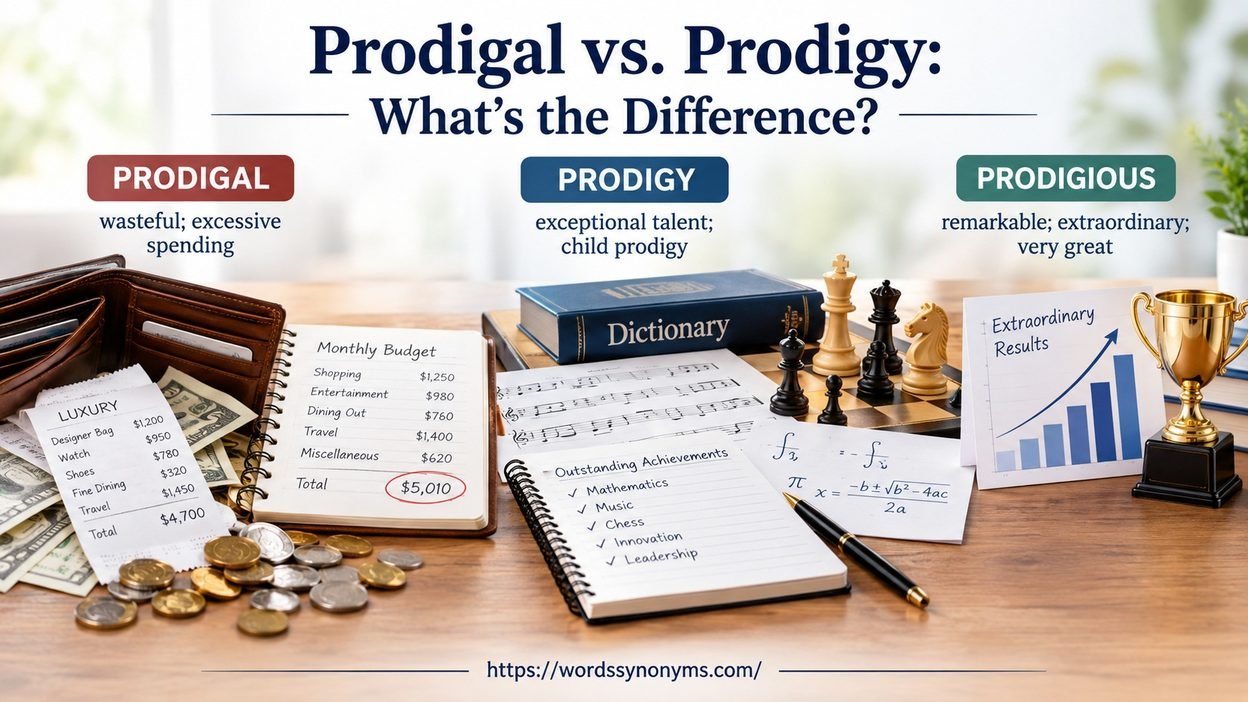
Prodigal vs. Prodigy: What’s the Difference? The prodigal is linked to wasteful or overly generous behavior, while a prodigy is unusually talented.
A prodigal can be an adjective or noun for a person who uses money, a resource, or valuable possessions lavishly and extravagantly. The word can suggest overabundance, wastefulness, extravagance, or excessive spending, especially when someone wastes wealth, financial resources, or other resources.
It can also describe producing or owning something in great abundance as a quality. In the Bible, the parable told by Jesus about the prodigal son gives the word a strong religious context. The son wasted his inheritance, made bad choices, became penniless, and came back home repentant. His returning home represents repentance and homecoming.
This Biblical parable from the New Testament also provides the familiar expression prodigal daughter for a similar female character. Its behavior shows how wasteful, lavish, and extravagant behavior can lead to regret and repentant actions before someone chooses a better path.
Quick Answer
The simplest distinction is this:
Prodigal means wastefully extravagant or excessively generous. Prodigy means a person with extraordinary ability, especially at a young age.
Here’s the difference at a glance:
| Word | Main meaning | Part of speech | Common context | Example |
| Prodigal | Wasteful, extravagant, or lavish | Adjective; noun in some uses | Money, resources, time, generosity | His prodigal spending caused serious problems. |
| Prodigy | An exceptionally talented person | Noun | Young talent, intelligence, music, sports, academics | The young chess player was a prodigy. |
| Prodigious | Remarkably great, impressive, or large | Adjective | Talent, effort, amount, achievement | She showed prodigious musical talent. |
A useful memory trick is simple:
Prodigal = excess.
Prodigy = exceptional talent.
Prodigious = exceptionally great.
Once you connect each word with its core idea, the confusion becomes much easier to avoid.
What Does Prodigal Mean?
Prodigal is an adjective that usually describes someone who spends, uses, or gives something excessively.
The word often carries a negative sense. If someone has a prodigal lifestyle, that person may spend money recklessly rather than carefully.
Oxford defines prodigal as being too willing to spend money or waste time, energy, or materials. It also recognizes the established expression “the prodigal son.”
Consider these examples:
- His prodigal spending left him with almost no savings.
- The company took a prodigal approach to its advertising budget.
- She was prodigal with her praise.
- The government faced criticism for its prodigal use of resources.
Notice something important: prodigal doesn’t apply only to money.
You can be prodigal with many things, including:
- Money
- Time
- Energy
- Resources
- Praise
- Affection
- Gifts
- Attention
- Words
For instance, someone might say:
She was prodigal with compliments.
That doesn’t mean she wasted money. It means she gave compliments generously and in abundance.
Prodigal Can Mean Lavish
Although prodigal often suggests wastefulness, it can sometimes emphasize abundance or lavishness rather than simple financial recklessness.
For example:
The landscape was prodigal in its beauty.
This older or more literary use focuses on something being richly abundant.
In everyday modern English, however, prodigal most commonly carries a sense of excessive or wasteful spending. If you want a neutral word for generosity, generous, lavish, or abundant may fit better depending on context.
Prodigal as a Noun
Prodigal can also function as a noun.
In this use, it refers to a person who behaves extravagantly or wastefully. The word is especially familiar through the expression “the prodigal son.”
For example:
- The prodigal eventually returned home.
- The family welcomed their prodigal back after years away.
The noun form isn’t as common in ordinary conversation as the phrase prodigal son.
Still, understanding it helps explain why the word appears without a noun immediately after it.
What Does Prodigy Mean?
A prodigy is a person whose ability is extraordinarily advanced, especially for their age.
Oxford defines a prodigy as a young person whose intelligence or skill is unusually good for their age. Cambridge similarly defines it as a young person who is exceptionally good at something.
A prodigy might demonstrate remarkable ability in:
- Mathematics
- Music
- Chess
- Science
- Art
- Writing
- Computing
- Sports
- Languages
Examples include:
- The eight-year-old was a piano prodigy.
- She became known as a mathematics prodigy.
- The young chess prodigy defeated experienced players.
- He was considered a programming prodigy before finishing high school.
The important idea is unusually advanced ability.
A person doesn’t become a prodigy simply because they’re talented. The word usually suggests that the person’s skill is strikingly advanced, particularly given their age.
Is a Prodigy Always a Child?
Not necessarily, but youth is central to the modern meaning.
When people hear prodigy, they typically imagine a child or teenager performing at a level associated with much older experts.
That’s why expressions such as these sound natural:
- Child prodigy
- Musical prodigy
- Chess prodigy
- Math prodigy
- Young prodigy
The word can occasionally describe an extraordinary person without strongly emphasizing childhood. However, the idea of exceptional ability at a young age remains the clearest modern sense.
Merriam-Webster also lists “a highly talented child or youth” as a primary meaning while noting that prodigy can also describe an extraordinary accomplishment or event.
So if an adult becomes highly skilled after decades of training, expert, master, or virtuoso may be more precise.
If that person displayed astonishing ability as a child, prodigy becomes a much better fit.
Prodigal vs. Prodigy: The Key Difference
The biggest difference is what each word focuses on.
Prodigal focuses on excessive use or spending.
Prodigy focuses on extraordinary ability.
Compare these sentences:
The prodigal heir spent his inheritance on expensive cars.
The young heir was a financial prodigy.
The first person wastes money. The second person has exceptional financial ability.
The contrast becomes even clearer in this table:
| Feature | Prodigal | Prodigy |
| Meaning | Excessively wasteful or lavish | Exceptionally talented person |
| Typical subject | A person, behavior, spending, or use | A person |
| Age connection | None required | Usually young |
| Emotional tone | Often negative or critical | Usually positive |
| Common examples | Prodigal spending, prodigal lifestyle | Child prodigy, musical prodigy |
| Grammar | Adjective; sometimes noun | Noun |
| Main idea | Excess | Exceptional ability |
Think of them as pointing in completely different directions.
Prodigal asks, “How excessively is something being used?”
Prodigy asks, “How unusually talented is this person?”
Why Do Prodigal and Prodigy Look So Similar?
Their spelling creates the trap.
Both begin with prodig-, and both ultimately come from Latin. However, their historical paths are different.
Prodigal comes from Latin prodigus, meaning lavish or wasteful. Its history is connected with the idea of squandering or driving something away.
Prodigy, meanwhile, comes from Latin prodigium, meaning an omen, portent, or extraordinary phenomenon. Its meaning later developed toward something extraordinary and eventually toward a person with exceptional ability.
So the similar appearance is not a reliable guide to their modern meanings.
That’s an important lesson in vocabulary: words that look related aren’t necessarily synonyms.
English contains many such traps.
The Origin of Prodigal
The history of prodigal explains its connection with wastefulness.
The word entered English through forms connected with French and Late Latin. Its Latin ancestor, prodigus, meant lavish or wasteful. The related Latin verb prodigere carried the sense of driving forth or squandering.
That history helps explain why the word became associated with extravagant expenditure.
Imagine someone receiving a large inheritance and immediately spending it on luxury goods, expensive trips, and lavish parties. Calling that person prodigal makes sense because the person is using wealth excessively.
The word therefore has a strong connection with wasteful abundance.
The Origin of Prodigy
Prodigy has a much different history.
The word comes from Latin prodigium, which referred to an omen, portent, or extraordinary occurrence. In earlier English, it could describe something strange or remarkable. Over time, its meaning expanded toward something extraordinary enough to inspire wonder.
Eventually, English speakers began using prodigy for an exceptionally gifted young person.
That modern meaning is now far more familiar than the older sense.
The semantic journey is fascinating:
omen → extraordinary occurrence → remarkable person → exceptionally gifted young person
This is one reason prodigy can still occasionally refer to an extraordinary accomplishment or event.
What Does “The Prodigal Son” Mean?
Few uses of prodigal are more famous than “the prodigal son.”
The phrase comes from the parable told in Luke 15. In the story, a younger son asks his father for his share of the property. He leaves home and eventually squanders his wealth through reckless living. After losing everything, he returns home.
His father welcomes him instead of rejecting him.
That story gave prodigal one of its most recognizable cultural uses.
The original idea of the word fits the story because the son wastes his inheritance. However, modern speakers often use prodigal son to emphasize the return rather than the wastefulness itself.
For example:
After years of working overseas, he returned to his hometown like a prodigal son.
The sentence doesn’t necessarily suggest that he literally wasted money. Instead, it draws on the familiar idea of someone leaving and eventually coming home.
Why the Phrase Can Be Misleading
A common misunderstanding is that prodigal simply means “one who returns.”
That’s not quite accurate.
The broader word prodigal has a strong connection to extravagance and wastefulness. The idea of returning comes specifically from the biblical expression and its later figurative use.
Therefore:
- Prodigal spending = excessive or wasteful spending
- A prodigal person = someone associated with extravagance or waste
- The prodigal son = a person who leaves, wastes his resources, and later returns
That distinction keeps the meaning precise.
Prodigal vs. Prodigy in Real Sentences
Context makes these words easy to separate once you see them in action.
| Sentence | Correct word | Why |
| The young pianist was a ___. | prodigy | The sentence describes exceptional talent. |
| His ___ spending destroyed his savings. | prodigal | The sentence describes wasteful spending. |
| She was ___ with her compliments. | prodigal | She gave compliments excessively. |
| The chess ___ defeated several champions. | prodigy | The person has remarkable skill. |
| The ___ son eventually returned home. | prodigal | This refers to the familiar biblical expression. |
| The scientist showed ___ talent. | prodigious | The adjective means remarkably great. |
The easiest test is to identify the idea first.
When you’re talking about talent, think prodigy.
For excessive spending or giving, the right word is prodigal.
When describing something remarkably large or impressive, consider prodigious.
Prodigal vs. Prodigious vs. Prodigy
This three-way comparison deserves special attention because these words are frequently mixed up.
Prodigal
Prodigal means excessively wasteful, lavish, or extravagant.
Example:
His prodigal spending quickly exhausted the family fortune.
Prodigy
Prodigy is a noun for an exceptionally gifted person, especially a young person.
Example:
The twelve-year-old was a chess prodigy.
Prodigious
Prodigious is an adjective meaning remarkably great, enormous, impressive, or extraordinary.
Example:
The pianist displayed prodigious technical skill.
Here’s the distinction in one table:
| Word | Grammar | Core meaning | Example |
| Prodigal | Adjective / noun | Wasteful or lavish | His prodigal spending worried his parents. |
| Prodigy | Noun | Exceptionally gifted person | She was a musical prodigy. |
| Prodigious | Adjective | Remarkably great or impressive | He showed prodigious talent. |
One sentence can even use prodigy and prodigious together:
The young prodigy displayed prodigious mathematical ability.
That sentence works because prodigy identifies the person while prodigious describes the remarkable quality of the person’s ability.
Common Mistakes With Prodigal and Prodigy
Mistake: Using Prodigal to Mean Talented
Incorrect:
She is a prodigal violinist.
If you mean that she has extraordinary talent, prodigy or prodigious may be appropriate.
Better:
She is a violin prodigy.
Or:
She has prodigious talent as a violinist.
The difference matters because prodigal doesn’t mean gifted.
Mistake: Using Prodigy for Wasteful Spending
Incorrect:
His prodigy spending caused financial trouble.
Prodigy is primarily a noun referring to an extraordinarily gifted person.
Better:
His prodigal spending caused financial trouble.
Here, prodigal correctly describes excessive spending.
Mistake: Assuming Prodigal Means “Very Good”
This confusion often happens because prodigious can mean extraordinary.
Consider the three sentences:
As a musician, she was prodigal with her talent.
She was a prodigy who amazed everyone with her skill.
Her prodigious musical talent set her apart from her peers.Only the second and third sentences communicate exceptional ability.
The first sentence suggests something quite different.
How to Use Prodigal Correctly
There are several common patterns worth learning.
Prodigal + Spending
This is one of the clearest uses.
- Prodigal spending
- A prodigal lifestyle
- Prodigal expenditure
- Prodigal use of resources
Example:
The executive faced criticism for his prodigal spending.
Prodigal With “Of”
The structure prodigal with can describe someone who gives or uses something excessively.
Examples:
- She was prodigal with praise.
- He was prodigal with his time.
- The host was prodigal with food.
- The manager was prodigal with company resources.
This construction shows that prodigal can extend beyond financial behavior.
The Prodigal Son
Use this phrase when discussing someone who returns after leaving.
Example:
After years away, the prodigal son finally returned.
The phrase can also appear humorously or figuratively:
After months without visiting, Jake returned to the office like the prodigal son.
The tone depends heavily on context.
Read more: Heretofore or Hitherto: Meaning and Correct Usage
How to Use Prodigy Correctly
Prodigy usually appears as a noun.
Prodigy After a Descriptive Noun
Common combinations include:
- Child prodigy
- Musical prodigy
- Chess prodigy
- Math prodigy
- Artistic prodigy
- Science prodigy
- Programming prodigy
Examples:
The child prodigy began composing music before turning five.
The young chess prodigy defeated several experienced competitors.
She became known as a mathematics prodigy during elementary school.
Prodigy With “Become” or “Be”
You can also structure sentences around the person directly:
- He became a prodigy in the world of chess.
- She was considered a musical prodigy.
- The student quickly gained attention as a scientific prodigy.
These constructions sound natural because prodigy functions as a noun.
A Practical Case Study: Three Similar Words
Consider a fictional student named Maya.
At age nine, Maya can solve advanced mathematical problems that challenge much older students. Teachers call her a math prodigy.
At fifteen, she wins major competitions and demonstrates prodigious mathematical ability.
Later, she receives a large research grant but spends the entire amount on unnecessary luxury purchases. Her spending becomes prodigal.
Notice how the three words describe completely different things:
| Situation | Correct word | Reason |
| Extraordinary mathematical ability at a young age | Prodigy | Describes the exceptionally gifted person |
| Remarkably advanced mathematical skill | Prodigious | Describes the extraordinary quality of the ability |
| Wasteful use of money | Prodigal | Describes excessive or reckless spending |
This is the cleanest way to understand the vocabulary family.
The person can be a prodigy. The ability can be prodigious. The spending can be prodigal.
How Do You Pronounce Prodigal and Prodigy?
Pronunciation provides another useful distinction.
Prodigal
In American English, prodigal is commonly pronounced approximately:
PRAH-di-guhl
IPA: /ˈprɑːdɪɡəl/
The final syllable sounds like “guhl.”
Prodigy
In American English, prodigy is commonly pronounced:
PRAH-duh-jee
IPA: /ˈprɑːdədʒi/
The final sound is “jee.”
The endings provide a helpful clue:
- Prodigal → “guhl”
- Prodigy → “jee”
They may look alike on the page, but they sound noticeably different when spoken naturally.
Prodigal vs. Prodigy: A Simple Memory Trick
When you’re writing quickly, use this mental shortcut.
Think “Spending” for Prodigal
Prodigal = excessive use
Imagine someone spending money as if there were no tomorrow.
Prodigal spending can destroy a fortune.
Think “Talent” for Prodigy
Prodigy = extraordinary talent
Imagine a child performing a skill at a level far beyond their age.
The young pianist is a prodigy.
Think “Remarkable” for Prodigious
Prodigious = remarkably great
Imagine something unusually large, powerful, or impressive.
The athlete made a prodigious effort.
This three-part shortcut can prevent most mistakes:
Prodigal → wasteful
Prodigy → gifted person
Prodigious → remarkably great
Are Prodigal and Prodigy Synonyms?
No.
They aren’t synonyms despite their similar spelling.
Prodigal describes extravagance, wastefulness, or a person associated with such behavior.
Prodigy describes an exceptionally talented person.
Replacing one with the other can completely change the meaning of a sentence.
Compare:
He is a prodigal.
This suggests a person associated with wasteful extravagance.
He is a prodigy.
This praises him as extraordinarily talented.
Those aren’t minor shades of meaning. They’re entirely different descriptions.
Is Prodigal a Positive or Negative Word?
Usually, prodigal has a negative or critical tone when it describes wastefulness.
For example:
The company adopted a prodigal spending policy.
The writer is clearly criticizing unnecessary expenditure.
However, prodigal can sometimes describe abundance or lavish generosity in a more positive or literary context.
For example:
The garden was prodigal with color.
Here, the emphasis falls on abundance rather than irresponsible spending.
Modern everyday English generally favors the negative or cautionary sense.
Is Prodigy Always a Positive Word?
Usually, yes.
Calling someone a prodigy generally expresses admiration for exceptional talent.
However, the word doesn’t automatically guarantee lifelong success.
A child can be a prodigy because of remarkable early ability. That doesn’t mean the person will necessarily become the world’s best adult performer.
The label describes an unusual level of ability, particularly at a young age. It doesn’t predict an entire career.
That’s an important distinction when using the word carefully.
Prodigal vs. Prodigy in Everyday English
In ordinary modern conversation, prodigy is relatively familiar when people discuss unusually gifted young people.
You’ll often encounter it in phrases such as:
- child prodigy
- music prodigy
- chess prodigy
- young prodigy
Prodigal, on the other hand, appears less frequently in casual conversation.
Its most familiar appearance is probably “the prodigal son.”
You may also see it in formal writing about:
- Government spending
- Corporate waste
- Resource consumption
- Excessive generosity
- Lavish lifestyles
So if you’re learning English, pay special attention to the contexts in which these words naturally appear.
Prodigal vs. Prodigy: More Example Sentences
1 Examples With Prodigal
- His prodigal lifestyle eventually caught up with him.
- The investor criticized the company’s prodigal spending.
- She was prodigal with her time and often helped everyone.
- The wealthy heir lived a prodigal life.
- The prodigal son returned to his family after years away.
- The organization could no longer afford such prodigal use of resources.
2 Examples With Prodigy
- The young pianist was a genuine prodigy.
- She became a chess prodigy before her teenage years.
- The school recognized him as a mathematics prodigy.
- The musical prodigy performed for an international audience.
- The young programmer was described as a technology prodigy.
- His teachers quickly recognized his unusual abilities.
3 Examples With Prodigious
- She has a prodigious memory.
- The athlete showed prodigious strength.
- He produced a prodigious amount of research.
- The artist had a prodigious talent for detail.
- The company experienced prodigious growth.
The examples reveal a useful pattern.
Prodigal describes excess.
Prodigy identifies an exceptional person.
Prodigious describes something remarkably great.
Quick Comparison: Which Word Should You Choose?
| If you mean… | Use… |
| Wasteful spending | Prodigal |
| Excessive generosity | Prodigal |
| Lavish use of resources | Prodigal |
| A person who returns after leaving in the familiar biblical sense | Prodigal |
| A highly gifted young person | Prodigy |
| A child with extraordinary ability | Prodigy |
| Remarkably great talent | Prodigious |
| An unusually large amount | Prodigious |
| An extraordinary accomplishment | Prodigious or prodigy, depending on grammar and meaning |
When in doubt, identify the noun or idea you’re describing.
For a talented person, choose prodigy.
When describing wasteful behavior, choose prodigal.
FAQs
What does “prodigal” mean?
Prodigal usually describes someone who spends or uses money and resources excessively or wastefully.
Is “prodigal” an adjective or a noun?
It can be both. As an adjective, it describes excessive or extravagant behavior. As a noun, it refers to a person who behaves this way.
What is the meaning of “prodigal son”?
The prodigal son refers to the biblical character who wastes his inheritance, becomes penniless, and eventually returns home repentant.
Does “prodigal” always mean wasteful?
Not always. It can also suggest great generosity or abundance, depending on the context, although wastefulness is a common meaning.
Is “prodigal” related to “prodigy”?
They look and sound somewhat similar, but their meanings are different. Prodigal relates to excessive spending or extravagance, while prodigy describes someone with exceptional natural talent.
What is the easiest way to remember prodigal vs. prodigy?
Think of prodigal as connected with excessive use or spending, while prodigy is connected with remarkable ability or talent.
Conclusion
The difference between prodigal and prodigy becomes much easier to understand when you focus on what each word describes. Prodigal is connected with excessive spending, wastefulness, or extravagant behavior, while prodigy describes a person whose talent or ability is far beyond what is normally expected at their age.
A useful way to remember them is to connect prodigal with the idea of using something too freely and prodigy with remarkable ability. The two words may look similar, but they have completely different meanings and should not be used interchangeably. Once you recognize this distinction, choosing the right word in your writing becomes much simpler.

Syeda Naalain Zahra is a content writer with an interest in English vocabulary and language. She creates simple and informative articles about synonyms, antonyms, word meanings, and everyday English usage. Her aim is to help readers build better vocabulary and communicate more confidently.