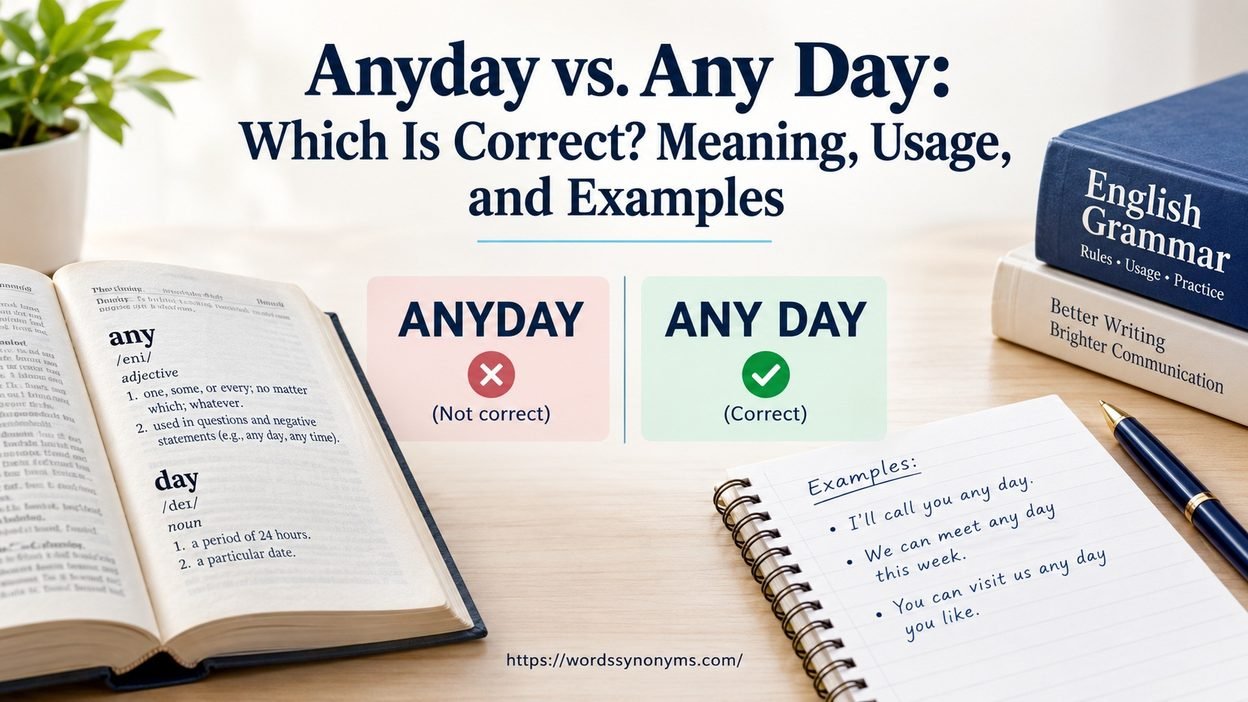
Anyday vs. Any Day: Meaning, Usage and Examples explains why any day is the correct form in standard English.
If you have typed anyday in a text message, paused, and started wondering whether it is a real word, you are not alone. The spelling looks natural because someday, anytime, and anywhere are single words.
However, English learners and native speakers should remember the simple rule: any day is written as two words. This spacing difference matters in professional writing, exams, emails, and everyday English.
A quick memory trick is to use any day when referring to a general time frame, especially when something is happening soon.
The phrase any day now means something is expected very soon, but the actual time is unknown. For example, a woman may deliver a child around her due date, yet labor can begin naturally at any hour or day.
Although anyday sometimes appears in informal writing or slang, major dictionaries do not generally accept it as a standard adverb. Spellcheck and AI tools may still get it wrong, so reliable usage guidance matters.
In formal works, keep the words separate. If anyday appears in a publication, readers may understand its purpose, but some may see it as a typo. Use any day correctly and confidently in formal and everyday writing.
Quick Answer
Any day is the standard form in ordinary English.
Use any day when you mean:
- whichever day
- any one of several possible days
- an unspecified day
- a day that may occur soon
- a flexible choice of day
For example:
- You can visit any day this week.
- Call me any day after Monday.
- The package could arrive any day now.
- I’d choose the blue one any day.
In standard prose, avoid writing:
- You can visit anyday this week.
- The package could arrive anyday now.
- I’d choose this one anyday.
Write any day instead.
| Form | Standard in ordinary English? | Main use |
| any day | Yes | An unspecified or possible day |
| anyday | No, not normally | Brand names, proper names, creative styling |
| any-day | No | Not the normal spelling |
The easiest rule is simple: When “any” describes the noun “day,” write the phrase as two words.
What Does “Any Day” Mean?
The phrase any day has several closely related meanings. Context determines which meaning the reader understands.
At its heart, any removes the need to identify one specific day. Instead of pointing to Monday, Tuesday, or another particular date, the phrase leaves the choice open.
“Any Day” Means Whichever Day
The most straightforward meaning is whichever day you choose or whichever day fits the situation.
Consider this sentence:
You can come any day this week.
The speaker isn’t naming one specific day. Monday works. Wednesday works. Friday may work, too. The exact day remains open.
Here are more examples:
- You can schedule the appointment any day next week.
- Choose any day that works for you.
- The store accepts returns any day during business hours.
- We can meet any day after the holiday.
- You may submit the form any day before the deadline.
In each example, any modifies day. The two words function together as a phrase.
“Any Day” Can Mean an Unspecified Day
Sometimes any day doesn’t give you a choice. Instead, it refers to a day that hasn’t been identified.
For example:
The announcement could come any day.
The sentence doesn’t necessarily mean you can choose the day. It means the announcement could happen on an unspecified day.
Another example makes the distinction clearer:
The weather could change any day.
Here, any day expresses possibility. The speaker doesn’t know exactly when the change will happen.
This use commonly appears when something is uncertain, unpredictable, or expected within a general period.
“Any Day” Can Express Strong Preference
There’s another interesting use that often catches learners off guard.
In a sentence such as:
I’d choose the original any day.
Any day doesn’t literally mean that the speaker would choose it on every calendar day. Instead, the phrase works as an idiomatic way to express a strong preference.
It means something close to:
“I’d choose it without hesitation.”
For example:
- I’d take the train over the bus any day.
- She’d pick homemade bread any day.
- I’d rather walk than wait for another ride any day.
- He’d choose experience over flashy credentials any day.
The phrase adds emphasis. It gives the sentence a confident, conversational tone.
Why Is “Any Day” Written as Two Words?
The grammar behind any day is surprisingly straightforward.
Any functions as a determiner. Day functions as a noun. Together, they form a noun phrase.
Look at the structure:
any + day = any day
The word any tells you that the noun isn’t restricted to one particular member of a group.
Compare:
- any day
- any week
- any month
- any year
- any morning
- any evening
- any weekend
These combinations normally remain separate because any modifies an ordinary noun.
This distinction becomes confusing because English contains several familiar words beginning with any that are written as single words.
For example:
- anyone
- anybody
- anything
- anywhere
- anytime
That pattern can tempt people to write anyday.
English, however, doesn’t turn every any + noun combination into one word. The spelling depends on the established word and its grammatical function.
That’s why you write:
- any day
- any week
- any month
- any person
but:
- anyone
- anything
- anywhere
The safest approach is to learn the established form rather than assume that similar-looking expressions follow identical spelling rules.
Is “Anyday” a Word?
Anyday may appear in real-world English, but that doesn’t make it the standard spelling of the ordinary phrase any day.
This distinction matters because English contains many names and branded terms that don’t follow ordinary spelling conventions.
For instance, a business might deliberately call itself Anyday. A website could use Anyday as its name. A username might also combine the two words.
In such cases, the spelling is part of the name.
That doesn’t mean you should transfer the spelling into normal sentences.
Think about a company with an unusual spelling. Its official name might use capitalization, missing spaces, abbreviations, or invented words. You wouldn’t automatically use that spelling elsewhere.
The same principle applies to Anyday.
When “Anyday” May Appear
You could encounter Anyday as:
- a company name
- a brand name
- a product name
- a website or app name
- a username
- a title
- a stylized business name
- a creative name for a project
If you’re referring specifically to that name, preserve its official spelling.
If you’re writing a normal sentence about an unspecified day, use any day.
Any Day vs. Any Day Now
One of the most common expressions containing any day is any day now.
The phrase means very soon or at any time in the near future.
For example:
The results should arrive any day now.
The speaker expects the results soon but doesn’t know the exact day.
Other examples include:
- The new store could open any day now.
- We’re expecting the shipment any day now.
- The announcement may come any day now.
- The repairs should be finished any day now.
Notice the spelling:
any day now
Not:
anyday now
The three words remain separate.
Why “Any Day Now” Can Be Confusing
The phrase often acts almost like a single unit in conversation. You may hear it frequently enough that it feels like one word.
However, pronunciation doesn’t determine spelling.
The same thing happens with many common phrases. When words occur together repeatedly, they can begin to sound like a single expression even though they remain separate in writing.
So when you’re writing any day now, keep all three words separate.
Any Day vs. Every Day
The difference between any day and every day is important because the phrases can look similar while expressing very different ideas.
Any day refers to one unspecified day or whichever day is possible.
Every day means each day.
Compare:
| Phrase | Meaning | Example |
| any day | Whichever or an unspecified day | You can call any day. |
| every day | Each day | She exercises every day. |
Consider these two sentences:
You can visit any day.
The visitor has flexibility. No particular day is required.
You should practice every day.
The instruction applies to each day.
A useful substitution test can help.
If you can replace every day with each day, you’re dealing with the two-word phrase every day.
For example:
I read every day.
becomes:
I read each day.
The meaning remains intact.
That test doesn’t work with any day because any carries a different idea of choice or possibility.
Any Day vs. Everyday
This distinction causes another common spelling problem.
Every day and everyday are not interchangeable.
Every day is an adverbial phrase meaning each day.
Everyday is an adjective meaning ordinary, routine, or common.
Compare:
I wear these shoes every day.
Here, every day tells us how often the action happens.
Now look at:
These are my everyday shoes.
Here, everyday describes the shoes. It means they’re ordinary shoes for regular use rather than special-occasion footwear.
The same grammatical distinction doesn’t apply to any day because anyday isn’t the standard ordinary form.
Compare these examples:
- You can call me any day.
- I call her every day.
- These are my everyday clothes.
Each phrase performs a different grammatical job.
Any Day vs. Someday
Any day and someday both refer to unspecified time, but their meanings aren’t the same.
Usually, any day refers to an unspecified day within a relevant period or to any possible day.
Someday usually refers to an unspecified time in the future.
Compare:
You can visit any day this month.
The speaker is offering flexibility within a known period.
Now consider:
I hope to visit someday.
The speaker doesn’t identify when the visit will happen. It could be months or years from now.
The contrast becomes clearer in a table:
| Expression | Core idea | Example |
| any day | Whichever possible day | Come any day this week. |
| someday | At an unspecified future time | I’d like to visit someday. |
So don’t replace any day with someday simply because both involve an uncertain time.
Any Day vs. One Day
The phrases any day and one day also carry different ideas.
Any day leaves the choice or identity completely open.
One day refers to a single day that isn’t specifically identified.
Compare:
You can submit the application any day this week.
The applicant has several possible choices.
Now:
One day, I’d like to visit Alaska.
The speaker imagines a particular future occasion but doesn’t say exactly when it will happen.
One day can also refer to an unspecified day in the past:
One day, I found an old photograph in a drawer.
The speaker has one particular event in mind. The exact date simply isn’t provided.
Any Day vs. Each Day
The phrase each day emphasizes individual days within a sequence.
For example:
The temperature changed each day.
The sentence focuses on the days one by one.
By comparison:
You can arrive any day.
The sentence focuses on freedom of choice.
The distinction is subtle but useful:
- any day = one day from an open range
- each day = every individual day in a range
This difference becomes especially important in instructions, schedules, and formal writing.
Read more: Super vs. Ultra: How Do You Use Them?
Common Phrases With “Any Day”
The phrase any day appears in several natural expressions. Learning these patterns can make correct usage much easier.
Any Day Now
Any day now means very soon.
Example:
The decision could be announced any day now.
Any Day of the Week
Any day of the week can have a literal meaning or an idiomatic meaning.
Literally:
The gym is open any day of the week.
This means you can go on whichever day suits you.
Idiomatic usage adds emphasis:
I’d choose the homemade version any day of the week.
Here, the speaker strongly prefers the homemade version.
On Any Day
The phrase can also appear after the preposition on.
For example:
On any day, the park can become crowded.
This construction often refers to a possible or representative day.
Any Given Day
Any given day refers to an unspecified or representative day.
For example:
On any given day, the café serves hundreds of customers.
The speaker isn’t claiming that every day has exactly the same number of customers. Instead, the phrase presents a typical or arbitrary day as an example.
This expression is especially common in explanatory and journalistic writing.
Any Day This Week
This phrase expresses flexibility within a defined period.
Examples include:
- We can meet any day this week.
- The delivery should arrive any day this week.
- You can reschedule for any day this week.
The context determines whether any day expresses choice or possibility.
Common Mistakes With “Anyday”
A tiny spelling mistake can make otherwise polished writing look careless. Fortunately, the common errors are easy to fix.
Writing “Anyday” in Ordinary Sentences
Incorrect:
You can call me anyday.
Correct:
You can call me any day.
The noun day remains separate from the determiner any.
Writing “Anyday Now”
Incorrect:
The package should arrive anyday now.
Correct:
The package should arrive any day now.
This is one of the most frequent places where the mistake appears.
Writing “Anyday of the Week”
Incorrect:
I’d choose that restaurant anyday of the week.
Correct:
I’d choose that restaurant any day of the week.
Even though the phrase is idiomatic, the spelling remains two words.
Assuming “Anytime” Means “Anyday”
It’s tempting to reason like this:
anytime → anyday
But English doesn’t work through perfect spelling symmetry.
Anytime is an established word in standard English. Any day remains a two-word phrase.
The same principle appears throughout English. Similar-looking constructions don’t necessarily share the same written form.
Correct and Incorrect Examples
The following examples show how any day works in different contexts.
| Nonstandard form | Correct form | Why |
| You can visit anyday. | You can visit any day. | “Any” modifies “day.” |
| Call me anyday this week. | Call me any day this week. | The day remains an ordinary noun. |
| It could happen anyday now. | It could happen any day now. | “Any day now” stays as three words. |
| Choose anyday you prefer. | Choose any day you prefer. | The phrase expresses free choice. |
| I’d take this one anyday. | I’d take this one any day. | Idiomatic preference still uses two words. |
| We can meet anyday after Tuesday. | We can meet any day after Tuesday. | “Any” determines the possible day. |
| The news may arrive anyday. | The news may arrive any day. | The day is unspecified. |
| Anyday this month works. | Any day this month works. | Standard phrase requires two words. |
| I would pick quality anyday. | I would pick quality any day. | The phrase emphasizes preference. |
| The order could arrive anyday now. | The order could arrive any day now. | Standard expression uses separate words. |
More Examples in Natural Sentences
Scheduling
Tuesday won’t work, but any day after Wednesday is fine.
Possibility
The weather could turn colder any day.
Expectation
The replacement part should arrive any day now.
Preference
I’d choose a quiet neighborhood any day.
Flexible plans
We can discuss the project any day next week.
General possibility
On any given day, traffic conditions can change quickly.
These examples show why context matters. The meaning shifts slightly, but the spelling doesn’t.
Any Day in Formal Writing
When you’re writing an email, article, report, academic assignment, business document, or application, use any day.
Standard spelling improves clarity and prevents readers from interpreting anyday as a typo or brand name.
For example, a professional message might say:
Please let us know which day works best. We can accommodate any day next week.
That sentence sounds natural because the phrase follows normal English grammar.
Another example:
The inspection can take place on any day between Monday and Friday.
There’s no reason to combine any and day.
Any Day in Casual Writing
Casual writing follows the same standard spelling.
You might see anyday in texts, comments, social media posts, or quick messages. However, frequent informal usage doesn’t make it the preferred standard form.
For polished writing, choose any day.
That’s especially important when the text represents a business, publication, website, school, or professional service.
Any Day in Brand Names and Proper Names
Here’s where the situation changes.
A company might officially use Anyday as its name. A product could also use the one-word spelling as part of its branding.
If you’re referring to that specific entity, use its official spelling.
For example:
Anyday launched a new service.
In that sentence, Anyday could function as a proper name.
That doesn’t conflict with the grammatical rule.
The important distinction is this:
Standard phrase:
You can come any day.
Possible proper name:
Anyday is the name of the service.
The first sentence uses ordinary English grammar. The second may use a deliberately created name.
Branding often ignores conventional spacing to create memorable names. Companies may join words, remove vowels, capitalize unusual letters, or create entirely new terms.
That is a naming choice, not a grammatical rule.
Any Day in American English
In standard US English, the ordinary phrase is any day.
This isn’t primarily an American-versus-British spelling difference. The basic construction remains two words when any modifies the noun day.
You’ll encounter the phrase in:
- everyday conversation
- business communication
- news writing
- educational material
- schedules
- instructions
- emails
- fiction
- essays
- formal documents
The same grammatical logic applies regardless of whether the sentence sounds formal or casual.
A Simple Case Study: Choosing the Correct Form
Imagine you’re writing an email to a client.
You want to say:
“We can schedule the meeting on whichever day works for you.”
You might initially write:
We can schedule the meeting anyday next week.
The meaning is understandable. The spelling, however, isn’t standard.
The polished version is:
We can schedule the meeting any day next week.
Now imagine a completely different context. You’re writing about a company officially called Anyday.
You might write:
Anyday offers customers a flexible payment service.
Here, Anyday functions as a proper name. Its one-word spelling is intentional.
This case study highlights the key principle:
Grammar controls ordinary phrases. Official names follow their established styling.
Don’t confuse the two.
How to Remember “Any Day”
If you regularly struggle with anyday vs. any day, use a simple mental test.
Try Replacing “Day” With “Week”
Ask yourself:
Would I write any week?
Yes.
You wouldn’t normally write:
anyweek
The same pattern helps you remember:
any day
Try Replacing “Day” With “Month”
Again:
any month
The words remain separate.
That gives you a useful pattern:
- any day
- any week
- any month
- any year
When any directly modifies an ordinary time noun, the phrase often stays visibly separate.
Remember “Any Day Now”
Memorize the entire expression:
any day now
Seeing the three-word pattern repeatedly makes the spelling easier to recall.
Don’t Let “Anytime” Trick You
Remember that anytime is its own established word.
It doesn’t create a rule that says every any + noun combination should become one word.
Think of English spelling as a collection of established conventions rather than a mathematical formula.
A Practical Decision Guide
When you’re unsure, ask what you actually mean.
| What you mean | Correct expression |
| Whichever day | any day |
| An unspecified day | any day |
| Something expected soon | any day |
| Something expected very soon | any day now |
| Each day | every day |
| Ordinary or routine | everyday |
| An unspecified future time | someday |
| One particular but unspecified day | one day |
| Every individual day | each day |
| A company or brand with that official name | Anyday, if that’s its official styling |
This table captures the distinction without requiring complicated grammar terminology.
FAQs
Is “anyday” a correct English word?
No. Any day is the standard form in English. Anyday may appear informally, but it is generally treated as a misspelling or typo in formal writing.
What does “any day” mean?
Any day usually refers to an unspecified day or a general time when something may happen. For example, “The package could arrive any day.”
Why do people write “anyday” as one word?
The spelling can seem natural because words such as anytime, anywhere, and anyhow are commonly written as single words. However, any day follows a different pattern.
Is “any day now” grammatically correct?
Yes. Any day now is a common phrase meaning that something is expected to happen very soon, although the exact time is unknown.
Can I use “anyday” in informal writing?
You may encounter anyday in casual messages, social media, or informal writing. However, any day is the safer choice because it is the accepted standard form.
How can I remember whether to use “any day” or “anyday”?
Think about the phrase as referring to any particular day. Keeping any and day separate is an easy memory trick that works well in exams, emails, and professional writing.
Conclusion
When in doubt, choose any day. The two-word form is the safest and most widely accepted choice in standard English, whether you’re writing an email, taking an exam, or preparing something for professional writing. Although anyday may look natural because of words like anytime and anywhere, it can still be viewed as a typo in formal contexts.
The easiest way to remember the difference is to think of any day as referring to an unspecified day or time. Once that simple pattern becomes familiar, this small English spelling issue becomes much easier to handle. Use any day confidently, and you won’t have to pause over the same question every time you write it.

Samreen Saif is a passionate writer and language enthusiast who contributes informative and engaging content to WordsSynonyms.com. She enjoys exploring English vocabulary, synonyms, antonyms, word meanings, and language usage to help readers understand and use words with confidence.
Samreen focuses on creating clear, accurate, and easy-to-read content for students, writers, professionals, and English learners. Through her articles, she aims to make vocabulary learning simple, practical, and useful for everyday communication.
When she is not writing, Samreen enjoys learning about language, discovering new words, and creating helpful content that makes English learning more accessible to everyone.