Orthopedic vs. Orthopaedic: Meaning, Spelling and Examples explains the difference between two different spellings of the same word, with no semantic difference in meaning.
Both describe the branch of medicine focused on the musculoskeletal system, including Bone, Joint, Disorders, and their treatment. In medical terminology, both forms are correct and interchangeable.
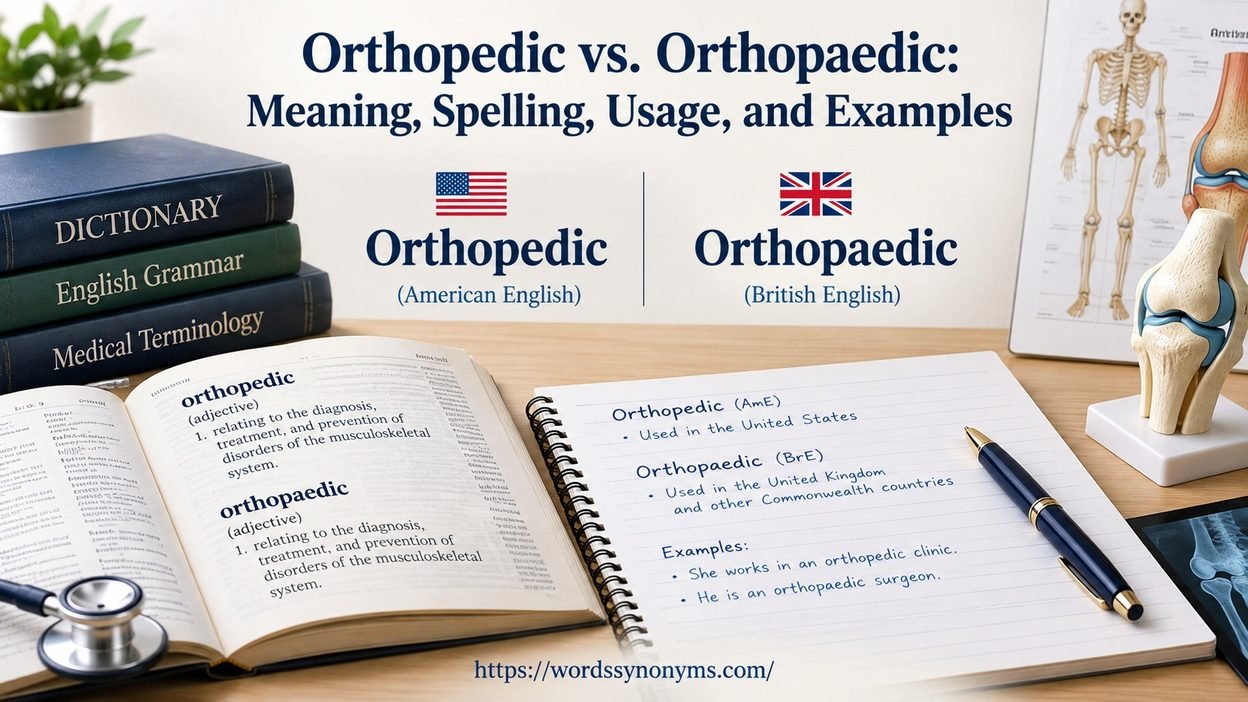
Orthopaedic is the standard British English spelling, while orthopedic is the preferred spelling in American English and is widely used in the US. This reflects familiar distinctions between British spelling and American spelling, such as colour and color.
The choice can depend on context, countries, and professional settings. A patient, medical professional, student, or content writer may encounter either version in clinical documentation, musculoskeletal medicine, or health related material.
Organizations such as the American Academy of Orthopaedic Surgeons (AAOS) and American Orthopaedic Association (AOA) retain orthopaedic in their names, reflecting institutional identity and professional standards.
The history and origin of the term also explain why both forms remain in use. Orthopedics refers to the field of orthopedics, while Orthopaedic vs. Orthopedics can create further clarification questions for readers.
Quick Answer
Orthopedic and orthopaedic mean the same thing. The only real difference is regional spelling: orthopedic is the standard form in American English, while orthopaedic is preferred in British English.
| Term | English Variety | Meaning |
| Orthopedic | American English | Related to bones, joints, and the musculoskeletal system |
| Orthopaedic | British English | Same meaning as orthopedic |
| Orthopedics | American English | The medical specialty |
| Orthopaedics | British English | Same specialty as orthopedics |
In short: use orthopedic for US English and orthopaedic for UK English. The spelling changes, but the medical meaning stays the same.
Orthopedic vs. Orthopaedic: Quick Difference
The easiest way to remember the distinction is simple:
- Orthopedic = American English
- Orthopaedic = British English
- Both words have the same meaning.
- Both relate to the treatment or study of bones and the wider musculoskeletal system.
- The spelling difference does not indicate a different medical specialty.
Cambridge Dictionary identifies orthopedic as the US form and orthopaedic as the UK form. It also gives the corresponding noun forms as orthopedics in US English and orthopaedics in UK English.
| Feature | Orthopedic | Orthopaedic |
| Main English variety | American English | British English |
| Part of speech | Adjective | Adjective |
| Meaning | Related to orthopedics | Related to orthopaedics |
| Spelling | No a after “p” | Includes a after “p” |
| Noun form | orthopedics | orthopaedics |
| Specialist | orthopedist | orthopaedist |
| Example | orthopedic surgeon | orthopaedic surgeon |
So, if you’re writing for a US audience, orthopedic is the natural choice. For British English, orthopaedic is the conventional form.
What Does Orthopedic Mean?
Orthopedic is an adjective that describes something connected with orthopedics, the medical specialty concerned with bones and related parts of the musculoskeletal system.
The term commonly appears in discussions of bones, joints, muscles, ligaments, tendons, injuries, deformities, and related conditions. Cambridge gives examples such as orthopedic surgeon, orthopedic specialist, and orthopedic hospital.
The word can also describe products designed to support, protect, or help treat musculoskeletal problems. For example, you might see phrases such as orthopedic shoes or orthopedic mattress.
Examples of Orthopedic in a Sentence
- She visited an orthopedic surgeon after injuring her knee.
- The hospital has a busy orthopedic department.
- He needed orthopedic surgery after the accident.
- The doctor recommended an orthopedic evaluation.
- These orthopedic shoes provide additional foot support.
- Her physician referred her to an orthopedic specialist.
- The athlete returned to training after receiving orthopedic care.
In each example, orthopedic functions as an adjective. It describes the type of surgeon, surgery, evaluation, shoes, specialist, or care involved.
What Does Orthopaedic Mean?
Orthopaedic has the same meaning as orthopedic. The difference is spelling rather than definition.
British English traditionally uses orthopaedic, particularly in formal medical contexts. You’ll commonly encounter phrases such as orthopaedic surgeon, orthopaedic surgery, and orthopaedic department.
Cambridge Dictionary specifically labels orthopaedic as the UK form and orthopedic as the US equivalent.
Examples of Orthopaedic in a Sentence
- She was referred to an orthopaedic surgeon.
- The hospital has a specialist orthopaedic department.
- He works in orthopaedic surgery.
- The patient received an orthopaedic assessment.
- The clinic provides specialist orthopaedic care.
- The doctor recommended orthopaedic shoes.
- She was admitted to the orthopaedic ward after her injury.
Notice something important: the meaning remains unchanged. Only the regional spelling shifts.
Orthopedic vs. Orthopaedic: Are They Different in Meaning?
No. Orthopedic and orthopaedic mean essentially the same thing.
The difference resembles other British-American spelling variations. For example, American English often uses color, while British English uses colour. The additional letter doesn’t create a different color. It reflects a different spelling convention.
The same principle applies here:
orthopedic = US spelling
orthopaedic = UK spelling
Neither word describes a separate branch of medicine.
The Difference Is in Spelling
Look closely at the middle of each word:
- ortho + pedic
- ortho + paedic
The British form retains the a in paedic, while the American form uses pedic.
That distinction continues through the word family:
- orthopedic → American English
- orthopaedic → British English
- orthopedics → American English
- orthopaedics → British English
- orthopedist → American English
- orthopaedist → British English
The pattern becomes easier to recognize once you see the words together.
Orthopedics vs. Orthopaedics
The adjective isn’t the only form that changes.
The name of the medical specialty also has two regional spellings:
- orthopedics — American English
- orthopaedics — British English
Cambridge defines orthopedics as the US form and identifies orthopaedics as the UK equivalent. Both refer to the treatment or study of bones that have developed incorrectly or have been damaged.
Examples of Orthopedics
- He plans to specialize in orthopedics.
- The hospital has a large orthopedics department.
- She works in orthopedics and sports medicine.
- The patient was referred to orthopedics for further assessment.
Examples of Orthopaedics
- She works in orthopaedics.
- He trained in orthopaedics and trauma.
- The hospital expanded its orthopaedics service.
- The patient was referred to orthopaedics after the injury.
The spelling changes, but the specialty doesn’t.
Orthopedic vs. Orthopaedic in American and British English
Regional consistency matters most when you’re writing professionally.
American English: Orthopedic
In American English, use orthopedic.
Common US expressions include:
- orthopedic surgeon
- orthopedic specialist
- orthopedic surgery
- orthopedic hospital
- orthopedic clinic
- orthopedic treatment
- orthopedic injury
- orthopedic care
- orthopedic implant
- orthopedic device
For a US-focused website or publication, orthopedic will usually fit the expected spelling style.
British English: Orthopaedic
In British English, use orthopaedic.
Common expressions include:
- orthopaedic surgeon
- orthopaedic specialist
- orthopaedic surgery
- orthopaedic hospital
- orthopaedic clinic
- orthopaedic treatment
- orthopaedic injury
- orthopaedic care
- orthopaedic implant
- orthopaedic device
If the surrounding content follows British spelling, orthopaedic keeps the terminology consistent.
Why Regional Spelling Matters
Imagine a British medical article that uses orthopaedic, paediatric, colour, and centre. Suddenly switching to orthopedic can make the writing look inconsistent.
The reverse is also true.
An American article that otherwise follows US spelling will generally read more naturally with orthopedic rather than orthopaedic.
This isn’t about one spelling being superior. It’s about matching the language variety of your audience.
Orthopedic vs. Orthopaedic Pronunciation
The spelling differs more noticeably than the pronunciation.
Cambridge gives the US pronunciation of orthopedic as approximately:
/ˌɔːr.θəˈpiː.dɪk/
For orthopaedic, Cambridge gives the same US pronunciation and a corresponding UK pronunciation.
In everyday speech, the two spellings generally sound the same or extremely similar for speakers using the corresponding regional variety.
A simple pronunciation guide is:
or-thuh-PEE-dik
The important point is that the extra a in orthopaedic doesn’t create a completely different spoken word.
Does the Extra “A” Change the Pronunciation?
Not in the way a learner might expect.
The spelling orthopaedic looks longer, but speakers don’t normally pronounce it as though the added a creates a separate syllable.
That makes this another useful example of why English spelling and pronunciation don’t always line up perfectly.
Orthopedic vs. Orthopaedic Examples
Seeing the words in realistic sentences makes the distinction much easier.
Examples With Orthopedic
- The athlete visited an orthopedic surgeon after injuring his shoulder.
- Her doctor recommended an orthopedic evaluation.
- The hospital opened a new orthopedic clinic.
- He specializes in orthopedic surgery.
- The patient received treatment for an orthopedic condition.
- She purchased orthopedic shoes for additional support.
- The hospital’s orthopedic department treats a wide range of injuries.
Examples With Orthopaedic
- The athlete visited an orthopaedic surgeon after injuring his shoulder.
- Her doctor recommended an orthopaedic evaluation.
- The hospital opened a new orthopaedic clinic.
- He specializes in orthopaedic surgery.
- The patient received treatment for an orthopaedic condition.
- She purchased orthopaedic shoes for additional support.
- The hospital’s orthopaedic department treats a wide range of injuries.
The sentences demonstrate the central point perfectly. The medical meaning stays the same while the spelling changes with regional English.
Orthopedic vs. Orthopaedic Side-by-Side
| American English | British English |
| orthopedic surgeon | orthopaedic surgeon |
| orthopedic specialist | orthopaedic specialist |
| orthopedic surgery | orthopaedic surgery |
| orthopedic clinic | orthopaedic clinic |
| orthopedic department | orthopaedic department |
| orthopedic hospital | orthopaedic hospital |
| orthopedic care | orthopaedic care |
| orthopedic treatment | orthopaedic treatment |
| orthopedic shoes | orthopaedic shoes |
| orthopedic implant | orthopaedic implant |
This table also shows why consistency matters. Once you choose a regional spelling, related terms usually follow the same pattern.
Related Words: Orthopedist and Orthopaedist
The person who specializes in this field also has two regional forms.
- orthopedist — American English
- orthopaedist — British English
Cambridge defines an orthopedist as a doctor who specializes in treating bones that have not developed correctly or have been damaged. It identifies orthopaedist as the UK form.
For example:
- American: “She consulted an orthopedist about her knee.”
- British: “She consulted an orthopaedist about her knee.”
Again, the spelling changes while the basic meaning remains the same.
Orthopedic vs. Orthopaedic vs. Orthodontic
One mistake deserves special attention: confusing orthopedic with orthodontic.
The words look somewhat alike, but they refer to different areas.
| Word | General meaning |
| orthopedic | Related to bones, joints, muscles, and the musculoskeletal system |
| orthopaedic | British spelling of orthopedic |
| orthodontic | Related to correcting the position and alignment of teeth and jaws |
For example:
- An orthopedic surgeon may treat a damaged knee.
- An orthopaedic surgeon means the same thing in British English.
- An orthodontist works with dental and jaw alignment.
The similar beginnings can cause confusion. The medical fields themselves are different.
What Does an Orthopedic Surgeon Do?
An orthopedic surgeon is a medical specialist who diagnoses and treats problems involving the musculoskeletal system.
That system includes structures such as:
- bones
- joints
- muscles
- ligaments
- tendons
- cartilage
Treatment can vary considerably depending on the condition. Some orthopedic problems respond to nonsurgical care, while others may require an operation.
Orthopedic care can involve assessment, imaging, medication, physical therapy, rehabilitation, injections, or surgery depending on the patient’s individual situation.
The adjective orthopedic therefore appears in a broad range of medical contexts. It doesn’t automatically mean that surgery is involved.
For example, orthopedic treatment is broader than orthopedic surgery.
Common Conditions Discussed in Orthopedic Care
The field covers many types of musculoskeletal problems.
Examples include:
- broken bones and fractures
- arthritis affecting joints
- ligament injuries
- tendon injuries
- sports injuries
- joint instability
- certain spinal conditions
- bone deformities
- cartilage damage
- some congenital musculoskeletal conditions
The exact scope of practice can vary among specialists. Some focus on particular areas such as sports medicine, hand surgery, foot and ankle care, hip and knee surgery, spine care, or pediatric orthopedics.
The spelling remains the same regardless of the subspecialty.
Orthopedic and Orthopaedic in Medical Writing
Medical writing benefits from precision. That doesn’t mean you need to make every sentence complicated.
The key is consistency.
If an American medical publication uses orthopedic, switching randomly to orthopaedic can create unnecessary inconsistency. A British publication following UK conventions would normally use orthopaedic instead.
Practical Rule for Writers
Before writing a medical article, identify the intended English variety.
Then follow that choice throughout the article.
For US English:
orthopedic → orthopedics → orthopedist
For UK English:
orthopaedic → orthopaedics → orthopaedist
This simple pattern prevents most spelling mistakes.
Orthopedic vs. Orthopaedic: Which Spelling Should You Use?
The right spelling depends on your audience.
Use Orthopedic for American English
Choose orthopedic when writing for a US audience or following American English style.
Examples include:
- orthopedic surgeon
- orthopedic clinic
- orthopedic surgery
- orthopedic specialist
- orthopedics
If your article uses other American spellings, orthopedic will generally fit naturally.
Use Orthopaedic for British English
Choose orthopaedic when following British English conventions.
Examples include:
- orthopaedic surgeon
- orthopaedic clinic
- orthopaedic surgery
- orthopaedic specialist
- orthopaedics
The same principle applies to formal documents, educational materials, websites, and professional publications.
What About International English?
International readers encounter both forms.
A global website may choose one spelling based on its editorial style or primary audience. An organization may also preserve its established name or branding even when that spelling comes from another variety of English.
The safest approach is straightforward: follow the spelling system used by the publication or institution you’re writing for.
Read more: All But vs. Anything But vs. Everything But: What’s the Difference?
Is Orthopaedic a Misspelling of Orthopedic?
No.
Orthopaedic is an established British English spelling. Orthopedic is the established American English form.
Calling orthopaedic a misspelling ignores the regional distinction between British and American English.
Cambridge explicitly identifies orthopaedic as UK usage and orthopedic as US usage.
So, if you see orthopaedic surgeon in a British publication, there’s nothing wrong with the spelling.
Likewise, orthopedic surgeon is completely standard in American English.
Is Orthopedic Correct in British English?
Orthopaedic is the conventional British spelling.
That said, British readers may encounter orthopedic in international material, American publications, product names, academic sources, or organizations that use American English.
Therefore, seeing orthopedic in a British context doesn’t automatically mean the writer made a spelling mistake.
For formal British writing, however, orthopaedic is the expected regional form.
Is Orthopaedic Correct in American English?
Orthopedic is the conventional American spelling.
American readers can still encounter orthopaedic in British publications or when an organization deliberately retains British spelling. The form is recognizable and has the same meaning.
For ordinary US English writing, though, orthopedic is the standard choice.
Common Mistakes With Orthopedic and Orthopaedic
A few errors appear repeatedly.
Treating Them as Different Medical Specialties
This is the biggest misunderstanding.
Orthopedic and orthopaedic don’t represent different branches of medicine. They’re regional spelling variants.
Calling Orthopaedic Incorrect
The spelling orthopaedic is not an error simply because American English uses orthopedic.
British English has its own established spelling conventions.
Mixing the Forms Without a Reason
A document might use:
orthopedic surgeon
in one section and:
orthopaedic surgery
in another.
That isn’t necessarily grammatically wrong, but unexplained switching can make the writing look inconsistent.
Pick the regional form that suits your audience and stick with it.
Confusing Orthopedic With Orthodontic
These terms describe different medical fields.
Orthopedic relates broadly to the musculoskeletal system.
Orthodontic relates to the correction of teeth and jaw alignment.
The similarity in spelling makes this an easy mistake to make.
A Simple Memory Trick
Need a quick way to remember the difference?
Think of the a in orthopaedic as a marker for British spelling.
American
orthopedic
British
orthopaedic
Then apply the same pattern:
American
- orthopedic
- orthopedics
- orthopedist
British
- orthopaedic
- orthopaedics
- orthopaedist
Once the pattern becomes familiar, the spelling choice takes only a moment.
A Practical Writing Case Study
Imagine that a US health website is publishing an article about knee injuries.
The article uses:
- center
- specialized
- pediatric
- color
Those choices clearly follow American English.
In that article, orthopedic would fit the established spelling style:
Patients with persistent knee problems may need an orthopedic evaluation.
Now imagine a British health publication discussing the same subject. Its spelling may follow forms such as:
- centre
- specialised
- paediatric
- colour
In that context, the natural equivalent would be:
Patients with persistent knee problems may need an orthopaedic assessment.
The medical information doesn’t change. The regional spelling does.
That distinction is exactly what orthopedic vs. orthopaedic is about.
Orthopedic vs. Orthopaedic: Quick Reference
| Question | Answer |
| Are orthopedic and orthopaedic the same? | Yes, they have the same basic meaning. |
| Is orthopedic American English? | Yes. |
| Is orthopaedic British English? | Yes. |
| Is orthopaedic a misspelling? | No. |
| Is orthopedic a misspelling? | No. |
| What is the US noun? | orthopedics |
| What is the UK noun? | orthopaedics |
| What is the US specialist form? | orthopedist |
| What is the UK specialist form? | orthopaedist |
| Does the spelling change the medical meaning? | No. |
| Which form should US writers use? | orthopedic |
| Which form should UK writers use? | orthopaedic |
FAQs
Is orthopedic different from orthopaedic?
No. Orthopedic and orthopaedic have the same meaning and refer to the branch of medicine concerned with the musculoskeletal system. The difference is mainly spelling and regional usage.
Which spelling is used in American English?
Orthopedic is the standard spelling generally preferred in American English. You’ll commonly see it in medical writing, healthcare services, and general US usage.
Which spelling is used in British English?
Orthopaedic is the traditional British English spelling. It is also used by some medical organizations and institutions outside the UK that follow British spelling conventions.
Why does orthopaedic have an extra “a”?
The a comes from the traditional spelling orthopaedic, which reflects its Greek and European linguistic history. American English commonly simplified the spelling to orthopedic.
Should a medical professional use orthopedic or orthopaedic?
The appropriate choice depends on the country, institution, publication style, and professional setting. Consistency is usually more important than treating one spelling as universally correct.
Is orthopedics the same as orthopaedics?
Yes. Orthopedics and orthopaedics refer to the same medical specialty. The spelling generally follows American or British English conventions, respectively.
Conclusion
Orthopedic and orthopaedic may look different on the page, but they describe the same medical specialty. The main distinction comes from American English and British English spelling conventions. Orthopedic is generally used in the United States, while orthopaedic remains common in British usage and in the names of some medical organizations.
The important thing is to match the spelling with your context, audience, and preferred style. Whether you’re a patient, student, medical professional, or writer, knowing this small spelling difference can help you write more clearly and avoid unnecessary confusion when discussing the musculoskeletal system.

Syeda Naalain Zahra is a content writer with an interest in English vocabulary and language. She creates simple and informative articles about synonyms, antonyms, word meanings, and everyday English usage. Her aim is to help readers build better vocabulary and communicate more confidently.