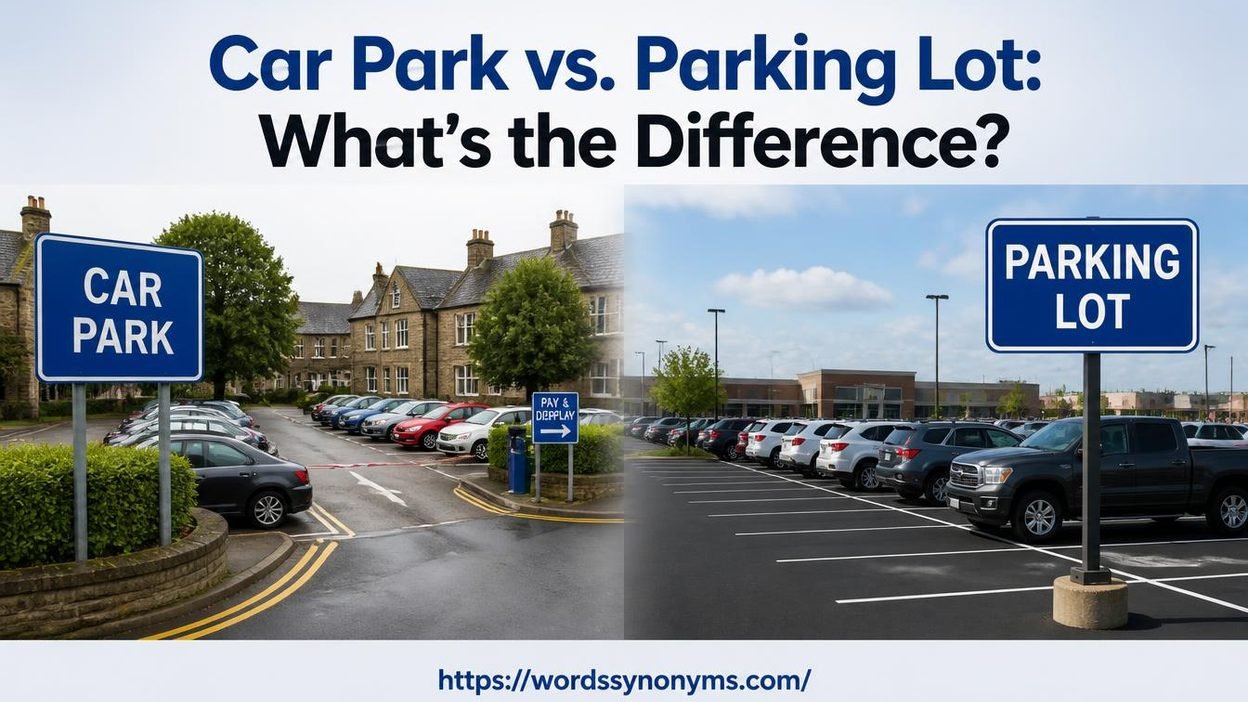
Car Park vs. Parking Lot shows how regional language changes while the purpose of organized vehicle parking remains largely the same for daily users.
A car park or parking lot is an area where a car, truck, or motorcycle stays off-street for a period of time, usually within a paved area containing spaces that are clearly marked with white paint or yellow paint, helping each driver use one space.
The difference mainly comes from regional language, with British English using car park and North American English or American English favoring parking lot. In my experience with travel-related terminology, the wording changes, but the purpose remains an organized place where cars are parked.
A multiple-storied building may be called a multi-storey car park in Britain or a parking garage in America, while different parking options include a satellite parking lot located away from the main building or lot it is servicing, often requiring passengers to take a shuttle to their destination. Many airports offer satellite parking as a cheaper alternative.
Similarly, a commuter parking lot allows a person to leave car behind, share a ride with a group, or continue by bus or train, making commuter parking lots convenient for people traveling a good distance between the city and work.
Quick Answer
Both car park and parking lot describe designated areas where people park vehicles. The biggest difference involves regional language usage.
| Feature | Car Park | Parking Lot |
| Primary English variety | British English | American English |
| Basic meaning | Area for parking vehicles | Area for parking vehicles |
| Common usage | UK and many Commonwealth countries | United States and Canada |
| Typical environment | Outdoor or structured facility | Usually an outdoor parking area |
| Example | “The car park is full.” | “The parking lot is full.” |
In everyday conversation, the terms often mean exactly the same thing.
For example, a British driver might say:
“I left my car in the car park.”
An American driver would likely say:
“I left my car in the parking lot.”
The vehicle hasn’t moved. Only the vocabulary has changed.
That’s the central difference.
However, once you start discussing multi-level buildings and covered parking facilities, the terminology becomes more specific.
What Does “Car Park” Mean?
A car park is an area or facility designed for parking cars and other vehicles.
The term is standard in British English. You’ll commonly hear it in the United Kingdom, Ireland, Australia, New Zealand, and several other countries where British English influences everyday vocabulary.
A car park may be:
- An open paved area
- A private parking facility
- A public parking area
- An underground parking facility
- A multi-level structure
- A hotel or office parking area
- A supermarket parking area
The exact physical structure doesn’t always matter as much as the function. If people leave vehicles there temporarily, British English speakers may broadly describe it as a car park.
Examples of “Car Park” in Sentences
Here are several natural examples:
- The supermarket car park was completely full.
- We found a space near the entrance.
- Please don’t leave your vehicle in the staff car park.
- The hotel offers free overnight parking in its car park.
- Security cameras monitor the car park around the clock.
- I parked on the top floor of the multi-storey car park.
Notice something important: car park refers to the entire parking area.
It doesn’t refer to one individual location for one car.
For that, you would normally use terms such as:
- Parking space
- Parking bay
- Parking spot
For example:
“The car park has 500 parking spaces.”
The car park is the larger facility. Each parking space is an individual place within it.
Where Is “Car Park” Commonly Used?
The term appears most naturally in countries influenced by British English.
Common regions include:
- United Kingdom
- Ireland
- Australia
- New Zealand
However, English vocabulary isn’t perfectly uniform across the world.
For example, regional preferences may differ between countries, industries, and local communities. That’s why understanding your audience matters more than memorizing rigid rules.
If you’re writing for a British audience, though, car park is usually the natural choice.
What Does “Parking Lot” Mean?
A parking lot is a designated area where multiple vehicles can park.
In American English, this is the standard everyday term.
You’ll commonly hear it when people discuss parking at:
- Shopping centers
- Schools
- Restaurants
- Hospitals
- Sports stadiums
- Office buildings
- Airports
- Hotels
A typical parking lot consists of marked spaces arranged in rows. Drivers enter through designated lanes, park their vehicles, and leave through one or more exits.
In most American contexts, when someone says parking lot, people picture an outdoor paved area.
For example:
“Meet me in the parking lot after the concert.”
Nobody would find that sentence unusual in the United States.
Examples of “Parking Lot” in Sentences
Here are some common examples:
- The parking lot was full before noon.
- We parked at the far end of the parking lot.
- New lights were installed throughout the parking lot.
- Employees must use the parking lot behind the building.
- The parking lot has spaces for more than 300 vehicles.
- Someone left a shopping cart in the middle of the parking lot.
The meaning remains straightforward. A parking lot is a place designed to hold parked vehicles.
Where Is “Parking Lot” Commonly Used?
Parking lot is most strongly associated with:
- United States
- Canada
- American English publications
- US-based businesses
- International content written primarily for American readers
If you’re writing a website aimed at an American audience, parking lot will usually sound more natural than car park.
Car Park vs. Parking Lot: Is There Actually a Difference?
Here’s where many explanations become unnecessarily complicated.
In their basic meaning, car park and parking lot describe essentially the same thing.
Both refer to areas where vehicles can be parked.
The biggest distinction is linguistic rather than physical.
| Situation | British English | American English |
| Outdoor parking area | Car park | Parking lot |
| Individual place for one vehicle | Parking space | Parking space |
| Multi-level facility | Multi-storey car park | Parking garage |
| Underground facility | Underground car park | Underground parking garage |
| Employee parking area | Staff car park | Employee parking lot |
Think of the terms like different labels on the same box.
A British speaker sees an outdoor paved area filled with vehicles and says car park.
An American speaker sees the same area and says parking lot.
Neither person is describing a fundamentally different place.
The Meaning Stays the Same, but Context Changes
Language rarely follows perfectly straight lines.
While car park and parking lot overlap heavily, specific building types can influence which word sounds more natural.
For example, Americans usually distinguish between:
- Parking lot — typically an open outdoor area
- Parking garage — usually a covered or multi-level structure
British English often uses more descriptive forms, such as:
- Car park
- Multi-storey car park
- Underground car park
That distinction becomes important when describing large urban parking facilities.
Car Park vs. Parking Lot: British English and American English
The difference between these terms fits into a larger pattern.
British and American English often use different words for ordinary objects and places.
Consider these examples:
| British English | American English |
| Car park | Parking lot |
| Lift | Elevator |
| Flat | Apartment |
| Lorry | Truck |
| Petrol | Gas |
| Motorway | Highway |
| Holiday | Vacation |
| Queue | Line |
Neither version is inherently more correct.
They simply reflect different regional varieties of English.
That’s an important point for writers, students, businesses, and language learners.
English isn’t one perfectly standardized system. It changes across countries and communities.
A word that sounds completely normal in London might sound distinctly British in Los Angeles.
Likewise, an everyday American expression may sound unusual in Manchester.
Why Regional Vocabulary Matters
Suppose you’re writing a hotel website for travelers in London.
This sentence sounds natural:
“Guests can use the secure car park located behind the hotel.”
Now imagine the same website targets travelers in Chicago.
A more natural version would be:
“Guests can use the secure parking lot located behind the hotel.”
The meaning hasn’t changed.
The audience has.
That small adjustment makes writing feel more familiar and locally relevant.
Read more: John Hancock vs. John Henry: Meaning and Examples
Car Park vs. Parking Garage vs. Parking Lot
This is where confusion often appears.
Many people assume every vehicle storage area falls under one general term. In reality, English often uses different words depending on the physical structure.
Car Park
A car park generally refers to a designated parking facility in British English.
It may be:
- Outdoor
- Underground
- Covered
- Multi-level
Writers often add descriptive words when necessary.
Examples include:
- Outdoor car park
- Underground car park
- Multi-storey car park
- Private car park
Parking Lot
A parking lot generally refers to an outdoor area where vehicles park.
Typical features include:
- Paved surfaces
- Painted parking lines
- Rows of spaces
- Entry and exit lanes
- Pedestrian walkways
- Lighting
You’ll often find parking lots outside:
- Stores
- Schools
- Restaurants
- Offices
- Stadiums
Parking Garage
A parking garage usually refers to a covered building or multi-level structure designed specifically for vehicle parking.
It may have several floors connected by ramps.
For example:
“The airport parking garage has six levels.”
In British English, a similar facility might be called a:
Multi-storey car park
Quick Comparison
| Term | Typical Structure | Primary Usage |
| Car park | Outdoor or structured | British English |
| Parking lot | Usually outdoor | American English |
| Parking garage | Covered or multi-level | American English |
| Multi-storey car park | Multi-level structure | British English |
This distinction helps prevent one of the most common vocabulary mistakes.
A parking lot isn’t always the best American term for a multi-level building.
Likewise, calling every parking facility a garage can create confusion.
The physical setting matters.
Types of Car Parks and Parking Lots
Parking facilities come in many forms.
Although the vocabulary differs by region, the underlying designs are familiar around the world.
Surface Parking
Surface parking is the most recognizable type.
It consists of an open area where vehicles park on ground level.
Common locations include:
- Shopping centers
- Supermarkets
- Schools
- Office parks
- Sports venues
A surface parking area may be called a car park in British English or a parking lot in American English.
These facilities typically include marked spaces, driving lanes, lighting, drainage systems, and pedestrian access.
Multi-Level Parking
Multi-level facilities solve a simple problem: land in busy cities costs money.
Instead of spreading hundreds of vehicles across a huge piece of land, developers build upward.
British English commonly uses:
Multi-storey car park
American English commonly uses:
Parking garage or parking structure
These buildings may contain several levels connected through ramps.
Some also use automated payment systems, electronic space indicators, and vehicle guidance technology.
Underground Parking
Underground parking sits below ground level.
It’s particularly common in dense city centers where surface land is valuable.
Examples include parking beneath:
- Office towers
- Hotels
- Shopping centers
- Residential buildings
- Airports
British English often calls this an underground car park.
American English may use underground parking garage.
Covered Parking
Covered parking protects vehicles from weather without necessarily forming a complete enclosed building.
A covered facility may include:
- Roof structures
- Open sides
- Support columns
- Marked spaces
Carports and covered parking areas often fall into this category.
Public and Private Parking Facilities
Ownership also changes how parking facilities operate.
Public parking generally allows members of the public to park, sometimes for a fee.
Private parking belongs to a business, organization, or property owner.
Examples include:
- Employee parking
- Resident parking
- Hotel guest parking
- Private office parking
Some private facilities restrict access using:
- Gates
- Permits
- Registration systems
- Security personnel
- License plate recognition
The terminology may change from country to country, but the purpose remains identical: organize vehicle storage safely and efficiently.
Common Vocabulary Differences Related to Parking
The difference between car park vs. parking lot is only one part of a broader vocabulary pattern.
Several parking-related terms also vary between British and American English.
| British English | American English | Meaning |
| Car park | Parking lot | Area for parking vehicles |
| Multi-storey car park | Parking garage | Multi-level parking building |
| Parking space | Parking space | Individual place for one vehicle |
| Parking bay | Parking space | Marked individual parking area |
| Disabled parking | Accessible parking | Reserved parking for eligible users |
| Car park attendant | Parking attendant | Person who manages parking |
| Pay and display | Pay station system | Parking payment method |
Not every regional difference follows a strict one-to-one pattern.
For example, some American terms appear internationally because of movies, television, technology, and global travel.
Still, choosing vocabulary based on your primary audience creates more natural writing.
How to Use “Car Park” and “Parking Lot” Correctly
The easiest rule is surprisingly simple.
Match the term to your audience.
Use “Car Park” When Writing for British English Readers
Choose car park when your audience is primarily located in:
- The United Kingdom
- Ireland
- Australia
- New Zealand
- Other regions where British English conventions dominate
For example:
“Visitors can park free of charge in the main car park.”
That sentence sounds natural in British English.
Use “Parking Lot” When Writing for American English Readers
Choose parking lot when writing primarily for:
- The United States
- Canada
- American English audiences
For example:
“Visitors can park free of charge in the main parking lot.”
The meaning remains identical, but the regional tone changes.
Stay Consistent Throughout Your Writing
Consistency matters.
Imagine reading this:
“The hotel has a large car park. Guests can enter the parking lot through the west gate.”
Technically, readers may understand both terms.
Stylistically, though, the language feels inconsistent.
Unless you’re intentionally comparing regional vocabulary, choose one variety of English and stick with it.
That’s especially important for:
- Websites
- Blogs
- Business signage
- Travel guides
- Educational materials
- Product documentation
Small vocabulary choices shape the reader’s experience.
Car Park vs. Parking Lot: Real-Life Examples
Sometimes the easiest way to understand vocabulary is through everyday situations.
Example: A Supermarket
Imagine a large supermarket surrounded by hundreds of vehicle spaces.
A British customer might say:
“The supermarket car park is packed today.”
An American customer might say:
“The supermarket parking lot is packed today.”
Same supermarket.
The same vehicles.
And, of course, the same traffic headache.
Different vocabulary.
Example: An Airport
Airports often have multiple parking facilities.
A British airport might use signs such as:
- Short Stay Car Park
- Long Stay Car Park
- Multi-storey Car Park
An American airport might use:
- Short-Term Parking
- Long-Term Parking
- Parking Garage
The terminology changes based on regional language conventions and facility design.
Example: An Office Building
A company website might write:
British English:
“Employees must display their permits while using the staff car park.”
American English:
“Employees must display their permits while using the employee parking lot.”
Both versions communicate the same instruction.
The audience determines which one feels natural.
Case Study: Why Context Matters More Than Literal Translation
Consider an international hotel company operating properties in both London and New York.
The company creates a standard amenities page.
The British version says:
“Secure on-site car parking is available for hotel guests.”
The American version says:
“Secure on-site parking is available for hotel guests.”
Notice something interesting.
The American version doesn’t necessarily need parking lot.
Why?
Because parking alone can work perfectly when the context is clear.
This reveals an important writing principle: don’t force a keyword into every sentence when a simpler phrase sounds better.
Depending on context, you might use:
- Parking available
- On-site parking
- Guest parking
- Free parking
- Secure parking
These phrases often sound more natural than repeatedly saying car park or parking lot.
Good writing doesn’t hammer readers with the same phrase.
It uses the most natural term for each sentence.
Common Mistakes When Using Car Park and Parking Lot
Even simple vocabulary can cause confusion.
Here are several mistakes worth avoiding.
Thinking Car Park and Parking Lot Describe Completely Different Things
This is the biggest misunderstanding.
In most everyday contexts, car park and parking lot refer to the same basic concept.
The difference primarily involves regional vocabulary.
Don’t assume a car park must look different from a parking lot.
Usually, it doesn’t.
Confusing a Parking Space With a Parking Lot
A parking space is one designated place for one vehicle.
A parking lot or car park contains many parking spaces.
For example:
“The parking lot has 250 parking spaces.”
Think of it like this:
Parking facility → rows → individual parking spaces
The larger facility contains the smaller spaces.
Calling Every Multi-Level Facility a Parking Lot
In American English, a multi-level structure is usually called a parking garage or parking structure.
For example:
“The downtown parking garage has eight floors.”
Calling it a parking lot isn’t always technically impossible, but it doesn’t describe the structure as precisely.
Mixing British and American English Randomly
This mistake often appears in online writing.
For example:
“Park your car in the car park and take the elevator to the third floor.”
This sentence mixes British and American vocabulary.
A British version might say:
“Park your car in the car park and take the lift to the third floor.”
An American version might say:
“Park your car in the parking lot and take the elevator to the third floor.”
Consistency creates smoother writing.
Assuming Every Country Uses the Same Terms
English varies around the world.
Even countries that primarily use British English may have local expressions and preferences.
That’s why writers should consider:
- Target country
- Local audience
- Industry terminology
- Brand style guide
- Regional expectations
Language doesn’t live inside a dictionary alone.
People shape it through everyday use.
Can You Say “Car Park” in America?
Yes.
Americans will generally understand car park.
However, the phrase sounds distinctly British to many American speakers.
In everyday American conversation, parking lot is usually the more natural choice for an outdoor parking area.
For example:
Less typical in American English:
“I’ll meet you in the car park.”
More natural in American English:
“I’ll meet you in the parking lot.”
That doesn’t mean the first sentence is incorrect.
It simply signals a different variety of English.
This happens with many vocabulary differences.
An American might understand flat, but they naturally say apartment.
A British speaker understands elevator, but lift may sound more natural.
The same principle applies to car park vs. parking lot.
Can You Say “Parking Lot” in the UK?
Yes, and most British English speakers will understand the term immediately.
However, parking lot sounds more American.
In ordinary British English, car park remains the natural everyday expression.
For example:
More natural in British English:
“There’s a large car park behind the shopping centre.”
More American in tone:
“There’s a large parking lot behind the shopping centre.”
Again, neither sentence creates confusion.
The difference involves regional identity and natural usage.
Which Term Should You Use?
Choosing between car park and parking lot doesn’t need to become complicated.
Use this simple guide.
Choose “Car Park” If:
- Your audience uses British English
- You’re writing for readers in the UK
- Your website follows British English style
- You’re describing British locations
- Your organization uses British terminology
Choose “Parking Lot” If:
- Your audience primarily uses American English
- You’re writing for US readers
- Your content follows American English conventions
- You’re describing locations in the United States
- Your brand style guide uses American vocabulary
Use “Parking” When You Don’t Need to Specify the Facility
Sometimes the best answer is neither term.
Consider this sentence:
“Free parking is available for guests.”
There’s no reason to say:
“A free parking lot is available for guests.”
The shorter version sounds more natural because the context already makes the meaning clear.
This matters in professional writing.
Precision doesn’t always mean using more words.
Sometimes it means choosing fewer.
Car Park vs. Parking Lot for Businesses and Websites
Regional vocabulary can affect how professional a website feels.
A business serving customers in London should generally use language that sounds familiar to London readers.
A business serving customers in Dallas should usually do the same for American readers.
Consider a simple hotel listing.
British English Version
Facilities include:
- Free Wi-Fi
- On-site car park
- Breakfast service
- Accessible rooms
- 24-hour reception
American English Version
Amenities include:
- Free Wi-Fi
- On-site parking
- Breakfast service
- Accessible rooms
- 24-hour front desk
Notice that localization involves more than swapping car park for parking lot.
Other vocabulary choices may change too.
That’s why businesses targeting international audiences should consider localization rather than direct word-for-word replacement.
Why Localization Matters
Localization helps content feel written for the reader.
It can improve:
- Clarity
- Trust
- User experience
- Search relevance
- Brand consistency
A reader shouldn’t feel like your content took a linguistic detour before reaching them.
Natural language makes communication easier.
Car Park vs. Parking Lot: A Simple Decision Guide
When you’re unsure which term to use, follow this quick process.
Step 1: Who is your audience?
British English audience → Consider car park.
American English audience → Consider parking lot.
Step 2: What type of facility are you describing?
Open outdoor area → Car park or parking lot, depending on dialect.
Multi-level building → Multi-storey car park or parking garage.
Underground facility → Underground car park or underground parking garage.
Step 3: Do you need the facility name at all?
If the context is obvious, simply use parking.
For example:
“Parking is available after 6 PM.”
Short.
Clear.
Natural.
Car Park vs. Parking Lot: Key Differences at a Glance
Here’s a final comparison of the most important points.
| Question | Car Park | Parking Lot |
| Does it mean a place for parked vehicles? | Yes | Yes |
| Is it common in British English? | Yes | Less common |
| Is it common in American English? | Less common | Yes |
| Can it describe an outdoor area? | Yes | Yes |
| Can it refer broadly to a parking facility? | Yes | Yes, depending on context |
| Does it sound regional? | British | American |
| Best choice for UK-focused content | Yes | Usually no |
| Best choice for US-focused content | Usually no | Yes |
The table highlights the central truth: the difference is primarily linguistic, not functional.
Car Park vs. Parking Lot: Final Verdict
The debate over car park vs. parking lot has a simple answer.
Both terms describe places where people park vehicles.
The key difference lies in regional English.
Car park is the standard term in British English.
Parking lot is the standard term in American English.
However, context adds an important layer.
A large open parking area may be called a car park in the UK and a parking lot in the United States. A multi-level facility, meanwhile, is more likely to be called a multi-storey car park in British English and a parking garage or parking structure in American English.
When choosing between the terms, think about your audience first.
If you’re writing for British readers, car park will usually feel right at home.
If you’re writing for American readers, parking lot will sound more natural.
And when the facility itself doesn’t matter, simply saying parking may be the cleanest choice.
Language is full of these small differences. They don’t change the world, but they do change how natural your writing sounds.
That’s the real lesson here.
Choose the word your audience would naturally use. Then let the meaning do the rest.
FAQs
1. What is the difference between a car park and a parking lot?
The main difference is regional language. Car park is commonly used in British English, while parking lot is the preferred term in American and North American English.
2. Is a parking garage the same as a car park?
They serve the same general purpose, but the terms can vary by region. A multi-level parking structure is often called a multi-storey car park in the UK and a parking garage in the US.
3. What is a satellite parking lot?
A satellite parking lot is located away from the main building or destination. It often provides a shuttle service to help passengers reach their final location.
4. Why do airports offer satellite parking?
Airports often use satellite parking to provide a more affordable parking option. Travelers can park farther away and use a shuttle to reach the terminal.
5. What is a commuter parking lot used for?
A commuter parking lot gives people a place to leave their vehicles before carpooling or taking public transportation, such as a bus or train, to work.
6. Are car parks and parking lots always paved?
Not always, but most modern car parks and parking lots have paved surfaces with clearly marked spaces to help drivers park safely and stay organized.
Conclusion
At the end of the day, whether you say car park or parking lot, you’re talking about the same essential idea: a place that keeps vehicles organized and accessible. What makes the topic interesting is how the terminology shifts across regions, from British English to American English, while parking facilities continue to adapt to modern needs through parking garages, satellite lots, and commuter spaces.
Knowing these differences not only clears up common language confusion but also makes navigating travel, cities, and everyday conversations a little easier.

Muhammad Taqi is a content writer interested in English vocabulary and language. He writes clear and useful articles on synonyms, antonyms, word meanings, and English usage, helping readers expand their vocabulary and improve their communication skills.