Stadia vs. Stadiums: Which Plural Form Is Correct? is a common question in English grammar and vocabulary.
Both words are accepted plurals of stadium, describing large venues for sports events, concerts, and public gatherings. However, stadiums is the widely accepted plural form in modern English usage, while stadia comes from traditional Latin pluralization. Across the English-speaking world, stadiums has remained more common for decades.
This reflects English pluralization rules, which often follow the English manner instead of strict Latin grammar. Understanding this spelling difference helps English learners, writers, and sports enthusiasts improve their written English, spoken English, and English usage accuracy.
When discussing stadium vs. stadia meaning, both words can describe sporting facilities, sports stadiums, and other sporting venues or event venues. For example, “The stadiums were full” sounds natural in everyday usage and contemporary English.
Although stadia sometimes appears in formal writing, academic writing, and historical writing, it also has unrelated meanings, including a telescopic instrument used to measure distances. These distinct meanings make word choice important.
For clear word usage, remember that both forms are grammatically acceptable, but stadiums is generally the more familiar choice in standard English.
Quick Answer
Both stadia and stadiums are correct plural forms of stadium. Stadia is the traditional Latin-derived plural, while stadiums follows the regular English plural rule. In everyday American English, stadiums is the more familiar choice. Use stadia when it suits a historical, formal, or specialized context.

What Is the Difference Between Stadia and Stadiums?
The main difference between stadia and stadiums is how English forms the plural of stadium. Both words refer to two or more stadiums, so their basic meaning remains the same.
English has borrowed many words from Latin and Greek. Some borrowed words retain their traditional plural forms, while others adopt the familiar English ending -s. The word stadium follows both patterns.
Consider this comparison:
| Feature | Stadia | Stadiums |
| Singular form | Stadium | Stadium |
| Plural form | Stadia | Stadiums |
| Word formation | Traditional Latin-derived plural | Regular English plural |
| Meaning | Two or more stadiums | Two or more stadiums |
| Common usage | More specialized or formal in some contexts | Everyday English and general writing |
| American English | Correct | Correct and generally more familiar |
| Example | The ancient stadia hosted athletic contests. | The city built two new stadiums. |
Neither spelling is inherently wrong. The choice depends on your audience, writing style, and context.
For example, a sports journalist might write, “The team will play at three different stadiums this month.” A historical discussion might refer to “the ancient stadia of Greece.”
Both sentences are grammatically sound.
What Does Stadium Mean?
A stadium is a large venue designed for sports competitions, entertainment, and other public events. It typically includes a playing field or track surrounded by seating for spectators.
Stadiums host a wide range of activities, including football games, track-and-field competitions, concerts, and international sporting events. Their designs vary depending on the sports they accommodate and the size of their audiences.
For example, a football stadium usually features a large playing field, spectator stands, changing rooms, and facilities for players and officials. A track-and-field stadium may include a running track around the central field.
The word stadium can also appear in historical and architectural discussions. Ancient Greek and Roman venues differed from many modern stadiums, but the word still describes places associated with public athletic events.
Examples of Stadium in Sentences
Here are five examples showing how to use the singular noun correctly:
- The stadium was packed with excited football fans.
- Our city plans to renovate its oldest stadium next year.
- The concert will take place inside a covered stadium.
- The Olympic stadium hosted several major athletic competitions.
- Engineers designed the stadium to improve visibility from every seat.
Each sentence refers to one venue. When you refer to more than one, you can use either stadia or stadiums.
What Does Stadia Mean?
Stadia is the traditional Latin-derived plural of stadium. It refers to multiple stadiums, especially in contexts where writers prefer the classical plural form.
The word reflects an older pattern in English vocabulary. Some nouns borrowed from Latin retain plural endings that differ from the standard English -s ending. This pattern appears in words such as medium and media, although their meanings and usage rules differ.
In modern English, stadia is less familiar to many general readers than stadiums. However, it remains a legitimate plural when discussing sports venues.
You might encounter it in historical writing, architectural discussions, or texts that preserve traditional terminology. Its use doesn’t automatically make a sentence more accurate or sophisticated. The word simply reflects a different plural form.
Examples of Stadia in Sentences
These examples show how stadia works when referring to multiple venues:
- The ancient stadia of Greece played an important role in athletic history.
- Several modern stadia were selected to host the international tournament.
- Researchers compared the designs of Roman stadia and other public venues.
- The architect studied historic stadia before developing the new sports complex.
- These stadia differ in size, seating capacity, and architectural style.
Notice that stadia replaces stadiums without changing the basic meaning. The surrounding sentence determines whether the word sounds natural for the intended audience.
Does Stadia Always Refer to Sports Venues?
Not necessarily. In specialized contexts, stadia can also be the plural of stadium in the historical surveying sense of a unit of distance.
A stadium was an ancient unit of length associated with the length of a Greek athletic course. Its precise measurement varied by place and historical period, so it shouldn’t be treated as one universal modern unit.
For example, a historical text might discuss the distance between two locations in stadia. In that context, the word refers to measurements rather than multiple sporting venues.
When reading stadia, therefore, pay attention to the surrounding words. The context usually makes the intended meaning clear.
What Does Stadiums Mean?
Stadiums is the regular English plural of stadium. You form it by adding -s to the singular noun, just as you do with parks, arenas, and buildings.
This form is widely accepted and easy for readers to recognize. It works well in news reports, academic assignments, business documents, travel guides, and everyday conversation.
Examples of Stadiums in Sentences
Here are five examples of the regular plural in action:
- The city plans to renovate two aging stadiums.
- Several stadiums will host matches during the tournament.
- Modern stadiums often include restaurants, shops, and accessible seating.
- The band performed at three major stadiums during its tour.
- Architects designed the new stadiums to reduce energy consumption.
These examples sound natural because stadiums is familiar to most English readers. Unless you have a specific reason to use the traditional plural, this form is a reliable choice.
Why Stadiums Works So Well in Everyday English
English regularly adapts borrowed words to its own grammar. Once a word becomes part of everyday vocabulary, speakers often use familiar English endings rather than preserving the original language’s rules.
You can see this pattern in many words borrowed from other languages. Some retain traditional plurals, while others develop regular English alternatives. Over time, the familiar form often becomes the practical choice in ordinary conversation.
The same principle applies to stadium. You don’t need to know Latin to form its plural correctly. Simply write stadiums when it best suits your sentence and audience.
Is Stadia or Stadiums Correct?
The short answer is both stadia and stadiums are correct when you mean more than one sports venue.
English accepts both forms because borrowed words don’t always follow a single plural pattern. Some retain older forms, while others take the standard English ending. Stadium allows both options.
However, grammatical correctness and everyday preference aren’t the same thing. A word can be correct without being the most natural choice for every audience.
For most American English readers, stadiums is the straightforward option. Stadia is also correct, but it may sound more formal, technical, or unfamiliar depending on the sentence.
When Should You Use Stadia?
Choose stadia when the traditional plural fits your context or your publication’s established style.
It can work well in:
- Historical discussions of ancient athletic venues.
- Academic writing that uses traditional plural forms.
- Specialized publications where the term is already familiar.
- Texts that consistently preserve classical plural patterns.
For example:
“Historians compared the layouts of several ancient Greek stadia.”
The word fits naturally because the sentence focuses on historical venues. Still, stadiums would also be grammatically acceptable.
When Should You Use Stadiums?
Use stadiums when you want clear, familiar language for a general audience.
It suits:
- Sports news and match reports.
- Blog posts and website articles.
- Travel guides and city descriptions.
- School assignments and general academic writing.
- Everyday conversations about sporting events.
For example:
“Several stadiums will host the tournament’s opening matches.”
This sentence is direct and easy to understand. Readers won’t need to pause over an unfamiliar plural.
A Simple Rule for Choosing the Correct Form
Use this quick guide whenever you feel unsure:
Writing for a general American audience?
Choose stadiums. It’s the familiar, practical option.
Writing historical or specialized material?
Consider stadia if it suits the style and terminology.
Following a publication’s style guide?
Use the form that guide recommends, then stay consistent.
The goal isn’t to choose the word that looks more sophisticated. It’s to communicate clearly while following accepted English usage.
Stadia vs. Stadiums: Key Differences at a Glance
The following table summarizes the distinction between these two plural forms.
| Comparison point | Stadia | Stadiums |
| Singular noun | Stadium | Stadium |
| Grammatical status | Correct plural | Correct plural |
| Formation | Traditional Latin-derived form | Regular English form |
| Basic meaning | Multiple stadiums | Multiple stadiums |
| Everyday familiarity | Less familiar to many readers | More familiar to general readers |
| Best general use | Contexts favoring traditional terminology | Everyday and general writing |
| Example | The ancient stadia attracted athletes. | The new stadiums attracted fans. |
The most important detail is that neither form changes the basic meaning when referring to sports venues. You aren’t describing two different types of buildings simply because you use different plurals.
Instead, you’re choosing between two accepted ways to express the same grammatical number.
Stadia vs. Stadiums: Quick Grammar Test
Consider these two sentences:
- The developers inspected four stadiums before choosing a construction site.
- The developers inspected four stadia before choosing a construction site.
Both sentences are grammatically correct. The first will usually feel more familiar in everyday American English, while the second may suit a more specialized style.
The number four tells you that the noun must be plural. Both words satisfy that requirement.
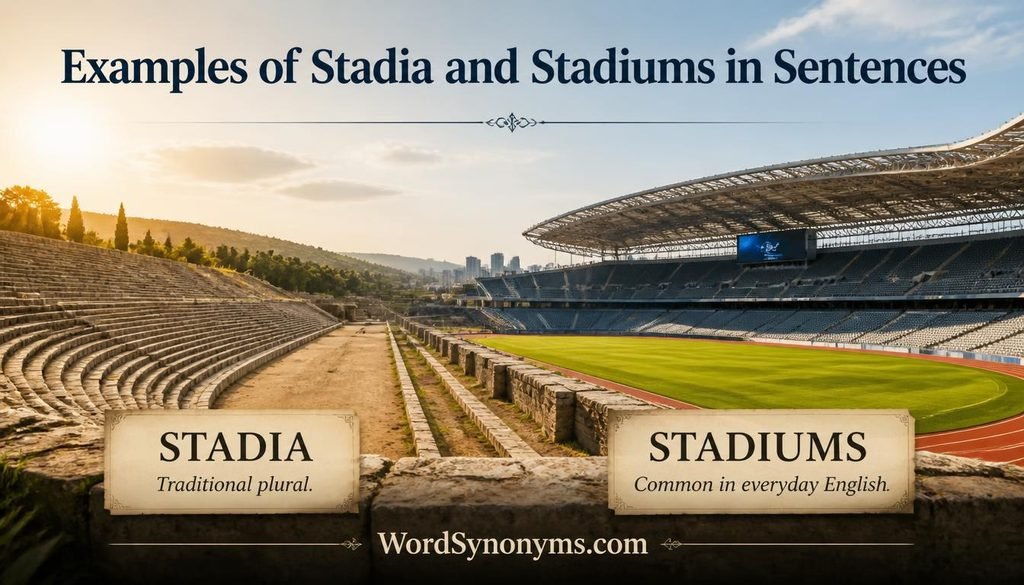
Examples of Stadia and Stadiums in Sentences
Examples make the difference easier to remember. Although both words are correct, the surrounding context can influence which form sounds most natural.
Examples Using Stadia
Use stadia when the traditional plural suits the writing style or subject matter.
- The historian documented several ancient stadia used for athletic contests.
- Researchers compared the architectural features of Roman stadia.
- The proposed tournament would require several international stadia.
- The book examines how ancient stadia influenced later sports architecture.
- Archaeologists uncovered evidence of athletic facilities near the remains of ancient stadia.
In each example, stadia refers to multiple venues. The word is especially useful when the surrounding text already uses historical or classical terminology.
However, don’t assume that a historical subject requires stadia. Writers can use stadiums in historical discussions too. The choice depends on the intended style, not a strict rule about time periods.
Examples Using Stadiums
For everyday writing, stadiums is generally the easier choice.
- Three stadiums will host games during the regional championship.
- The city operates two football stadiums.
- Modern stadiums often feature digital scoreboards and improved accessibility.
- Several stadiums have introduced cashless payment systems.
- The tour includes visits to famous stadiums across Europe.
These sentences use familiar vocabulary and straightforward grammar. Readers can focus on the information rather than the plural form.
Stadia vs. Stadiums in the Same Context
Compare these pairs to see how both forms work.
| Using stadia | Using stadiums |
| The country renovated several stadia. | The country renovated several stadiums. |
| These stadia can accommodate thousands of spectators. | These stadiums can accommodate thousands of spectators. |
| The tournament will use four stadia. | The tournament will use four stadiums. |
| Officials inspected the stadia before the event. | Officials inspected the stadiums before the event. |
| Modern stadia require careful planning. | Modern stadiums require careful planning. |
Each pair communicates essentially the same message. In general writing, the stadiums versions will often feel more natural to American readers.
One useful editing trick is to replace stadia with stadiums temporarily. If the sentence becomes clearer without losing meaning, the regular plural may be the better choice.
Read more: Car Park vs. Parking Lot: What’s the Difference?
Why Does Stadium Have Two Plural Forms?
The answer lies in the history of English and its habit of borrowing words from other languages.
English has borrowed extensively from Latin, Greek, French, and many other languages. Some borrowed nouns retain their original plural patterns. Others adapt to English grammar, and some accept both forms.
The word stadium ultimately comes through Latin from the Greek stadion, which referred to a measure of distance and an athletic course. Over time, stadium developed its familiar modern meaning: a venue with seating for spectators at sporting events.
Dictionary.com
+1
The Traditional Plural: Stadia
The form stadia reflects a traditional classical plural pattern associated with the word’s history.
Readers may recognize similar endings in other borrowed words. However, classical plurals don’t all follow one universal rule. Their forms depend on the individual word and its history.
For example, stadia follows the traditional plural pattern associated with stadium. That doesn’t mean every English noun ending in -um must change to -a.
The Regular English Plural: Stadiums
The form stadiums follows a familiar English pattern: add -s to a singular noun.
This approach makes the word easy to use without requiring knowledge of Latin. It also fits the way English has adapted many borrowed words over time.
Both forms are established in modern English dictionaries. Choosing stadiums doesn’t mean you have ignored the word’s history. It simply means you’re using a standard English plural.
Other Words With Traditional and English Plurals
The following examples show how English sometimes accepts multiple plural forms.
| Singular | Traditional or classical plural | Regular or alternative plural |
| Stadium | Stadia | Stadiums |
| Formula | Formulae | Formulas |
| Antenna | Antennae | Antennas |
| Focus | Foci | Focuses |
| Index | Indices | Indexes |
These pairs don’t always have identical meanings or usage patterns in every field. For instance, antennae often refers to insect sensory organs, while antennas commonly refers to devices used to transmit or receive signals.
Similarly, indices is common in mathematics and technical writing, while indexes often appears in books and general contexts. The best form depends on the word and the subject.
The lesson is simple: English doesn’t require every borrowed noun to preserve its original plural. Established usage matters.

Stadia vs. Stadiums: Which Should You Use in American English?
For most American English writing, choose stadiums. It is clear, widely recognized, and suitable for nearly every general context.
You can use it in a sports article, a travel blog, a school essay, or a report about public construction. Readers will understand the meaning immediately.
That said, stadia isn’t incorrect or forbidden in American English. Dictionaries recognize it as a valid plural. If you’re writing for a publication that prefers traditional forms, follow its guidance.
Use Stadiums for General Readers
Imagine you’re writing an article about cities preparing for a major sporting event.
You could write:
“The host cities will upgrade their stadiums before the competition begins.”
This sentence sounds natural and communicates the point clearly. Most readers won’t question the plural.
Now consider a travel guide:
“Visitors can tour several famous stadiums during their stay.”
Again, the regular plural fits the context without drawing unnecessary attention to the wording.
Use Stadia When It Fits Your Subject or Style
Suppose you’re writing a scholarly article about ancient Greek athletics. You might choose stadia to maintain a consistent historical or classical style.
For example:
“Archaeologists examined the remains of several ancient stadia.”
This wording is acceptable. However, stadiums would also be correct, so the traditional form isn’t compulsory.
Keep Your Usage Consistent
Consistency helps your writing feel polished. If you choose stadiums for a general article, continue using that form throughout.
Switching between stadia and stadiums without a clear reason may distract readers. It can also make the article look as though it contains an editing mistake, even when both forms are correct.
Consistency doesn’t mean you must use one form in every piece of writing. It means you should make a deliberate choice within each document.
A Practical Case Study: Editing a Sports Article
Consider a writer preparing an article about a city that plans to improve its sporting facilities.
The first draft reads:
“The city will renovate three stadia before the tournament. Officials will inspect the stadiums again after construction ends.”
Both plural forms are grammatically correct. However, the article switches between them without an obvious reason.
For a general American audience, an editor could revise the passage as follows:
“The city will renovate three stadiums before the tournament. Officials will inspect the stadiums again after construction ends.”
The revised version uses one plural consistently. It also keeps the wording familiar and easy to follow.
Now imagine a historical article that consistently uses traditional terminology. In that case, an editor might retain stadia throughout the relevant discussion.
This example illustrates an important editing principle: correctness comes first, but consistency and audience awareness make writing stronger.
The right choice isn’t always the oldest form or the most unusual one. It’s the form that serves the reader.
Read more: Hodgepodge or Hotchpotch: Which Should You Use?
Common Mistakes to Avoid When Using Stadia or Stadiums
Although the distinction is straightforward, a few common misunderstandings can lead to unnecessary corrections.
Assuming Stadia Is the Only Correct Plural
Some writers believe stadia must be the only correct form because stadium has Latin roots.
That conclusion is incorrect. Modern English accepts stadiums as well. You don’t have to preserve the traditional plural to write grammatically correct English.
Treating Stadiums as Incorrect
Adding -s is a normal English way to form plurals. Since stadiums is an accepted form, editors shouldn’t automatically mark it as an error.
For general American English, it is often the more practical option.
Believing Stadia Is Exclusively British English
Neither form belongs exclusively to British or American English. Both appear in English-language dictionaries, and both are accepted in American English.
Oxford Learner’s Dictionaries
+1
Regional preferences and publication styles may influence which form writers choose. However, the distinction isn’t a simple British-versus-American rule.
Using Stadia to Sound More Sophisticated
A traditional plural isn’t automatically better. If your readers rarely encounter stadia, using it may make an otherwise clear sentence less accessible.
Choose the word that fits your audience rather than trying to make ordinary writing sound more formal.
Confusing Stadia With Surveying Terminology
The word stadia also appears in surveying terminology, where it relates to techniques and instruments used to measure distances. This specialized meaning differs from its use as the plural of stadium.
American Heritage Dictionary
+1
Context resolves the difference. A sentence about sports venues uses stadia as a plural noun, while a technical surveying text may use the same spelling for a specialized term.
Assuming Every Word Ending in -Um Takes -A
English plural forms vary from word to word. Some nouns ending in -um take -a in traditional usage, while others commonly use -s or accept both.
Don’t apply one pattern blindly. Check the accepted forms of the specific word when you’re unsure.
FAQs
1. Is stadia or stadiums correct?
Both stadia and stadiums are correct plural forms of stadium. However, stadiums is more common in modern English and sounds natural in everyday conversation.
2. Why does stadium have two plural forms?
The word stadium comes from Latin, where stadia is the traditional plural. English also uses its own pluralization rules, which give us stadiums. Both forms remain acceptable.
3. Should I use stadia in formal writing?
You can use stadia in formal or academic writing, but it isn’t necessary. Stadiums is widely accepted in professional documents, essays, articles, and everyday communication.
4. Is stadia still used in modern English?
Yes, although it’s less common than stadiums. You may encounter it in historical texts, academic discussions, or specialized contexts. The word also has other meanings, including a type of telescopic instrument used to measure distances.
5. What is the plural of stadium in American English?
Stadiums is the usual plural in American English. It is also widely used throughout the English-speaking world, making it a reliable choice for general writing.
6. How can I remember when to use stadia or stadiums?
Use stadiums when writing about sports venues, concerts, or public events. Remember stadia as the traditional Latin-derived alternative. Unless your context specifically favors the Latin form, stadiums is usually the simplest and clearest choice.
Conclusion
Choosing between stadia and stadiums doesn’t have to be confusing. Both are correct plural forms of stadium, but stadiums is the more common choice in modern English. You’ll see it in everyday conversations, sports reports, news articles, and general writing. Meanwhile, stadia remains an acceptable Latin-derived alternative that sometimes appears in formal or historical contexts.
When you’re unsure which word to use, consider your audience and purpose. For most situations, stadiums sounds natural and keeps your writing clear. Once you understand this small difference, you’ll find it easier to use both forms confidently without getting caught up in complicated grammar rules.

Samreen Saif is a passionate writer and language enthusiast who contributes informative and engaging content to WordsSynonyms.com. She enjoys exploring English vocabulary, synonyms, antonyms, word meanings, and language usage to help readers understand and use words with confidence.
Samreen focuses on creating clear, accurate, and easy-to-read content for students, writers, professionals, and English learners. Through her articles, she aims to make vocabulary learning simple, practical, and useful for everyday communication.
When she is not writing, Samreen enjoys learning about language, discovering new words, and creating helpful content that makes English learning more accessible to everyone.