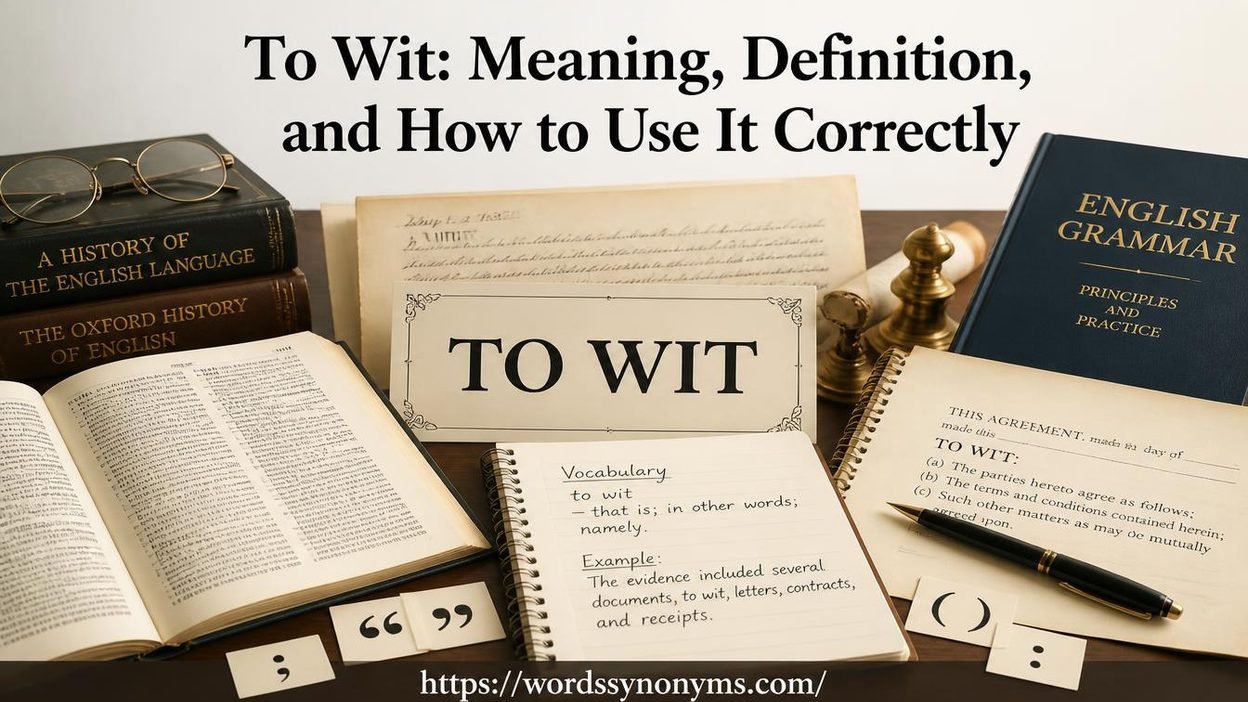
To Wit: How to Use It Correctly becomes easier when you understand how this phrase adds clear, precise details to a general statement in legal documents.
In legal writing, to wit introduces specific information or examples after a general statement, much like namely or that is to say. Lawyers have used it in legal texts, legal speech, contracts, and agreements for hundreds of years.
During drafting and reviews, clarity and precision matter, so you should use correctly the phrase when a sentence needs an exact meaning. It can make a general point clearer and stronger by giving specific information and exact details.
Anyone who writes legal documents can apply it when the reader needs a focused explanation.Because to wit is primarily used in formal writing, it fits a formal tone better than casual communication.
From my experience, careful legal writing works best when clarification serves the reader, rather than adding unnecessary decoration. Several alternatives express the same purpose, including specifically, in other words, more precisely, and to clarify. Each replacement can help the reader follow an explanation, while to wit keeps its formal character in texts and speech.
Quick Answer
“To wit” means “namely,” “specifically,” or “that is to say.” It introduces a precise detail that explains or identifies something mentioned just before it. The phrase is correct but quite formal and somewhat old-fashioned, so it appears most often in legal, academic, and official writing.
Example: The company faced one major problem, to wit, a shortage of skilled workers.
In everyday writing, “namely,” “specifically,” or simply a colon will usually sound more natural.
What Does “To Wit” Mean?
To wit means “namely,” “specifically,” or “that is to say.” Dictionaries classify it as a formal expression used to make something already mentioned clearer or more particular.
The phrase doesn’t normally introduce an entirely unrelated thought. Instead, it points back to something broader and then identifies its exact meaning.
Consider this example:
The museum acquired three important artifacts, to wit, a Roman coin, a Greek vase, and an Egyptian amulet.
The opening statement tells you that three artifacts were acquired. The words after to wit tell you exactly which three.
That relationship is the heart of the expression.
To Wit Meaning in Simple English
If to wit feels unnecessarily formal, replace it mentally with one of these expressions:
- namely
- specifically
- that is
- that is to say
- in particular
For example:
She had one request, to wit, that nobody disturb her during the meeting.
In simpler modern English:
She had one request, namely, that nobody disturb her during the meeting.
Or:
She had one request. Specifically, she didn’t want anyone to disturb her during the meeting.
The meaning remains essentially the same. The main difference is tone.
What Does “Wit” Mean in “To Wit”?
Here’s where the expression gets interesting.
The wit in to wit isn’t the modern noun meaning cleverness or humor. It comes from an old verb meaning “to know,” “to be aware of,” or “to have knowledge of.” The American Heritage Dictionary traces this verb to Middle English and Old English witan.
That older verb survives today mainly in a handful of fixed expressions. To wit is the most recognizable survivor.
So, don’t read:
to wit
as though it means:
“to be clever.”
Its historical sense is much closer to:
“to know” → “that is to say” → “namely.”
The modern meaning developed through an older construction, “that is to wit,” which appeared in Middle English. The shorter to wit became established later. Etymological evidence places the shortened phrase in use by the 1570s.
How to Use “To Wit” in a Sentence
The easiest way to use to wit correctly is to remember its job.
It introduces specific information that clarifies something stated immediately before it.
Here are several patterns:
The company needed one thing, to wit, additional funding.
Three employees received awards, to wit, Maria, James, and Robert.
He had a simple goal, to wit, finishing the project before Friday.
The agreement identifies two prohibited activities, to wit, unauthorized copying and resale.
Each sentence begins with a broad statement. The phrase then introduces the precise information.
Examples of “To Wit” in Sentences
Here are more examples across different contexts:
General writing
The town had one major attraction, to wit, its historic lighthouse.
Business writing
The company identified two immediate priorities, to wit, reducing costs and improving customer support.
Academic writing
The study produced one particularly striking result, to wit, participants remembered visual information more accurately than isolated words.
Legal-style writing
The defendant possessed a controlled substance, to wit, cocaine.
Historical writing
The expedition faced one serious obstacle, to wit, a lack of reliable maps.
Notice that to wit works best when the information following it has a clear connection to the preceding statement.
It shouldn’t feel like a random detour.
“To Wit” Before a List
One of the most useful applications appears before a list.
For example:
The committee identified three weaknesses, to wit: poor communication, inadequate training, and inconsistent supervision.
The phrase tells the reader that the upcoming list identifies the three weaknesses.
You can use the same structure with names:
The three witnesses were present, to wit: Daniel, Priya, and Marcus.
Or with items:
The shipment contained four machines, to wit: two pumps, one generator, and one compressor.
This construction is particularly common in formal documents because precision matters there.
“To Wit” After a General Statement
The expression also works when the following material isn’t a simple list.
For example:
The business had one unavoidable problem, to wit, its main supplier had stopped operating.
The phrase introduces a complete explanation rather than several individual items.
Another example:
Her decision reflected one concern, to wit, she didn’t trust the proposed safety measures.
Here, to wit effectively means “specifically, this is what that concern was.”
“To Wit” Punctuation: Comma, Colon, or Semicolon?
Punctuation around to wit can confuse writers because several constructions occur in real English.
There isn’t one punctuation mark that fits every sentence. The punctuation should reflect the grammatical structure surrounding the phrase.
When to Use a Comma With “To Wit”
A comma often appears before to wit when the phrase introduces a closely connected clarification.
For example:
The plan had one serious weakness, to wit, its cost.
Another example:
She had one overriding concern, to wit, the safety of her children.
The comma separates the broad statement from the specification that follows.
When to Use a Colon After “To Wit”
A colon often appears when to wit introduces a list or a substantial explanation.
For example:
The investigation uncovered three problems, to wit: missing records, inaccurate invoices, and incomplete reports.
This construction is especially common in formal writing.
Cambridge uses a similar structure in its dictionary example, while the Legal Information Institute notes that a colon or dash commonly separates to wit from the examples or details that follow.
Can You Put a Semicolon Before “To Wit”?
A semicolon can appear when the larger sentence contains independent clauses that need stronger separation.
For example:
The proposal looked attractive at first; to wit, it promised lower costs without reducing production.
However, there’s usually no reason to force a semicolon into a sentence simply because to wit appears.
Punctuation should follow the sentence’s structure rather than a memorized formula.
A Practical Punctuation Rule
When you’re unsure, ask what follows to wit.
If it introduces a list or substantial elaboration, a colon can work naturally:
The company had three priorities, to wit: quality, safety, and efficiency.
If it introduces a closely connected specification, a comma may be enough:
The company had one priority, to wit, safety.
The exact punctuation can vary with style and sentence construction. The important point is that to wit introduces the specific material.
Is “To Wit” Formal or Informal?
To wit is formal. Cambridge explicitly labels the expression as formal.
It isn’t wrong or obsolete. However, it can sound stiff in ordinary conversation.
Imagine a friend asking:
“Why did you leave the party early?”
Replying:
“I had one pressing concern, to wit, I was exhausted.”
would sound deliberately formal.
A natural response would be:
“I had one problem: I was exhausted.”
The same distinction matters in professional writing.
A legal contract may comfortably use to wit. A friendly email probably doesn’t need it.
Where You’re Most Likely to See “To Wit”
The expression appears most naturally in:
- Legal documents
- Contracts
- Court opinions
- Formal statements
- Academic prose
- Historical writing
- Literary prose
- Official documents
- Highly formal business writing
The New York State Law Reporting Bureau’s style manual specifically lists to wit as a formal equivalent of namely in legal writing.
That doesn’t mean lawyers own the phrase. They don’t. It simply means legal writing provides a particularly fertile environment for this kind of precise, traditional wording.
“To Wit” in Legal Writing
Legal writing often moves from broad categories to exact details.
That’s precisely the job to wit performs.
A legal document might describe property generally before identifying a specific parcel. A filing might mention a controlled substance before naming the exact substance. A court opinion might state a broad legal proposition before specifying the particular guarantee or circumstance involved.
The Legal Information Institute explains that to wit can introduce examples or specifics following a more general statement.
Consider this simplified legal-style sentence:
The defendant possessed a controlled substance, to wit, cocaine.
The words controlled substance establish a broad category. Cocaine supplies the specific item.
That’s a useful way to understand the expression.
Example of “To Wit” in a Legal Sentence
Consider:
The tenant violated two provisions of the agreement, to wit: unauthorized subletting and failure to maintain the premises.
The sentence works in layers:
- Two provisions were violated.
- To wit signals that exact details are coming.
- The following material identifies those provisions.
In plainer English:
The tenant violated two provisions of the agreement: unauthorized subletting and failure to maintain the premises.
The second version is easier for most readers.
That raises an important writing principle: formal doesn’t automatically mean better.
Use to wit when the tone and context justify it. Don’t insert it merely to make ordinary prose sound sophisticated.
Where Did “To Wit” Come From?
The history of to wit explains much of its modern strangeness.
The word wit once functioned as a verb meaning “to know.” That verb traces back through Middle English to Old English witan. Etymological sources connect it with a wider Germanic family of words associated with knowing.
The history also explains why the phrase doesn’t mean what modern readers might initially expect.
In present-day English, wit usually refers to cleverness, humor, or quick intelligence. Cambridge lists meanings involving clever and humorous language as well as quick thinking.
But the older verb had a different sense.
Historically:
wit = know
Therefore:
to wit = to know
The phrase eventually developed its familiar function of introducing a precise statement. The older construction “that is to wit” dates back to the Middle English period, while the shortened form to wit is recorded from the 16th century.
This is a good example of how English preserves linguistic fossils.
A word can disappear from everyday use while leaving behind a small footprint inside an established phrase.
“To Wit” vs. “Namely”
To wit and namely are close in meaning, but their styles differ.
| Expression | Meaning | Tone | Common Use |
| to wit | namely; specifically | Formal | Legal and formal prose |
| namely | specifically; that is | Neutral to formal | General writing |
| specifically | in precise terms | Neutral | Everyday and professional writing |
| that is | clarification | Neutral | General writing |
| for example | an illustrative instance | Neutral | General explanation |
Compare these:
The project needs one thing, to wit, additional funding.
The project needs one thing, namely, additional funding.
The meaning is almost identical.
However, namely sounds more natural in most modern prose.
If clarity matters more than ceremonial formality, namely will often be the better choice.
“To Wit” vs. “That Is”
That is provides another straightforward alternative.
Compare:
The problem involved one major issue, to wit, unreliable data.
with:
The problem involved one major issue. That is, the data couldn’t be trusted.
The first sentence has a formal, compact quality. The second sounds more conversational.
You can also write:
The problem involved one major issue, that is, unreliable data.
In ordinary communication, readers usually process the simpler construction faster.
That’s why to wit works best when you deliberately want its formal register.
Read more: Sear vs. Seer vs. Sere: Differences and Examples
“To Wit” vs. “For Example”
These expressions are related, but they’re not exact synonyms.
To wit generally identifies or specifies something.
For example normally provides an illustration.
Consider:
Several European languages have grammatical gender, to wit, French, Spanish, and Italian.
The sentence presents those languages as the specific examples being identified.
Now consider:
Many languages have grammatical gender. For example, Spanish has masculine and feminine nouns.
Here, Spanish illustrates a broader point. It isn’t necessarily an exhaustive list.
That distinction matters.
If you’re giving one illustrative case, for example is usually more natural. If you’re identifying exactly what a previous statement refers to, to wit or namely may fit better.
Is “To Wit” Still Used Today?
Yes. To wit remains part of modern English.
Its survival isn’t merely historical. Contemporary dictionaries still define it as a living formal expression, and modern legal and formal texts continue to use it.
However, frequency and context matter.
You won’t normally hear people say:
“I bought several things, to wit, milk and bread.”
At the grocery store, that sentence sounds comically grand.
A normal speaker would say:
“I bought a few things, including milk and bread.”
In a formal document, though, the traditional expression may fit the register.
Why Does It Sound Old-Fashioned?
English has gradually favored shorter, plainer constructions in many everyday contexts.
Words such as:
- namely
- specifically
- including
- that is
- for example
usually communicate the same basic relationship with less ceremony.
As a result, to wit developed a distinctly formal flavor.
It’s similar to wearing a suit to a backyard barbecue. There’s nothing grammatically wrong with it. The setting simply determines whether it feels natural.
Common Mistakes With “To Wit”
Although to wit isn’t grammatically difficult, writers often misuse it because its historical meaning isn’t obvious.
Treating “Wit” as Humor
This is the biggest conceptual mistake.
The wit in to wit isn’t referring to jokes, clever remarks, or humor.
It comes from an older verb associated with knowing.
So this phrase has nothing inherently humorous about it.
Using “To Wit” When “For Example” Is Better
If you simply want to offer an illustration, for example may be clearer.
Instead of:
Many fruits contain natural sugars, to wit, apples are a common example.
Write:
Many fruits contain natural sugars. For example, apples contain naturally occurring sugars.
The second version makes the relationship clearer.
Overusing “To Wit”
A single to wit can give formal prose a precise edge.
Five of them in one paragraph can make the writing sound like a 19th-century legal document.
For example, this becomes cumbersome:
The company has three goals, to wit, growth, to wit, efficiency, and to wit, customer retention.
That’s unnecessary.
Write:
The company has three goals: growth, efficiency, and customer retention.
Good writing doesn’t use an elaborate phrase when a clean construction does the job.
Misusing Punctuation
Don’t assume every occurrence requires exactly the same punctuation.
The expression can appear after a comma and may introduce material with a colon or dash. The Legal Information Institute specifically notes these common structures.
The surrounding sentence determines the best punctuation.
Using It in Casual Conversation
You can use to wit conversationally. English grammar won’t arrest you.
Still, most casual speakers would choose simpler wording.
Instead of:
“I have one concern, to wit, we’re late.”
Say:
“I have one concern: we’re late.”
The second version is shorter, clearer, and more natural.
How to Replace “To Wit” With Simpler Words
The best replacement depends on what you’re trying to accomplish.
| If you mean… | Consider using… | Example |
| Specifically | specifically | The problem was specifically the cost. |
| Namely | namely | Three people attended, namely, Ana, Luis, and Sam. |
| Clarification | that is | He needed one thing, that is, more time. |
| Illustration | for example | Several tools work. For example, a spreadsheet can help. |
| Particular emphasis | in particular | One issue stood out in particular. |
The key isn’t finding a perfect one-word replacement every time.
Instead, identify the relationship between the first statement and the information that follows.
If you’re naming the exact thing, namely may work.
If you’re narrowing the meaning, specifically may work.
If you’re illustrating an idea, for example may be better.
“To Wit” Examples in Different Contexts
Seeing the expression across different settings makes its function easier to recognize.
Everyday Writing
The restaurant had one major advantage, to wit, its location near the station.
This is grammatically fine. Still, a casual writer would probably choose:
The restaurant had one major advantage: its location near the station.
Business Writing
The company identified two immediate concerns, to wit: rising costs and declining sales.
The expression works because the sentence has a formal business tone.
Academic Writing
The experiment produced one unexpected result, to wit, the control group improved more rapidly than the treatment group.
Here, the phrase introduces a precise result that explains the preceding claim.
Legal Writing
The agreement prohibits two activities, to wit: unauthorized disclosure and commercial redistribution.
The formal register makes the phrase feel more at home.
Historical or Literary Writing
His journey had one destination, to wit, the distant city beyond the mountains.
A literary or historical context can accommodate the deliberately formal flavor.
A Closer Look: “To Wit” as a Precision Marker
One useful way to understand the phrase is to treat it as a precision marker.
Imagine that your sentence starts with a wide circle.
The company faced a problem.
That’s broad. We don’t know which problem.
Now narrow the circle:
The company faced one serious problem, to wit, a shortage of skilled technicians.
The phrase acts almost like a spotlight. It tells the reader, “Here is the exact thing being discussed.”
This makes to wit especially useful when precision matters.
The pattern looks like this:
General statement → To wit → Specific information
For example:
General:
The investigation uncovered a problem.
Precision marker:
to wit,
Specific:
several financial records had been altered.
Together:
The investigation uncovered a problem, to wit, several financial records had been altered.
Once you understand this pattern, the phrase becomes much less mysterious.
A Practical Case Study: Choosing the Right Expression
Consider this sentence:
The project had three major weaknesses, to wit: poor planning, limited funding, and weak communication.
The sentence is grammatically understandable and appropriately formal.
Now imagine that the article is a friendly workplace guide. The same sentence could become:
The project had three major weaknesses: poor planning, limited funding, and weak communication.
Nothing important was lost.
Now imagine that the writer wants to emphasize exact identification:
The project had three major weaknesses, namely: poor planning, limited funding, and weak communication.
This works in some styles, although many editors would simply remove the colon after namely:
The project had three major weaknesses, namely, poor planning, limited funding, and weak communication.
Finally, if the writer is explaining rather than formally identifying:
The project had three major weaknesses. Specifically, it suffered from poor planning, limited funding, and weak communication.
Each version communicates nearly the same information.
The difference lies primarily in tone, rhythm, and emphasis.
That’s an important lesson for anyone learning English: choosing the right word isn’t only about dictionary meaning. Register matters too.
Read more: Spectra vs. Spectrums: Meaning and Examples
Quick Guide: When Should You Use “To Wit”?
Use to wit when the following information precisely identifies or clarifies something already mentioned.
It can work well when:
- You’re writing in a formal register.
- You’re identifying specific details.
- You’re introducing an exact list.
- You’re writing legal or official prose.
- You’re discussing historical or literary material.
- You want a deliberately traditional tone.
Consider avoiding it when:
- You’re writing casual conversation.
- Your audience may find formal language distracting.
- Namely would sound more natural.
- Specifically communicates the idea more clearly.
- For example is actually what you mean.
- The phrase adds ceremony without adding meaning.
The best choice isn’t always the oldest or most sophisticated expression.
Often, the clearest sentence wins.
Key Facts About “To Wit”
| Fact | Detail |
| Meaning | Namely; specifically; that is to say |
| Part of speech | Formal idiomatic expression |
| Main function | Introduces precise information or clarification |
| Modern tone | Formal, traditional, sometimes old-fashioned |
| Common contexts | Legal, academic, official, literary, and formal writing |
| Modern alternative | Namely, specifically, that is, for example |
| Origin of “wit” | Old English verb related to knowing |
| Older construction | “That is to wit” |
| Recorded shortened form | From the 16th century |
| Connection to humor? | No; the phrase uses the older “know” sense of wit |
The historical development of the expression explains why its modern meaning isn’t obvious from the individual words.
FAQs
What does “to wit” mean?
“To wit” means namely, specifically, or that is to say. It introduces details that explain or identify something mentioned earlier.
Is “to wit” still commonly used?
Yes, but it’s most common in legal writing, formal documents, and other serious contexts. In everyday conversation, simpler alternatives usually sound more natural.
How do you use “to wit” in a sentence?
Use “to wit” before specific details that explain a broader statement. For example: “The company owns three properties, to wit, two offices and a warehouse.”
Is “to wit” only used by lawyers?
No. Although lawyers use it frequently, anyone can use the phrase. However, its formal tone makes it more suitable for contracts, legal texts, academic writing, and official documents.
What can I use instead of “to wit”?
Depending on the sentence, you can use namely, specifically, in other words, more precisely, or to clarify. These alternatives often sound more natural in modern writing.
Does “to wit” need a comma?
Usually, a comma follows “to wit” when the phrase introduces explanatory details. For example: “She brought three items, to wit, a notebook, a pen, and a folder.”
Conclusion
To wit may sound old-fashioned, but it still has a useful place in legal writing. It helps you move from a broad statement to the exact information that explains it. When a document needs precision, that small phrase can make the writer’s intended meaning easier to understand.
Still, you don’t need to use to wit simply because it sounds formal. In many situations, namely, specifically, in other words, more precisely, or to clarify may feel more natural. Choose the wording that fits your audience and purpose. When you use to wit correctly, however, it can give formal legal documents a concise and unmistakably precise tone.

Syeda Naalain Zahra is a content writer with an interest in English vocabulary and language. She creates simple and informative articles about synonyms, antonyms, word meanings, and everyday English usage. Her aim is to help readers build better vocabulary and communicate more confidently.