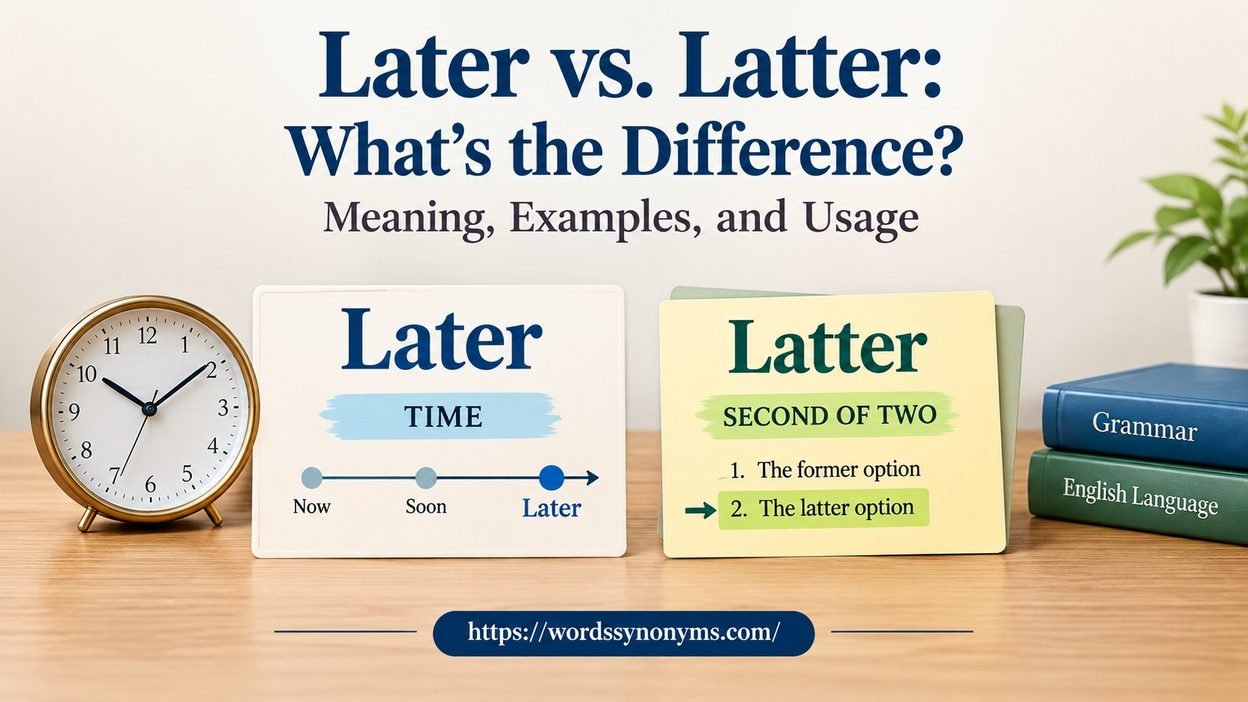
In Later vs. Latter: What’s the Difference?, later is an adverb about time, referring to something that happens in the future.
It is generally used when something will happen after now, so I find it easiest to connect this word with time.
Later can also be an exclamation when departing from a person or group of people. The short phrase see you later is common in the United States, while laters is its plural form. In casual speech, this usage sounds natural and friendly.
Latter is an adjective that helps describe one of two things in a comparison. It identifies what happens or exists after something else, or lies toward the end, not the beginning.
Though similar, these words are not synonyms or interchangeable: later concerns time, while latter concerns space and sequence. This distinction makes choosing the right word much easier and clearer.
Quick Answer
A quick memory trick can make the difference much easier. Later is connected with time, so use it when something happens after now or after another point in time. Latter, on the other hand, helps you identify the second of two choices. If someone says, “I can travel by train or bus. I prefer the latter,” they mean bus because it was mentioned second.
The words may look almost identical, but their jobs are different. Think of later as answering the question “When?” and latter as answering “Which one?” Once you make that connection, choosing the right word becomes much more natural.
Later vs Latter at a Glance
| Word | Main Meaning | Used For | Example |
| Later | At a future time | Time or sequence | I’ll finish the work later. |
| Latter | The second of two things | Choices or comparisons | I prefer the latter option. |
| Later | A time after another point | Events | She arrived later than expected. |
| Latter | Nearer the end | Parts or periods | The latter half was more exciting. |
| Former | The first of two things | Choices or comparisons | I chose the former. |
Quick rule: Later = time. Latter = the second choice. When you remember that simple distinction, you’ll avoid one of the most common mix-ups in English.
Later vs. Latter at a Glance
The quickest way to understand later vs. latter is to compare their core meanings.
| Word | Main meaning | Usually refers to | Example |
| Later | At a subsequent time | Time or sequence | “I’ll call you later.” |
| Latter | The second of two things mentioned | Position in a comparison | “I chose the latter.” |
| Latter | Nearer the end | The later part of something | “The latter half was stronger.” |
Think of the distinction this way:
Later = when
Latter = which one
If you’re talking about something happening after now, use later.
“We can discuss the problem later.”
If you’re choosing between two things already mentioned, use latter.
“The company considered hiring or outsourcing. It chose the latter.”
This simple contrast covers the most common everyday uses.
What Does “Later” Mean?
Later primarily deals with time. It describes something that happens after another point in time, whether that point is now, an earlier event, or another moment in a sequence.
The word can function as an adverb, an adjective, and occasionally as part of other grammatical constructions.
Later Means “At a Future Time”
When someone says later, they usually mean a time after the present moment.
Consider these examples:
- “I’ll call you later.”
- “We’ll finish the project later.”
- “She’s coming over later.”
- “Let’s talk about that later.”
- “I’ll send the documents later today.”
In each sentence, later answers the question when?
That’s the clearest signal that later is the correct word.
If someone tells you, “I’m busy right now, but I’ll help you later,” they’re describing a future point. The exact time doesn’t matter. It could mean twenty minutes from now or several hours from now.
Later Can Mean “Afterward”
Later can also describe something that happens after another event.
For example:
“He left the office and returned later.”
Here, later doesn’t necessarily mean “later today.” It simply means after he left.
Another example makes the relationship clearer:
“She graduated from college and later started her own business.”
The business came after graduation. The word later establishes that sequence.
You’ll see this use frequently in biographies, news reports, essays, historical writing, and storytelling.
Later Can Compare Two Times
Later is also the comparative form of late.
For example:
“I arrived later than expected.”
The sentence compares the actual arrival time with an expected time.
You can also say:
- “She arrived later than I did.”
- “The second train leaves later.”
- “He started working later in the morning.”
- “The meeting began later than scheduled.”
Notice that the word still revolves around time.
This remains true even when later modifies a noun.
“The later flight leaves at 9 p.m.”
Here, later means the flight scheduled after another flight.
That distinction matters because some people see later and latter as interchangeable when they encounter them in discussions involving order. They aren’t.
Later describes relative timing. Latter identifies position within a pair or sequence.
What Does “Latter” Mean?
Latter has a much narrower core meaning than later.
When writers use the latter, they normally refer to the second of two people, things, choices, or ideas that they have just mentioned.
For example:
“The store sells fresh bread and pastries. I prefer the latter.”
Two things appear in the first sentence:
- Fresh bread
- Pastries
Because pastries appear second, the latter refers to pastries.
That’s the key.
Latter Means the Second of Two
Consider another example:
“Maria considered studying medicine or engineering. She chose the latter.”
The two options are:
- medicine
- engineering
Engineering appears second. Therefore, the latter means engineering.
You can mentally replace the latter with the second one.
“She chose the second one.”
If that replacement makes sense, latter probably works.
Latter Can Describe the Part Near the End
There’s another legitimate use of latter that doesn’t involve exactly two choices.
The word can describe something nearer the end of a period, event, process, or thing.
For example:
“The latter half of the movie was much more dramatic.”
Here, latter half means the half closer to the end.
You might also see:
- “during the latter years of his career”
- “in the latter part of the century”
- “the latter stages of the competition”
- “the latter portion of the report”
- “the latter half of the season”
In these examples, latter means nearer the end.
That’s different from the most familiar use of the latter, where the word identifies the second of two previously mentioned items.
Latter Doesn’t Mean “At a Later Time”
This is where the confusion usually starts.
You shouldn’t use latter when you mean later in reference to time.
Incorrect:
“I’ll call you latter.”
Correct:
“I’ll call you later.”
The first sentence suggests the writer is trying to describe a future time. That’s exactly what later does.
Latter doesn’t mean “afterward,” “soon,” “eventually,” or “at a future time.”
Later vs. Latter: The Key Difference
The central difference between later vs. latter comes down to what you’re trying to express.
Use “Later” for Time
Use later when you mean:
- afterward
- at a future time
- after another event
- at a more advanced point in time
- at a time farther along in a sequence
Examples:
“I’ll finish the article later.”
“She arrived later than expected.”
“We can discuss the details later.”
“He later became the company’s CEO.”
Every example involves time.
Use “Latter” for the Second of Two
Use latter when you’re referring back to two previously mentioned items and want to identify the second.
Example:
“The company offers remote work and flexible hours. Employees often prefer the latter.”
The two options are:
- remote work
- flexible hours
Therefore, the latter means flexible hours.
The word isn’t telling you when something happened. It’s telling you which item you’re talking about.
Use “Latter” for Something Near the End
You can also use latter when describing the later part of a larger period or thing.
“The latter part of the meeting focused on budget cuts.”
Here, latter means the part closer to the end of the meeting.
Compare that with:
“We discussed the budget later.”
This sentence refers to time.
The distinction becomes obvious when you put the examples together:
| Sentence | Meaning |
| “We discussed the budget later.” | We discussed it at a subsequent time. |
| “The latter part of the meeting covered the budget.” | The budget appeared toward the end of the meeting. |
| “We discussed salary and benefits. I preferred the latter.” | Benefits were the second item mentioned. |
The Easiest Way to Remember Later vs. Latter
You don’t need an elaborate grammar trick.
Remember:
Later = time.
Latter = second.
That’s enough for most situations.
The “Afterward” Test
When you’re unsure, replace the word with afterward.
“I’ll see you later.”
Becomes:
“I’ll see you afterward.”
The meaning still works. Therefore, later is correct.
Now try:
“I chose the latter.”
Replace latter with afterward:
“I chose the afterward.”
That doesn’t work.
Instead, replace it with the second one:
“I chose the second one.”
Now the meaning works perfectly.
The “Second One” Test
Ask yourself whether you’re pointing to the second of two previously mentioned things.
If yes, use latter.
“We can take the bus or train. I prefer the latter.”
The latter = the second one = train.
If you’re talking about a future or subsequent time, use later.
“We can take the bus later.”
The meaning is completely different.
Later vs. Latter Examples
Examples make this distinction much easier to remember because they show how context controls word choice.
Examples of “Later”
Here are common examples of later:
- “I’ll email you later.”
- “She came back later that evening.”
- “We can decide later.”
- “He later admitted that he had made a mistake.”
- “The meeting started later than planned.”
- “They moved to another city later in life.”
- “The later chapters explain the theory in greater detail.”
- “Call me later if you need help.”
- “The train arrived later than expected.”
- “The company introduced the product several years later.”
Notice how every example involves time or sequence in time.
Examples of “Latter”
Now compare those with examples using latter:
- “I like tea and coffee, but I prefer the latter.”
- “She considered law and journalism. She chose the latter.”
- “The report discusses cost and efficiency. The latter received more attention.”
- “The latter half of the film was surprisingly intense.”
- “He became more successful during the latter years of his career.”
- “The latter stages of the project required more testing.”
- “Between the two proposals, the latter seems more practical.”
- “The latter part of the speech addressed the main issue.”
The first group concerns time. The second group concerns position or order.
Read more: Hodgepodge or Hotchpotch: Which Should You Use?
Later vs. Latter in Real Sentences
The difference becomes even clearer when the two words appear in similar contexts.
Example: A Phone Call
“I’ll call you later.”
This means the call will happen at a future time.
Now consider:
“John and David called me. I spoke with the latter for an hour.”
Here, latter refers to David because David appeared second.
One word describes when. The other identifies who.
Example: Two Choices
“The restaurant offers indoor and outdoor seating. I chose the latter.”
The latter = outdoor seating.
You couldn’t replace it with later.
“I chose the later.”
That construction doesn’t express the intended meaning.
Example: A Book
“I’ll read the book later.”
The word refers to time.
Now:
“The first half of the book was slow, but the latter half was gripping.”
Here, latter means the second half, the part closer to the end.
Example: Business Decisions
“The company considered hiring another employee or outsourcing the work. It chose the latter.”
The latter refers to outsourcing.
But:
“The company decided to outsource the work later.”
Now later refers to when the company made the decision.
Same general topic. Completely different grammatical function.
Common Mistakes With Later and Latter
Because the words look so similar, certain mistakes appear repeatedly.
Mistake: “See You Latter”
One of the most common errors is writing:
“See you latter.”
The correct expression is:
“See you later.”
The phrase refers to a future meeting. Therefore, later is the only appropriate choice.
Mistake: “I Prefer the Later”
Suppose you write:
“I can choose tea or coffee. I prefer the later.”
That’s incorrect if you mean coffee.
The correct sentence is:
“I can choose tea or coffee. I prefer the latter.”
Coffee appears second. Therefore, it is the latter.
Mistake: Treating “Latter” as a Fancy Version of “Later”
Some writers mistakenly believe latter sounds more formal and sophisticated than later.
It doesn’t.
These words aren’t interchangeable levels of formality. They have different meanings.
Using latter where later belongs doesn’t make a sentence more polished. It makes the sentence incorrect.
Mistake: Confusing Latter With Last
Latter and last can overlap in some contexts, but they aren’t identical.
Consider:
“The latter part of the book was more interesting.”
This means the part toward the end.
But:
“The last chapter was more interesting.”
This specifically identifies the final chapter.
In references to two items, latter has a particularly precise meaning: the second item mentioned.
For larger groups, clarity often improves when you name the specific item instead of forcing readers to interpret latter.
Mistake: Using Latter After a Long List
Consider this sentence:
“The conference covered marketing, sales, customer service, product design, hiring, budgeting, logistics, and cybersecurity. The latter was especially controversial.”
What does latter mean here?
A reader may reasonably hesitate. Does it refer to cybersecurity because it appeared last? Or is the writer using latter more broadly?
Even when a usage can be defended, ambiguity creates friction.
A clearer version is:
“The conference covered eight major topics. Cybersecurity was especially controversial.”
Good writing isn’t merely grammatically correct. It’s easy to follow.
Later vs. Latter in Formal Writing
Both words appear frequently in formal writing. However, latter requires more care because it asks readers to remember what came before.
Consider:
“The researchers compared traditional instruction with online learning. The latter produced higher completion rates.”
This sentence works well because the comparison contains two clear items:
- traditional instruction
- online learning
The latter clearly means online learning.
Now imagine a paragraph containing five different educational models before the writer suddenly says the latter. The reference becomes harder to track.
When clarity matters, repeating the noun can be better.
Instead of:
“The latter produced stronger results.”
Write:
“Online learning produced stronger results.”
The second version uses more words. Yet it makes the reader’s job easier.
When “The Latter” Works Well
Use the latter when:
- you’ve mentioned exactly two items;
- the two items appear close together;
- the reference is unmistakable;
- repeating the noun would sound unnecessarily repetitive;
- you’re writing a formal comparison.
For example:
“The proposal compares fixed and variable costs. The latter changes with production volume.”
That’s concise and clear.
When Repeating the Noun Is Better
Avoid the latter when:
- you’ve mentioned several possible antecedents;
- the reference appears several sentences earlier;
- the paragraph contains multiple comparisons;
- the reader could interpret the reference more than one way.
In those situations, clarity wins.
Later vs. Latter and “Former”
Understanding former makes latter easier.
When writers discuss two things, they can use:
- former = the first one
- latter = the second one
For example:
“The company considered expansion and acquisition. The former required more staff, while the latter required more capital.”
Here:
- former = expansion
- latter = acquisition
The order matters.
If you reverse the original sentence:
“The company considered acquisition and expansion.”
Then:
- former = acquisition
- latter = expansion
The words don’t carry permanent identities. Their meanings depend on the order in which the writer introduces the two items.
A Useful Comparison
| Position | Word | Example |
| First of two | former | “I compared apples and oranges. The former was cheaper.” |
| Second of two | latter | “I compared apples and oranges. The latter was sweeter.” |
| Future/subsequent time | later | “I’ll compare them later.” |
This three-way distinction eliminates a surprising amount of confusion.
Is “Latter” Only Used for Two Things?
This question deserves a careful answer.
Traditional grammar instruction commonly teaches that latter refers to the second of two items. That’s the safest rule for clear modern writing.
Some dictionaries and established usage references recognize broader uses of latter, particularly when it means nearer the end or the last-mentioned item.
However, writers should consider their audience.
If you’ve mentioned three, four, or eight things, saying the latter can force readers to pause and determine exactly what you mean.
For example, instead of:
“The latter was the most expensive.”
Write:
“The final option was the most expensive.”
Or simply name the item:
“The enterprise plan was the most expensive.”
That tiny change can make a sentence much easier to process.
When a pronoun-like reference creates doubt, use the noun.
Latter vs. Later in the Phrase “Latter Part”
One especially useful distinction appears in phrases such as latter part, latter half, and latter years.
Examples include:
- “the latter part of the century”
- “the latter half of the book”
- “the latter years of his career”
- “the latter stages of development”
Here, latter means something closer to the end.
Compare:
“In the latter part of the meeting, the manager discussed salaries.”
The meeting has an early portion and a later portion. The writer identifies the part closer to the end.
Now compare:
“The manager discussed salaries later.”
This means the manager discussed salaries at a subsequent time.
The difference is subtle but important:
Latter modifies a part or position. Later identifies a subsequent time.
A Practical Case Study: Choosing the Correct Word
Imagine you’re writing about two types of exercise:
“The study compared walking and running. Participants preferred the latter.”
Which activity did participants prefer?
Running.
Why?
Because running appears second.
Now change the sentence:
“Participants completed the walking session first and the running session later.”
Now later refers to the timing of the running session.
The underlying subject hasn’t changed. Only the relationship has changed.
Case Study Breakdown
| Sentence | Correct word | Why? |
| “I’ll discuss the results later.” | Later | Refers to time. |
| “The study compared walking and running. The latter was more popular.” | Latter | Refers to the second item. |
| “The latter half of the study focused on running.” | Latter | Refers to the part closer to the end. |
| “The researchers published the findings later.” | Later | Refers to a subsequent time. |
This is the underlying pattern in almost every later vs. latter question.
How to Remember Later vs. Latter
A few simple memory devices can make the distinction automatic.
Remember “Later” With “See You Later”
The phrase see you later is familiar to almost everyone.
It immediately connects later with time.
Think:
Later = time.
That’s your first checkpoint.
Remember “Latter” as “Second”
Think of latter whenever you see two options.
“Option A or Option B? I chose the latter.”
The latter is the second option.
Think:
Latter = second.
Use the Two-Question Method
When you’re uncertain, ask:
Question 1: Am I talking about when something happens?
If yes, use later.
Question 2: Am I identifying the second of two things?
If yes, use latter.
This works because the words answer different kinds of questions.
| Question | Likely word |
| When? | Later |
| After when? | Later |
| Which of the two? | Latter |
| Which part is closer to the end? | Latter |
Later vs. Latter Practice Quiz
Try choosing the correct word before checking the answers.
Choose “Later” or “Latter”
- “I’ll finish the assignment ___.”
- “Between tea and coffee, I prefer the ___.”
- “She arrived two hours ___.”
- “The company considered two proposals and accepted the ___.”
- “The ___ half of the movie was more exciting.”
- “We can discuss the problem ___.”
- “He later became a successful author.”
- “The report compares traditional and digital advertising. The ___ received more attention.”
- “The company introduced a new policy several years ___.”
- “The ___ stages of the project required additional testing.”
Answers
- later
- latter
- later
- latter
- latter
- later
- later
- latter
- later
- latter
Why the Answers Work
1. Later refers to a future time.
2. Latter identifies coffee, the second item mentioned.
3. Later describes the time of arrival relative to another point.
4. Latter identifies the second proposal.
5. Latter describes the half nearer the end.
6. Later refers to a subsequent time.
7. Later establishes what happened after an earlier event.
8. Latter identifies digital advertising, which appears second.
9. Later means at a subsequent time.
10. Latter describes the stages closer to the end of the project.
Later vs. Latter: Quick Reference
When you’re in a hurry, use this cheat sheet.
| If you mean… | Use | Example |
| At a future time | later | “I’ll call later.” |
| After something happens | later | “She returned later.” |
| At a subsequent point | later | “He later changed his mind.” |
| A comparison of timing | later | “She arrived later than me.” |
| The second of two items | latter | “I chose the latter.” |
| The second option | latter | “The latter option costs less.” |
| The part nearer the end | latter | “The latter half was stronger.” |
| A period closer to its end | latter | “During the latter years of his career…” |
FAQs
What does “later” mean?
“Later” is mainly used for time. It means something will happen after the present or at another point in the future.
What does “latter” mean?
“Latter” refers to the second of two things mentioned in a comparison. It can also describe something closer to the end of a sequence.
Are “later” and “latter” synonyms?
No. Although the words look similar, they aren’t synonyms and shouldn’t be treated as interchangeable.
Is “later” an adjective?
Usually, no. Later is generally an adverb, while latter is an adjective used to describe one of two things.
Can “later” be used when saying goodbye?
Yes. “See you later” is a common phrase used when departing from a person or group of people. “Later!” can also work as a casual exclamation.
How can I remember the difference between later and latter?
A simple trick is to connect later with time and latter with order or sequence. If you’re talking about when something happens, choose “later.”
Conclusion
Understanding the difference between later and latter becomes much easier once you stop treating them as interchangeable words. Later points to time. You use it when something happens after a certain moment, whether that moment is now or another point already mentioned.
Latter, however, points to order. When you mention two things and refer back to the second one, latter is the correct choice. That small distinction can save you from one of those common writing mistakes that looks harmless but changes the meaning of a sentence.
A useful way to remember it is to connect later with something that comes afterward in time and latter with something that comes second in a sequence. For example, if you say, “I’ll finish the report later,” you’re talking about when the action will happen.
If you say, “Between writing and editing, I prefer the latter,” you’re identifying the second item. I’ve found this simple time-versus-order test especially useful when proofreading because it quickly reveals which word belongs in the sentence without requiring you to overthink the grammar.

Samreen Saif is a passionate writer and language enthusiast who contributes informative and engaging content to WordsSynonyms.com. She enjoys exploring English vocabulary, synonyms, antonyms, word meanings, and language usage to help readers understand and use words with confidence.
Samreen focuses on creating clear, accurate, and easy-to-read content for students, writers, professionals, and English learners. Through her articles, she aims to make vocabulary learning simple, practical, and useful for everyday communication.
When she is not writing, Samreen enjoys learning about language, discovering new words, and creating helpful content that makes English learning more accessible to everyone.