
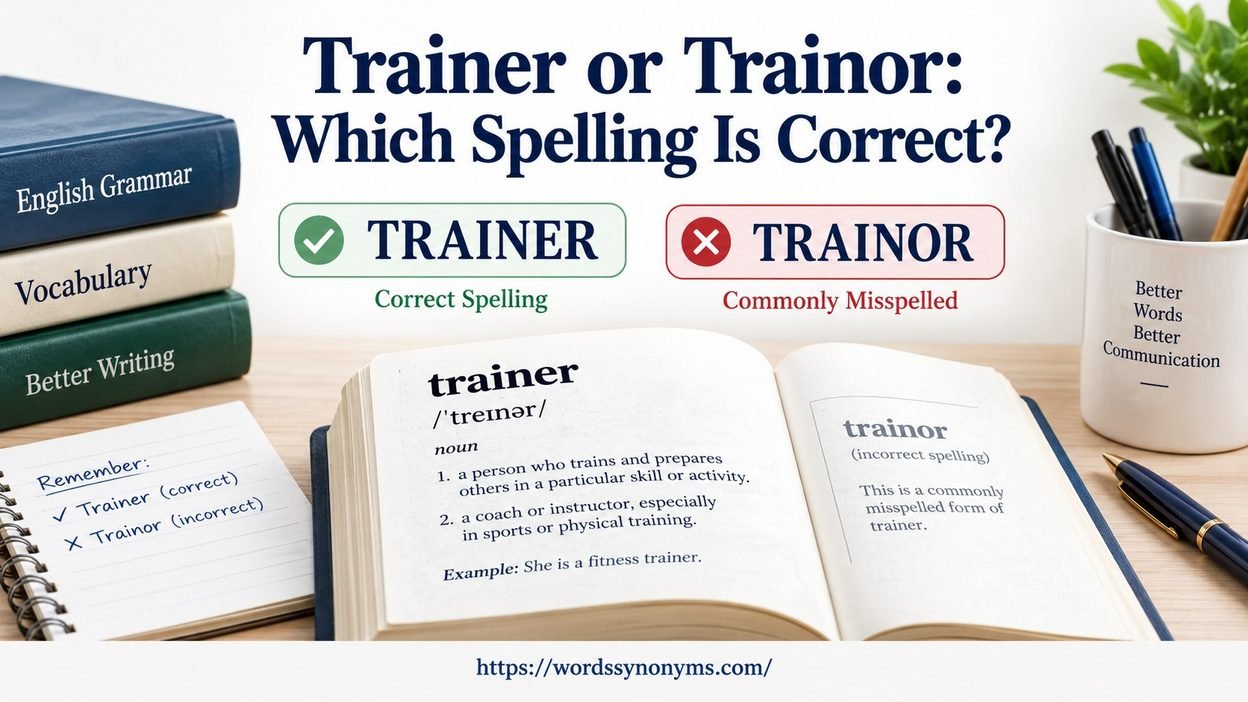
Trainer or Trainor: Which Spelling Is Correct? The correct spelling is trainer, the standard English noun for a person who provides training, guidance, or instruction.
A trainer may teach, coach, or instruct an individual or team in fitness, education, sports, or another profession. The spelling confusion often comes from spelling patterns such as -or and -er.
Although words like supervisor, evaluator, and counselor may make Trainor seem logical, trainer remains the standard occupation word. In British English, trainer can also mean sneakers or tennis shoes.
Trainor is generally a surname, misspelling, or outdated reference rather than the normal occupation spelling. In both American usage and British usage, use trainer when referring to someone who offers professional training or guidance.
This distinction matters when you write a resume, job title, article, social media post, or professional profile. Even when both words have the same pronunciation or sound, their written differences remain important.
Typing errors, usernames, and online references may explain why you encounter Trainor, but established English spelling and spelling rules favor trainer for the occupation.
Quick Answer
Trainer is the correct spelling when you mean someone who trains people or animals. Trainor is generally not the standard English spelling, although Trainor can be a legitimate surname or proper name.
So, if you mean a fitness expert, coach, or someone who provides training, use trainer.
Correct: “I hired a personal trainer.”
Trainor: Use it only when it’s part of an official name.
Trainer or Trainor: Which One Is Correct?
When you’re choosing between trainer and trainor in ordinary English, choose trainer.
Trainer is a standard dictionary word. Major English dictionaries define it as a person who teaches skills or prepares people or animals for a particular activity, job, or sport. The word also has additional meanings in specific contexts, including athletic footwear in British English.
Trainor, by contrast, isn’t the standard common-noun spelling for someone who trains.
Here’s the distinction at a glance:
| Word | Standard common noun? | Main use |
| Trainer | Yes | A person who trains people or animals |
| Trainor | No, generally | Usually a surname or proper name |
| Trainer | Yes | British English term for a sports shoe |
| Trainor | Yes in proper-name contexts | A legitimate surname |
For example:
- Correct: “I hired a personal trainer.”
- Incorrect in ordinary usage: “I hired a personal trainor.”
- Correct proper name: “Ms. Trainor signed the document.”
The difference is small on the page, but it matters in polished writing.
What Does Trainer Mean?
The noun trainer comes from the verb train. It refers broadly to a person who provides instruction, practice, coaching, or preparation.
Cambridge defines a trainer as someone who teaches skills to people or animals and prepares them for a job, activity, or sport.
That broad definition covers several familiar roles.
Trainer as a Person Who Teaches or Coaches
A trainer helps another person develop a skill, improve performance, or prepare for a particular task.
You might encounter the word in:
- Personal training
- Fitness
- Sports
- Animal training
- Workplace training
- Professional development
- Technical instruction
- Military training
- Horse racing
The exact duties depend on the setting.
A personal trainer may design workouts and demonstrate exercises. A workplace trainer may teach employees how to use new software. A racehorse trainer prepares horses for competition.
The core idea remains the same: a trainer helps someone or something become better prepared through training.
Trainer in Fitness
In fitness, a personal trainer works directly with clients to improve physical performance, strength, mobility, endurance, or general fitness.
For example:
“My personal trainer changed my workout after I reached a plateau.”
Here, trainer identifies the person providing the instruction and guidance.
The related word training describes the process itself. Cambridge defines training as the process of learning the skills needed for a particular job or activity.
That gives you a useful distinction:
Trainer → person providing the training
Training → process of learning or practicing
Trainee → person receiving the training
Trainer in Sports
In sports, a trainer can help athletes prepare for competition. Depending on the sport and region, the job may overlap with roles such as coach, athletic trainer, or sports trainer.
For example:
“The team hired a new trainer before the start of the season.”
The word can also describe someone who works with athletes on physical preparation or injury-related care. Collins includes several athletic and sports-related meanings for trainer.
However, don’t assume trainer and coach always mean exactly the same thing.
A coach often focuses on strategy, technique, competition, and performance. A trainer may focus more broadly on skill development, physical preparation, or structured instruction.
The exact distinction depends on the sport and workplace.
Trainer in Animal Training
The word also applies to people who train animals.
A dog trainer teaches dogs commands, behaviors, and responses. A horse trainer prepares horses for riding or competition. A racehorse trainer may oversee a horse’s conditioning and preparation for races.
For example:
“The dog’s trainer taught it to respond to basic commands.”
The same word works whether the subject is a person, animal, athlete, employee, or student.
Trainer in the Workplace
Companies frequently use trainer for someone who teaches employees specific skills.
A corporate trainer might teach:
- New software
- Customer-service procedures
- Workplace safety
- Sales techniques
- Communication skills
- Company policies
- Technical processes
For example:
“The company hired a trainer to teach employees the new accounting system.”
This use is especially common in professional and organizational settings.
Trainer as Footwear
Here’s where British and American English take different paths.
In British English, a trainer can mean a lightweight sports shoe. The plural trainers is especially common.
In American English, the usual word for this type of shoe is sneaker.
Compare these sentences:
British English:
“I bought a new pair of trainers.”
American English:
“I bought a new pair of sneakers.”
This meaning has nothing to do with the spelling dispute between trainer and trainor. The spelling remains trainer.
Why Do People Write Trainor Instead of Trainer?
The spelling trainor looks believable because English contains many nouns ending in -or.
Consider words such as:
- Actor
- Creator
- Instructor
- Operator
- Translator
- Administrator
That pattern can make trainor feel natural even though standard English uses trainer.
English also has plenty of nouns ending in -er:
- Teacher
- Driver
- Writer
- Runner
- Player
- Manager
- Trainer
The problem becomes clearer when you connect the word directly to its verb.
Train + er = trainer
The -er ending commonly forms nouns referring to people who perform an action.
For example:
| Verb | Person who performs the action |
| teach | teacher |
| drive | driver |
| write | writer |
| run | runner |
| train | trainer |
| paint | painter |
| sing | singer |
This doesn’t mean English always uses -er for people who perform actions. English word formation has many historical exceptions. Still, trainer is the established form.
Trainer vs. Trainor: The Key Difference
The easiest way to remember the distinction is to focus on ordinary usage versus proper names.
Use Trainer for the Common Noun
If you’re talking about someone who trains another person or animal, write trainer.
Examples:
- personal trainer
- fitness trainer
- dog trainer
- horse trainer
- sports trainer
- corporate trainer
- athletic trainer
Use Trainor for a Proper Name
If Trainor is someone’s surname, don’t change it.
For example:
“The report was prepared by Daniel Trainor.”
Here, Trainor isn’t functioning as the noun trainer. It’s a person’s name.
The surname Trainor has documented historical use. Ancestry’s entry for the surname notes Irish and English origins and identifies Trainor as an established family name. (Ancestry)
That’s an important distinction because a spelling that looks unusual isn’t automatically a spelling mistake.
Trainer Meaning and Examples
The best way to understand trainer is to see how it behaves in real sentences.
Fitness and Personal Training
“My trainer created a new strength program for me.”
Here, trainer means a person who provides fitness instruction.
Another example:
“She meets her trainer twice a week.”
The word identifies the person helping her with her fitness goals.
Sports
“The team’s trainer helped the players prepare for the tournament.”
The exact responsibilities of a sports trainer vary by context. The word still centers on preparation and training.
Workplace Training
“The trainer showed the new employees how to use the software.”
This sentence has nothing to do with athletics. A trainer can work in a corporate or technical environment too.
Animal Training
“The horse’s trainer prepared it for the upcoming race.”
Here, the trainer works with an animal rather than a human learner.
British Footwear
“She bought a new pair of trainers for the gym.”
In this sentence, trainers means sports shoes in British English. (Cambridge Dictionary)
The context tells you which meaning applies.
Trainor in a Sentence: When Can It Be Correct?
The word Trainor can be perfectly correct when it functions as a proper name.
For example:
“Patrick Trainor joined the company last year.”
In this sentence, Trainor is a surname.
You might also encounter Trainor in:
- Family names
- Business names
- Organization names
- Place names
- Product names
- Titles
- Other officially registered names
The important rule is simple: proper names retain their established spelling.
You wouldn’t change Smith to Smyth because another spelling exists. Likewise, you shouldn’t change Trainor to Trainer when Trainor is someone’s actual name.
A Useful Context Test
Ask yourself:
Am I describing someone’s job or role?
If yes, use trainer.
“She works as a trainer.”
Am I identifying a person whose surname is Trainor?
If yes, use Trainor.
“Mr. Trainor works at the company.”
That quick test solves most cases.
Trainer as a Noun: Grammar and Word Forms
Understanding related forms makes the spelling easier to remember.
| Word | Part of speech | Meaning |
| train | Verb | To teach or prepare through practice |
| trainer | Noun | Someone or something that trains |
| training | Noun | The process of learning or practicing |
| trained | Adjective/verb form | Having received training |
| trainee | Noun | Someone receiving training |
Consider this sentence:
“The trainer provided training to the new trainees.”
Each word performs a different grammatical job.
Trainer identifies the person giving instruction.
Training describes the instructional process.
Trainees identifies the people receiving that instruction.
Trainer vs. Trainee: Don’t Mix Them Up
A surprisingly common mistake involves trainer and trainee rather than trainer and trainor.
The distinction is straightforward:
- Trainer = gives instruction
- Trainee = receives instruction
Think of a classroom.
The person at the front teaching the lesson is the trainer. The employee sitting in the class is the trainee.
For example:
“The trainer answered questions from the new trainees.”
Switching those words changes the meaning completely.
Trainer vs. Trainee Example
Imagine a company introducing new billing software.
The company hires Maria to teach employees how to use it. Maria is the trainer.
The employees learning the software are the trainees.
So you could write:
“The trainer spent two hours teaching the trainees how to process invoices.”
That sentence clearly establishes both roles.
Common Mistakes With Trainer and Trainor
Spelling mistakes often become easier to avoid once you see them in context.
Using Trainor as the Ordinary Noun
Incorrect:
“I need a personal trainor.”
Correct:
“I need a personal trainer.”
The ordinary noun requires -er.
Assuming Trainor Is an Alternative Spelling
Some writers assume that trainer and trainor are interchangeable.
They aren’t.
For standard English writing, trainer is the established spelling for the person who trains.
Using trainor in a résumé, article, report, email, or academic paper can make the writing look misspelled.
Changing Someone’s Proper Name
The opposite mistake can also happen.
Suppose someone’s surname is Trainor.
You shouldn’t “correct” it to Trainer.
“Sarah Trainor joined the meeting.”
That’s correct if Trainor is her actual surname.
Proper names follow their established spellings. A dictionary spelling rule doesn’t give you permission to alter someone’s name.
Confusing Trainer With Trainee
Another common error is calling the learner the trainer.
Remember:
The trainer trains. The trainee receives training.
It’s a tiny distinction with a big effect on meaning.
Is Trainor a Word?
The answer depends on what you mean by word.
If you’re asking whether trainor is the standard common noun for someone who trains, the answer is no. The standard form is trainer.
If you’re asking whether Trainor exists in English usage, the answer is yes. It is an established surname.
That distinction matters because dictionaries and surname references serve different purposes.
A common noun describes a category or role:
“The trainer arrived early.”
A proper noun identifies a particular person:
“Mr. Trainor arrived early.”
The capitalization provides another clue, although capitalization alone doesn’t always settle the issue.
Is Trainer an American or British Word?
Trainer is used in both American and British English when it means a person who provides training.
The major regional difference appears with footwear.
| Meaning | American English | British English |
| Person who trains | trainer | trainer |
| Athletic shoe | sneaker | trainer |
So an American might say:
“I need new sneakers.”
A British speaker might say:
“I need new trainers.”
Both are standard expressions within their respective varieties of English.
How Is Trainer Pronounced?
The pronunciation also explains why the spelling can cause confusion.
The beginning sounds like train.
That means the word is pronounced naturally as:
TRAIN-er
Because the ending is unstressed, the spelling difference between trainer and the imagined trainor may not be obvious in speech.
That’s one reason people sometimes write the wrong form.
Read more: Sub vs. Infra: What’s the Difference?
Why Trainer Is the Safer Choice
When you’re writing standard English, trainer is the clear choice.
That gives you a useful writing rule:
If the word describes someone who trains, write trainer.
This applies whether the person trains:
- People
- Athletes
- Employees
- Animals
- Students
- Horses
- Clients
The context changes. The spelling doesn’t.
Trainer Synonyms
Depending on the situation, you can replace trainer with another word. However, these alternatives don’t always have exactly the same meaning.
| Synonym | Best used for |
| Coach | Sports, performance, skill development |
| Instructor | Structured teaching or technical instruction |
| Teacher | Academic or educational settings |
| Tutor | Individual academic instruction |
| Mentor | Long-term guidance and professional development |
| Educator | Broader educational contexts |
| Handler | Certain animal-training contexts |
| Fitness coach | Exercise and performance settings |
For example, coach may be more natural for a basketball team:
“The basketball coach changed the defensive strategy.”
Meanwhile, trainer may fit a workplace setting better:
“The corporate trainer introduced the new software.”
Choosing the right synonym depends on the relationship, setting, and type of instruction involved.
How to Remember the Correct Spelling
If you frequently confuse trainer and trainor, use a simple word-building trick.
Train + er = Trainer
The word comes directly from train:
TRAIN + ER → TRAINER
The -er ending appears in many familiar nouns describing people who perform actions:
- teach → teacher
- drive → driver
- work → worker
- run → runner
- paint → painter
- train → trainer
This isn’t a universal English spelling rule. Still, it’s an effective memory aid for this particular word.
A One-Line Memory Rule
Someone who trains is a trainer.
If you’re talking about someone’s surname, however, preserve the official spelling:
Mr. Trainor may be a person.
A trainer is a role.
Trainer or Trainor: Quick Comparison
When you need a fast answer, this table covers the essential difference.
| Feature | Trainer | Trainor |
| Standard English common noun | Yes | No |
| Means someone who trains | Yes | No |
| Used for fitness professionals | Yes | No |
| Used for animal trainers | Yes | No |
| Used in workplace training | Yes | No |
| Used in British English | Yes | Not as the ordinary noun |
| Used in American English | Yes | Not as the ordinary noun |
| Can be a surname | Yes, potentially | Yes |
| Can appear as a proper name | Yes | Yes |
| British word for athletic shoe | Yes | No |
| American equivalent for the shoe meaning | Sneaker | No |
The practical answer is remarkably simple: choose trainer unless you’re reproducing an official proper name.
Real-World Usage: A Few Clear Cases
Sometimes the easiest way to settle a spelling question is to test the word against realistic situations.
Case Study: Personal Fitness
Imagine you’re writing:
“I met with my personal ___ three times this week.”
The correct answer is trainer.
Why? You’re naming a person whose job involves providing fitness instruction.
Correct:
“I met with my personal trainer three times this week.”
Incorrect:
“I met with my personal trainor three times this week.”
Case Study: Employee Training
Now consider a workplace:
“The company hired an experienced ___ to train the new staff.”
Again, the correct word is trainer.
The person provides instruction. Therefore, trainer fits the standard noun pattern.
Case Study: A Family Name
Now change the context:
“The email came from Michael ___.”
Suppose his surname is Trainor.
In that situation, Trainor is correct.
Changing it to Trainer would alter the person’s name.
Case Study: British Footwear
Consider this sentence:
“She bought a new pair of ___ before her trip.”
If the writer uses British English and means athletic shoes, trainers is correct.
In American English, sneakers would normally sound more natural.
The spelling question therefore depends partly on meaning and context. However, none of these contexts makes trainor a standard alternative spelling for the common noun trainer.
FAQs
Is “trainer” or “trainor” the correct spelling?
Trainer is the correct spelling when you mean someone who teaches, coaches, or provides training. Trainor is generally a misspelling in this context.
Why do people spell “trainer” as “trainor”?
The confusion often comes from pronunciation and English spelling patterns. Words ending in -or, such as “supervisor” and “counselor,” can make “trainor” seem reasonable.
Is “Trainor” ever a correct word?
Yes. Trainor can be a legitimate surname. However, it isn’t the standard spelling for the occupation of someone who provides training.
Does “trainer” mean something different in British English?
Yes. In British English, “trainer” can refer to what Americans commonly call sneakers or tennis shoes. It can also mean a person who trains others.
Should I use “trainer” on a resume?
Yes. Use trainer in a resume, job title, professional profile, or application when describing someone whose role involves teaching, coaching, or training.
Can “trainer” and “trainor” sound the same?
In many accents, they can have the same or very similar pronunciation. However, similar sound doesn’t make the spellings interchangeable. Trainer is the standard English form for the occupation.
Conclusion
Choosing trainer over trainor is simple once you separate pronunciation from spelling. Trainer is the standard English word for someone who teaches, coaches, or provides training, while Trainor is mainly found as a surname. Whether you’re writing a resume, professional profile, job title, or everyday sentence, trainer is the safe and correct choice.
The two forms may sound alike, but English spelling doesn’t always follow pronunciation. Remember the -er ending in trainer, and you’ll avoid this common spelling mistake.

Syeda Naalain Zahra is a content writer with an interest in English vocabulary and language. She creates simple and informative articles about synonyms, antonyms, word meanings, and everyday English usage. Her aim is to help readers build better vocabulary and communicate more confidently.