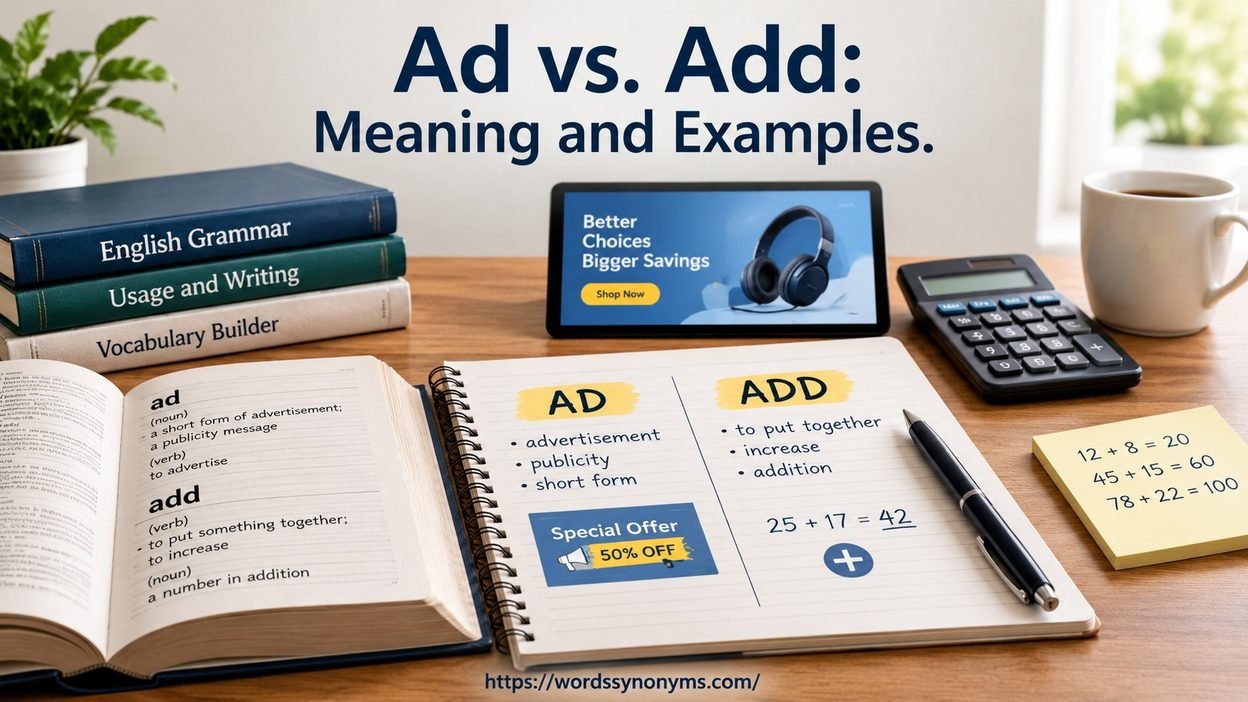
Ad vs. Add: Meaning and Examples helps explain why ad and add cause confusion in English and often have different meanings.
These homophones sound alike, have the same pronunciation, but have different meanings, spelling, and uses. Add is a verb meaning to join, combine, increase, or include something.
You might add numbers in math, add sugar to tea, or add information and choices. Knowing the difference between add and ad helps English learners, students, and writers avoid common spelling mistakes and grammar mistakes.
Ad is a noun and the short form of advertisement. It means promotional content used to promote a product, service, or idea. You may see an ad in a TV commercial, online marketing ad, social media, websites, television, or newspapers.
Learning when to use ad and when to use add makes everyday writing, speaking, and messages clearer. Examples, tips, and memory tricks can help you remember the correct word and communicate clearly in English confidently and accurately.
Quick Answer
Ad and add sound the same but have different meanings. Ad is short for advertisement, such as a TV ad or online ad. Add is a verb meaning to put something together, include something, increase something, or calculate a total. For example, “I saw an ad online” is correct, while “Please add my name to the list” uses add correctly.
Easy trick: Remember ad = advertisement and add = put more. If you’re talking about promotional content, use ad. If you’re putting something extra into a list, mixture, calculation, or situation, use add.
Ad vs. Add: Quick Difference
The easiest way to understand ad vs. add is to look at what each word does in a sentence.
| Word | Meaning | Part of Speech | Example |
| ad | A shortened form of advertisement | Noun | I saw an ad for a new laptop. |
| add | To put something together or include something | Verb | Please add your name to the list. |
| add | To calculate a total | Verb | Add five and seven. |
| add | To increase or contribute something | Verb | These flowers add color to the room. |
In short:
Ad = advertisement
Add = put something with something else
The distinction becomes even clearer when you replace ad with advertisement. If the sentence still makes sense, ad is probably the word you need.
For example:
- I saw an ad online.
- I saw an advertisement online.
Both sentences work.
Now consider:
- Please add my name.
- Please advertisement my name.
The second sentence clearly fails. Here, add is the correct verb.
What Does “Ad” Mean?
Ad is a noun that means an advertisement. It refers to a message designed to promote or publicize a product, service, business, event, job, or sometimes an idea.
The word is simply a shortened form of advertisement. It has become extremely common in everyday English, especially when people talk about television, websites, apps, newspapers, social media, and other forms of media.
For example:
- I saw an ad for a new car.
- That ad was surprisingly funny.
- The company placed an ad in the newspaper.
- I keep seeing the same ad online.
- The job ad listed several requirements.
Because ad names something, it generally functions as a noun.
Ad as a Noun
An ad can refer to almost any type of promotional message.
You might encounter:
- TV ad
- online ad
- video ad
- social media ad
- newspaper ad
- radio ad
- print ad
- display ad
- job ad
- classified ad
- banner ad
- political ad
The exact format changes, but the basic meaning remains the same: an ad is promotional content intended to attract attention or communicate an offer or message.
Examples of “Ad”
Here are some natural examples:
I clicked on an ad for a pair of running shoes.
The restaurant’s new ad appeared during the game.
We found the apartment through an online ad.
That ad makes the product look much more expensive than it is.
The company created a short video ad for its new service.
Notice something important: ad doesn’t describe the act of putting something somewhere. It identifies the advertisement itself.
That’s the key grammatical clue.
What Does “Add” Mean?
Add is primarily a verb. Its central idea is bringing something together with something else.
You can add ingredients to a recipe, numbers in a calculation, details to a document, or people to a group. You can also add something that increases the value, effect, or quality of another thing.
For example:
- Add two cups of flour.
- Add my name to the list.
- Add these numbers together.
- The painting adds character to the room.
- This feature adds convenience.
Unlike ad, the word add describes an action.
Add Meaning “Include Something”
One of the most common meanings of add is to include something with something else.
You might add:
- a name to a list
- a person to a group
- information to a report
- an ingredient to food
- a sentence to an essay
- a file to an email
- a feature to an application
For example:
Please add my email address to the contact list.
She added another example to her presentation.
You can add some lemon juice for extra flavor.
The thing being added doesn’t have to be physical. Information, ideas, people, and features can all be added.
Add Meaning “Calculate”
Add also has a specific mathematical meaning: to combine numbers to find their total.
For example:
- 2 + 3 = 5
- 10 + 15 = 25
- 125 + 75 = 200
You could say:
Add five and eight.
Or:
Add the numbers together to find the total.
The related noun is addition.
For example:
The problem requires simple addition.
Here, add describes the action while addition names the mathematical process.
Add Meaning “Increase or Contribute”
The word add can also describe something that contributes to another thing.
For example:
Fresh herbs add flavor to the dish.
Large windows add brightness to the room.
Her explanation added clarity to the discussion.
The new feature adds value for customers.
In these examples, nothing necessarily gets physically placed somewhere. Instead, something contributes an effect, quality, benefit, or characteristic.
That broader meaning makes add a remarkably useful English verb.
Ad vs. Add: Key Differences
The difference between ad and add comes down to meaning, grammar, spelling, and context.
Meaning Difference
Ad means an advertisement.
Add means to combine, include, increase, contribute, or calculate.
Compare these sentences:
I saw an ad for a new phone.
The store will add a new phone to its inventory.
The first sentence discusses promotional material. The second describes an action.
Grammar Difference
Ad normally functions as a noun.
Add normally functions as a verb.
Consider:
That ad looks professional.
Here, ad is the thing being discussed.
Now look at:
Please add another example.
Here, add describes what someone should do.
This grammatical difference can help you choose the correct spelling even when you’re writing quickly.
Spelling Difference
The visual difference is tiny:
- ad → one d
- add → two d’s
That extra d belongs to the verb add.
A useful memory trick is to associate the second d with the idea of putting more into something.
Add = put more.
Pronunciation Difference
Here’s where the confusion becomes understandable.
In standard American English, ad and add are generally pronounced the same: /æd/.
They sound like the word at the beginning of:
Add two numbers.
and:
I saw an ad yesterday.
Because the pronunciation usually doesn’t distinguish them, context and spelling do the heavy lifting in written English.
This is an example of a homophone-like spelling problem. Words that sound alike can still have entirely different meanings and spellings.
Ad vs. Add in Sentences
Seeing the two words side by side makes the distinction much easier.
| With Ad | With Add |
| I saw an ad for a hotel. | Add the hotel to the list. |
| The ad appeared online. | Add the information to the document. |
| That ad was only thirty seconds long. | Add another sentence to the paragraph. |
| We created an ad for the product. | We need to add the product to the catalog. |
| The ad attracted many viewers. | The new image will add visual interest. |
The meaning changes completely even though the pronunciation remains essentially identical.
Example: Advertising
The company created an ad for its new service.
Here, ad means advertisement.
The company will add a new service next month.
Here, add describes introducing something extra.
Example: School
The teacher showed us an ad from an old newspaper.
The teacher asked us to add the numbers.
One word refers to promotional content. The other refers to an action involving numbers.
Example: Work
I saw the job ad this morning.
Please add the applicant’s name to the spreadsheet.
Again, the difference is straightforward once you focus on the meaning.
Example: Everyday Conversation
Did you see that ad?
Yes. Can you add the website to our notes?
These two words can even appear naturally in the same conversation.

How to Remember Ad vs. Add
A simple memory trick can save you from most mistakes.
Remember “Ad” With “Advertisement”
Think:
Ad → Advertisement
If you’re talking about something designed to promote a product, service, event, or message, use ad.
For example:
I saw an ad on television.
You can replace ad with advertisement:
I saw an advertisement on television.
The meaning stays intact.
Remember “Add” With “More”
Think:
Add → Put more
If you’re putting something together, including something, increasing something, or calculating something, use add.
For example:
Add another name to the list.
The idea is that something becomes larger because something else joins it.
Another useful connection is:
add → added → addition
These related forms all revolve around the idea of combining or increasing.
Common Mistakes With Ad and Add
Because the words sound alike, spelling mistakes happen frequently.
Mistake: “Ad” Instead of “Add”
Incorrect:
Please ad my name to the document.
Correct:
Please add my name to the document.
Why? The sentence describes an action. You want someone to include your name.
Mistake: “Add” Instead of “Ad”
Incorrect:
I saw an add for a new restaurant.
Correct:
I saw an ad for a new restaurant.
Why? You’re talking about an advertisement.
Mistake: “Add” as a Noun for an Advertisement
A common spelling error appears when people write:
I saw a funny add yesterday.
The correct sentence is:
I saw a funny ad yesterday.
Although add is pronounced the same way, it doesn’t mean advertisement.
Mistake: “Ad” as a Verb
Another common error is:
Can you ad this information to the report?
The correct form is:
Can you add this information to the report?
The verb requires two d’s.
Ad vs. Add in Formal and Informal Writing
Both words are legitimate English words, but they have different roles.
Ad is a shortened form of advertisement. It’s common in everyday writing and conversation.
For example:
I found the job through an online ad.
In more formal writing, advertisement may be preferable depending on the tone and context.
For example:
The company published an advertisement in a national newspaper.
However, ad isn’t inherently incorrect or unprofessional. Its suitability depends on the publication, audience, and style.
Add, meanwhile, is a standard verb used across casual, professional, academic, technical, and formal contexts.
For example:
Please add the following information to the report.
There’s no need to replace add with a more elaborate verb unless the context specifically calls for one.
Ad vs. Advertisement
Since ad is short for advertisement, the two words share the same basic meaning.
| Word | Meaning | Typical Use |
| ad | Advertisement | Everyday and concise writing |
| advertisement | Promotional message | Formal or full-form writing |
| advertising | The activity or industry of promoting products or services | General or professional discussion |
Examples:
I saw an ad for a new restaurant.
I saw an advertisement for a new restaurant.
Both are grammatically correct.
The main difference is length and style rather than basic meaning.
Ad vs. Additional
Don’t confuse add with additional, either.
These words are related, but they don’t perform the same grammatical job.
Add is a verb:
Please add another example.
Additional is an adjective:
Please provide additional examples.
The first sentence tells someone to perform an action. The second describes something extra.
Other related forms include:
- add — verb
- adds — third-person singular verb
- added — past tense and past participle
- adding — present participle
- addition — noun
- additional — adjective
Understanding these forms makes the spelling distinction easier to retain.
Common Phrases With “Ad”
The noun ad appears in many everyday expressions.
Online Ad
I clicked on an online ad.
TV Ad
That TV ad became popular.
Job Ad
The job ad listed five requirements.
Newspaper Ad
The business placed a newspaper ad.
Video Ad
The video started with an ad.
Social Media Ad
The company launched a social media ad.
Classified Ad
She found the used bicycle through a classified ad.
In each expression, ad refers to promotional or informational material.
Common Phrases With “Add”
The verb add also appears in many useful combinations.
Add to
Add to means to increase something or contribute to it.
The music adds to the atmosphere.
Add Up
Use Add up can mean to calculate a total.
Add up the numbers before submitting the report.
It can also mean that something makes sense when considered together.
His explanation doesn’t add up.
Add On
Add on means to attach or include something extra.
You can add on another service later.
Add Value
Add value means to contribute something useful or beneficial.
Good customer service can add value to a business.
Add Details
Please add details about the project.
Add Information
You can add information to the form later.
These phrases all retain the basic idea of putting something extra into a situation.
Ad vs. Add: Word Forms
The two words develop in very different ways.
Word Forms Related to “Ad”
The most common forms include:
- ad
- ads
- advertisement
- advertisements
- advertising
Examples:
The website displays several ads.
The company created an advertisement.
She works in advertising.
Word Forms Related to “Add”
Common forms include:
- add
- adds
- added
- adding
- addition
- additional
Examples:
Please add your address.
He adds useful examples.
She added another paragraph.
They are adding new features.
The addition improved the design.
We need additional information.
These forms shouldn’t be mixed with the ad family.
Ad vs. Add in Digital Communication
Modern technology has made ad especially common.
People encounter advertisements on:
- websites
- search engines
- mobile applications
- streaming platforms
- social networks
- online marketplaces
- email newsletters
- video platforms
As a result, ad appears constantly in digital conversations.
You might say:
This website has too many ads.
Or:
I skipped the ad after five seconds.
Meanwhile, add appears just as naturally in digital instructions:
1 Add the file to your message.
2 Add the contact to your phone.
3 Add a description before publishing.
The two words often appear in the same digital environment, which makes understanding their grammatical roles even more useful.
Read more: Chute vs. Shoot: Meaning and Correct Usage
Ad vs. Add: A Practical Editing Trick
When you’re unsure which spelling belongs in your sentence, stop focusing on pronunciation.
Instead, ask:
Am I talking about an advertisement?
If yes, use:
ad
If not, ask:
Am I describing the act of putting something together, including something, increasing something, or calculating something?
If yes, use:
add
This meaning-first approach works better than trying to hear the difference because the words generally sound identical.
A Three-Second Test
Use this quick test while proofreading:
- Replace ad with advertisement.
- Replace add with include, combine, or increase.
- Choose the word that preserves the sentence’s meaning.
For example:
Please ___ your phone number.
Try advertisement:
Please advertisement your phone number.
That doesn’t work.
Try include:
Please include your phone number.
Therefore:
Please add your phone number.
Now try:
I saw an ___ online.
Replace it with advertisement:
I saw an advertisement online.
That works perfectly.
Therefore:
I saw an ad online.
Ad vs. Add: Mini Case Studies
Realistic situations make confusing words much easier to remember.
Case Study: A Job Search
Imagine you’re browsing a website for employment opportunities.
You might see:
I found an interesting job ad this morning.
Here, ad refers to the advertisement announcing the position.
After opening it, you might tell a colleague:
I need to add this job to my application tracker.
The spelling changes because the grammatical function changes.
Case Study: A Recipe
Suppose you’re following a recipe.
The instructions might say:
Add two tablespoons of olive oil.
Here, add means to put the ingredient into the mixture.
If the recipe website displays an advertisement, you could say:
An ad appeared beside the recipe.
The context separates the words instantly.
Case Study: A School Assignment
A teacher might tell a student:
Add another example to your essay.
The student could later say:
I saw an ad for the same book online.
One word describes an action. The other identifies promotional content.
These examples show why spelling matters even when pronunciation doesn’t help.
Ad vs. Add: Quick Practice Quiz
Test your understanding by choosing ad or add.
- I saw an ___ for a new restaurant.
- Please ___ your name to the form.
- The company created a television ___.
- ___ three more examples to the list.
- Did you see that online ___?
- The new feature will ___ more value.
- I found the apartment through an online ___.
- Please ___ the numbers before submitting the report.
- That ___ appeared before the video.
- She decided to ___ another paragraph.
Answers
- ad
- add
- ad
- add
- ad
- add
- ad
- add
- ad
- add
A quick pattern emerges: when the sentence identifies promotional material, use ad. When the sentence describes an action of inclusion or increase, use add.
FAQs
What is the difference between ad and add?
Add is a verb that means to join, include, or increase something. Ad is a noun and a short form of advertisement, usually referring to promotional content.
Are ad and add pronounced the same?
Yes. Ad and add have the same pronunciation in standard English, which makes them easy to confuse when speaking or writing.
When should I use add?
Use add when you mean to combine, include, or increase something. For example, you can add numbers, add sugar to tea, or add information to a sentence.
When should I use ad?
Use ad when you mean an advertisement. You might see an ad for a product, service, event, or business on a website, television, newspaper, or social media platform.
Is ad a noun or a verb?
Ad is a noun because it names an advertisement. Add is a verb because it describes an action, such as combining or including something.
How can I remember ad vs. add?
A simple trick is to connect the extra d in add with doing something extra. If you are combining or increasing something, use add. If you mean an advertisement, use ad.
Conclusion
Ad and add may sound identical, but their jobs in a sentence are quite different. Use add when you mean to combine, include, or increase something. Use ad when you mean an advertisement or promotional message. Once you connect each word with its purpose, the difference becomes much easier to spot.
A quick check can save you from an unnecessary spelling mistake. If you’re talking about putting something together, choose add. If you’re talking about something designed to promote a product, service, or idea, choose ad. With a little practice, this common mix-up becomes one less thing to worry about in your everyday English.

Samreen Saif is a passionate writer and language enthusiast who contributes informative and engaging content to WordsSynonyms.com. She enjoys exploring English vocabulary, synonyms, antonyms, word meanings, and language usage to help readers understand and use words with confidence.
Samreen focuses on creating clear, accurate, and easy-to-read content for students, writers, professionals, and English learners. Through her articles, she aims to make vocabulary learning simple, practical, and useful for everyday communication.
When she is not writing, Samreen enjoys learning about language, discovering new words, and creating helpful content that makes English learning more accessible to everyone.